Bikesrepublic

ducati v4

Di tatkala kami kagum dengan barisan Ducati yang menggunakan enjin V4 semasa yang terdiri daripada Panigale V4, Streetfighter V4, Multistrada V4, dan terbaru Diavel V4, Ducati sebenarnya telah membuat enjin V4 walaupun sebelum menghasilkan enjin V-Twin pertama mereka. Sebaliknya dan mungkin ironisnya, enjin V-Twin yang membawa nama Ducati kepada orang ramai, sebelum mereka kembali ke V4 untuk menguasai litar perlumbaan dunia. Jawapannya ada kaitan dengan motosikal yang dipasang enjin V4 pada masa itu, iaitu Ducati Berliner 1260 Apollo yang tampil pada 1964.

Bagaimana ia bermula

Pengedar Ducati di Amerika Syarikat, adik beradik Joe dan Mike Berliner dari Berliner Motor Corporation yakin mereka boleh menjual motosikal kepada jabatan polis Amerika. Tetapi mereka terpaksa bersaing dengan Harley-Davidson yang mempunyai monopoli dalam segmen itu.

Jadi, Joe Berliner mendekati Ducati pada tahun 1959 dengan cadangan untuk membina motosikal itu. Ducati dimiliki oleh kerajaan Itali pada masa itu dan hanya mengeluarkan 200cc Elite. Dan, mereka juga berada dalam keadaan kewangan yang buruk seperti semua pengeluar motosikal Itali lain yang terpaksa bersaing dengan populariti Fiat 500.

Walaubagaimanapun, spesifikasi rasmi jabatan polis AS semakin diseragamkan di seluruh negara, dan mereka mengutamakan produk nasional mereka iaitu Harley. Mereka memerlukan kapasiti enjin sekurang-kurangnya 1200cc, jarak roda minimum 60 inci/1525mm, dan tayar 5.00 inci x 16 inci.

Mike Berliner menghantar dua Harley Duo Glide kepada Ducati untuk penilaian. Selepas mempertimbangkan rekabentuk enjin Harley FL 74 inci padu (1212cc) yang kuno, ketua Ducati Dr. Giuseppe Montano dan ketua jurutera Dr. Fabio Taglioni bersetuju bahawa mereka boleh menghasilkan rekabentuk yang lebih cekap dan moden. Taglioni menerima tugasan itu sebagai suatu cabaran teknikal dengan penuh semangat.

Malangnya para birokrat di Rom menunjukkan banyak keraguan yang mengakibatkan rundingan dilanjutkan sehingga 1961 sebelum Montana mendapat kata putus, dan selepas Berliner berjanji untuk menaja jamin projek itu termasuk kos pembangunan dan pengeluaran.

Nama Apollo dipilih oleh adik-beradik Berliner sebagai penghormatan kepada program bulan Apollo yang baru sahaja bermula.

Enjin dan prestasinya

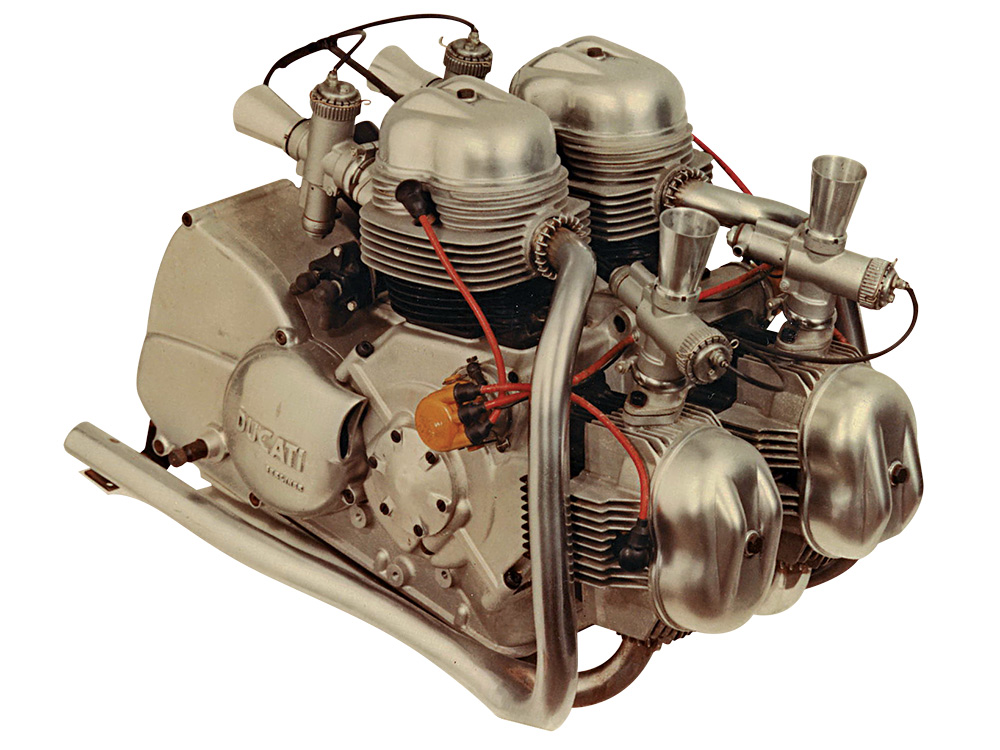
Taglioni diberitahu untuk membuat enjin yang besar lebih besar dan lebih pantas dan oleh itu, dia merekabentuk sebuah unit V4 90°, 1257cc, sejukan udara, dua injap, dengan aci engkol 180°. Lejang dan gerek masing-masing adalah 84.5 mm dan 56 mm, menjadikannya enjin Ducati dengan nisbah gerek/lejang yang paling luas pada masa itu. Penggerakan injap dikendalikan oleh rod penolak (pushrod) dan lengan jungkit (rocker arms), bukannya syaf pemacu dan gear serong (bevel gear). Ia menghasilkan 100 hp pada hanya 7,000 RPM.
Ducati memasangkan transmisi 5-kelajuan untuk mengatasi pesaing mereka yang mempunyai kotak gear 4-kelajuan. Taglioni juga menyediakan peruntukan untuk memuatkan transmisi automatik (CVT) pada masa hadapan.

Enjin itu dipasang dalam kerangka tugas berat. Terdapat pemula tendangan (kick starter) bagi penunggang yang berani atau yang dengan tulang kering besi, tetapi terdapat juga pemula elektrik yang kelihatan serupa dengan Fiat TV1100. Juga terdapat penjana (stator) 200w yang besar di sebelah kanan untuk menampung semua peralatan elektrik polis. Ceriani membangunkan suspensi, serta brek dram  depan dan belakang.

Berat motosikal ini ialah 270 kg, kering. Walaupun itu agak banyak walaupun mengikut piawaian hari ini, ia sebenarnya lebih ringan daripada Harley dengan 291 kg.
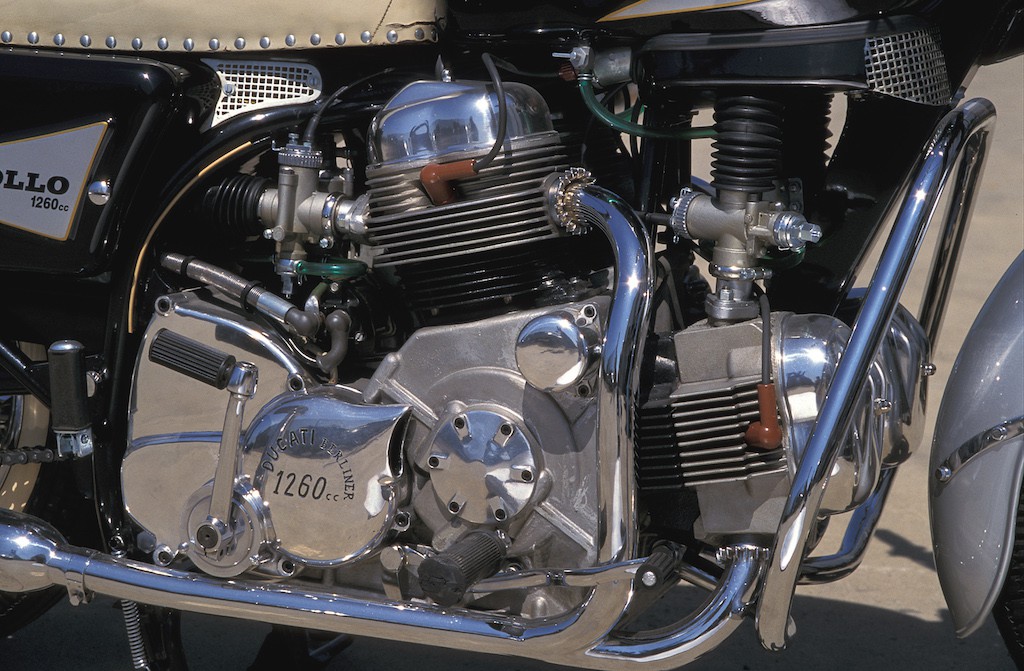
Ducati melengkapkan penggayaan motosikal ini dengan tangki bahan api gaya ‘peanut,’ pelana ‘koboi’ dengan rel genggam sangkar berkrom, serta fork depan dan penyerap hentakan belakang yang kelihatan serupa dengan Harley Duo Glide.

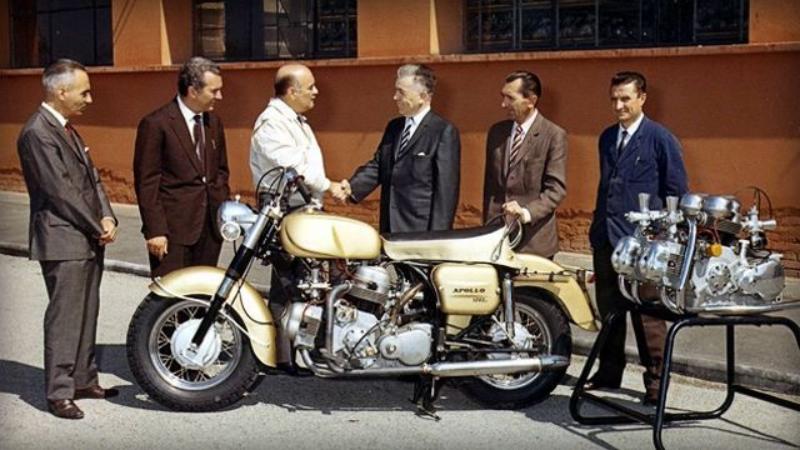
Dua prototaip berfungsi sepenuhnya telah dibina, dengan satu dicat emas untuk ditunjukkan oleh Berliner di pameran, manakala satu lagi dalam warna hitam dan perak. Terdapat juga dua enjin ganti tambahan.

Tunggang uji

Penunggang ujian Ducati, Franco Farne, keluar daripada kilang Ducati untuk melakukan ujian jalanan sulung buat motosikal itu, namun dia kembali dengan keputusan: “pengendaliannya seperti trak.” Tetapi Ducati Berliner 1260 Apollo menebuskan dirinya dengan prestasi garis lurus, di mana ia mencecah lebih 200 km/j. Ujian ini mengesahkan bahawa ia merupakan motosikal Eropah terpantas pasca Perang Dunia Kedua.

Malangnya, prestasi yang menakjubkan itu juga menyebabkan kejatuhannya, terutamanya kerana ia dipasang dengan tayar kereta 16 inci. Seorang lagi penguji Ducati, dan bekas mekanik GP Giancarlo Fuzzi‚ keluar untuk ujian kelajuan tinggi pada autostrada Milan-Bologna. Tiba-tiba tayar Pirelli belakang motosikal ini mengembang dan tertanggal bunganya, malah keseluruhan tayar tercabut daripada rim pada kelajuan kira-kira 160 km/j. Fuzzi memanggil kelangsungan hidupnya sebagai ” satu keajaiban.”
Kuasa enjin itu kemudiannya dikurangkan kepada 80 hp dengan menurunkan nisbah mampatan dan memasang sesondol yang kurang agresif, tetapi ia masih terlalu kuat bagi mana-mana tayar pada masa itu. Sekali lagi ia telah dikurangkan kuasanya dengan menurunkan nisbah mampatan dan 65 hp; barulah kehausan tayar dikatakan “boleh diterima.”

Sebagai perbandingan, Moto Guzzi Grand Prix 500cc V8 mempunyai roda 20-inci, tetapi kuasa enjin 78 hp-nya sudah cukup untuk mengoyakkan tayar belakangnya.

Penghujung projek

Berliner gembira dengan persembahan itu dan terus mencetak risalah untuk menjual motosikal itu. Mereka bercadang untuk menjual versi ‘normale‘ dengan kuasa yang dikurangkan kepada orang awam sebagai model jelajah, sambil mengekalkan versi ‘Sport‘ yang berkuasa penuh untuk penguatkuasa undang-undang. Malah, 65 hp dari V4 masih lebih berkuasa daripada enjin Harley yang menghasilkan hanya 55 hp.

Bagaimanapun, versi yang dikurangkan kuasa enjin terpaksa bersaing dengan motosikal Eropah lain seperti BMW dan British Twins.

Harley juga boleh mendakwa bahawa harga Apollo sebanyak USD 1,500 itu terlalu mahal dan mereka menawarkan sesuatu yang hampir dengan prestasi itu pada harga yang jauh lebih murah.

Kemudian kerajaan Itali memutuskan bahawa pasaran terhad untuk model Apollo ini tidak membawa faedah daripada segi kos perkakas dan pengeluaran, dan menarik balik pembiayaan projek. Ini adalah tamparan hebat kepada rancangan perniagaan Berliner.

Sesuatu peluang yang terlepas

Ducati Berliner 1260 Apollo sebenarnya boleh menjadi ‘superbike‘ yang pertama jika teknologi tayar  masa itu dapat menampung kuasa enjinnya. Sebaliknya, Honda CB750 muncul pada tahun 1969 untuk menuntut penghormatan itu. Walaupun begitu, ia hanya mempunyai 68 hp dan kelajuan tertinggi 201 km/j. Kawasaki Z1 dengan enjin 903cc pada tahun 1972 pun hanya menghasilkan 81 hp dan kelajuan tertinggi 209 km/j.

Beberapa tahun kemudian, Honda dan Suzuki akan meniru rekabentuk V4 Ducati untuk mereka menguasai perlumbaan GP.

Ia sememangnya suatu peluang yang terlepas.

Walaubagaimanapun, reka bentuk enjin V4 membawa Taglioni kepada merekabentuk enjin yang akan membawa penguasaan Ducati dalam perlumbaan superbike, iaity V-Kembar (V-Twin) 90º. Tetapi dapat dilihat bahawa enjin V4 1257cc ini mempunyai tempat di hatinya, yang mana salah satu enjin ganti tersebut berada di dalam pejabatnya sehingga persaraannya pada 1984.

Hari ini, prototaip hitam dan perak itu dimiliki oleh Hiroaki Iwashita, dan ditempatkan di muziumnya di Yufuin di pulau Kyushu, Jepun.

Nasib prototaip berwarna emas tidak diketahui.
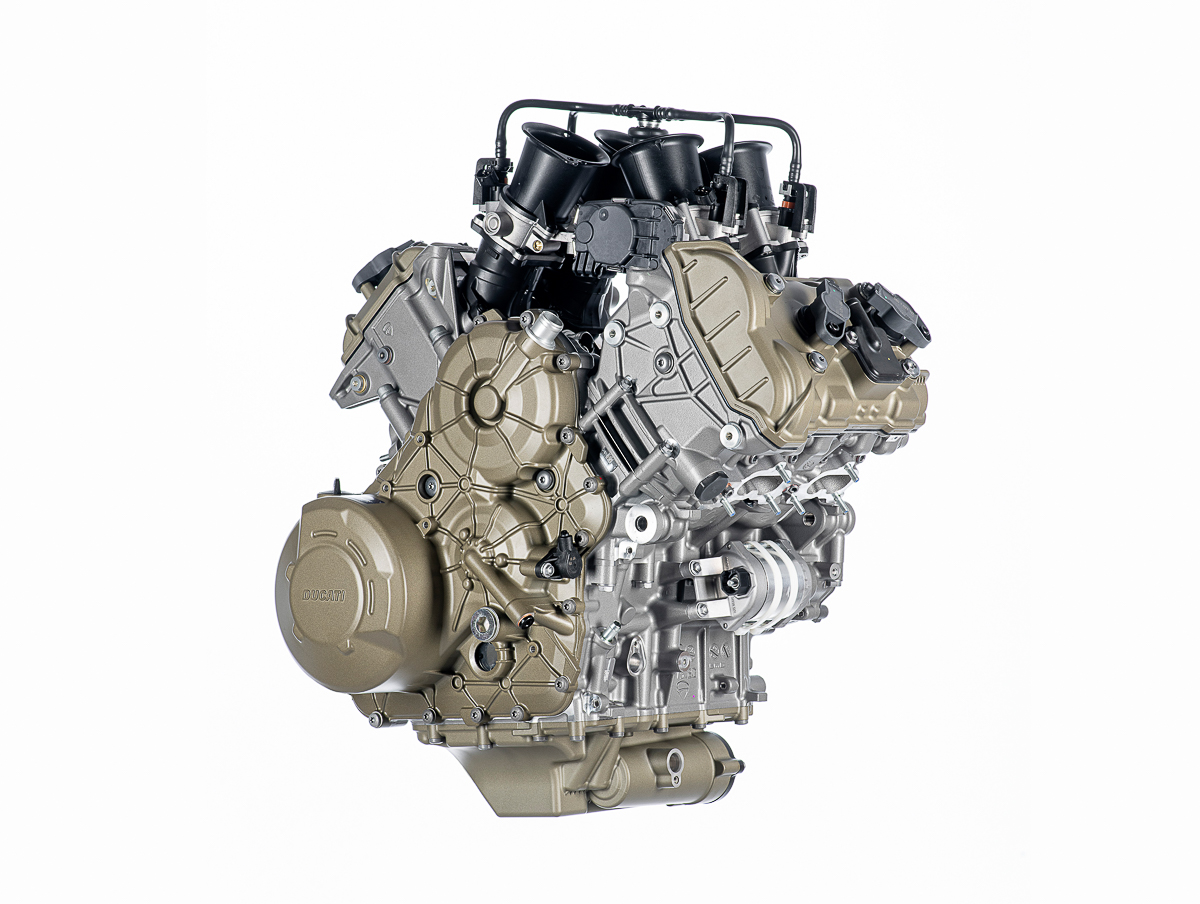
While we revel at the current Ducati’s V4 lineup consisting of the Panigale V4, Streetfighter V4, Multistrada V4, and most recently the Diavel V4, Ducati had actually made a V4 engine even prior to producing their first V-Twin engine. Instead, perhaps ironically, it was the V-Twin that went on to bring the Ducati name to the masses, before they went back to the V4 to dominate the world’s racing circuits. The answer has to do with the machine the engine was fitted to: The Ducati Berliner 1260 Apollo which debuted in 1964.

How it began

Ducati’s United States distributor, the brothers Joe and Mike Berliner of Berliner Motor Corporation were convinced they could sell motorcycles to the American police departments. But they had to compete with Harley-Davidson who had a free run in that segment.

So, Joe Berliner approached Ducati in 1959 with a proposal to build that bike. Ducati was owned by the Italian government at the time and produced only the 20occ Elite. And, they were also in a bad state as with all other Italian motorcycle manufacturers who had to contend with the Fiat 500’s popularity.

However, official US police department specifications were increasingly standardised across the country, and naturally favoured their national product i.e. Harley. They required an engine capacity of at least 1200cc, a minimum 60-inch/1525mm wheelbase, and 5.00-inch x 16-inch tyres.

Mike Berliner shipped two Harley FL Duo Glides to Ducati for evaluation. After considering the design of the archaic 74 cubic inch (1212cc) Harley FL’s engine, Ducati’s chief Dr. Giuseppe Montano and chief engineer Dr. Fabio Taglioni agreed they could produce a more efficient and modern design. Taglioni eagerly accepted the commission as a technical challenge.

Unfortunately the bureaucrats in Rome showed much scepticism which resulted in dragged out negotiations until 1961 before Montana got the green light, and after Berliner promised to underwrite the project including development and production costs.

The name Apollo was chosen by the Berliner brothers in honour of the Apollo moon program which had just begun.

The engine and its performance

Taglioni was told to make the big bigger and faster and so, he designed a 1257cc, air-cooled, two-valved, 90° V4, with a 180 crankshaft. The bores and strokes were 84.5 mm and 56 mm, respectively, making it the most oversquare Ducati engine at the time. Valve actuation was handled by pushrods and rocker arms, rather than tower shafts and bevel gears. It made 100 hp at just 7,000 RPM.

Ducati gave it a 5-speed transmission to up the ante against their rivals who had 4-speed gearboxes. Taglioni even designed a provision to fit an automatic (CVT) in the future.

The engine was mounted in a heavy duty open cradle frame. There was a kick starter for the brave or with steel shins, but there was also an electric starter which looks similar to the Fiat TV1100’s. There was a massive 200w generator on the right side to cater for all the police electrical equipment. Ceriani developed the suspension, and front and rear single leading show drum brakes.

Weigh was finally tallied at 270 kg, dry. Although that is a lot even by today’s standards, it was actually lighter than the Harley’s 291 kg.

Ducati completed the bike’s styling with a peanut-style fuel tank, cowboy seat with a chrome cage grab rail, and forks and shocks that look similar to the FL’s.

Two fully working prototypes were built, one was painted gold for Berliner to demonstrate at shows, while another in black and silver. There were also two extra spare engines.

The test

So, off went Ducati’s test rider Franco Farne on the bike’s maiden test, only for him to return with the verdict: “It handles like a truck.” But the Ducati Berliner 1260 Apollo made up for it in straight-line performance, where it hit more than 200 km/h. It confirmed that it was most powerful the fastest European bike.

Unfortunately, that amazing performance was also its downfall, especially because it was fitted with those 16-inch automobile tyres. Another Ducati tester, and former GP mechanic Giancarlo Fuzzi‚ went out for a high speed test on the Milan-Bologna autostrada when the whitewall rear Pirelli ballooned, detached its tread, and came off the rim at around 160 km/h. Fuzzi called his survival “a miracle.”

The engine was subsequently detuned to 80 hp by lowering the compression ratio and fitting less aggressive cams, but it was still too much for any tyre at the time. Again it was detuned by lowering the compression even more to 65 hp and tyre wear became “acceptable.”

By comparison, the Moto Guzzi Grand Prix 500cc V8 had 20-inch wheels, but its 78 hp also shredded the bike’s tyres.

The end of the project

Berliner was of course happy with the performance and went ahead to print flyers to sell the bike. They planned to sell the detuned ‘normale‘ version to civilians as a touring model, while reserving the fully powered ‘Sport‘ version for law enforcement. In fact, 65 hp from the V4 was still more powerful than Harley’s 55 hp.

However, the detuned version had to contend with other European bikes such as BMW and British Twins.

Harley could also undercut the Apollo’s price of USD 1,500 by saying that they offer something close to that performance and a much cheaper price.

Then the Italian government decided that the limited market did not justify the tooling costs of production, and withdrew project funding. This was a severe blow to Berliner’s business plans.

What it could have been

The Ducati Berliner 1260 Apollo could have been the very first ‘superbike’ had tyre technology been up to the task; that and if it had used 18-inch tyres instead. Instead, the Honda CB750 appeared in 1969 to claim the honour. Even then, it had only 68 hp and a top speed of 201 km/h. Heck, even the “groundbreaking” Kawasaki Z1’s 903cc inline-four in 1972 produced only 81 hp and a top speed of 209 km/h.

Years later, Honda and Suzuki would copy the V4’s design for them to dominate GP racing.

It was indeed as missed opportunity.

However, the V4 engine’s design led Taglioni to design the engine that would bring about Ducati’s dominance in the superbike racing: The 90º V-Twin. But it could be seen that the 1257cc V4 had a place in his heart, which one of the spare engines sat in his office until his retirement in 1984.

Today, the black and silver prototype is owned by Hiroaki Iwashita, and resides in his museum at Yufuin on the island of Kyushu, Japan.

The fate of the gold coloured prototype is unkown.

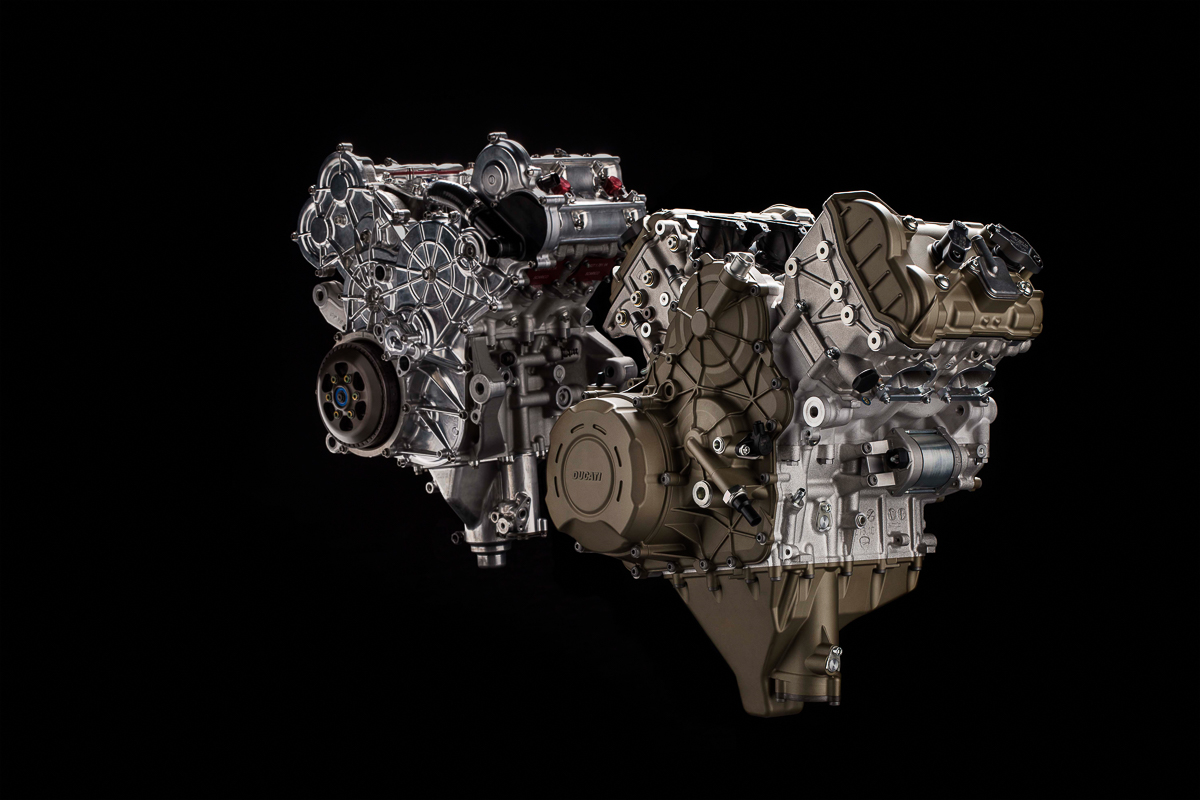
The Ducati V4 Granturismo engine has finally dropped and on paper, it looks quite amazing but to some Ducati purists, it’s a bit of a sacrilege. While the numbers of good, the decision to omit the legendary Desmodromic valves away from this new powerplant is deemed to be blasphemous, but not without its advantages. (more…)

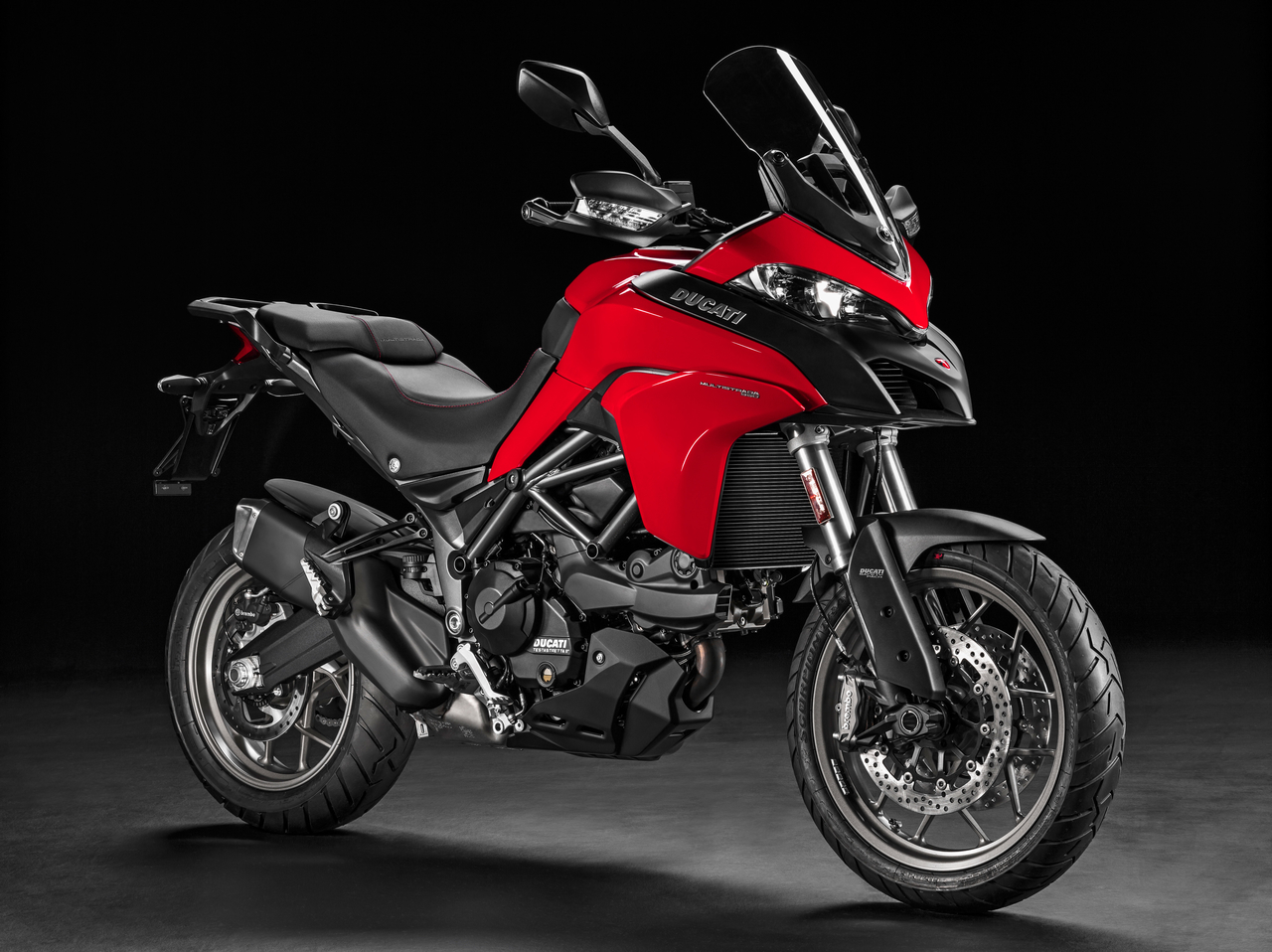
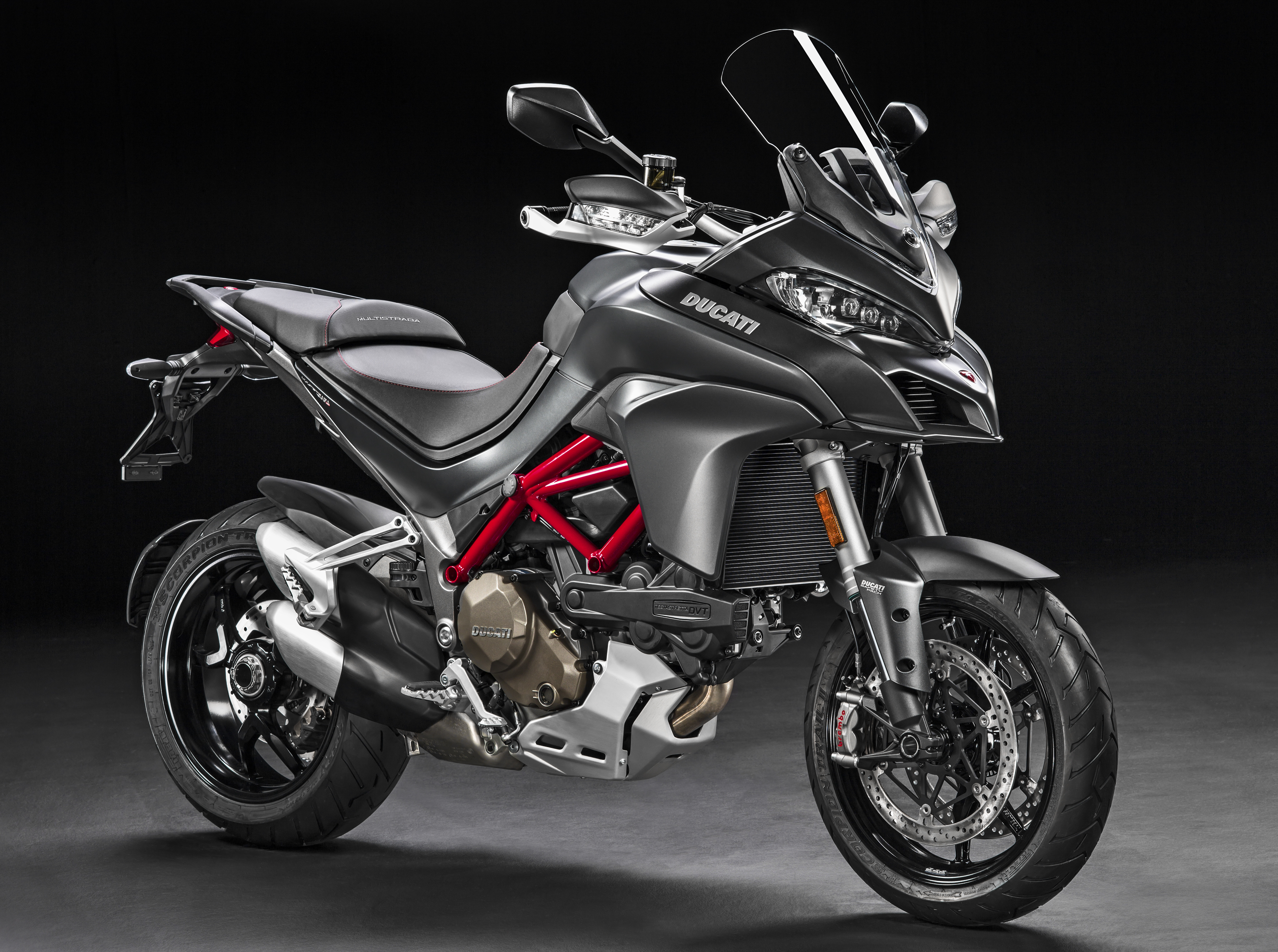
Ducati is hard on developing their current line-up with their latest 1,103cc Desmosedici Stradale V4 engine and the latest spotting of the Ducati Multistrada V4 showcased the engine’s ability into the world of dual-sport motorcycles. (more…)

Merujuk kepada definisi yang boleh didapati dari Dewan Bahasa dan Pustaka, gila bererti tidak sihat fikiran, sakit otak, tidak seperti biasa dan tidak dapat diterima akal.

Definisi ini mungkin paling sesuai untuk menggambarkan pendekatan yang diambil para jurutera jenama motosikal Itali paling popular di dunia dalam menghasilkan V4 versi Superleggera.

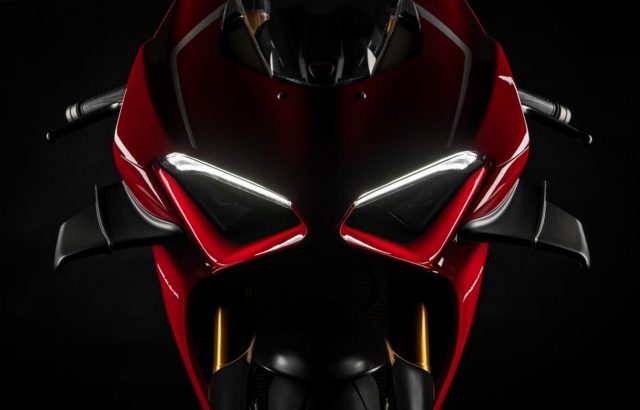
Menggunakan Ducati Panigale V4R sebagai platform utama, maka lahirlah Ducati V4 Superleggera yang kini menjana 234hp.

Menariknya, kerja gila ini berjalan di bawah nama Projek 1708 dan baru-baru ini setiap Ducatisti telah menerima hantaran email secara langsung daripada Ketua Pegawai Eksekutif (CEO) Ducati, Claudio Domenicalli, yang memaklumkan tentang sebuah superbike baharu.

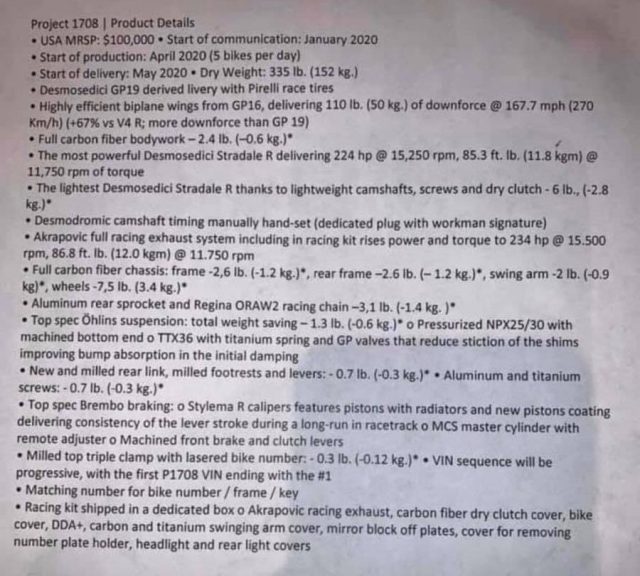
Tidak lama kemudian, beberapa info spesifikasi dan gambar turut disebarkan di internet yang memaparkan harga USD100,000 (RM406,960) di samping beberapa info menarik lain antaranya:

  • 224hp pada 15,250 rpm
  • 115Nm pada 11,750 rpm
  • 152kg
  • winglet bi-plane menawarkan 50kg downforce
  • rim gentian karbon
  • kerangka gentian karbon

Menurut imej terbabit, jentera akan mula diedarkan sekitar bulan Mei tahun ini namun dijangka kurang 500 unit akan ditawarkan kepada orang ramai.

  • A Ducati Multistrada V4 could be in the works.

  • Ducati already started with Streetfighter V4.

  • The new Multistrada could make its appearance for year 2021.

When Ducati CEO Claudio Domenicali said that there will eventually be more V-Four powered models, he wasn’t joking. First up was the Streetfighter V4 (although in tragic circumstances) and now perhaps a new Ducati Multistrada V4?

The current Multistrada 1260 is powered by a 158-hp V-Twin but adding the V-Four could be just the thing to move the sport-tourer yardstick.

It may seem that sticking a 214-hp V-Four into a sport-tourer is foolhardy but consider the 200-hp supercharged Kawasaki Ninja H2 SX. It certainly begs the question of who goes touring at 250 km/h. Just to answer that questions, we’ve seen Kawasaki 1400GTR riders who ride at more than 200 km/h in convoys, complete with spouses and luggage.

Anyway, detuning the 1,103cc Desmosedici Stradale engine to 180-odd-hp ought to be the game should there be a Multistrada V4. Bringing the horsepower down would be easier than opting for a high-revving engine like in the Panigale V-Four.

In a way, a Multistrada V4 makes sense since it could then share the same engine as the Panigale. Development costs will be lower as the manufacturer doesn’t have to design and build an entirely new engine.

We predict that the new bike should show itself by the end of 2020, instead of this year, since the current Multistrada 1260 only needs to comply to Euro5 in 2021.

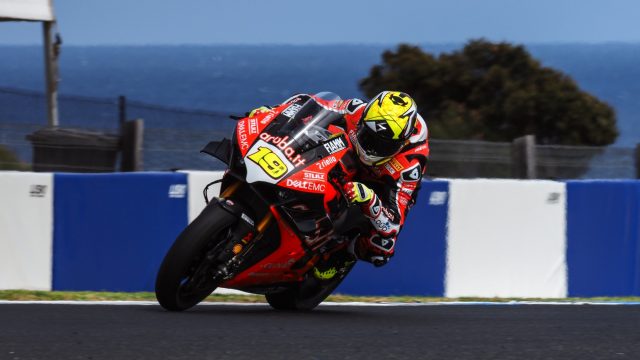
lvaro Bautista di atas motosikal Ducati Panigale V4 R – Sumber imej: WorldSBK.com

Ducati melalui minggu yang malang di litar perlumbaan hujung minggu lalu apabila Dovizioso dan Petrucci gagal mengekang kemaraan Marc Marquez di Sachsenring sementara Alvaro Bautista tidak lagi memegang takhta pendahulu di SBK.

Bautista kehilangan takhta sebagai pendahulu kejuaraan apabila dipintas Johnny Rea yang kini mendahului dengan 24 mata selepas mendominasi Donington Park, baru-baru ini.

Pelumba Sepanyol itu mengakui bergelut untuk mengawal jentera Ducati V4 di sepanjang perlumbaan.

“Jentera saya tidak stabil dan saya terpaksa melawan dengan jentera sendiri hanya untuk memastikaan ia bergerak lurus. Pada masa sama, saya tidak memiliki kestabilan yang baik ketika keluar daripada selekoh.

“Saya cuba lakukan yang terbaik tetapi fizikal saya merana kerana terpaksa bertarung dengan jentera tersebut,” ujar Bautista.

Menyedari dia dan pasukan perlu bangkit dengan aksi yang lebih baik seperti di Misano dan Jerez, Bautista bagaimanapun mengakui ia tidak semudah itu.

“Ini bukan MotoGP dimana pasukan boleh menggunakan komponen berbeza bagi mempertingkatkan kemantapan jentera. Inilah pakej jentera yang kami ada, kami tidak bernasib baik tetapan dilakukan di Donington tidak menjadi,”tambahnya.

SBK bakal ke Laguna Seca selepas ini dan Bautista mengakui litar tersebut bukanlah medan terbaik buat jentera Ducati V4.

(SUMBER: GPONE.com)

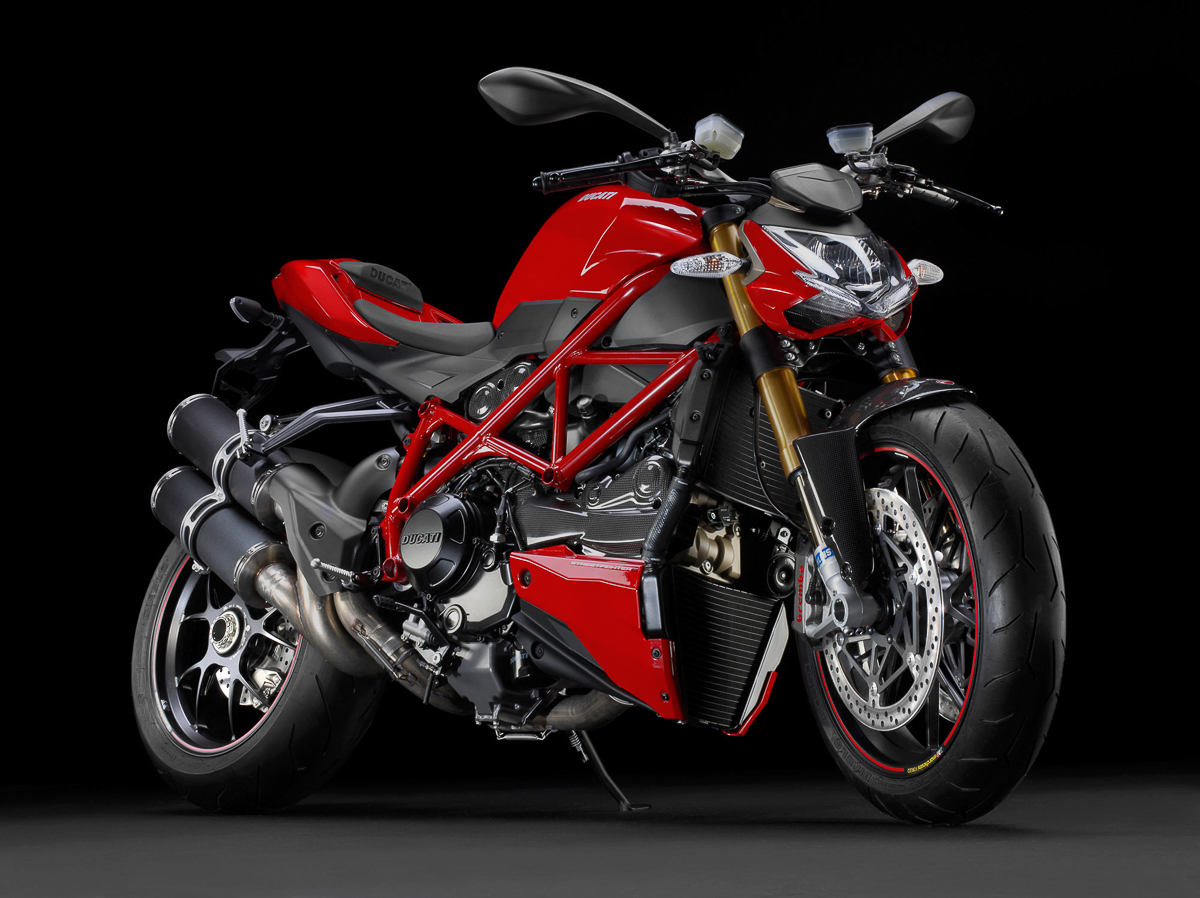
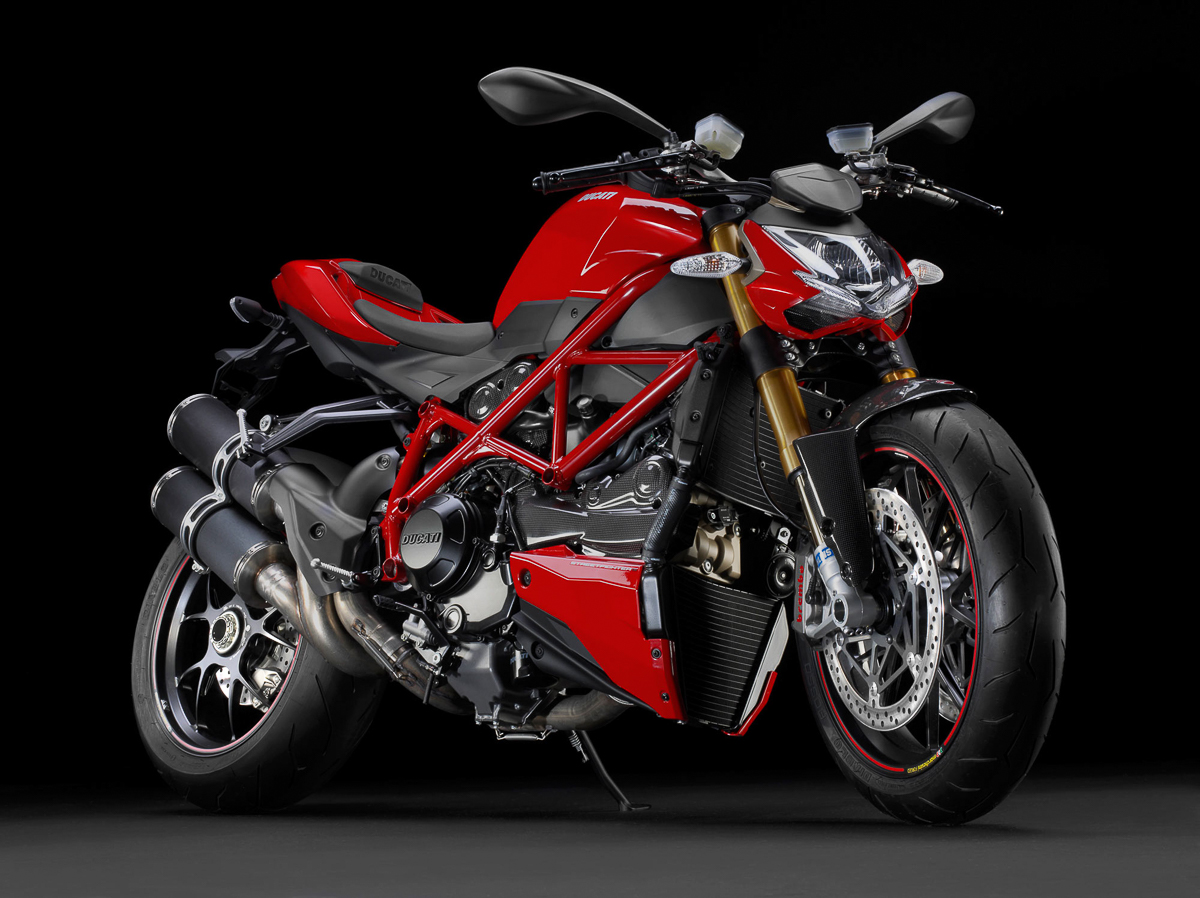
  • Nampaknya khabar angin mengenai motosikal Ducati Streetfighter V4 yang telah tesebar sebelum ini ada kebenarannya.
  • Satu temuramah baru-baru ini bersama dengan Ketua Pegawai Eksekutif Ducati, Claudio Domenicali, telah membayangkan yang ianya bakal tiba.
  • Dia menyatakan bahawa “ia (Streetfighter V4) akan tiba secepat mungkin!”

(more…)

  • Looks like the Ducati Streetfighter V4 rumour is more than just a fairytale.

  • A recent interview with Ducati CEO Claudio Domenicali suggests that it might be on its way.

  • He stated that “She (Streetfighter V4) will be there as soon as possible!”

According to a recent interview with Ducati CEO Claudio Domenicali posted by AcidMoto, it seems that there is light at the end of the tunnel when it comes to the re-emergence of the Ducati Streetfighter model. This time around, talks about a possible Ducati Panigale V4 is going around and what the Ducati big boss mentioned in the interview might just be a point of high interest. (more…)

  • Ketua Pegawai Eksekutif Ducati, Claudio Domenicali telah mengatakan sebelum ini bahawa akan ada lebih banyak model V4 yang akan diperkenalkan.
  • Para penggemar Ducati mengharapkan yang salah sebuah daripadanya adalah Streetfighter V4 baharu.
  • Buat masa ini, Officine GP Design telah membina Ducati Streetfighter V4 ini.

(more…)

  • Ducati CEO Claudio Domenicali said there could be more V4 models on the way.

  • Ducati fans hope a new Streetfighter V4 is among them.

  • In the meantime, Officine GP Design built this Ducati Streetfighter V4.

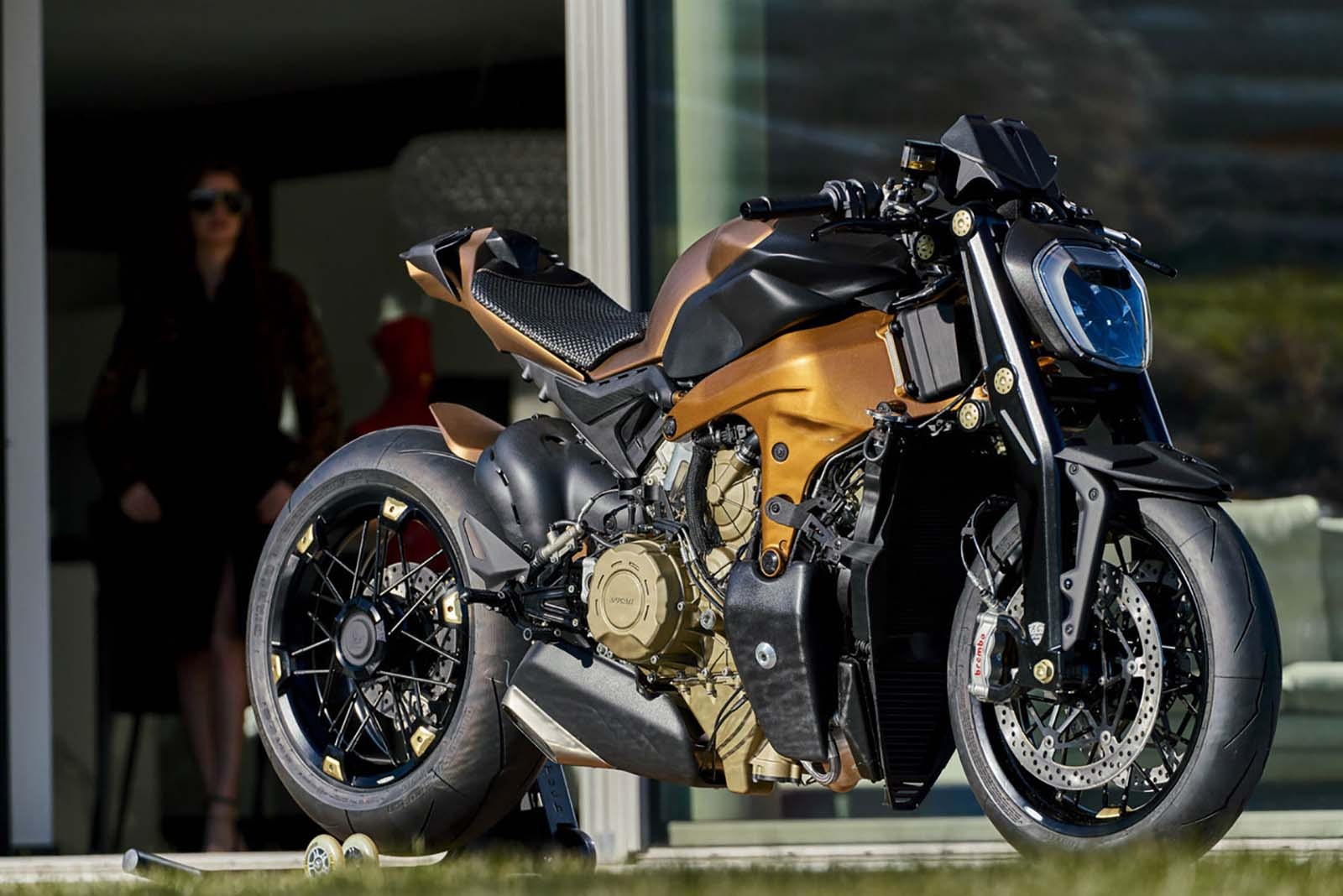
Raise your hands if you are one of many who miss the Ducati Streetfighter and looking forward to a new one. But here’s the Officine GP Design Ducati Streetfighter V4 while we wait.

The anticipation for a new V4-powered Streetfighter became a storm when Ducati CEO Claudio Domenicali said there will be more Ducati V4 models in the future. It’s a news well received because Ducati doesn’t have a true blood naked sportbike, apart from the current Monster 821.

However, Italian design house Officine GP Design went ahead and built their own Streetfighter. They will produce ten of these exquisite bikes. While it was built independently from the manufacturer, it goes to show that the V4 and frame platform have the potential to be turned into other bikes.

Besides the lack of bodywork, the most striking feature are the girder forks in place of the stock Öhlins items. The girder forks are supplied by FG racing and they are machined from solid billet. The Jonich SX wheels add even more drama to the entire package.

The tank and frame aren’t just painted, instead they are covered with a specially made textured copper. The headlight was sourced from a Ducati Diavel. The instrument display is stock but is mounted on a 3D-printed mount.

The leather seat is by Foglizzo with a V4 Penta logo. The bike’s tailsection was also redesigned. Other components are mostly from Rizoma.

Let’s hope Ducati’s V4 naked bike will look as good as this or even better.

All photos by MCN

  • Ducati telah mengumumkan bahawa akan ada lebih banyak model yang dijana oleh enjin V4.
  • Enjin ini akan digarap dari enjin Desmosedici Stradale yang menjana motosikal Panigale V4.
  • Enjin V4 baharu tersebut akan lebih ‘mampu milik’, menurut Ducati.

(more…)

Archive

Follow us on Facebook

Follow us on YouTube