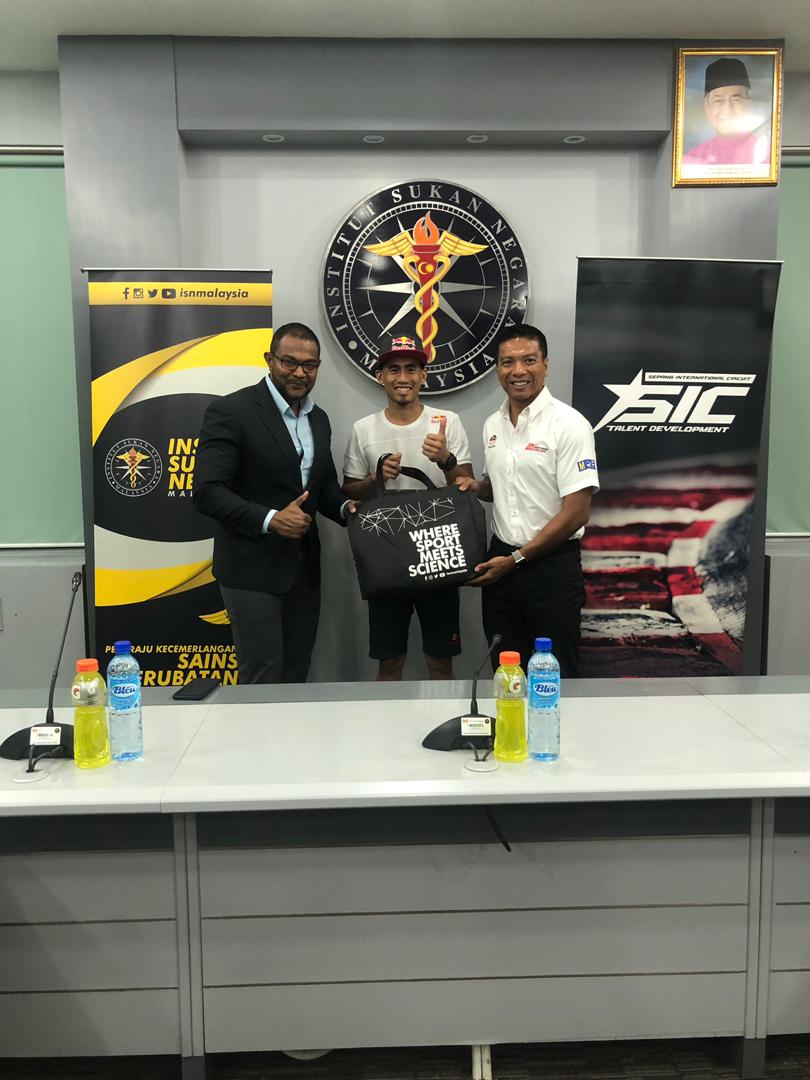
Sepang International Circuit and National Sports Institute Sign Official Strategic Partnership.
The NSI will provide sports services to the PETRONAS Sepang Racing Team in MotoGP and also SIC’s talent development programs.
SIC hopes that these facilities will assist their riders in growing to be future MotoGP riders.
The National Sports Institute (NSI) announced the participation of Sepang International Circuit (SIC) as an official strategic partner.
This partnership between is the first ever joint venture held in the field of high-performance sports services for motor sports.This collaboration is also a positive step in promoting the country’s motor sports. The scope of the strategic cooperation covers:
NSI will provide high performance sports services by planning and implementing sports science and sports medical programs to PETRONAS Sepang Racing Team riders and riders, and also riders under the talent development program SIC, such as Dream to MotoGP (Impian Ke MotoGP). The Dream to MotoGP program consists of preparation in various tournaments such as the Spanish CEV Teen Championships (CEV), European Talent Cup, Idemitsu Asia Talent Cup and Asia Road Racing Championship (ARRC).
The NSI will provide comprehensive and systematic application of sports science based on best practices and research in specializations such as nutrition, psychology, gymnastics physiology, biomechanics and physical fitness for motorsport.
The NSI will provide sports medical services such as health screening, injury treatment, physiotherapy and rehabilitation, sports rehabilitation treatments and clinical trials.
Both parties expect more exchanges of experience and high-performance sports research for motorsports can be implemented through this collaboration. In fact, this collaboration is an important step for the exchange of information, experience, knowledge and the latest research into the development of the national motor sports industry.
Dato’ Razlan Razali, CEO of SIC said, “To ensure that SIC talents in 2- and 4- wheels (racing) are fully prepared, physically and mentally fit, we are pleased with the strategic partnership with NSI. NSI has the best place and facility to produce world class athletes and they are proven with a number of success stories. Hence, with a whole suite of services offered for our motorsport talents to utilise, we have a complete chain of ecosystem and structure to ensure that our motorsport athletes are prepared to compete in their respective championships. There are simply no excuses now for these athletes as we have provided nearly everything for them to ensure they are competitive and aspire to be champions.”
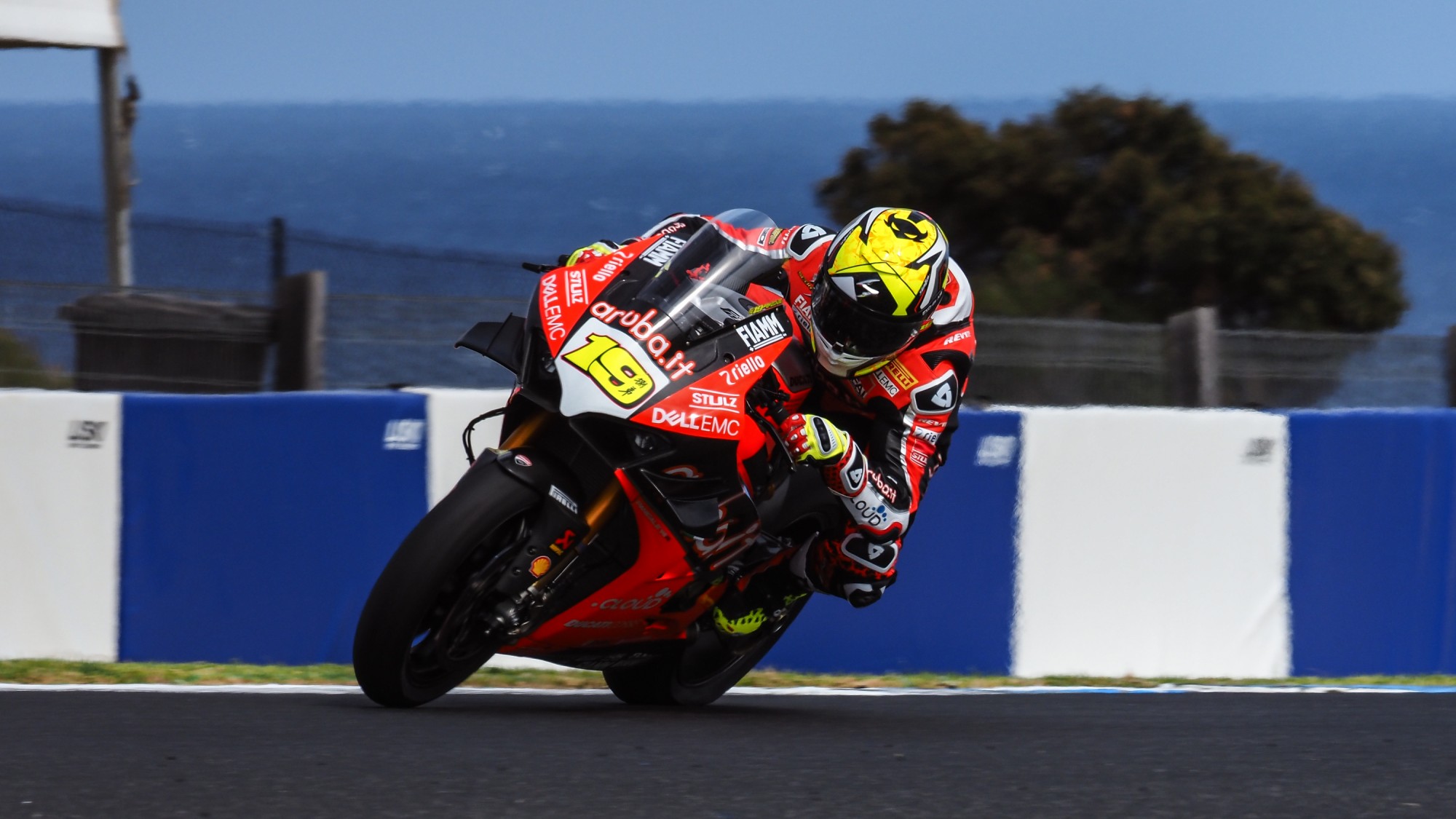
Former MotoGP rider Alvaro Bautista was quickest on the Ducati Panigale V4 R on Day One of the final WorldSBK 2019 pre-season test.
Bautista’s Ducati was one of four different manufacturers in the Top 5.
Testing continues tomorrow.
New factory Ducati signing Alvaro Bautista dominated the first day of the final pre-season testing at the Phillip Island Circuit, ahead of the opening round of WorldSBK 2019.
Riding the new Ducati Panigale V4 R, Bautista was the only rider to dip below the 1m 31s mark with 1m 30.743s. Bautista was only fifth fastest at Jerez test in November. The Spanish rider and Gigi Dall’Igna have both said previously that it’s still early days for the Panigale V4 R but this result is surely an encouraging sign in their quest to recapture the WSBK crown that Ducati once held.
That wasn’t the only big news from Day One. There were four different manufacturers in the Top Five. Alex Lowes took the new Yamaha YZF-R1 to second fastest with a time of 1m 31.146s.
Four-time WorldSBK champion Jonathan Rea captured third on the new Kawasaki Ninja ZX-10RR, just a whisker behind Lowes with a time of 1m 31.189s. He blew everyone away during the test at Jerez by being one second faster than the next nearest rival.
Rea’s ex-teammate and former world champion Tom Sykes rode the new BMW S 1000 RR to fourth fastest in 1m 31.300s.
Fifth fastest was Rea’s new teammate Leon Haslam who recorded his fastest time of 1m 31.999s.
Many fans and pundits of the series are hoping for a closer fight this year, after Rea’s domination in the past two seasons. They shall get their wish if it continues like today, and Rea will have his hands full in stemming the tide from three other manufacturers.
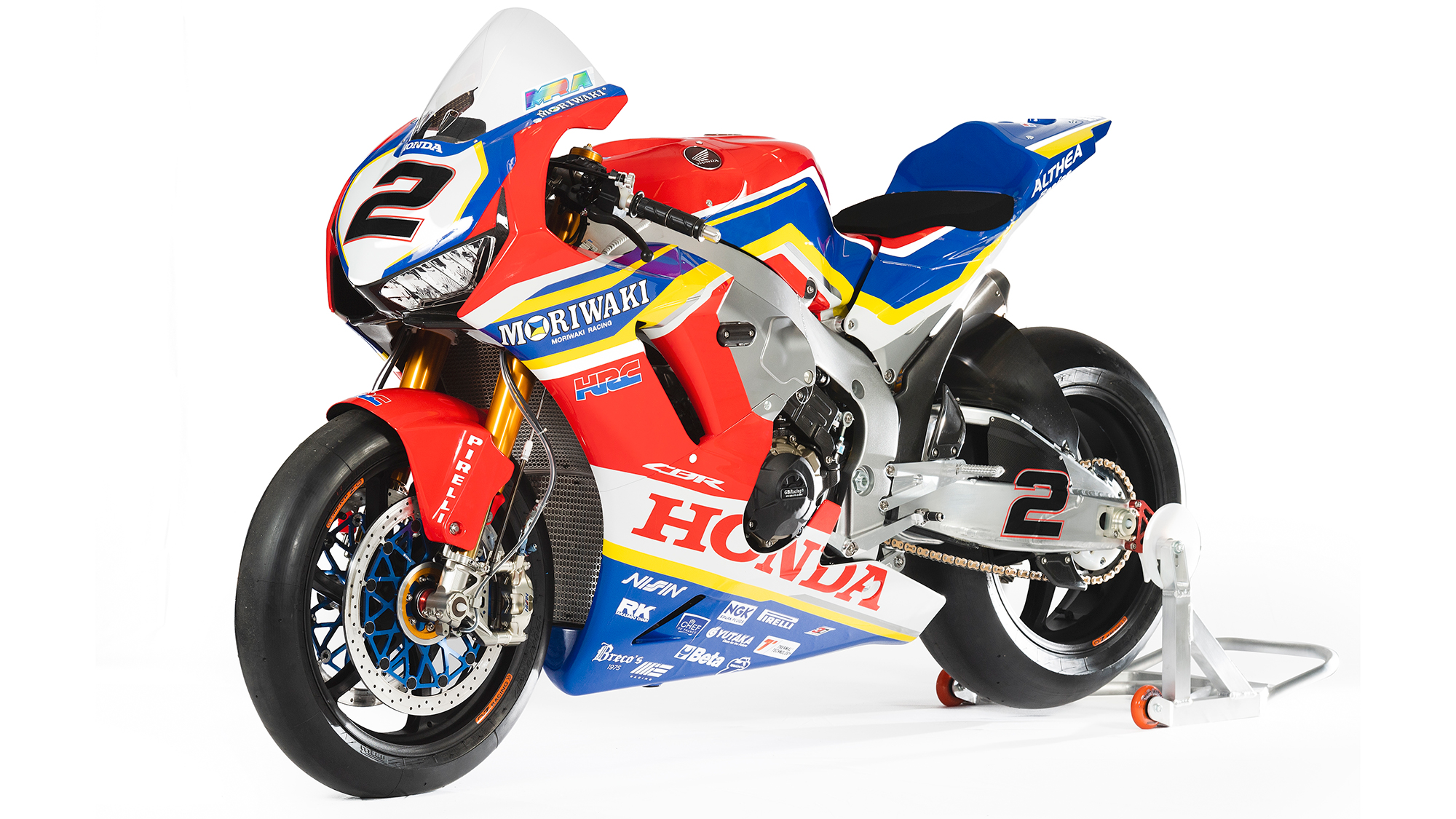
Honda returns to WorldSBK 2019 with the Honda CBR1000RR Fireblade SP2.
The new Moriwaki Althea Honda is a full factory effort.
Riders are Ryuichi Kiyonari and Leon Camier.
The Honda CBR1000RR Fireblade SP2 WorldSBK 2019 challenger was unveiled by the new Honda factory team Moriwaki Althea Honda.
Riders Leon Camier and Ryuichi Kiyonari pulled the covers off the new bikes at Phillip Island. The launch was just hours before the start of the final pre-season test at the track. It was also mere days prior to the start of the WorldSBK 2019 season.
The entry marks Honda’s return to WorldSBK as a factory team since 2002 when Colin Edwards won the WSBK title. The team, now known as Moriwaki Althea Honda, takes over from Ten Kate Honda who have campaigned for the Japanese manufacturer since 2004. The much-publicized move drove out Ten Kate who later applied for bankruptcy.
It seemed harsh for Honda to do so, but it was because Suzuka-based Moriwaki Engineering is no stranger to bringing in success for Honda. Moriwaki started campaigning in the All-Japan Superbike Championship on Pirelli tyres (like in WorldSBK) since 2016 in the hopes of taking that experience to the world stage.
Kiyonari signed on to the team in 2017. He was a former British Superbike champion and WorldSBK winner.
A Delhi traffic policeman holds up a mirror to traffic violators.
He does it to encourage violators to start wearing helmets while riding.
The measure has so far worked according to him.
A Delhi traffic policeman holds up a mirror to traffic violators to reflect upon themselves and their wrongdoings.
Prior to this, the cop Sandeep Shahi gave out free helmets to motorcyclists riding without them. Still, many are riding without helmets although the law mandates it, the risking being fined INR 1,000 and their lives. Motorcyclists are often seen zipping around traffic at high speeds without helmets, while carrying up to three pillions. The pillions themselves often shun head protection, too.
Shahi told AFP, “I was riding pillion with a helmet one day and say myself in a mirror. I felt ashamed. But at the same time, I thought it would be a great way of raising awareness. A mirror never lies.”
He says the measure is working so far. Offending riders apologized and promised to wear their headgear after that.
“I’ve also slides about road safety which I show to road users. But using the mirror is a much simpler way.”
A 2018 World Health Organization report showed 150,785 deaths due to road accidents in India, making it the highest in the world in terms of numbers. The number corresponds to a rate of 22.6 deaths per 100,000 people.
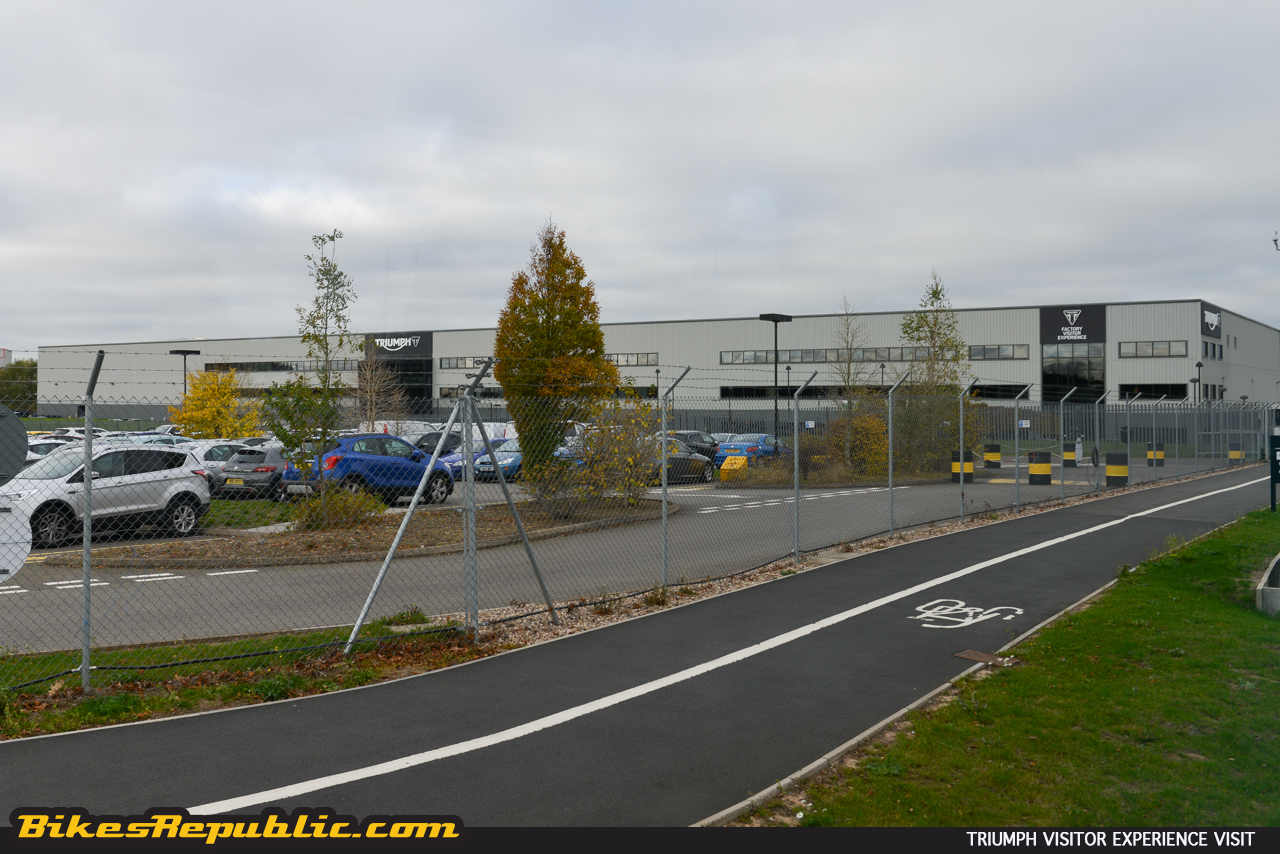
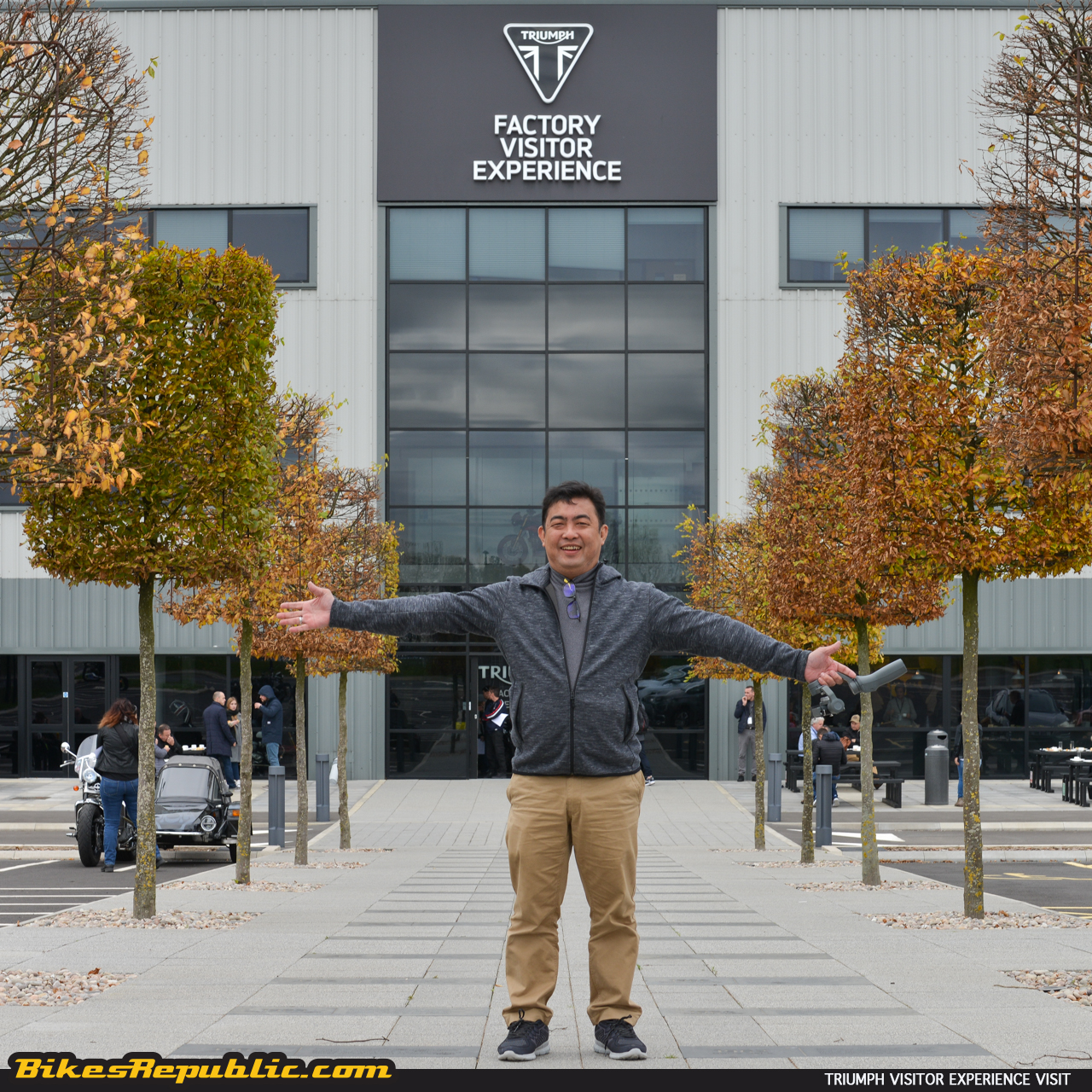
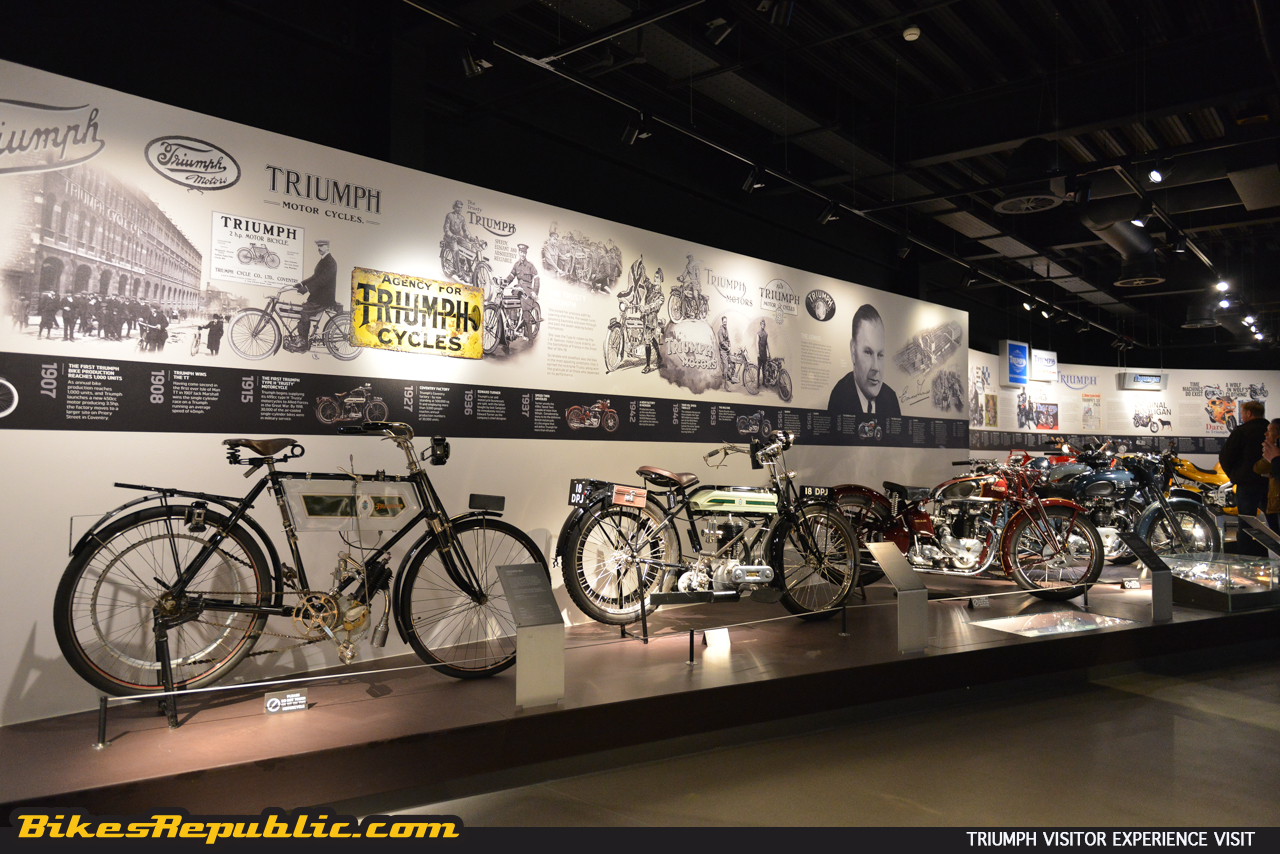
We visited the Triumph Factory Visitor Experience during our trip to London.
The visit included a factory tour in addition to the “gallery.”
The center featured significant models in Triumph’s history, highlights in R&D, new models, custom bikes, and much more.
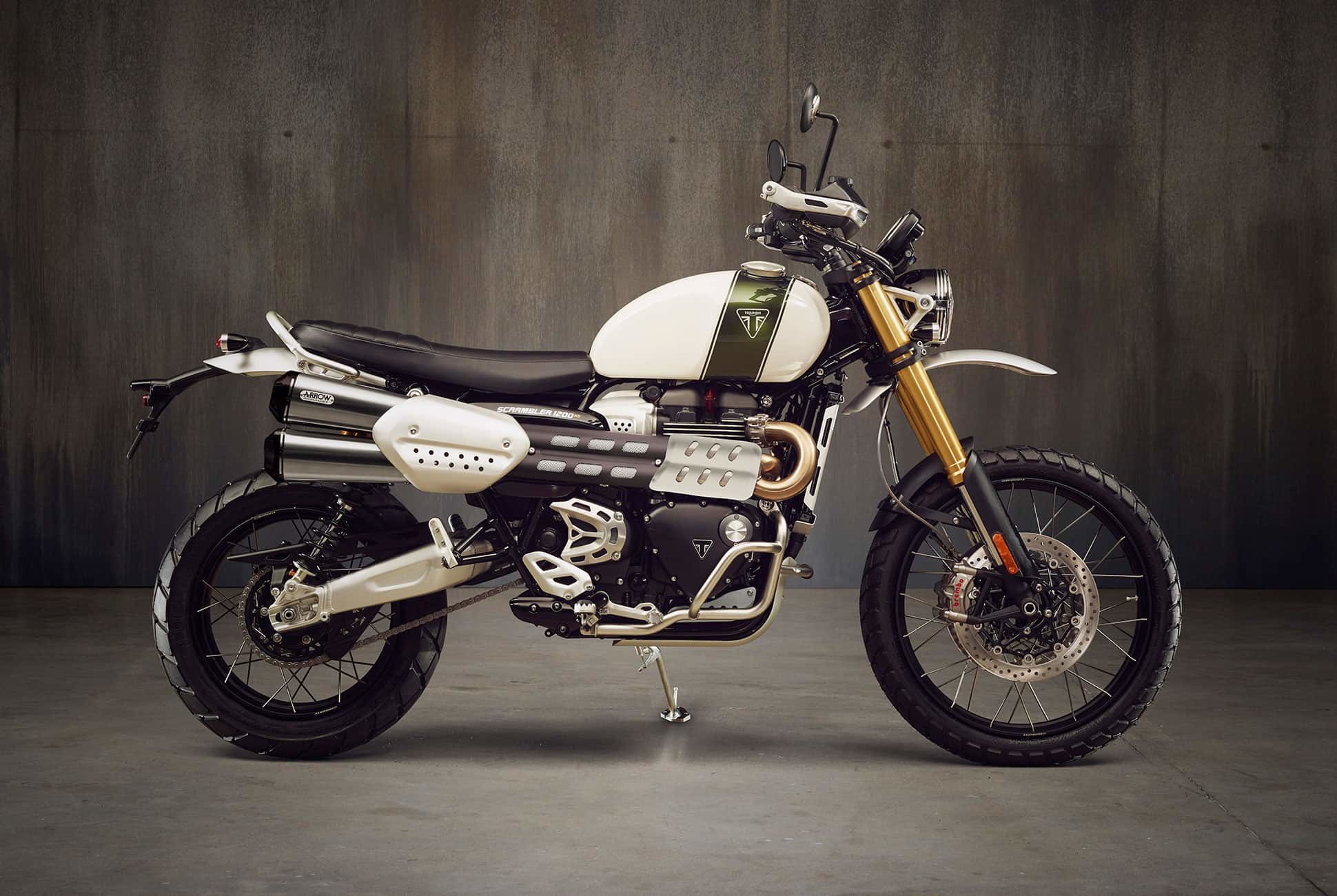
Besides witnessing the launch of the 2019 Triumph Scrambler 1200, the other main highlight was visiting the Triumph Factory Visitor Experience, during the Triumph Motorcycles Malaysia London Adventure.
To recap, this writer had won the lucky draw’s Grand Prize during the launch of the 2018 Triumphs that included the two Tiger 800 variants, Bonneville Bobber Black and Bonneville Speedmaster.
The trip coincided with Triumph Motorcycles’ Global Dealer Conference (GDC) and launch of the 2019 Bonneville Scrambler 1200. Thus, the entourage included Dato’ Razak Al-Malique Hussein, the Chief Executive Officer of Fast Bikes Sdn. Bhd. (the official distributor of Triumph motorcycles in Malaysia); his son Rafique; the Tan family of Triumph Motorcycles Bukit Mertajam and Guan How Superbike; and Asep Ahmad Iskandar, the founder of the Art of Speed Malaysia.
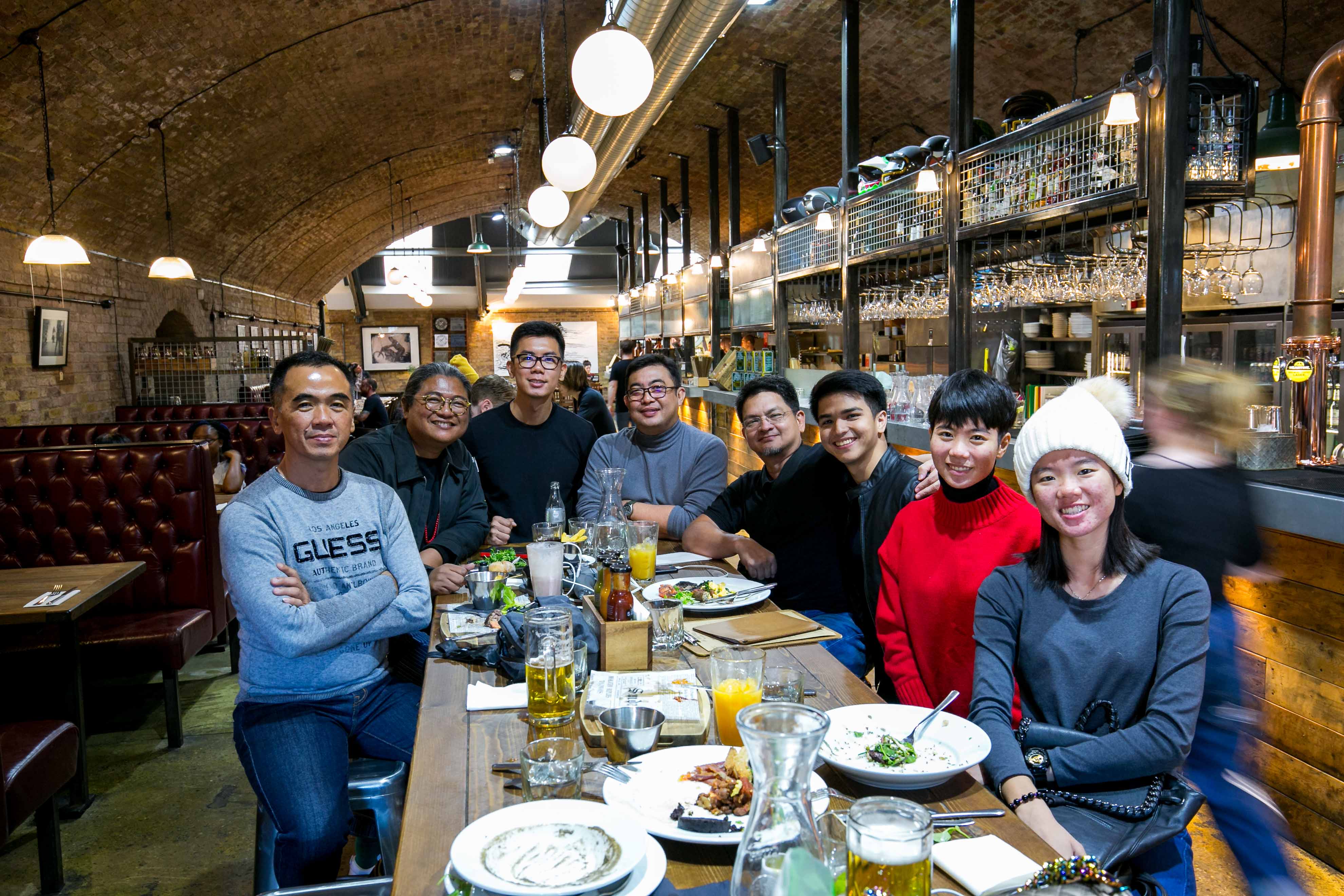
The gang at The Bike Shed – credit Rafique Muzaffar
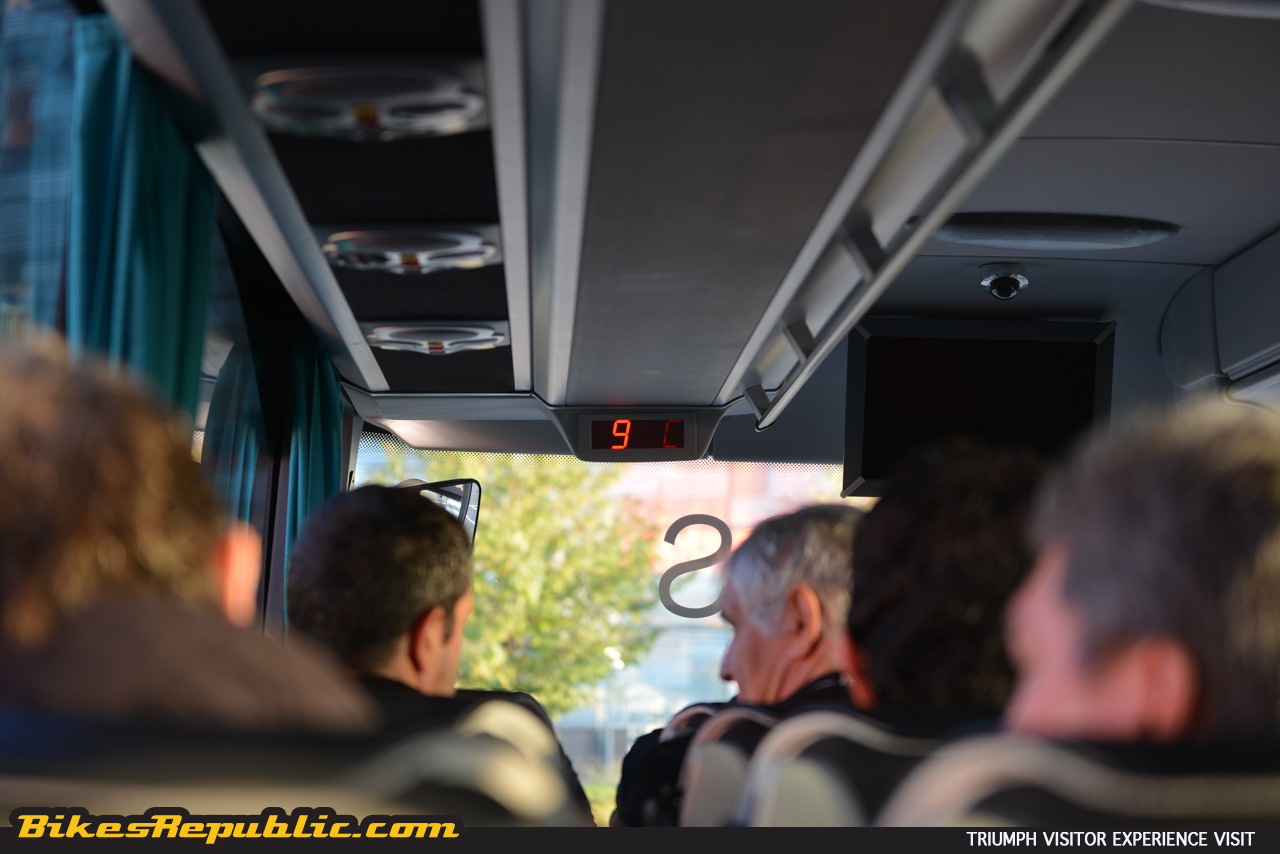
We assembled at the ExCel London at 5.30am before boarding the coaches to Hinckley in Leicestershire, the home of Triumph Motorcycles. It was good to get into the heated buses – the thermometer onboard showed 9oC outside.
The manufacturer’s HQ, factory and visitor centre complex is located 188 km from the exhibition centre but was a direct route via the oft-heard “M1” (Motorway 1). Traffic was heavy even during these early hours.
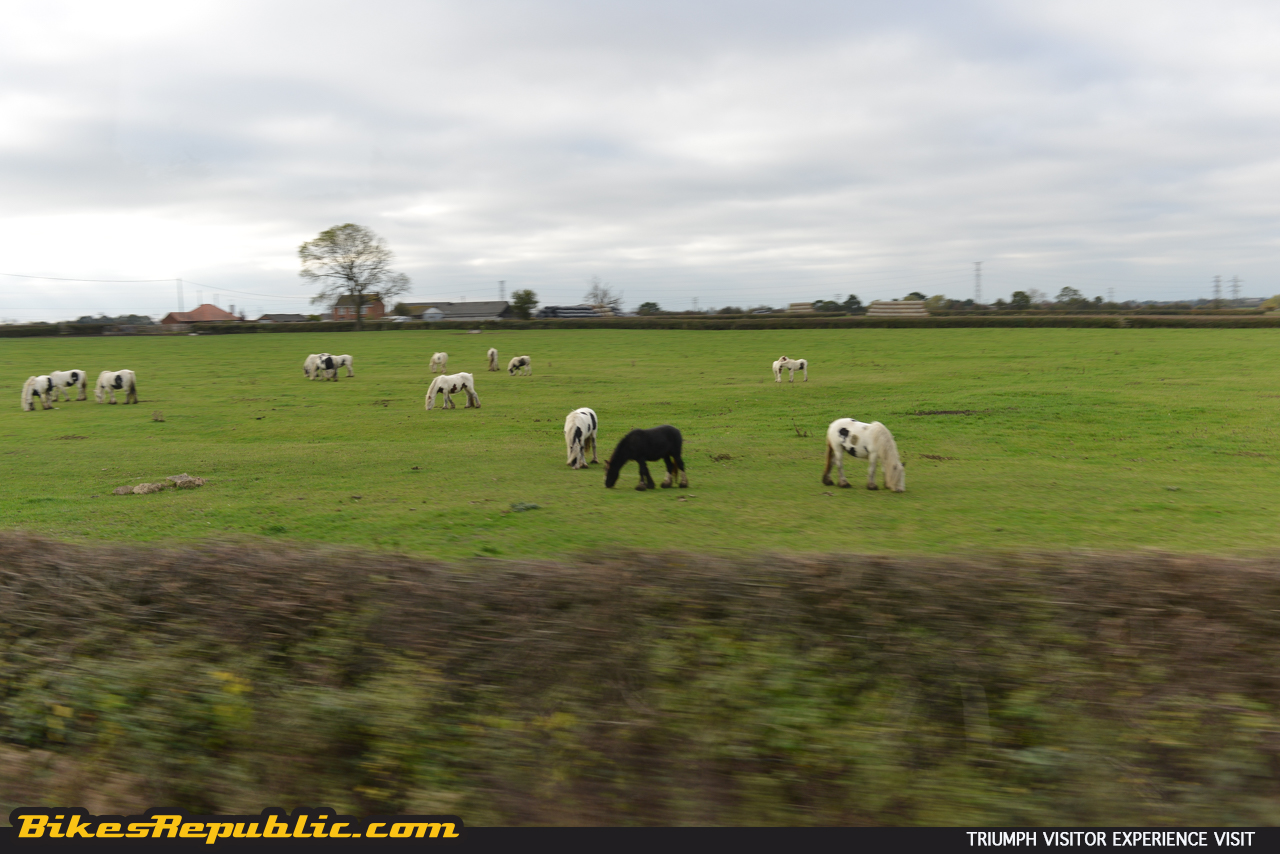
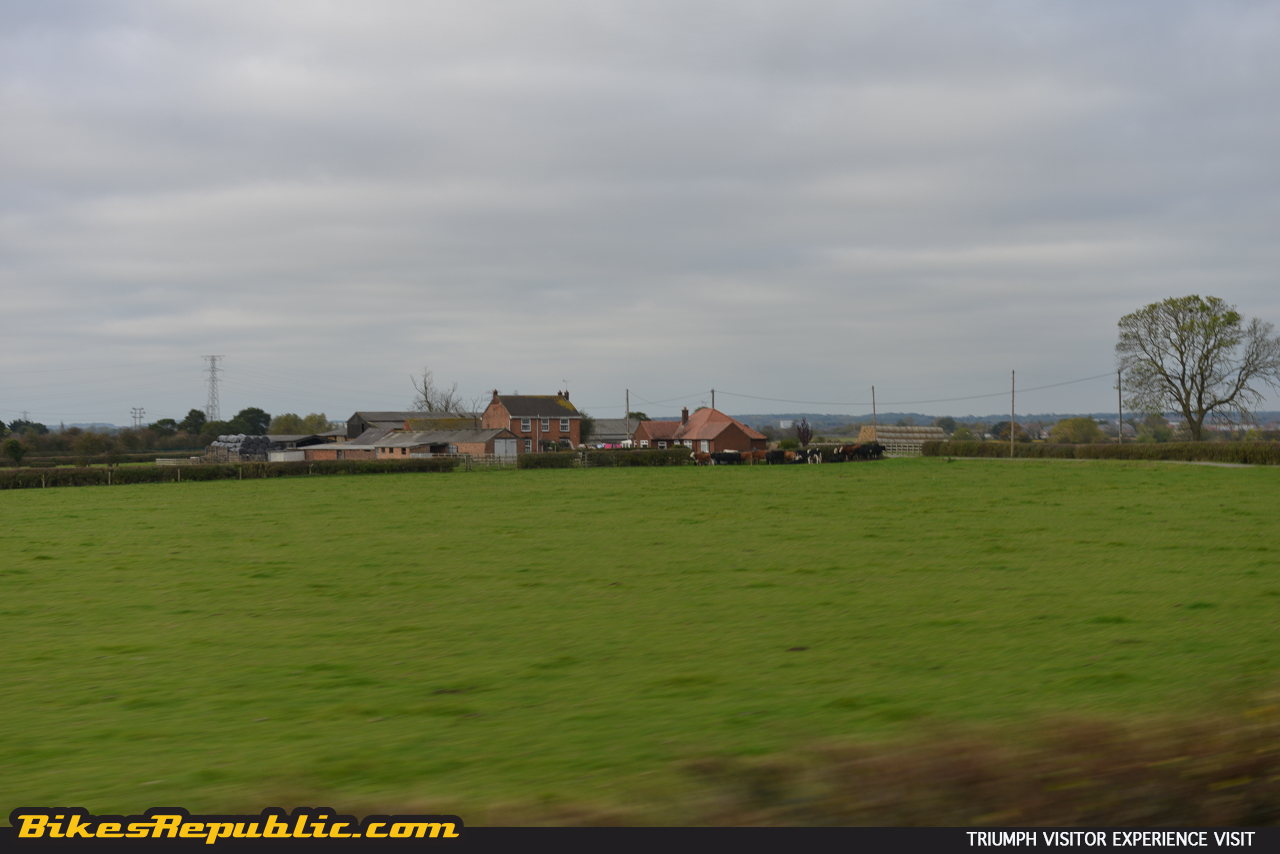
We were soon treated to the sights of the beautiful English countryside. Rolling hills and expansive pastureland were dotted with farmhouses in the yonder. Factories small and large sprung up intermittently.
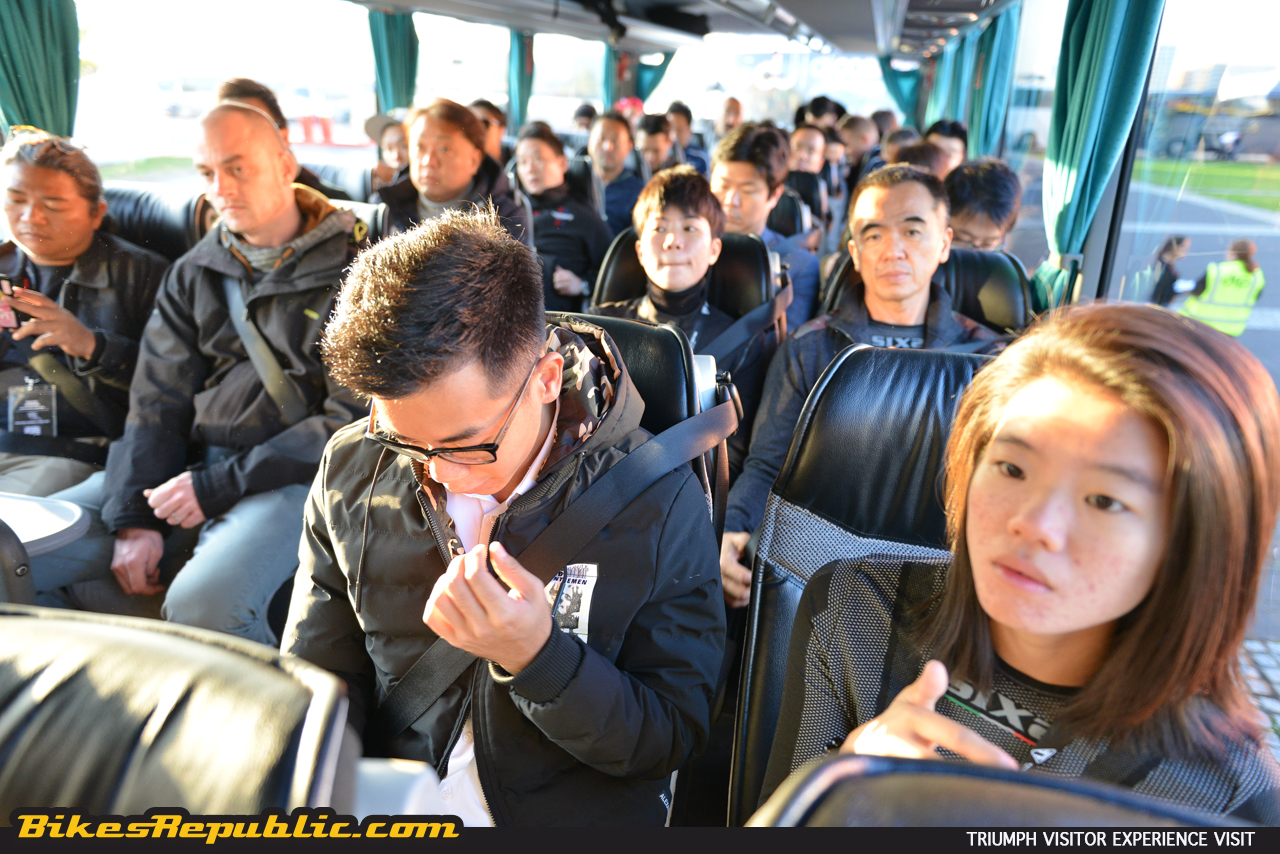
We soon rolled up to the complex and an excited murmur went up in the bus. They were Triumph dealers from the world over. I heard Japanese, Korean, Spanish, American accented English.
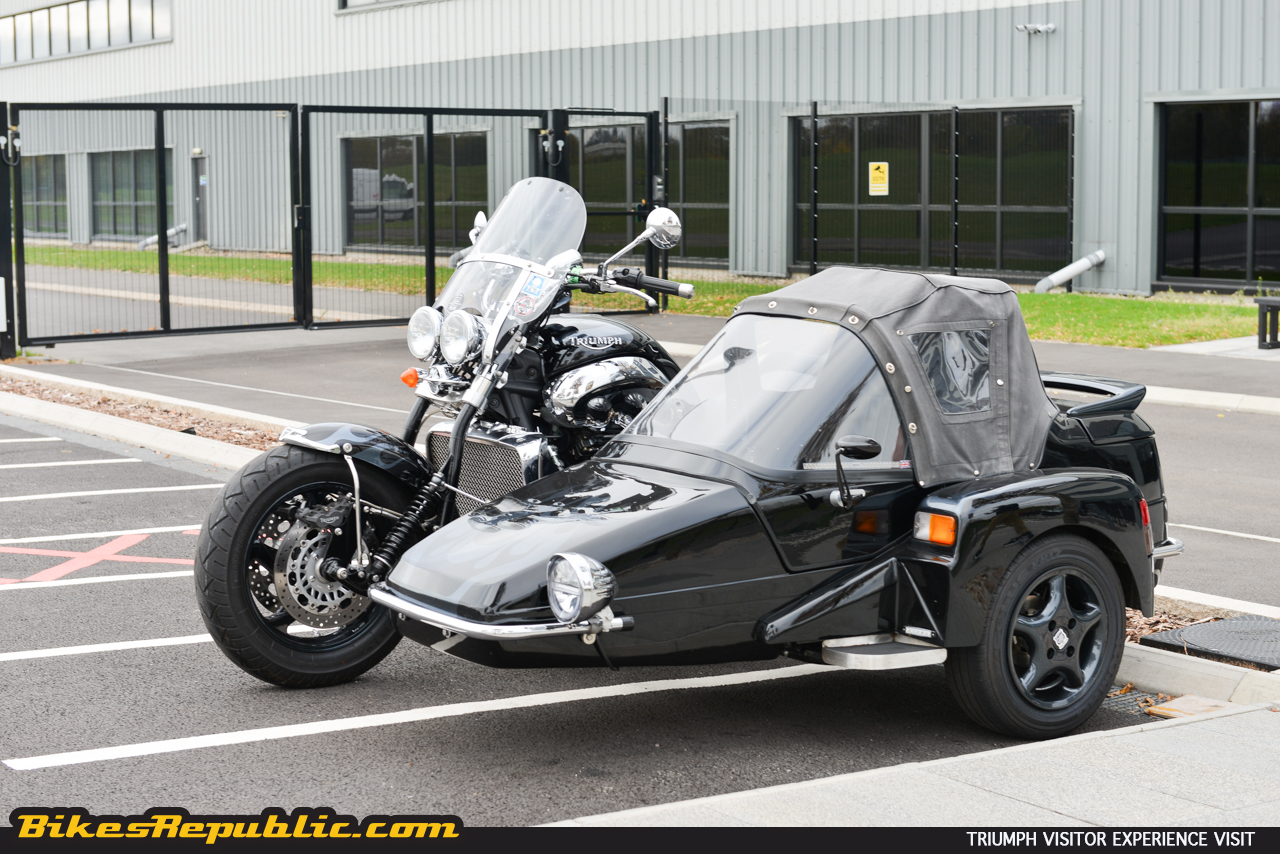
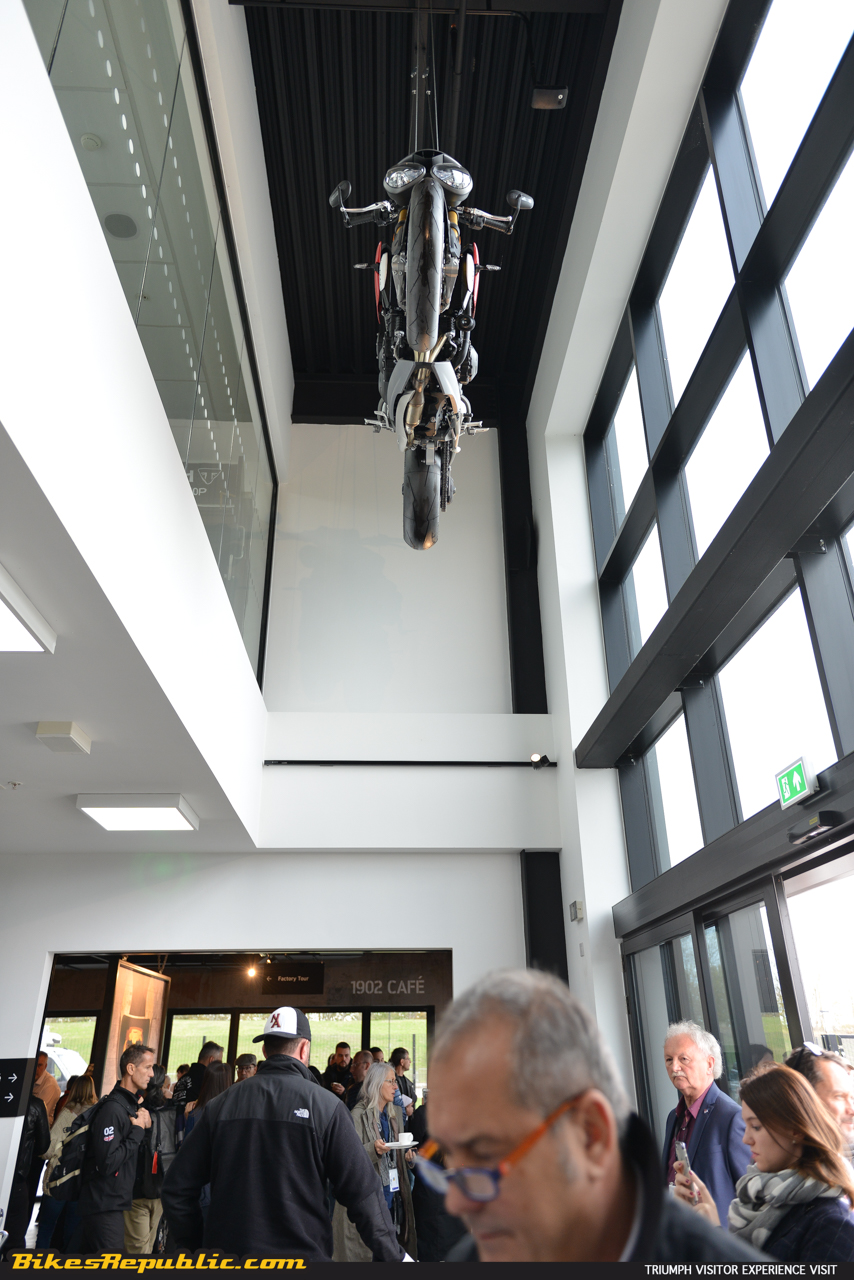
We were shepherded to the 1902 Café and a staff member welcomed us. They also served light refreshments but more importantly, hot coffee. The café was named so for the year when the first Triumph appeared. Yes, Triumph was established earlier than Harley-Davidson.
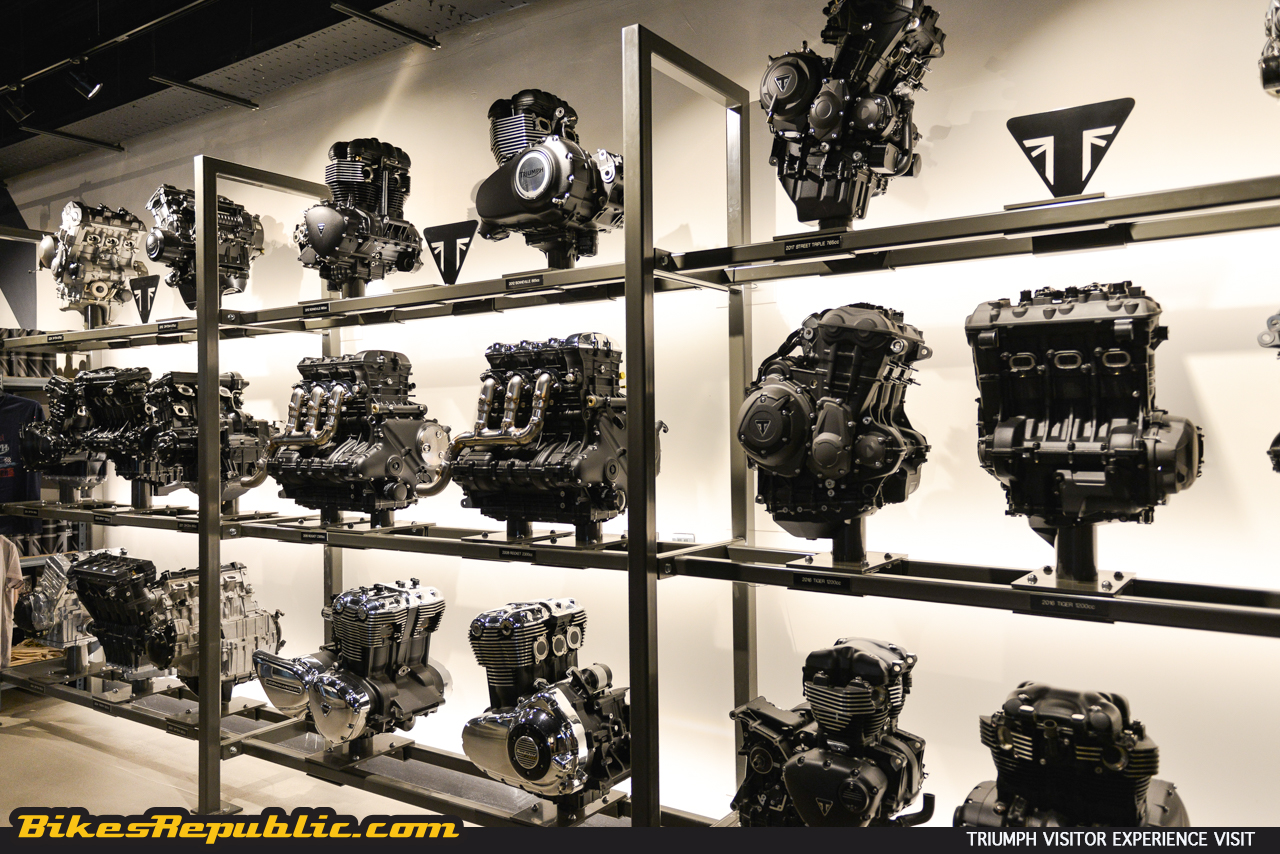
At the back was the “wall of engines” which displayed Triumph’s engines through the ages.
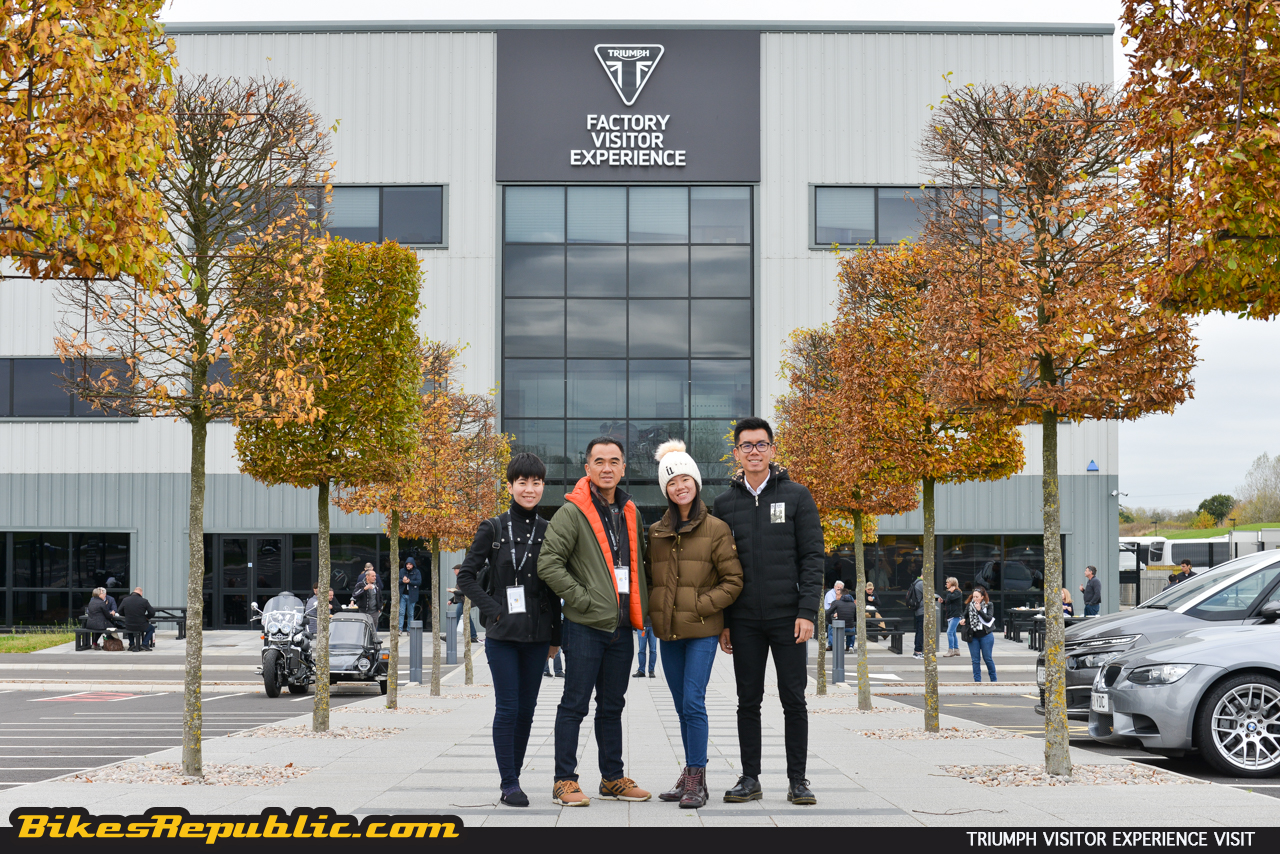
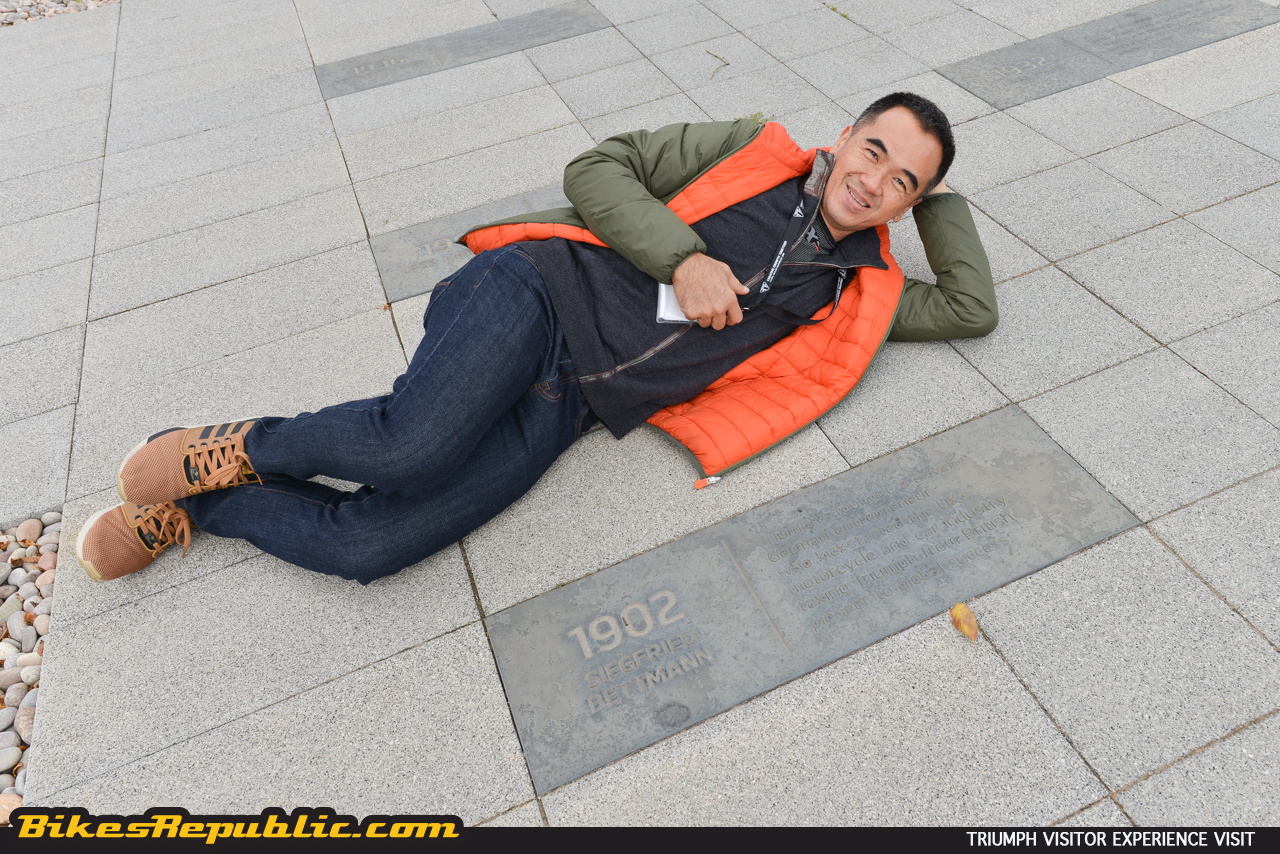
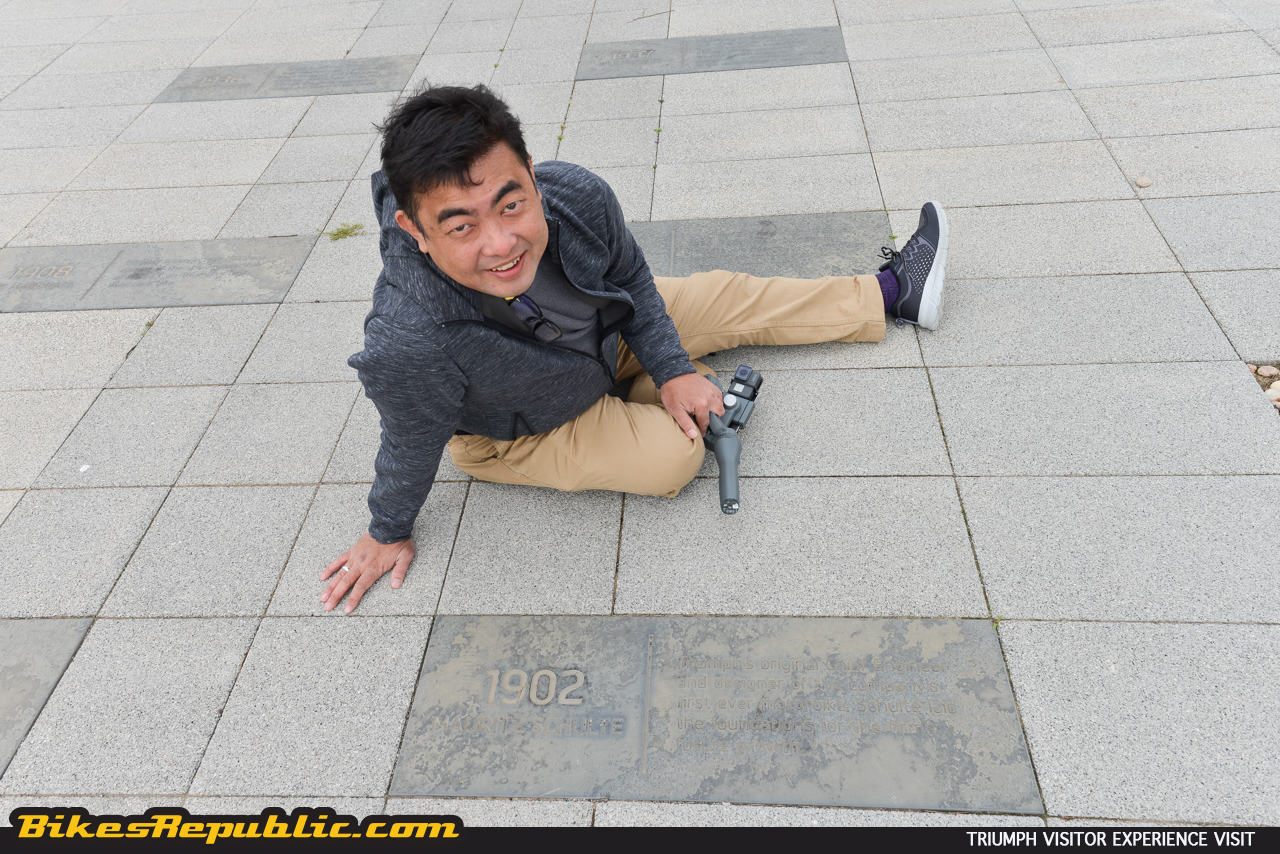
Outside was the Avenue of Legends. Significant dates that represented milestones and names of Triumph riders were laid into the path leading up the main doors. I stood out here trying to believe that I was actually standing in front of THE Triumph Motorcycles Ltd. factory in England. The strong wind brought with it chilling temperatures but I didn’t care. I was too absorbed.
We shot a few photos with the Tan family along the Avenue of Legends after waiting for quite a while. He came back and complained that his children had disappeared into the gift shop as soon as they got off the bus. Who can blame them?
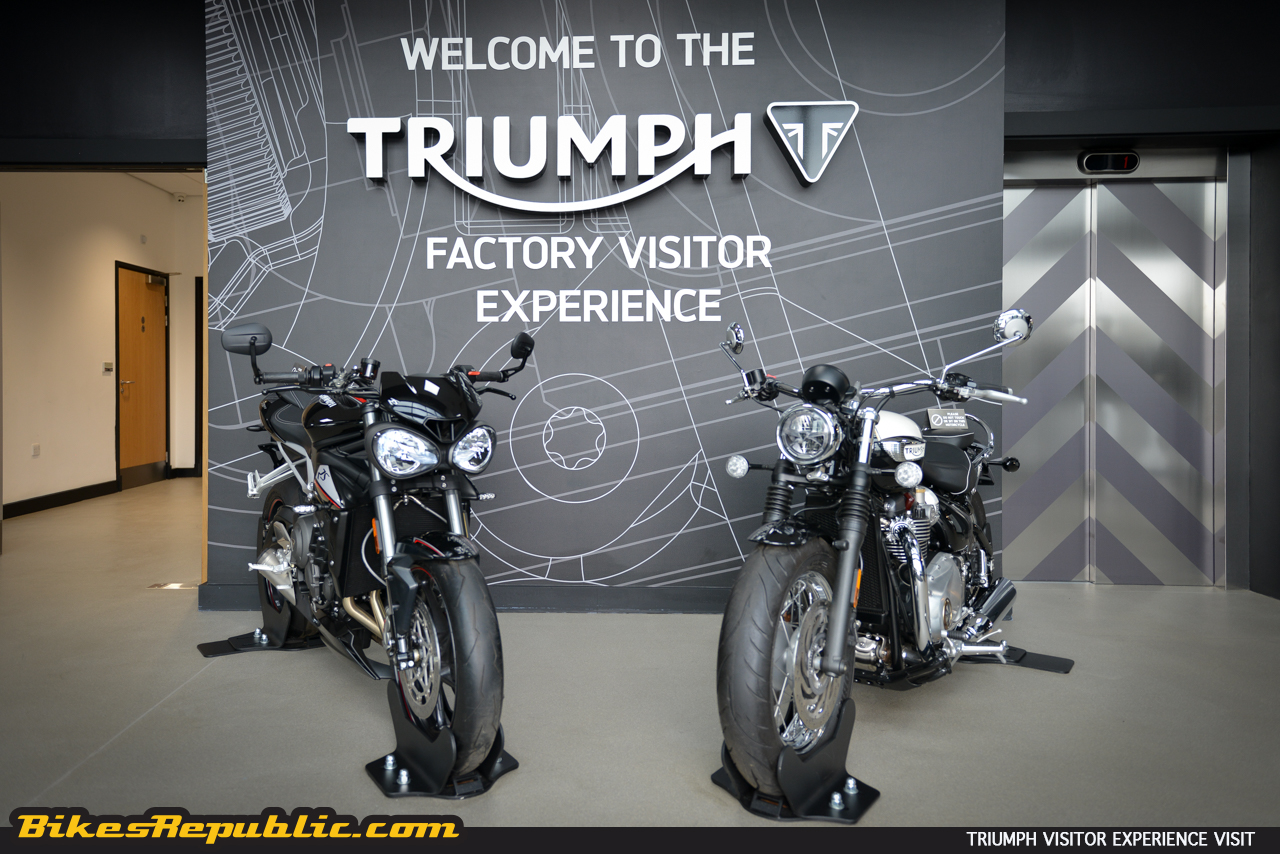
It was time to visit the facilities. The doors opened to a Street Triple RS and Bonneville Speedmaster in the foyer.
A new Speed Triple and classic Bonneville hung from the ceiling.
The Factory Tour
The exhibition area was choked up with the dealers, so I “‘scuse me, ‘scuse me” at a whole bunch of human torsos (that was all I saw at my height) and made my way into the factory. NOTE: No photography was allowed so there are a limited number of pictures from this area.
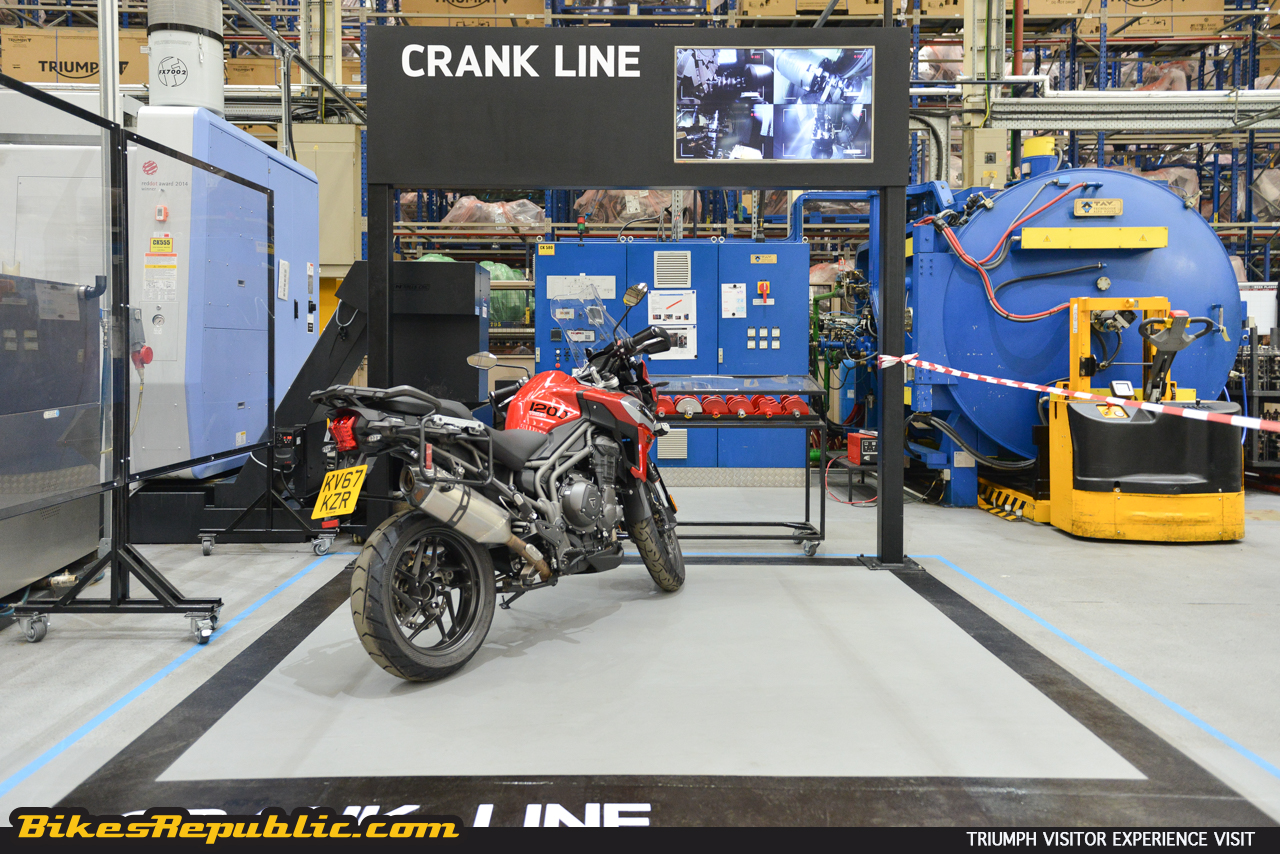
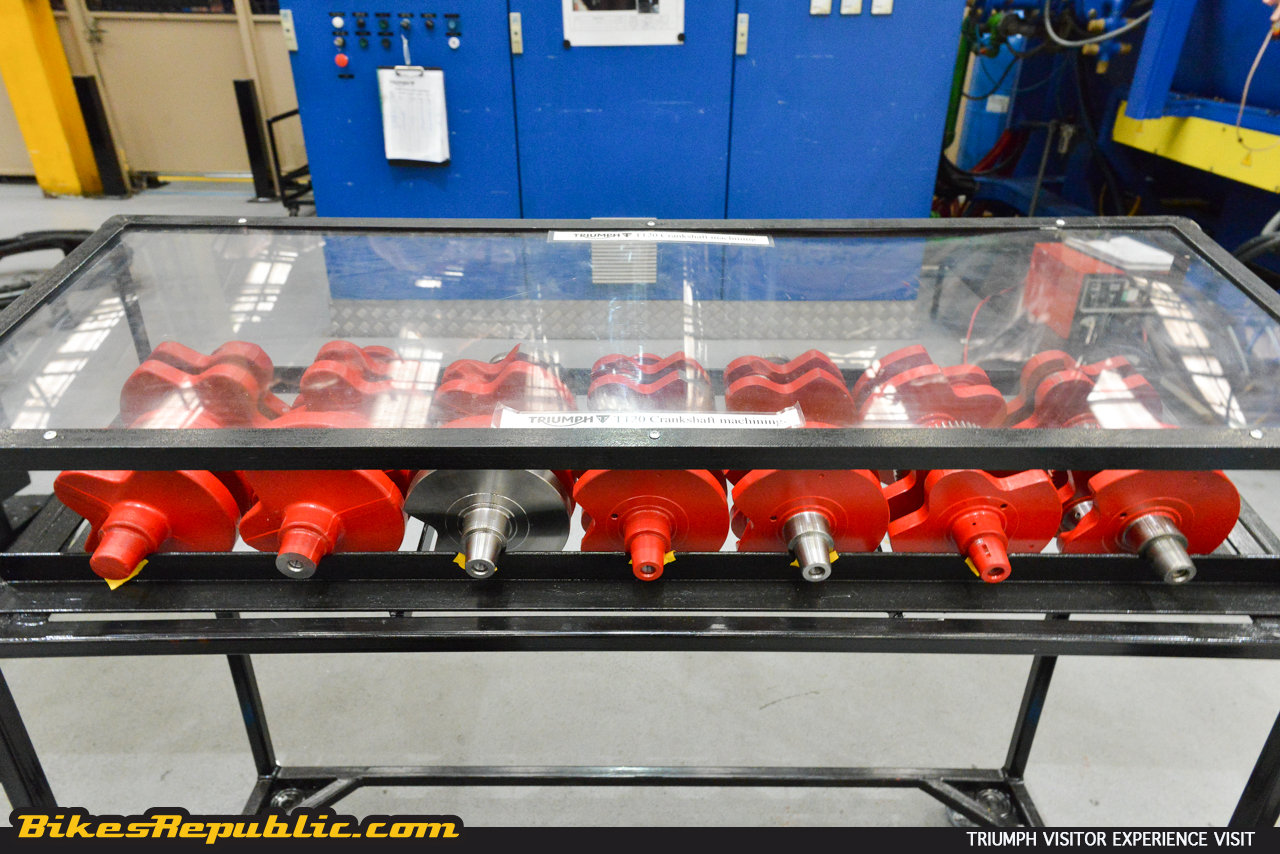
No, this wasn’t where random prank calls are handled. Crankshafts are made here. A case contained the Bonneville T120 crankshafts in different stages of machining.
There were many other areas along the way, of course, including engine assembly, motorcycle assembly and everything else in between. Unfortunately, the factory staff watched me intently as I shouldered a large DSLR. However, the Spanish-speaking dealers ahead were sneaking in shots with their smartphones. Merda!
We came up to a section where an elderly Englishman applied the striping to the wheels. The work was fast but the results were immaculate.
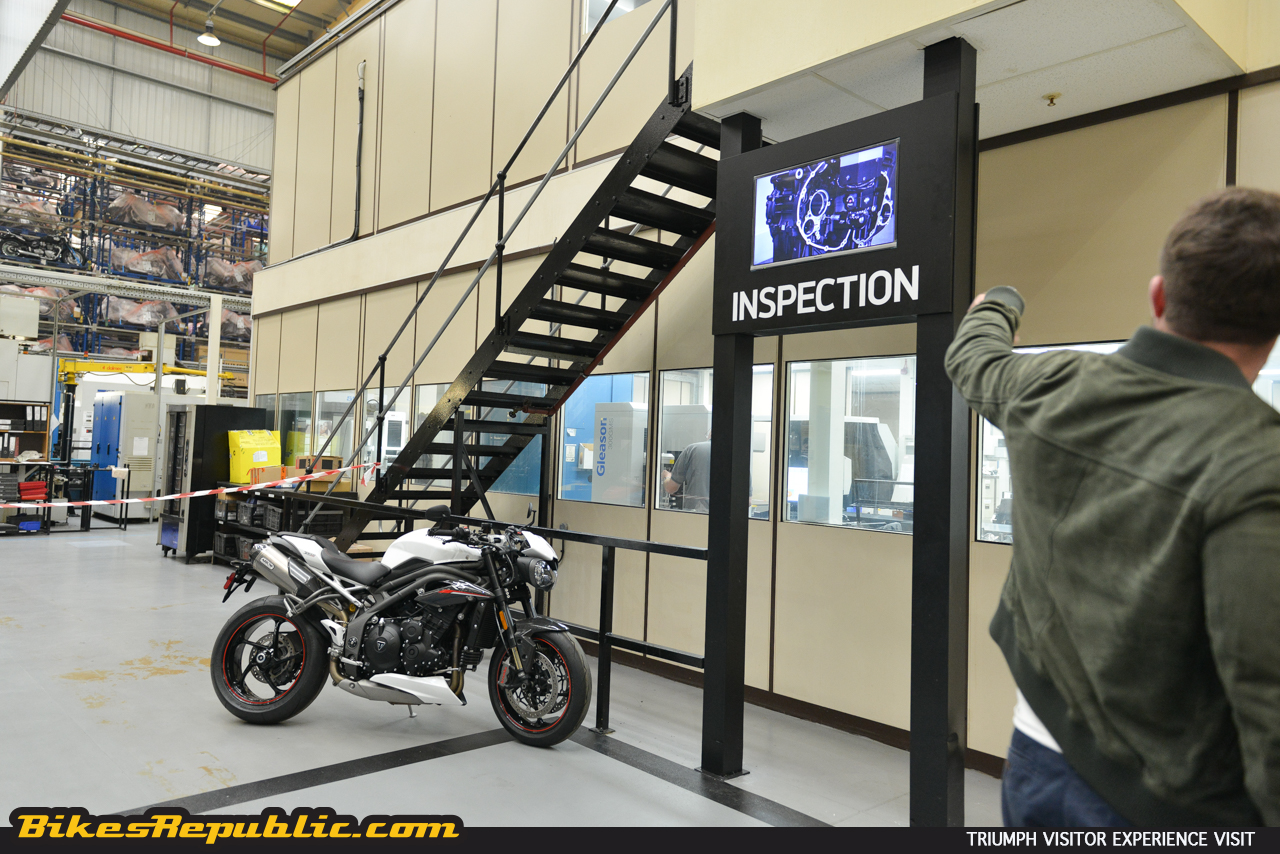
The inspection “booth” is where parts were picked up from the production line and inspected closely. Safe to say that inspection was carried out visually and with tools such as X-ray and ultrasound machines, among others.
At 2294cc, the Rocket III’s engine is the world’s largest production motorcycle engine. Here are three separated pieces of the cylinder head, showing the different stages of production. On the left is the raw casting; partly machined in the centre and; fully machined on the right.
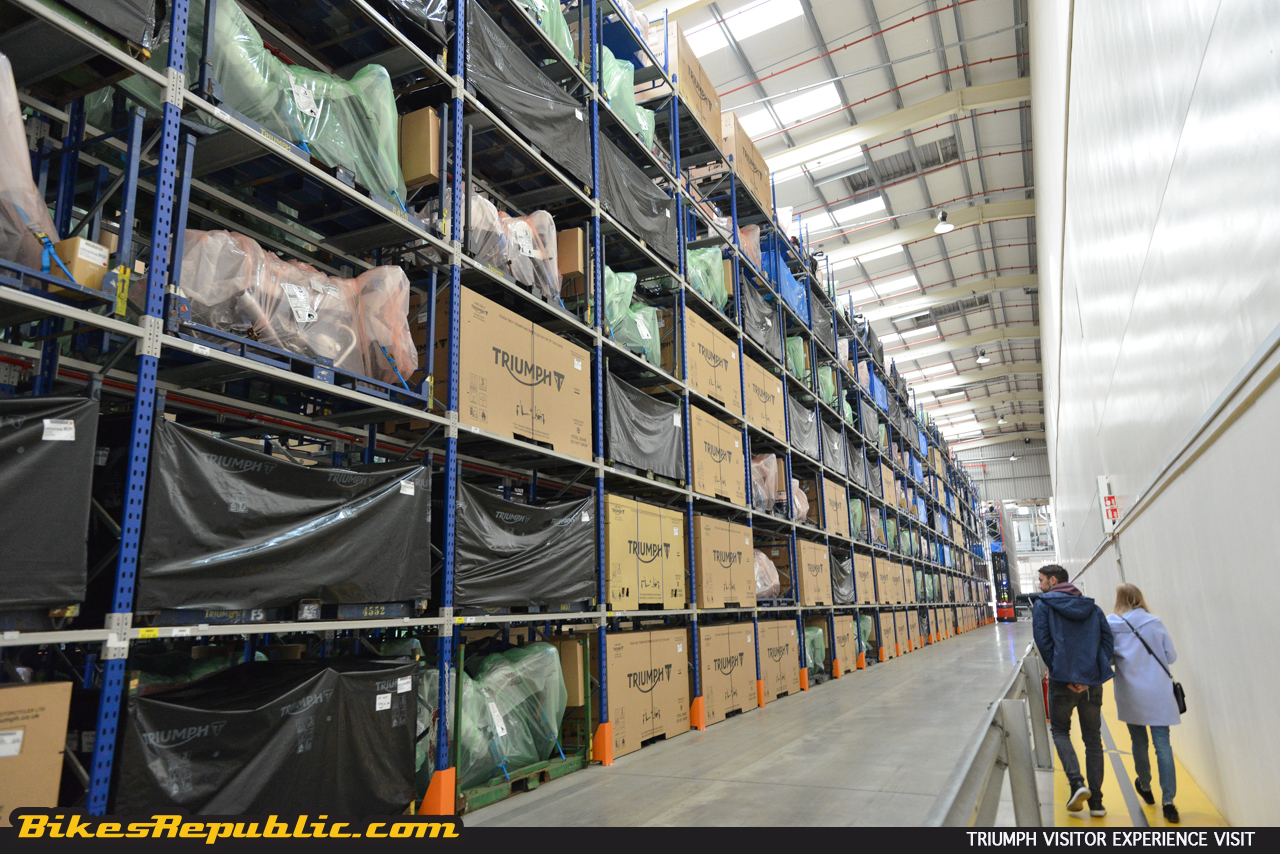
Looks like an IKEA stock area, doesn’t it? It’s the same concept here except that the bikes are fully built, instead of needing self-assembly (although I wouldn’t mind doing that!).
Triumph Factory Visitor Experience
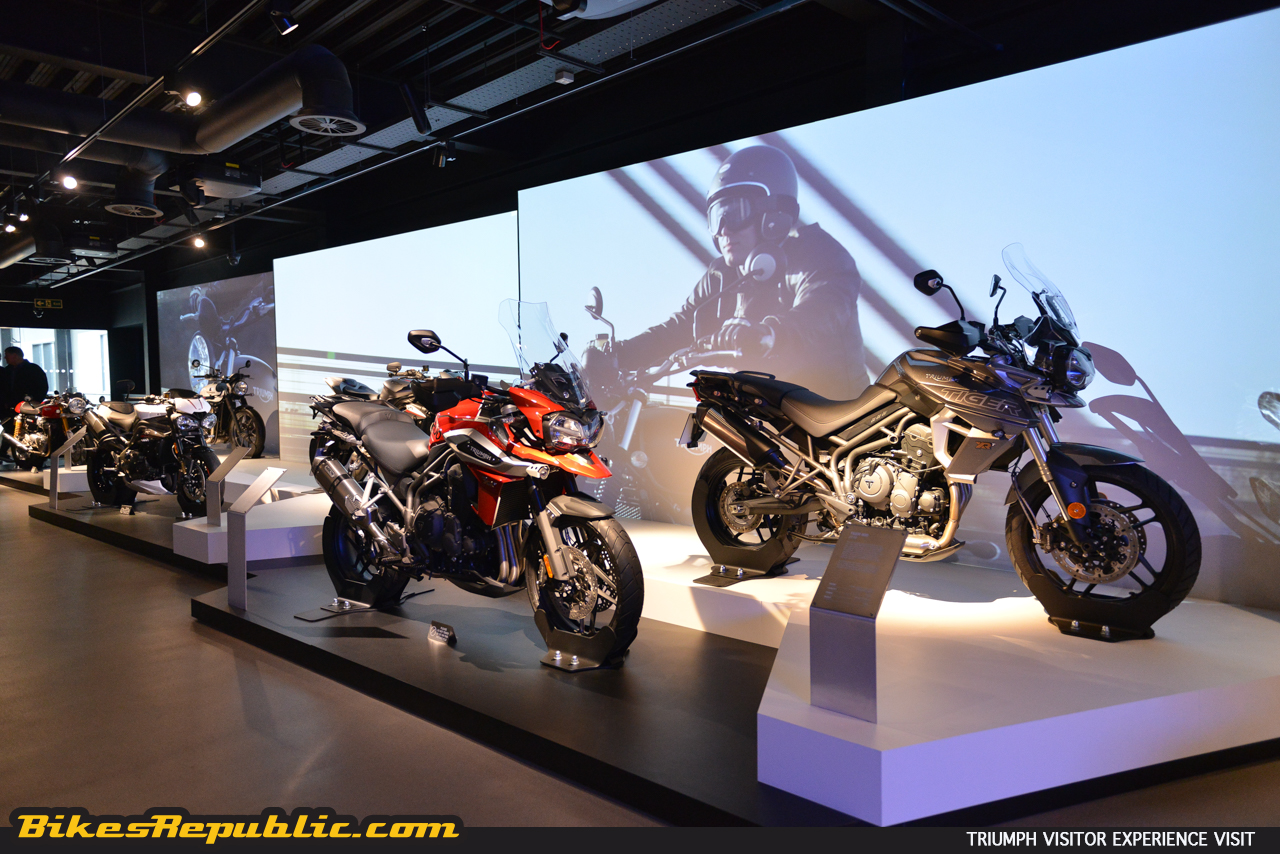
The Triumph Visitor Experience is a gallery adjoining the main building.
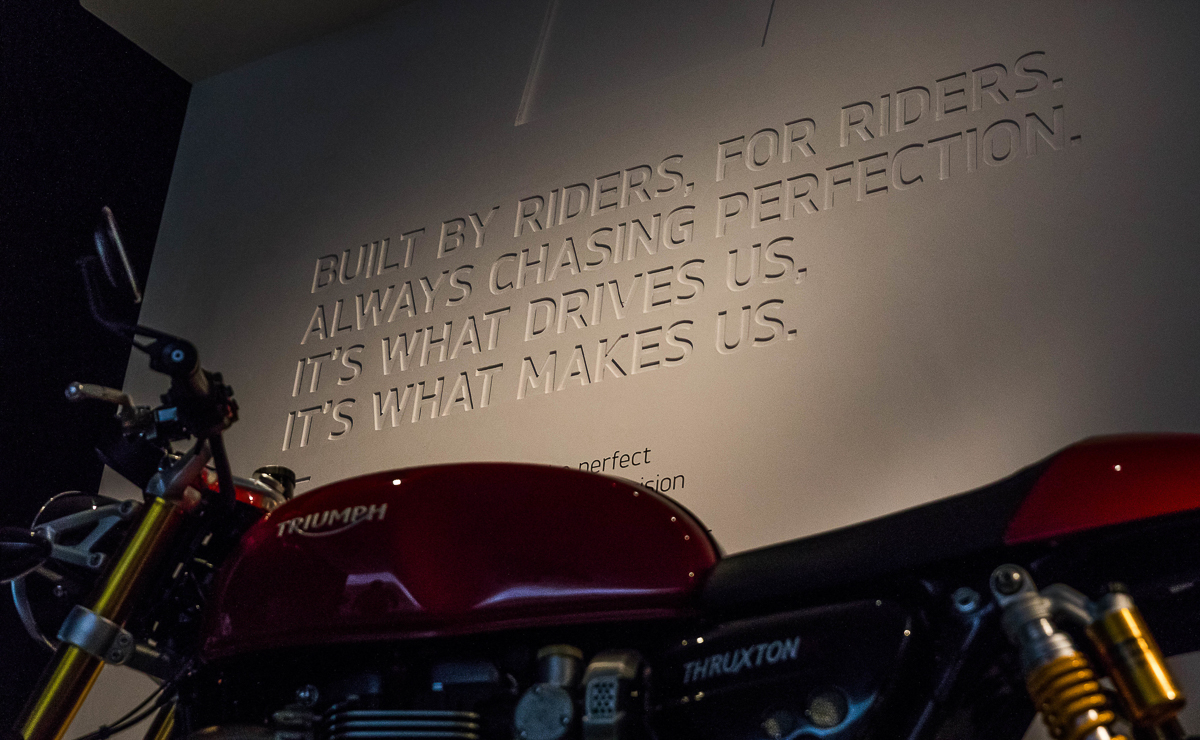
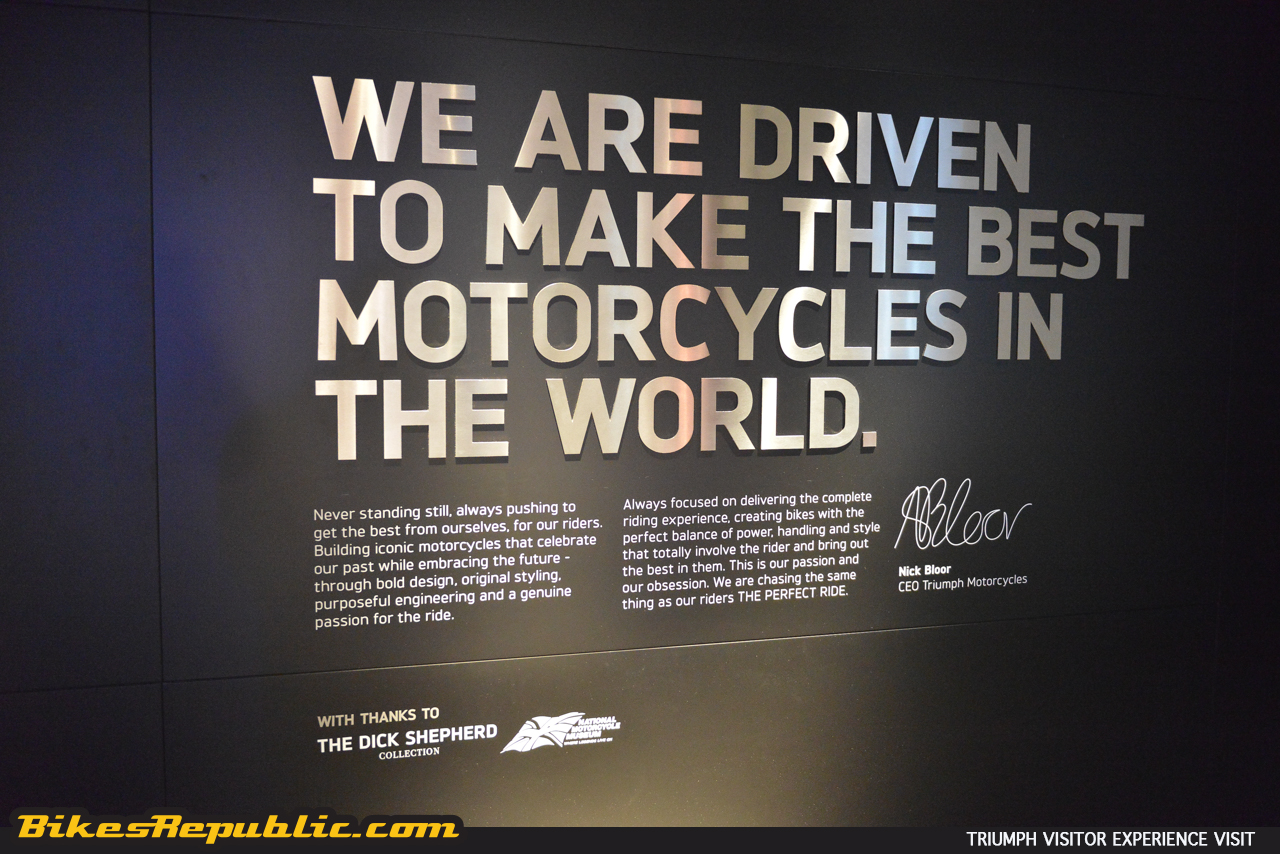
It’s divided into different segments, starting with ATTITUDE. It alludes the philosophy that Triumph was built on and what drives the brand. Etched into the wall are these words, “Built by riders, for riders, always chasing perfection, it’s what drives us, it’s what makes us.”
Although Triumph is proudly a British brand, it was started by Siegfried Bettman, who emigrated from Nuremberg, Germany. He sold bicycles originally and named his company Triumph Cycle Company in 1886, before registering it as New Triumph Co., Ltd the next year with funding from the Dunlop Pneumatic Tyre Company. He was joined by another Nuremberg native Moritz Schulte as a partner in the same year.
Schulte encouraged Bettman to turn the company into manufacturing. They moved to a site in Coventry in 1886 and produced the first Triumph bicycles in 1889. Now I know where my Grandad’s Triumph bicycle came from.
Anyhow, they expanded into motorcycle manufacturing and produced the first in 1902, powered by a Belgian Minerva engine. So voila, Triumph No. 1.
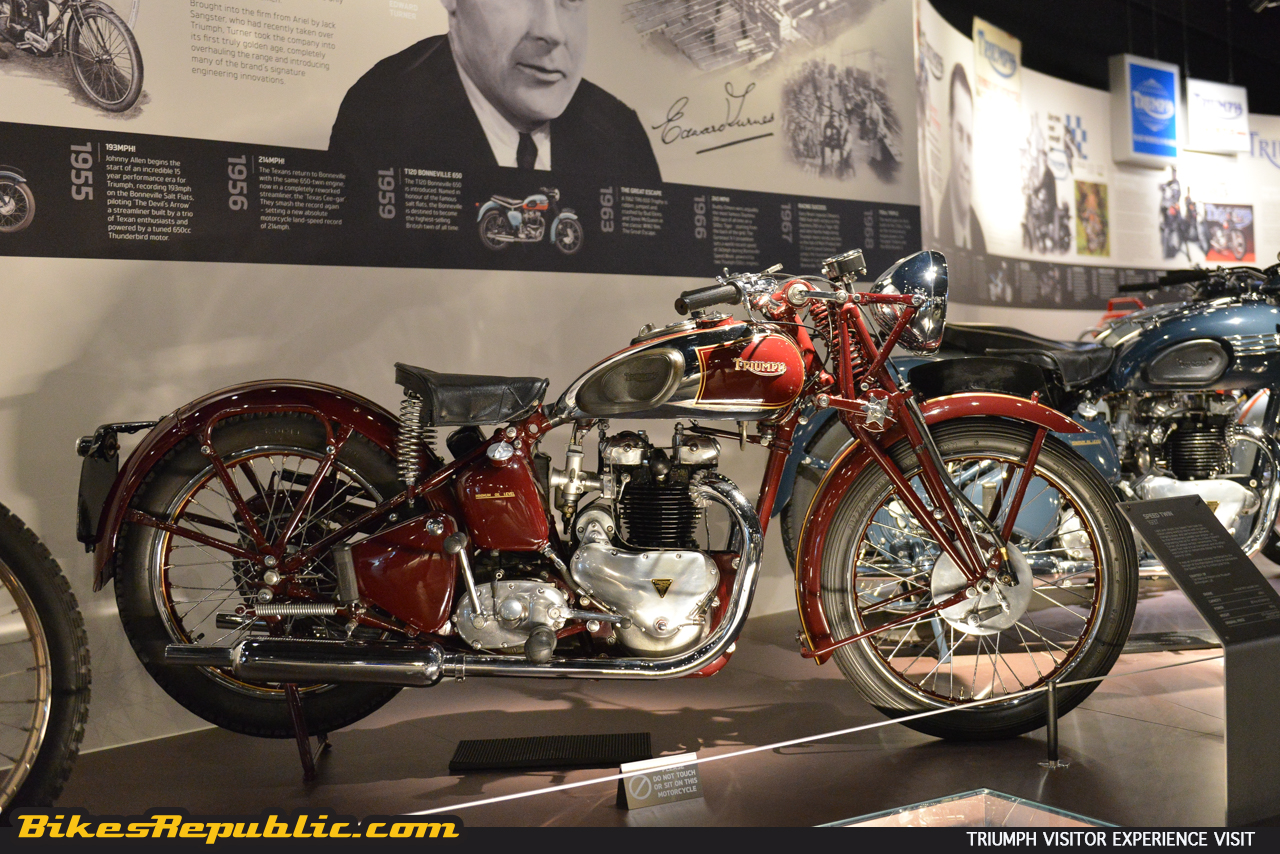
This beautiful 1937 Speed Twin had me staring at it for a good 20 minutes. Featuring a 500cc parallel-Twin, it was the first truly successful British twin and set the standards for those that followed.
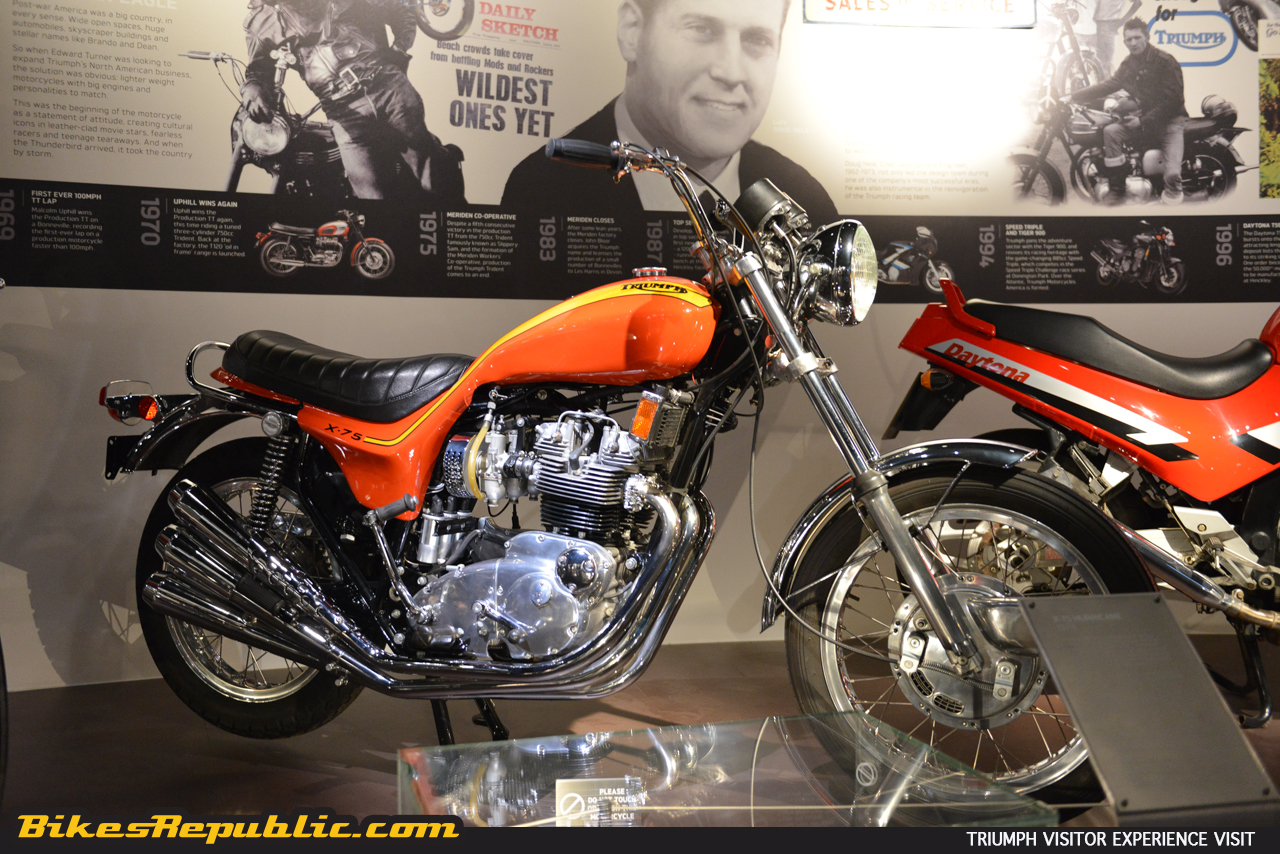
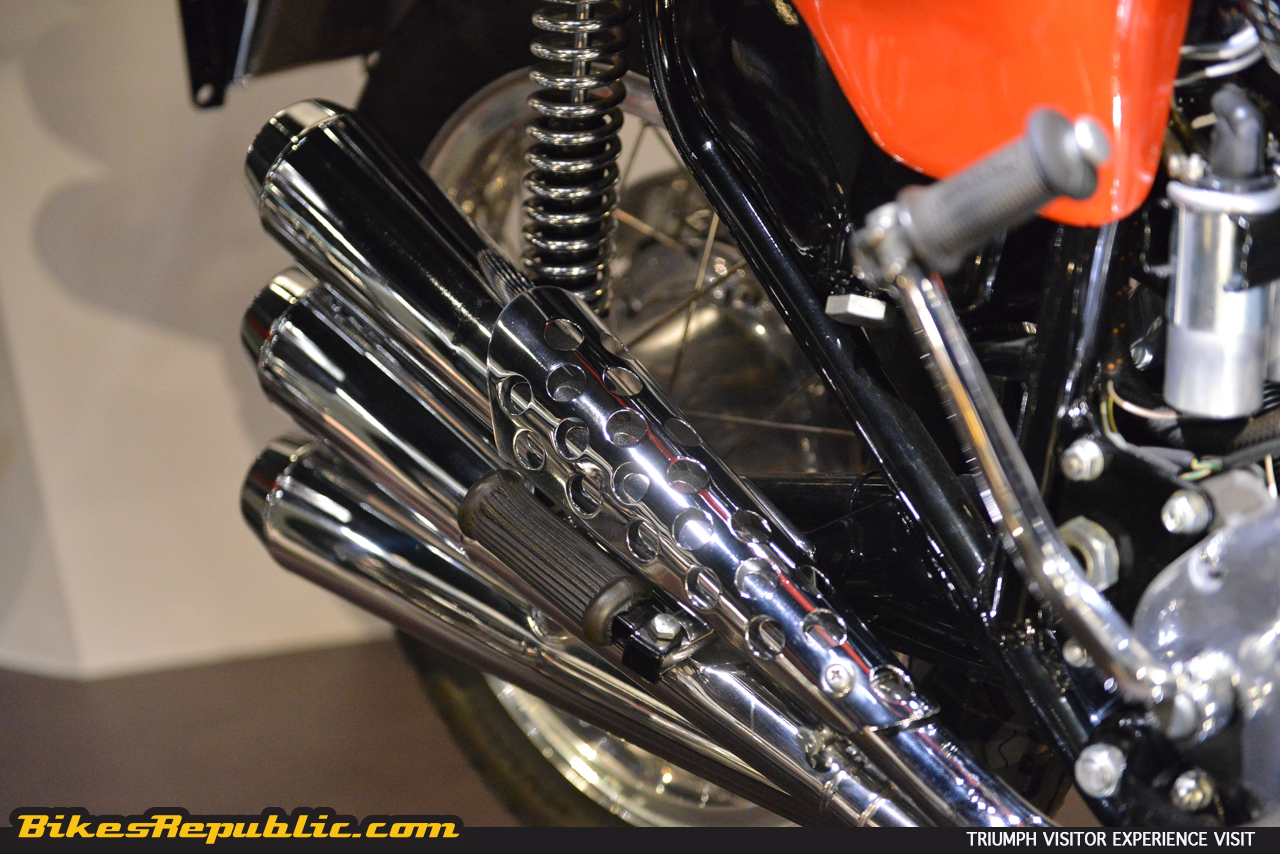
Next was this X-75 Hurricane. BSA (owner of the Triumph brand back then) wanted a design that could sell in the US and employed Craig Vetter to redesign the BSA Rocket 3. But BSA went bust in 1972 so the bike was sold as a Triumph, thus the Vetter BSA Rocket 3 became the Triumph X-75. Production stopped in 1973 as the bike failed new American noise standards. I love the triple exhaust tips!
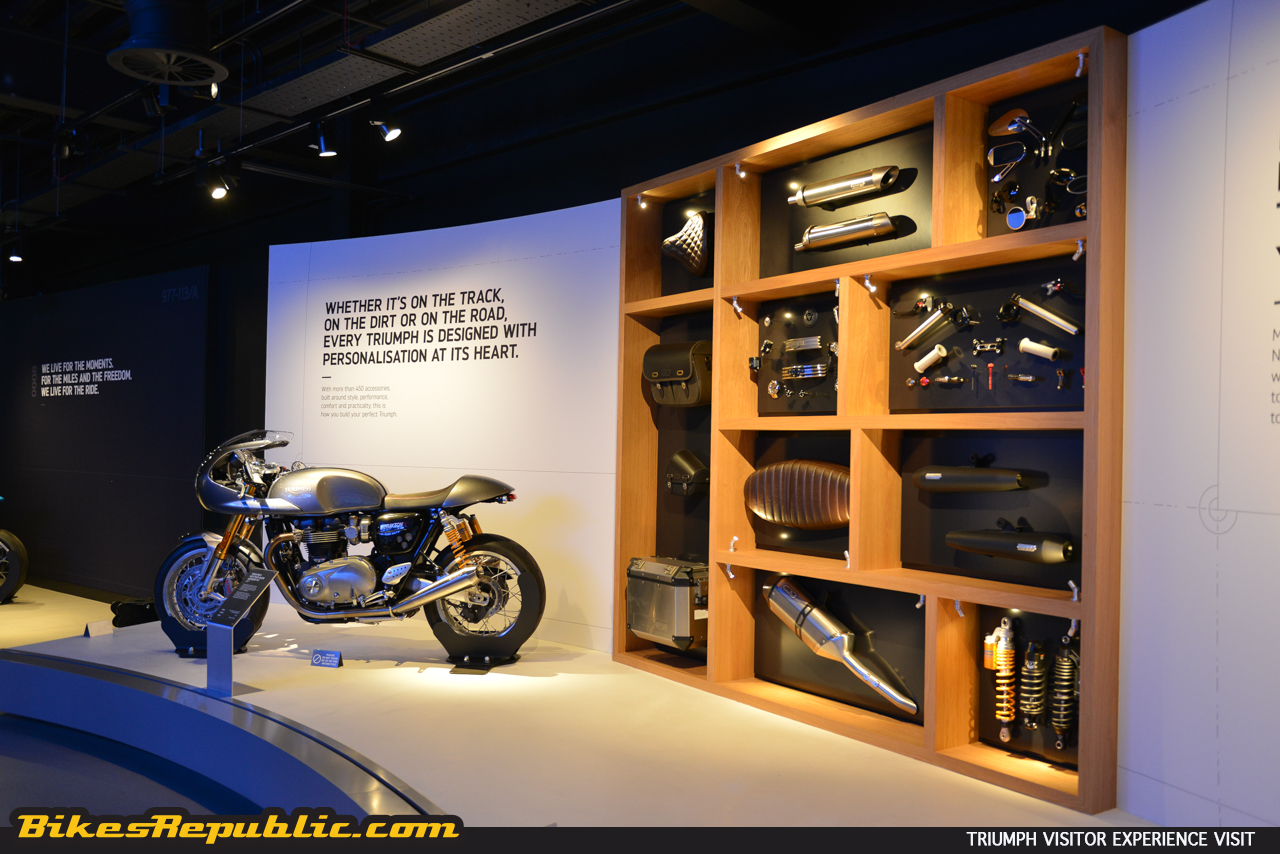
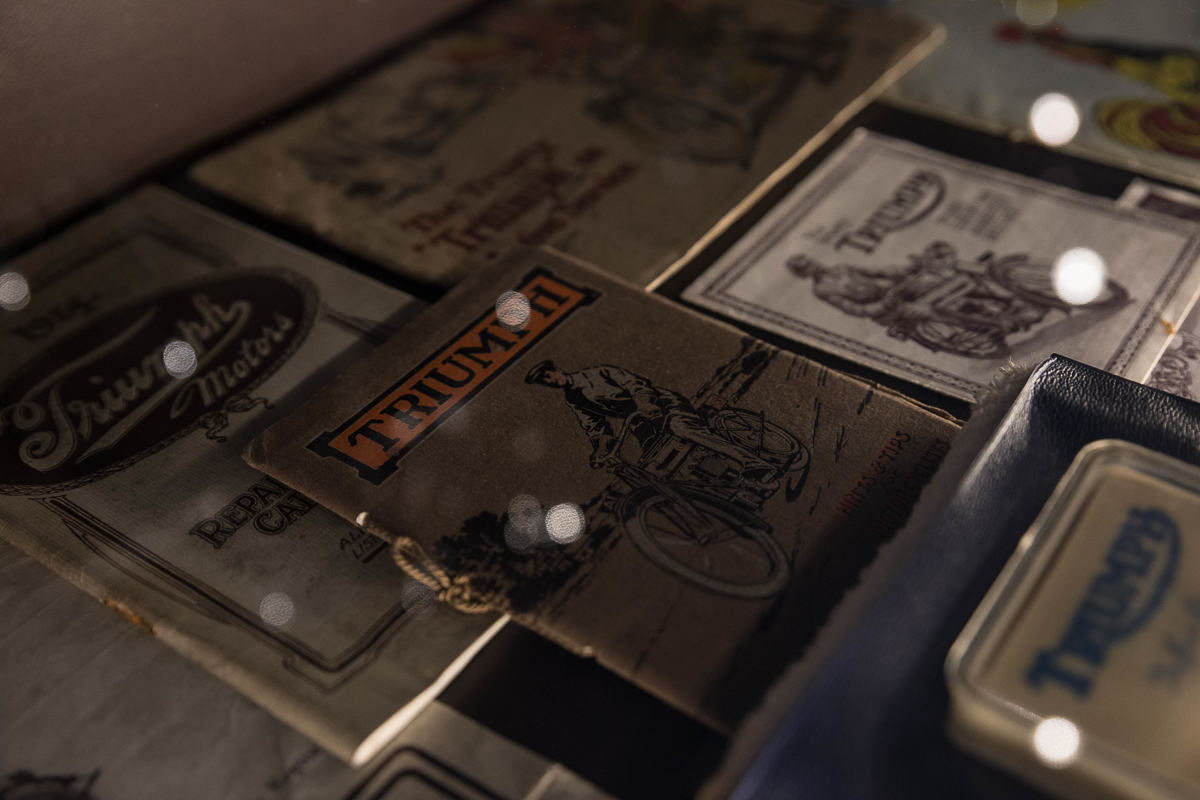
Before turning the corner, a Thruxton R sat in front of a large display case. The cubbies were filled with Triumph factory accessories. Yes, the manufacturer has more than 300 accessories to choose from.
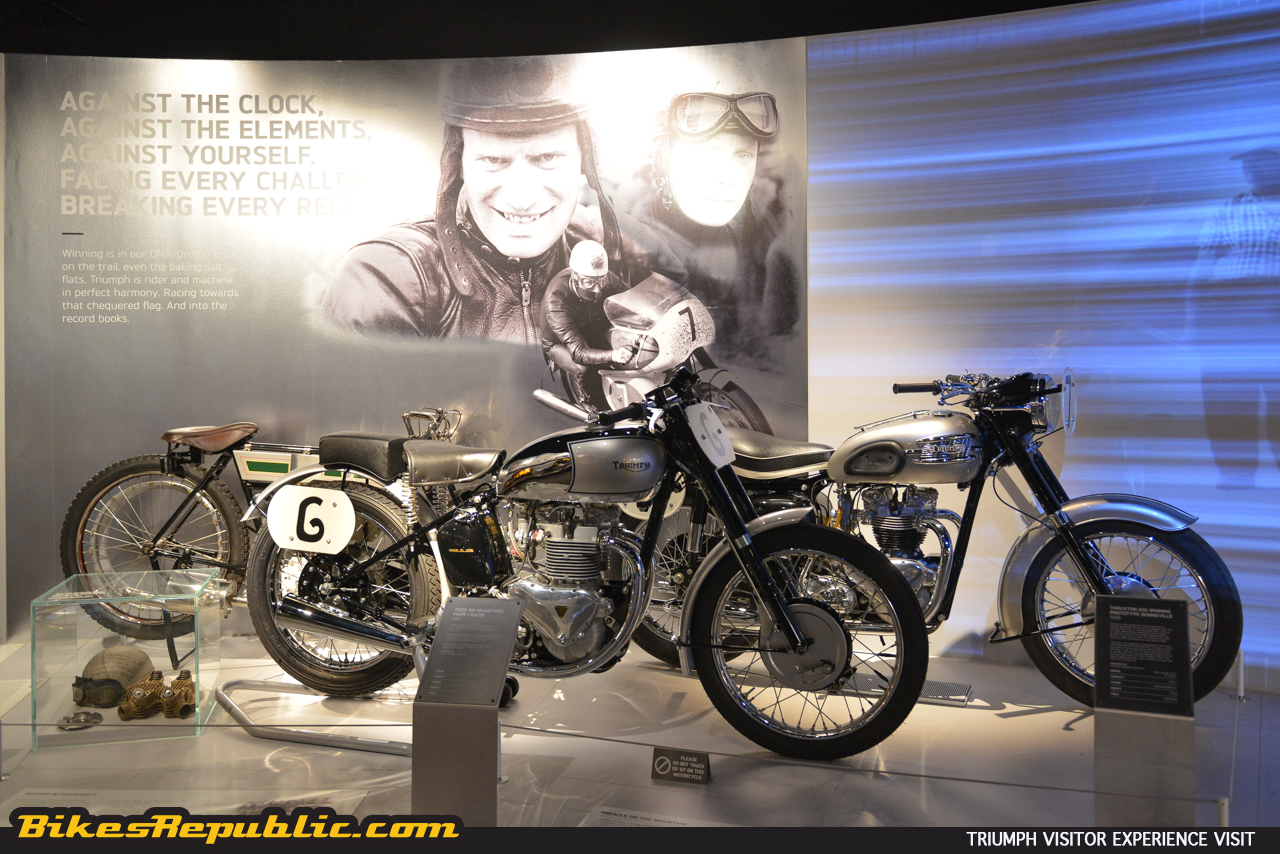
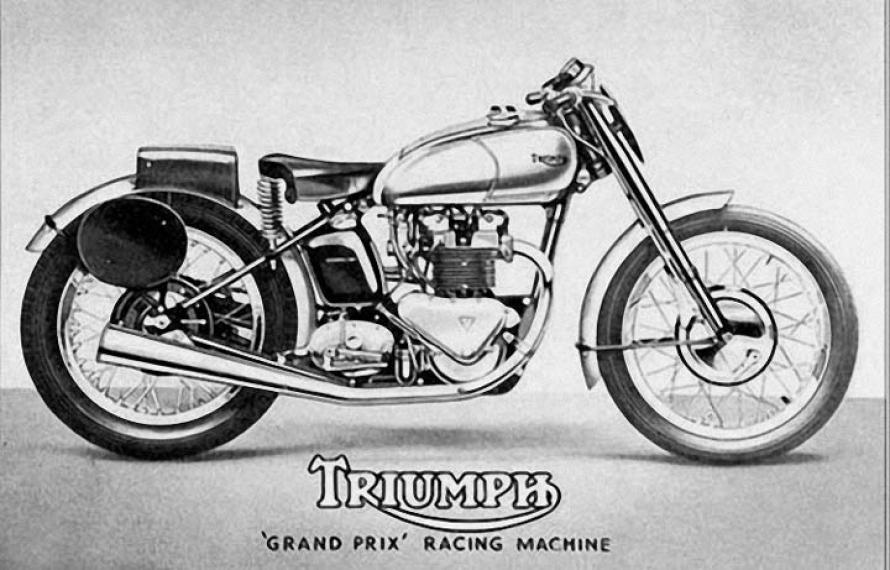
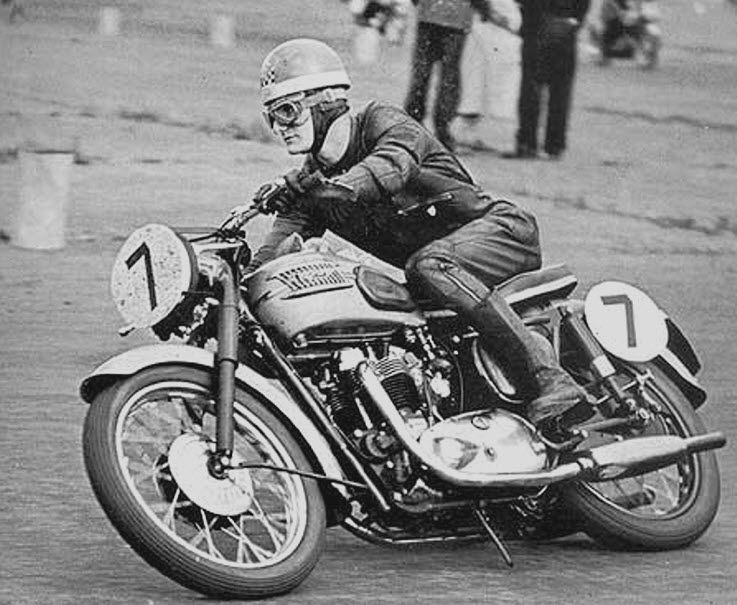
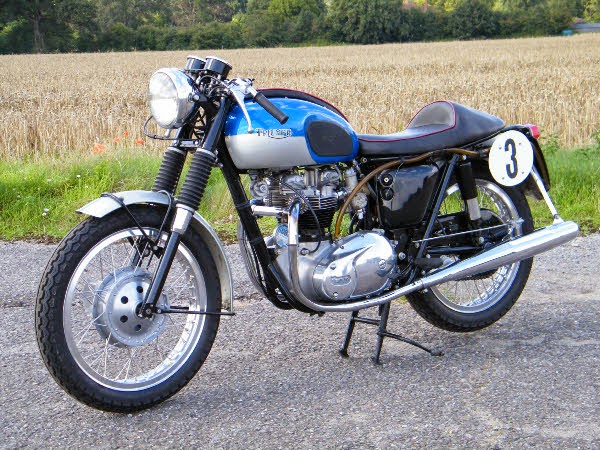
Starting the PERFORMANCE area were two race bikes. A 1947 Tiger 100 Grand Prix Mark I Racer sits in front of a 1958 Thruxton 500. The Tiger 100 was also known as the T100, so it’s the Granddaddy of the present Bonneville T100. Ernie Lyons rode the race bike to victory at Manx Grand Prix. Triumph commemorate the win by selling the stripped-down Tiger 100 race replica in 1947, which became known as the “Grand Prix.” The victory at Manx was just one of the many that the Tiger 100 won.
1947 Triumph Tiger 100 Grand Prix poster
The name “Thruxton” actually belongs to a racetrack converted from an airfield near Andover, Hampshire. The track was well-known by 1951 and holds six-event motorcycle races as part of the Festival of Britain. Geoff Duke and John Surtees raced there. Thruxton started hosting endurance races soon after.
Mike Hailwood on a Triumph at the 1958 Thruxton 500 – Photo credit Pinterest.com
In 1958, the endurance race became a 500-mile (800-km) affair. Mike “The Bike” Hailwood a 650cc Triumph. This was the start of Triumph’s reputation as a fearsome competitor. Hailwood’s win was the first of eight Thruxton 500 victories for Triumph.
There weren’t exactly factory-built racing prototypes those early days. Instead, competitors buy their bikes from showrooms and modify them for racing. So, Triumph did the smart thing of producing racing parts (like modern-day race kits) and sold them to mechanics and dealers.
The first factory-built Thruxton racer was in 1964. 52 of these were made to homologate them for racing. The 1958 “Thruxton” may be the start but the supreme Thruxton was introduced in 1969. Based on the T120, it finished 1-2-3 at Thruxton, second in the Barcelona GP, and won the Isle of Man Production TT by a record average of 100 mph (160 km/h). That’s super fast for a 1969 bike!
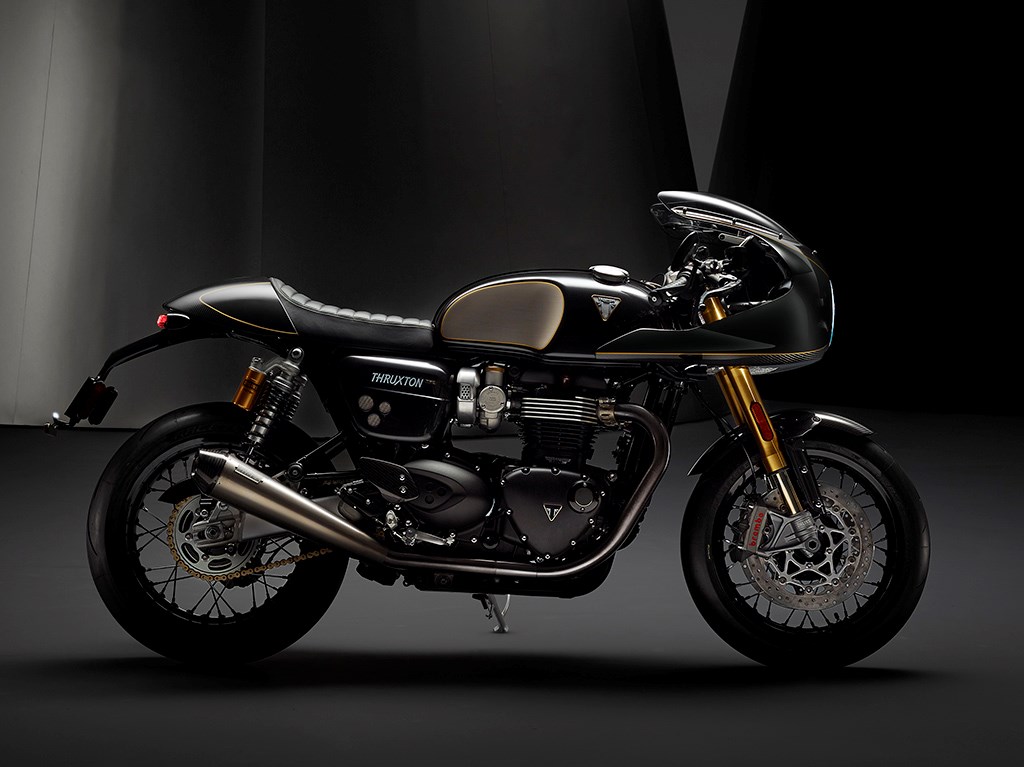
This is why the current Thruxton model is the racer variant and alpha-bike of the Bonneville line-up. As with its descendant, it’s built on the Bonneville T120 and shares the same engine, albeit with the High Power tune.
Triumph Bonneville Thruxton R TFC (Triumph Factory Custom)
(OMG! We still have 4 more sections to go!)
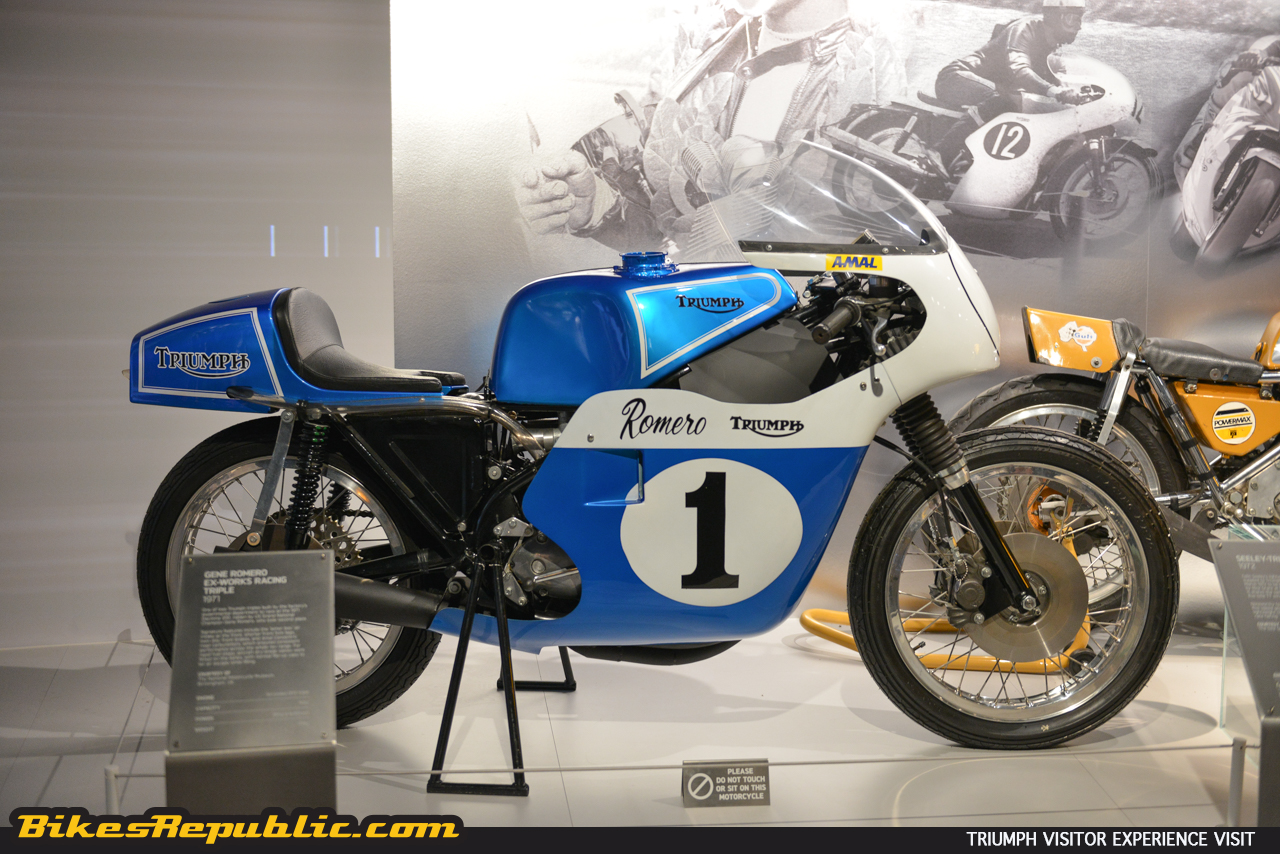
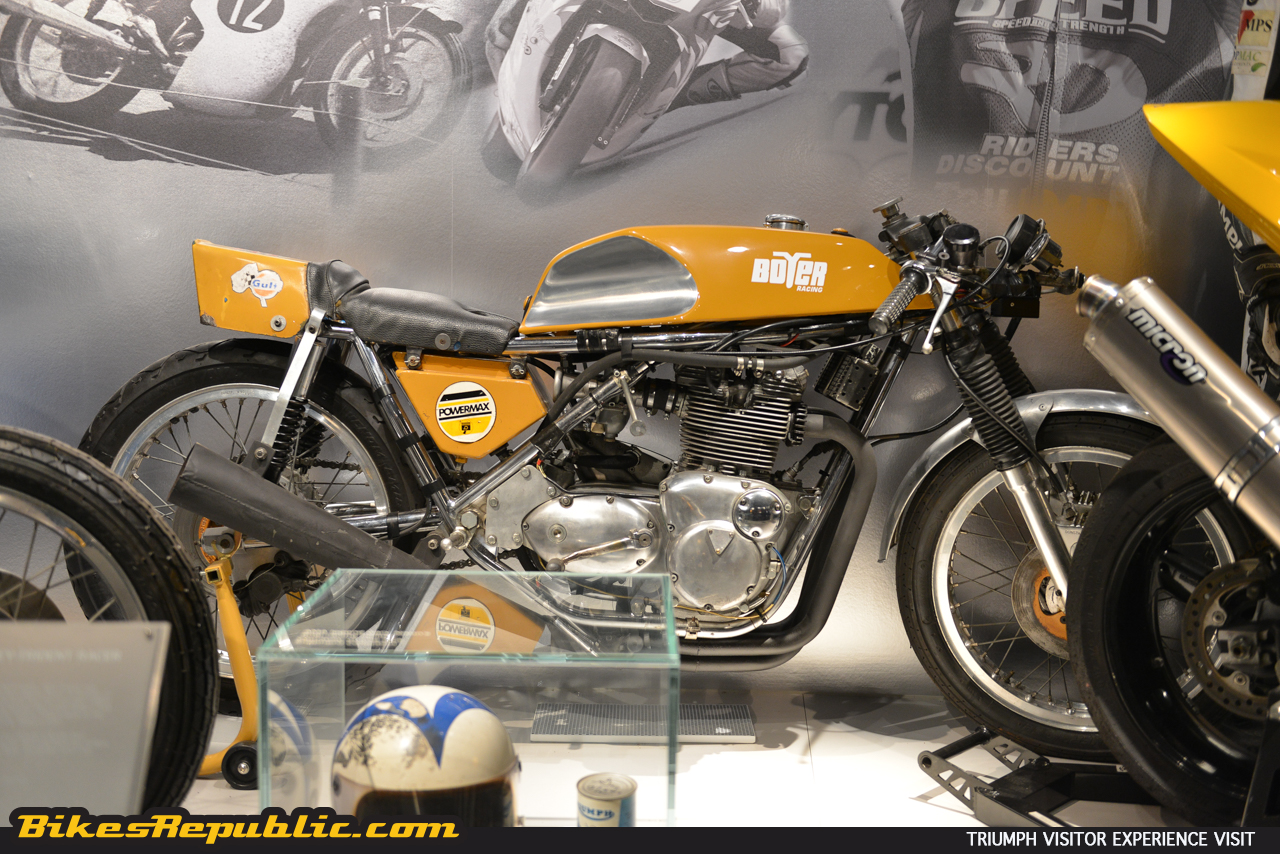
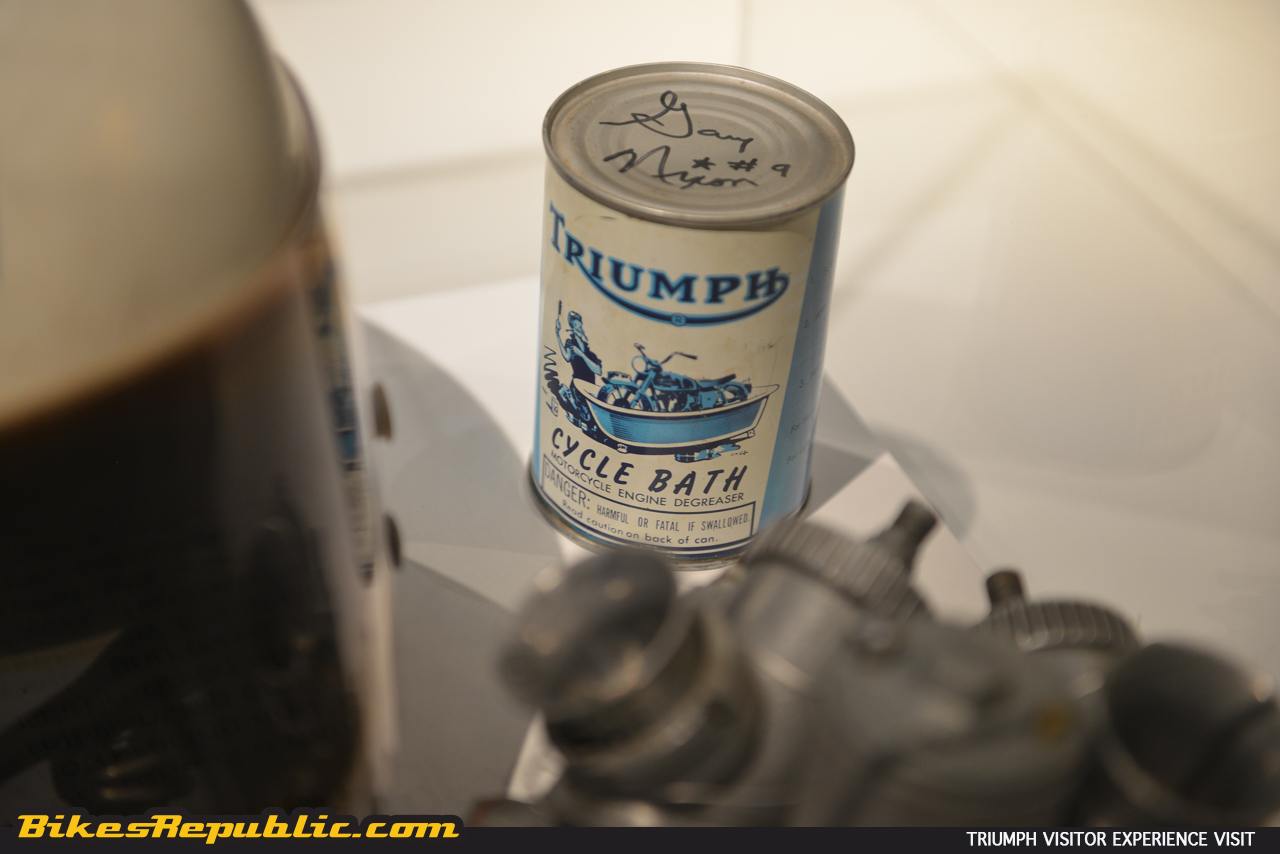
Gene Romero rode this racing 750ccTrident Triple to second place at the 1971 Daytona 200 race. It was part of Triumph Meridien’s 5-rider team assault on the pre-eminent American race. Romera finished just 2 seconds behind the winner in the 320-kilometer race (200 miles). Just below the fuel tank is the trademark “letterbox” airbox. Intake air was routed through the front of the fairing into the airbox and past the oil-cooler, like the modern ram air system. Gene Romero was a multiple AMA Grand National Champion. His teammates were Gary Nixon, Don Castro, Paul Smart and Tim Rockwood.
This Daytona TT600 won the Isle of Man TT in 2003. The bike was built by the famed Valmoto team. This was the early Daytona 600 which uses an inline-Four engine, instead of the triple in the later Daytona 675. But it cemented the Triumph Daytona’s name in the supersport category.
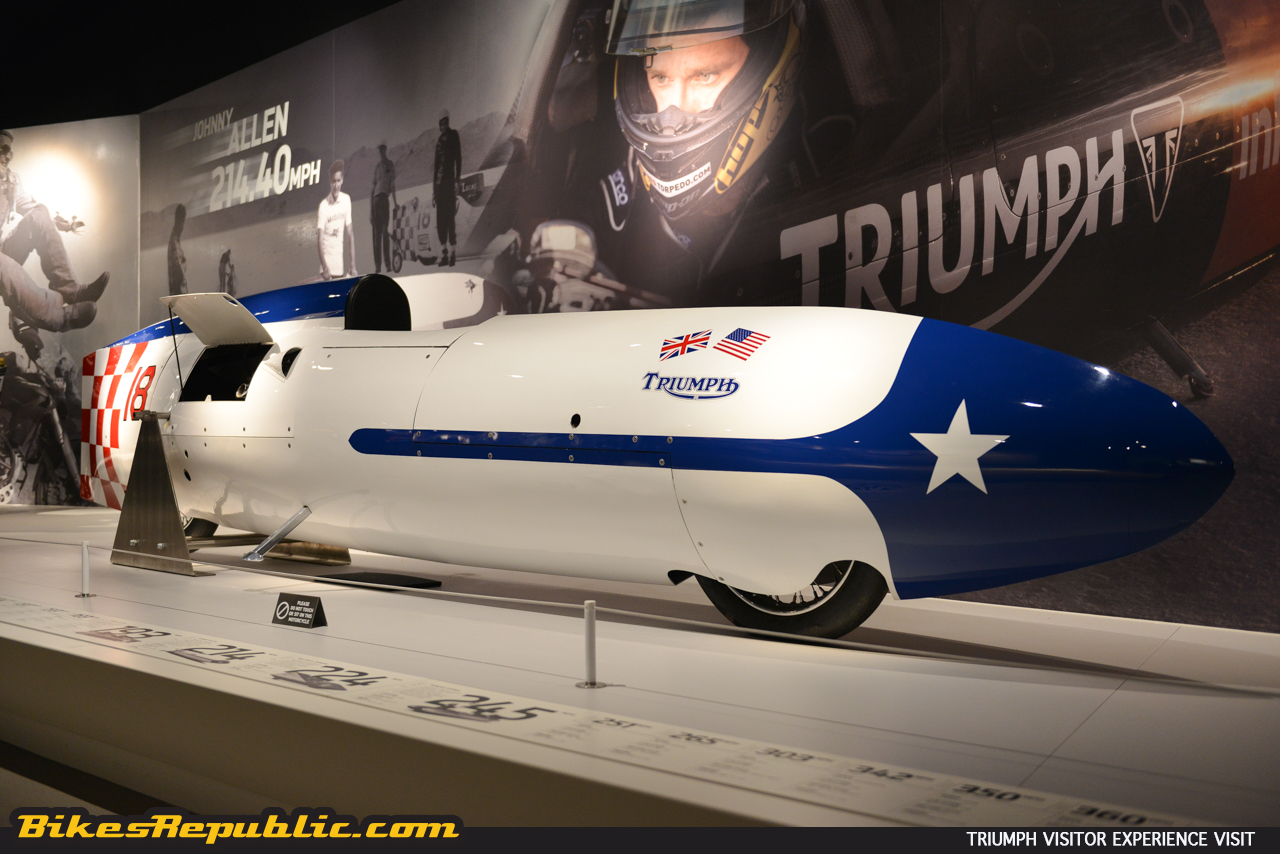
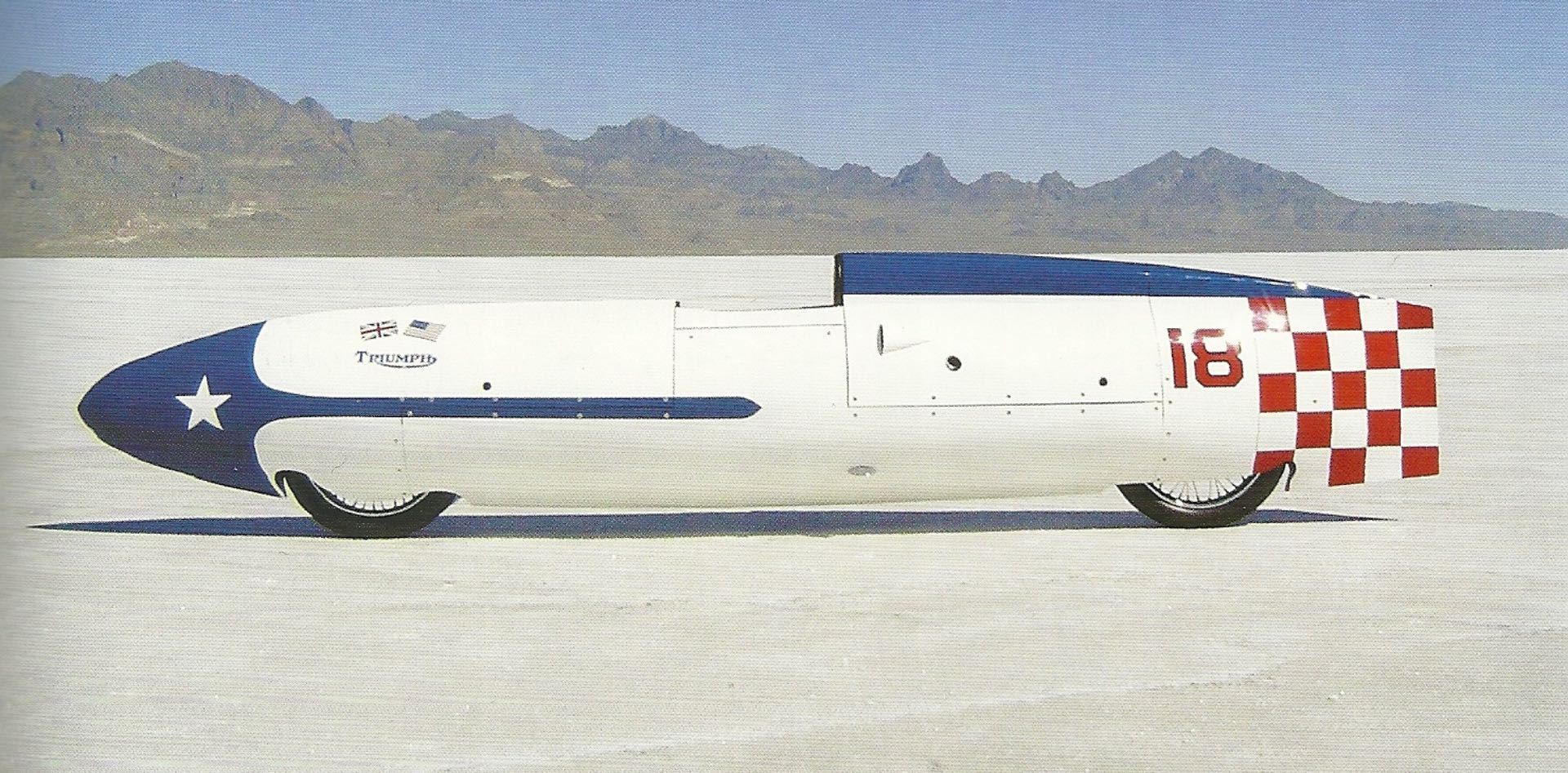
Ah hah. The Triumph Streamliner. Johnny Allen rode (drove?) this machine to the fastest land speed record of 214.40 mph (345.0 km/h) on 1stSeptember 1956 at the Bonneville Salt Flats in Utah, USA. 345 km/h seems mild now, but this was 63 years ago.
Triumph Streamliner at the Bonneville Salt Flats – Picture credit ultimatemotorcycling.com
But what made the feat even more remarkable was the engine which powered the streamliner. It wasn’t supercharged, turbocharged; not a factory-built one-off special. Only one engine normally-aspirated engine was used, instead of the twin-engine powered sleds used for breaking records. Not only that, the donor engine was a 650cc parallel-Twin which powered the Triumph Thunderbird. It was fettled a little by having larger valves, larger Amal carbs and ran on an 80% methanol/20% nitromethane fuel. But the cylinders were stock!
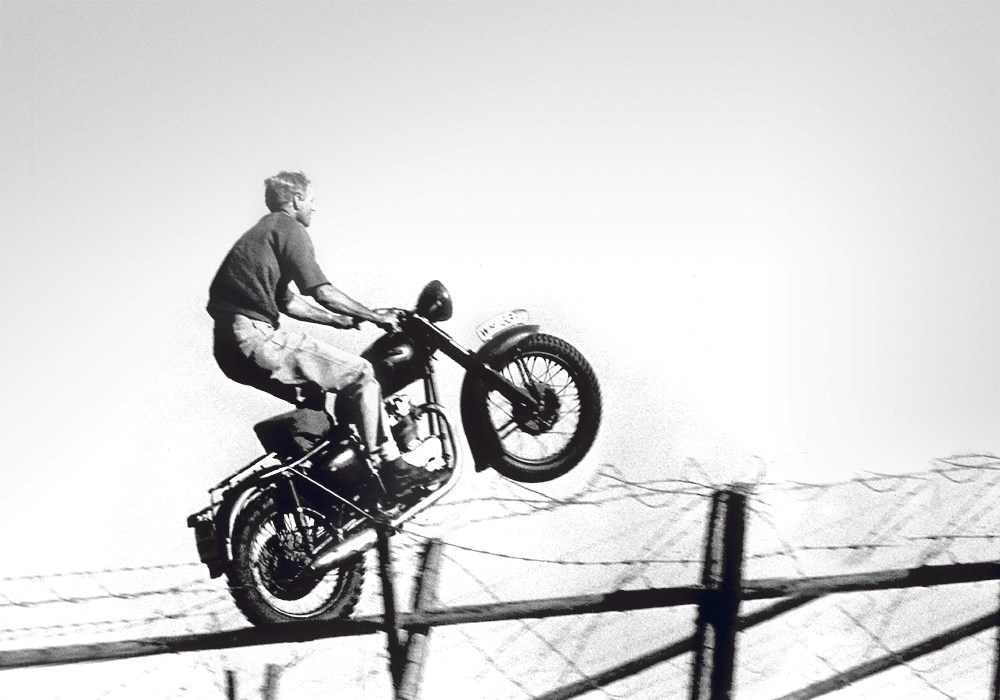
Oh yes! We’ve come to the bike I really wanted to see! It’s the original TR6 Trophy which was dressed up to like a Nazi’s R75 in Steve McQueen’s movie, “The Great Escape.” This was the legendary bike on which McQueen’s character jumped the concentration camp’s wire fences on this bike, although the stunts were performed by his stunt double and racing buddy, Bud Ekins.
The pair didn’t only use the TR6 Trophy model for the movie. They actually raced the bike in rallies, including the punishing Baja Rally.
The TR6 Trophy is the predecessor of the current 900cc Bonneville Street Scrambler and the new Bonneville Scrambler 1200.
Next to the Great Escape bike is another segment which showcases how Triumph carries out R&D and building their bikes.
The first display showed a raw aluminium ingot before it is turned into an engine casing.
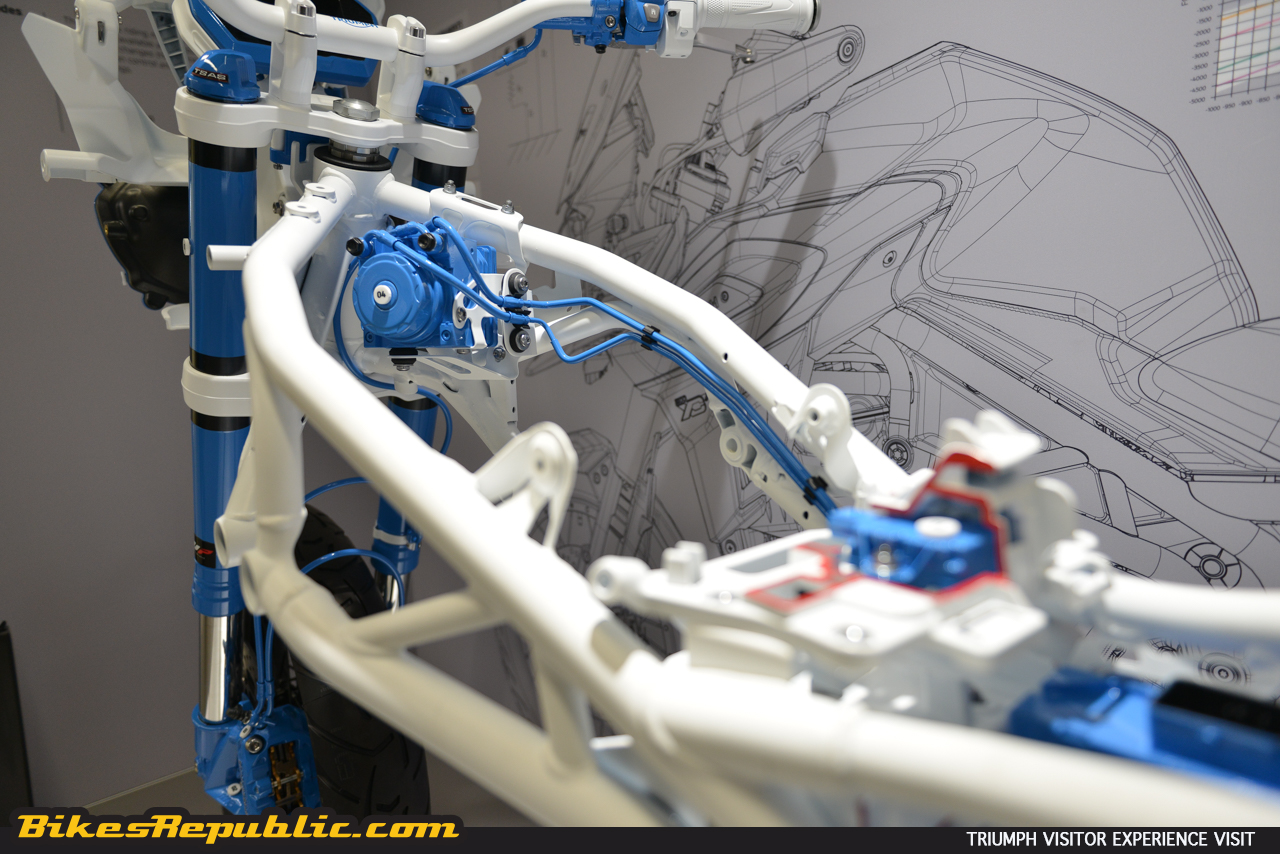
Next was the frame and chassis of a new Tiger 1200. This area showcases the R&D carried out particularly for traction control, ABS and electronic suspension.
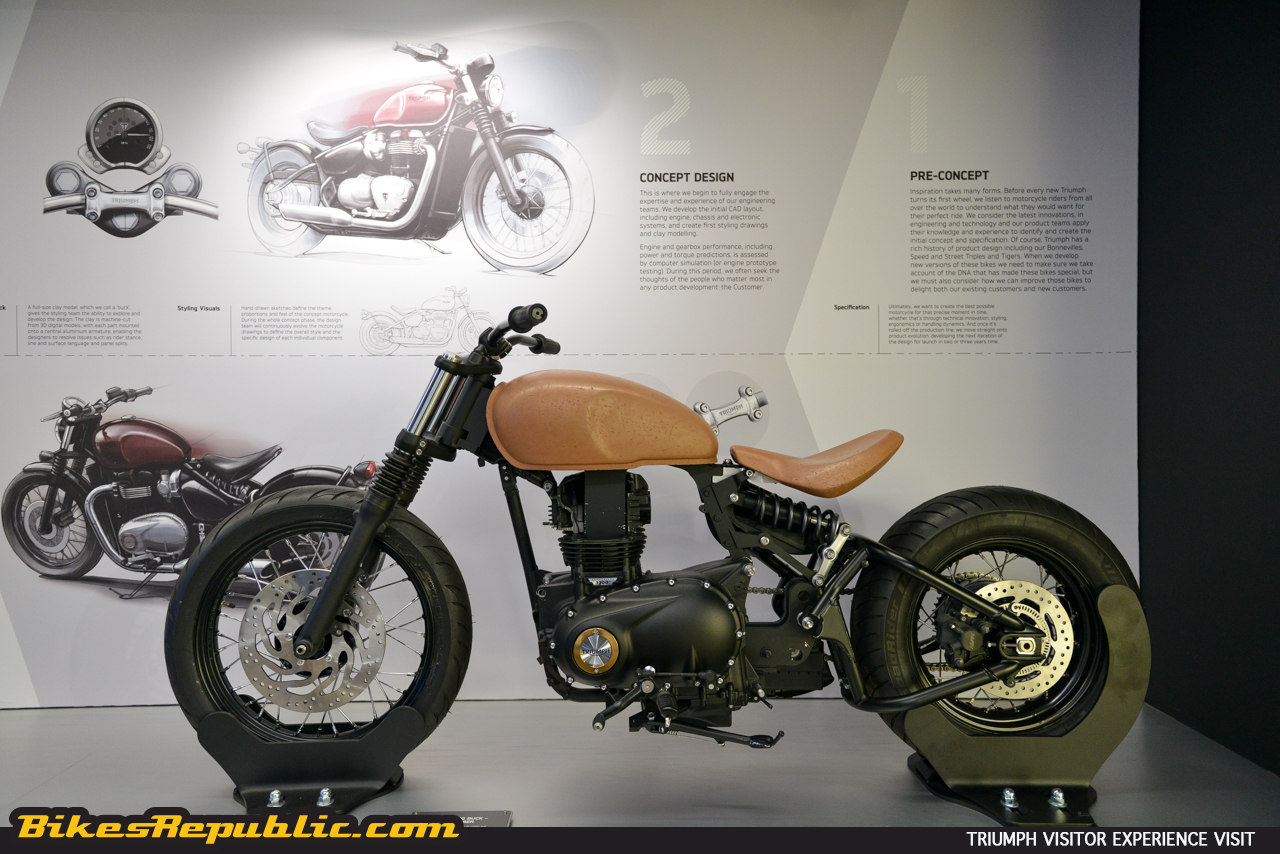
Moving on is the section showing how Triumph designs their bikes, in particular the Bonneville Bobber. The exhibit described the stages of development from pre-concept to the clay mock up displayed here. The Bobber is Triumph’s best-selling model of all time.
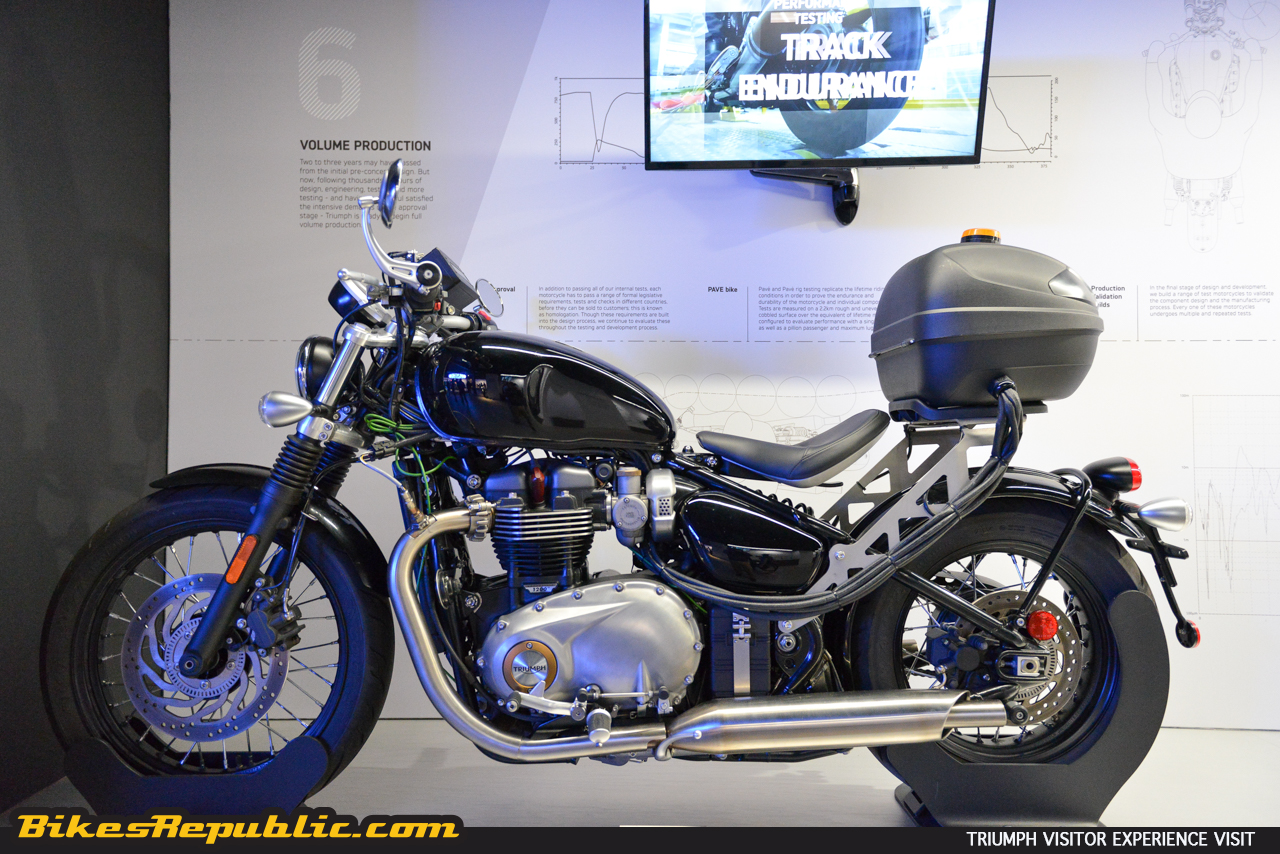
Roadgoing prototypes were built for real-world testing. These are the stages we see usually see in spyshots. Although it already resembles the production bike, look closer and you’ll see a different instrument display, extra wire looms, a not-so-subtle exhaust O2 sensor, and the unmissable bracket for the GIVI box. Notice the fat wire looms that lead into it. The box carries data acquisition devices (recorders) for various performance parameters.
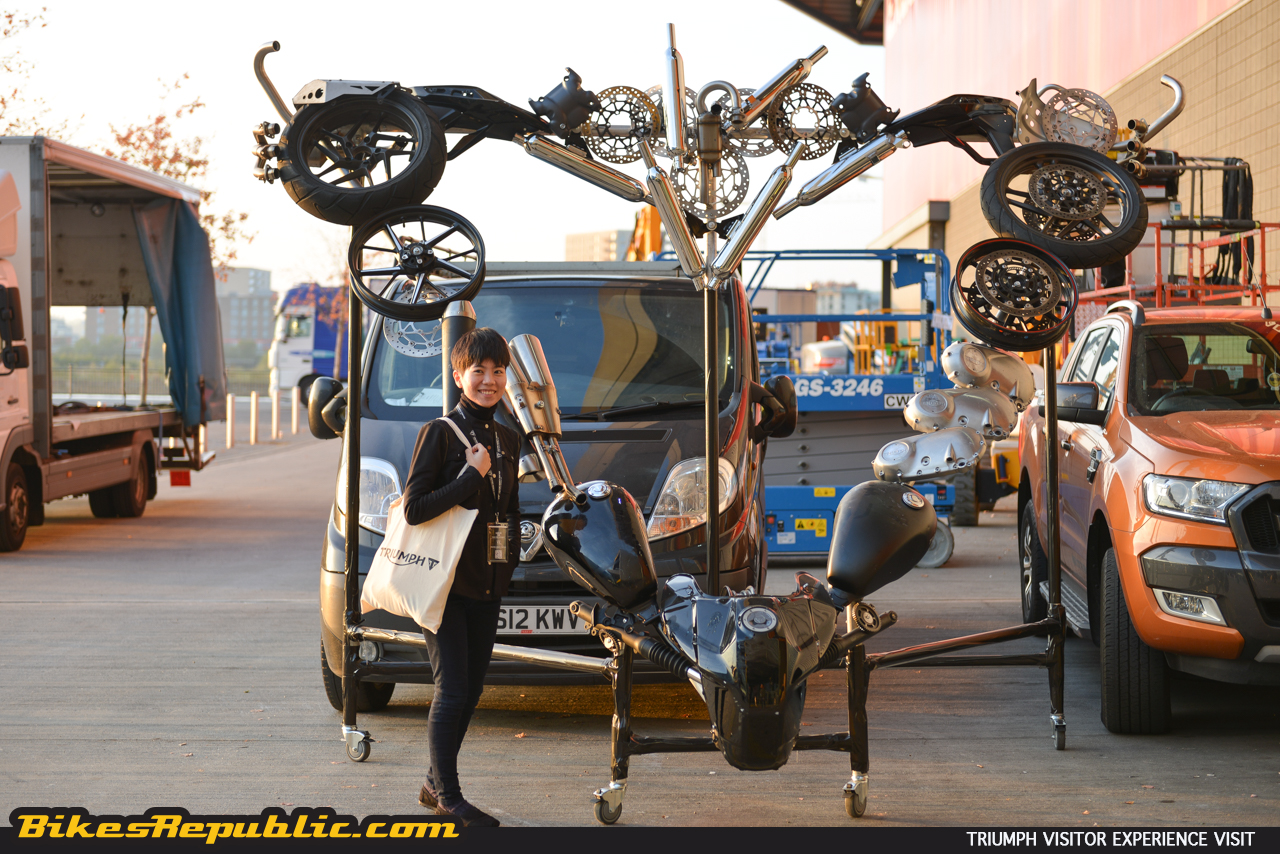
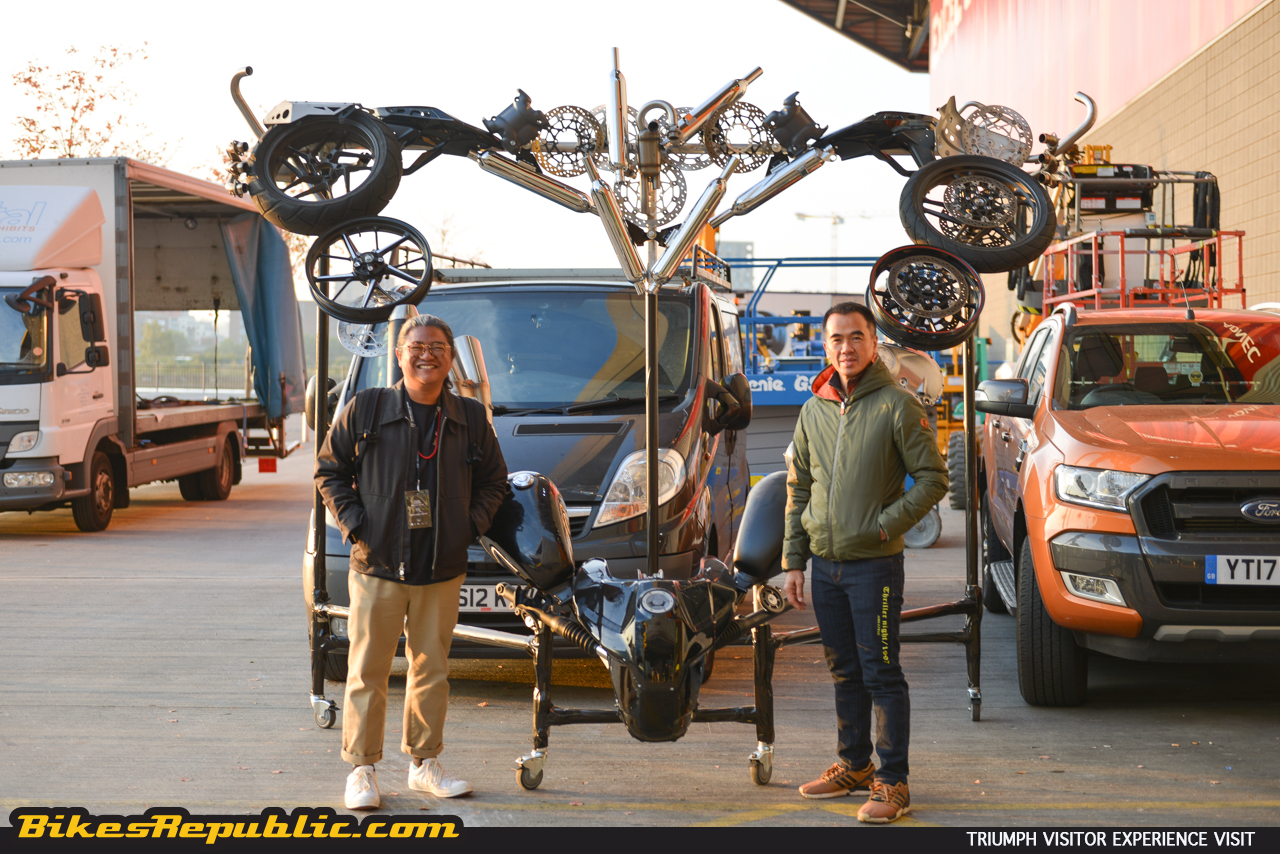
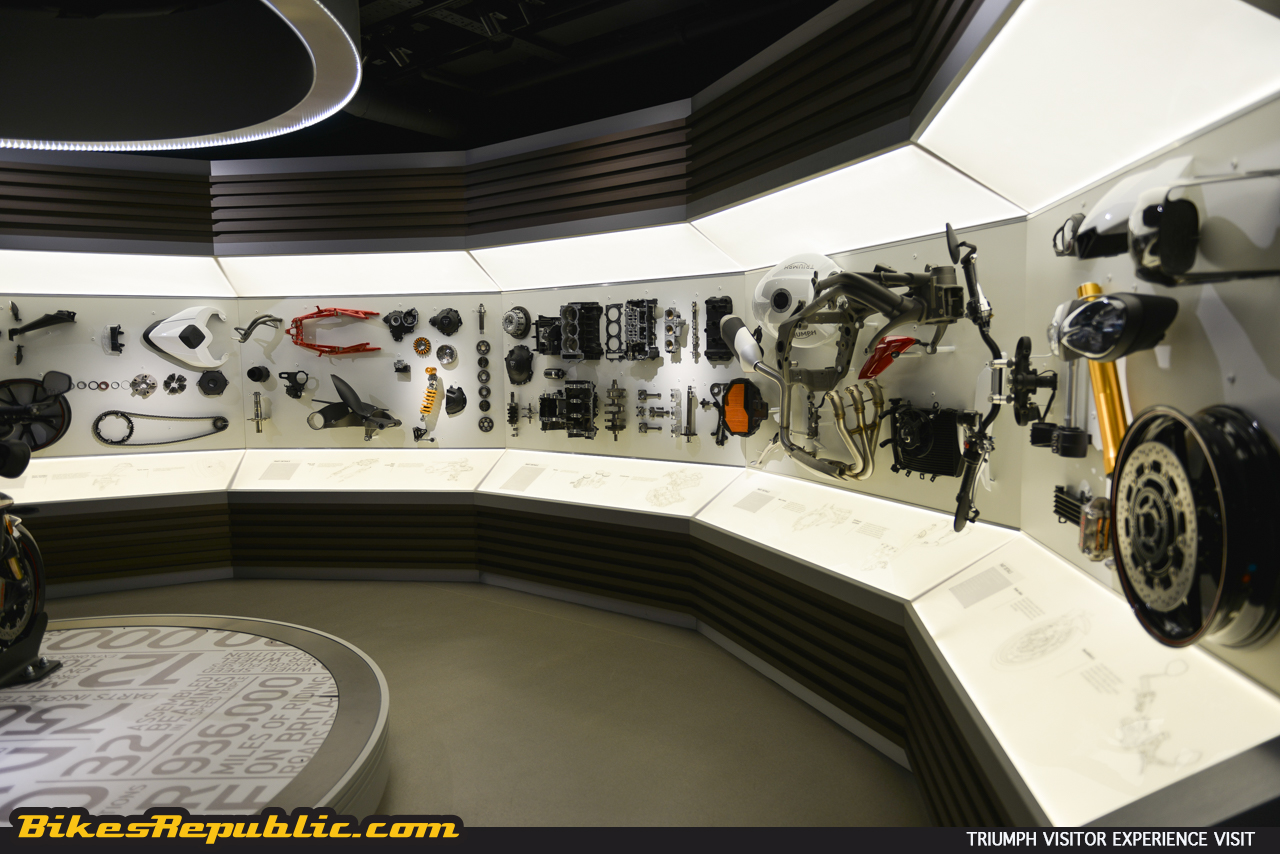
In the farthest corner was a wall which displayed the components of a Speed Triple like a Lego set. Visitors i.e. me, were free to inspect the intricacy and quality of each piece.
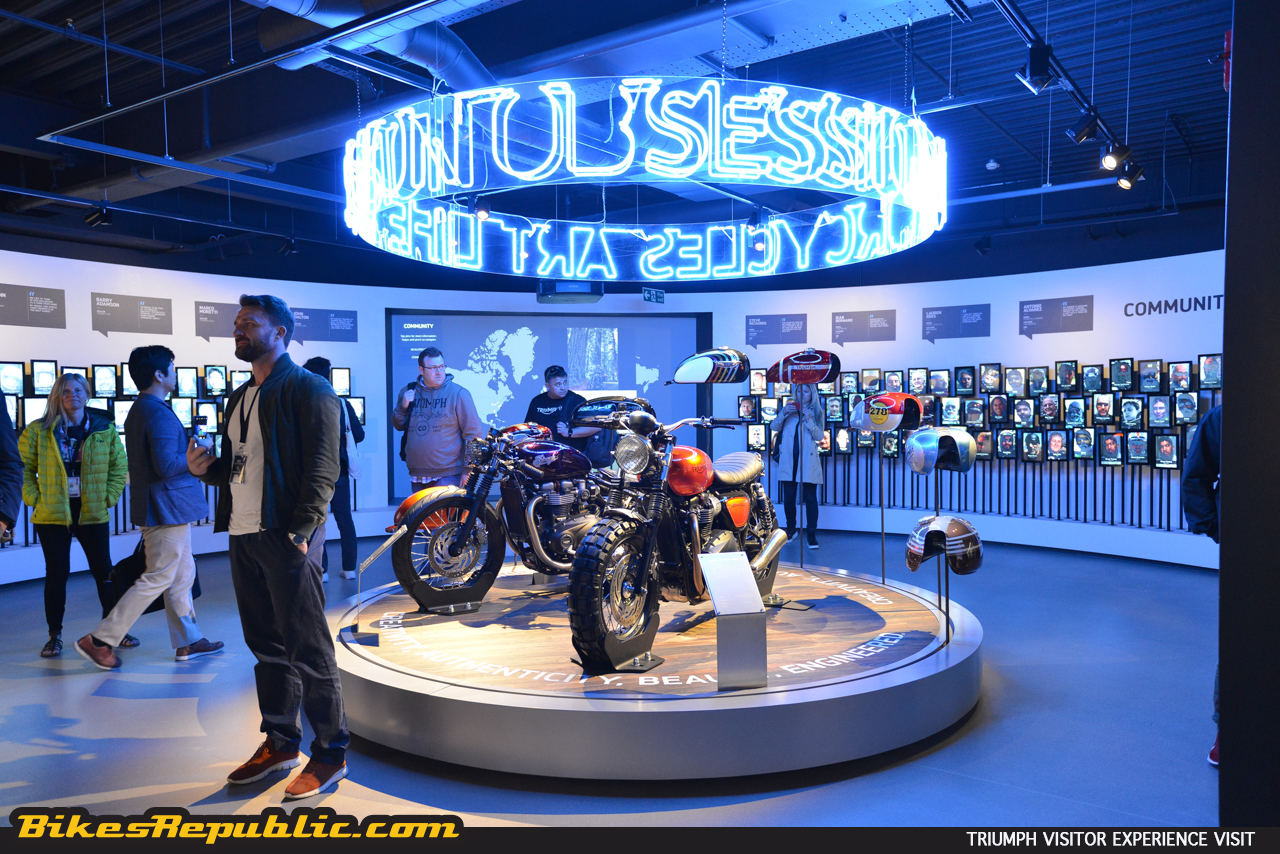
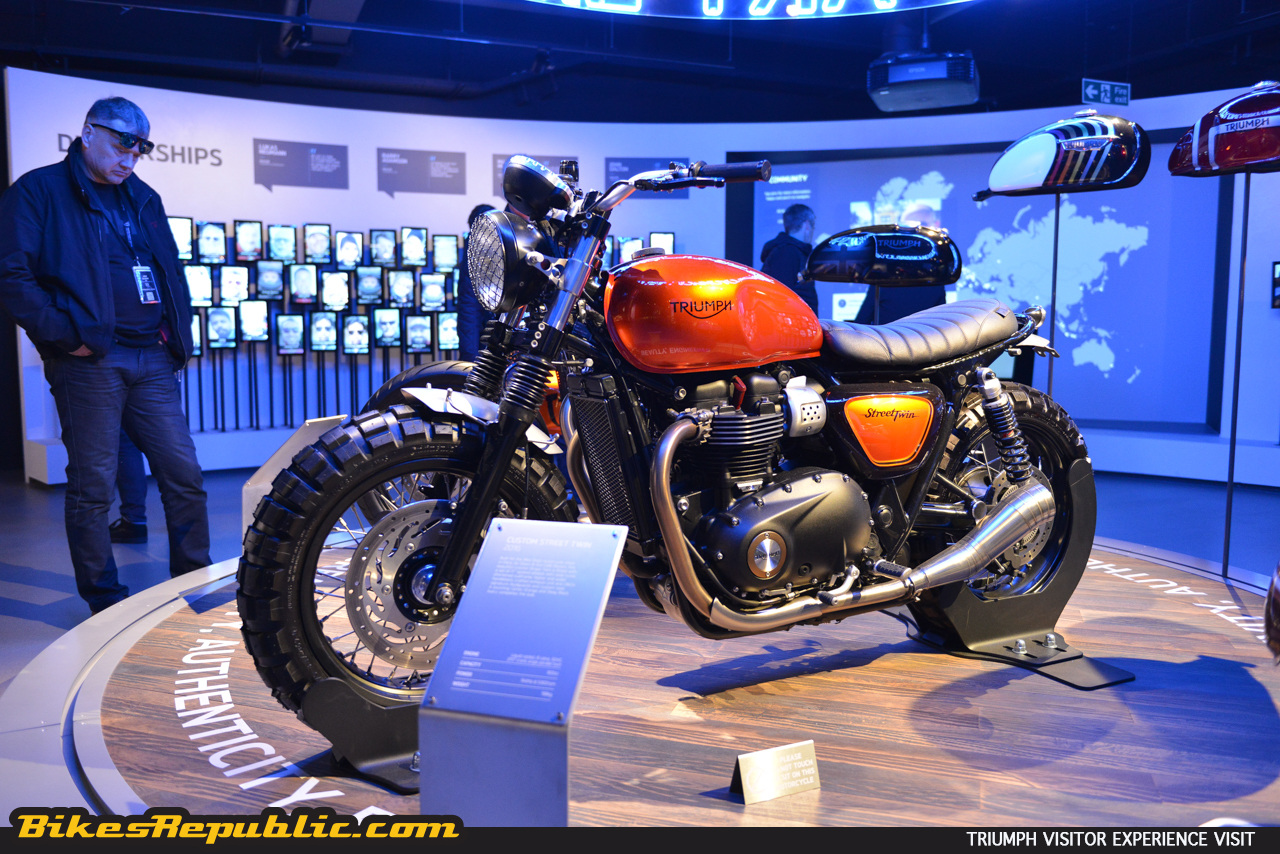
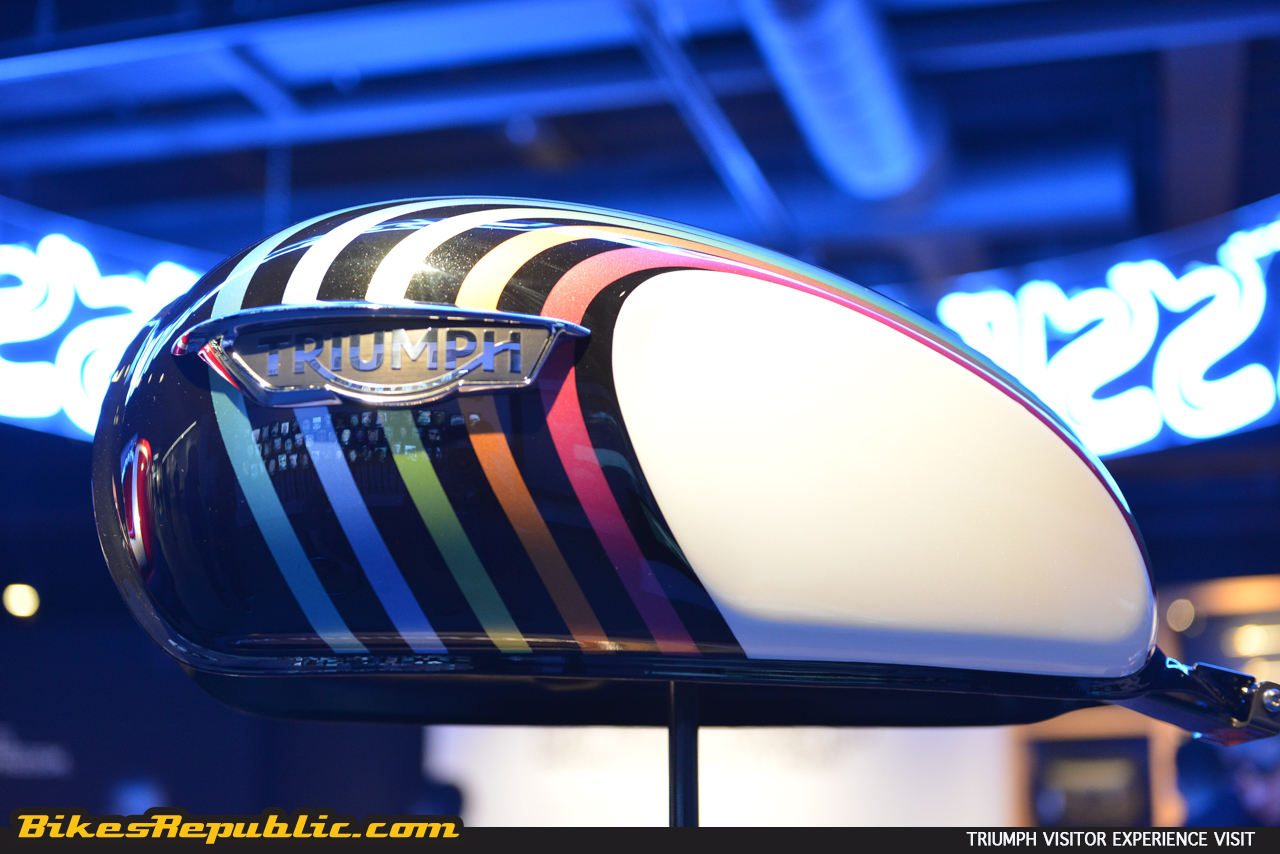
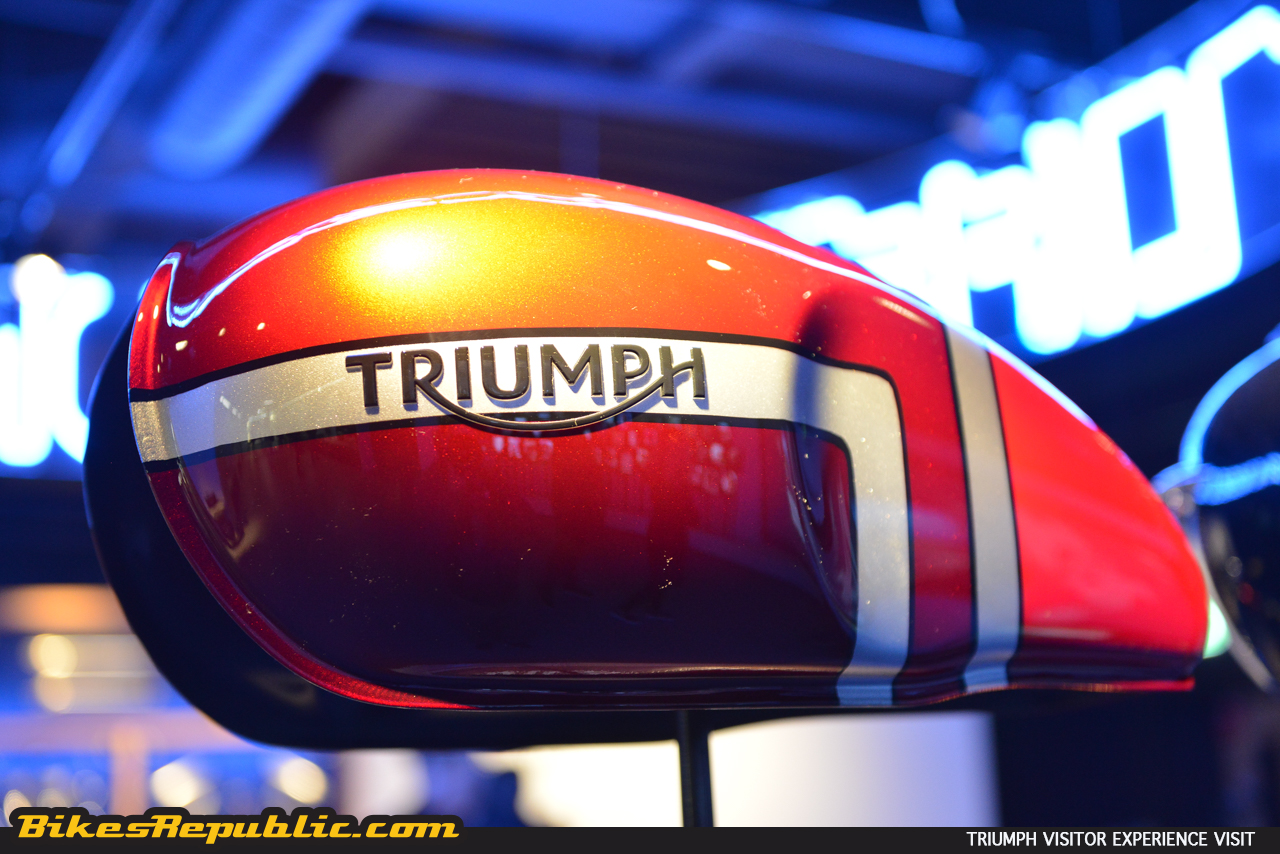
In the centre of both areas was a neon-lit island which highlighted customized Triumphs. A custom Street Twin was joined by a Bobber and were surrounded by beautifully custom-painted fuel tanks.
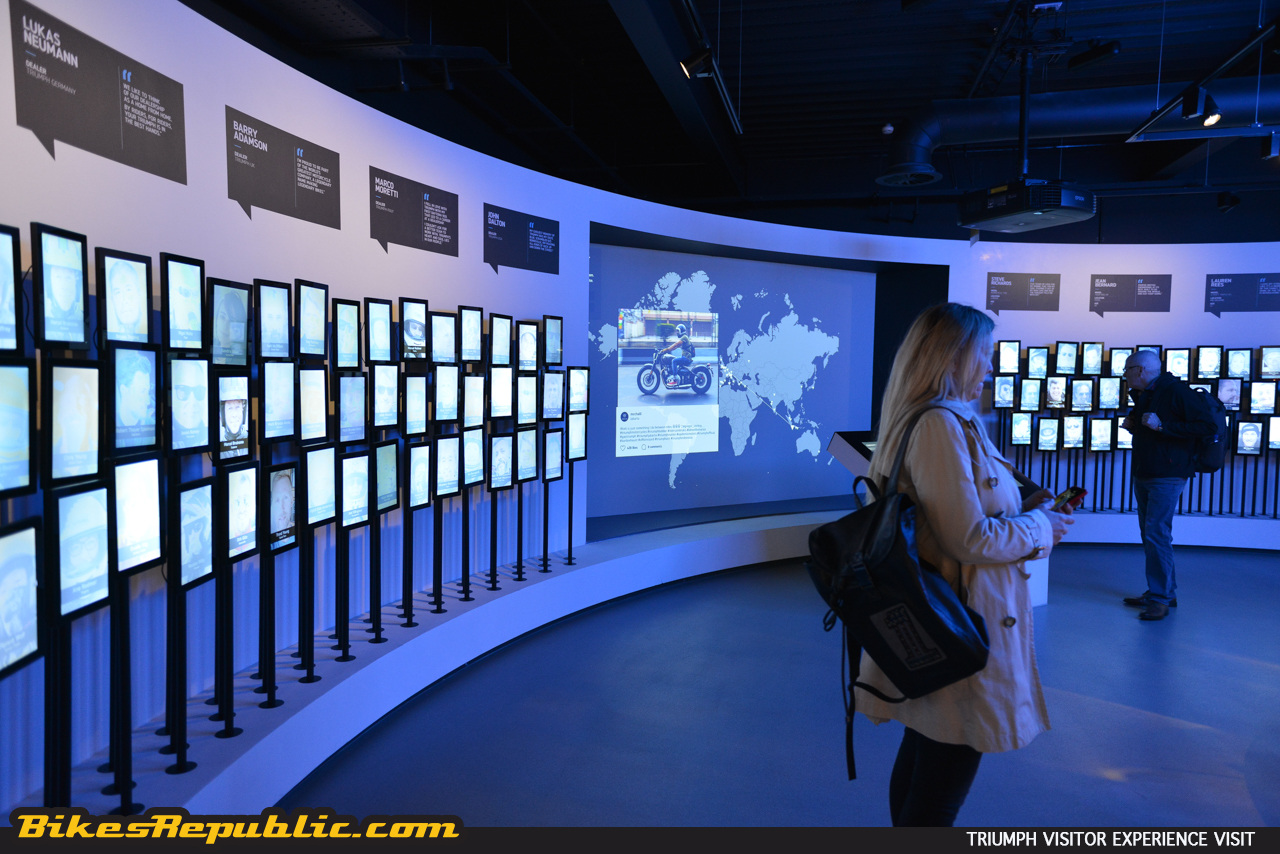
Opposite the island was the “Wall of Dealers.” Hundreds of displays presented Triumph’s worldwide dealer network. Triumph Motorcycles Ltd. has definitely grown by leaps and bounds since John Bloor acquired the brand in 1983.
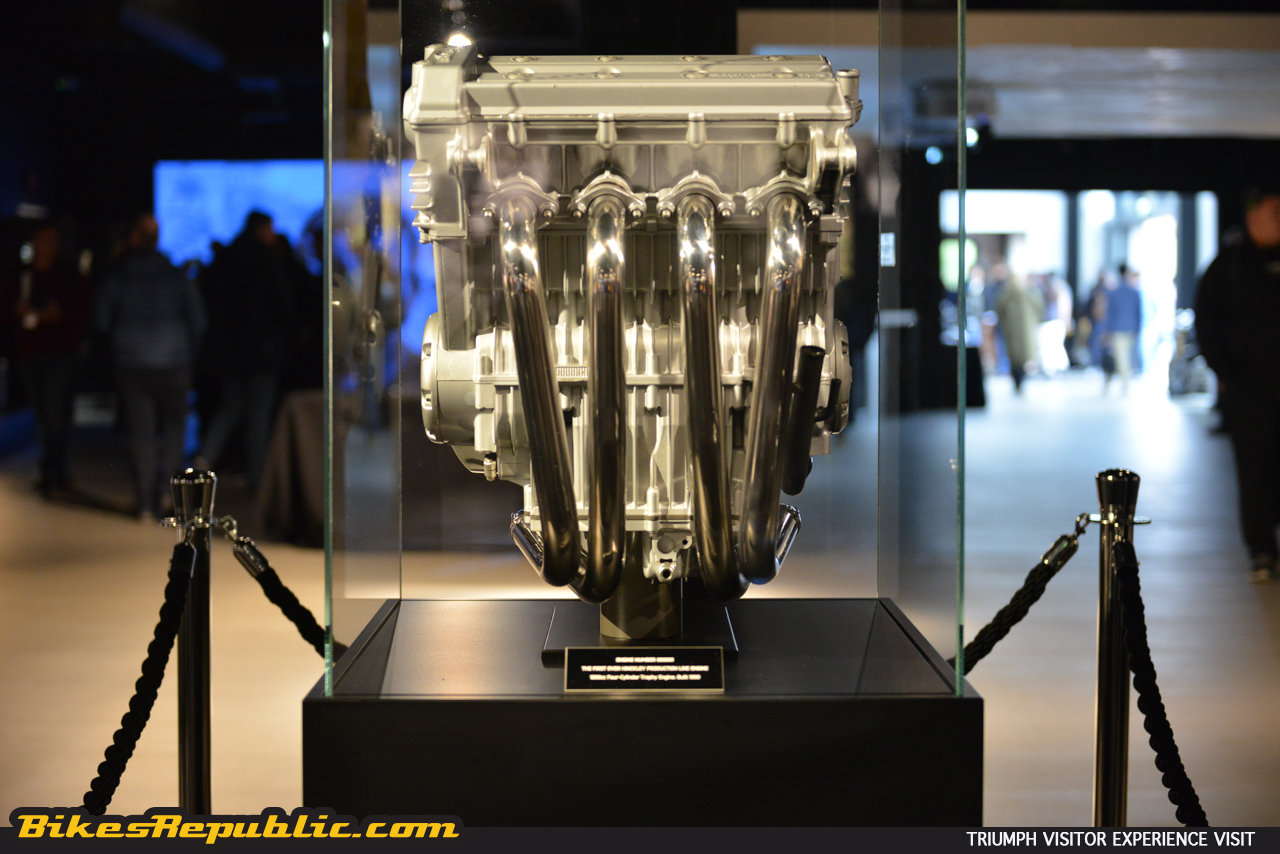
Also, near this centre area was an engine placed in a transparent case. The inscription on a plaque said, “ENGINE 000001. THE FIRST EVER HINCKLEY PRODUCTION LINE ENGINE. 1200cc Four-Cylinder Trophy Engine. Built 1990.”
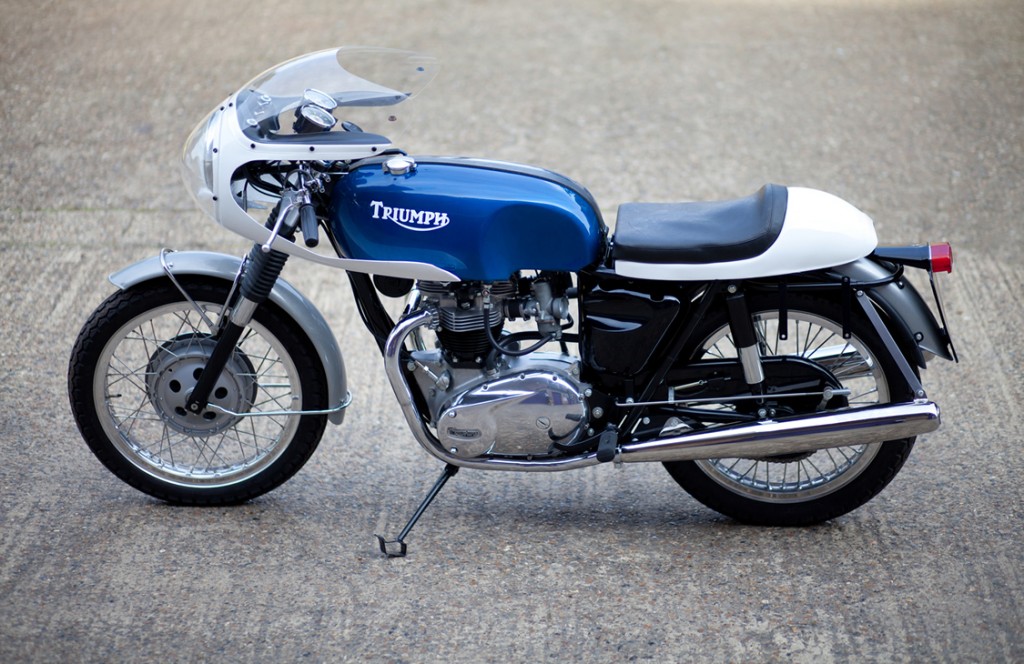
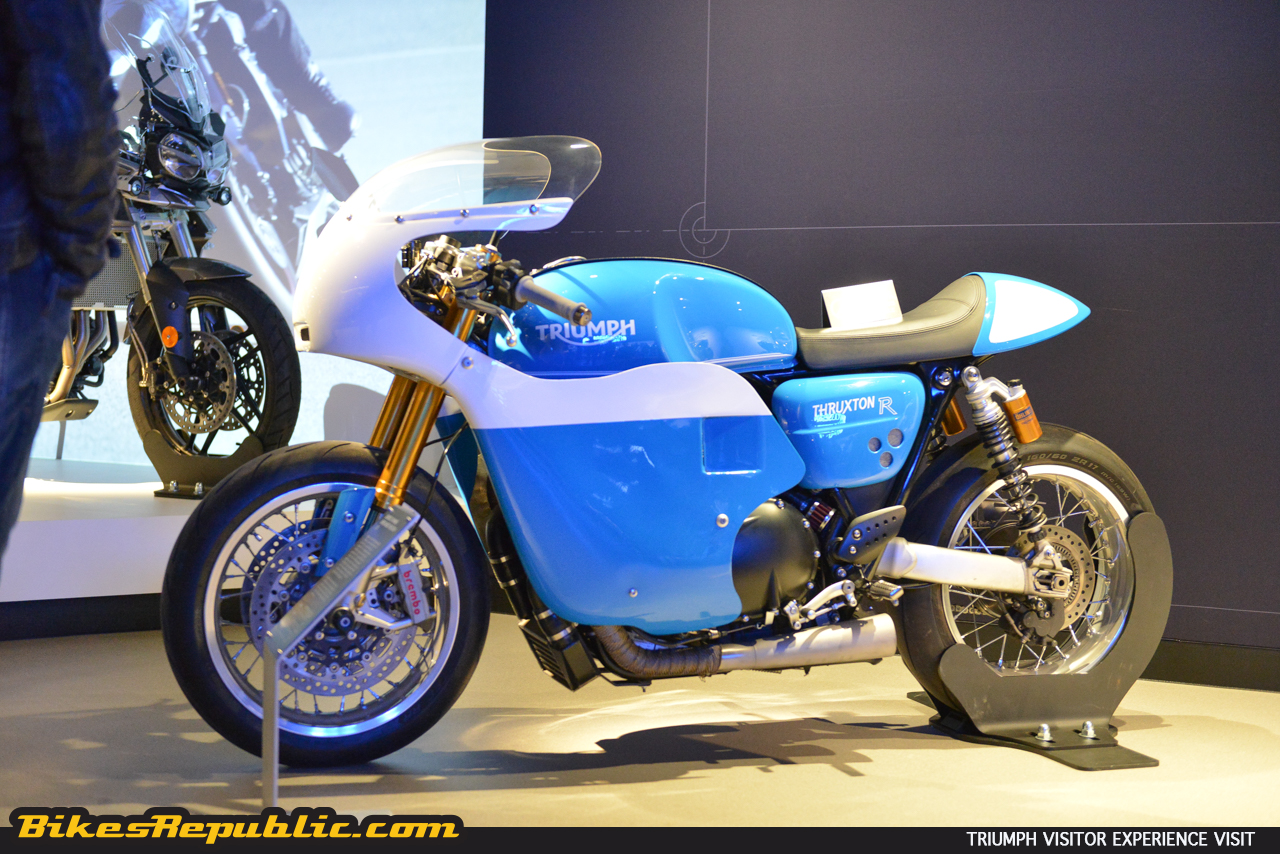
On the way out, I stopped by at a Thruxton R which wore a white and blue bodywork akin to Gene Romero’s Trident Triple racer. It was on closer inspection that I found out it was supercharged!
Just as fascinating was its background. The bike was built by British rider and four-time World Superbike Champion Carl Fogarty to race at the 2016 Glemseck 101 event. Supercharging pumped maximum power up to 148 PS and torque to a huge 157 Nm. Glemseck is the annual café racer event held in Leonburg, Germany, consisting of a bike show and 1/8-mile drag race. Fogarty owned everyone on this bike by winning all 12 drag races he entered and walked away with the overall win in the Essenza class.
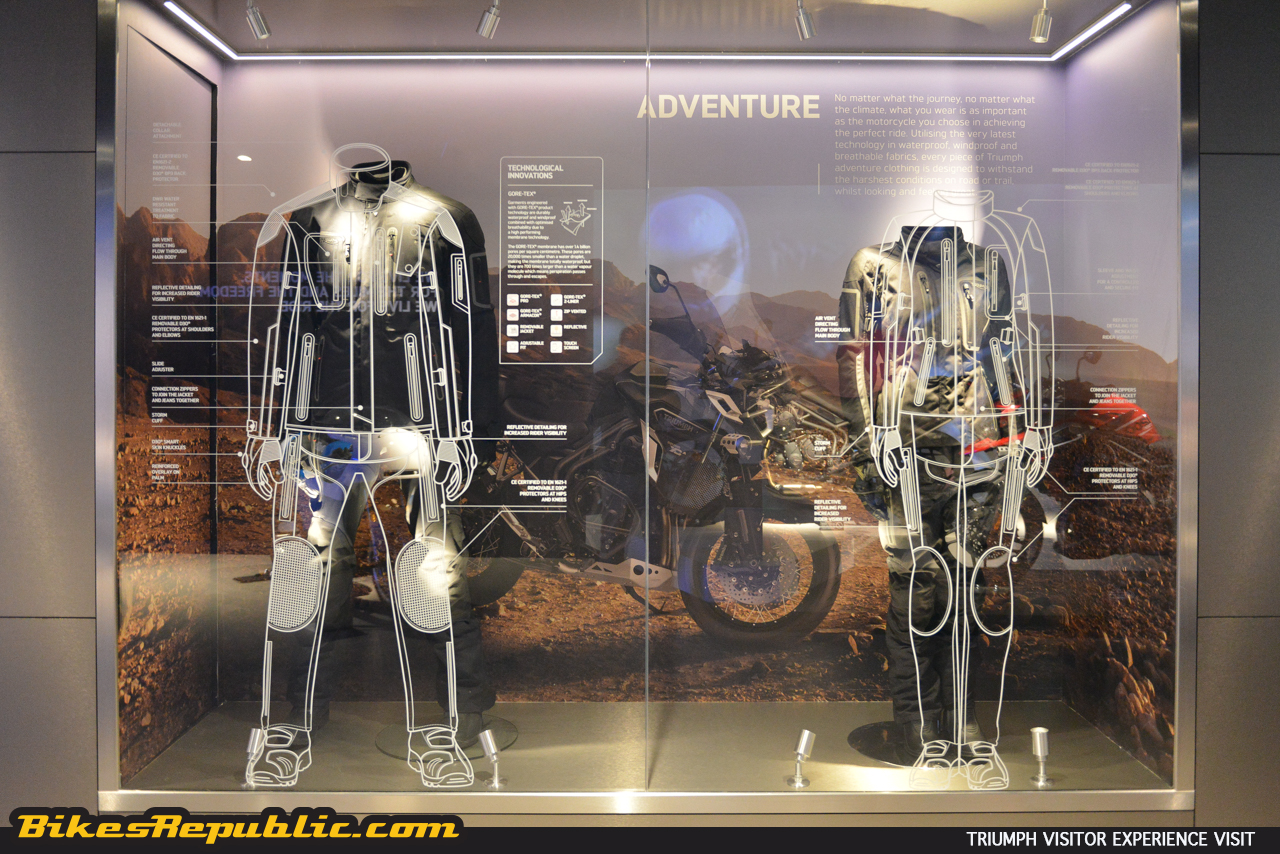
On the left side of the isle is the riding gear section. Triumph is not only hard at work in developing new bikes but also technology and design of riding gear.
Further up the line were rows of the latest models, including the Tiger 1200, Tiger 800 XRT, Street Triple RS, Speed Triple, Bonneville Thruxton R, Bonneville Street Twin.
It was time to visit the gift shop upstairs.
It was packed to the gills! People were grabbing stuff off the racks, tables, benches… the cashier had beads of sweat on his forehead, while two lady staff members ran around looking for clothing items the dealers asked for. I only managed to grab a cash box which looks like an oil can, an aluminium lunchbox, a couple of teddy bear keychains and a leather card holder. The queue extended from the cashier to outside the door.
The American couple of me had loads of t-shirts and leather jackets under their arms, that the half-dumped on the cashier’s desk in a heap. It took a long time for the hapless clerk to scan through all the items and the Japanese man behind me started to sigh (you know it’s taking too long when a Japanese sighs). “That’ll be £560 pounds please.” The cheerful demeanor of the couple turned to almost-horror. Compared to theirs, my stash cost “only” £50.
Back downstairs, Asep was waiting for me outside while puffing away on a cigarette. Later, we re-boarded the bus to take us back to London.
CONCLUSION
It’s only apt that Triumph calls the centre an “experience.” While there weren’t as many bikes in the gallery as we expected, those there were of great significance motorcycling history and culture, besides to the brand. I for one still could not believe that I actually saw The Great Escape’s TR6 Trophy in front of my very eyes.
The factory visit was just as awesome. It’s almost a spiritual experience to actually step foot inside the very facility which produced my favourite bikes. At the same time, the sense of amazement never ceased as I traced the progression of a piece of aluminium ingot into a complete engine assembly, which in turn became part of a Triumph motorcycle.
Again, we would like to thank Fast Bikes Sdn. Bhd. and Dato’ Razak Al-Malique Hussein for the opportunity of a lifetime.
Official presentation slides for the 2019 Bajaj Dominar 400 were leaked online.
The new bike gets a maximum power upgrade to 39.9 PS from the present 35 PS.
Other changes include upside-down forks and new instrument panel.
Technical information from the 2019 Bajaj Dominar 400 company presentation was leaked online, reports maxabout.com.
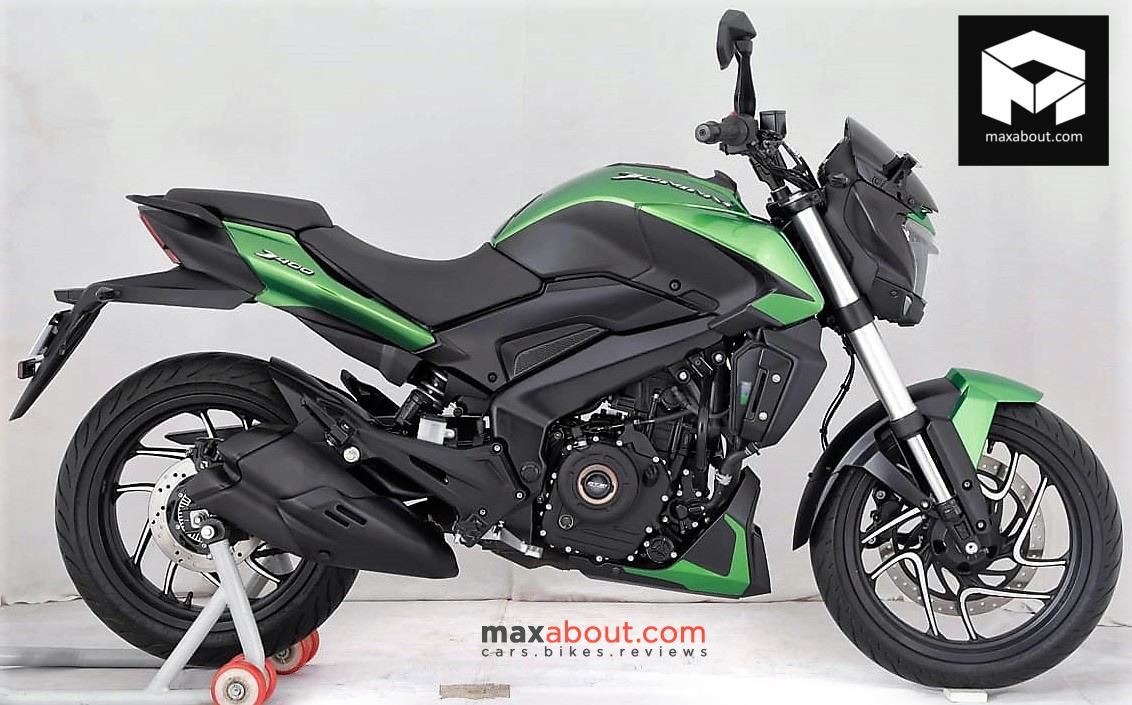
The silhouette of the 2019 bike remains the same, as the upgrades focused on increased power output. There’s lots of potential from the 373cc, single-cylinder engine to be exploited. As such, the new exhaust the new Dominar 400 has dual exits and maximum power is attained at 650 RPM further up the rev range. The revisions bump maximum power to 39.9 PS at 8,650 RPM, up from 35 PS. Maximum torque remains at 35 Nm but is at 500 RPM higher in 7,000 RPM.
Bajaj also made changes to the transmission for better roll-on acceleration.
Besides gains in performance, the 2019 model features an updated instrument panel with dot matrix alerts and warning messages in the display.
One last new addition are the upside-down forks.
The bike pictured in green here is for the Indian market. Looks good, though!
Here’s the quick comparison of differences between the present model and the new model.
Kawasaki Racing Team WorldSBK launched their 2019 line-up for the World Superbike Championship.
Riders are four-time champion Jonathan Rea and new signing Leon Haslam.
The season kicks off next weekend at Phillip Island, Australia.
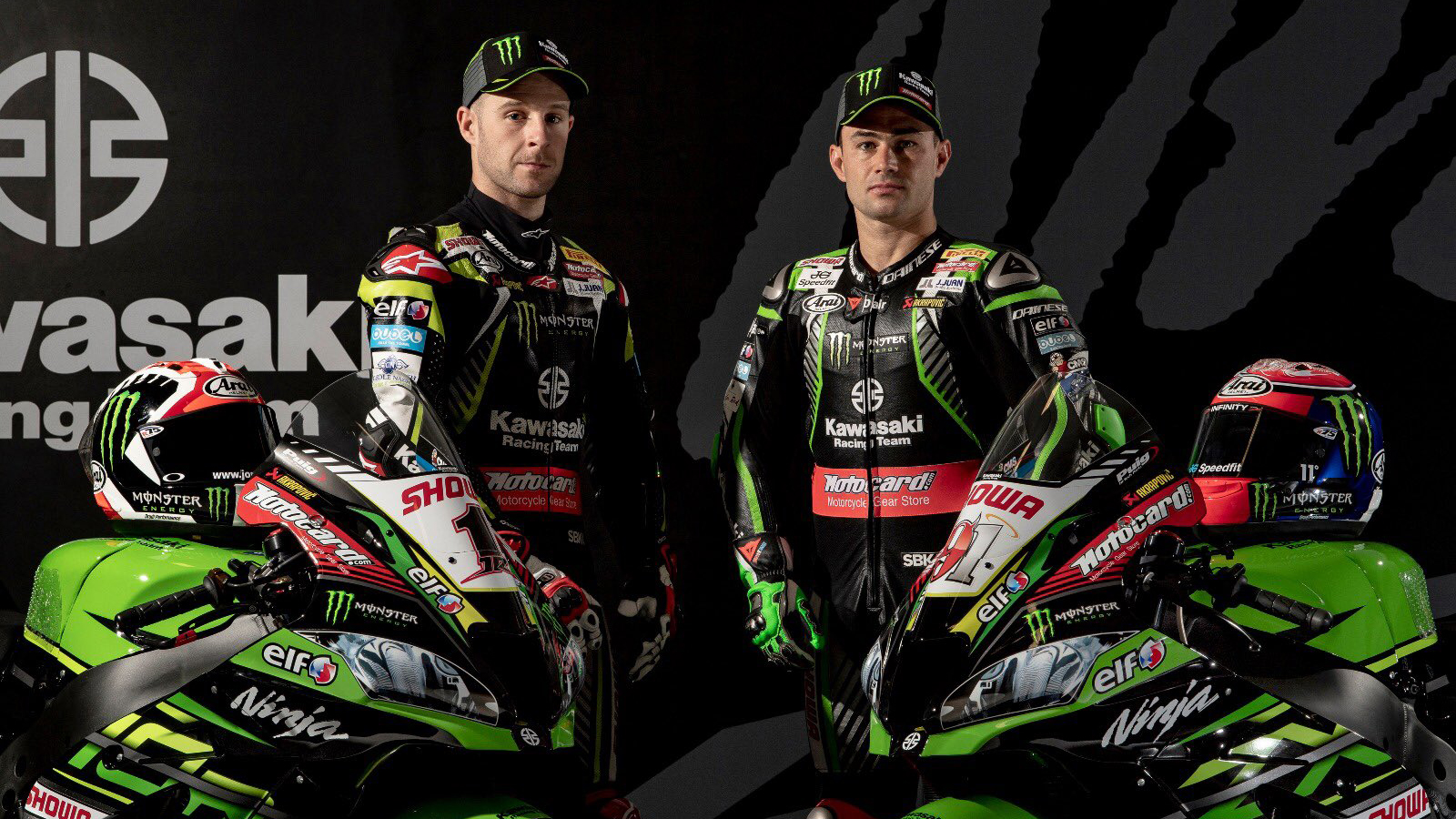
The Kawasaki Racing Team WorldSBK launched their line-up and bikes to continue their dominance in the 2019 World Superbike Championship.
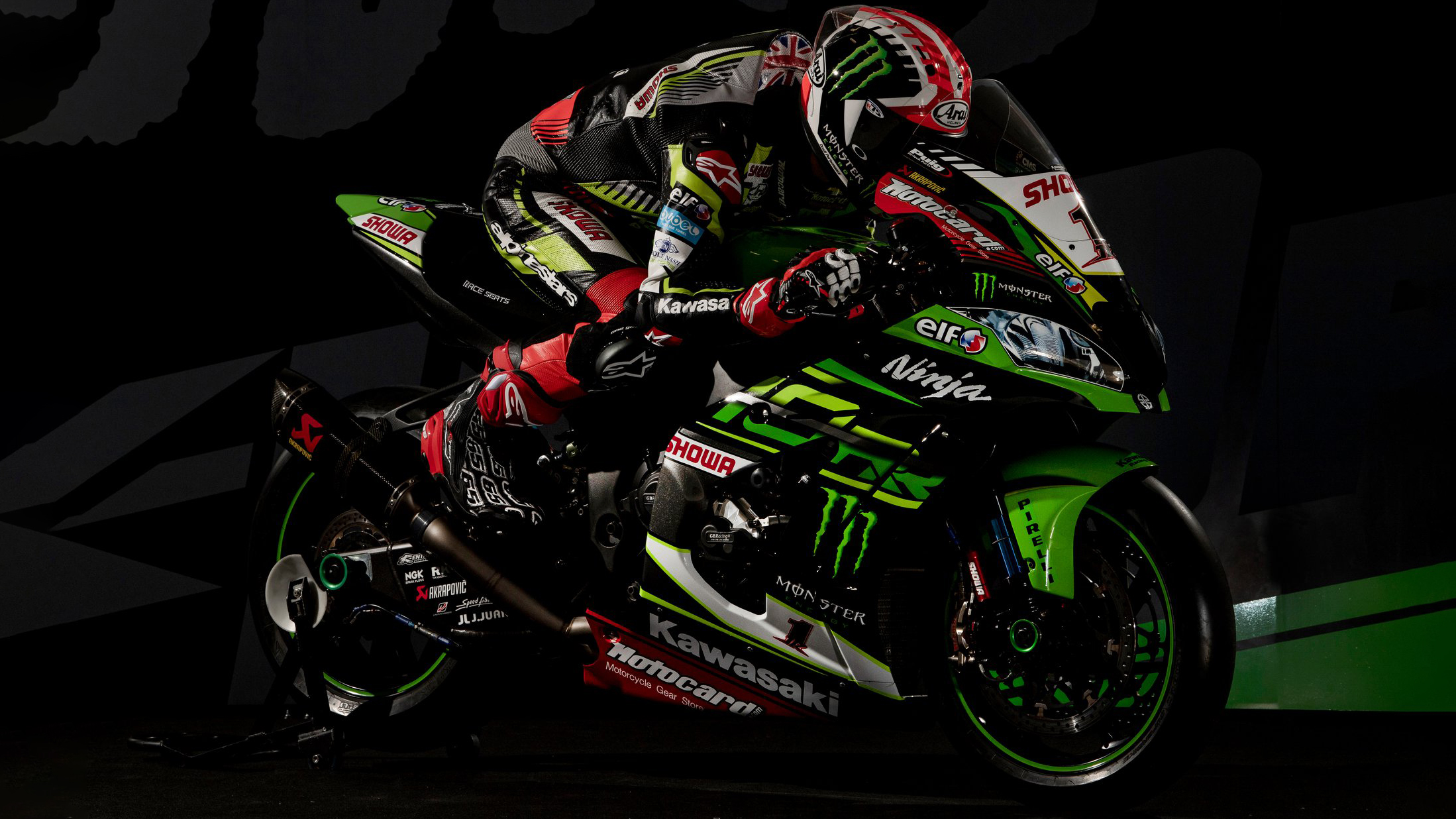
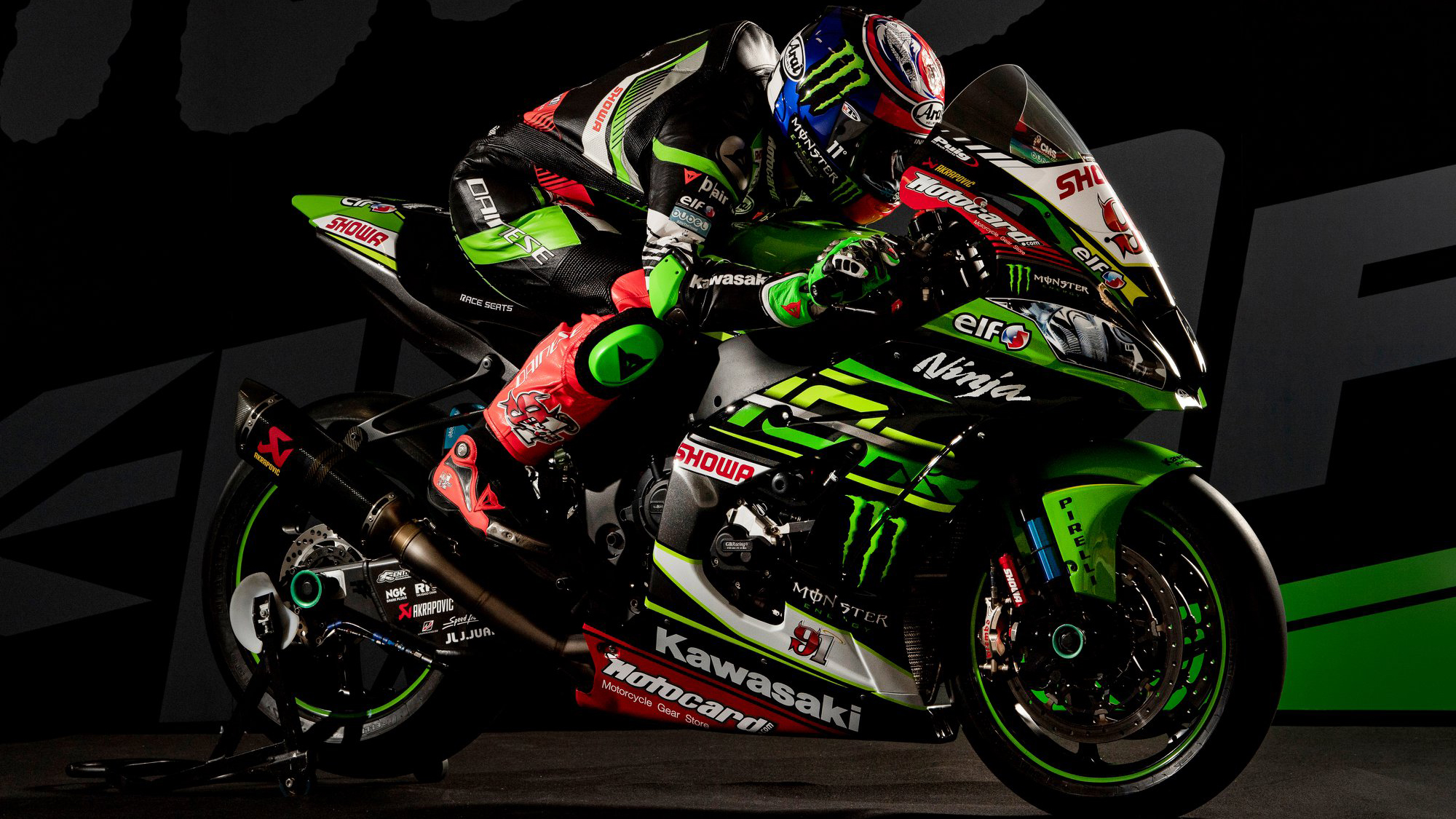
Four-time and defending WorldSBK Champion Jonathan Rea and new signing Leon Haslam revealed the 2019 Kawasaki Ninja ZX-10RR at a resort not far from the Phillip Island Grand Prix Circuit in Australia.
The circuit plays host to the final round of pre-season testing and the first round of the 2019 championship. The tests will take place next Monday and Tuesday, while the season opener begins later that weekend.
It goes without reminding that Rea absolutely destroyed the WorldSBK field last year with the Kawasaki. Out of 25 races, he won 17, placed second four times, once third and once fifth. He suffered only 1 retirement throughout the year, while the final Race 2 in Qatar was cancelled.
Jonathan Rea on the 2019 Kawasaki Ninja ZX-10RR
Despite the strong challenges mounted by his rivals Chaz Davies of Ducati and Michael van der Mark of Yamaha, Rea prevailed.
So, what made him such a powerful force?
“What I’ve learned with my experience over the year is to stay calm and focused with my team. We have the best crew in the business, the best motorcycle underneath me. I feel like the pressure is always on me, I need to find my way with the bike. Once we did that last year, we were absolutely unbeatable,” explained Rea.
Leon Haslam is back to racing full time in WorldSBK since 2015. Son of the great Ron Haslam, he shows that speed is in his family’s genes.
Leon Haslam on the 2019 Kawasaki Ninja ZX-10RR
“I’m just waiting to wake up, it’s like a dream. I had 9 good years in WorldSBK but I’ve never had an opportunity like this. To be involved with KRT, Kawasaki, joining the team that has dominated the last four years… I just can’t wait, I want to start racing now,” he said.
Tune in next week and beyond as we bring you news from the world’s premier production racing series.
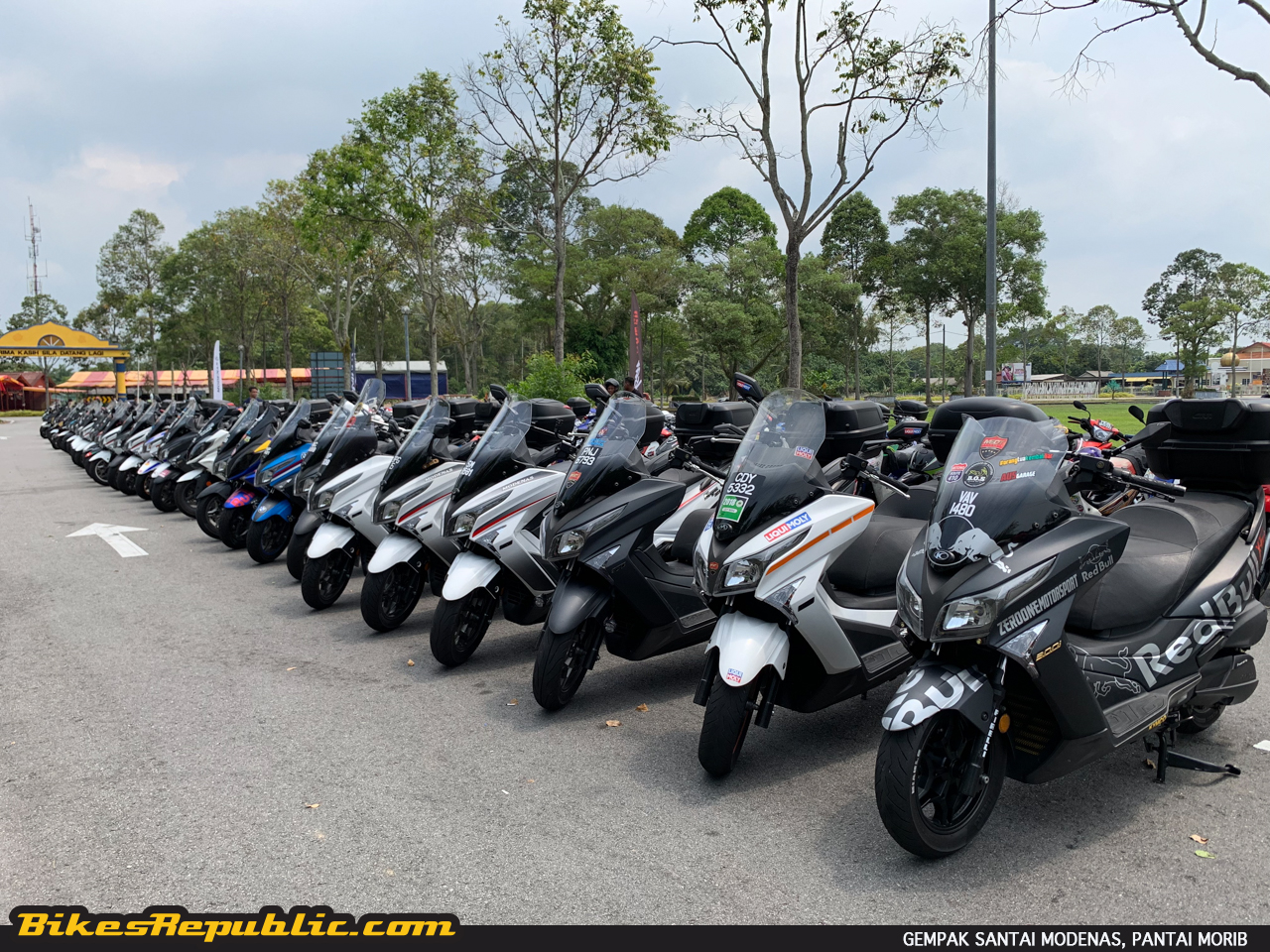
Gempak Santai Modenas carnival saw the participation of 600 Modenas bike owners.
The event was held at Dataran Pantai Morib in Banting, Selangor.
Modenas organized various fun programs for the attendees.
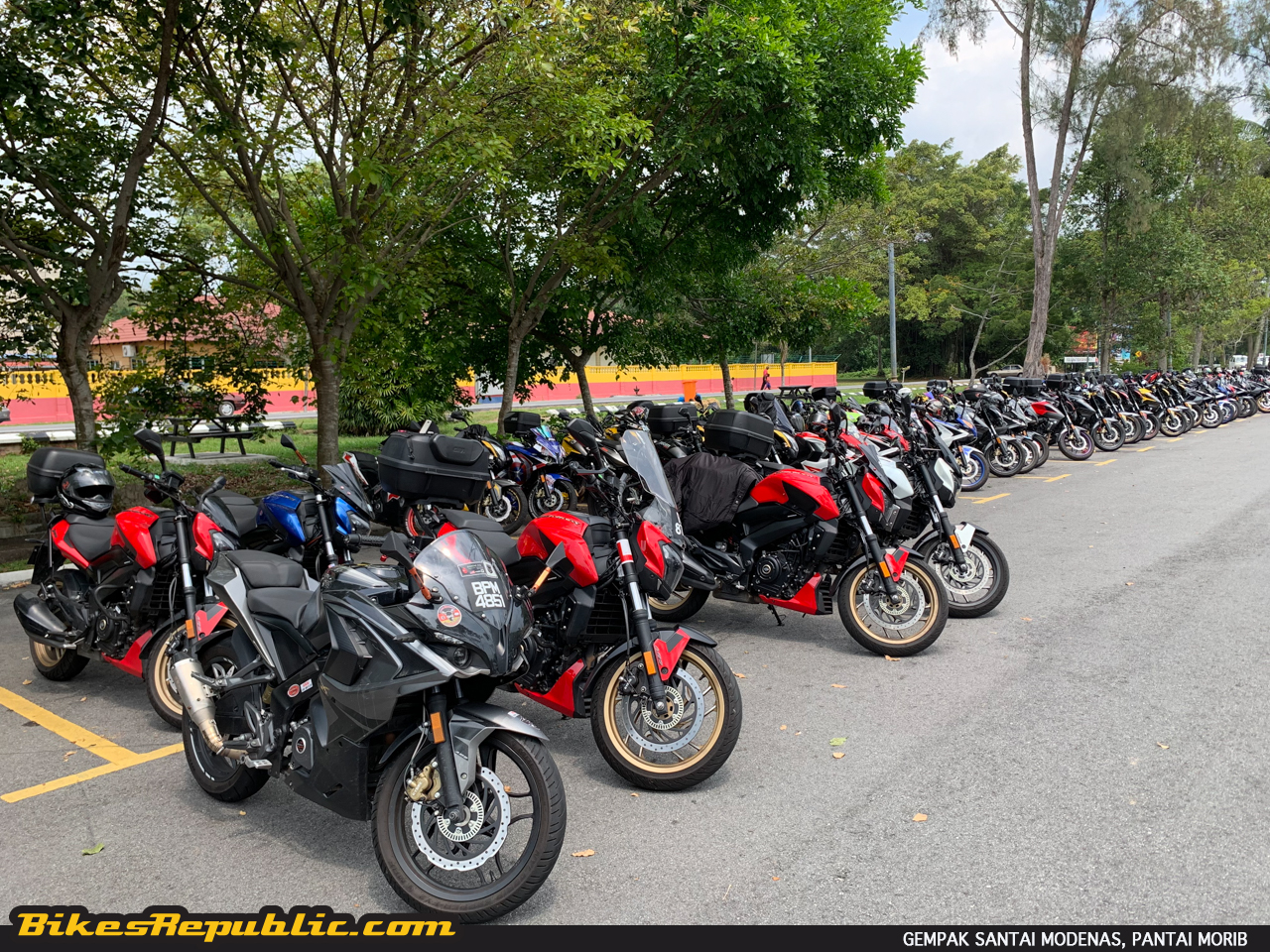
The Gempak Santai Modenas carnival saw a huge number of participants today.
The event was held at a seaside setting at Dataran Pantai Morib in Banting, Selangor, as a celebration for Modenas motorcycle owners.
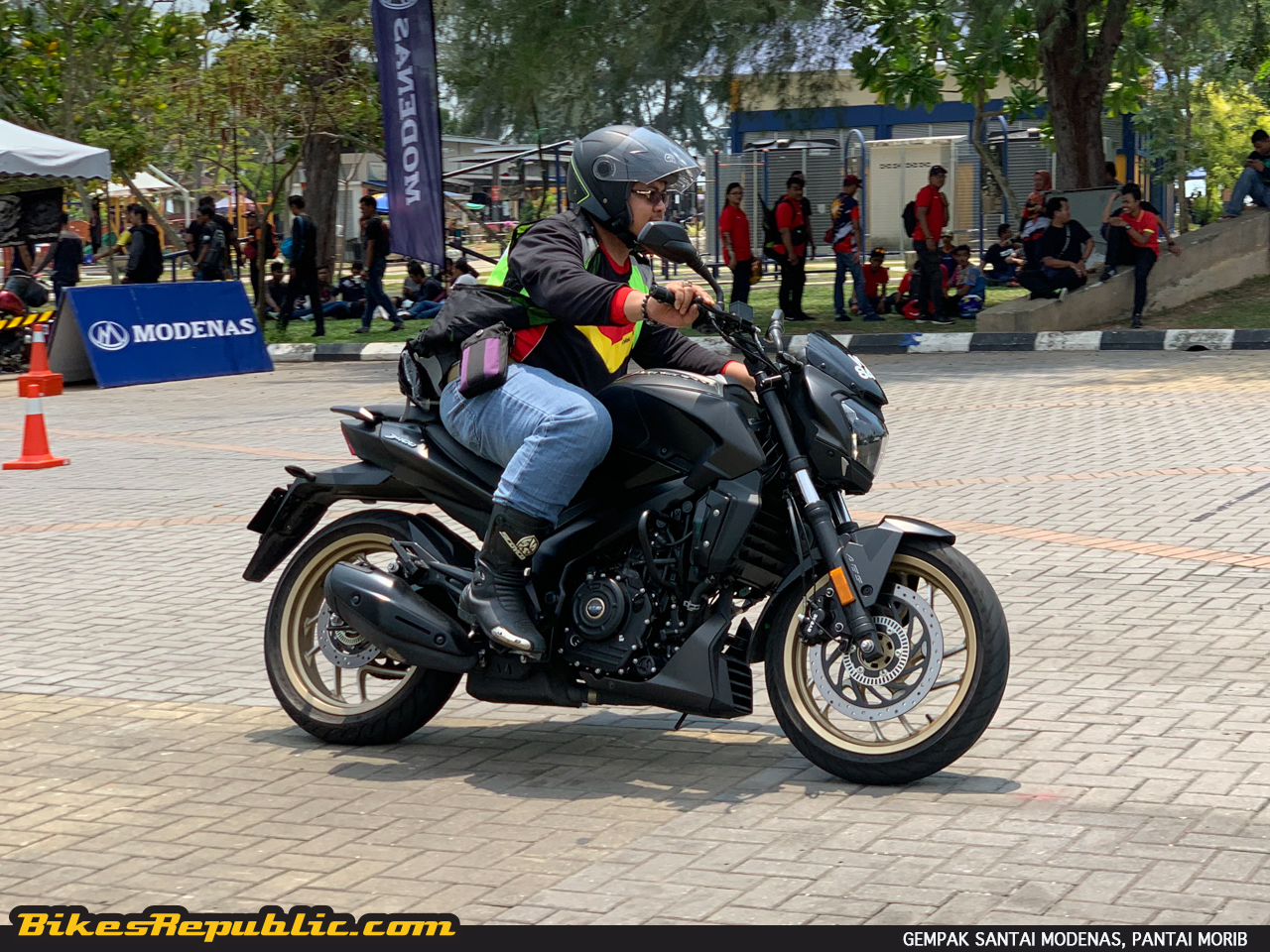
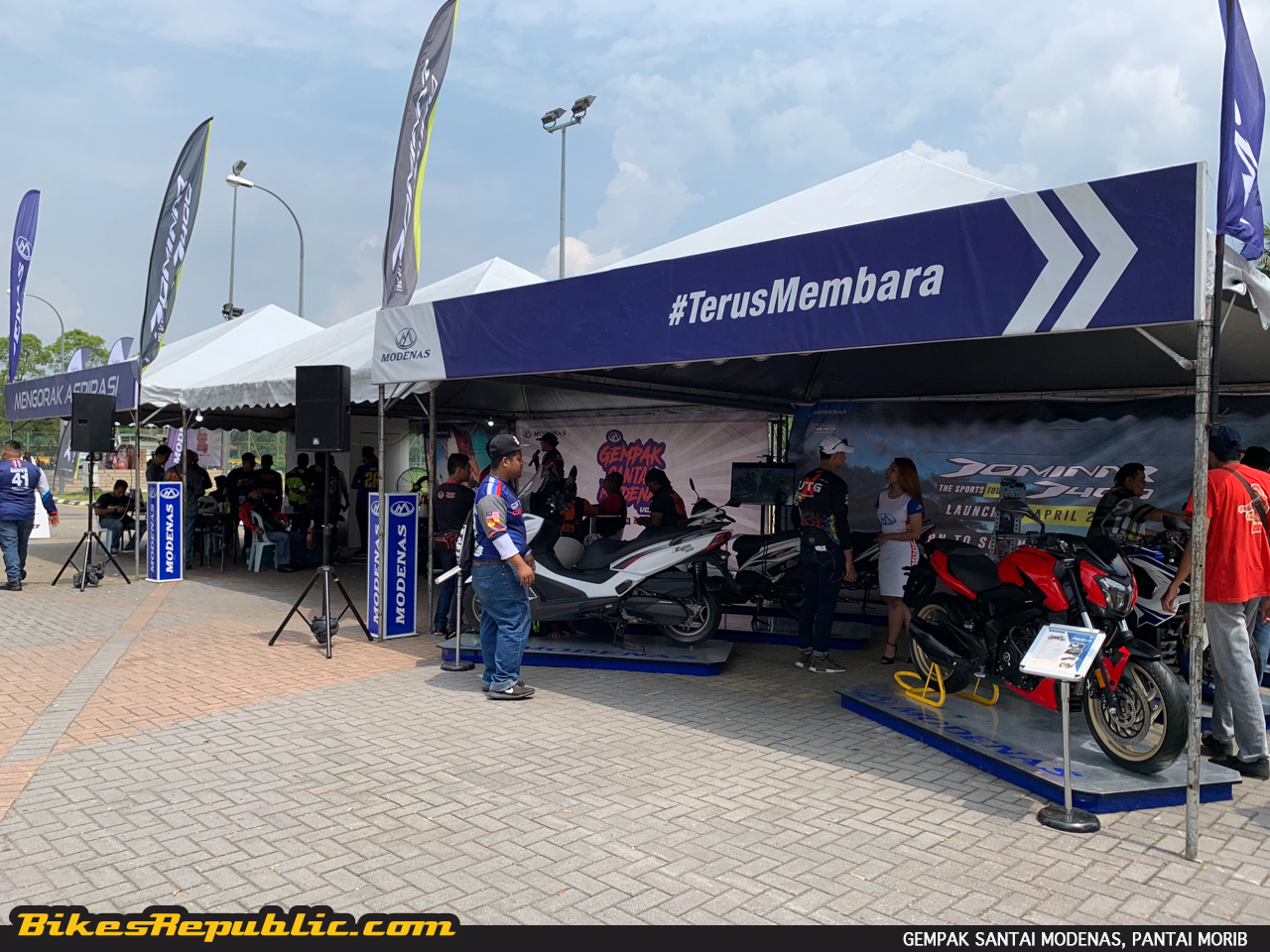
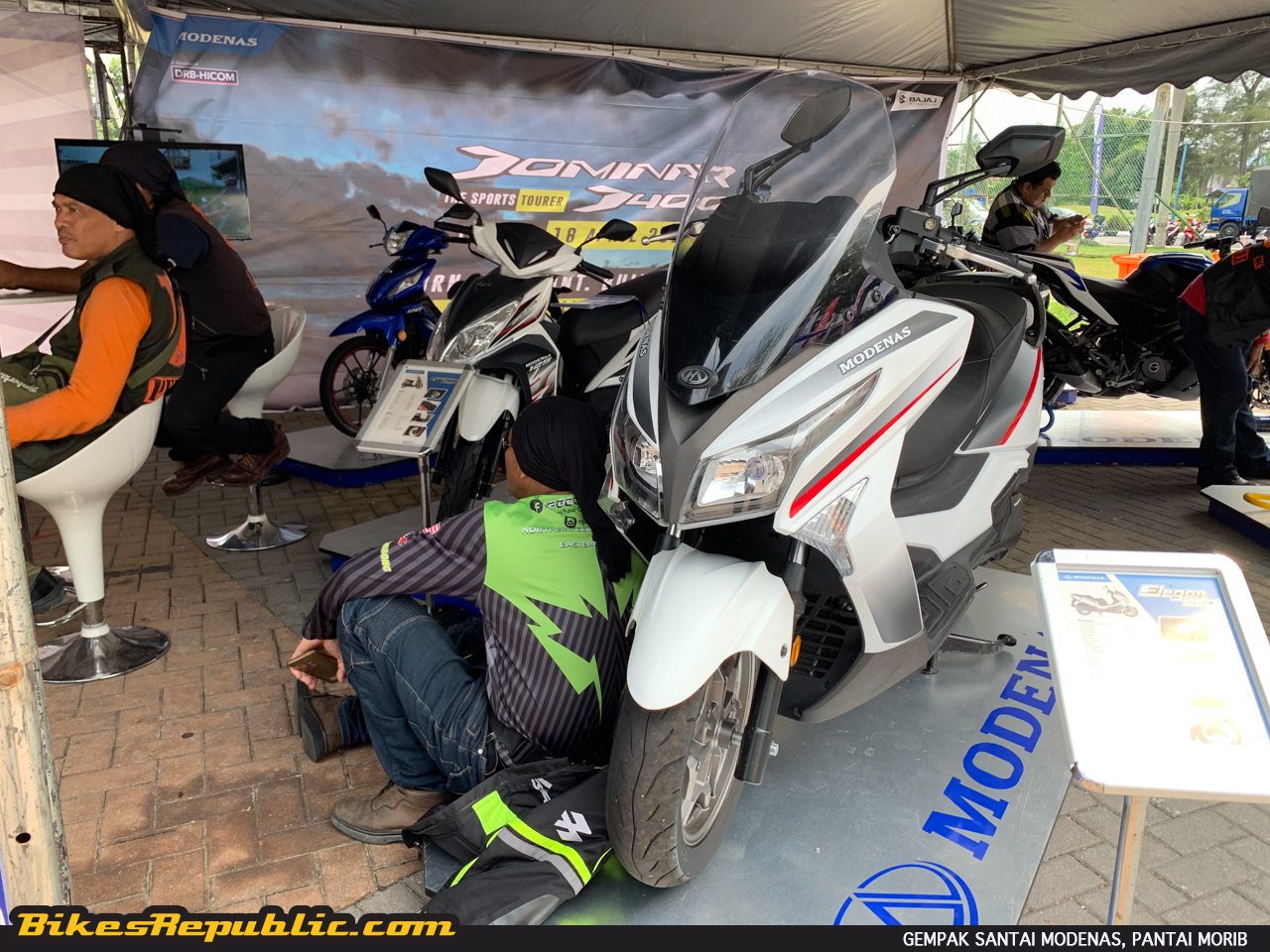
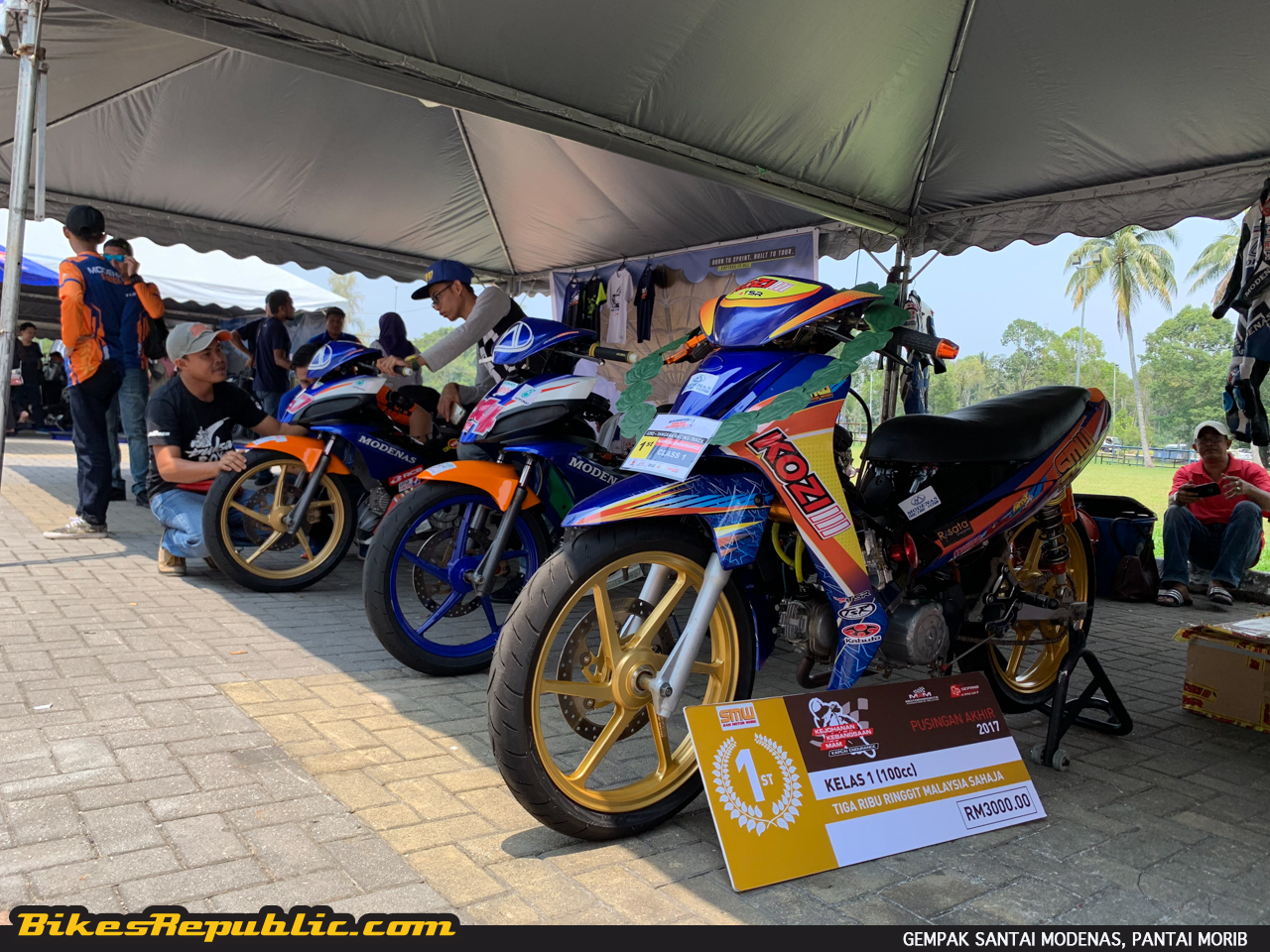
Sure enough, participants showed up on some 600 Modenas motorcycles of all models including the current Dominar 400, Pulsar RS200, Pulsar NS200, Elegan 250 scooters, Jaguh cruisers and, KRISS and Dinamik variants. This large number hasn’t taken owners of other motorcycle makes into account.
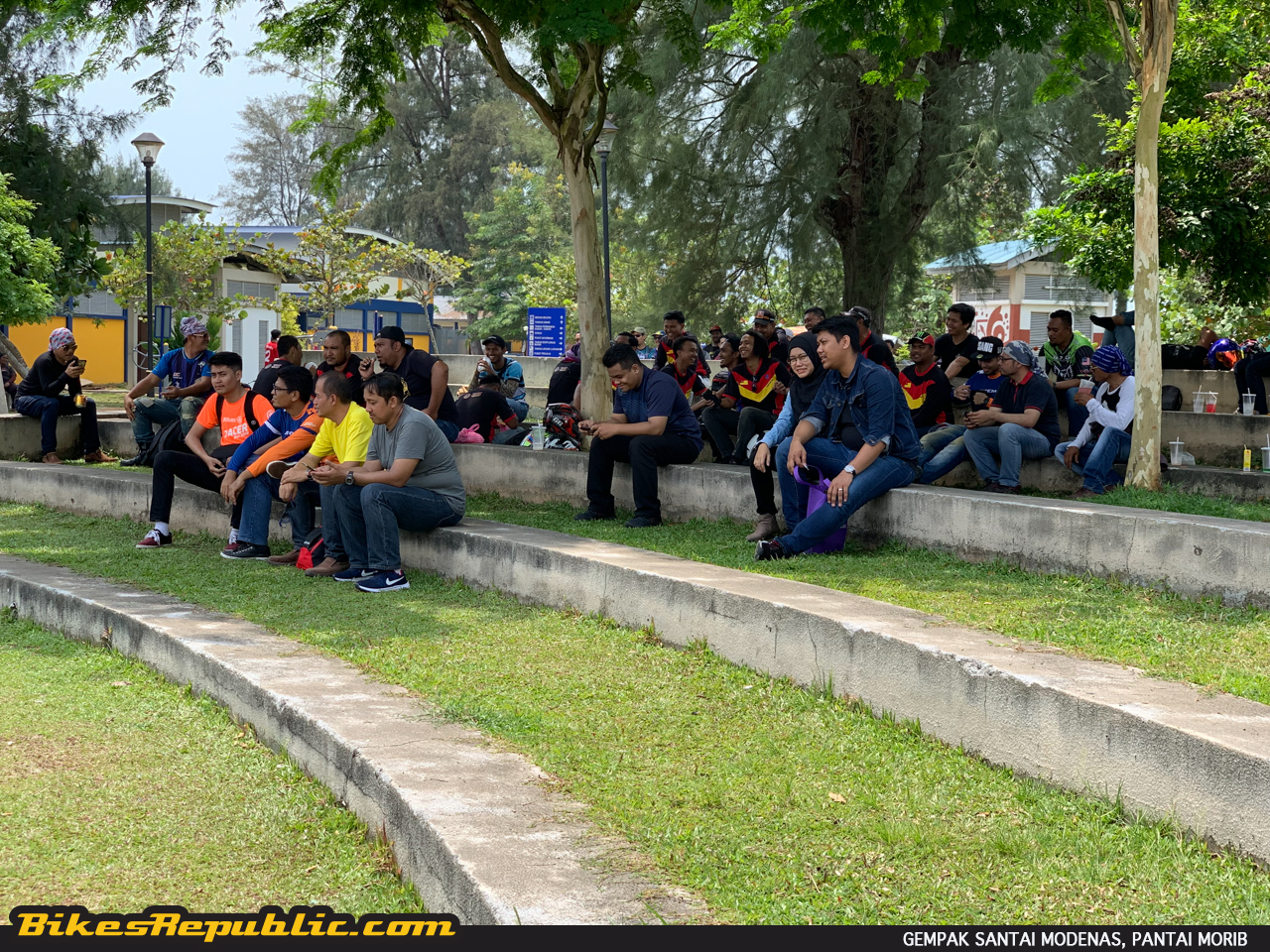
As the name suggests, the atmosphere of the event was one of “santai” (relaxation). The riders, their friends and partners took to the beach, food and gift stalls while keeping an ear for the lucky draw.
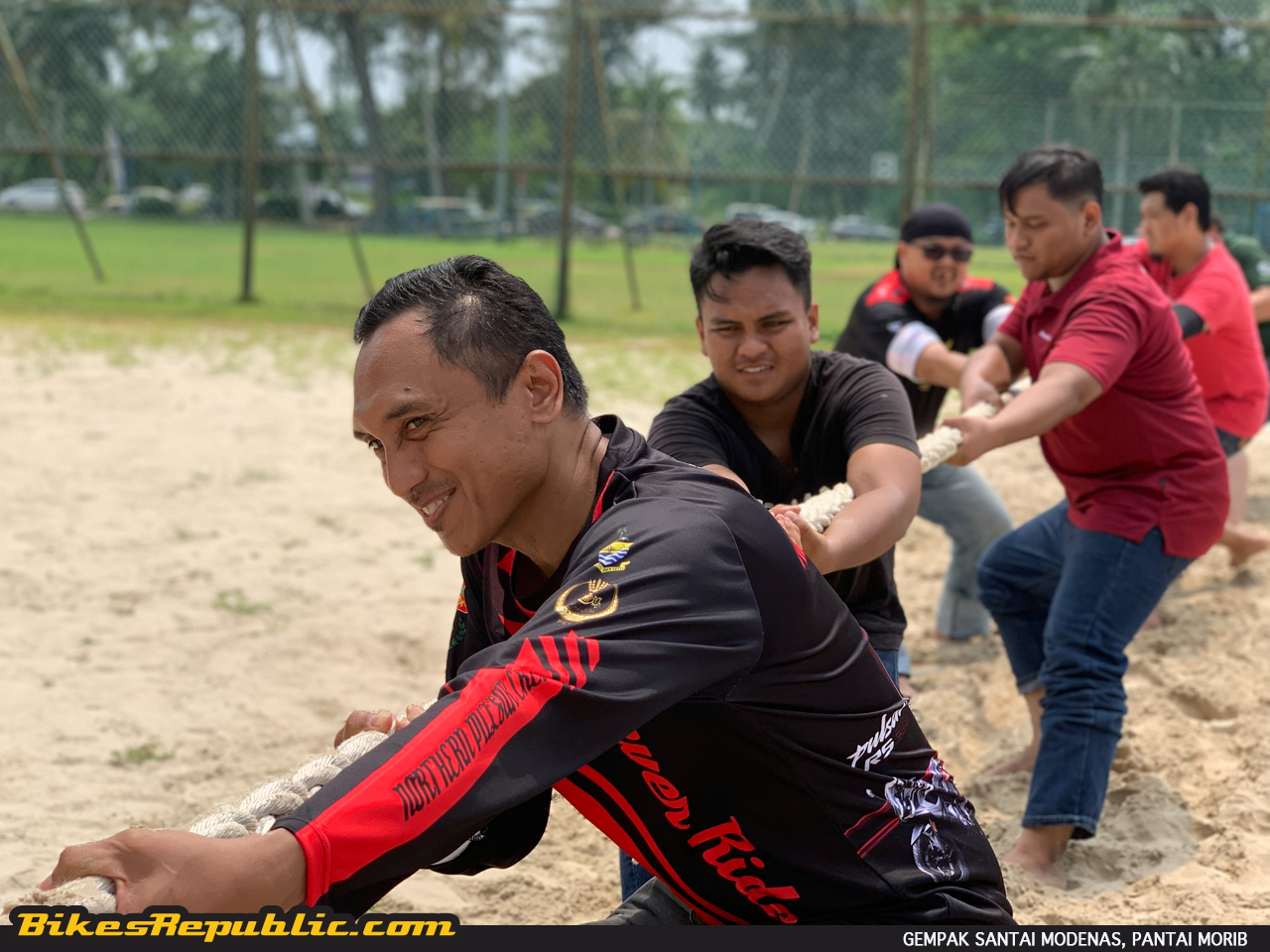
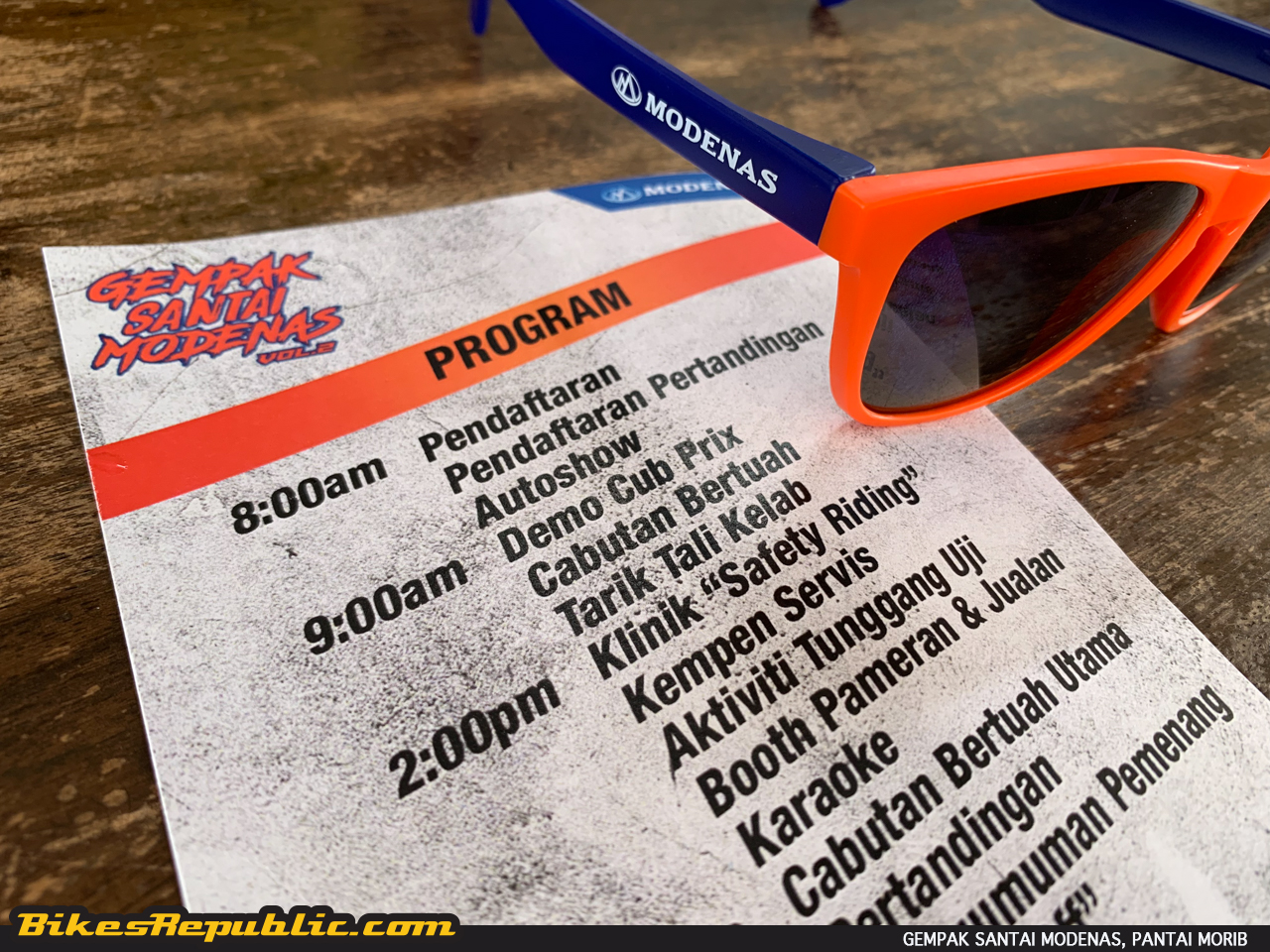
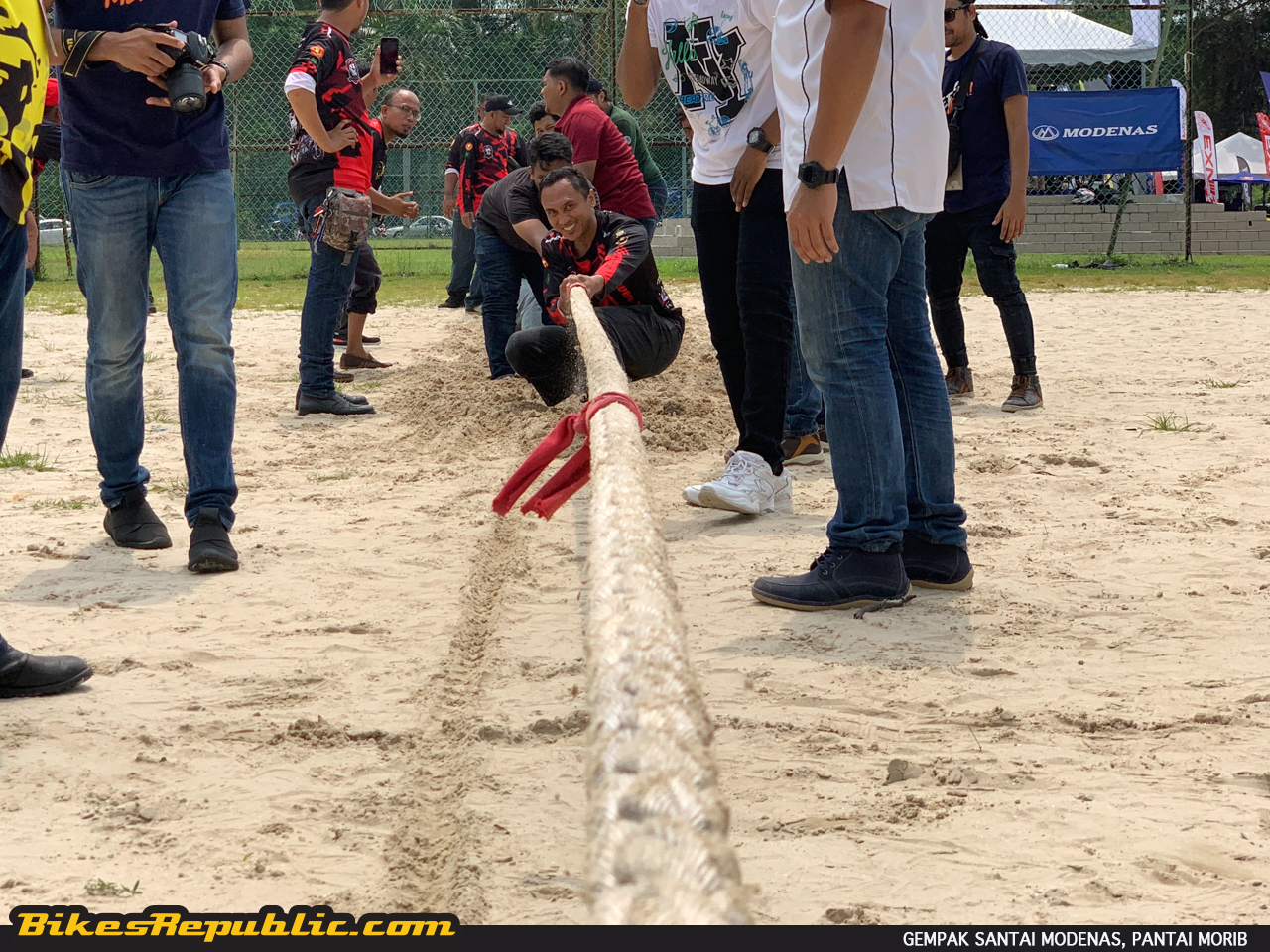
Modenas organized a number of activities. They were the Autoshow, Cub Prix Demonstration, Lucky Draws, Tug-of-War Competition among Modenas motorcycle clubs, Safety Riding Clinic, Service Campaign, Test Ride, Karaoke, new model exhibition, booths selling motorcycle-related stuff, and so forth.
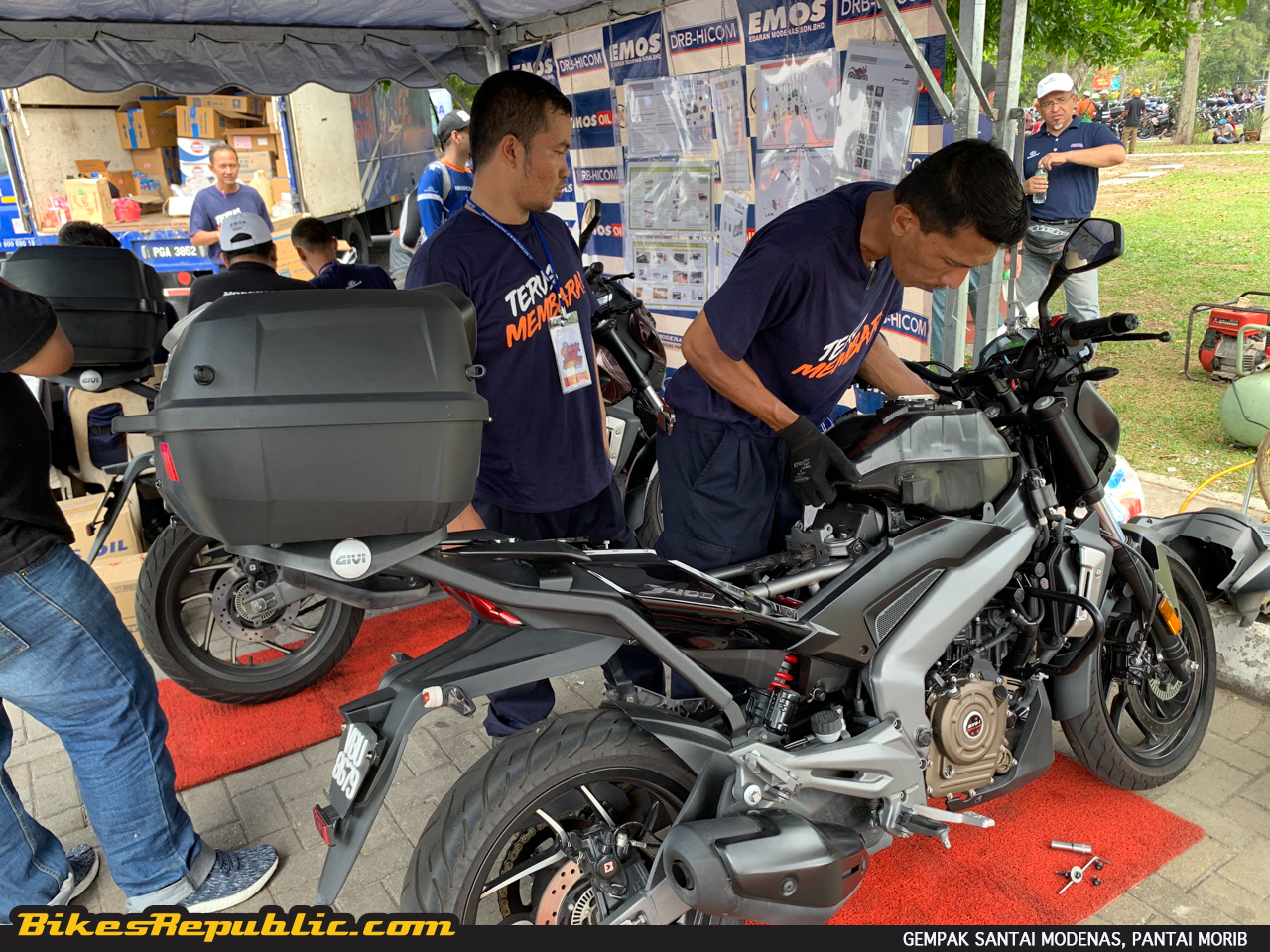
Also important during the event was the Service Campaign. Modenas owners serviced their bikes or had issues rectified on the spot. So popular was the campaign that some of the activities had to be carried outside the tents.
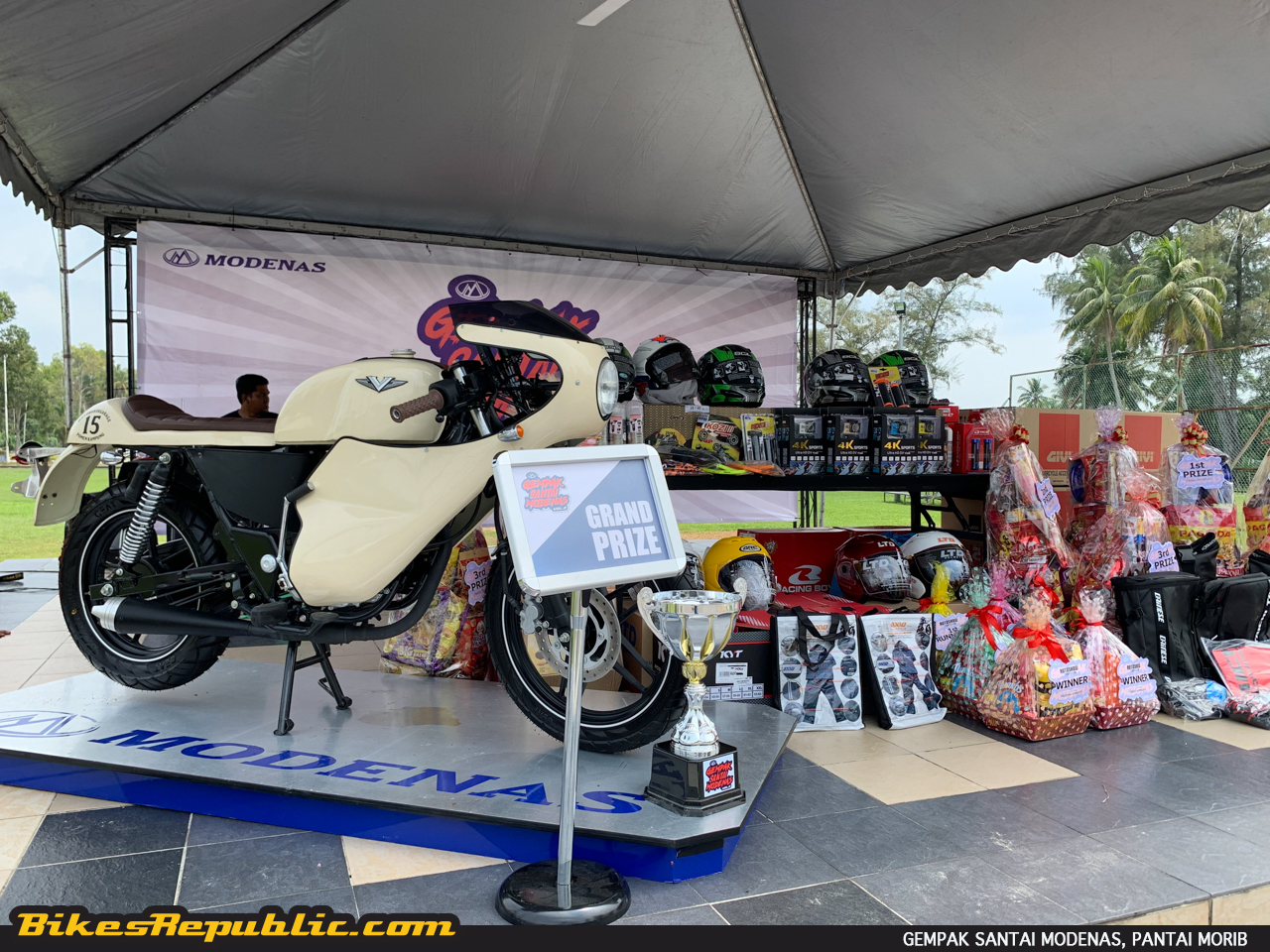
The aforementioned lucky draw went on throughout the day but the grand prize – a customized VT15 – was announced at the end of the day. The lucky winners walked away with hampers and products from the sponsors.
GIVI supported event by driving up in their transformer bus while Red Bull sold drinks at special prices.
Gempak Santai Modenas was sponsored by GIVI, Red Bull, Racing Boy, MotoNation and Samurai 2K.
The nine-time world champion has won the 125cc, 250cc, 500cc and multiple MotoGP titles on the way.
His father Graziano says Vale can race until 46 years old, if he wants.
Nine-time World Champion Valentino Rossi celebrates his 40thbirthday today.
Coming up the ranks, he won the 125cc, 250cc, 500cc, and multiple MotoGP titles along the way. His career at the world now spans 22 years, starting from 1997.
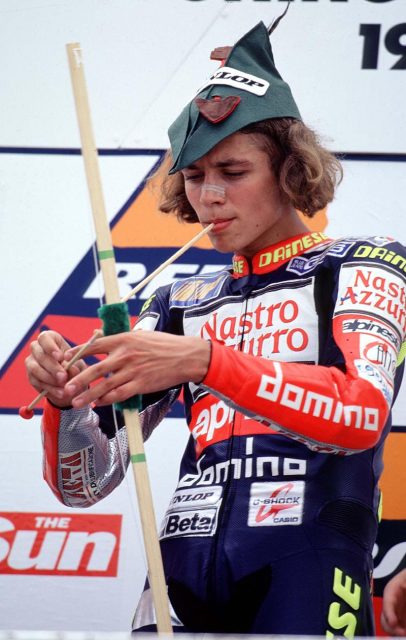
Rossi Hood British GP 1997
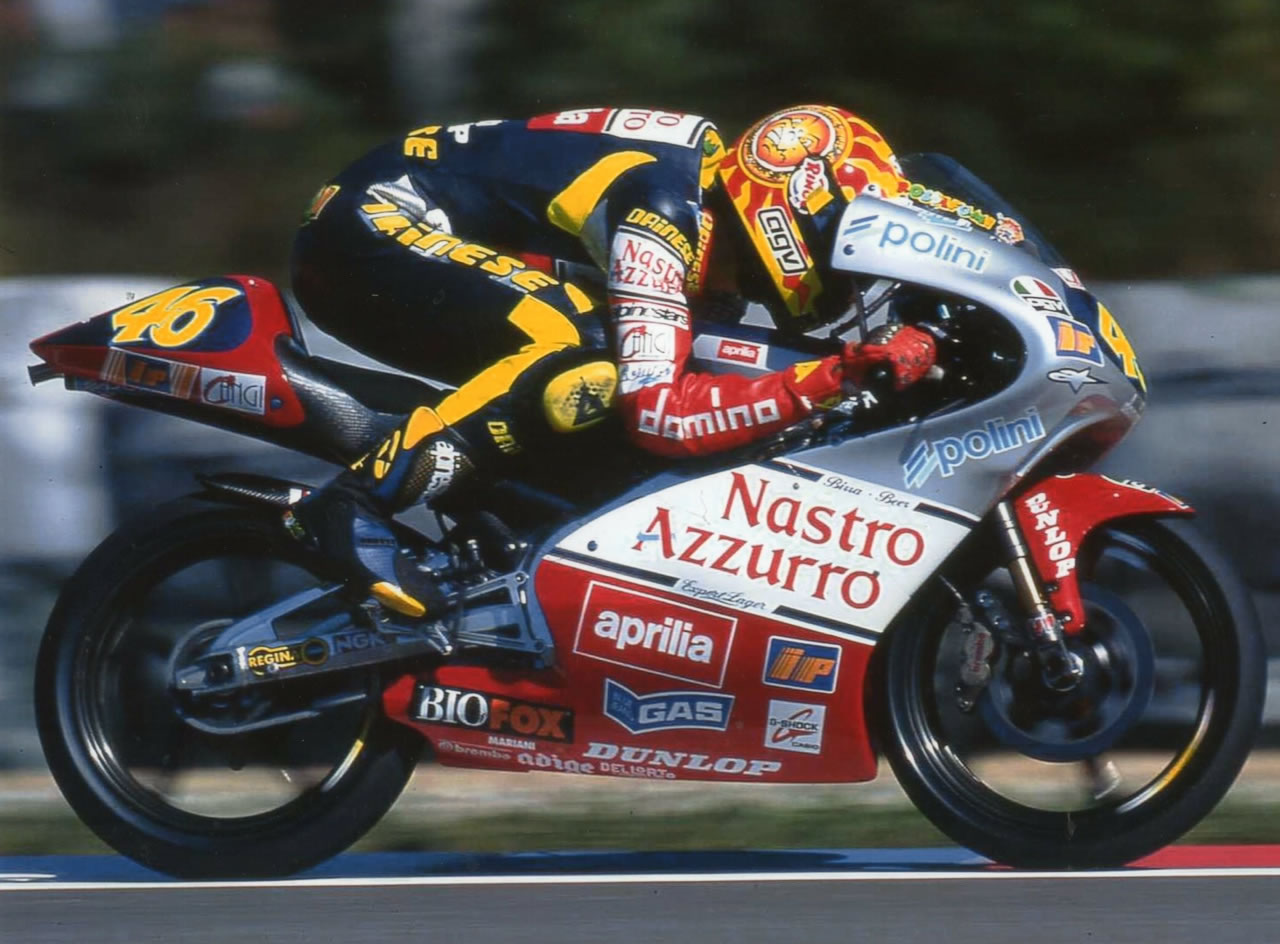
We remembered Rossi being the gangly and plucky kid who couldn’t fit fully into his Aprilia RS125 and RS250, raising his bum over the rear seat hump as he attempted to flatten his body on the fuel tank on the straights.
We know he still wears leathers with lots of fluorescent yellow. MotoGP commentator, Julian Ryder once referred to Rossi as “a highlighter pen.” Flamboyance is his trademark, his character.
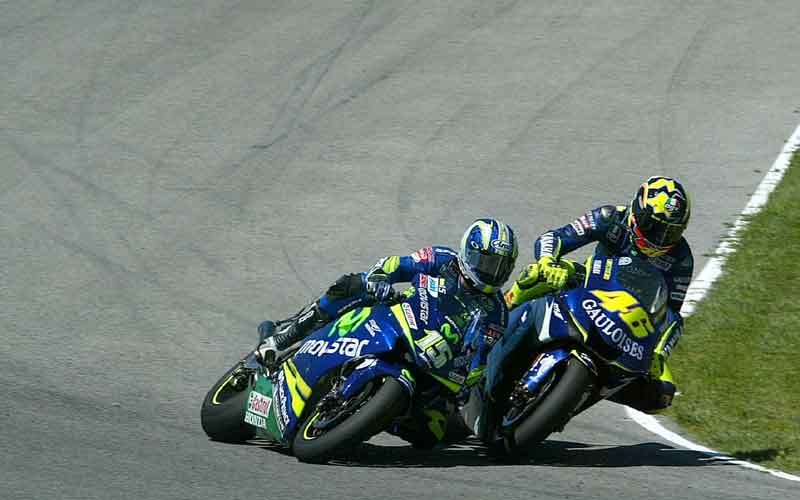
He still wears his bubbly outlook at press conferences and public appearances. But behind that devil-may-care attitude is a man driven to a single-minded purpose: To win. He used to do it at the expense of other riders, “rubbing” them out of the way. Ask Sete Gibernau, Casey Stoner and many more.
Playing mind games is his forte, although many say that he’s mellowed by age. Yet, he isn’t afraid to call a spade a spade including criticizing his long-time team Yamaha for the lackluster performance in the past two years. He still uses press conferences to burn his rivals with a smile, before resorting to diplomatic answers. In the past, look at how Rossi’s psychological warfare affected more so fellow Italian Max Biaggi than others. Rossi was a walking controversy magnet and he relished in it.
He even went on to be called many nicknames along the way, most recently “GOAT” for “Greatest of all Time.”
It’s all these “unconformities” that won him legions of fans around the world. Heck, bet he wouldn’t have trouble winning the race to be “President of the World.”
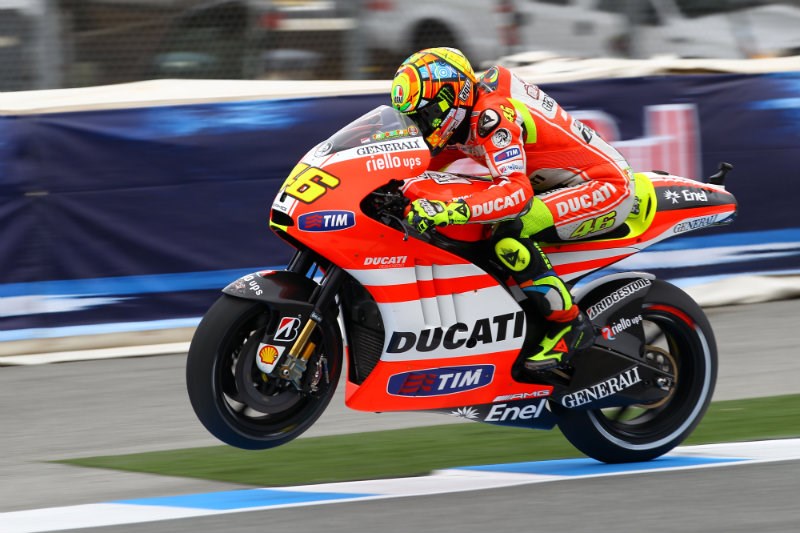
His domination in the early years of MotoGP may seem detrimental to some, but let’s face it, it drove other manufacturers mad in finding the answers to stop his march, which indirectly brought lots of new technology and development to the fore. Ironically, his winning streak was stopped by another manufacturer. His days at Ducati were considered a black hole in his career.
Pundits are now calling him “too old” for cut-throat world of MotoGP. But let’s face it, racing will be a lot less colourful without him around.
Happy Birthday, Valentino Rossi. Like your father said, let’s hope you keep racing and earn more wins along the way.
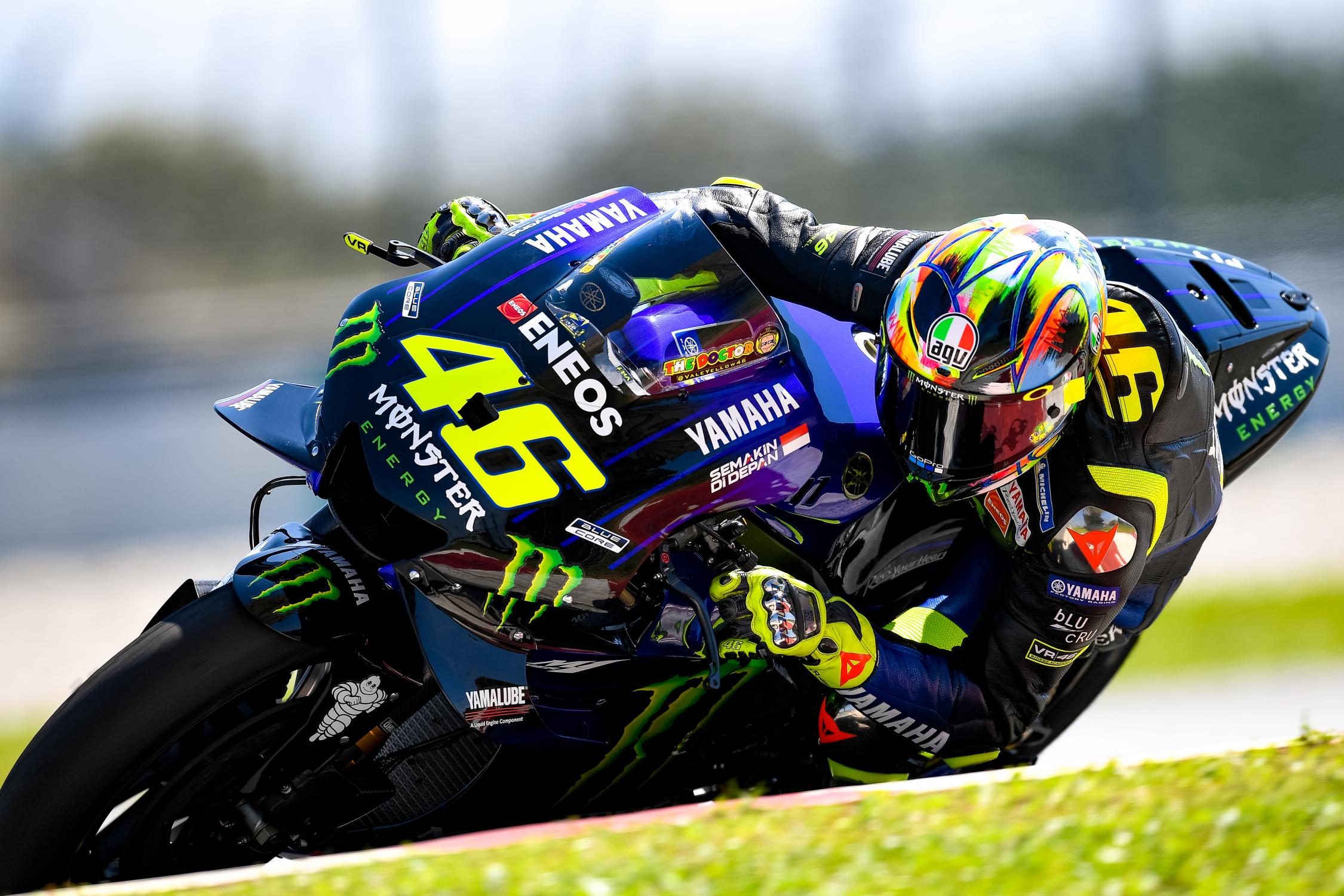
Valentino Rossi at 2019 SIC pre-season test – Photo credit MotoGP.com
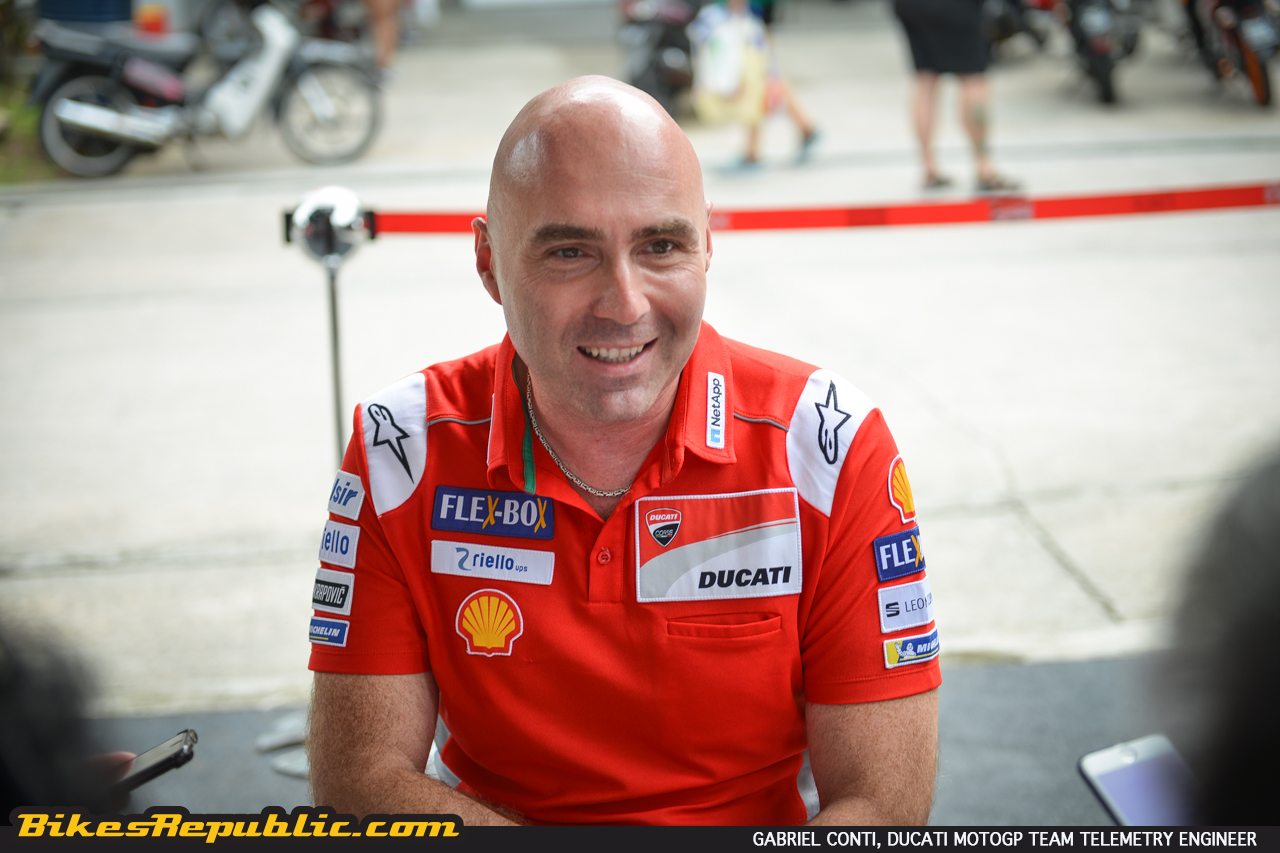
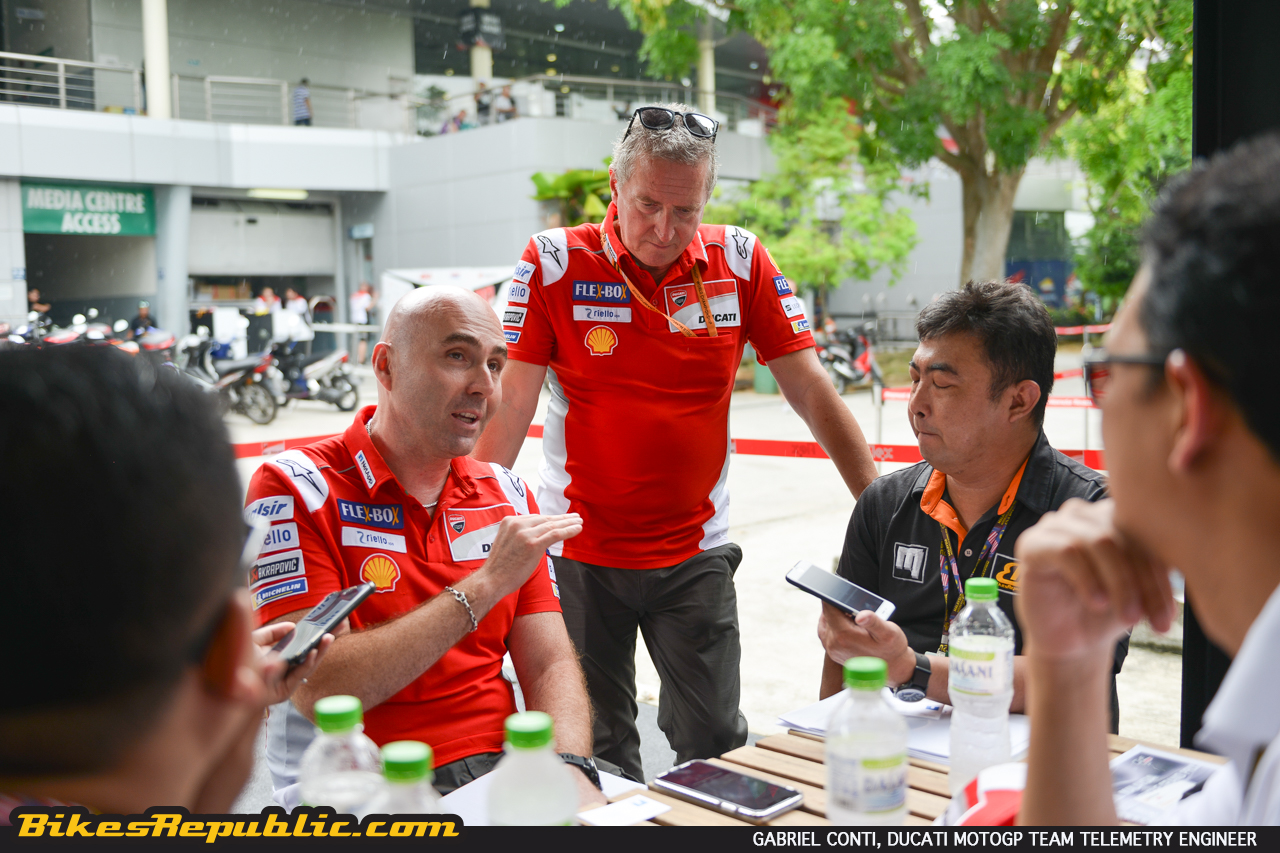
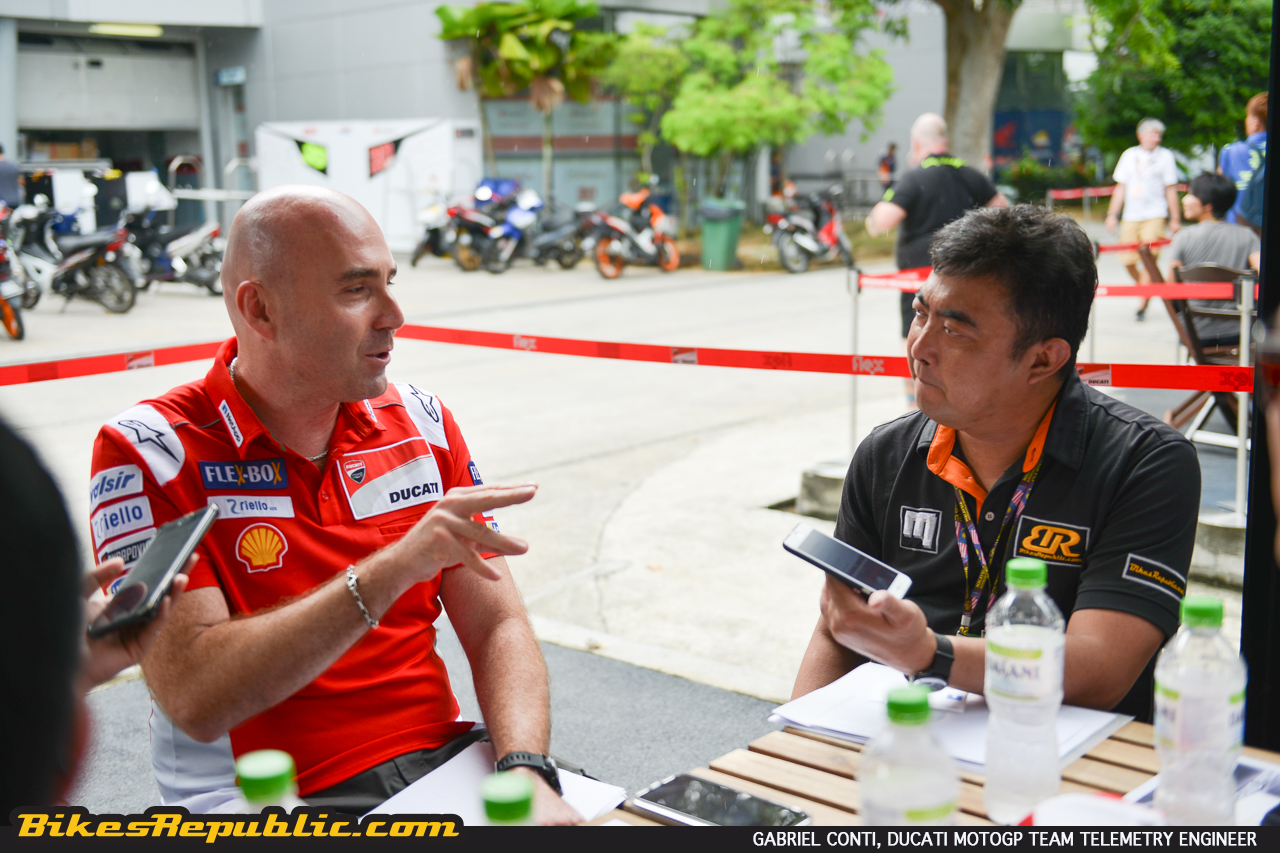
We spoke to Gabriel Conti, Ducati MotoGP Team’s Telemetry Engineer to know more about how the Ducati MotoGP Team uses data and information.
We found out that racing is not just about twisting the throttle to the max.
Data collected is used for bike setup and plan race strategies.
We spoke to Gabriel Conti, Ducati Telemetry Engineer in the factory Ducati MotoGP Team during the last Malaysian MotoGP. Ducati looked to have made a strong comeback in the second part of the season.
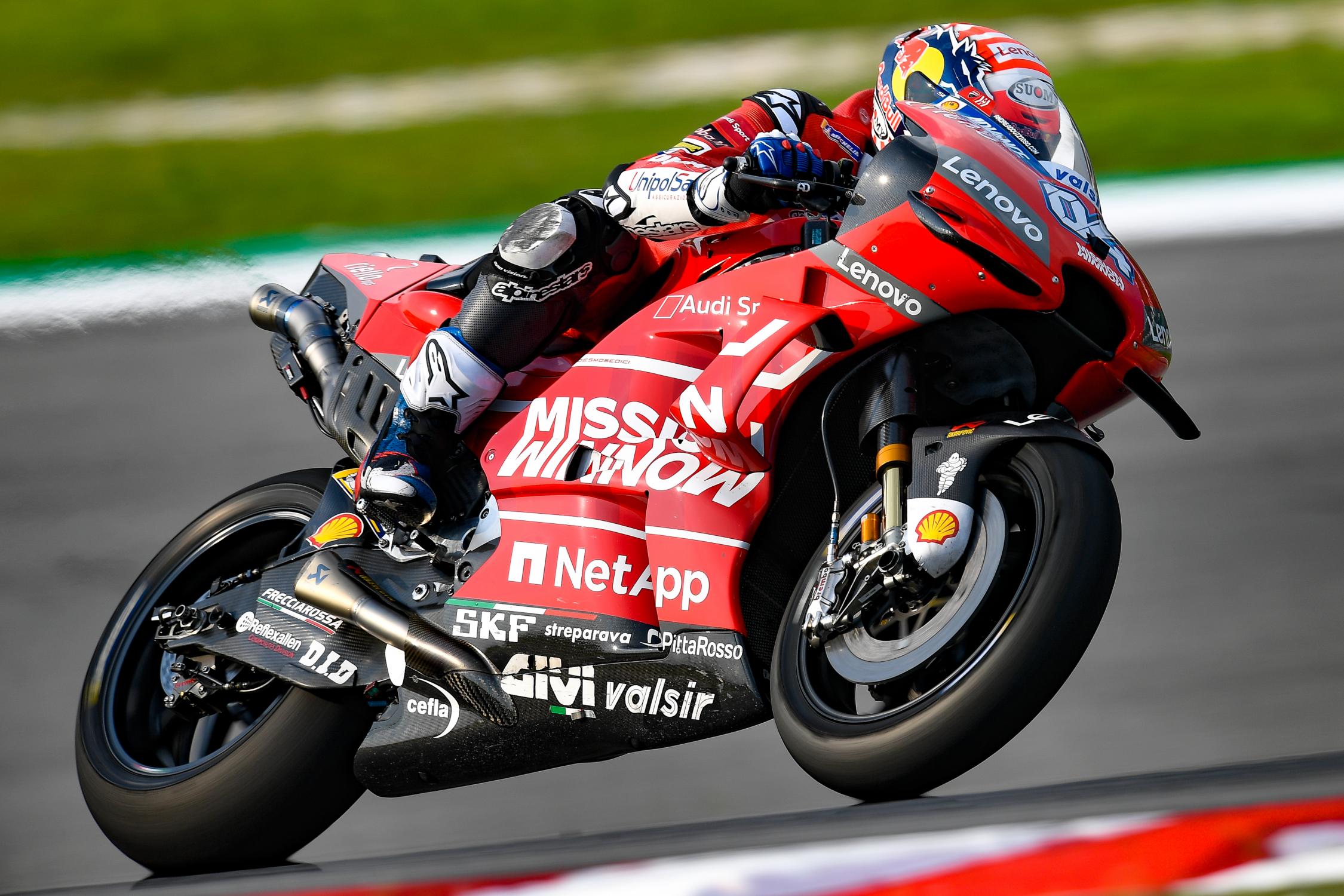
We also saw how the team’s riders Andrea Dovizioso and Jorge Lorenzo ride at high paces throughout, yet they still had enough rubber to push all out in the closing five laps. Was that due to tyres? Electronics?
BikesRepublic.com (BR): What was the strategy that allowed Ducati riders to being able to push at the end of races? Was that due to electronic strategies? Gabriel Conti (GC): Technically it evolved from the tyres because there is one tyre supplier for everybody. We have to analyze what the tyres do and with the data we can look to manage the tyres better.
With a lot of data we are able to manage the situation. Unlike Formula 1, we cannot change strategies during the race. We cannot speak with the riders (there’s no 2-way radio), we cannot send data (to the bikes), we cannot read data (from the bikes). As such, it’s very important to start the race with the data (we have). We decide with a strategy before the race, so the rider knows what to do.
The engineers check the numbers through the night. We have two automatic machines to make the calculations for tyres, electronics and bike setup.
But the last part is in the hands of the riders.
What we do is setup the electronics for the bike to be not so strong for one lap but is strong throughout the race. So in the last 5 laps there’s enough tyre to push.
We start by gaining and using data from pre-season tests and setup the bike up with the data at the start of the season. As we go on, we gain data everytime the bike goes out and we develop the setup. The data we have stored is important especially for different weather conditions.
For example, if there’s rain throughout the weekend and no practice can take place, we already have the data to use.
Other journalist: How does this benefit in racing? Gabriel Conti: The data helps to setup the bikes in terms of tyres, suspension, electronics, traction control, engine performance. So, data and the rider combination are so important. We are absolutely data-dependant in this competition.
Other journalist: What’s role does Net.App play in the Ducati Team? Gabriel Conti: Data (collection) has increased in the last year. For example, I remember 2005, we don’t have so much data. We didn’t send it to the factory, we didn’t use so much of it.
But we started increasing after 2006, to have deeper analysis.
Now we are strong for the data (sic). What we have improved are “thinking machines” that are quicker than the engineer to analyze a lot of data. Now we are improving because we have many riders, and more data to choose the right strategies.
Rather than let the factory take time with the data, we want to move the factory to the track.
BikesRepublic.com: The standardized Inertia Measurement Unit (IMU) will used for the 2019 season. How will it play out for Ducati? Gabriel Conti: I explain the situation. In the past, four years ago the electronics was different. Then we started with the (standardized) ECU hardware, but you can develop the software yourself. Then the ECU and software were standardized (in 2016 – Editor).
But the Japanese manufacturers still want “free” IMU. The IMU is not a sensor itself, but it has (data from) 6 sensors fed into it. Which means it there is an algorithm to calibrate (the different axis of movement) so this is becomes suspicious. So, in the end all manufacturers agreed to move to a standard IMU.
You can still calibrate the standard IMU but by how much we don’t know.
Other journalist: Can you share with us instances where you tell the riders to go faster based on the data you have?
Gabriel Conti: Ah! Many, many times! The riders will look at the data to compare with other riders or the riders of the past. For example, when we had Valentino Rossi, he compared himself to Casey Stoner. We have a performance index that we give at the end of every session to say to the rider where is stronger and where he’s not.
It’s not to say he should push, push, push but for him to see that he might miss something. Andrea Dovizioso is a very clever guy, not all riders can use numbers. He uses them to improve himself.
Other journalist: In Qatar 2018, Dovi won by 0.02 second. Gabriel Conti: It was five years he lose by 0.02 second. In four years the gap to winner is less than one second. So you see 0.02 second is hard to find for the rider. Gigi (Dall’Igna) would say to us, “Pay attention to the thousandths” because the sum of a lot of thousandths can make you win or lose a race.
Other journalist: How much data are we talking about here? Gabriel Conti: We generate like 100 Gigabyte of data per race these days.
CONCLUSION
Racing in MotoGP isn’t about going out there and twisting the throttle to the stop. There are so much more fascinating stuff that goes on behind the scenes that many of us could never ever have imagined!
The numbers that makeup lap times are made up of data. Where we see numbers, the engineers see information that can help the rider and team win.
So, the next time see the Ducati team win a race, think about how much data and information went into creating that victory.
Join us for Part 2 tomorrow as we unravel the secret of how NetApp plays a necessary role in Ducati’s victories.
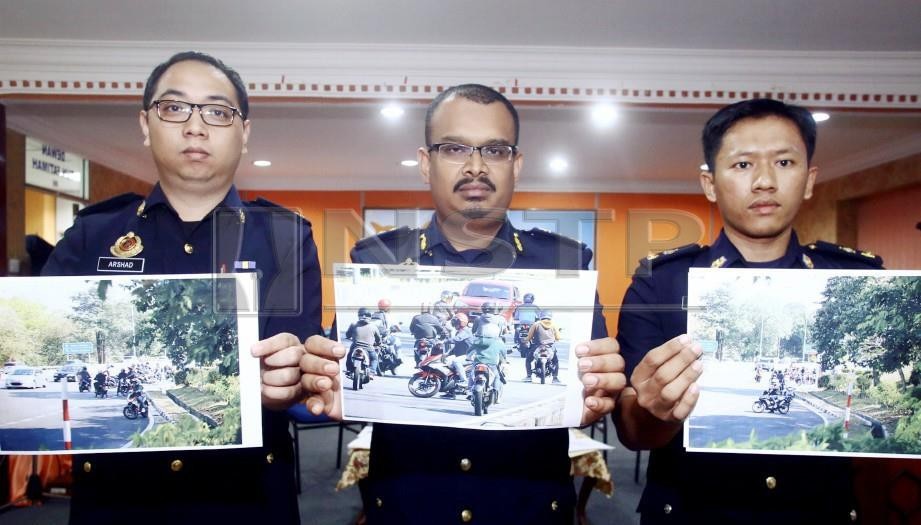
The Road Transport Department of Malaysia (JPJ) has warned motorcyclists to not run from roadblocks.
The department will record those who did so for evidence.
They will then issue a notice before moving onto summoning and blacklisting those who did.
The Road Transport Department (JPJ) has issued a warning to road users, especially motorcyclists to not avoid roadblocks i.e. U-turn. Or risk being blacklisted.
We’ve seen it countless times: Motorcycles heading the opposite direction against the flow of traffic, attempting to get away from roadblocks up ahead. Doing puts not only the rider at risk but also other road users.
The department’s Melaka Director General Muhammad Firdaus Shariff said that they will first issue a notice to those found running away from roadblocks, before moving on to blacklisting them in accordance to Section 55 of the Road Transport Act 1987.
He added that his men will record those who U-turn from roadblocks as evidence.
“We will issue Notice 114 demanding the vehicle owner to present himself for questioning within 21 days. If he does not, we will issue a RM150 compound and he will be blacklisted.”
“Blacklisting” a vehicle means the owner could not renew his driving license and vehicle’s road tax.
The Director General made the statement during the closing of the Chinese New Ops 2019. The operations from 29 January to 12 February saw 1,236 summonses issued for various offences. Motorcycle owners were the biggest majority amongst other vehicle owners with 329 cases. Out of that number, the most infringements were due to “vehicle licensing” i.e. road tax.
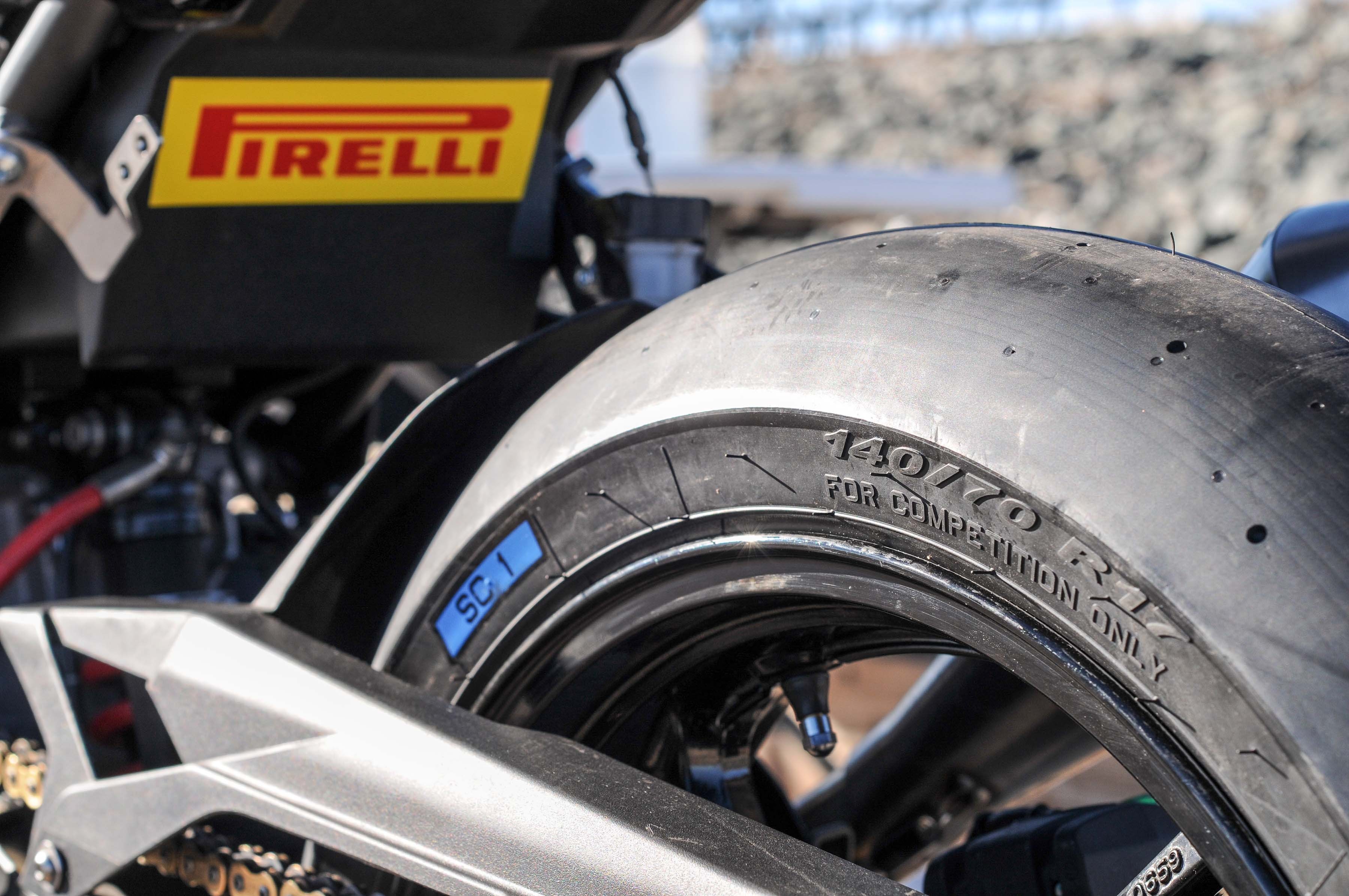
The Pirelli Diablo Supercorsa SC1 racing slicks are available for small capacity bikes.
Sizes are 110/70-ZR17 front and 140/70-ZR rear.
They will be available by Round 1 of the 2019 Pirelli Malaysia Superbike Championship.
Everyone’s favourite race and performance tyre brand, Pirelli has launched the Pirelli Diablo Supercorsa SC1 V3 for smaller capacity bikes.
Smaller capacity classes are ever popular worldwide. We have the underbone a.k.a. cub prix class in Southeast Asia, before stepping up to the 250cc, 300cc and now 400cc classes. One of the biggest problems was finding the correct-sized tyres.
Pirelli recognizes this and debuts the Supercorsa racing slicks in 110/70-ZR17 front and 140/70-ZR17 rear sizes. The new tyres are made with the super-sticky SC1 compound. These are meant for 300cc and 400cc bikes, but the 250cc should find them useful, too.Indeed, Pirelli is the title sponsor and tyre provider for the World Superbike Championship which included the SuperSport 300 class.
Why the need for different tyres? Why not just use bigger rims to fit bigger sizes?
Smaller motorcycles do not have the weight and speed to create the type and of forces like big bikes do. As such, the tyres may not heat up enough and many not be able to retain the heat for optimum performance. Tyres designed for lighter bikes may have the same compounds as their bigger brothers but have slightly different construction.
The new tyres are now available in Europe and the US. BikesRepublic.com got in touch in with the Malaysian Pirelli official distributor Southeast Asia Parts for confirmation. According to them, these new tyres will be available by the first round of the 2019 Pirelli Malaysia Superbike Championship (MSBK) 2019.
Get ready for even faster times in the Super 250 class!
*Note that these are racing slicks and the racetrack is the only place for them. Do not be foolish and mount them for road use!