Bikesrepublic

AES

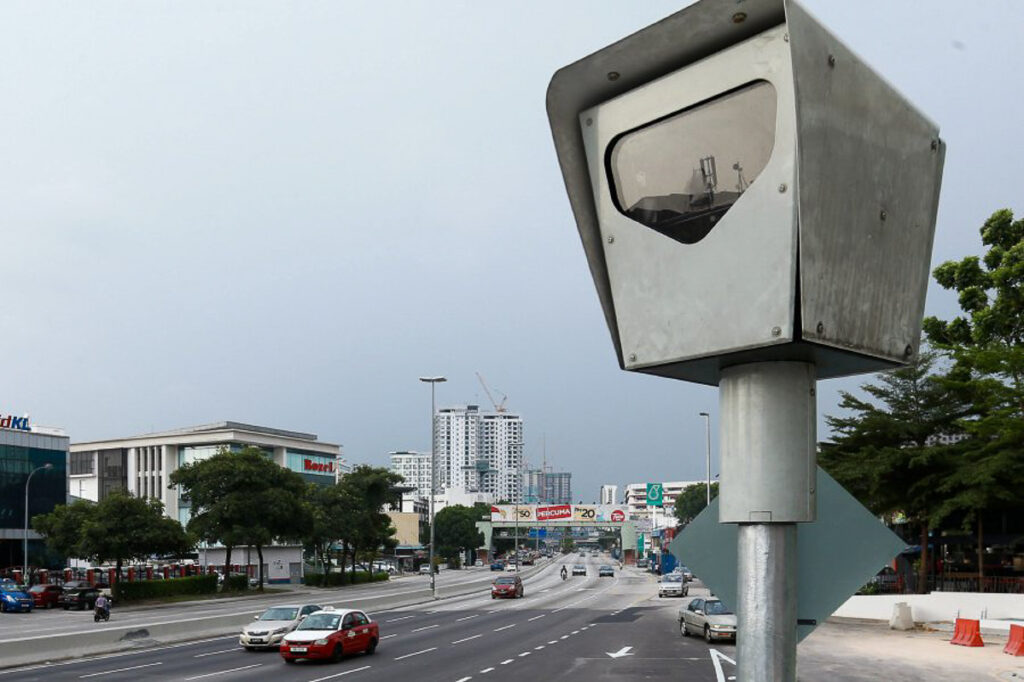
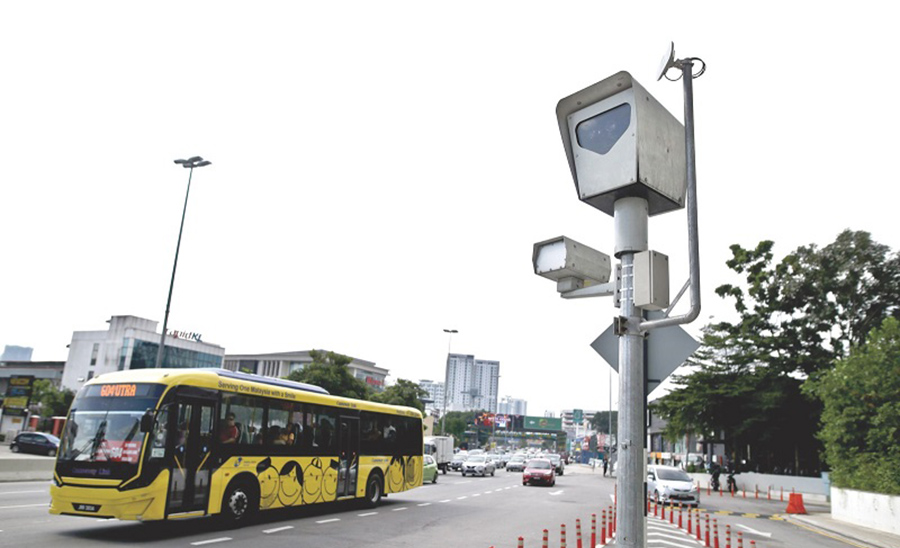
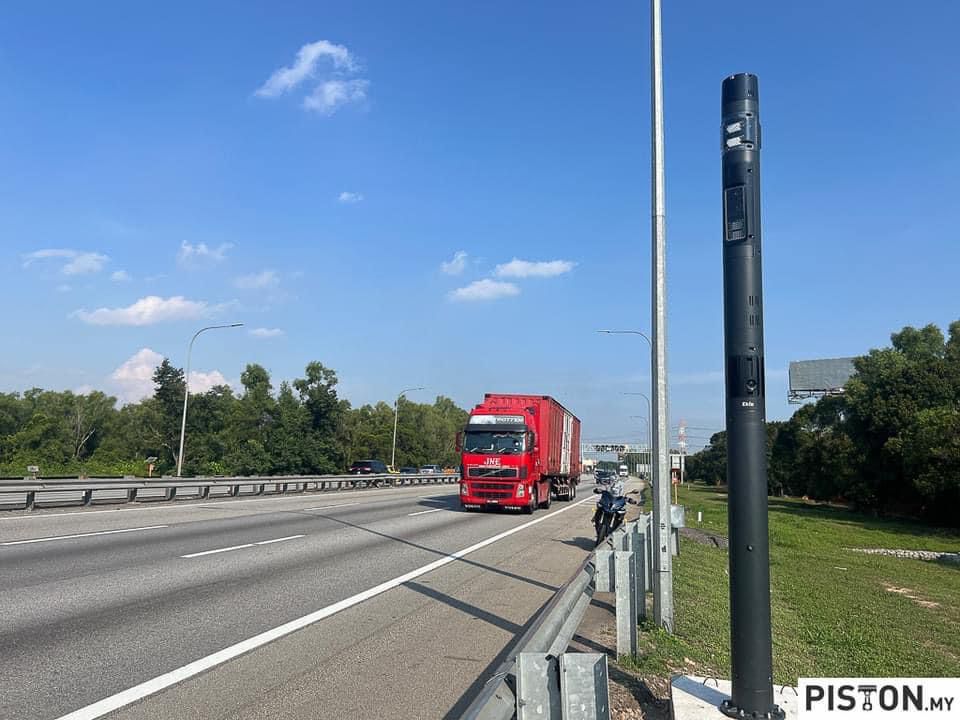
Malaysian authorities will begin testing a system that records the travel duration of a vehicle from one location to another using AWAS (Automated Awareness Safety System) cameras.

This means the system will capture an image of the vehicle’s license plate via the first AWAS camera and record the time. Then, this image will be compared with the image taken by the next AWAS camera, with its time also recorded and compared. If the vehicle passes the subsequent AWAS camera too early based on the calculated duration, it is deemed that the vehicle was driven too fast.

How is a driver determined to have exceeded the speed limit?

The calculation uses the formula:

Distance (km) = Time [(minutes / 60) hours] × Average Speed (km/h)

For example, let’s set the distance as 100 km and the time taken by the vehicle to travel from Toll A to Toll B. We use time because the AWAS system considers it to determine the vehicle’s average speed. Do note that time is converted from minutes to hours by dividing it by 60 (since there are 60 minutes in an hour) to express speed in km/h.

Example A:

Suppose a vehicle covers a 100 km journey in 30 minutes. The speed limit for this route is 110 km/h.

Average speed = 100 km / (30 minutes / 60) hour,

Average speed = 100 km / 0.5 hour = 200 km/h

Result: Fined! (Exceeds the speed limit)

Example B:

The vehicle covered the 100 km distance in 60 minutes.

Average speed = 100 km / (60 minutes / 60) hours,

Average speed = 100 km / 1 hour = 100 km/h

Result: No fine (Average speed did not exceed the limit).

Calculating the “Safe” Travel Duration to Comply with the Speed Limit

Since the AWAS system tracks the duration taken for a vehicle to move between two points, what is the calculated “safe” duration?

100 km = (X / 60) hours × 110 km/h

(X / 60) = 100 km / 110 km/h = 0.909 hours

Thus, X (average time) = 0.909 hours × 60 minutes = 54.54 minutes

To verify if this calculation is correct, check whether 54.54 minutes multiplied by 110 km/h equals 100 km:

Distance = 0.909 hours × 110 km/h = 100 km

TA-DA!

This means you should pass the second AWAS camera in at least 54.54 minutes after passing the first one. With this formula, you can plan your trip by calculating the required travel time and adjusting your speed accordingly.

However…

This system is not a foolproof solution, especially for those proficient in math who know how to circumvent the formulated time by speeding excessively at certain stretches and then slowing down to match the calculated time, making it appear as if they complied with the speed limit. In fact, this is a technique used by rally drivers when transitioning between Special Stages (SS) on public roads.

Or, of more concern is that many Malaysians are not math proficient and/or too lazy to calculate anything, thus not knowing the required travel duration and consequently driving either too fast or too slow. So, back to square one.

Additionally, you can no longer arrive earlier than the calculated time even if the road is completely empty, which increases travel duration, and may even contribute to traffic build up and congestion.

So, what’s your opinion?

Is the current system better, or is this new system more effective?

The Awareness Automatic System (AWAS) will introduce an upgraded AI-powered ‘point-to-point’ (P2P) method to measure vehicle travel duration and distance, enabling the detection of speeding violations. A trial run is expected to begin this June.

This pilot project, designed to replace the current static speed enforcement method, will monitor two highway routes:

  1. Genting Sempah Tunnel to Gombak Rest Stop;
  2. Senawang Toll Plaza to Simpang Ampat (Alor Gajah) Toll Plaza.

Additionally, the system will be installed at high-risk accident zones along longer stretches, such as the Menora Tunnel to Sungai Perak Rest Stop route.

Datuk Jana Santhiran Muniayan, Secretary-General of the Ministry of Transport (MOT), explained in an interview with Berita Harian that speeding drivers can be detected by toll plaza sensors if they arrive at their destination earlier than the estimated travel time.

He mentioned that a company has already been appointed to handle the proof of concept (POC) for this system without any financial burden on the government.

“The pilot will be conducted on two selected highway routes. If proven effective, we are ready to implement it fully. The system, installed at toll plazas, will record travel time based on distance coverage.”

“For example, if a driver travels from Jalan Duta (Kuala Lumpur) to Tanjung Malim (Perak) faster than the allowed time, their vehicle’s license plate will be automatically detected, and a summons will be issued,” he said.

Jana Santhiran added that the AI-powered system can also detect if a driver stops at any location to artificially extend their travel time and evade detection.

“This means drivers cannot escape being caught for speeding, as the system calculates violations based on distance and time,” he emphasized.

Earlier in January, Transport Minister Anthony Loke announced that the AWAS cameras would be upgraded with the point-to-point method, replacing the previous static enforcement approach.

Kaedah ‘point-to-point‘ (satu tempat ke satu tempat) yang dilengkapkan dalam Sistem Keselamatan Kesedaran Automatik (AWAS) dengan teknologi AI (‘artificial intelligence‘/kecerdasan buatan) bagi mengukur tempoh dan jarak perjalanan kenderaan untuk mengesan pemandu melanggar had laju, dijangka dimulakan secara percubaan pada Jun ini.

Projek rintis kaedah itu yang dirancang menggantikan kaedah statik diguna pakai selama ini, akan memantau dua laluan lebuh raya, masing-masing antara laluan terowong Genting Sempah ke hentian Rehat Gombak dan arah Plaza Tol Senawang ke Plaza Tol Simpang Ampat (Alor Gajah).

Selain itu, sistem ini akan dipasang di lokasi yang sering berlaku kemalangan di jarak laluan yang lebih panjang contohnya di lokasi Terowong Menora ke Hentian Rehat Sungai Perak.

Ketua Setiausaha Kementerian Pengangkutan (MOT), Datuk Jana Santhiran Muniayan ketika ditemui BH, berkata pemandu melanggar had laju boleh dikesan alat dipasang di plaza tol jika tiba di destinasi lebih cepat daripada anggaran tempoh sepatutnya.

Katanya, sebuah syarikat sudah dilantik mengendalikan proses bukti konsep atau proof of concept (POC) kaedah berkenaan tanpa sebarang impak kewangan kepada kerajaan.

Projek akan dilaksana secara rintis di dua lokasi lebuh raya terbabit. Jika benar-benar efisien, kita sedia serahkannya untuk dilaksanakan. Sistem ini dipasang di plaza tol, akan ambil bacaan masa perjalanan berdasarkan jarak ke jarak.

Contohnya pemandu dari Jalan Duta, Kuala Lumpur ke Tanjung Malim, Perak, tiba lebih awal dari masa sepatutnya, jadi nombor plat kenderaan akan dikesan dan saman dikeluarkan automatik,” katanya.

Jana Santhiran menjelaskan, sistem dengan teknologi AI itu juga boleh mengesan tempoh seorang pemandu berhenti di mana-mana lokasi jika mereka berbuat demikian untuk memanjangkan tempoh perjalanan bagi mengelak dikesan sistem itu.

Maksudnya pemandu tidak boleh terlepas daripada dikesan jika memandu melebihi had laju, berdasarkan jarak dan tempoh masa yang diukur menerusi sistem baharu ini,” katanya.

Awal Januari lalu, Menteri Pengangkutan, Anthony Loke dilapor berkata, pelaksanaan kamera AWAS akan ditambah baik dengan kaedah point-to-point berbanding kaedah statik dilaksanakan sebelum ini.

Pihak berkuasa Malaysia akan memulakan percubaan sistem yang merakam tempoh pergerakan sesuatu kenderaan dari satu tempat ke satu tempat, dengan menggunakan kamera AWAS (Automated Awareness Safety System).

Ia bermaksud sistem tersebut akan mengambil imej nombor kenderaan itu melalui kamera AWAS yang pertama dan waktu imej itu direkod. Kemudian, imej tersebut akan dibanding dengan imej yang diambil oleh kamera AWAS yang seterusnya dan waktunya turut direkod dan dibandingkan. Jika kenderaan itu didapati melepasi kamera AWAS yang kemudiannya terlalu awal daripada pengiraan, ia bermaksud kenderaan itu telah dipandu dengan terlalu laju.

Bagaimanakah seseorang pemandu didapati telah memandu lebih daripada had laju yang ditetapkan? Ia dikira menggunakan formula:

Jarak (km) = Masa [(minit / 60) jam] x Kelajuan purata (km/j)

Sebagai contoh, kita tetapkan jarak sebagai 100 km dan kita ubahkan masa yang diambil oleh kenderaan tersebut begerak dari Tol A ke Tol B. Kita gunakan masa sebab sistem AWAS mengambil kira masa bagi menentukan kelajuan purata kenderaan tersebut. Masa merupakan minit dibahagi dengan 60 kerana ada 60 minit dalam sejam dan kita hendak alihkan kelajuan kepada km/j.

Contoh A:

Katakanlah kenderaan itu meliputi perjalanan 100 km dalam 30 minit. Had laju laluan ini ialah 110 km/j.

Kelajuan purata = 100 km / (30 minit / 60) jam,

Oleh itu, kelajuan purata = 100 km / 0.5 jam = 200 km/j

Kena samanlah!

Contoh B:

Kenderaan itu meliputi laluan 100 km yang sama dalam 60 minit.

Kelajuan purata = 100 km / 60 minit,

Kelajuan purata = 100 km / (60 minit / 60),

Oleh itu, kelajuan purata = 100 km / 1 jam = 100 km/j

Ok, tidak disaman sebab kelajuan purata tidak melebihi had laju nasional.

Masa yang diperlukan dengan menepati had laju:

Ingat, sistem AWAS menjejak tempoh yang diambil oleh sesuatu kenderaan bergerak dari satu tempat ke satu tempat. Jadi apakah tempoh yang dikira ‘selamat’?

100 km = (X / 60) jam x 110 km/j,

(X / 60) = 100 km / 110 km/j = 0.909 jam,

Oleh yang demikian, X (masa purata) = 0.909 jam x 60 minit = 54.54 minit

Bagi menentukan samada pengiraan ini betul, kita lihat samada 54.54 minit itu dikali dengan 110 km/j bersamaan 100 km:

Jarak = 0.909 jam x 110 km/j = 100 km

TA-DAAA!!!

Jadi kita hendaklah melepasi kamera AWAS yang kedua itu 54.54 minit dari masa kita melepasi kamera AWAS yang pertama. Dengan formula ini, kita boleh rancang perjalanan kita, kerana kita dapat mengira masa yang diperlukan untuk meliputi sesuatu laluan dan sesuaikan kelajuan kenderaan kita.

Tetapi…

Sistem ini bukanlah penyelesaian yang sempurna, khususnya bagi mereka yang mahir dalam matematik dan tahu cara memanipulasi tempoh yang dikira dengan memecut laju pada bahagian tertentu, kemudian memperlahankan kenderaan untuk menepati masa yang ditetapkan—seolah-olah mereka mematuhi had laju. Malah, ini adalah teknik yang digunakan oleh pemandu rali ketika beralih antara Special Stages (SS) di jalan raya awam.

Atau yang lebih membimbangkan, ramai rakyat Malaysia tidak gemar kepada matematik dan/atau terlalu culas untuk mengira, lalu tidak tahu tempoh perjalanan yang diperlukan. Akibatnya, mereka mungkin memandu terlalu laju atau terlalu perlahan. Kita hanya kembali ke masalah asal.

Selain itu, anda tidak boleh tiba lebih awal daripada masa yang ditetapkan walaupun jalan kosong sepenuhnya. Ini bakal memanjangkan tempoh perjalanan dan mungkin menyebabkan kepada kesesakan lalu lintas.

Jadi, apakah pendapat anda? Sistem yang sedia ada lebih baik atau sistem baharu ini kelak?


Kementerian Wilayah Persekutuan bersama Dewan Bandaraya Kuala Lumpur (DBKL) dan unit siasatan polis trafik Kuala Lumpur kini dalam perbincangan untuk menentukan kebolehlaksanaan menggunakan kamera lalulintas sekitar bandar untuk menyaman pemandu yang melakukan kesalahan.

Timbalan Menteri Wilayah Persekutuan Datuk Seri Jalaludin Alias ​​berkata kementerian akan membincangkan perkara ini dengan Datuk Bandar Kuala Lumpur Datuk Seri Mahadi Che Ngah mengenai idea itu, sambil menambah datuk bandar telah dimaklumkan mengenai menaik taraf semua kamera trafik bandar raya di Kuala Lumpur.

“Kami akan berbincang dengan polis trafik KL serta penasihat undang-undang kami dan pejabat Peguam Negara untuk menyemak isu kesahihan mengeluarkan saman trafik menggunakan bukti yang diambil daripada imej CCTV,” katanya.

“Kamera kami boleh menangkap imej masa nyata dengan tepat. Oleh itu, kami berharap kami boleh mengeluarkan saman menggunakan imej tersebut kepada peraturan lalu lintas yang melanggar peraturan tersebut. Kami percaya ini akan mendidik mereka yang melanggar peraturan jalan raya secara berterusan dan membantu mengurangkan kesesakan,” tambah Jalaludin.

Jalaludin berkata kamera itu mempunyai ciri-ciri untuk merakam aktiviti haram seperti parkir haram, parkir di laluan kuning dan lorong bas termasuk penjaja yang beroperasi di kawasan yang tidak dibenarkan.

“Sesetengahnya mungkin membawa isu itu kepada mahkamah apabila kami memanggil mereka menggunakan rakaman ini, jadi sebab itu kami perlu menyelesaikan isu undang-undang sebelum melaksanakannya,” katanya.

Jalaludin bercakap kepada pemberita di Jalan Istana pagi ini selepas operasi trafik bersepadu untuk menahan kenderaan berat melebihi 7.5 tan daripada memasuki pusat bandar dari 6.30 pagi hingga 9.30 pagi dan 4.30 petang hingga 7.30 malam setiap hari.

Ini adalah sebahagian daripada pasukan petugas yang ditubuhkan bulan lepas untuk menyelia dan mengkaji aliran trafik di Kuala Lumpur, satu langkah yang bertujuan mengurangkan kesesakan yang semakin teruk di bandar itu.

  • PLUS will add 11 more Automated Awareness Safety System (AWAS) cameras will be added along the North-South Highway.

  • The number adds to the 19 currently in place.

  • Priority will be given to the stretch near the Menora Tunnel.

11 more Automated Awareness Safety System (AWAS) cameras will be added along the North-South Highway (PLUS).

The installation will take place in phases. According to the Deputy Minister of Transportation, Datuk Kamarudin Jaffar, the locations will be determined after studies by PLUS Malaysia Berhad and the Malaysian Institute of Road Safety Research. Results from the research will be ready later this year.

The 11 new AWAS cameras will supplement the 19 currently in place. The sites chosen for the will consist of stretches that are accident prone and have caused many casualties.

Priority will be given to the Menora Tunnel near Ipoh, Perak. The hilly and winding stretch has seen many serious accidents and deaths over the decades.

There was an earlier talk about installing the system along the first Penang Bridge but there was no mention about it this time. The bridge has seen its share of fatal accidents including the recent one in which an SUV rolled over the barrier and crashed into the sea.

PLUS will undertake the costs of installation and maintenance, estimated at RM 3 million each.

Do note that AWAS cameras can detect motorcycles, too.

Please click on the link below to find out how an AWAS (previously known as AES) camera works.

How Do the AES Speed Cameras Work?

Sumber gambar: SoyaCincau

  • PLUS akan mengusulkan pemasangan lebih banyak kamera AES di ke semua enam buah lebuh raya mereka.
  • Jika diluluskan, ia akan turut dipasang di Jambatan Pulau Pinang.
  • Namun, bagaimanakah kamera AES ini berfungsi?

(more…)

  • PLUS will propose to install more AES speed cameras on all their six highways.

  • If approved, installation will include the Penang Bridge.

  • But how does the AES speed camera work?

In the news

PLUS (Projek Lebuhraya Utara Selatan Berhad) will submit a proposal to the authorities to install more AES (Automated Enforcement System) speed cameras.

The concessionaire is thinking of installing more of the speed cameras on all six highways under their charge. If the proposal is approved, the cameras will also be installed on the Penang Bridge.

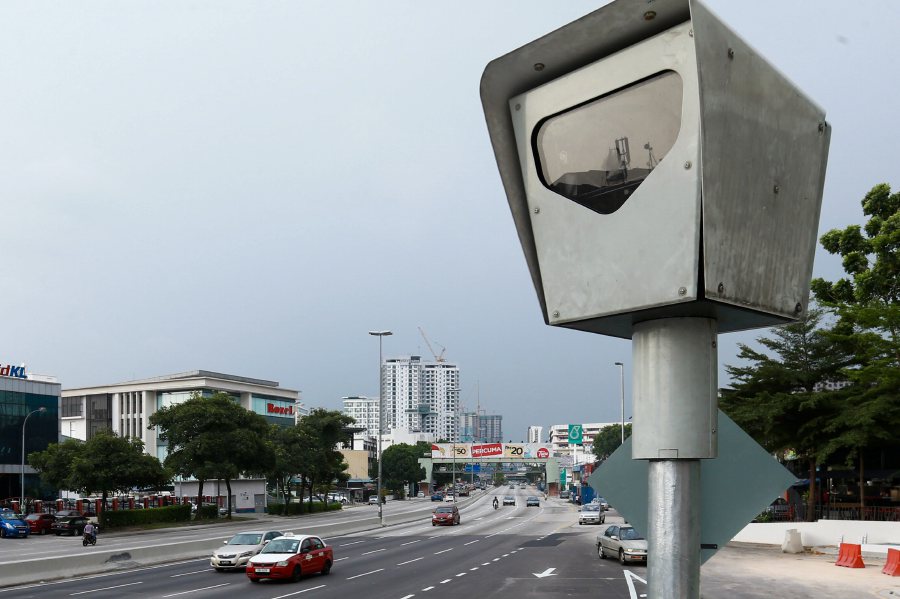
AES camera – Courtesy of NSTP/ASYRAF HAMZAH

Speaking to The Star, PLUS Managing Director Datuk Azman Ismail said the proposal is to ensure road users obey traffic laws and create road safety awareness.

Datuk Azman made the statement at the launching of Ops Selamat 14. The operation will be held from 29thJanuary to 12thFebruary in conjunction with the Chinese New Year.

How Does the AES Work?

We’ve heard some motorcyclists say that covering the motorcycle’s speedometer will avoid the AES snapping the speedometer. We didn’t know if we should laugh or cry.

The AES trigger works by determining how much time it took the vehicle to travel through a set distance. Remember the formula Speed = Distance/Time? (Please click here if you don’t.)

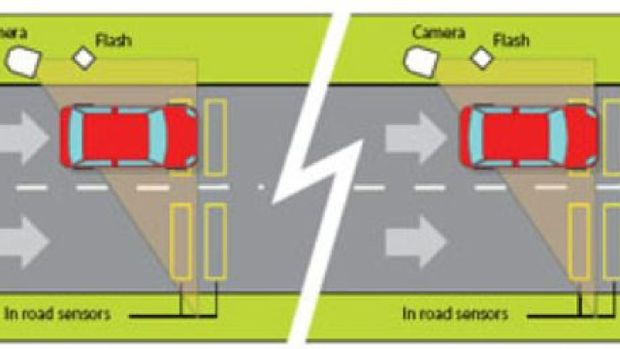
There are two types of sensors:
  1. Piezo or inductive loop sensors embedded in the road. These are to detect “slower” speeds over the limit. This system is also used to detect traffic at some intersections.
  2. A radar detector attached on the outside of the camera housing. This detects vehicles that travel at higher speeds.

For the road detectors, a pair are embedded some distance before the camera. The earlier the vehicle passes both, the faster it is travelling.

Radar works by bouncing microwaves off an object. The faster the waves return to the detector, the nearer the object is to the detector. The processing unit calculates the time difference between when the first wave was returned to the subsequent waves. The faster they come back, the faster the vehicle is travelling.

For example:

Let’s assume the two detectors or radar waves are 20 metres apart, and the car crosses in 0.5 second.

Speed = 50m/5 second = (20/1000) km/(2/3600) hr = 0.02 km/0.00014 hr = 142 km/h

CLICK! Check in MyEG for your summons.

Kamera AES – Sumber imej: NSTP/ASYRAF HAMZAH

Kerajaan akan membatalkan 3.1 juta saman AES (Automated Enforcement System).
Keputusan ini seiringan dengan pengambilalihan operasi AES oleh Jabatan Pengangkutan Jalan bermula 1 September 2018.
Menteri Pengangkutan Anthony Loke menekankan yang ini adalah tawaran sekali sahaja.

(more…)

  • The government is foregoing 3.1 million AES (Automatic Enforcement System) summons.

  • This decision is in line with the Cabinet (JPJ) taking over AES operations from 1st September 2018.

  • Transport Minister Anthony Loke stressed that this is a one-off deal.

The government has announced that they are nullifying speeding summons recorded by the Automated Enforcement System (AES).

Transport Minister Anthony Loke made the announcement during a press conference earlier today in line with the Cabinet’s decision to take over the operations of AES from two private companies beginning 1st September 2018.

“This is a one-off,” he said, “There will not be any more such offers or discounts.”

However, no refunds will be paid to those who have paid their AES summons earlier, to whom the Minister addressed, “I know those who have paid will feel it is unfair that we are cancelling unpaid summons. I would like to say thank you and sorry at the same time.”

Anthony Loke – Courtesy of mole.my

Only 690,000 AES summons were paid for since 2012, leaving 3.1 million unpaid worth RM430 million.

The agreement with the current operators is set to end on 31st August 2018, but the government has no plans to renew it. Instead, operations will be taken over by the Road Transport Department (JPJ – Jabatan Pengangkutan Jalan). “Operations” means taking of photos and issuance of summons.

The decision to not renew the concessions agreement with Beta Tegap Sdn. Bhd. and ATES Sdn. Bhd. was “because the payment system to these two companies were lopsided and received public backlash. For every summon issued, RM16 was paid to them.”

“In 2015, the (previous) government had ordered Lembaga Tabung Angkatan Tentera (LTAT) through its subsidiary Irat Properties to take over the operations of AES. RM555 million was paid to both companies for just 40 speed cameras along the highways,” revealed Loke.

Archive

Follow us on Facebook

Follow us on YouTube