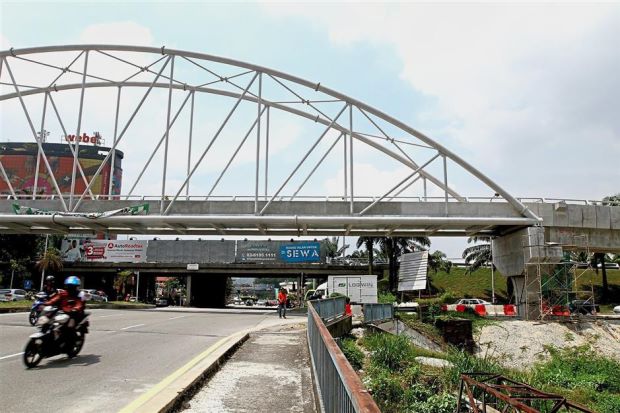
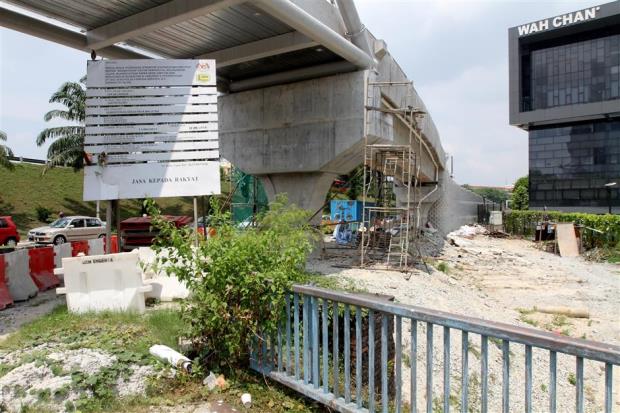
The Federal Highway motorcycle lane upgrading project will include a motorcycle-only bridge.
It spans the busy Jalan 222 – Jalan Templar – Federal Highway intersection.
The project had been delayed and is slated to be ready by early-October 2018.
The Jalan 222 – Jalan Templar – Federal Highway may be the most congested during the rush hours, but it is for a good thing in the future, reports The Star.
As part of the 8.1km-long motorcycle lane and drainage upgrade project which costs RM28 million, a motorcycles-only bridge which spans the intersection will be ready for use by early October. The project starts from Kelab Gold Negeri Selangor along the Federal Highway near Subang Parade and ends at the Kota Darul Ehsan arch, which marks the Selangor-Kuala Lumpur border.
The bridge’s underpass – Courtesy of thestar.com.my
The project had been slated to be completed in June this year, but heavy rain which began in May and change of design delayed it for over a month, explained a Public Works Department (JKR) spokesman. Other factors that caused the delays were theft of equipment, the general elections and long stretches of public holidays.
The project seeks to repair or upgrade damaged road surface and alleviate flooding problems in sections of the bike lanes which spans a total of 16km in both directions.
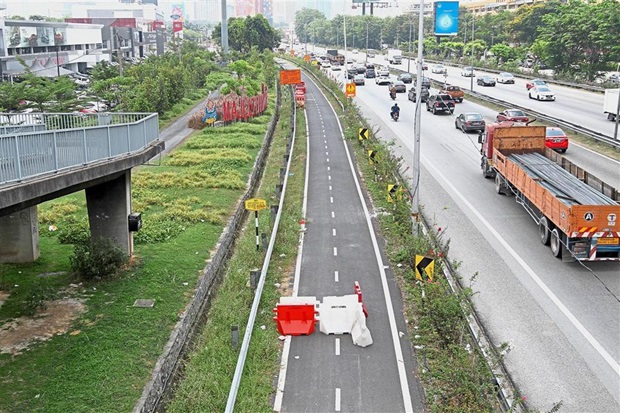
A check by Bikes Republic revealed that a section of the bike lane after Jalan Barat heading towards Kuala Lumpur had been given a new asphalt cover, although it had not been widened as most expected. However, the section remains closed for some reason.
A section of the bike lane near Jalan 222 is still closed – Courtesy of thestar.com.my
In the time being, motorcyclists are forced to share the Federal Highway’s main throughway with other heavy vehicles, putting their lives and those of others in danger. (Please click on the link below to read our earlier report.)
As such, we recommend that motorcyclists remain in the left lane as much as possible should you choose to use the Federal Highway. Since the old highway’s lanes are narrower, heavier vehicles drive closer to one another, and this represents dangerous challenges to motorcyclists, especially if you are caught in the faster lanes when the traffic suddenly becomes less congested and speeds of other vehicles pick up.
We hope the Public Works Department and their contractors pick up the pace and complete the project as soon as possible in the interest of safety of all road users.
TechTOC is a weekly technical column moderated by “Foreman” Oh Kah Beng (KB).
KB is now the Motorsports Consultant at the TOC Automotive College’s motorcycle racing venture and Principal Trainer at his Most Fun Gym (MFG) MX-school
Send in your technical questions, and the winner receives a complimentary session at KB’s Most Fun Gym MX-school!
We began with TechTOC last week, when “Foreman” Oh or as he likes to be called, “KB”, answered a reader’s query about engine operating temperatures (please click on the this link to read about it). This week, KB answers a good question about motorcycle suspension, namely the terminologies.
Question:
I always hear my friends talking about set up. Can you explain what is preload, compression and rebound damping?
— Wong Siew Seng, Selangor
Answer:
To answer your question needs to take up and entire article so I’ll try to be as brief as I can and cover only the basics.
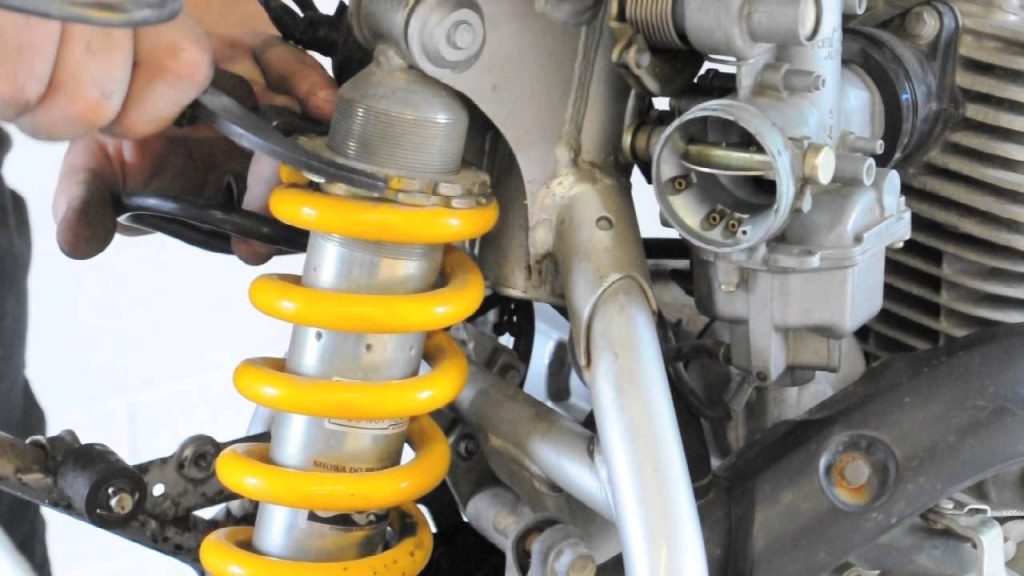
The short answer is, preload is to adjust suspension sag. Sag (there are unladed and laden sag) is the name given to the amount of suspension travel used up when the bike settles under the bike’s own weight (unladen) and when the rider sits on the bike (laden). You alter its settings by rotating the collars or ramp clockwise, which loads the spring. It will cause the spring to push back on the collar, thereby reducing the sag and raising that end of the bike’s ride height at the same time. Move the collars up and the ride height drops.
But do not be fooled! The frustrating misconception is that altering the preload also changes your suspension’s stiffness (spring rate). This is totally wrong! You DO NOT change the spring rate unless you replace the spring. The suspension feels harsh when you add in too much preload as you have reduced the sag too much and the suspension sinks into its stiffer stroke. Think of sag as “freeplay.” However, too little preload is also a bad thing, as the suspension will have to much “freeplay” and compress all the way to its bump stop.
Before we proceed to the subject of damping, let us get this out of the way:
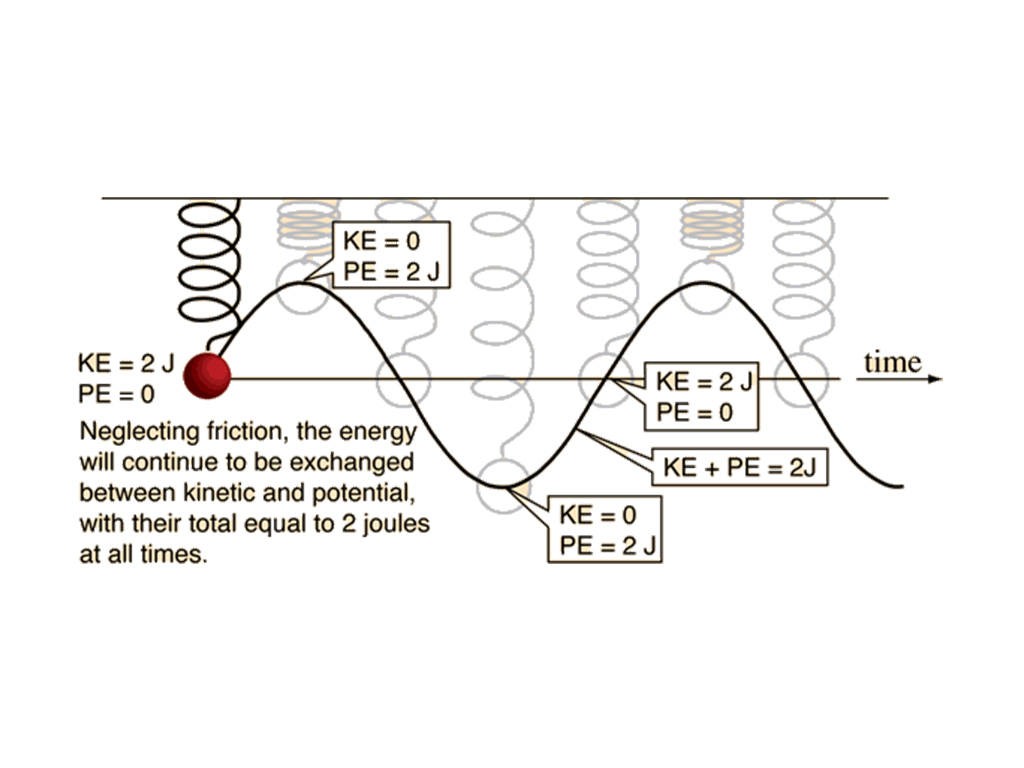
A spring if left to work alone (without damping) is prone “oscillations.” A compressed spring stores energy and when that energy is released, the spring will re-extend past its original length. When that happens, the elongated spring now stores potential energy and will recompress the spring when released. This process happens over and over again, the spring will “oscillate” until the energy turns translates totally to heat. You will feel the bike wallow up and down, like sitting on a motionless boat on a stormy sea – up and down, down and up, up and down.
Spring oscillation graph – hyperphysics.phy-astr.gsu.edu
This is where damping comes into play. Damping controls the movements of the spring.
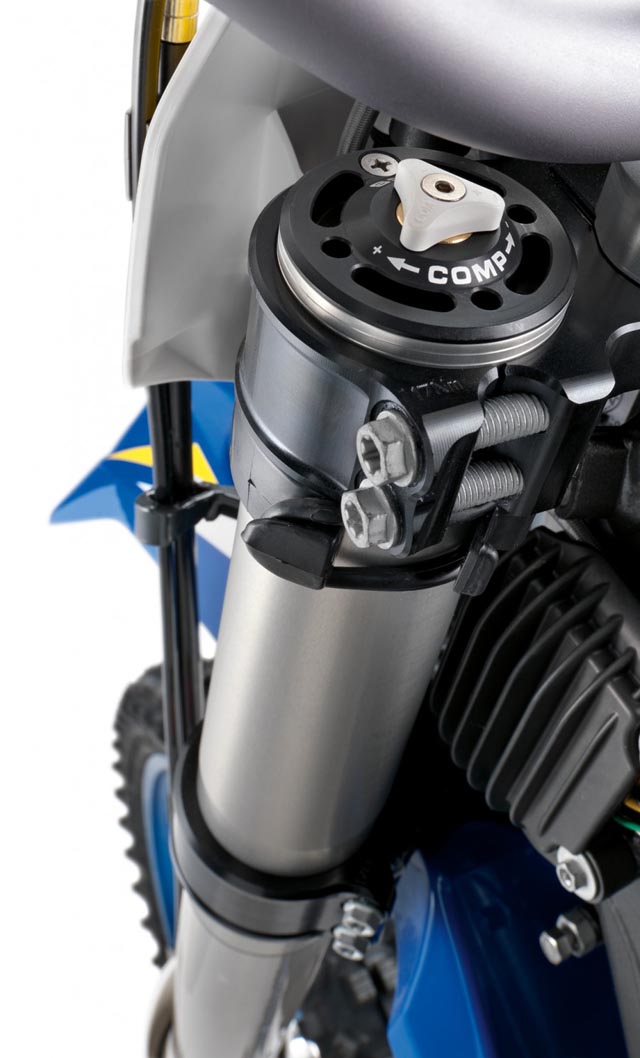
Compression damping (marked as “COM”on the fork/s or shock/s) pertains to how “quickly” or “slowly” the wheel is allowed to push upwards when it contacts a bump. If you increase compression, the valves inside the fork or shock shuts off the flow of hydraulic oil or gas, thereby resisting the wheel’s upward movement. Conversely, if you decrease compression, the valves open up and oil or gas is able to flow more freely, hence the wheel comes up faster.
But DO NOT go to extremes. Just because you ride fast, it does not mean you need more compression damping. If you increase it too much, there will be too much resistance to the wheel’s movement, rendering it difficult to “soak” up bumps i.e. the suspension could not comply with road irregularities. This will cause the wheel to hop and lose traction. Additionally, a lot of bump energy is transferred to the rider. A bit less compression works for cornering at times, allowing the tyre to absorb the bumps and “dig” into the road (better mid-corner stability, too).
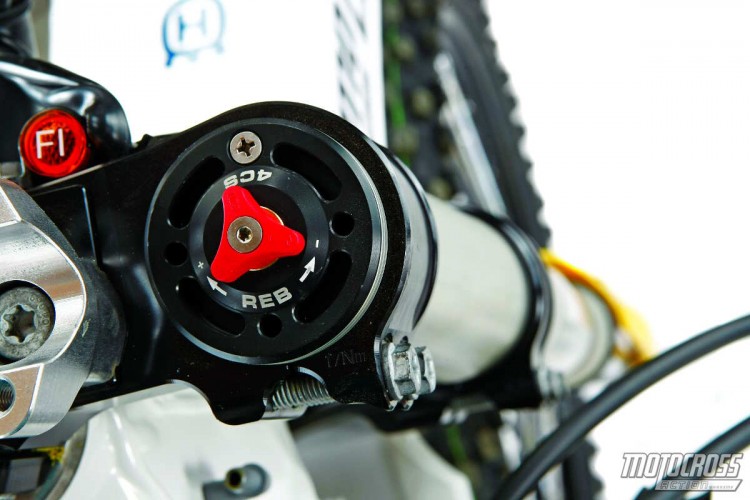
Rebound damping is opposite to compression damping. It regulates how quickly or slowly the wheel returns to its normal position after compression. Too much rebound will cause the suspension to “pack up,” as in it returns too slowly and that end of the bike will feel loose as the wheel stays up too long from its optimal position. Too little rebound, conversely, causes the wheel to be pushed back down too quickly (“packing down”) and the bike will feel harsh.
Too little rebound can be confused with too much compression but pay attention to whether the “hit” is felt immediately when you contact a bump or just after it. If it is felt immediately when you hit a bump, it is due to too much compression (or a spring that is too hard). Conversely, if the bump is felt after contacting it, it is due to too little rebound damping.
So, adjust the preload to obtain the correct sag (30 to 40 mm or 1/3 of total suspension travel) and ride height, compression damping for bump absorption and rebound damping for how the wheel returns after bump absorption. Understanding this will do wonders to the handling of your motorcycle.
Although suspension settings are subjective as every rider has a different comfort zone and riding environment, personally, I always like to set both compression and rebound damping on the softer side, and work my way up, using the factory (stock) setting as the baseline. An overly soft setting is more forgiving than overly hard one, as the former is more pliant while the latter is harsh and unforgiving, which could lead to extreme occurrences such as tyre slides and tank slappers.
You can learn more about this in the TOC Automotive College’s Superbike Technician Course. Please visit TOC Automotive College’s Facebook page or their campus (map below) or call call (+603) 7960 8833 for more information. Likewise, you can find more information about the TOC Bina Bakat Program here, or email info@toc.edu.my. Please click on this link for further information on the TOC Superbike Technician Course.
You may also visit Most Fun Gym for off-road training, as it improves your riding skills for all riding conditions. Please call +6012-2072516 for more enquiries or to book an appointment.
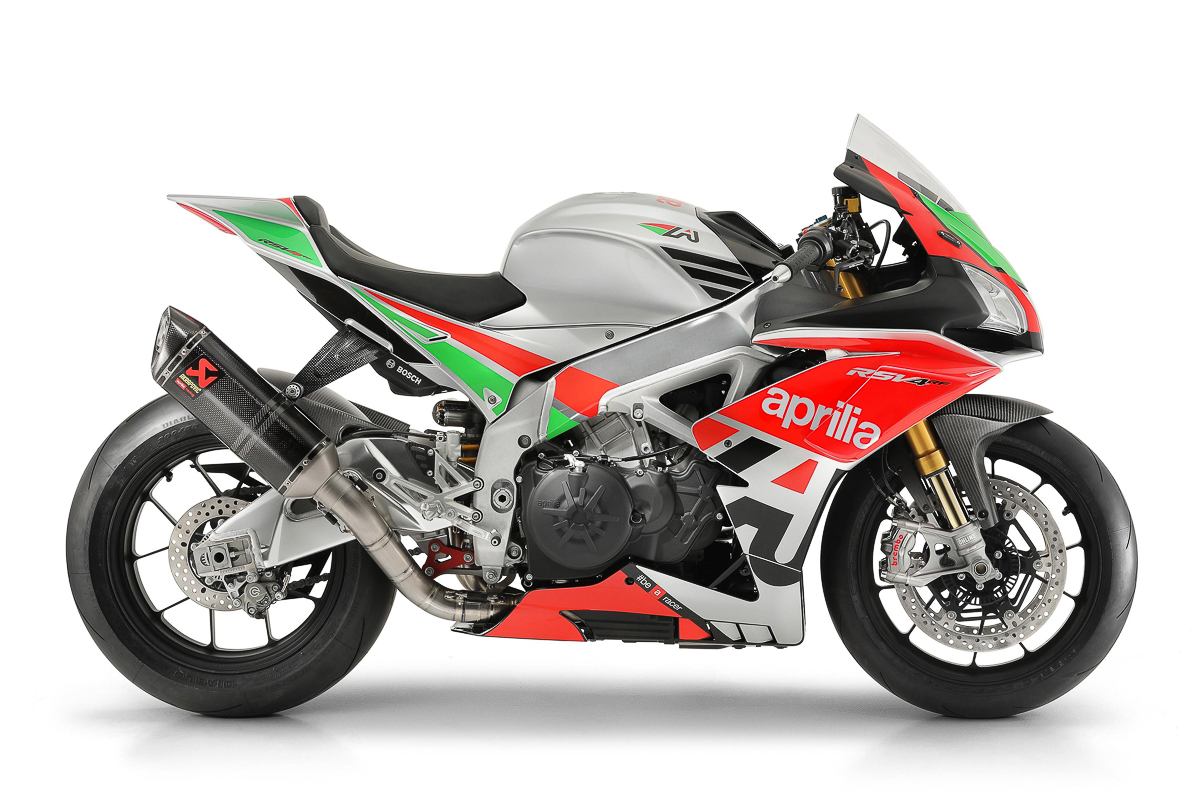
Talks about a possible 10th anniversary 2019 Aprilia RSV4 are currently ongoing in the world of motorcycling.
The 2019 model is set for the latest updates in order to stay ahead of the game, especially in WorldSBK.
We’re talking about a massive power increase, new chassis, the latest electronics, aero-fairings, and many more.
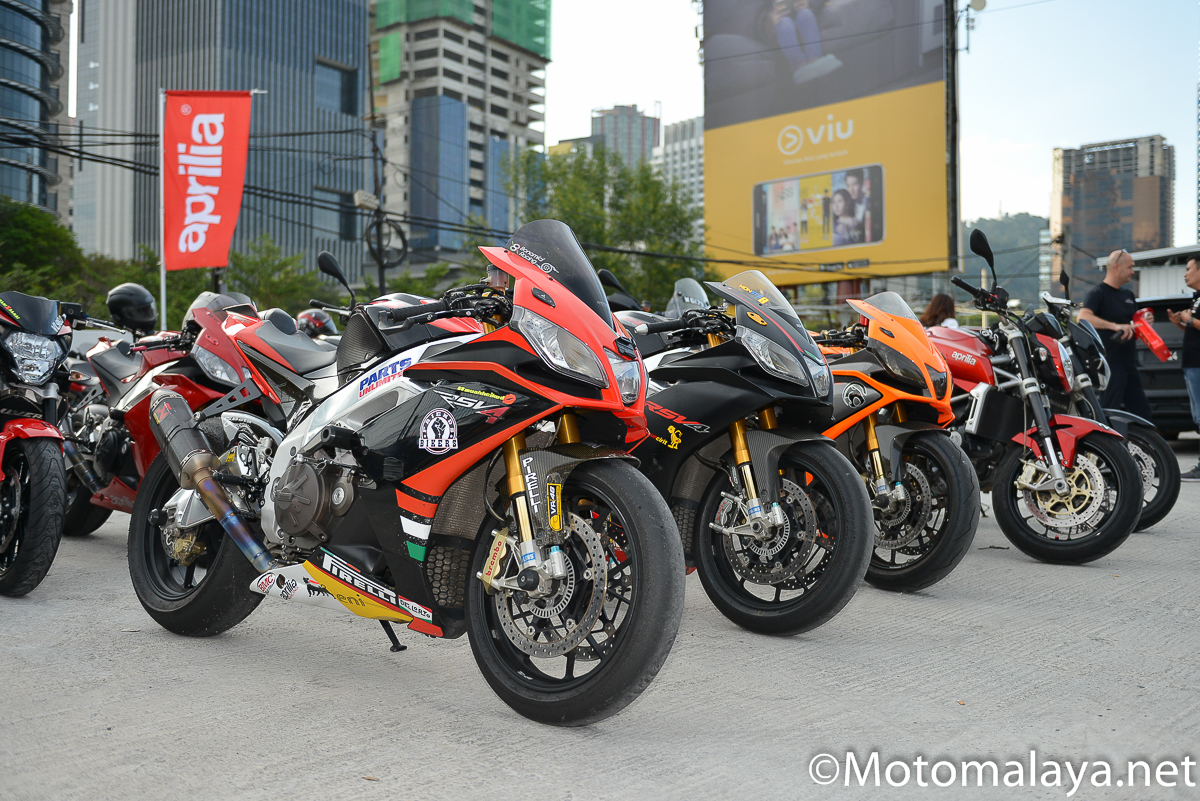
The Aprilia RSV4 superbike has been around for quite some time now and for 2018, it will be celebrating its 10th anniversary as one of the most unbelievable sports machines of all time. With that being said, is Aprilia planning anything special to celebrate this decade-long success? (more…)
While modern motorcycles are as reliable as the atomic clock, that doesn’t discount emergencies.
It’s always best to be prepared for the worst.
Roadside motorcycle repairs are almost extinct in these times as motorcycles become ever more reliable. However, that doesn’t rule out breakdowns due to say, minor accidents (touch wood!), such as experienced by this writer during the recent GIVI Rimba Raid Mat Daling.
Time to break out the tools kit.
This is no time to discover that either you’ve got no tools or crappy and/or inadequate ones that came with your bike (depending on the manufacturer).
Here are Ten Must Have Tools. You could choose to store them under your bike’s seat or in the tool box, but best to we ride while adhering to the Scouts’ principle of being ready.
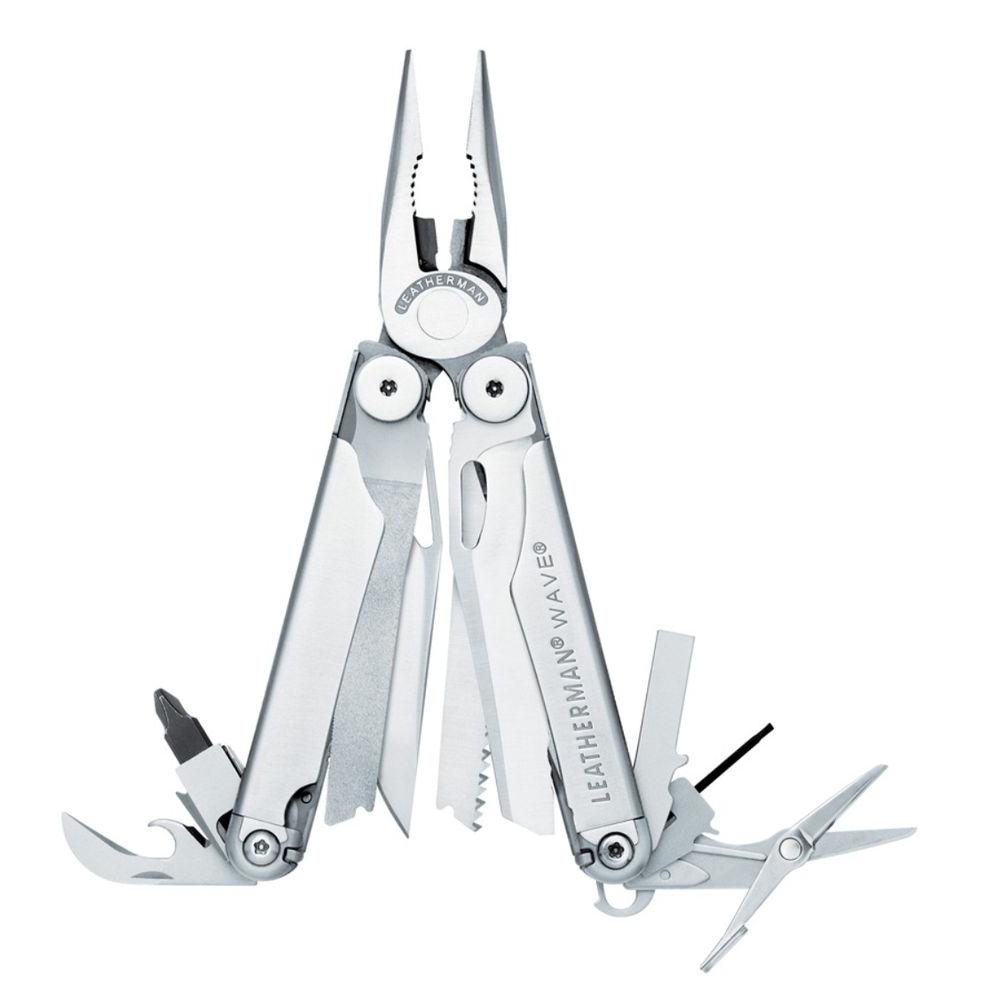
Multi-tool
A multi-tool is always handy as it combines many tools into one compact package. You’d usually find a knife, a pair of pliers, a pair of screwdrivers with different heads. Do get yourself a sturdy set such as those from Victorinox (the ever-popular Swiss Army knife), Gerber or Leatherman.
The caveat of a multi-tool is that it only contains basic tools, leaving out the wrench, among others.
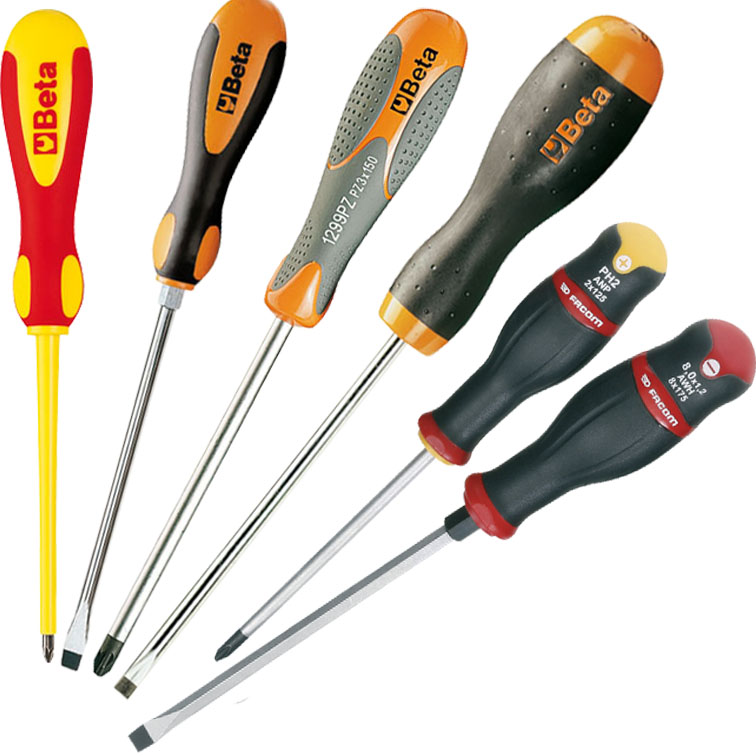
2. Screwdrivers
The screwdrivers included with multi-tools are too short, thereby lacking the torque to turn stubborn screws, besides being unable to reach difficult places. You ought to include a pair of 15cm (6”) long Phillips and straight-edged screwdrivers under the seat. Also, best that they have magnetic tips to help you in retrieving metal objects.
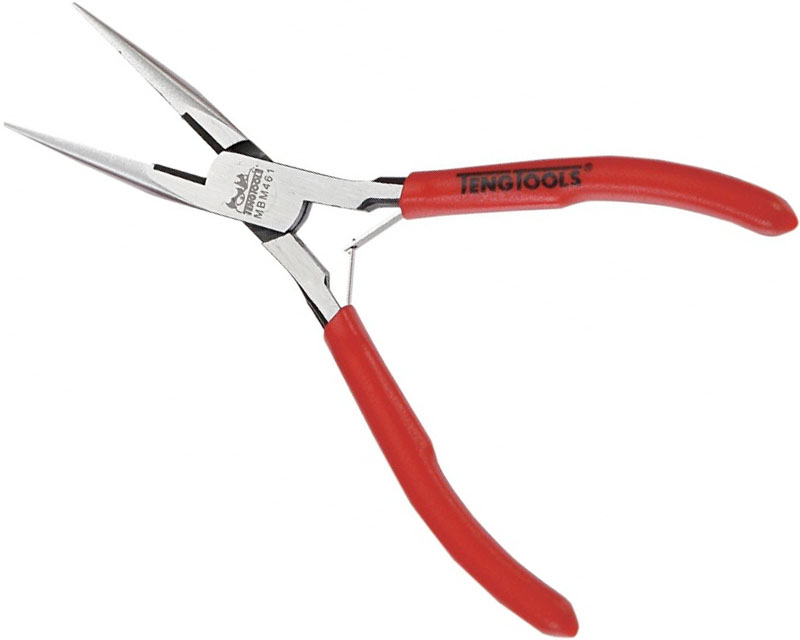
3. Pliers
You may already have a multi-tool, but it’s still best to have a dedicated pair of pliers under the seat, in case you forget the multi-tool. We prefer the needle-nose (long nose) variety as it could fit into tight spaces. Do choose the pair with a sharp and strong cutter.
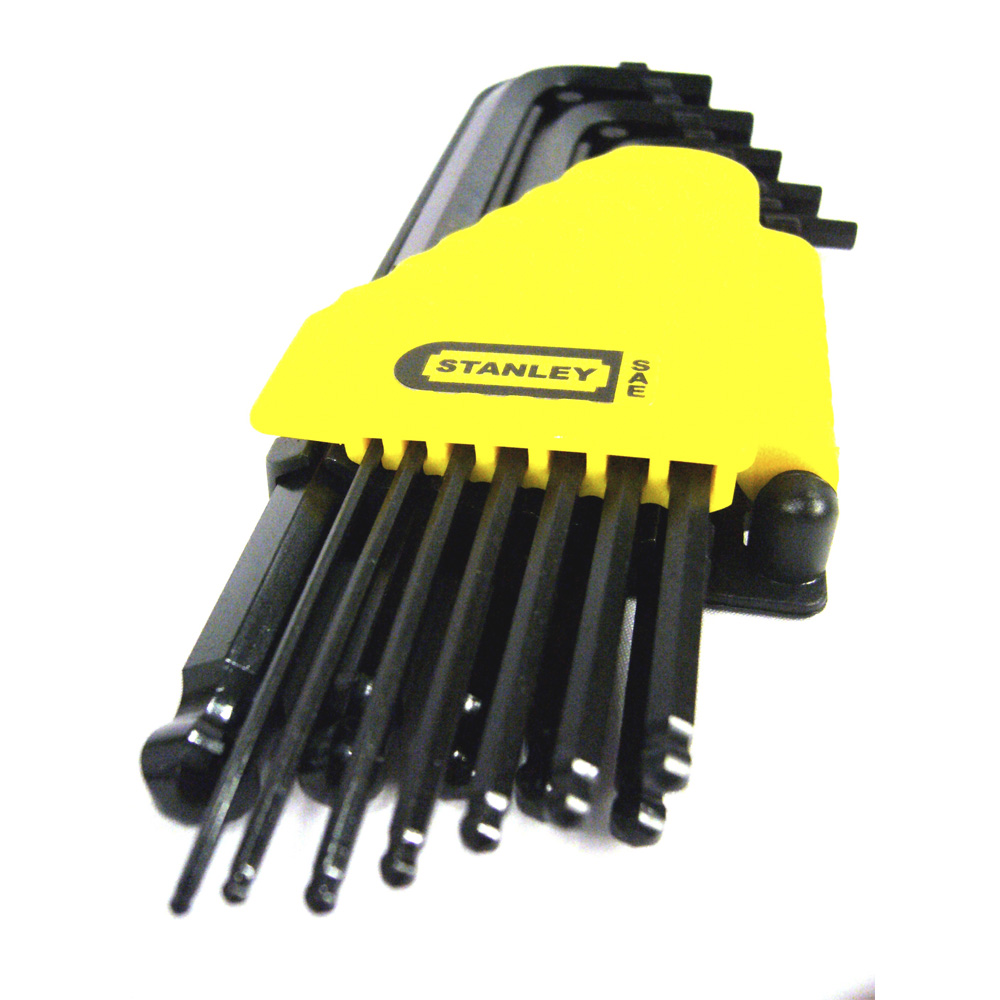
4. Allen/Hex Keys
Most bikes use both normal screws in combination with allen or hex (usually called “flower” locally) screws. Yes, you can find an entire set contained in a flip-out style holder, but we recommend that you obtain ones with long handles for the necessary torque. Additionally, find those with ball-ends as they slot in easier at acute angles. You can bring those corresponding to the sizes of the screws on your bike and leave the rest at home.
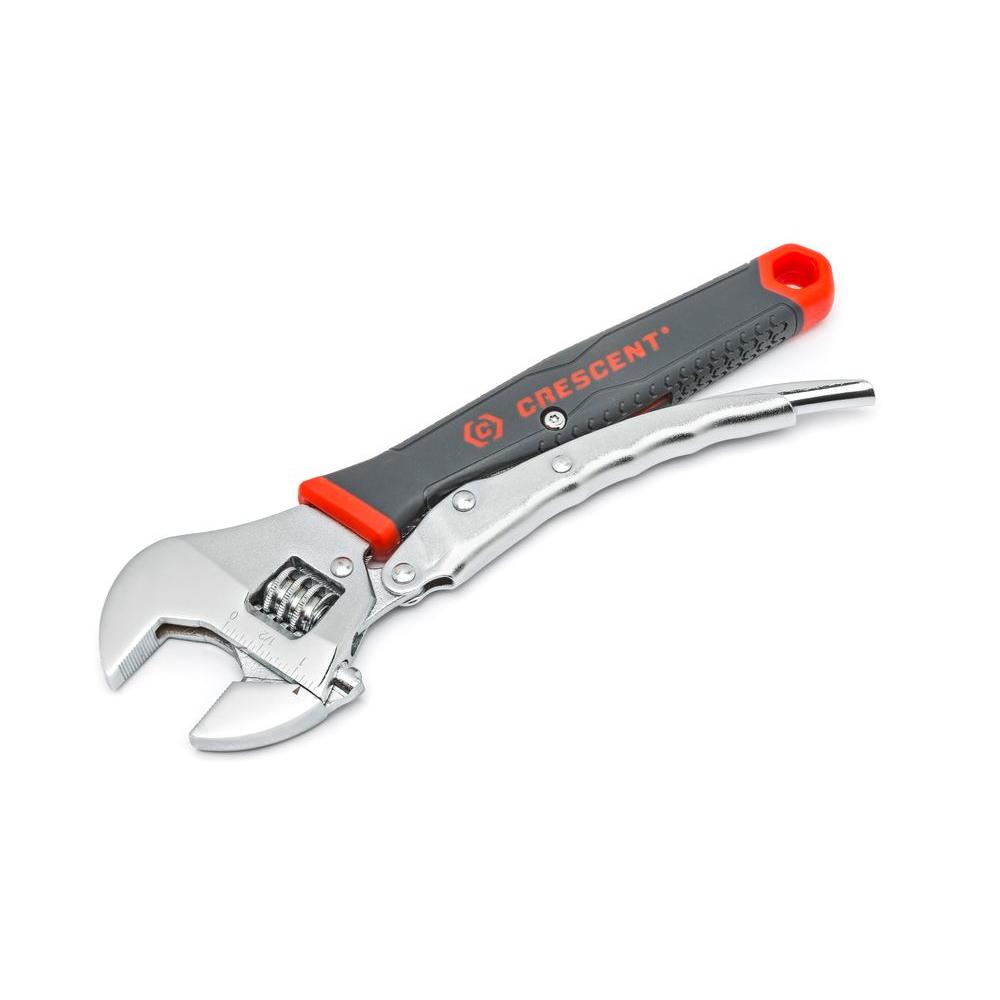
5. Adjustable wrench (spanner)
Honestly, we abhor the adjustable wrench as it never fits a bolt or nut exactly, leading to rounded bolts and nuts. Yet, it’s the only tool you could turn to when you don’t have enough wrenches or sockets. A locking type is recommended as it frees your hands to work on other things.
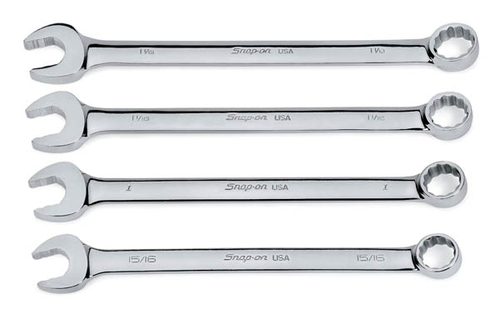
6. Wrenches (Spanners)
How could anyone leave these out? You don’t have to buy from the smallest to the largest, instead have those sizes on your bike. Please don’t be cheap when you shop for wrenches (or any tool for that matter) as low-quality ones with have you crying over rounded bolts and nuts.
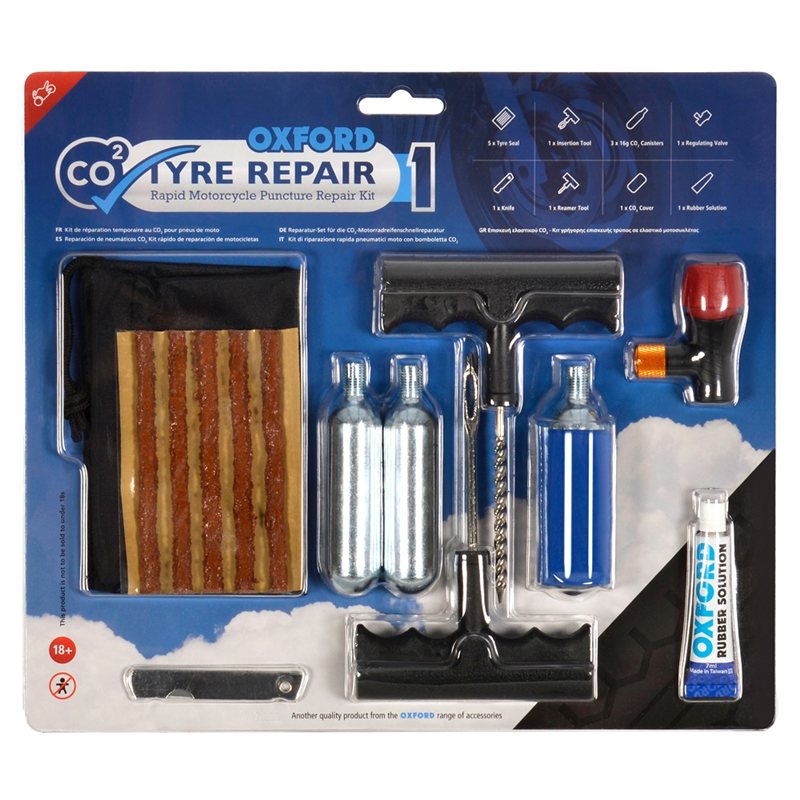
7. Puncture repair kit
Every motorist, motorcyclists included, should learn how to fix a flat tyre and carry a set of puncture repair kit. Sure, you could call for assistance but what if you had a flat in some deserted location without telephone service. At night. We found this Oxford tyre repair kit in Hodaka Motoworld.
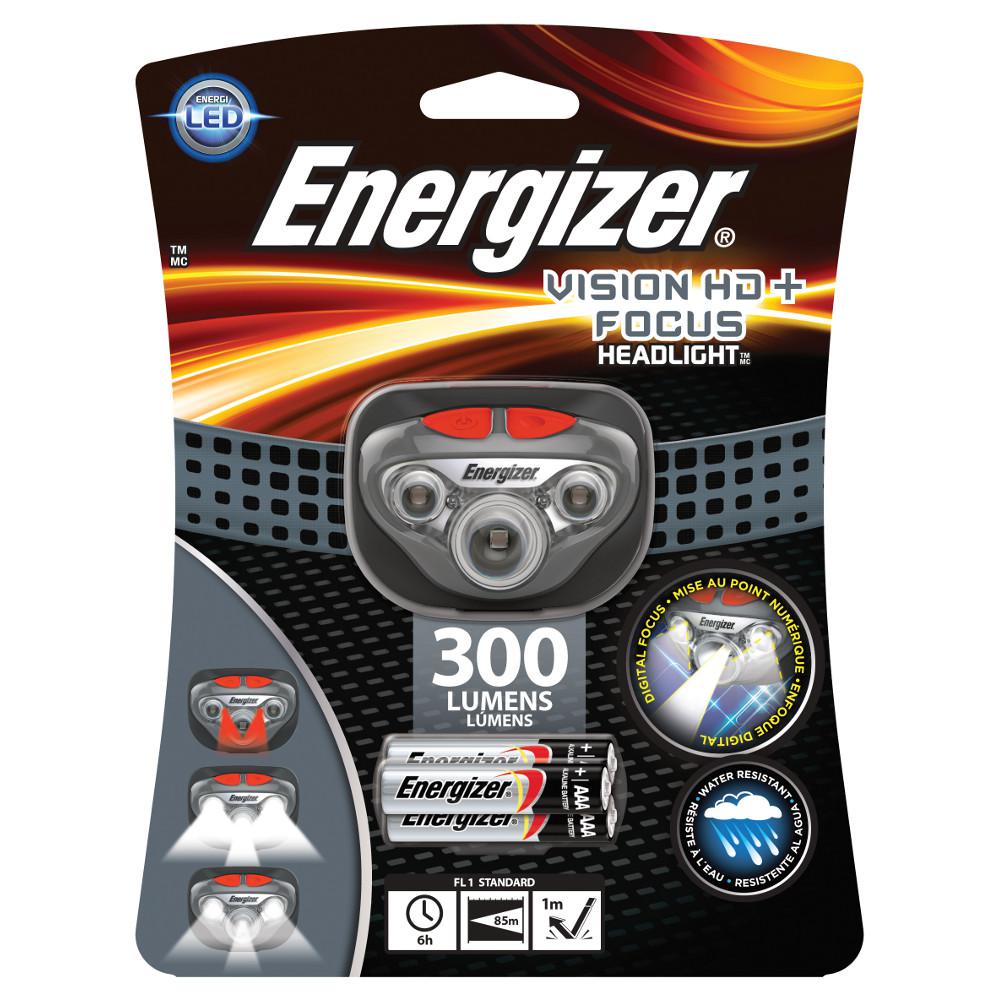
8. Torchlight
You could argue that any mobile phone has a torchlight function. Very true. But you need one hand to hold on to it or place it on somewhere secure. A headlamp is best. We found compact, bright, weatherproof and long-running LED ones from Energizer here in Malaysia.
9. Cable ties
No tool pouch or toolbox is complete without cable ties. You could repair just about anything with them, such a dropped number plate, loose bodywork, etc.
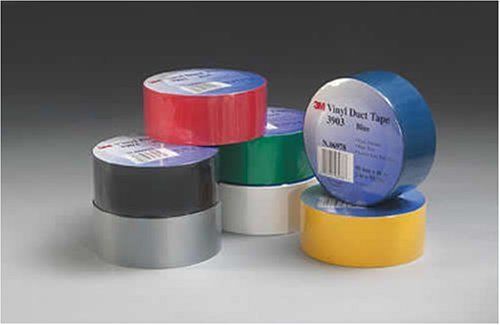
10. Duct Tape
No ducks were harmed in making duck tapes. Hahaha. Sorry, just a little joke. Duct tapes are excellent for temporarily repairing leaks for example a hose (hence the name “duct”) or patching up small leaks.
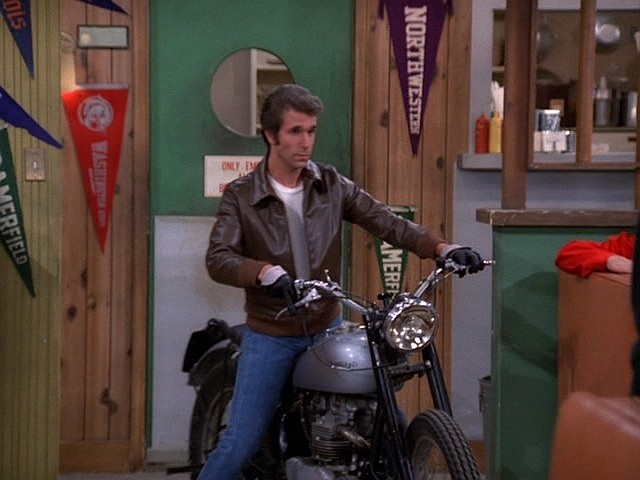
TV sitcom Happy Days portrayed the ideal American life in the 60’s.
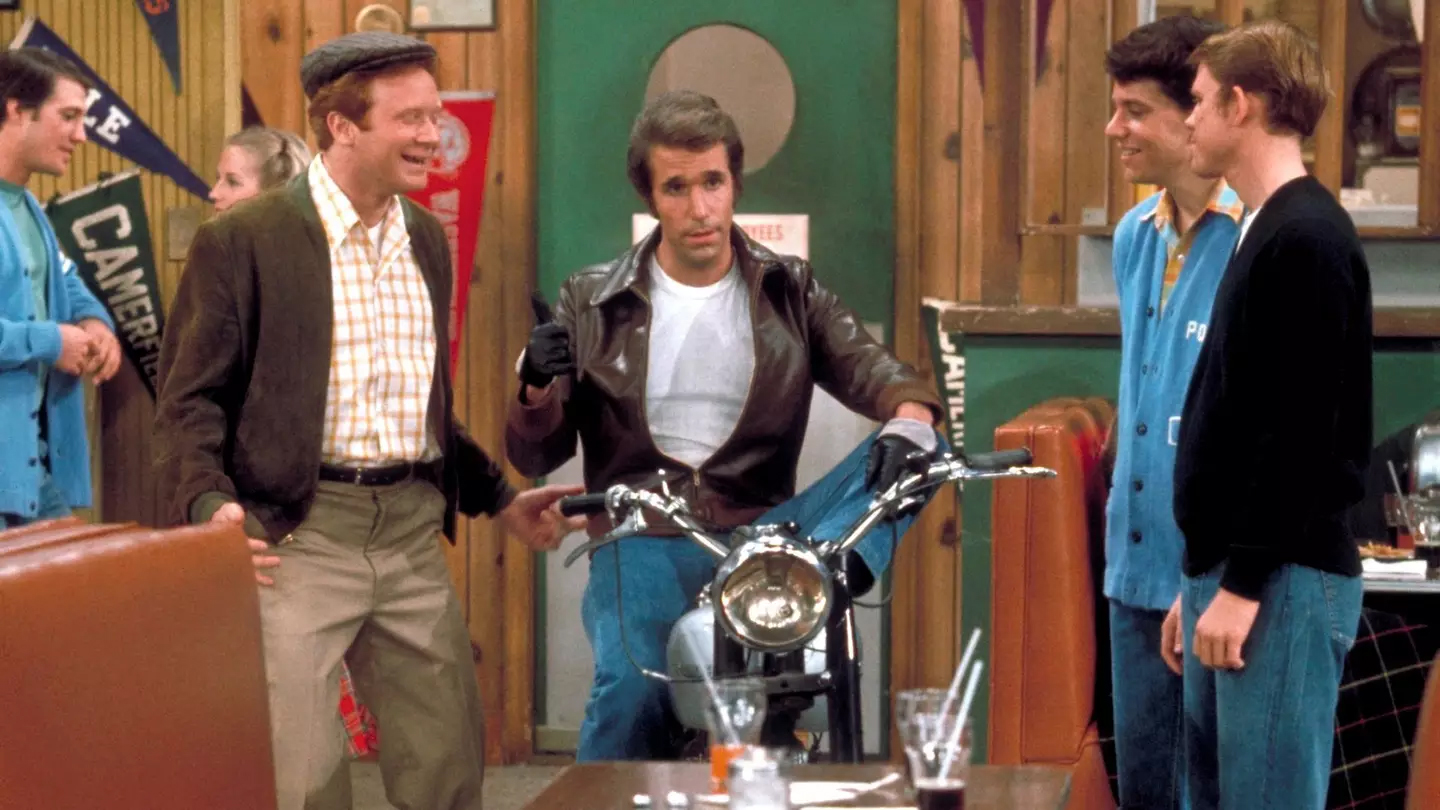
One memorable character was “The Fonz.”
He was shown posing on a 1949 Triumph TR5 Trophy which was auctioned last month.
Long before The 70’s Show celebrated life in the Baby Boomer, another TV sitcome called Happy Days celebrated the Swingin’-60s. Some of you may well remember a colourful (well, black leather is colourful for us bikers) character called Arthur Herbert Fonzarelli (played by Henry Winkler), better known as “Fonzie” or just “The Fonz.”
The intro of the show had The Fonz posing on a motorcycle, with his signature pose and “Ayyy” tagline. Other characters included “Richie Cunningham” which was played by a certain Ron Howard.
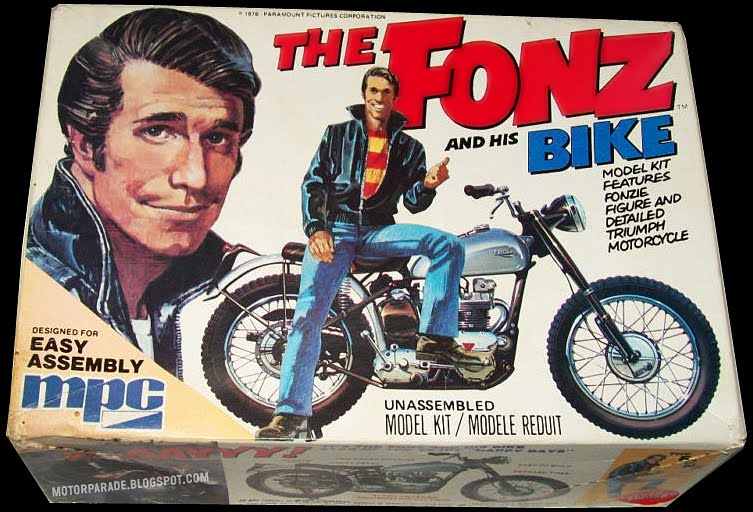
Fonzie and the Triumph were so famous that they even sparked a model kit.
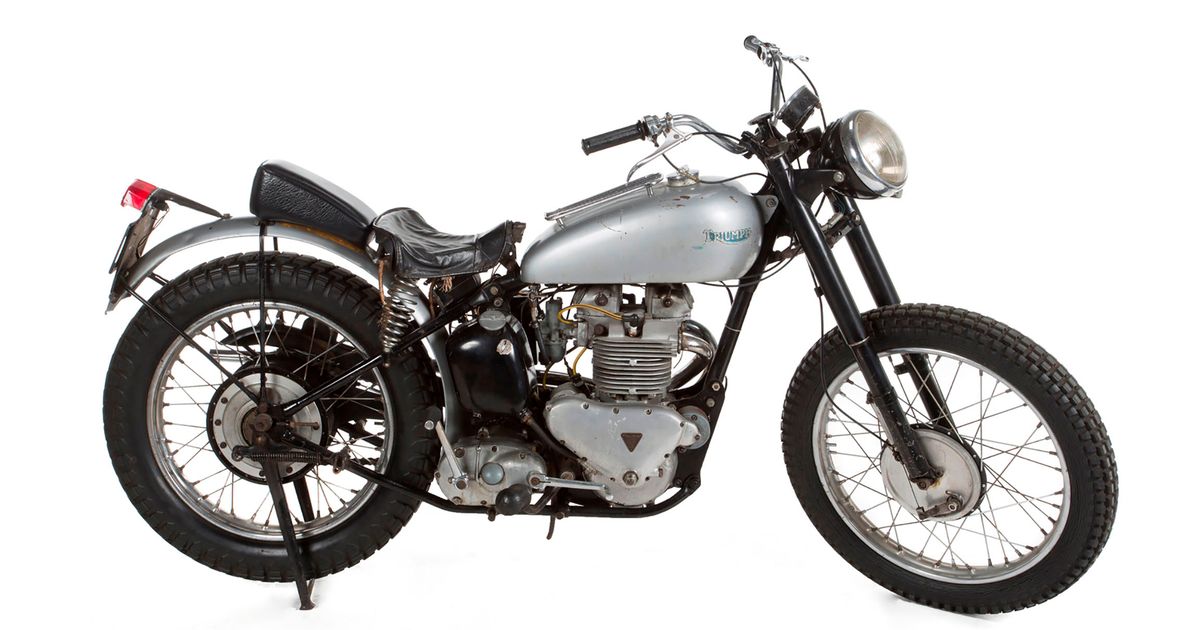
That motorcycle The Fonz posed on was a 1949 Triumph TR5 Trophy, when it was not too unlike the Bonneville but focused more on all-terrain riding. Yes, before the Trophy became a tourer. It was made from 1949 to 1958, powered by a 498cc OHV parallel-Twin.
The Fonz on the Triumph – invaluable.com
Although The Fonz epitomized the 50s/60s cool of being on a bike, Winkler didn’t actually know how ride very much. Hence, he was only filmed mostly posing on the bike and riding it a little; the sound of a motorcycle was inserted during scenes when he arrived at the Cunningham house. There were three bikes used for the show, but Winkler preferred the Triumph because it was the lightest (easier to balance).
On a side note, this particular Triumph wasn’t any other Trophy, as it was customized by Bud Ekins. Yes, the stuntman who stood in for Steve McQueen’s heroic and iconic motorcycle jump over the fences of the PoW camp on a Triumph TR6, in the movie The Great Escape. Ekins customized The Fonz’s TR5 Trophy with a silver paint job, new handlebar and removed the front mudguard.
The Fonz’s 1949 Triumph TR5 Trophy – www.mirror.co.uk
The bike was part of an exclusive Julien’s Auctions Hollywood Legends auction at Planet Hollywood in Los Angeles last month. Other items included Han Solo’s blaster from Return of the Jedi, the Evil Superman suit from Superman III, a 1969 Harley-Davidson Electra Glide owned by Marlon Brando and a 1987 Harley-Davidson Heritage Softail Classic, among other legendary Hollywood paraphernalia.
Fonzie’s Triumph was expected to fetch between $100,000 to $200,000. The hammer fell on S179,200.
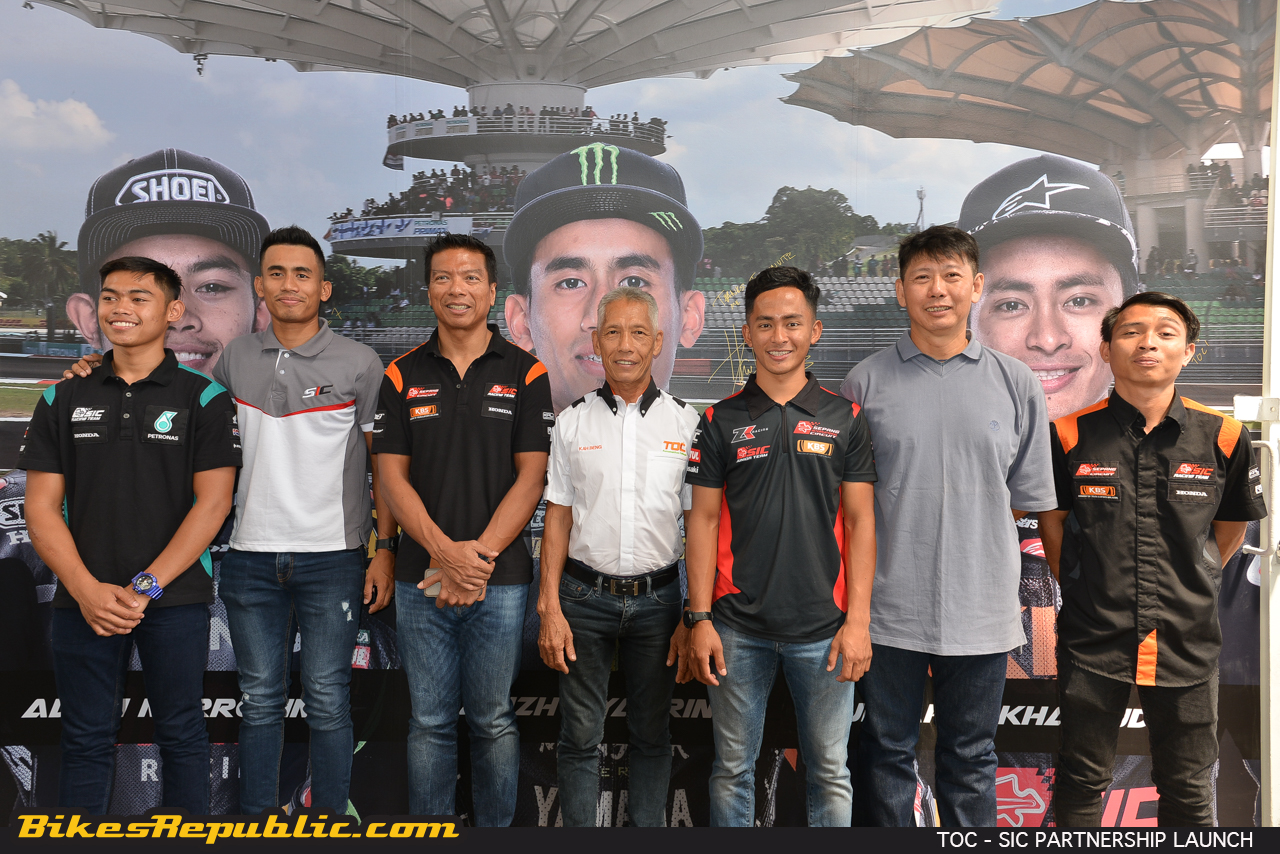
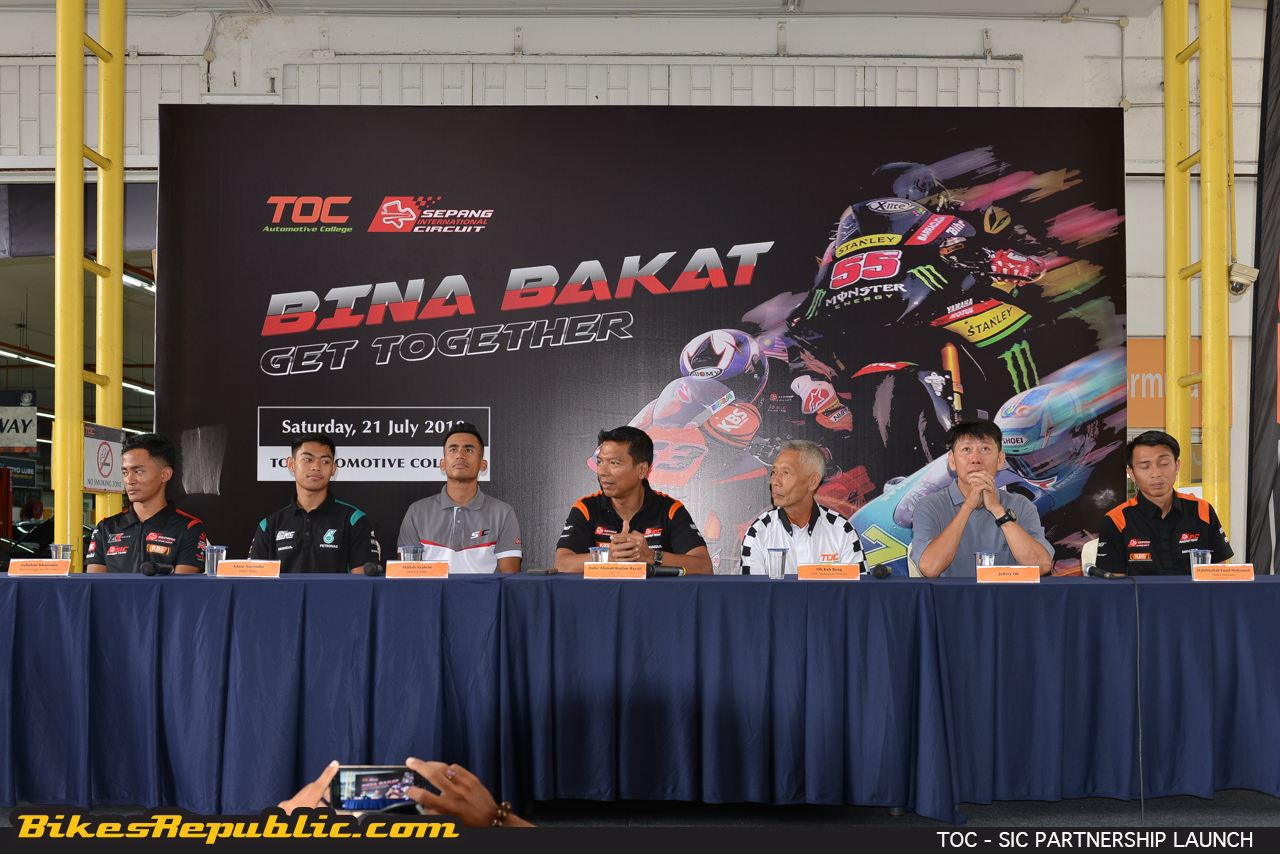
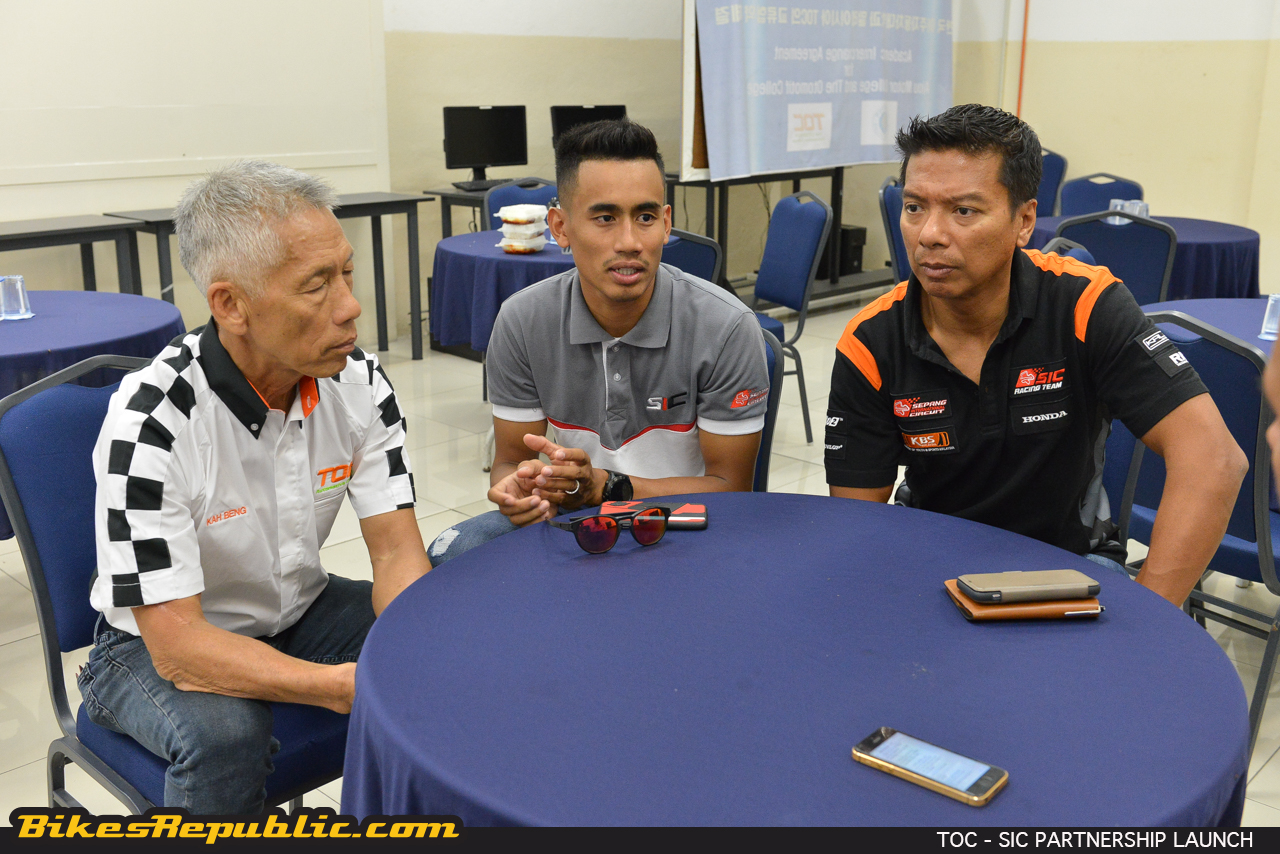
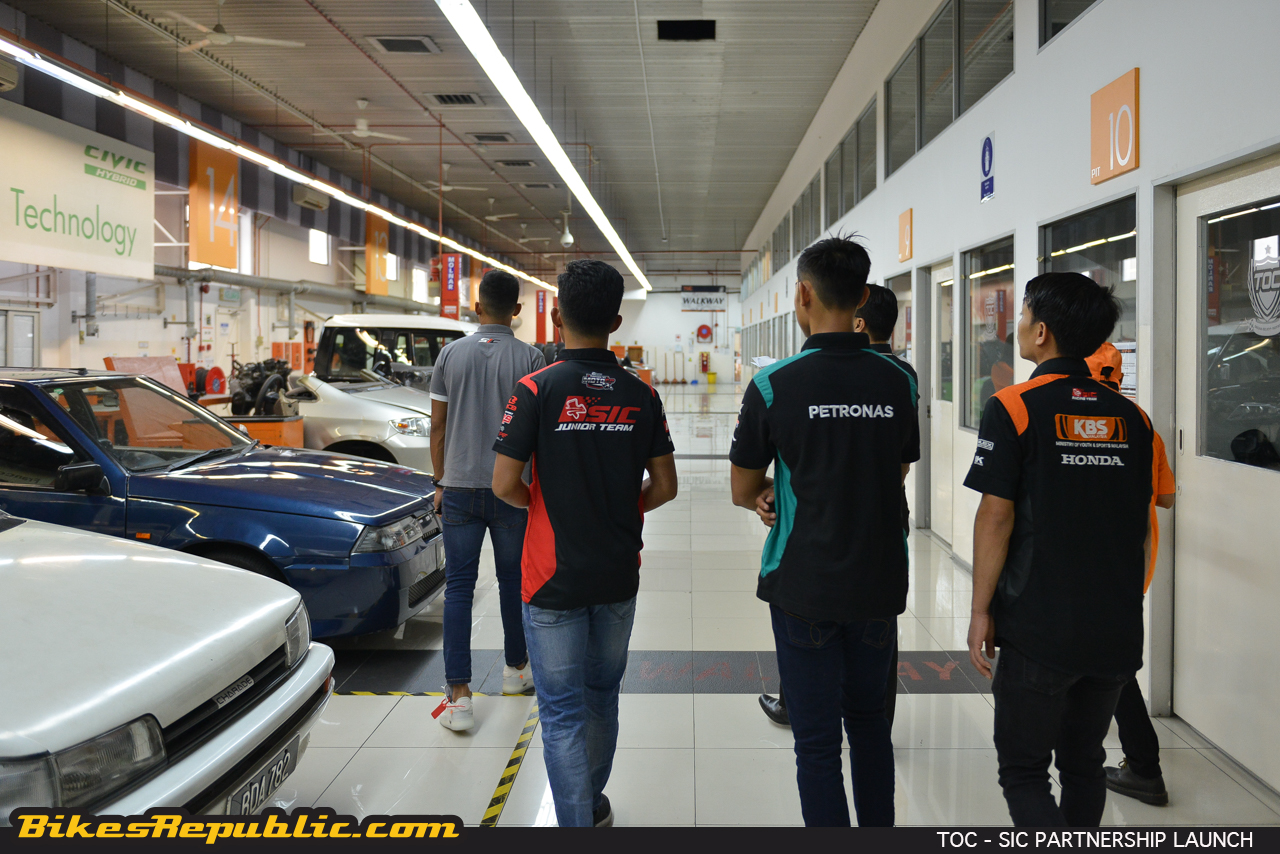
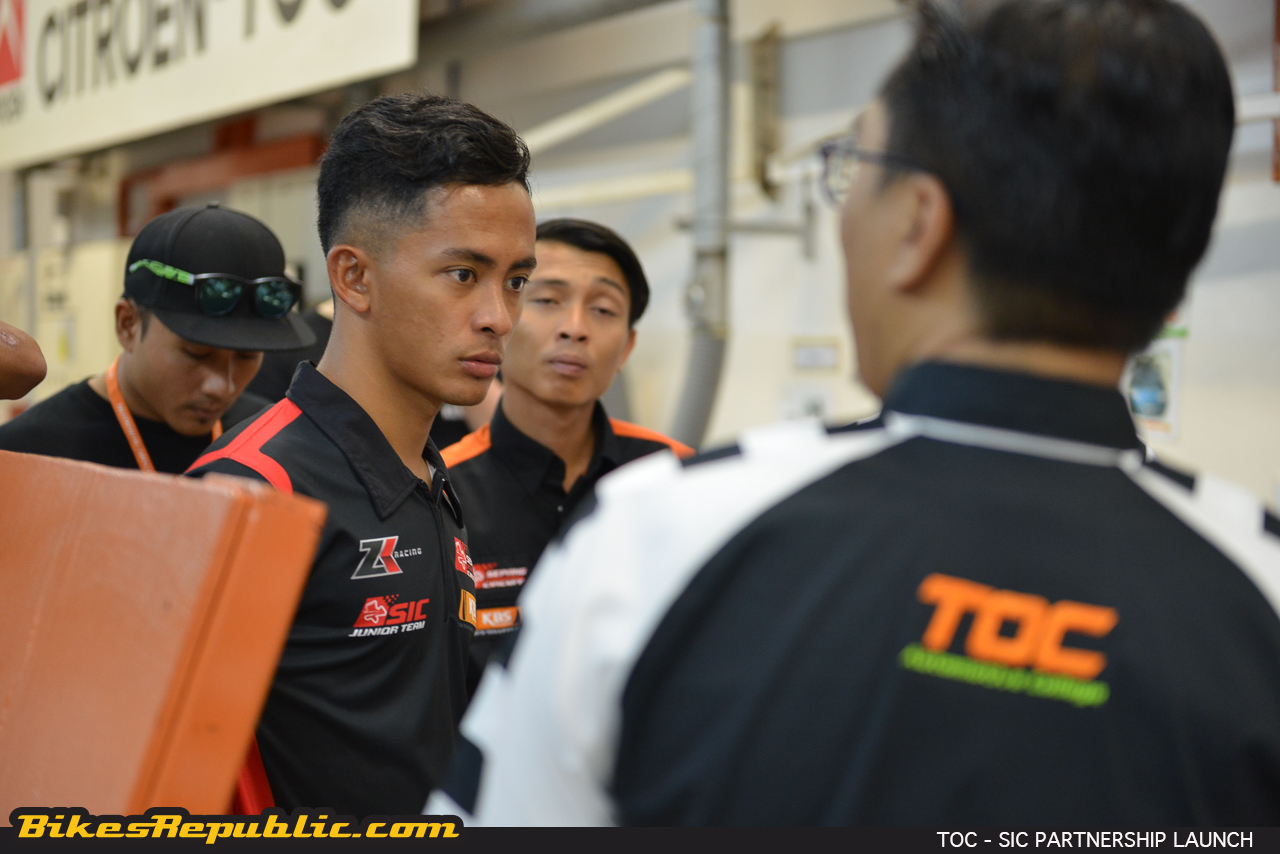
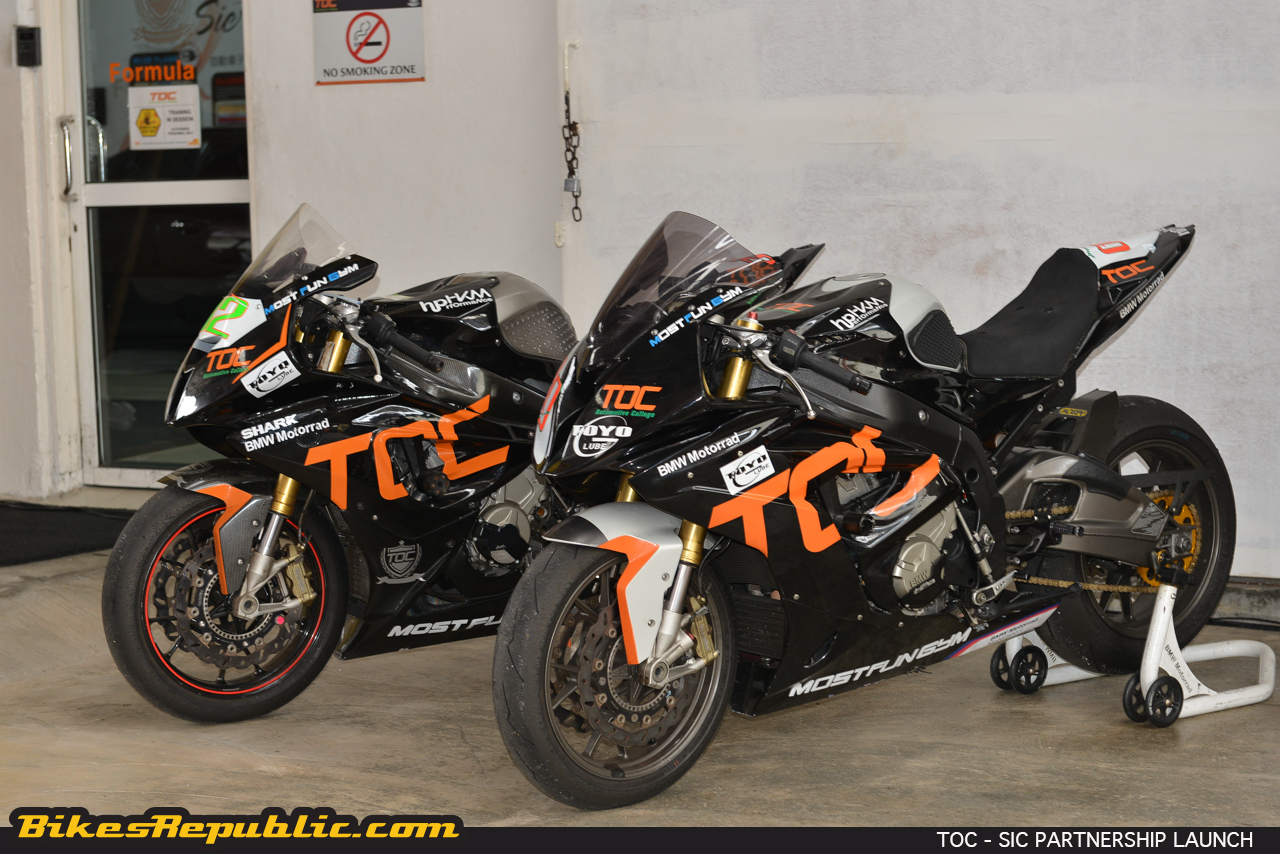
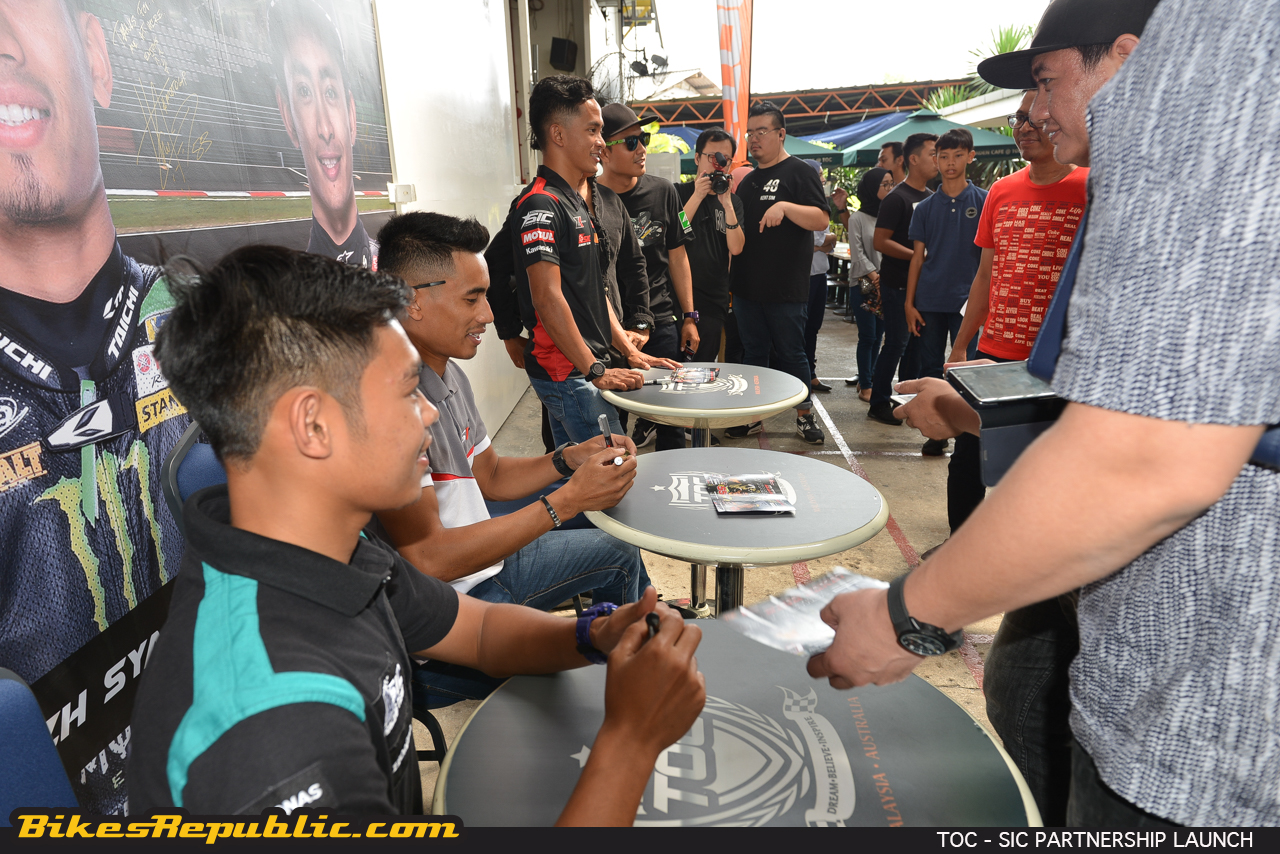
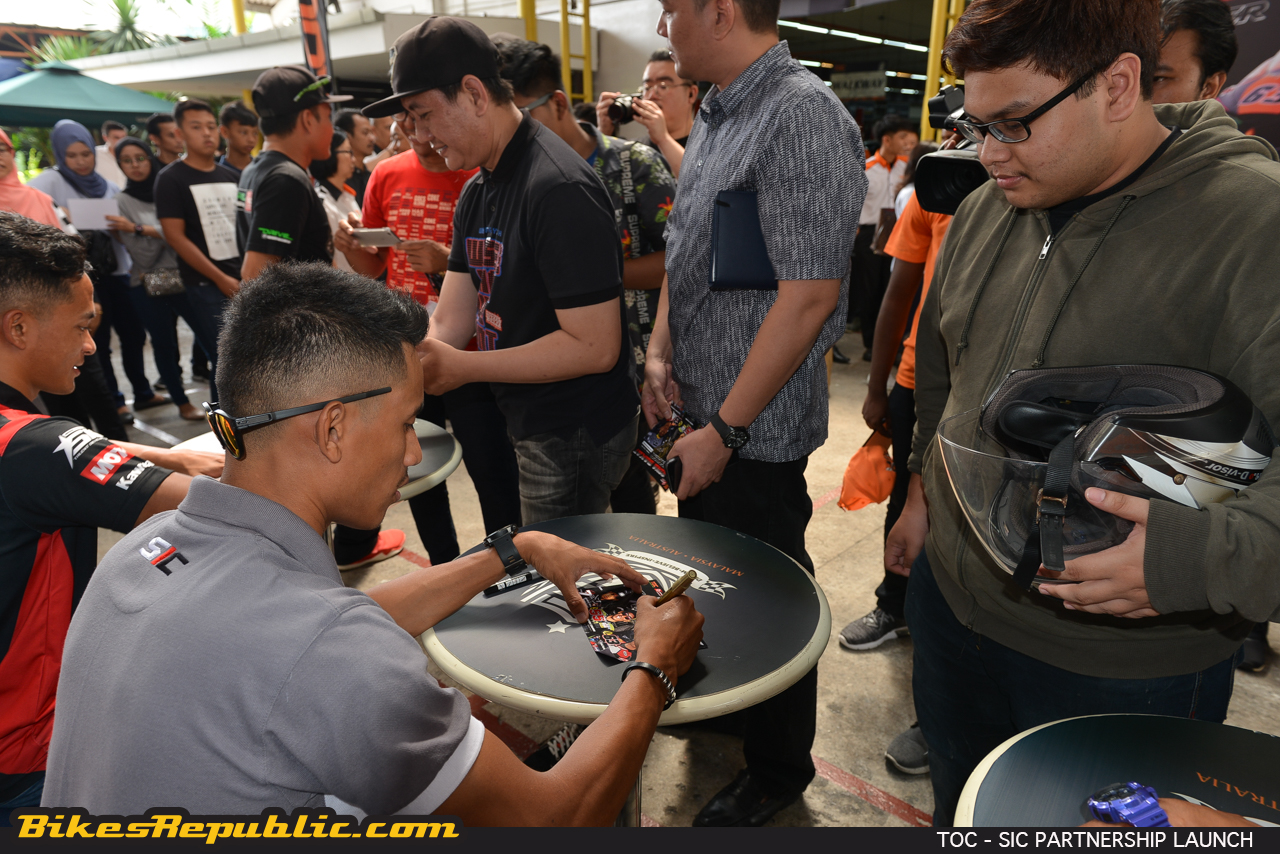
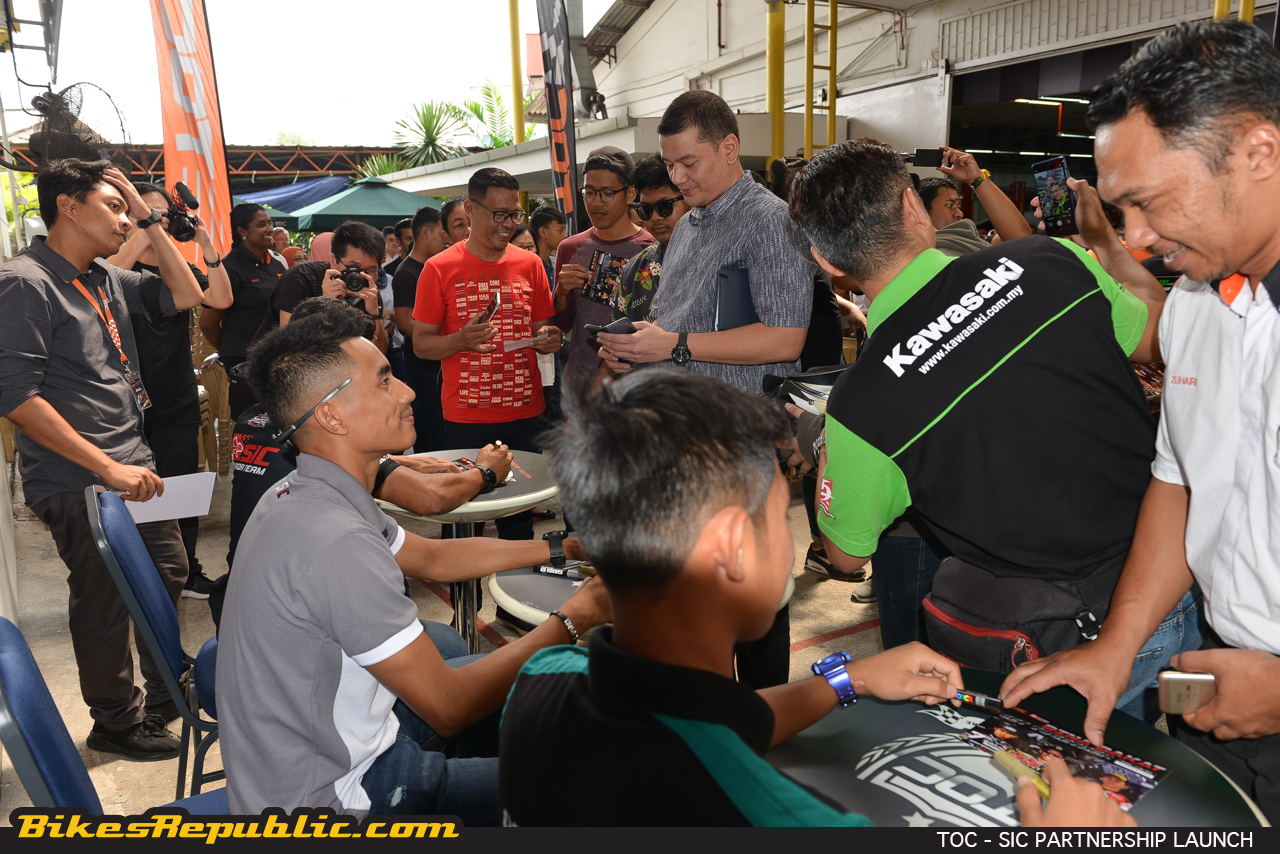
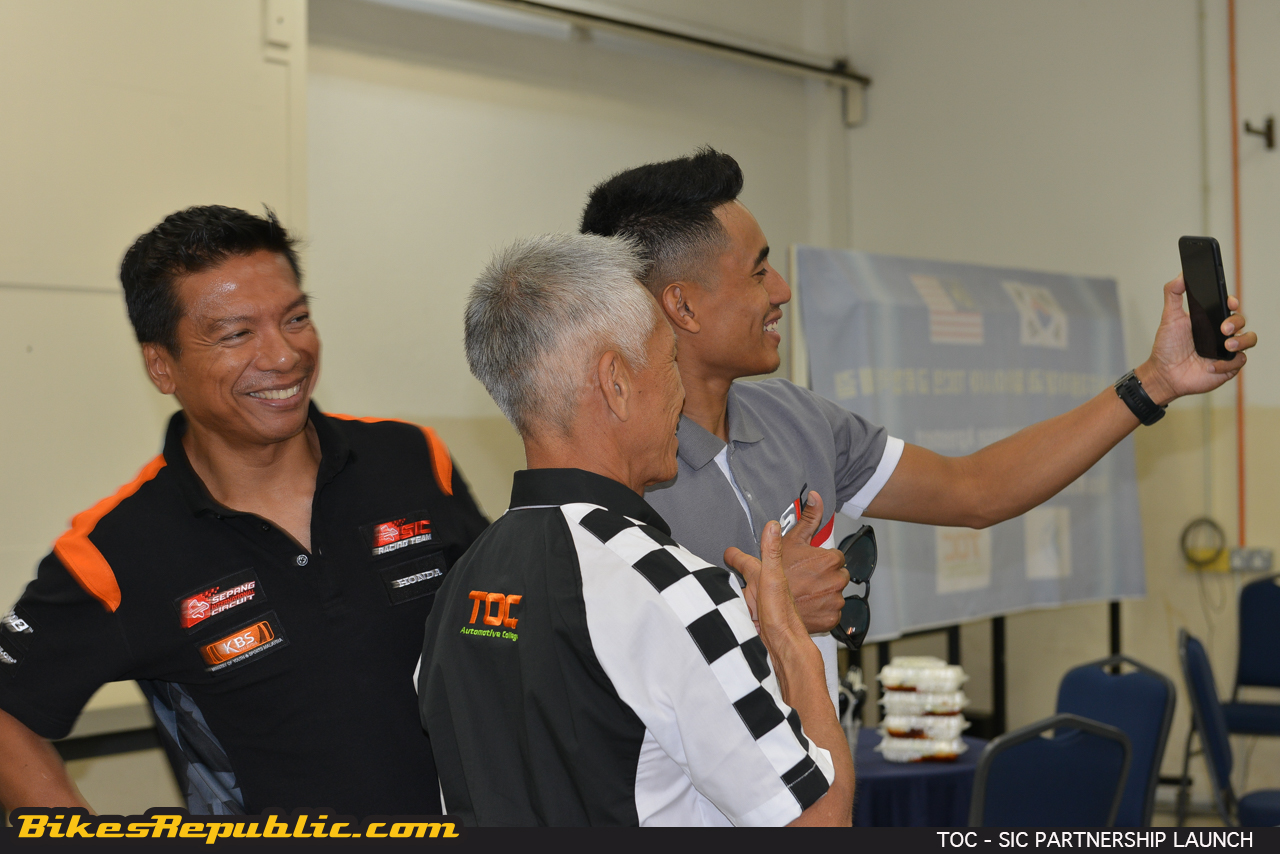
TOC and SIC have partnered to develop talents through Bina Bakat program and Superbike Technician Course.
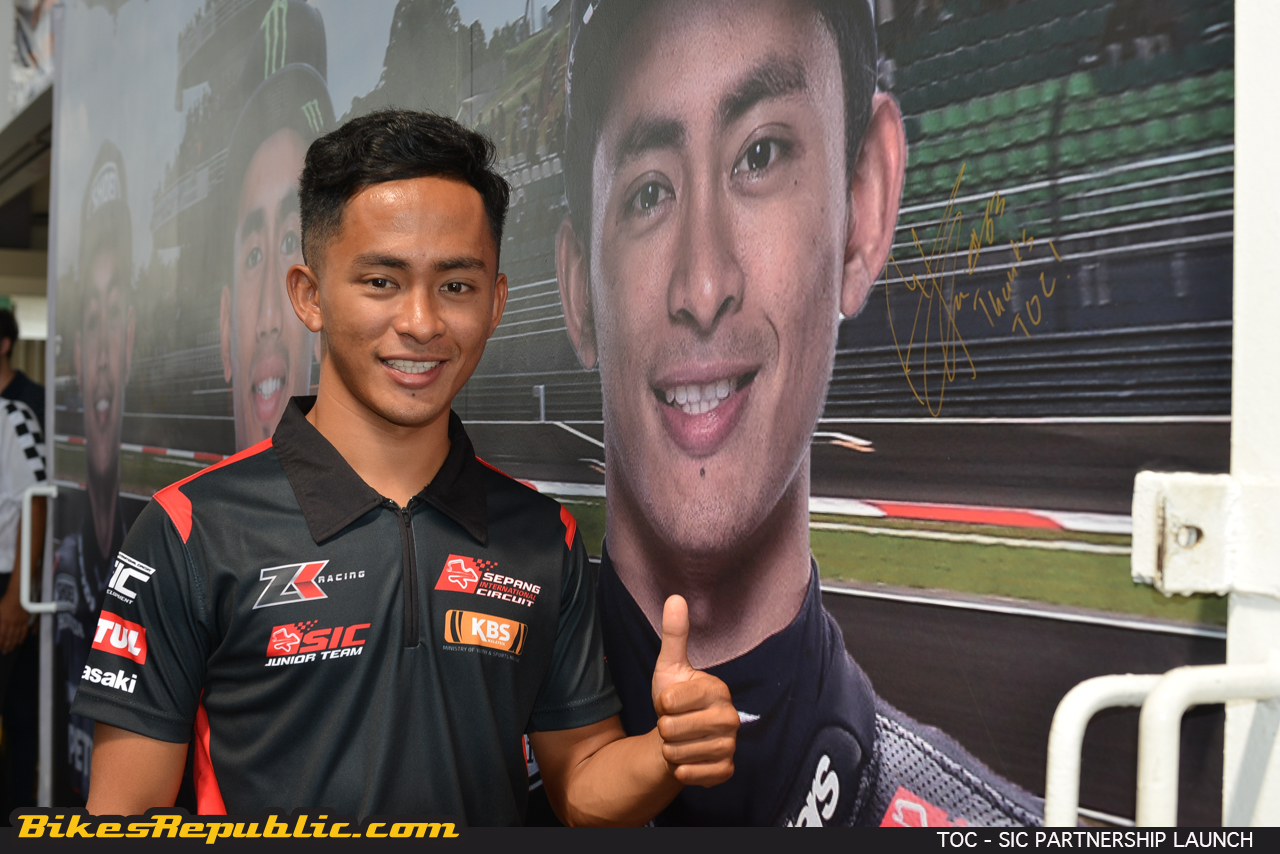
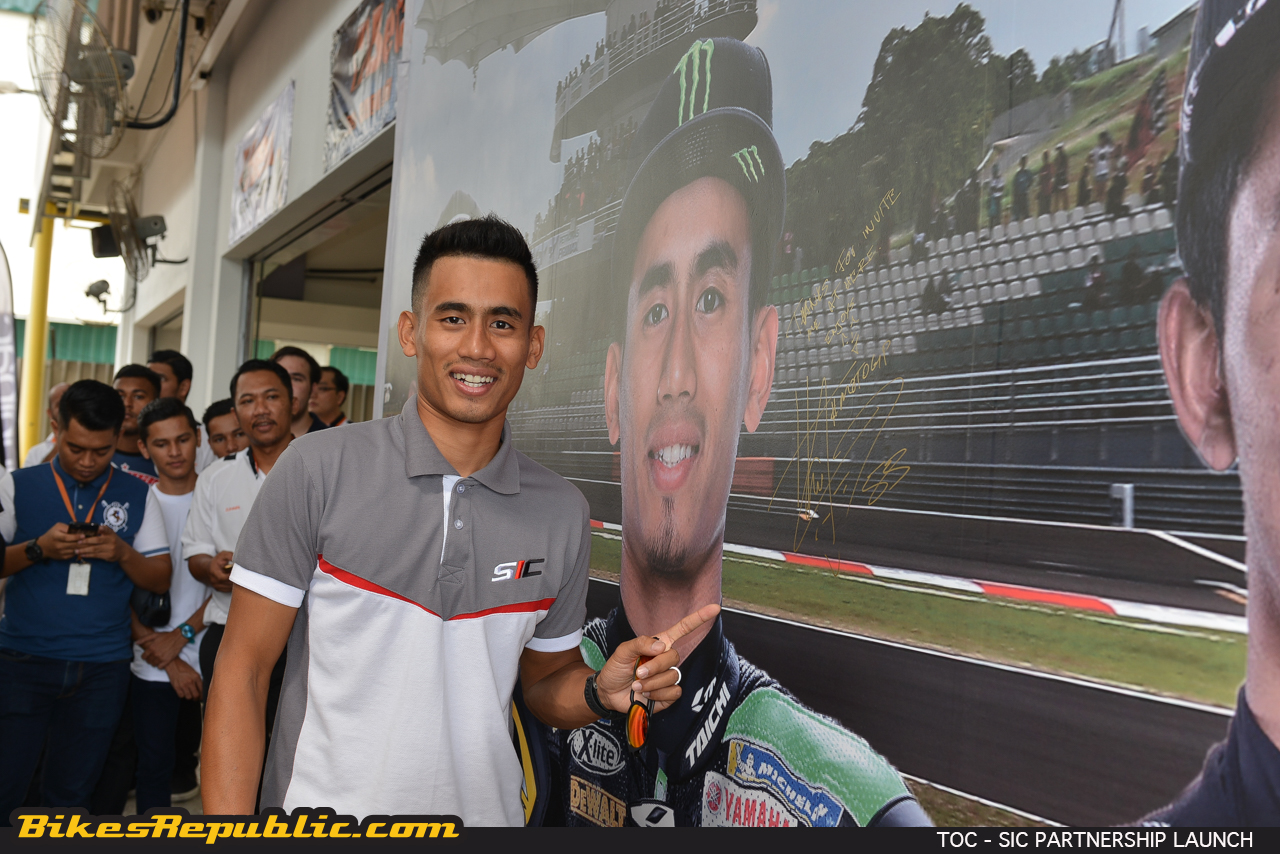
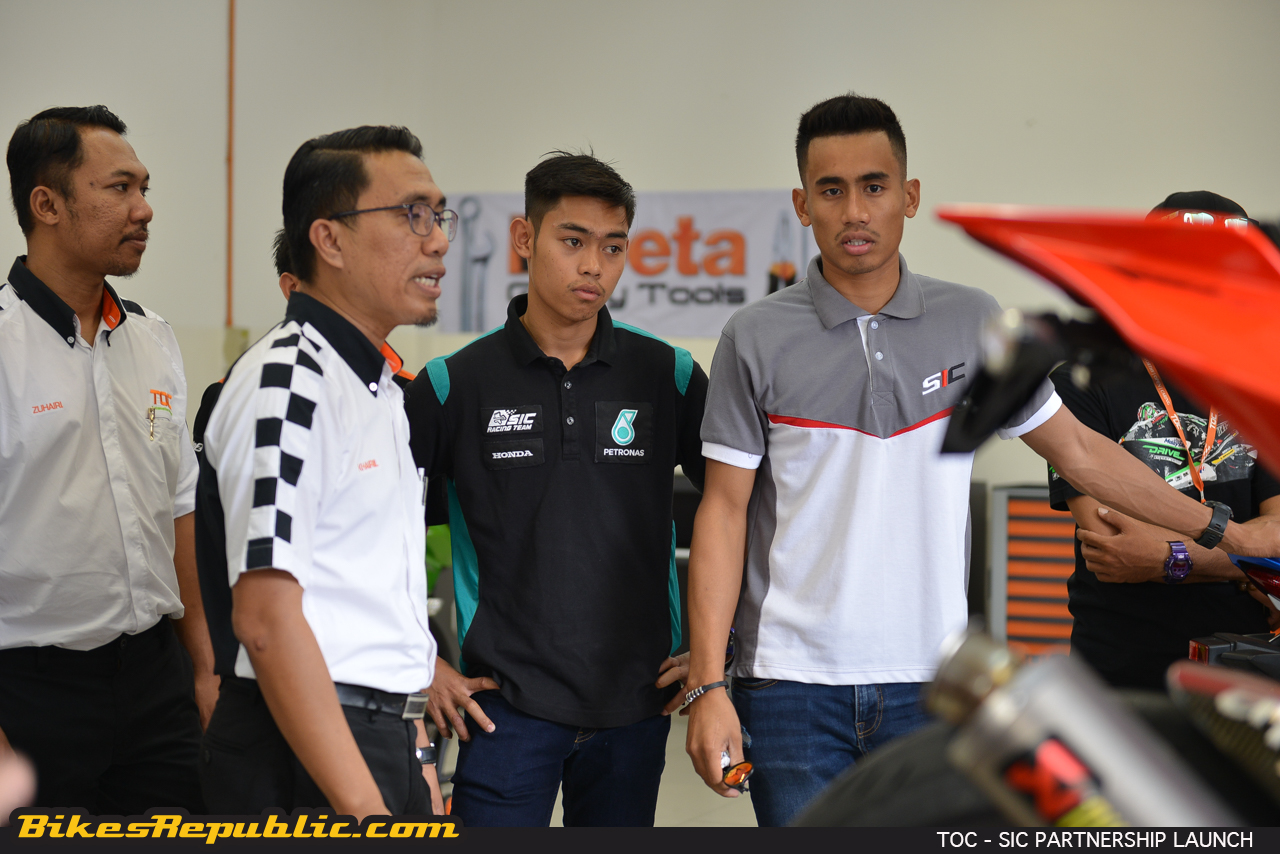
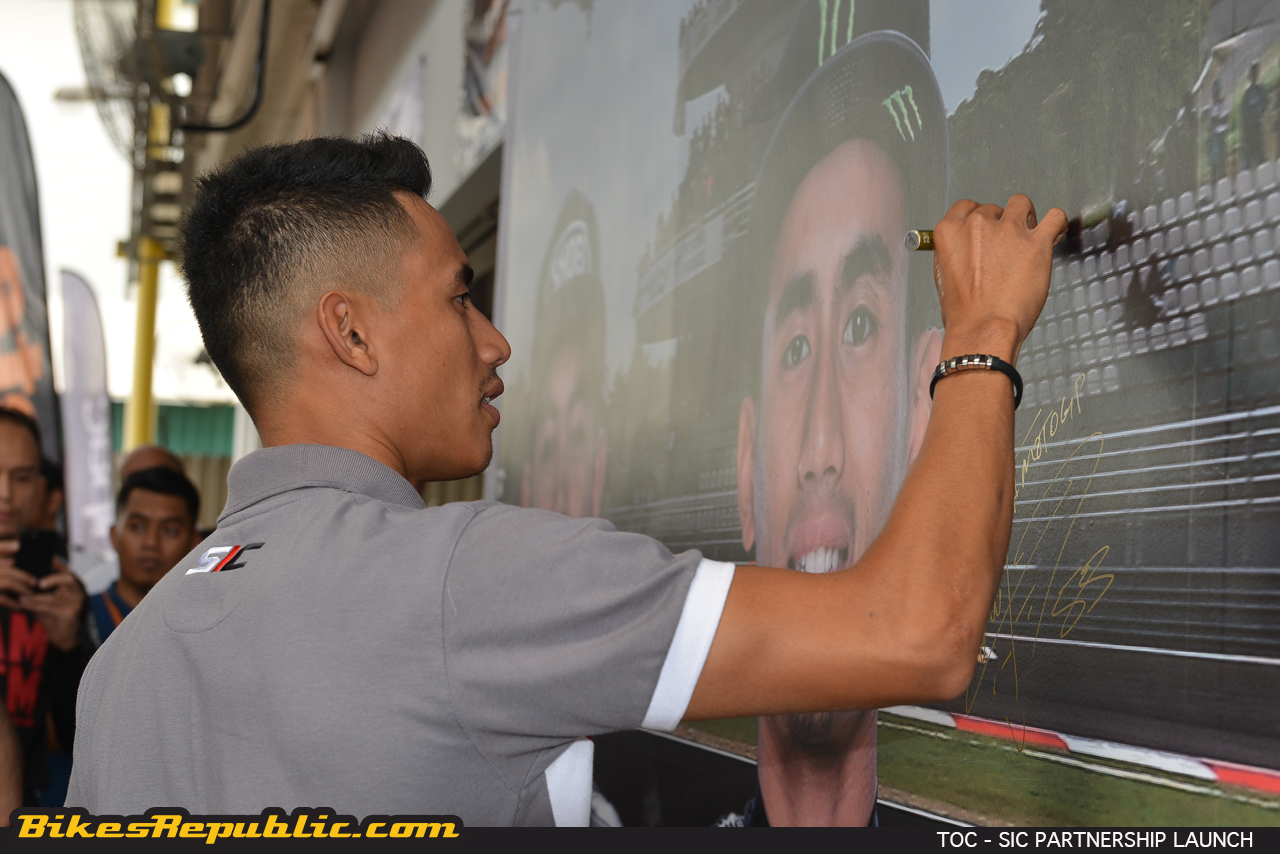
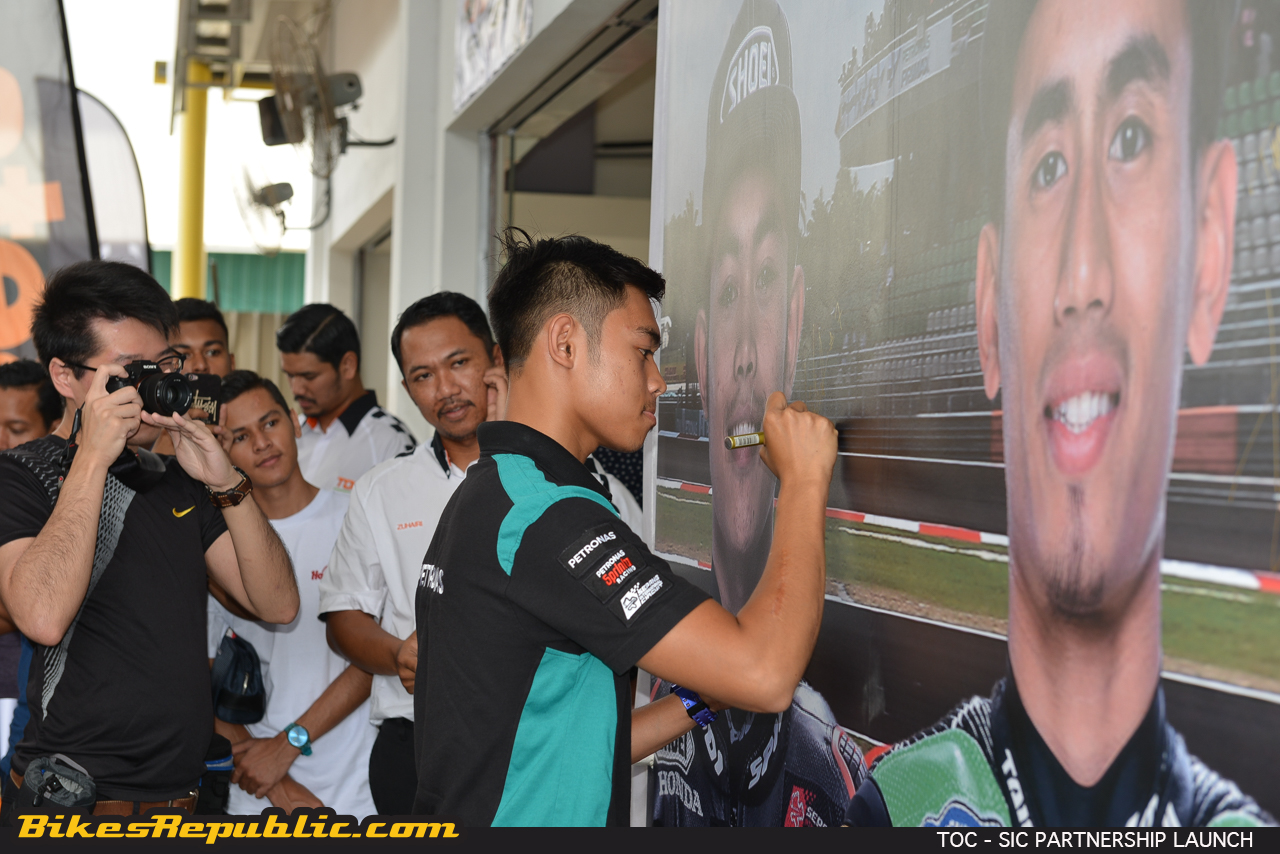
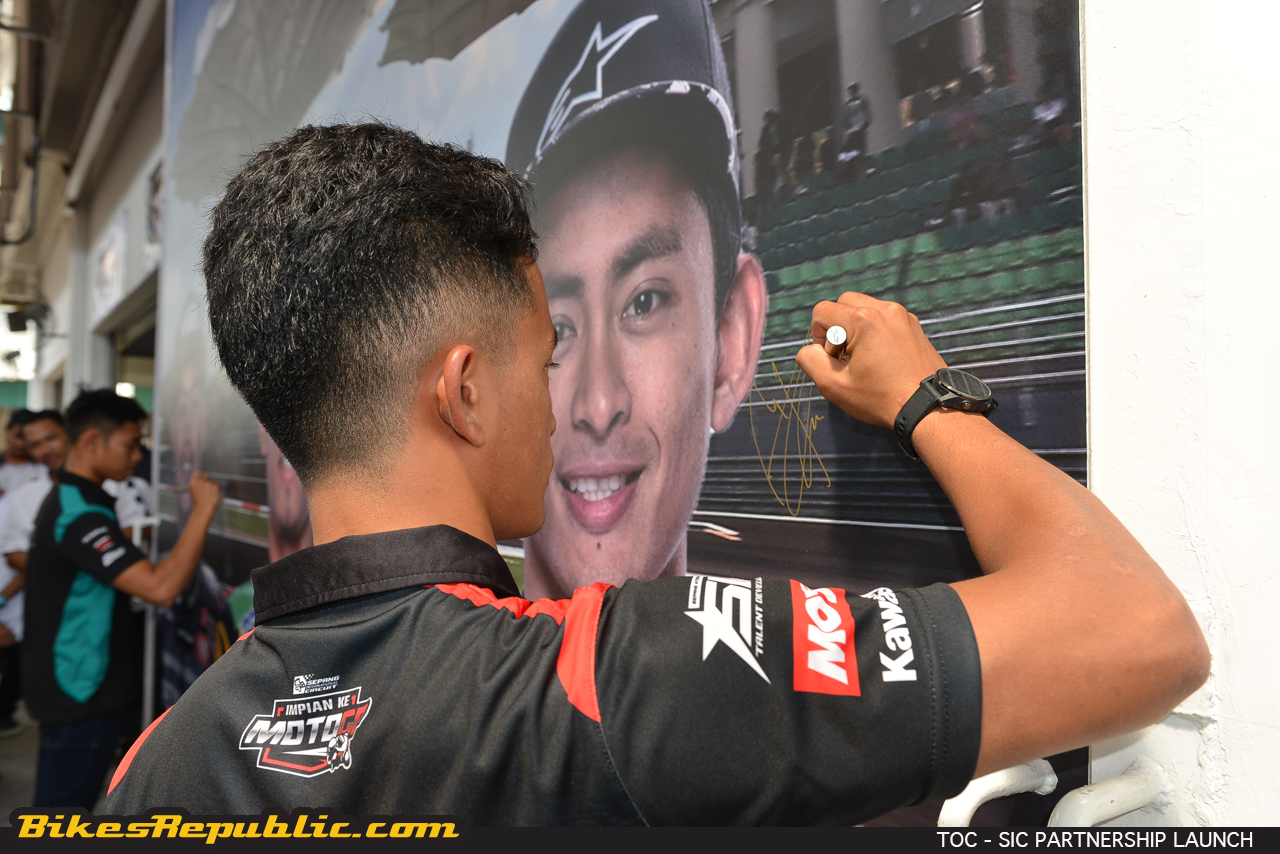
The announcement was made with Hafizh Syahrin, Adam Norrodin and Zulfahmi Khairuddin in attendance.
The partnership augurs well for both parties as SIC is actively expanding into motorsports.
As we’ve reported on previous occasions, the TOC Automotive College (TOC) is providing a loan for students aspiring to be certified superbike technicians through a program called, “Bina Bakat (Talent Development).” (Please click here for the full article.) Now, to provide graduates opportunities for greater job placement portfolios, as the college has announced their partnership with the Sepang International Circuit (SIC).
This augurs well with SIC as the world-class motorsports venue’s management has expanded their reach into two-motorsports by running their own MotoGP team next year, after SIC tied up with the Angel Nieto Team and Yamaha to run the manufacturer’s satellite team beginning 2019 (please click here to read the full news). Besides that, SIC has also set up a Talent Cup to develop young racers in Malaysia, managed by Zulfahmi Khairuddin.
This is on top of Hafizh Syahrin making the jump to the MotoGP premier class this year.
Dato’ Ahmad Razlan Razali, the CEO of Sepang International Circuit said that such expansion requires certified and skilled mechanics, who are disciplined in their work ethics. He is confident that these are the very sort of technicians who are produced by TOC through the Superbike Technician Course, which also encompasses motorsports as part of their syllabus.
Indeed, as part of TOC’s “Enriching Lives” theme, the college seeks to provide the best talent development program through Bina Bakat. The program builds the students’ development path through 80% practical work, preparing them for potential job placements after graduation. Obviously, SIC is an attractive goal for many students.
To rehash, Bina Bakat program offers 100% education loan to eligible student to follow the Superbike Technician Course. They will then repay their loans after they have found job placements.
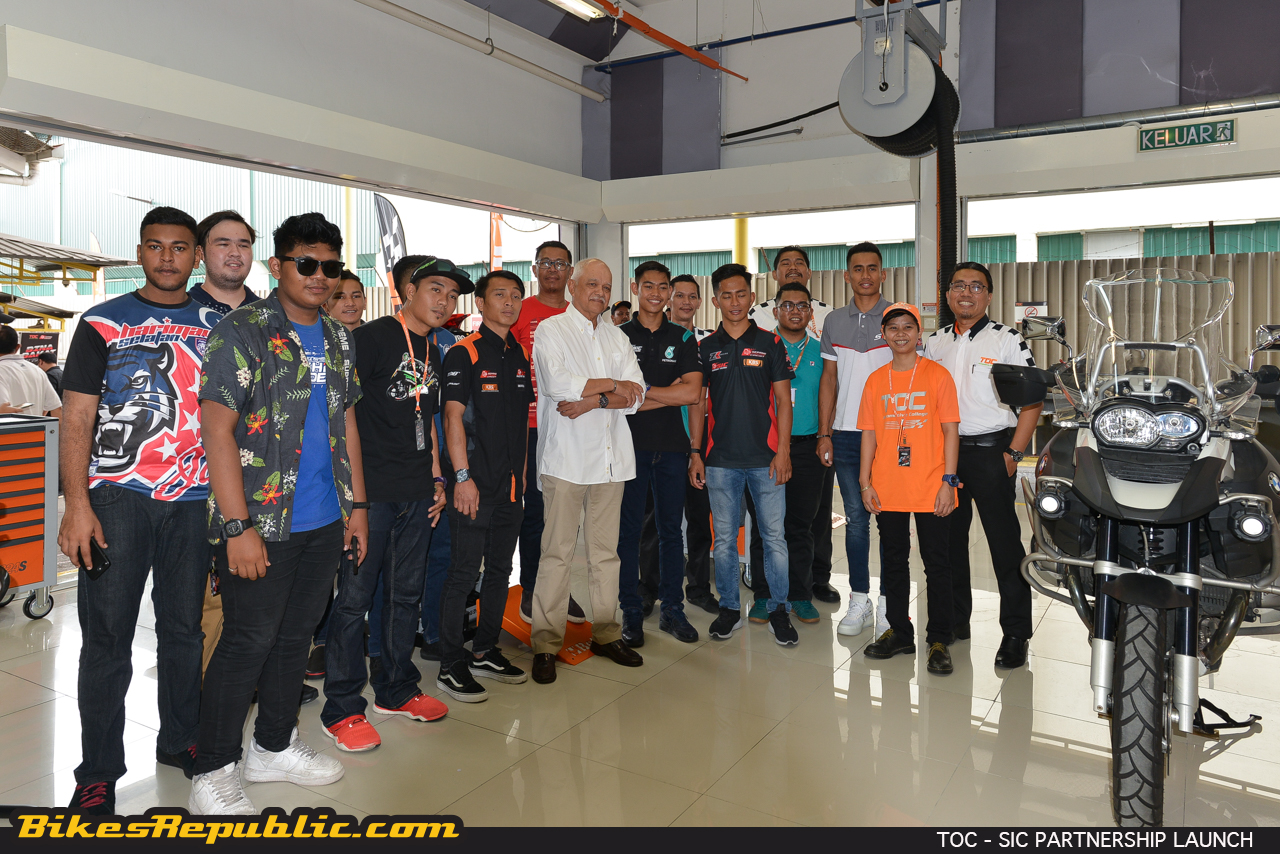
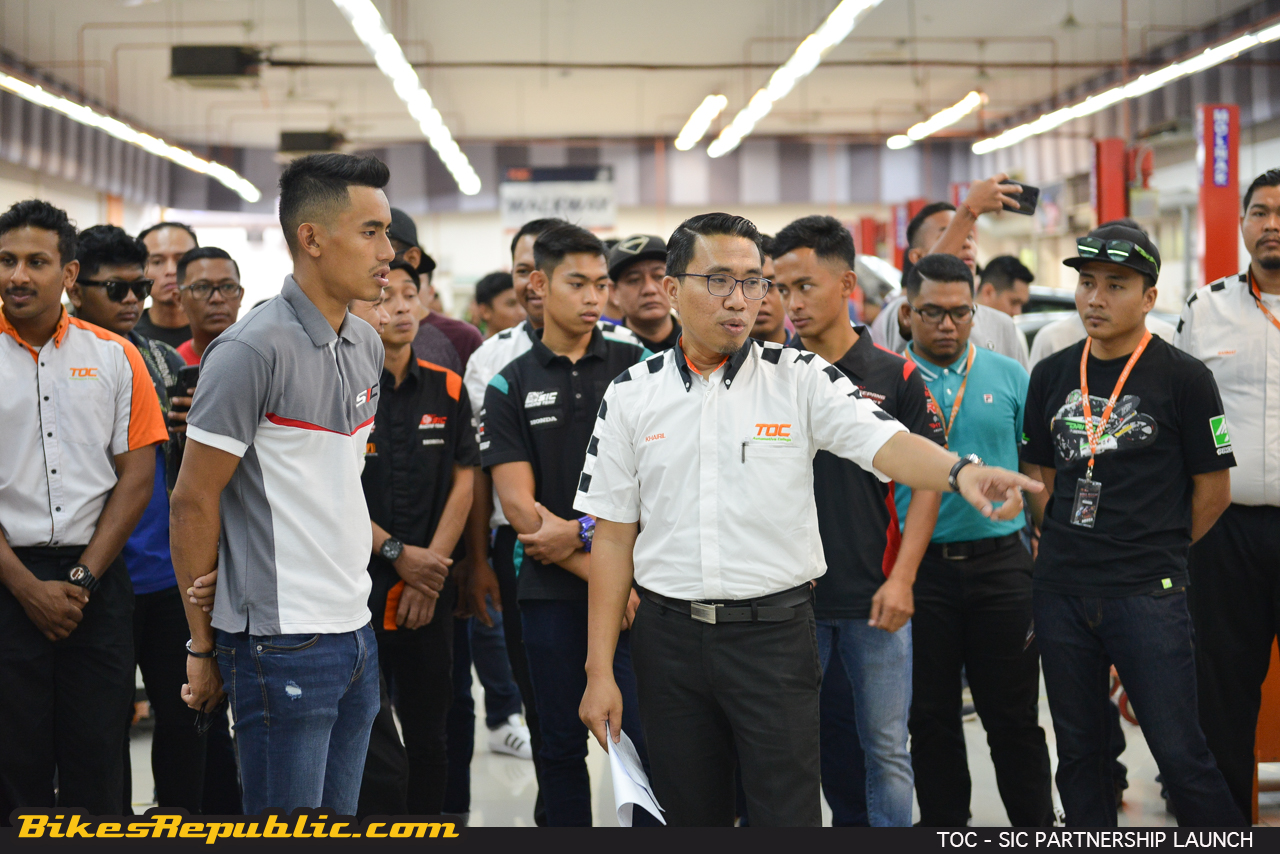
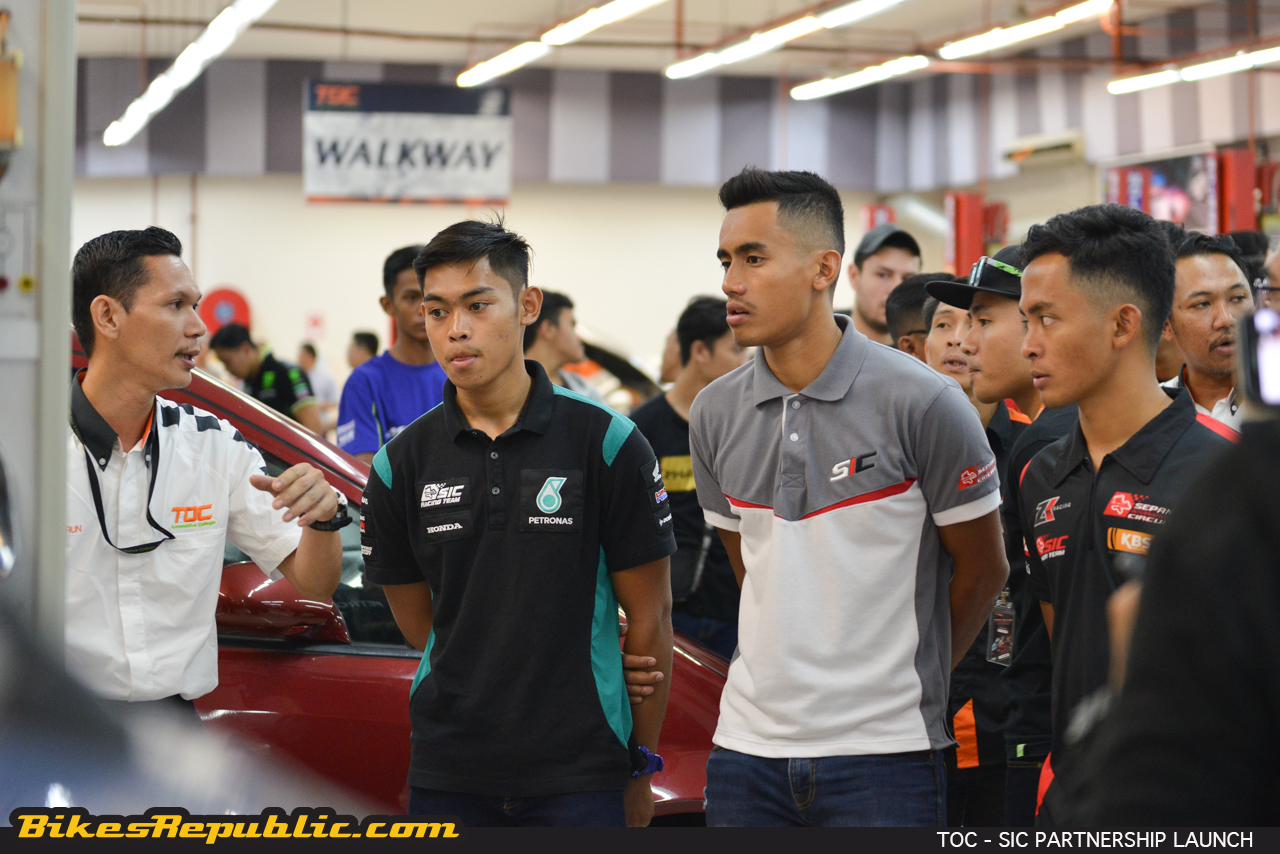
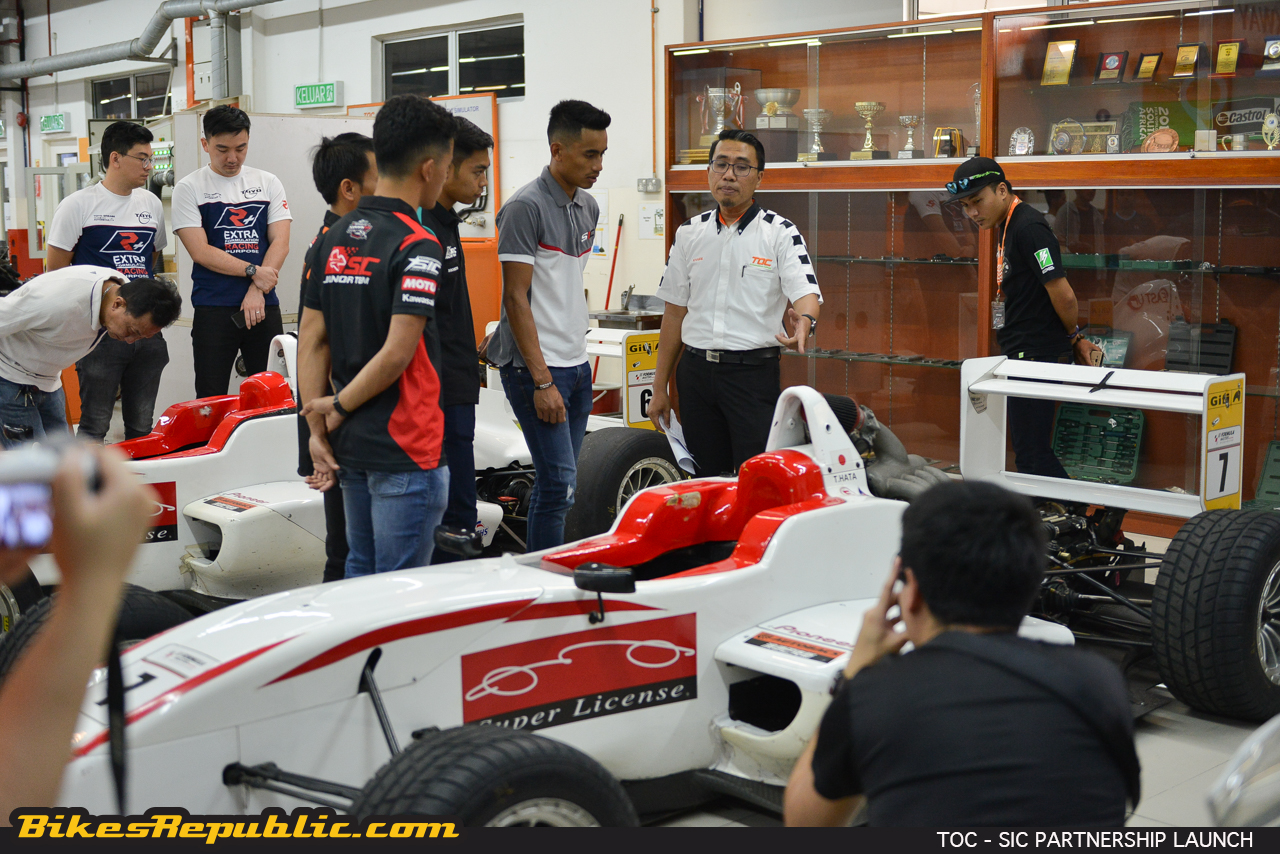
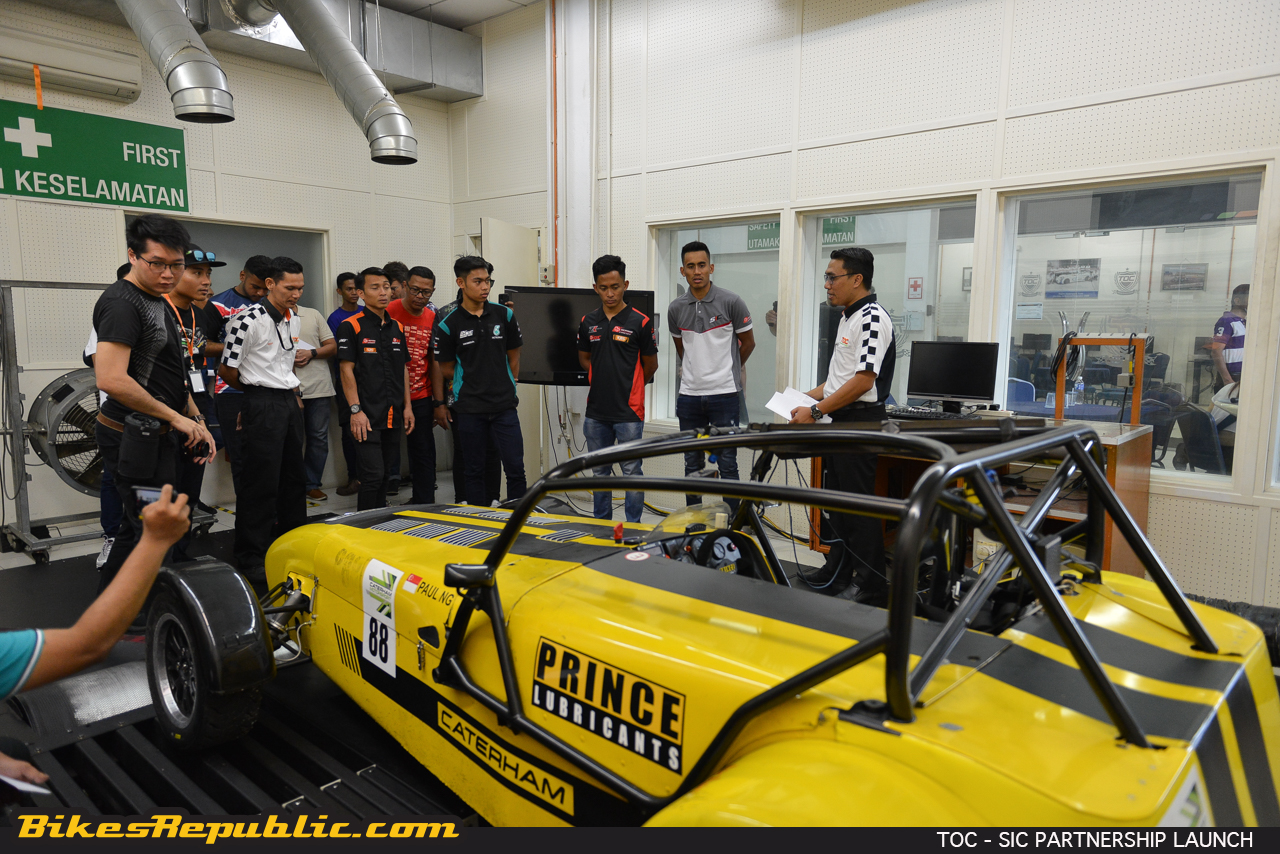
The announcement was made during a special get-together event at the TOC Automotive College’s campus in Petaling Jaya. Present were Hafizh Syahrin (MotoGP), Adam Norrodin (Moto3), Zulfahmi Khairuddin (Team Manager), Dato’ Ahmad Razlan Razali, Oh Kah Beng (TOC Motorsports Director), Jeffrey Oh (Oh Kah Beng’s brother and co-ordinator for the Asia Talent Cup and British Talent Cup) and Habibtullah Fuad Mohamad (Moto2 Mechanic), among other dignitaries and well-known figures in Malaysian motosports.
The guests were given a guided tour of TOC’s facilities and they signed autographs for their fans after the press conference.
Please visit TOC Automotive College’s Facebook page or their campus (map below) or call call (+603) 7960 8833 for more information. Likewise, you can find more information about the TOC Bina Bakat Program here, or email info@toc.edu.my. Please click on this link for further information on the TOC Superbike Technician Course.