Bikesrepublic

Wahid Ooi

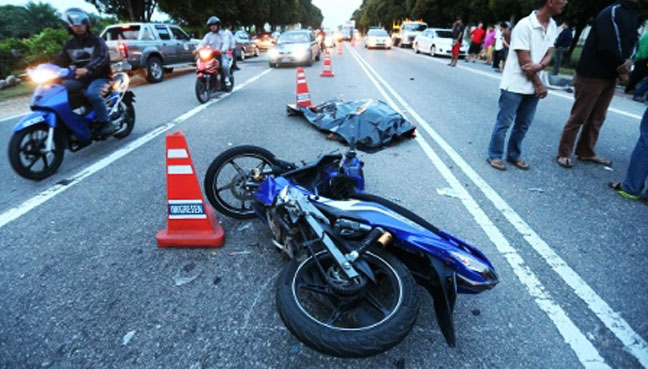
  • According to the WHO, Malaysia has the third highest rate of road accident deaths in ASEAN and Asia.

  • Malaysia recorded a 23.6/100,000 road accident fatality rate which equals 7,152 cases.

  • More than 60% were motorcyclists and pillions.

We published a report months ago about Thailand being the deadliest in terms of road accidents in ASEAN and Asia, but a new report shows that Malaysia is in third place. The report was based on the WHO Global Status Report on Road Safety (2018).

But here’s another look, especially since Malaysia is the “third deadliest.”

Rate vs. number

There’s been concern about reports highlighting accidents as rates i.e. XX/100,000, compared to pure numbers.

For example, India has the most deaths due to road accidents in the world. The rate was a relatively low 22.6/100,000 (lower than even Malaysia’s 23.6/100,000) due to the sub-continent’s massive population of more than 1.3 billion. In actual fact, 150,785 were killed in 2016.

Another instance was Indonesia who recorded 31,282 road accident fatalities in 2016. However, it became one of the “safest” as the rate was an incredibly low 12.2/100,000 due to her 261 million population.

However, rates serve as a method of looking at the number of people among the population who is likely to be involved in a fatal road accident.

More Malaysian data

A report in The Star Online today has shed some light with some raw data.

Again, the WHO report in December 2018 includes data from 2016.

In 2016, there are:
  • A total of 27,613,120 vehicles in Malaysia.
  • 13,123,638 were cars and four-wheeled light vehicles.
  • 12,677,041 were motorized two- and three-wheelers.
  • 1,191,310 heavy trucks.
  • 59,977 buses.
  • 561,154 other types of vehicles.

The writer also highlighted that a total of 91% of motorcyclists wear helmets, while 87% of their passengers did. There was still no concrete number of deaths involving motorcyclists, but it is a well-known fact that it constitutes to approximately 60% or higher.

But more alarmingly, the writer stated that only 75% of the motorcyclists killed wore helmets. We think that there may be some discrepancy in this number, but it could be that the victims involved must have lost their helmets due to improper fastening or wearing old and/or non-regulated helmets.

Motorcyclists bear the brunt

It’s no surprise that we motorcyclists bear the brunt of road accidents, regardless of the party at fault. But the motorcycle is the only form of transportation some of us could afford. The WHO acknowledges this by saying, “It is also a social equity issue with vulnerable road users bearing a disproportionate share of risk, injury and fatality.”

What needs to be done

The BikesRepublic.com team have been harping on the need to revamp our driver training methodology and syllabus for many years, even before the start of this magazine. This call has fallen on deaf ears.

Road users be they car drivers, motorcyclists, truck/bus drivers are taught on the procedures needed to pass their licensing tests and little more else. Yes, there’s the addition of theory lessons to the traditional highway code but how many actually remember even 10% of that? Every student is only looking forward to obtaining his license.

Thus, the best way to teach driving etiquette and skills is at the practical level. Which is unfortunately missing. This is what really should be done instead of setting everyone loose on the roads and them figure everything out by themselves. Worse, everyone blames everyone else.

Isn’t it better than subjecting the people to punitive measures while saying that you wish for accident rates to come down? It won’t happen automatically.

The authorities should look into this if they are really serious about lowering accident and fatality rates.

Source: World Health Organization and The Star Online

  • Silverstone Circuit will undergo full resurfacing for 2019 British MotoGP round.

  • Their contract was also extended to 2021.

  • Work will begin in June 2019.

The Silverstone circuit will undergo full resurfacing for the 2019 MotoGP round. At the same time, their contract was extended to 2021.

The move follows last year’s British MotoGP fracas. Fans waited for hours in the stands before the round was cancelled due to rain and standing water. Apart from that, the tarmac was previously smoothened to accommodate Formula 1 cars and their underbody skid plates.
The FIM demanded the resurfacing of the track in order to meet safety and homologation standards. In response, the circuit announced that full resurfacing will commence in June ahead of Formula 1 in July and MotoGP in August, this year.

Track work will be carried out by construction company Tarmac and overseen by consultant Jarno Zaffelli, who has overseen successful resurfacing jobs at Sepang and Termas de Rio Hondo, which have gathered praise since the last MotoGP races at the respective circuits.

Silverstone managing director Stuart Pringle, who was the central figure in last year’s controversy, is delighted with both the resurfacing confirmation and the British MotoGP contract extension.

“Getting to this point has involved a lot of work by the staff at Silverstone but throughout it all we have been completely focused on making sure we make the right decisions to guarantee the future of our most important events with Formula 1 and MotoGP,” Pringle said.

Tarmac’s managing director Paul Fleetham is confident in delivering a high-quality resurfacing.

“We are exceptionally proud to be working with the team at Silverstone to resurface the iconic British race circuit,” Fleetham said. “It demonstrates both the quality of our people and our first-class track record in delivering high-profile, nationally significant schemes.”

MotoGP CEO Carmelo Ezpeleta added: “The extension to the contract at Silverstone is a mark of the confidence we have in the circuit to host a successful MotoGP event over the next three years.”

Source: Crash.net

  • Knowing how to inspect your scooter’s drive belt gives you a heads up on its condition.

  • It can save you a from a long push or unscrupulous mechanics.

  • Take a look at the symptoms and memorize them.

While we’ve tested many bikes, we do root for the automatic scooter for its ultimate convenience. But we understand there’s always one main concern among scooter owners: The drive belt.

Drive belts are definitely cleaner and hassle-free compared to the link-chain. Chains have come a long way from being snap happy, but years ago, drive chains could turn into whips and mobile chainsaws. Still, chains need cleaning and lubricating every 300 km, and it needs to be performed correctly.

However, whereas you can inspect the chain everytime before you ride, it’s not so easy with a scooter’s drive belt. Here are some tips on how to inspect your scooter’s drive belt and what to look out for. It’ll save you from a long push to the nearest workshop.

Learning to identify the symptoms is also a great way against being “slaughtered” by unscrupulous so-called mechanics.

How long does my drive belt last?

It depends on the manufacturer and specific bike, so you have to refer to the service/owner’s manual. Both manuals contain a wealth of information, so do flip through from time to time.

Certain manufacturers recommend a change at 10,000 km, 20,000 km and so forth. For comparison sake, those are the mileage one will usually get from link-chains.

How do I inspect my belt?

*NOTE: PLEASE DO NOT ATTEMPT THESE STEPS YOURSELF UNLESS YOU HAVE EXPERIENCE AND FULLY CONFIDENT. BUT PLEASE DO IDENTIFY AND REMEMBER THE SYMPTOMS.

There are symptoms, of course. Sluggish drive, lower top speed, abnormal noise, etc.

The best is when you are having your bike serviced. You can request for the mechanic to check it while the oil is draining, thus saving time.

What are the signs?

Check out the illustration below.

Rotate the pulleys and check the belt’s condition for abnormal wear, cracks, missing teeth, tears or holes. Tears on the sidewall, wear on the top surface, long cracks are signs of serious problems.

A snapped belt means you have to replace it, you smart alec.

Also remember to check the pulleys for broken teeth and wear. Lastly, don’t forget to check in the inside surfaces of the cover. Scuff marks mean the belt has lost its tension.

How do I replace the belt?

It is best done by trained professionals with the proper tools and equipment. The worst thing one could do is taking a shortcut on repairs. It could lead to an even bigger disaster.

  • A seemingly production-ready Triumph Rocket 3 GT was spotted in Croatia.

  • Many asked if there will be a regular version of the Triumph Rocket 3 following the launch of the Rocket 3 TFC.

  • The regular model looks pretty good, too!

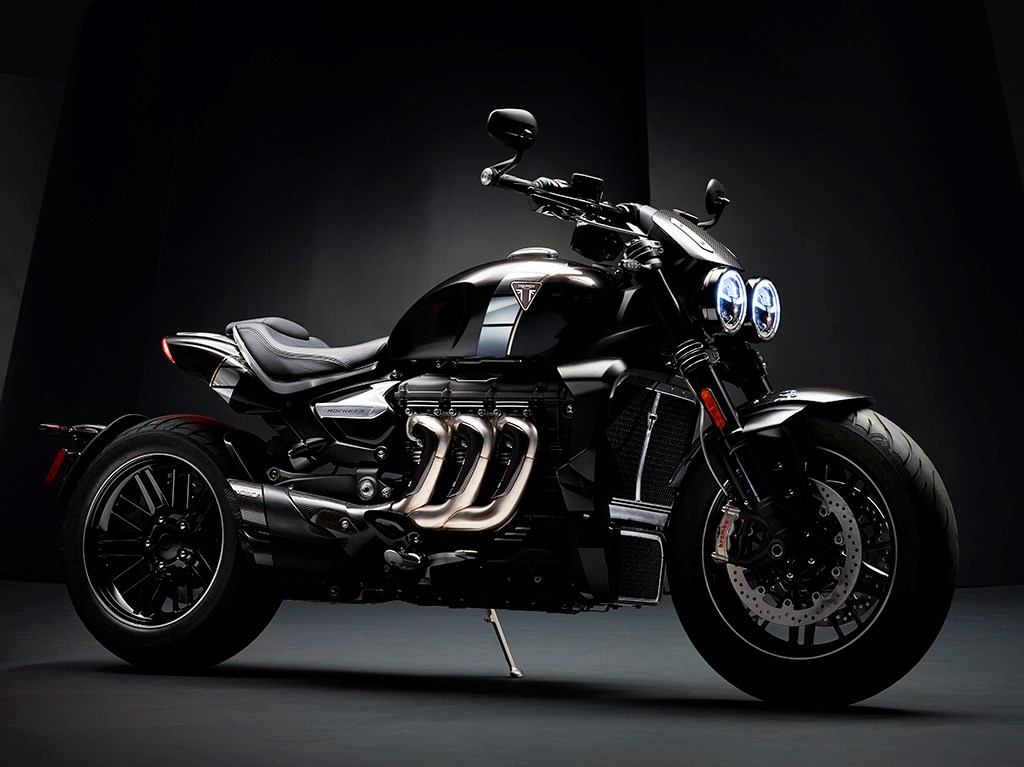
An MCN UK reader spotted a seemingly production ready new Rocket 3 in Croatia and sent this picture in. And oh my, does it look good!

The Triumph Rocket 3 launched last week was the limited-edition Rocket 3 TFC (Triumph Factory Custom). But many wondered if there will be a new “regular” Rocket 3.

“Regular” doesn’t necessarily mean bland. Not in this case anyway.

Apart from the Rocket 3 TFC, we also wondered if the styling will be updated for the new bike or if Triumph wanted to remain with the old, if not archaic, styling. Well, looks like the new design is really good!
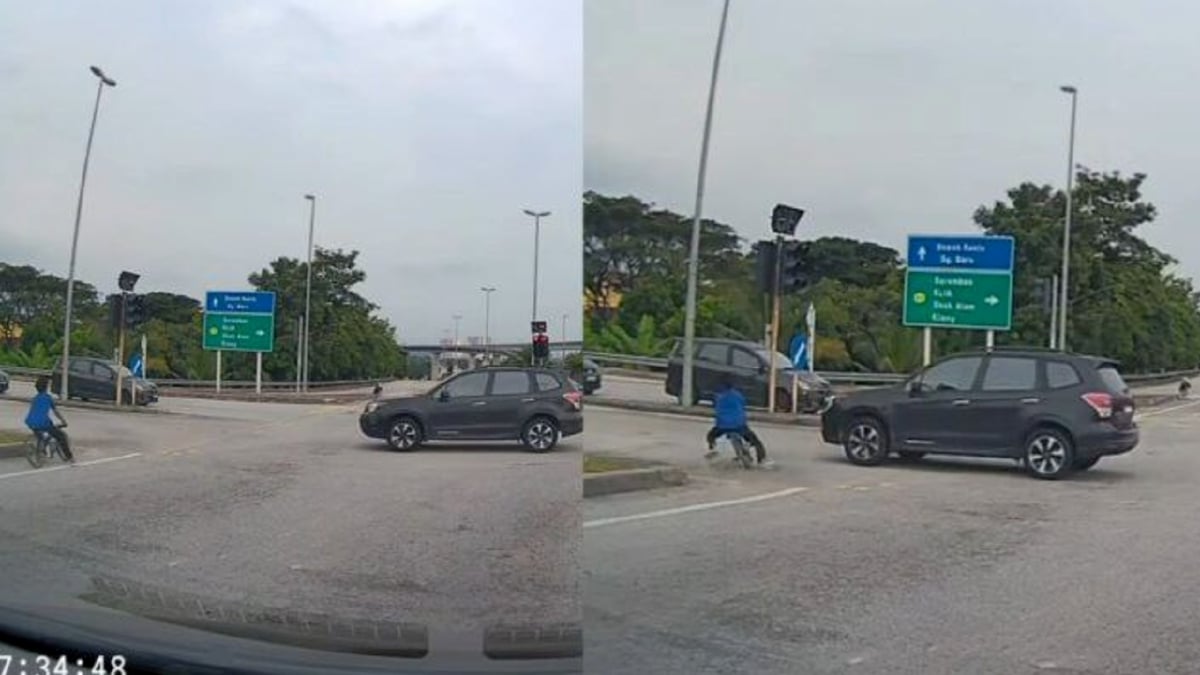
The rear wheel looks awesome with the single-sided swingarm; those exhaust pipe tips alludes to a big bore engine that they serve; the seat unit has been redone along with the addition of a chrome strip underneath; the side covers are thoroughly modern. Even the fuel tank looks good with the knee recesses and beautiful paint treatment. The three exhaust headers coming out the side gives the illusion of the ribs on a beast. But look at that front fork and its massive stanchion! The monobloc brake caliper looks like a Brembo Stylema, used on the TFC variant and first on the Ducati Panigale V4.

The Rocket 3 TFC’s 2458cc engine is rated at 167 hp and 221 Nm of torque. Will the Rocket 3 GT’s engine produce the same? Most probably.

Source and picture: Igor Skunca for MCN UK

  • A British coroner concluded that high-heeled boots contributed to the death of a lady rider.

  • She appeared to have been distracted by her footwear.

  • We recommend boots with wide, flat soles.

British coroner determined that it was high-heeled boots that caused a lady rider’s death in an accident.

The Dorset Coroner’s Court heard a statement from Coroner Brendan Allan. According to him, the rider was distracted by her boots before losing control of her bike and crashing. He added that, “It is with the utmost importance that bikers wear appropriate clothing, no matter how short the journey and no matter how familiar the person is with it”

The debate of fashion vs. practical biker wear continues to rage in this case. Some motorcyclists refuse to wear boots because “they are hot,” especially in our climate. Some swear by boots, but they are divided into two schools of thought. One group says any type of boot is fine, as long as they are boots. The other says that there is a specific type that’s safe for riders.

So, who is correct?

Motorcycle boots should have flat heels and soles, even if they are thick (or tall). Flat soles allow for a wider area for feet placement on the footpegs. Besides that, the wider area contributes to safety when you put a foot down on the road, especially during emergy stops.

Stilettos make ladies look hot but it isn’t so when you’re struggling for balance.

Source: Daily Mail UK

  • Indian Motorcycle patented their variable valve timing (VVT) system.

  • It will equip a new Euro 5-compliant engine.

  • The technology is the best solution in delivering power with low fuel consumption and emission.

More and more manufacturers embrace variable valve timing technology as Euro 5 looms. Indian Motorcycle is next up.

As Euro 5 seeks to cut more emission, motorcycle manufacturers are forced into looking for other solutions. It was either that or downsizing the engine or reducing power production (god forbid!).

Right now, VVT offers the best answer. Variable valve timing and variable valve lift controls valve overlap at the correct engine loads and timing, yielding power while saving fuel and limiting emission at the same time. Please click the link below to learn more about variable valve timing/variable valve actuation.

2019 Ducati Diavel 1260 to Feature DVT

VVT usually finds place in motorcycles with “sportier” deposition such as the BMW S 1000 RR, Suzuki GSX-R1000, it’s made its way into other types of motorcycle engines. Ducati uses their proprietary Desmodromic Valve Timing (DVT) in the 1260cc V-Twins, while Yamaha employ the tech in their scooters. BMW has now equipped the new 1254cc Boxer (flat-twin) with their own “ShiftCam” technology.

Photo credit – United States Trademark and Patent Office, Motorcycle.com

A new Indian engine was spied months back, but patents revealed that the American manufacturer is pursing VVT technology as well.

Indian’s VVT looks different in because the engine employs overhead valves (OHV) and pushrods rather than overhead camshafts (OHC). Therefore, the VVT phaser is situated at the of the crankcase.

  • Prices for the KTM 790 Adventure and and KTM 790 Adventure were released by KTM Malaysia recently.

  • KTM intends to revolutionize the dual-sport market with the new bike.

  • The 790 Adventure is priced from RM 78,800 while the 790 Adventure R is priced from RM 84,800.

Prices for the KTM 790 Adventure and and KTM 790 Adventure R were released by KTM Malaysia recently

KTM had listened to the wishes of adventure and dual-sport riders around the world in creating the new bikes. Consequently, both variants are “different” when compared to dual-sport motorcycles in its middleweight and of capacities, as well.

But it wasn’t a case of just building an adventure bike with two variants. The Austrian manufacturer wanted to “revolutionize the dual-sport market.”

The engine is shared with the 790 Duke naked sportbike, but tuned for smoothness and tractability, especially in the rough. The new LC8c parallel-Twin allows KTM engineers to place it in the frame for optimal weight distribution, hence easier handling characteristics. Another benefit is the lower seat height.

Next, the fuel tank is moved downwards to the sides of crankcase. Doing so moved the bike’s centre of gravity downwards. There are two benefits to this: 1) It makes the bike more stable and not top-heavy; 2) It allows the rider to move around easier when standing up in the rough.

790 Adventure (left) and 790 Adventure R (right)

The 790 Adventure (without the “R”) is more road-biased and intended for riders who tour and include some light off-road in their itinerary. The 790 Adventure R, on the other hand, is more off-road biased.

As such, the 790 Adventure R includes a Rally mode where the rider could choose the level of traction control and throttle response on-the-fly.

You can read about our impressions in the link below:

KTM 790 Adventure and KTM 790 Adventure R Test & Review

The 2019 KTM 790 Adventure is priced from RM 78,800 while the 2019 KTM Adventure R is priced from RM 84,800. The prices are inclusive of SST but not on-the-road.

Please follow KTM Malaysia’s official Facebook page for more up-to-date information.

  • Jonathan Rea and Kawasaki finally ended Alvaro Bautista and Ducati’s WorldSBK 2019 winning streak.

  • Rea won in Race 1 at the Imola circuit in Italy.

  • Bautista finished second after winning the first ten races of the year.

Four-time and reigning WorldSBK champion Jonathan Rea and his Kawasaki team ended Alvaro Bautista and Ducati’s winning streak in Race 1 at Imola, Italy.

Bautista and Ducati have scored a perfect ten out of ten races in five rounds prior. However, Rea proved the spoiler when Bautista tried to adapt to the tricky Imola circuit. It was the latter’s first race there. Rea had been strong throughout the practice sessions only to be pipped by Bautista’s teammate Chaz Davies in Superpole for pole position.

Come race day, Rea took the lead as soon as the lights went out, but passed by Davies soon after. It looked like the pair was going to resume their hard battles and rivalry through the last few seasons. Unfortunately, Davies’s bike encountered a problem and forced the Welshman to retire. In so doing, he handed second place to Bautista.

A battle soon erupted behind them.

Tom Sykes (BMW Motorrad WorldSBK Team) sat in third, while Michael van der Mark (Pata Yamaha WorldSBK Team) fought up to 4thfrom 8thon the grid. Van der Mark’s teammate Alex Lowes followed in 5th, ahead of Rea’s teammate Leon Haslam. Independent rider Toprak Razgatlioglu (Turkish Purcetti Racing) moved in 7th.

At the front, Bautista had no answer to Rea’s pace. The Kawasaki man began to pull away at 0.7s per lap.

Photo credit Visordown

On a day of seeing front runners suffering bike problems, Tom Sykes’s BMW started to slow and eventually retired. At the same time, Lowes started to slip backwards.

With the final position suddenly available, van der Mark and Razgatlioglu battled tooth and nail. The pair swapped paint and traded blows on the penultimate lap to the stage of colliding twice. But it was the Turkish rider Razgatlioglu who presevered to cross the line in 3rd.

There was no problem for Rea, conversely. It was his eighth win at the track and 72ndin WorldSBK. It was Kawsaki’s 128thwin in the series.

Race 2 continues today at 8pm Malaysian local time.

Final results after Race 1:
  1. Jonathan Rea (Kawasaki Racing Team WorldSBK)
  2. Alvaro Bautista (ARUBA.IT Racing – Ducati)
  3. Toprak Razgatlioglu (Turkish Puccetti Racing)
  4. Michael van der Mark (Pata Yamaha WorldSBK Team)
  5. Leon Haslam (Kawasaki Racing Team WorldSBK)
  6. Marco Melandri (GRT Yamaha WorldSBK)
  • Ducati posted a 5% increase in sales for the first quarter of 2019 vis-à-vis the same period in 2018.

  • The biggest selling segments were the Hypermotard/Multistrada and Scrambler.

  • The Supersport/Superbike category saw a large drop.

Ducati posted a 5% increase in sales for the first quarter of 2019 vis-à-vis the same period in 2018.

The number equals a total of 12,541 motorcycles compared to 11,949. That’s good news considering the global motorcycle sales slump.

However, the model which drove the sales was of a surprise. The Italian manufacturer had hoped the new Diavel 1260 will drive sales in 2019, but it was the new Hypermotard 950, instead. The Hyper’ contributed an 18.6% growth. Ducati grouped the Diavel and Monster in the same “naked” category which dropped by 1.13%. The Hypermotard is in the same category as the Multistrada, on the other hand.

The other contributor is the Scrambler line-up, which saw a 14.8% increase. Ducati shored up the yellow-bike family with a slew of new models for 2019.

As for the Supersport/Superbike category, it posted a 13.5% drop after the huge success of the Panigale V4’s success in 2018.

The manufacturer is yet to launch further 2019 models. We shall see how these will do by the first half of the year.

Segment

Q1 2019

Q1 2018

% Change

Scrambler

2,894

2,522

+14.8

Diavel / Monster

3,054

3,089

-1.13

Hypermotard / Multistrada

4,113

3,469

+18.6

Supersport / Superbike

2,480

2,868

-13.5

Total

12,541

11,948

+4.96

Source: Audi AG

  • David Beckham was handed a driving ban.

  • He was charged with using his mobile phone while driving.

  • The driving ban is in effect for six months.

We wanted to not publish this story, but the temptation was too great. David Beckham was handed a driving ban by a British judge.

A member of the public spotted Beckham using a mobile phone while driving his Bentley in Central London. He then lodged a report against the former Manchester United, Real Madrid and LA Galaxy star.

Beckham’s counsel, Gerrard Tyrrell said his client had “no recollection” of the incident. However, Beckham pleaded guilty anyway.

The celebrity already logged six points on his driving license for speeding previously. The District Judge handed out six more points for the mobile phone offence, bringing the total to 12 that’s needed to lose driving privileges. The ban is in effect for six months.

Besides owning a bevy of exotic cars, Beckham also owns many motorcycles but his favourites are Triumphs. One of his motorcycles is a customized Triumph Bonneville on display in the Triumph Factory Visitor Experience in Hinckley.

David Beckham and his Triumph – Photo credit harrolds.com.au
  • Malaysia’s largest e-wallet, Boost and Shell Malaysia announced the availability of the e-wallet payment service at 800 Shell stations nationwide.

  • An exclusive promotion offers 2 times RM5 cashback with the spending of RM40 at selected Shell stations.

  • The e-Boost app is available for iOS and Android.

Malaysia’s largest e-wallet, Boost, and Shell Malaysia today officially announced the availability of the e-wallet payment service at 800 Shell stations nationwide. The partnership aims to enhance customers’ retail experience at Shell stations by providing them with an alternative payment method.

With this collaboration which began in April 2019, the e-wallet service is now available in more than 80% of the Shell stations across the country. The response to this e-wallet payment option has been encouraging, motivating both Boost and Shell to make this service available at all Shell stations nationwide by end May 2019.

The CEO of Axiata Digital Services Sdn Bhd, parent company to Boost, Mohd Khairil Abdullah shared the inspiration behind the collaboration, “Boost was first launched for mobile prepaid users to reload their mobile credit but since getting our e-Money license from Bank Negara Malaysia, our e-wallet features have gained a lot of traction. We are excited to play a leading role in turning Malaysia into a cashless society, in-line with the Government’s ambitions.”

“We wanted customers to be able to pay for their goods and services in a convenient and safe manner. As such, we see this partnership as providing more convenience to our users, because now they can use our e-wallet at Shell stations nationwide,” he added.

Shairan Huzani Husain, Managing Director of Shell Malaysia Trading Sdn Bhd and Shell Timur Sdn Bhd echoed the sentiment, “Our customers are digitally savvy and technology plays an important role in their day-to-day lives. Hence, partnering with the nation’s leading e-wallet enables us to offer them the additional option to pay with their Boost e-wallet when fuelling up with Shell fuels and grabbing their favourite treats at Shell Select.”

“We are constantly looking to offer Malaysians a more convenient and enhanced retail experience, to help make their life’s journeys better,” Shairan stated.

Customers can enjoy hassle-free payments, easy money transfers, e-vouchers, e-gifting and prepaid top ups through the Boost e-wallet, which can be downloaded from the App Store (for iOS users) or the Google Play Store (for Android users). The local e-wallet platform now has over 4 million registered users and over 80,000 merchant touchpoints, and growing.

To celebrate this partnership, Boost and Shell are rewarding Malaysians with an exclusive promotion from 14 May to 14 June 2019, customers to enjoy a two (2) times RM5 cashback if they spend RM40 with their Boost e-wallet at the selected Shell stations.

  • KTM CEO Stefan Pierer said, “Johann Zarco is a disappointment.”

  • It follows Zarco’s outrage by calling the RC16’s frame and delivery “sh*t” in Spain.

  • But Pierer conceded that the bike needs more work.

The KTM MotoGP saga continues with KTM CEO Stefan Pierer saying, “Johann Zarco is a disappointment.”

Pierer uttered the statement following Zarco’s struggle to achieve better results. The two-time Moto2 champion’s best was 13th in Austin, Texas. He placed 15thin the season opener in Qatar and Argentina, and 14th in the Spanish round last week.

Zarco has said that he couldn’t adapt to the KTM RC16, a bike which he said, “only goes well down the straight and only wants to go straight.” He had also been caught on camera calling the frame and power delivery as “sh*t” in Jerez, Spain. This, coming from one of the nicest MotoGP riders was certainly something.

But his statements didn’t go well with KTM’s management.

KTM CEO Stefan Pierer told Speedweek, “Johann is a big disappointment and I’m very sorry about that. We hired him so that he and Pol (Espargarò) could push one another but the opposite happened. Espargarò is on his own.”

The other KTM rider pushing Espargarò was new signing Miguel Oliveira in the Red Bull Tech 3 KTM Racing team, instead. Apart from struggling in Jerez to finish 18th ahead of his teammate Hafizh Syahrin, Oliveira had come home in 17th, 11th and 14th, respectively. KTM was so impressed that they’ve extended Oliveira’s contract through 2020.
Photo credit Autosport
In addition to struggling with a completely new bike, Zarco had to contend with his manager and mentor (and friend) Laurent Falon switching camps to Honda. Falon had kept Honda’s offer a secret from Zarco and team through 2018.
“When an athlete at this level doesn’t have everything under control, then he has a problem. They told me that he was already very rude in the garage in Texas and the situation worsened in Jerez. But I want to say that we will do all we can to improve this year. We’ve already got the new materials, following his indications, and he’ll be joined by Jean-Michel Bayle,” added Pierer.

But Pierer was quick to add that KTM is not seeking to end Zarco’s contract. The French rider was signed also through 2020.

“We still have 15 races to run this year. Going from Yamaha to the KTM requires adaptation and that takes time. There are two different kinds of bikes in MotoGP: Yamaha and Suzuki with the inline 4-cylinders and Honda, Ducati, KTM and Aprilia with the V4. With the latter, you have to ride a certain way. You need to be bold and throw the bike down into the corners, you can’t go easy. Consider how, post Stoner, it took Ducati from 2010 to 2016 to find someone else who could win with their bike.”

On the other hand, Pierer didn’t deny that the RC16 needs more development. He revealed that the bike needs to lose another 4 to 5 kilograms and that the electronics are still an issue.

But what Pierer didn’t mention was the KTM RC16’s chassis architecture, which uses a steel-lattice frame and WP suspension. All MotoGP bikes use Öhlins suspension and aluminium frames. Ducati had suffered with the carbon monocoque for many years (including with Valentino Rossi) before swallowing their pride and reverting to an aluminium frame. It may not make a difference to you and I who ride on the streets and in the occasional track days, but it does for riders who push their bikes to the limits.

Why not change riding styles then? Both Zarco and Syahrin are suffering with turning into corners. Syahrin, Espargarò and Oliveira have all stated that one needs to be “aggressive” with the bike, echoing Zarco’s call.

Zarco has stated before that changing his smooth riding style will result in the team having with too much inconsistent data, especially while developing a new riding style. Setting up a bike is based on how the bike reacts to the rider’s inputs, after all. The best rider to illustrate this was Jorge Lorenzo who also rides with the “traditional” smooth style. He had suffered to no end during his first year with Ducati before the team solved his woes for his second year.

Changing a riding style, especially one that had brought past successes is not easy. The last thing a rider needs to concern himself about is his riding style in the heat of competition. It is the team’s job to provide the rider a bike that he doesn’t have to worry about, to allow him to concentrate on his race strategies i.e. lap times vs. tyre degradation, him vs. his opponents, etc.

The KTM factory had better come up with some solutions fast because all the new riders are at their mercy, rather than the other around.

Archive

Follow us on Facebook

Follow us on YouTube