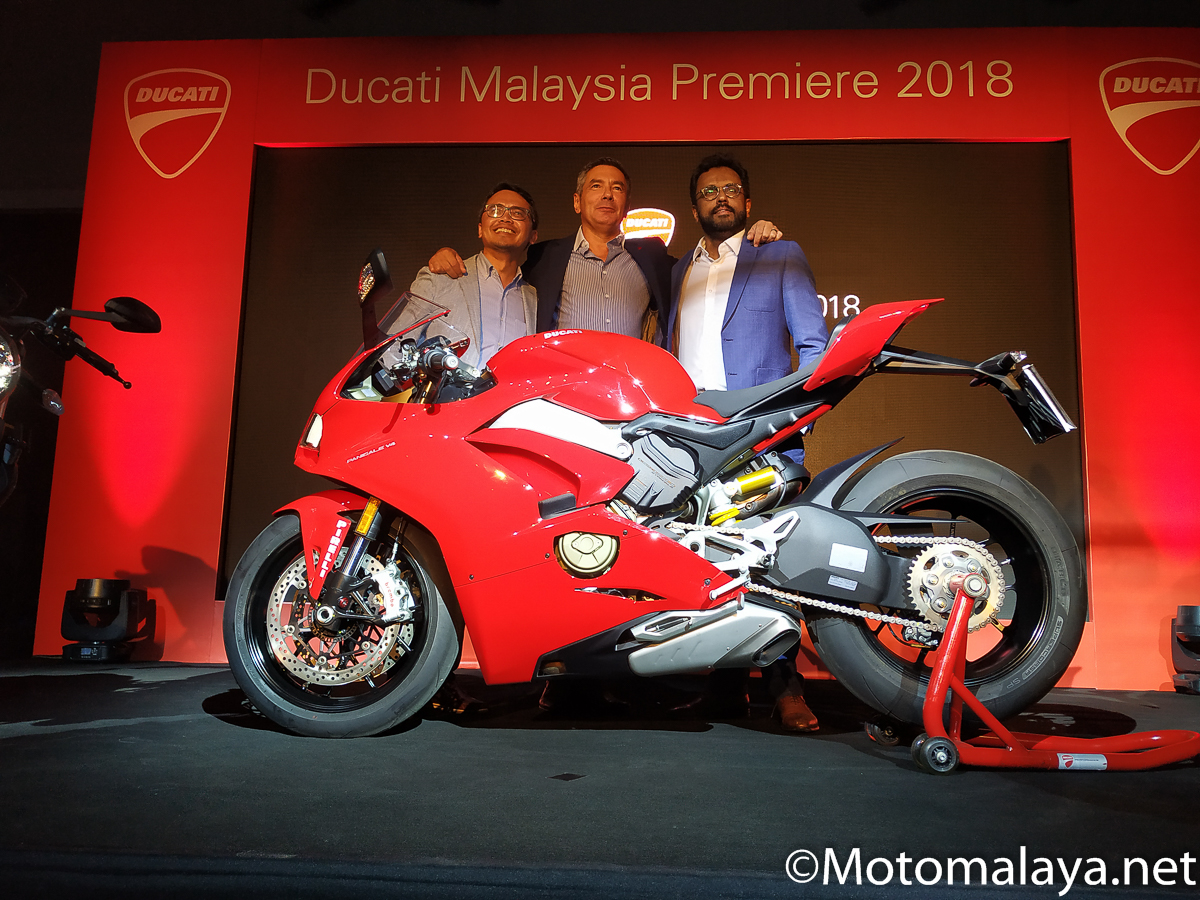
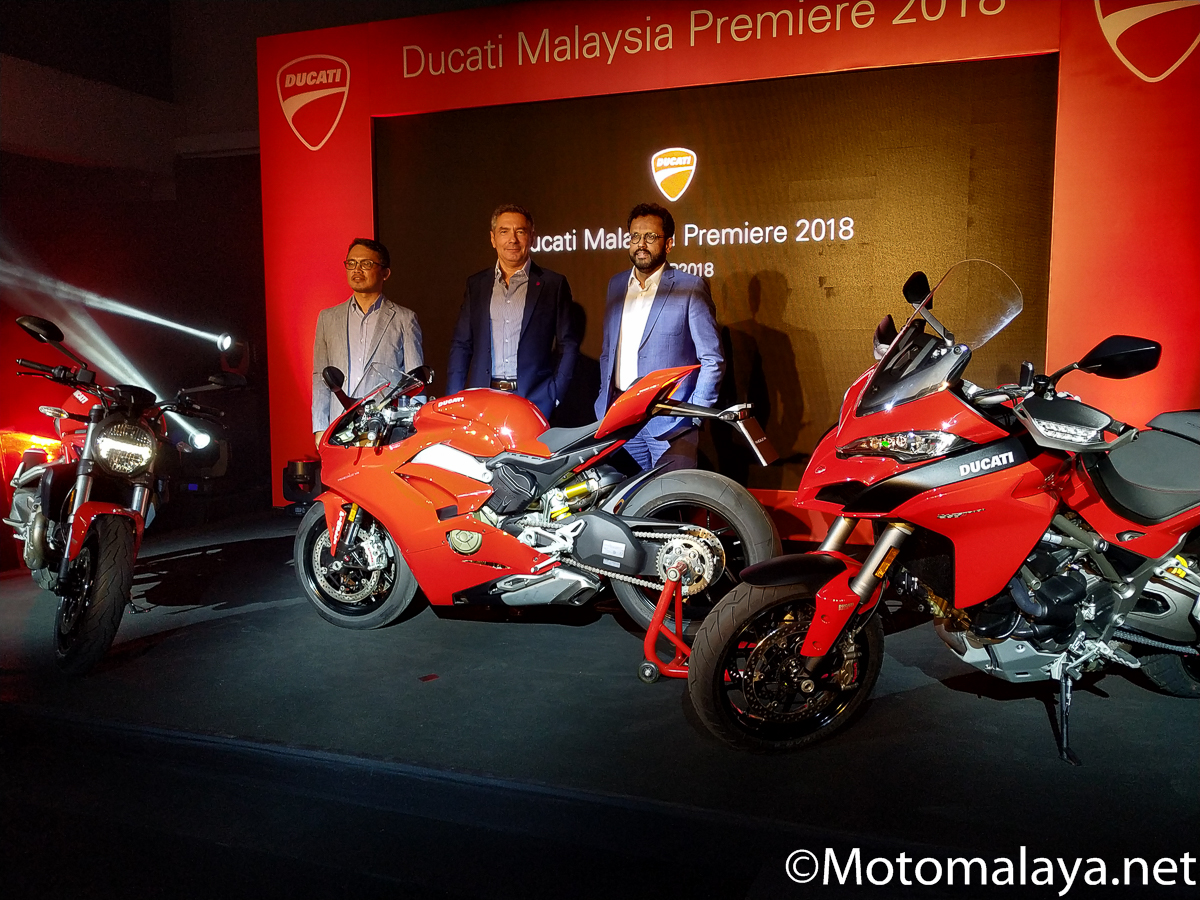
Ducati Malaysia (Next Bike Sdn Bhd) has officially launched three new models for 2018.
The three models are the 2018 Ducati Panigale V4, Multistrada 1260 S, and the new Monster 821.
Prices start from RM60,900 all the way to RM362,900.
The official distributor of Ducati here in Malaysia that is Next Bike Sdn Bhd has officially launched three of their latest bikes for 2018 in the form of the 2018 Ducati Panigale V4 and V4 S, 2018 Ducati Multistrada 1260 S, and the highly-awaited 2018 Ducati Monster 821. The launch was held at the heart of Kuala Lumpur together with their extensive range of models for 2018. (more…)
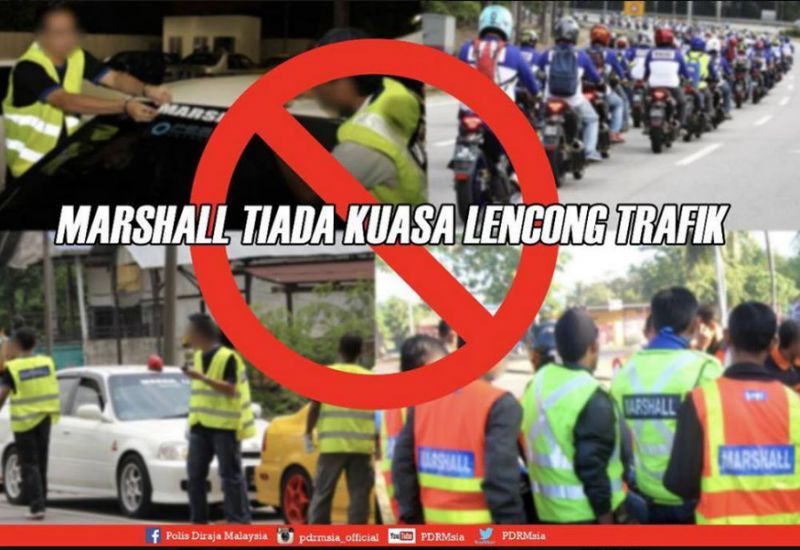
Polis Diraja Malaysia (PDRM) has again warned that marshals are not to direct traffic during convoys.
Marshals can only exist with Traffic Police escort.
Also, convoy organizers must apply for the right to convoy with the Traffic Control Division (Bahagain Kawalan Lalulintas).
Polis Diraja Malaysia (PDRM) has once again reminded that marshals in motorcycle convoys are prohibited against stopping or directing traffic.
The post in PDRM’s official Facebook page also stated that the use of marshals in competitions, convoys or programs on public roads must be accompanied by the Traffic Police.
Members of the public or road user are considered in violation of this specific order if they request right of way, stop traffic, redirect traffic or other such activities.
Furthermore, ride marshals are not allowed without the presence of police escorts. Marshals are also not allowed to direct traffic in the presence of police escorts. Rather, the marshals’ duties are to ensure the ride participants adhere to traffic rules.
The police will act against individuals who attempt to control traffic flow without police escort under Section 21 of the Police Act (1967) or Section 79(2) Road Transport Act (1987).
Bikes Republic has also placed a called to the PDRM’s Traffic Control Division (Bahagian Kawalan Lalulintas) at their headquarters in Bukit Aman, Kuala Lumpur to seek confirmation on the matter. The need to apply for organizing convoys has existed for many years.
We were told that every motorcycle convoy must be applied to the aforementioned division ahead of time for approval. Besides that, Traffic Police escort is specifically for matters of national importance, thus escort for motorcycle convoys is due to the discretion of the PDRM.
Bahagian Kawalan Lalulintas can be reached at 03-22663358. You may submit your applications by hand to:
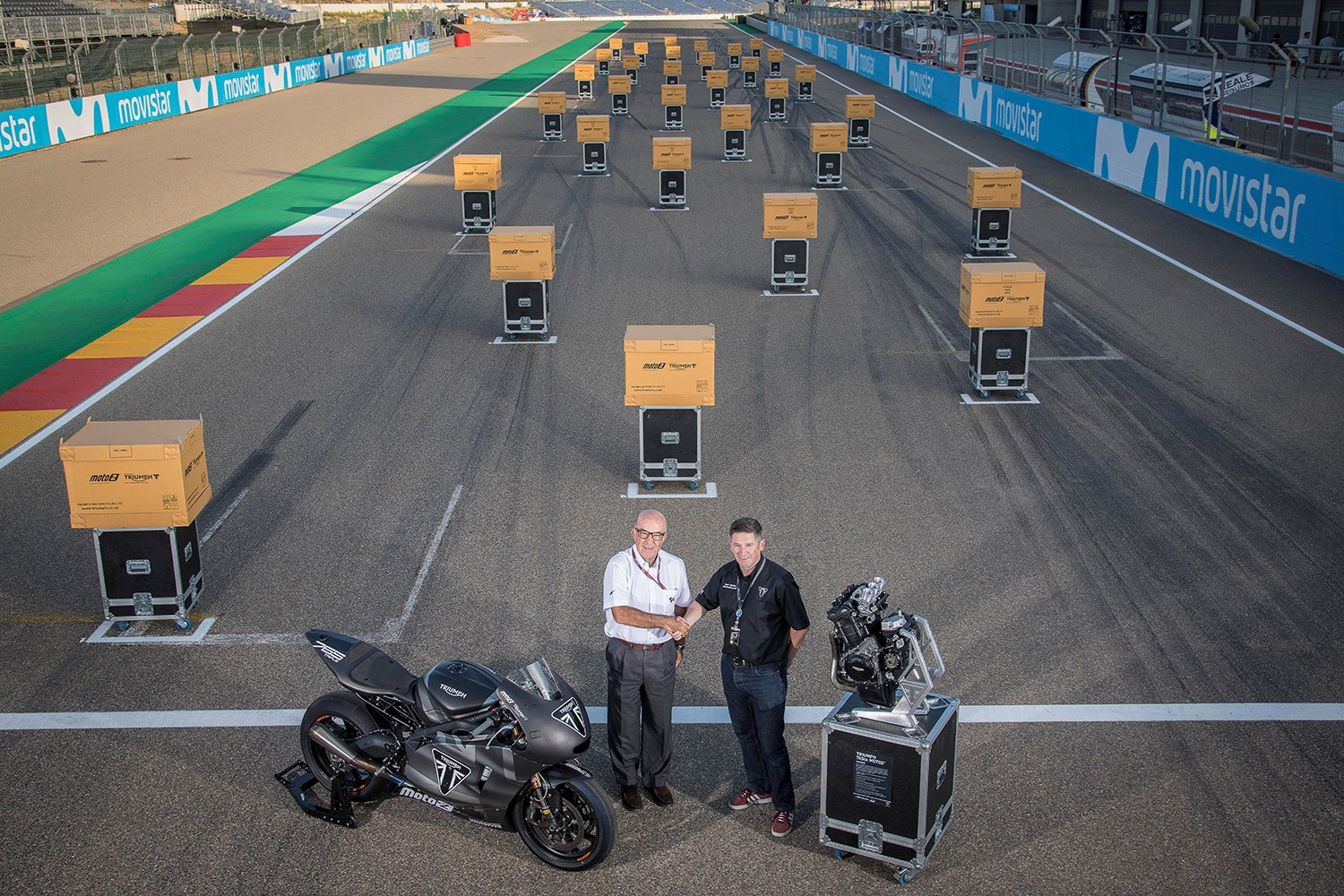
Triumph has handed over the Moto2 engines to their technical partner over the Aragon GP weekend.
Technical partner ExternPro will build and maintain the engines throughout the season.
The handover signals the end of development and the beginning of a new Moto2 era.
Triumph has officially handed over the first batch of engines that power the Moto2 field in the 2019 season. The engines were presented to Triumph’s technical partner ExternPro who will build and maintain them. The ceremony was carried out at ExternPro’s base at Motorland Aragon ahead of the weekend’s races.
The handover signifies the end of the engine’s development for the 2019 season. The engines will be assembled by ExternPro and installed into the individual chassis makes in Moto2, namely Kalex, Speed Up, Tech 3, NTS and KTM.
While it is the end of the race engine development, it is the beginning of a new era for the Triumph 765cc Triple in the intermediate class and re-entry of the Hinckley-based marque into motorsports, albeit as an engine supplier.
The new engines will be ridden in anger the first time during the Moto2 Winter Test from 23rd to 25th November 2018 at Jerez, Spain.
Triumph’s Chief Product Officer, Steve Sargent said, “The excitement and positive response already seen from our customers, the army of Triumph fans worldwide and in the Moto2 paddock has shown us how powerful this partnership will be for Triumph.”
“For me this is just the beginning as we will continue to support the engine programme and feed the key learnings into our motorcycle development, particularly in our class-leading Street and Speed Triples.”
(A Moto2-inspired Street Triple? Shaddup and take my money – Ed.)
As we reported earlier, the Triumph 765cc inline-Triple Moto2 engine carries over many stock parts from the Street Triple including the pistons, cams, crankshaft and conrods. The engine will then be hooked up to a Dorna-issued Magneti Marelli standard ECU which features traction control, launch control and quickshifter with autoblipper for the first time in Moto2.
HLYM launched the Riding Safety Awareness Booklet to instill safety awareness especially among new motorcycle owners.
The booklets will be included with every new Yamaha motorcycle purchased through dealers.
The dealers are responsible in briefing each new owner on the points of safety, contained within the booklet.
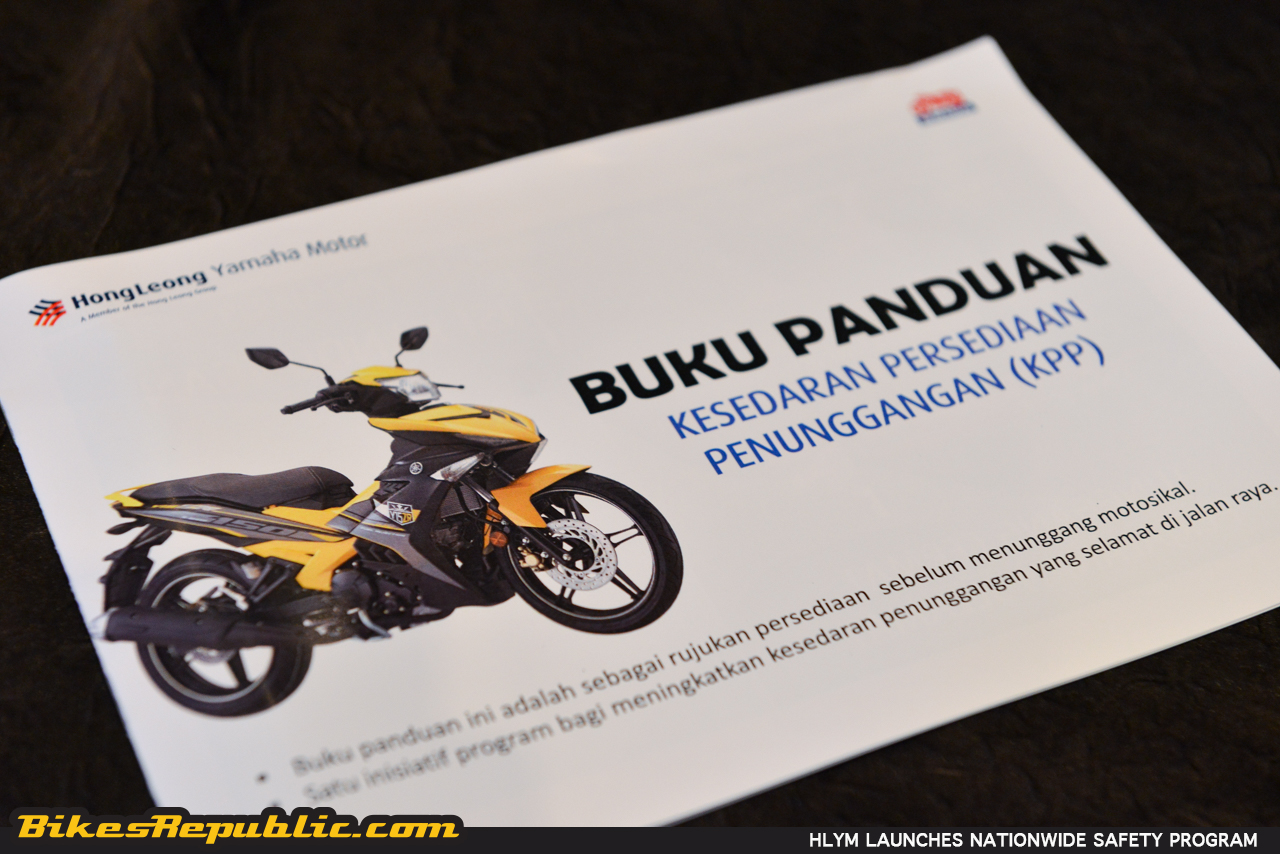
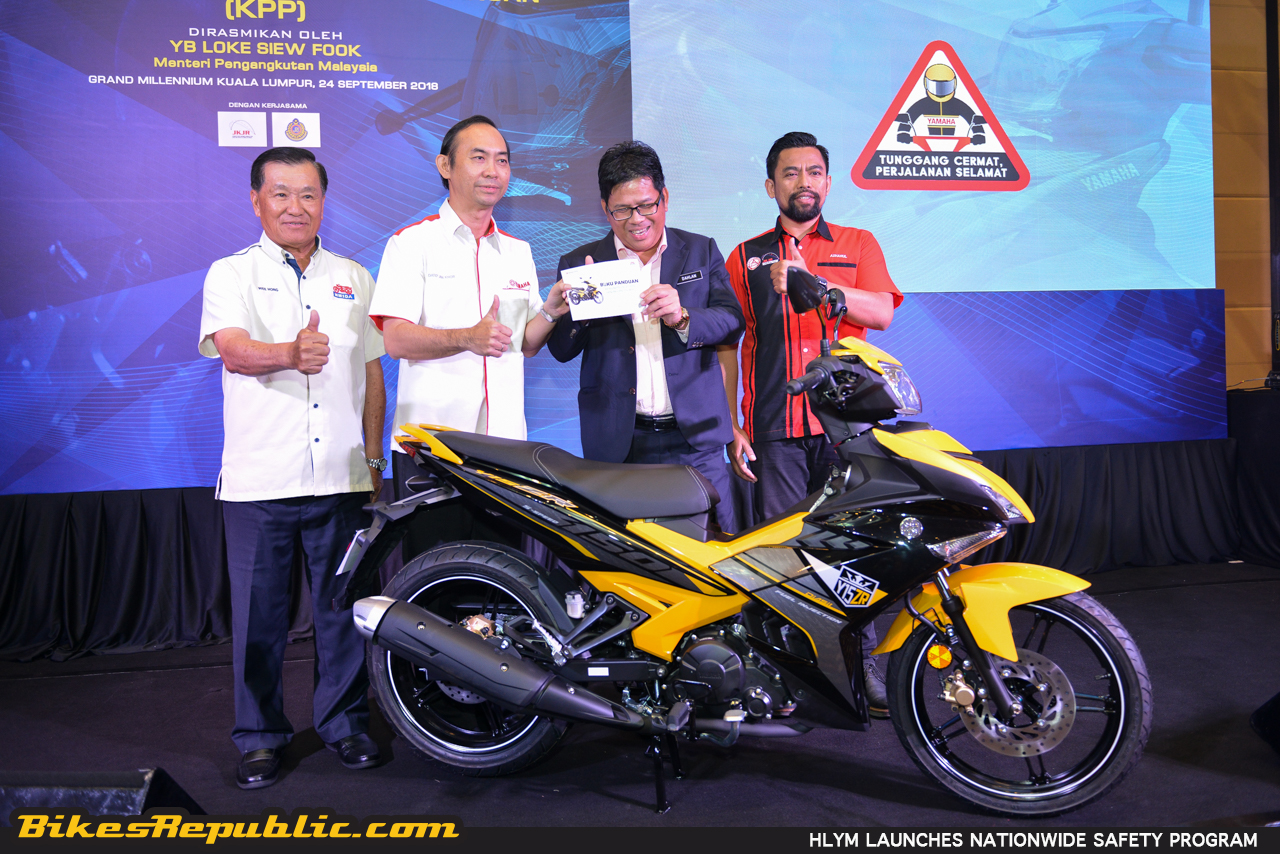
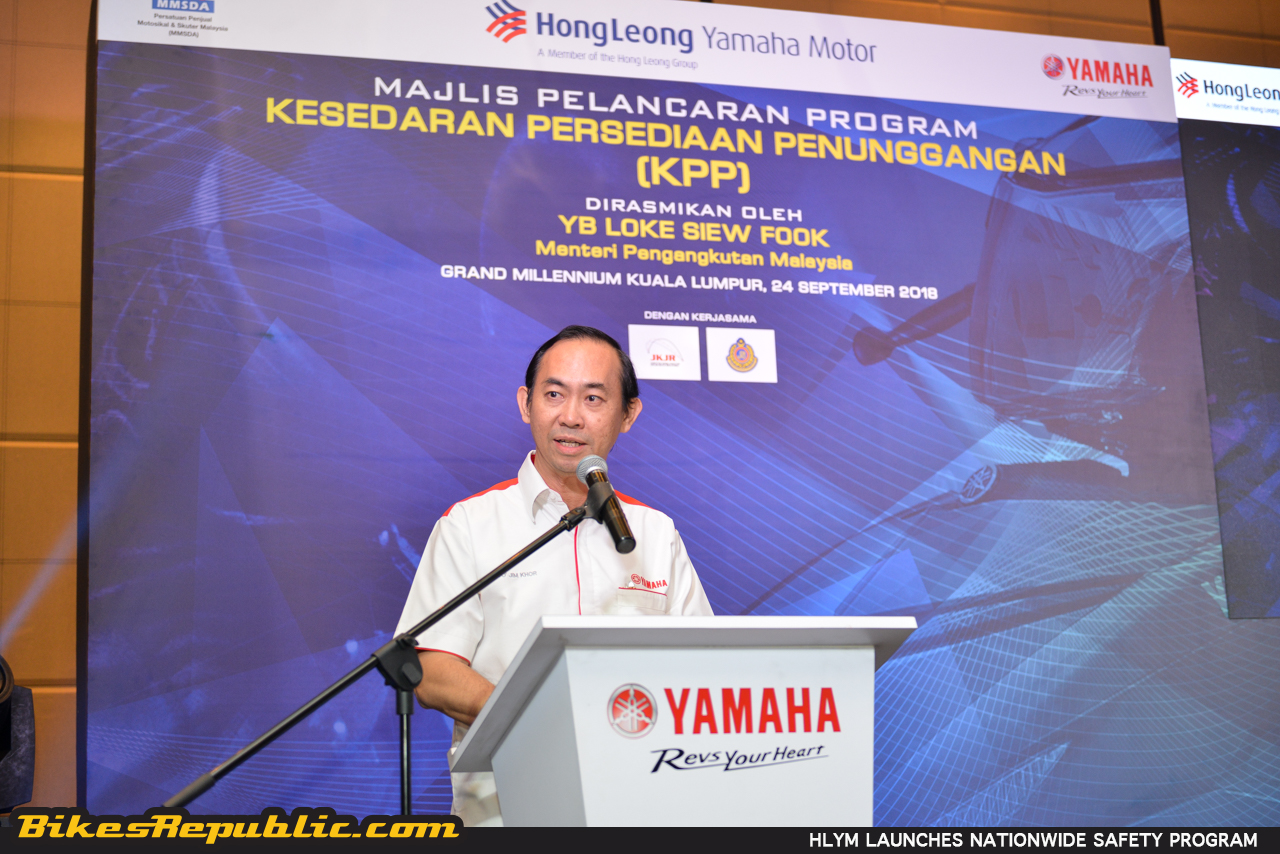
Hong Leong Yamaha Motor Sdn. Bhd. (HLYM) has launched a new safety program in a bid to increase safety awareness among motorcyclists. Core to the program is a new safety awareness booklet called, “Buku Panduan Kesedaran Persediaan Penunggangan (KPP),” translatable to “Riding Safety Awareness Booklet.”
HLYM Managing Director, Dato’ Jim Khor said during the launch that the booklets will be included with every new Yamaha motorcycle purchased through authorized dealers, throughout the country. Through the cooperation with the Malaysian Motorcycle and Scooter Dealer Association (MMSDA), he also iterated that it is the responsibility of each dealer to brief new motorcycle buyers on the points contained within the booklet. HLYM expects to distribute 20,000 copies to dealers per month to also cater for riders who have purchased motorcycles previously.
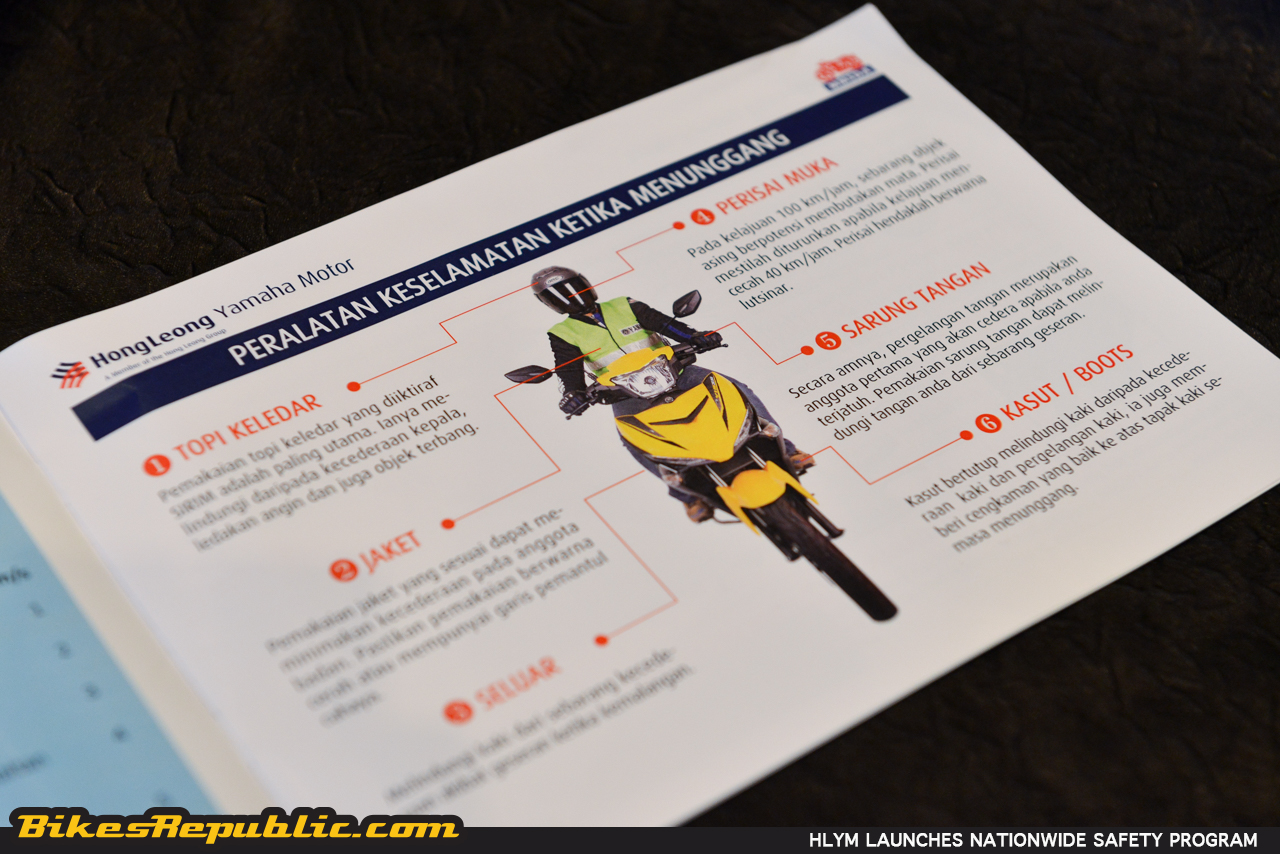
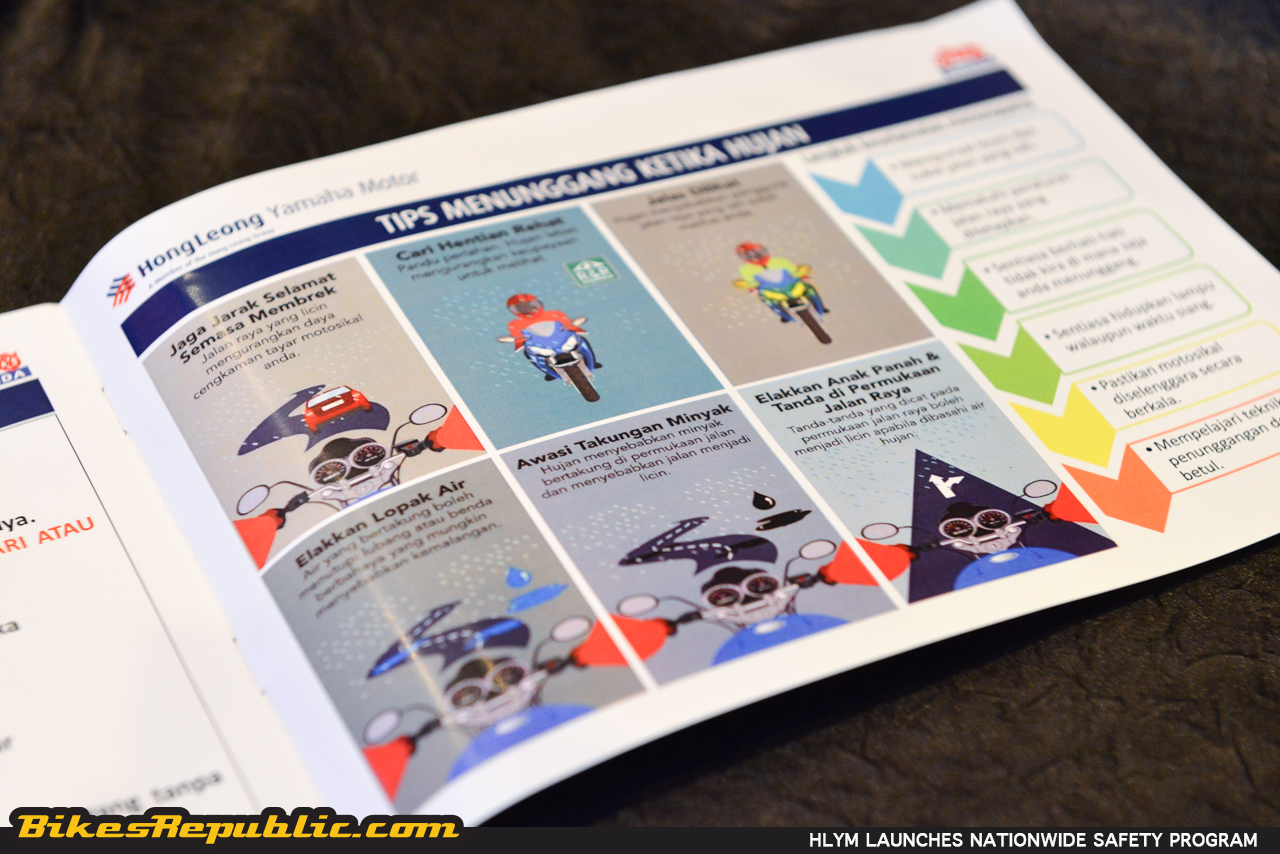
The booklet contains brief but important aspects on riding gear, pre-ride checks, simple motorcycle self-diagnosis, riding tips and a few fines and summonses applicable to those who flout the law.
“The emphasis on our customers’ safety will always be our company’s utmost priority and HLYM will continue to advocate the importance of road safety through many more programmes in the future. Based on our insights, we realized that some of the new motorcycle owners are not quite well aware on the basic safety requirements when they are on the road. We hope that with the KPP Programme, we will be able to educate them with the right information so that they can be good examples to other road users,” added Dato’ Jim Khor.
The launch of the program was launched by Datuk Mohamad Dahlan Md Maamor, the Political Secretary on behalf of the Transport Minister, YB Anthony Loke. The launching was also witnessed by the aforementioned Dato’ Jim Khor and Mr. Wee Hong, the Chairman of the MMSDA.
Here are the next five riding tips from pro riders.
Pro riders started out riding using the same techniques as all riders.
Those basic techniques were then honed to fit the type of bike they ride.
Continuing from Part 1, here’s the conclusion to our feature Ten Riding Tips from Ten Pro Riders. As we wrote in the previous edition, motorcycle racing pros may have different riding styles but be aware that their riding techniques were honed from the same basics of motorcycle riding.
For example, Marc Marquez’s elbow dragging style was developed when he rode in Moto2. Jorge Lorenzo’s high mid-corner speed style was brought over from 250cc GP.
So here are the basics. We hope all of us (including us) could apply these lessons.
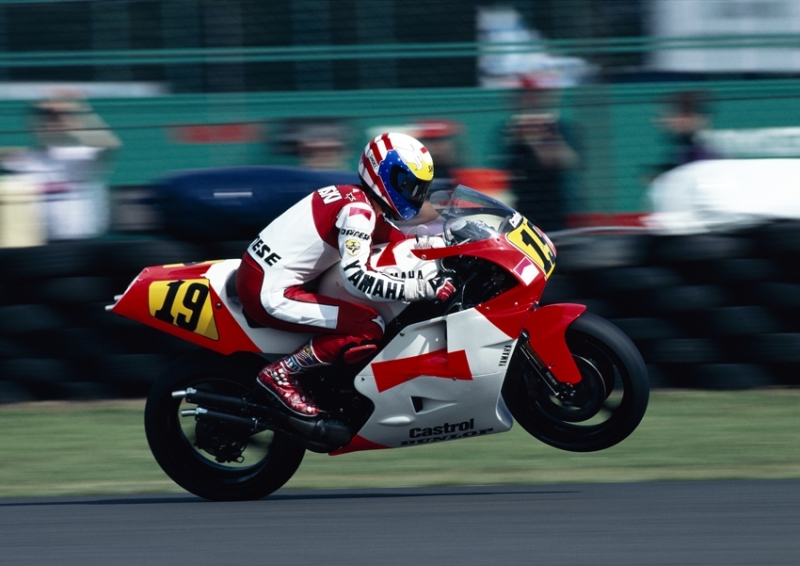
6. John Kocinski – “Scrub your tyres”
John Kocinski – courtesy of www.greatprints.co.uk
Pushing hard on new or cold tyres is, but John-Boy worked around them when he was racing in US before heading to the World 250cc GP. He’d show up on the grid on shiny, unscrubbed slicks then push the front a couple of times during the warm up lap. Kocinski would slide his tyres at will due dirt training taught by his mentor, Kenny Roberts Sr.
Always break in your new tyres and warm them up before you banzai through the very first corner you see.
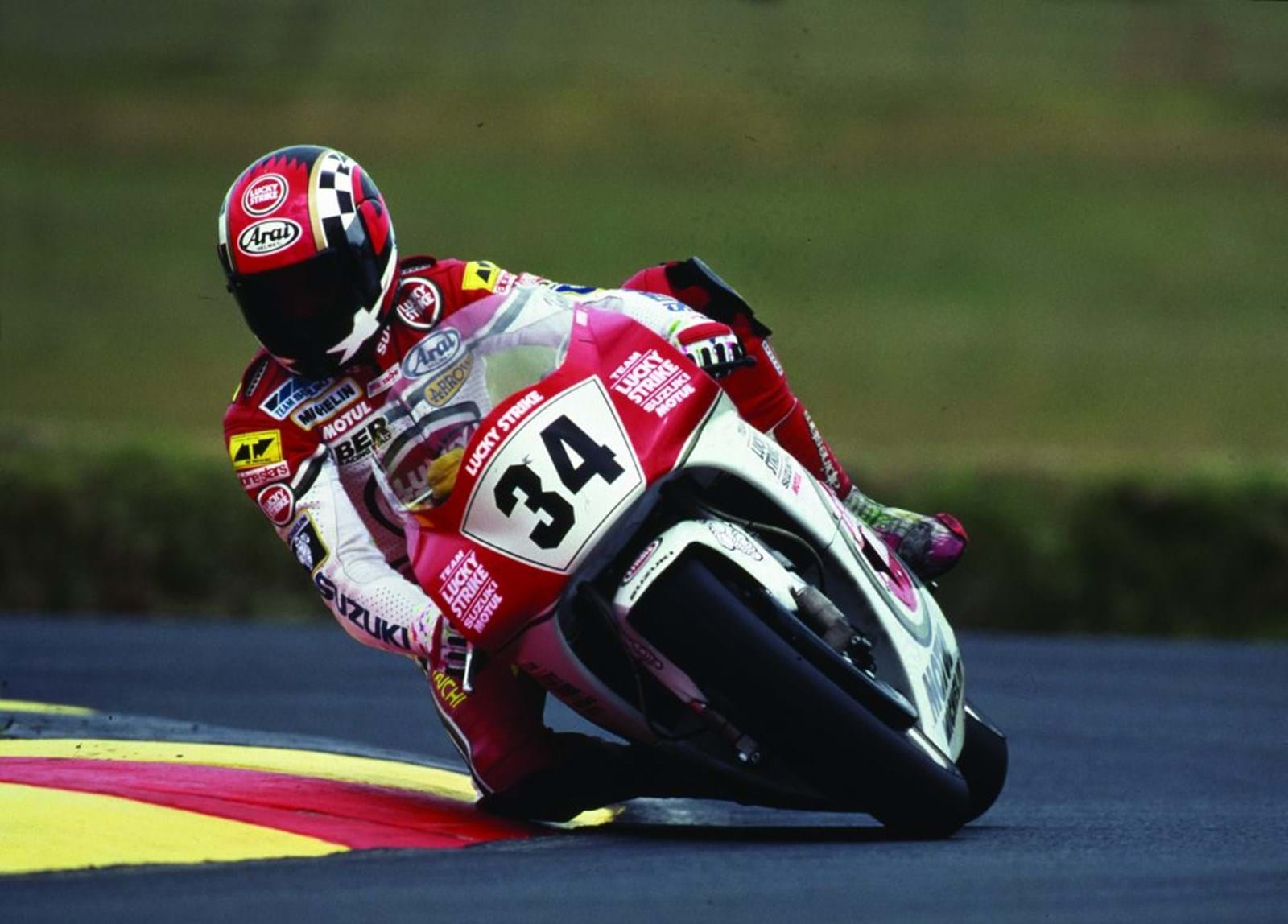
7. Kevin Schwantz – “Look where you’re going”
Kevin Schwantz – courtesy of bikes.suzuki.co.uk
This may sound like a superfluous advice from one of the most popular GP riders, but let’s admit it: We will still stare at the outside of corner when we panic or the tyres slide unexpectedly.
The motorcycle goes where we’re looking, and we should keep looking towards where we want it to go, even when we feel it’s out of control. This technique is taught at every advanced riding school for a reason.
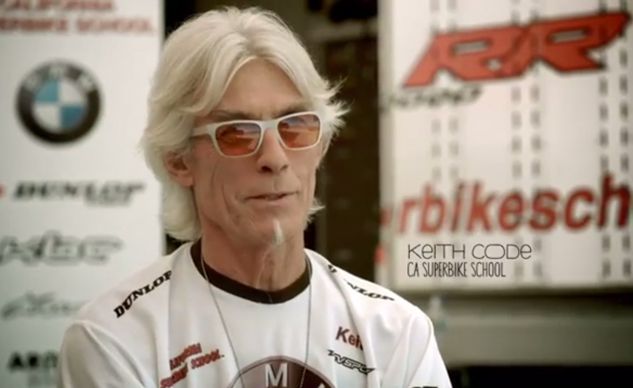
8. Keith Code – “Keep a wide view”
Keith Code
Speaking of “views,” Keith Code is the founder of the California Superbike School and his books, A Twist of the Wrist and A Twist of the Wrist Vol. II are considered the “bible” of how to ride a motorcycle around corners. His protégés included GP greats such as Wayne Rainey, Doug Chandler, among many others.
In summing up all the lessons he taught, he wrote, “All the best riding skills you have is only as good as your visual skills.”
Apart from looking towards where you want to go, we should also keep a wide view of the road ahead. “Keeping a wide view” means utilizing your peripheral vision to resist your view from tunneling down. As the name implies, “tunnel vision” is like staring down a toilet paper tube as your senses eliminate everything else to a narrow field of view of only what’s directly in front, usually at high speeds.
Yes, it’s thrilling because it’s like the view you get when the Millennium Falcon goes to light speed, but it’s downright dangerous on the road and track.
Tunnel vision fools us into thinking that we’re travelling much faster than we actually are and that “fake speed” will overwhelm us when we approach a corner or a hazard. On the track, we’d end up braking too hard, too soon and losing speed and consequently time. However, on the roads, coupled with target fixation, we could even think we’ve run out of brakes or road hence running wide or smashing into the hazard.
Conversely, keeping a wide field of vision “slows” things down, giving us a better sense of our surroundings, effectively opening up space around ourselves. On the road, it’s one of the most important safety techniques as we could anticipate other vehicles or hazards that are starting to encroach into our path.
We understand the feeling. We’re sweeping through a beautiful set of corners and the suddenly, the rear tyre kicks out under us. Our instinct instantaneously shuts off the throttle and the rear end let go completely. There were times when the bike almost high-sided us.
Shutting the throttle abruptly when a tyre slides is against motorcycle dynamics and will cause a crash, more often than not. Learn from the pros: A sliding tyre isn’t the end of your riding.
As mentioned earlier, Doug Chandler came up through the American National Dirt-Track and supermoto championships before heading over to Superbikes and the world 500cc GP, so sliding around is second nature to him.
So, what should we do when our tyres slide? Nothing, according to Chandler. We just need to stop adding throttle, keep looking through the corner and maintain a relaxed body. Think of a sliding tyre as looking for a stable position because it will hook back up naturally. A sliding tyre will also slow down. Fighting the slide only exacerbates it as we are preventing it from carrying out its duty.
Of course, this takes some nerve, but nerves can be polished out by training. Controlling your instincts and slides are taught at Most Fun Gym.
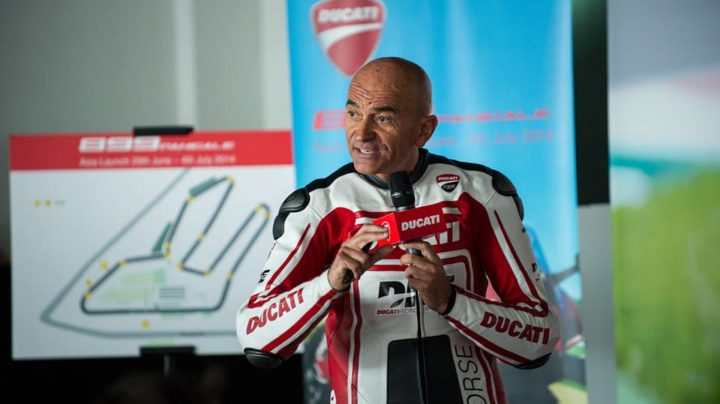
10. “Use both brakes” – Dario Marchetti
Dario Marchetti
You may not have heard of his name, but Dario Marchetti is the Technical Director and Chief Instructor of the Ducati Riding Experience (DRE) Racetrack Academy. Having raced in 250 GP, 500 GP, Superbikes, Endurance besides winning at the Battle of the Twins on a Ducati at Daytona in 2004, 2006 and 2007.
He and his panel of DRE instructors include racing greats such as Carlos Checa, Manuel Poggiali and other regional champions.
Among many advices that he provides during the recent Ducati Panigale V-4 test ride at the Sepang International Circuit, he expounded explicitly on using both brakes. Using the rear brake together with front stabilizes the rear especially under hard braking. It’s a boon especially when the road condition is iffy or wet.
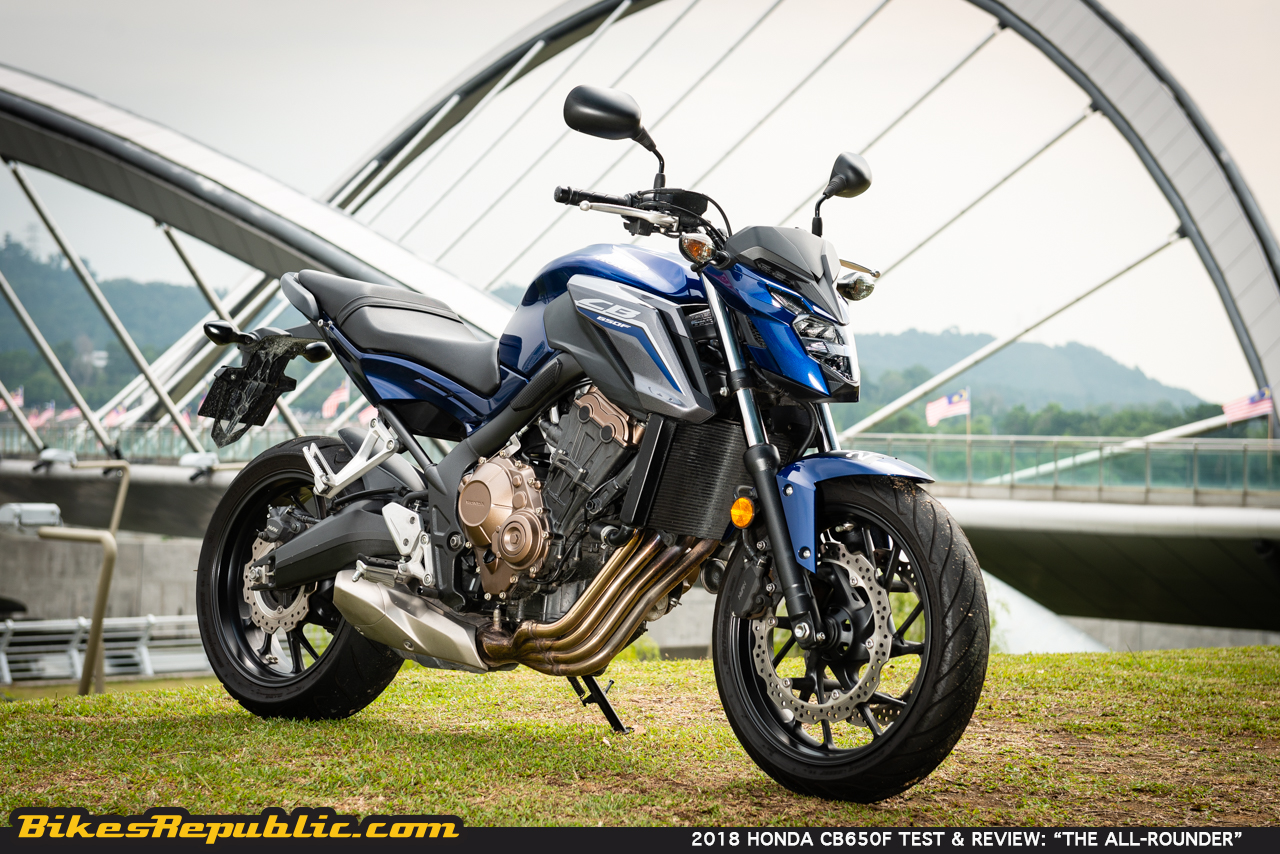
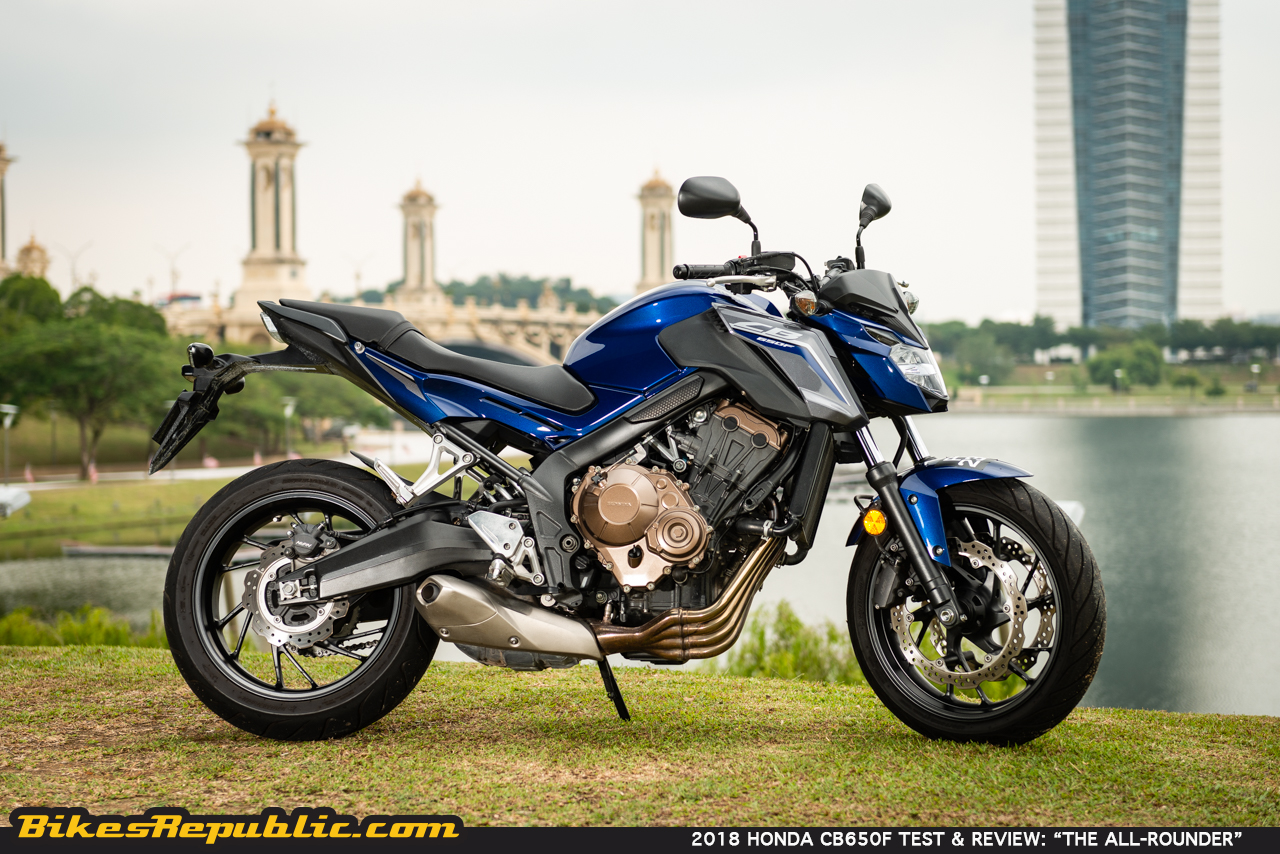
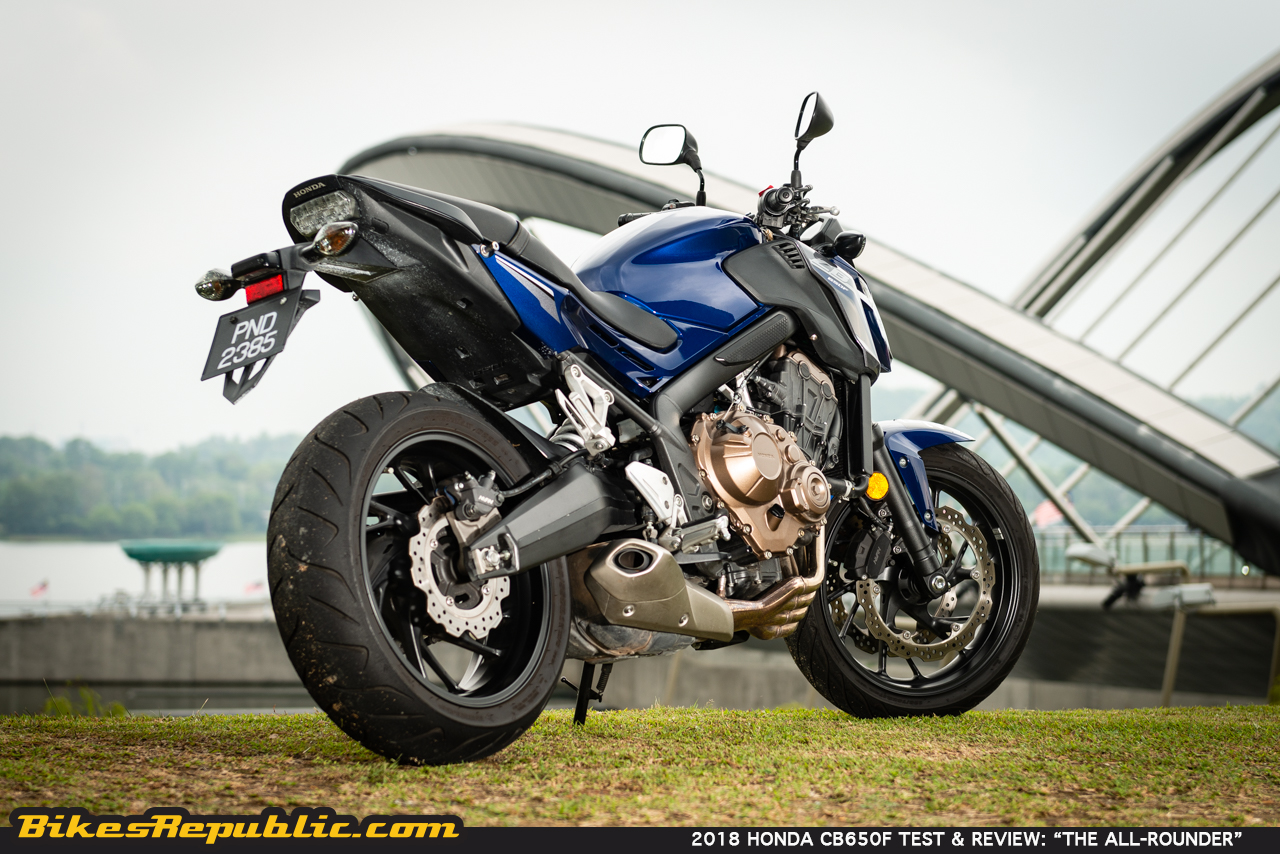
The 2018 Honda CB650F is the naked version of the fully-faired CBR650F.
Both bikes share the same engine but different riding dynamics.
While the CB650F is meant to be a naked sportbike, it does well as an all-rounder, too.
We’ve tested many motorcycles. Adventure-tourers, luxury tourers, supersports, scooters, cruisers, standards, café racers, modern classics, classics that aren’t modern, etc., etc. Many fit into their respective categories and perform their roles well with singular purposes. But the 2018 Honda CB650F seemed to do just about everything.
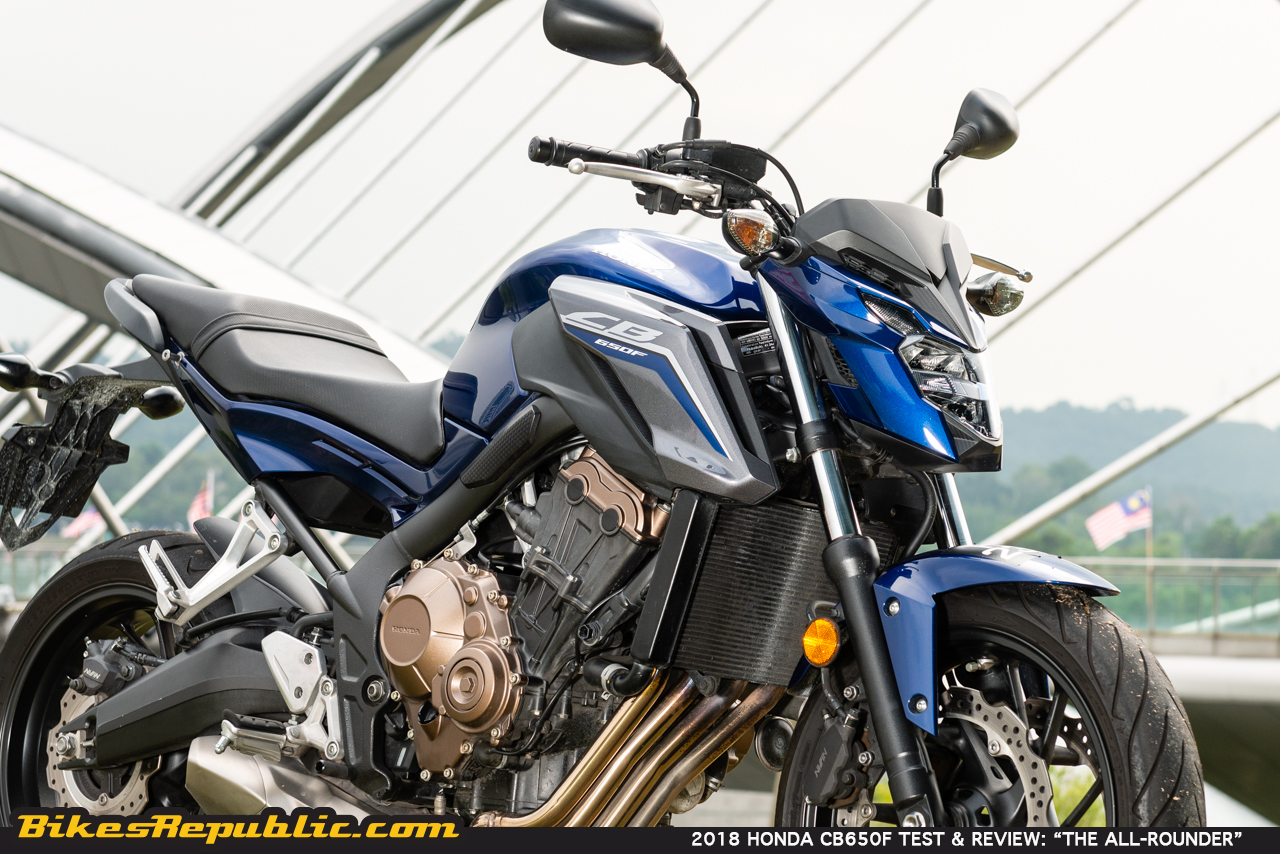
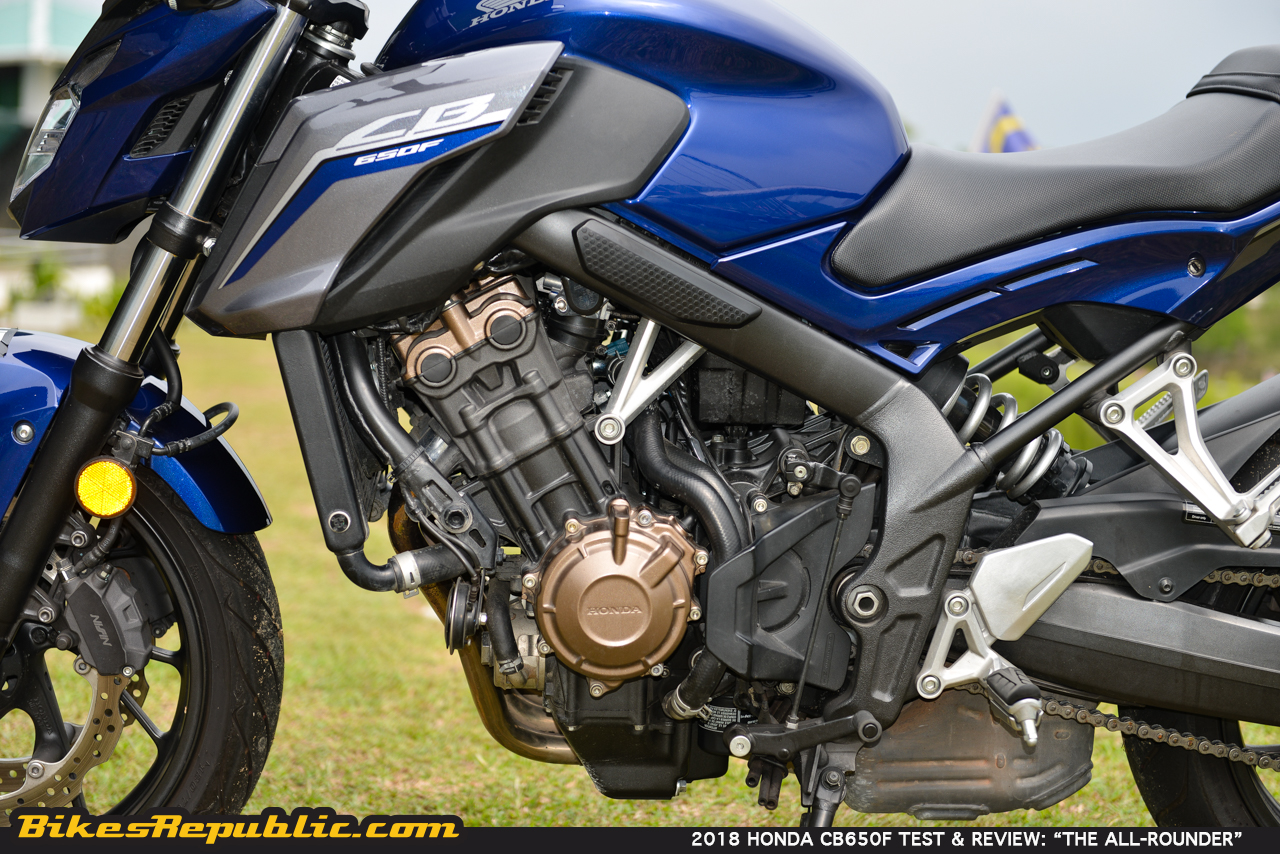
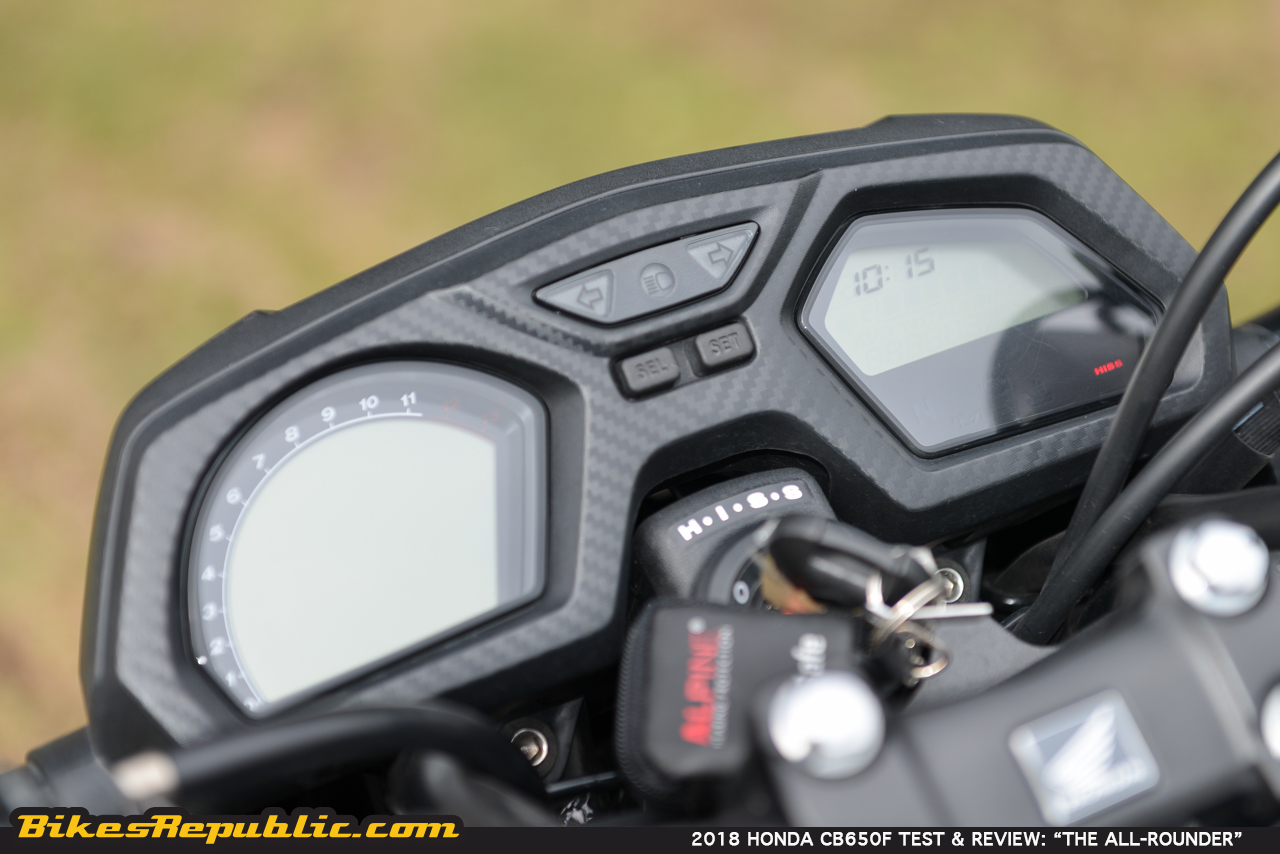
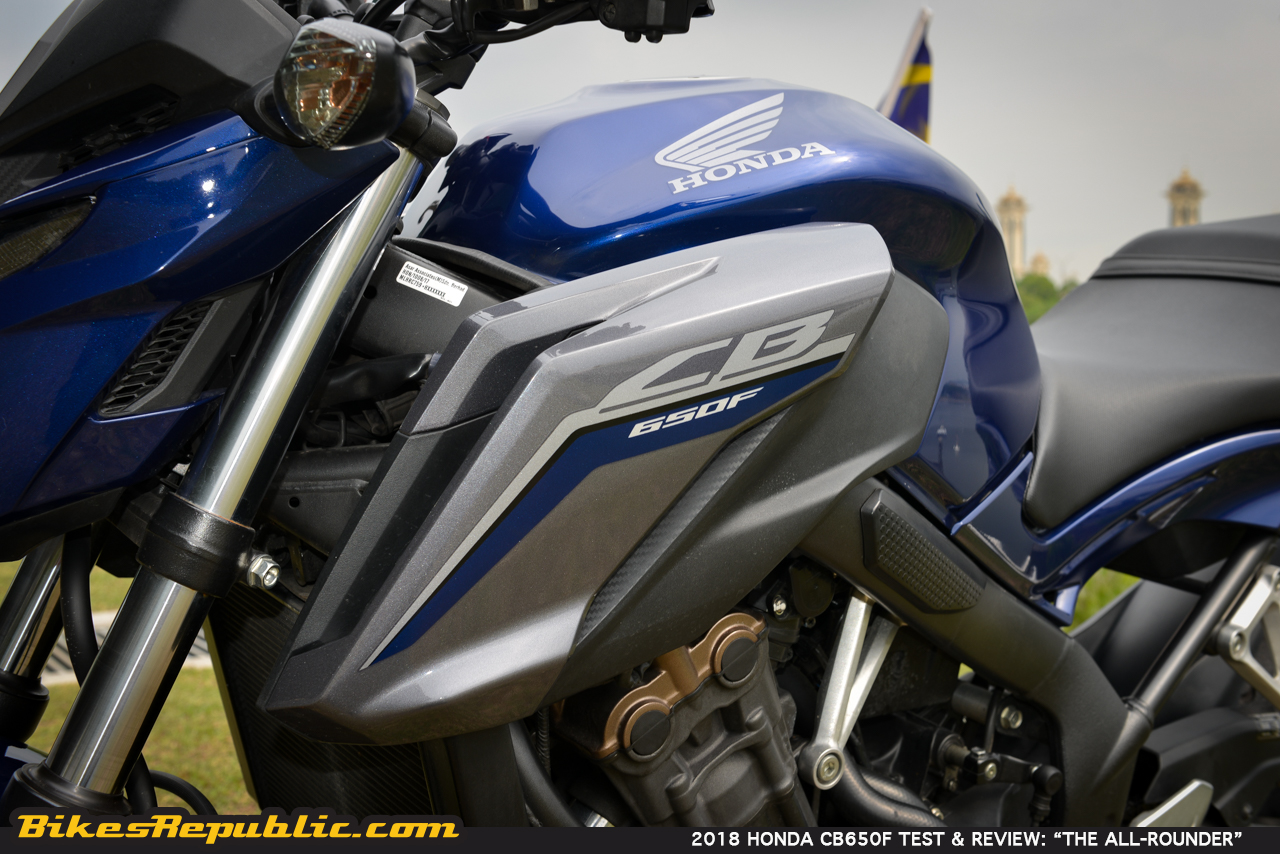
Launched together with its CBR650F fully-faired brethren, the CB650F takes on the look of a naked sportbike. It does look the part with its multi-faceted bodywork, engine hung out in open with its four exhaust headers for all to see, a stepped seat.
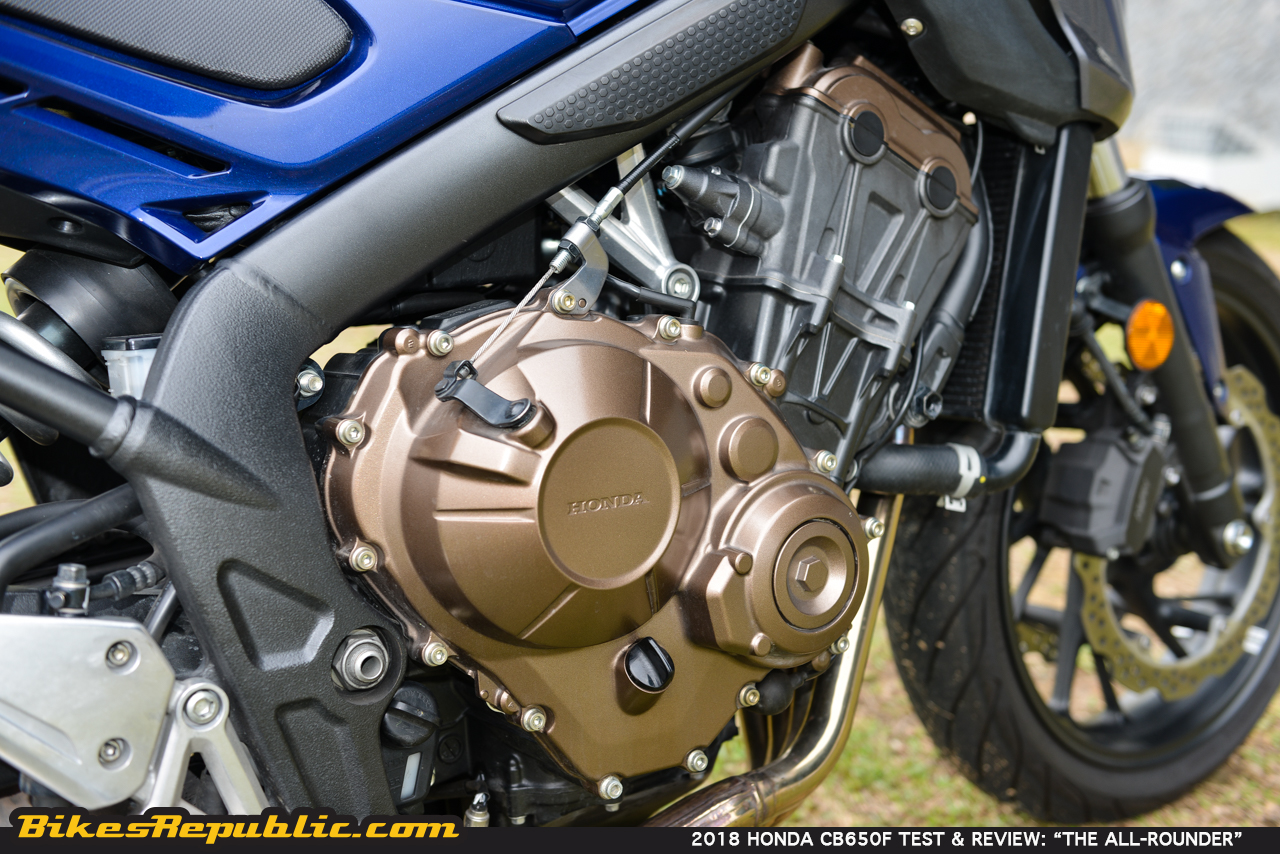
The 650cc, liquid-cooled, DOHC, 16-valve, inline-Four engine is shared with the CBR650F, so as almost every part of the bike, with the exception of the headlight and handlebar.
The CB650F’s seating position put me in a nice forward crouch without needing me to plop my (substantial) belly over the tank and offering my bum to the traffic behind. The angle was between the fully sit-up style of say the Yamaha MT-07 and aggressive Honda CBR650F.
The seat may look tall but has a nice height which is accessible to most riders, while the footpegs are placed relatively high and back for ground clearance.
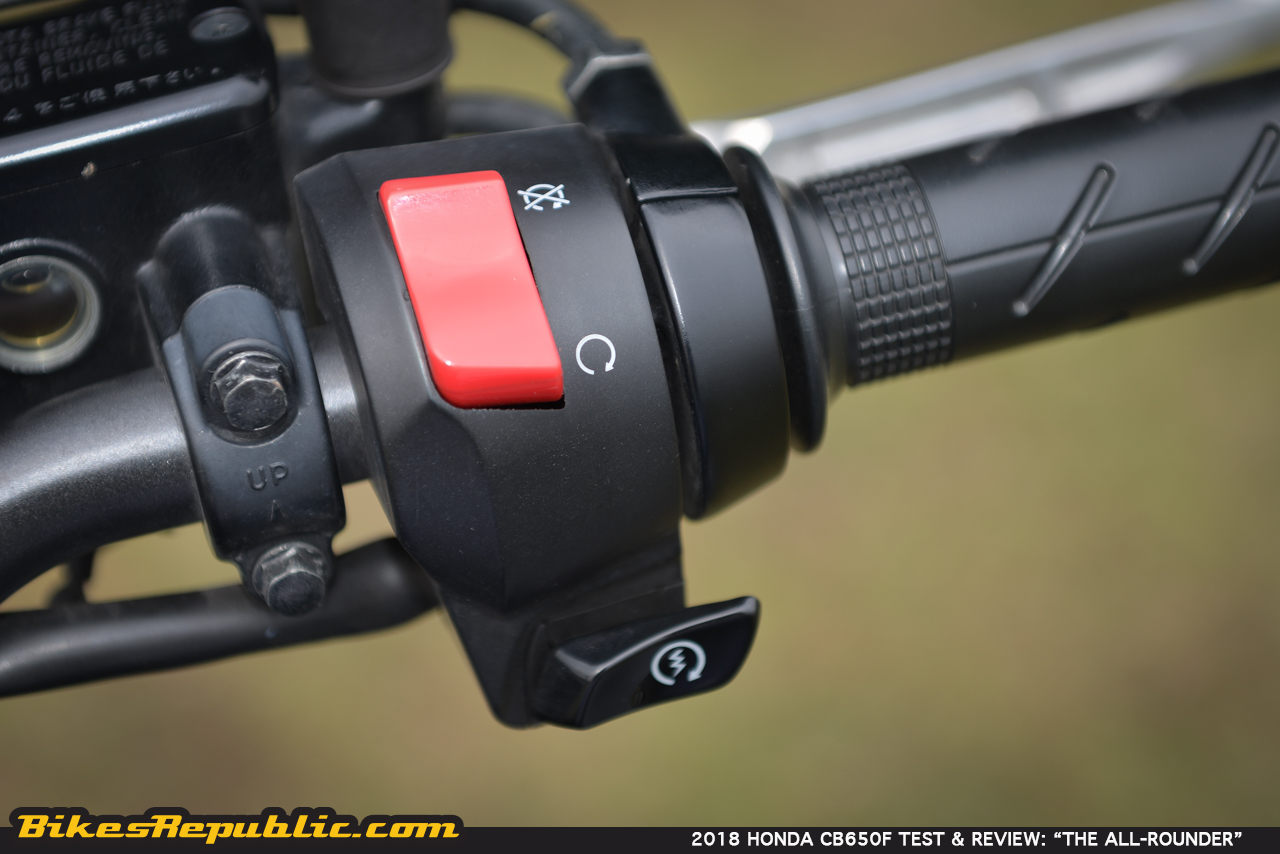
Stabbing the ignition button brought the bike instantly to life with a “whooshing boom,” courtesy of four cylinders. The engine felt smooth when I blipped the throttle, although there was some vibration to tickle certain parts of the body.
The CB650F needed a little more clutch slip to get going put the power kicked in quickly, accompanied by a hair-raising burble from the airbox under the fuel tank. Just as Honda claimed, the engine was tuned for low- to mid-range torque and it accelerated surprisingly fast for a mid-range inline-Four through the slick gearbox as it surfed that wave of torque around heavy traffic.
Its engine served more like a three-cylinder bike, actually, because there’s always torque everywhere up to 8000 RPM. Heck, you could even filter through traffic at 60 km/h in fourth gear without any driveline snatch. It makes life a whole lot easier than having to constantly shift gears back and forth.
But when the roads opened up, so did the CB650F as it rocketed away and kept building speed briskly. It kept finding myself riding faster than I should. Well, why not, it’s got 90 bhp and 64 Nm of torque.
Now the bike has taken on the role of a sport-tourer, as it could hold on to any high-speed I chose. There’s another surprise here: Most naked bikes would have the windblast hammering on your chest at 130 km/h, but I found that I could sit up relaxed at 160 km/h. That’s true credit to the bike’s seating position.
The tingles typical of inline-Fours stayed with me at most times but it seemed to balance out at above 110 k/h. There’s still plenty of go at this speed as a twist of the throttle had me passing an entire line of cars in a hurry.
The Honda CB650F handled quite well and it’s more nimble than the CBR650F despite the same 25.5o rake and 101 mm trail. The taller handlebar means your arms are extended straighter while gripping the handlebar, hence your countersteering forces are more perpendicular (straight ahead) in relation the handlebar. Compared to bikes with their handlebars down in front the headstock, there is a tendency to push downwards on them as support for your upper body weight, resulting in slower steering.
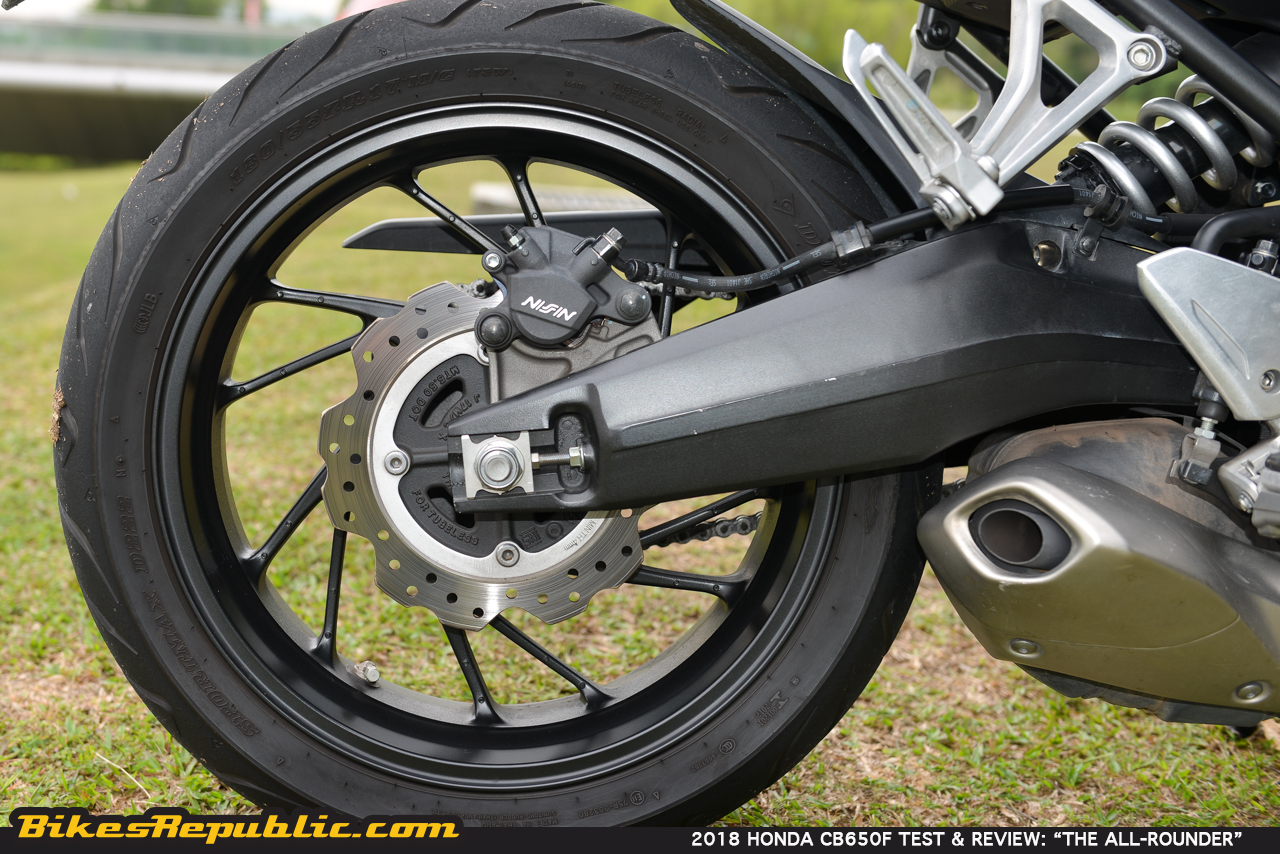
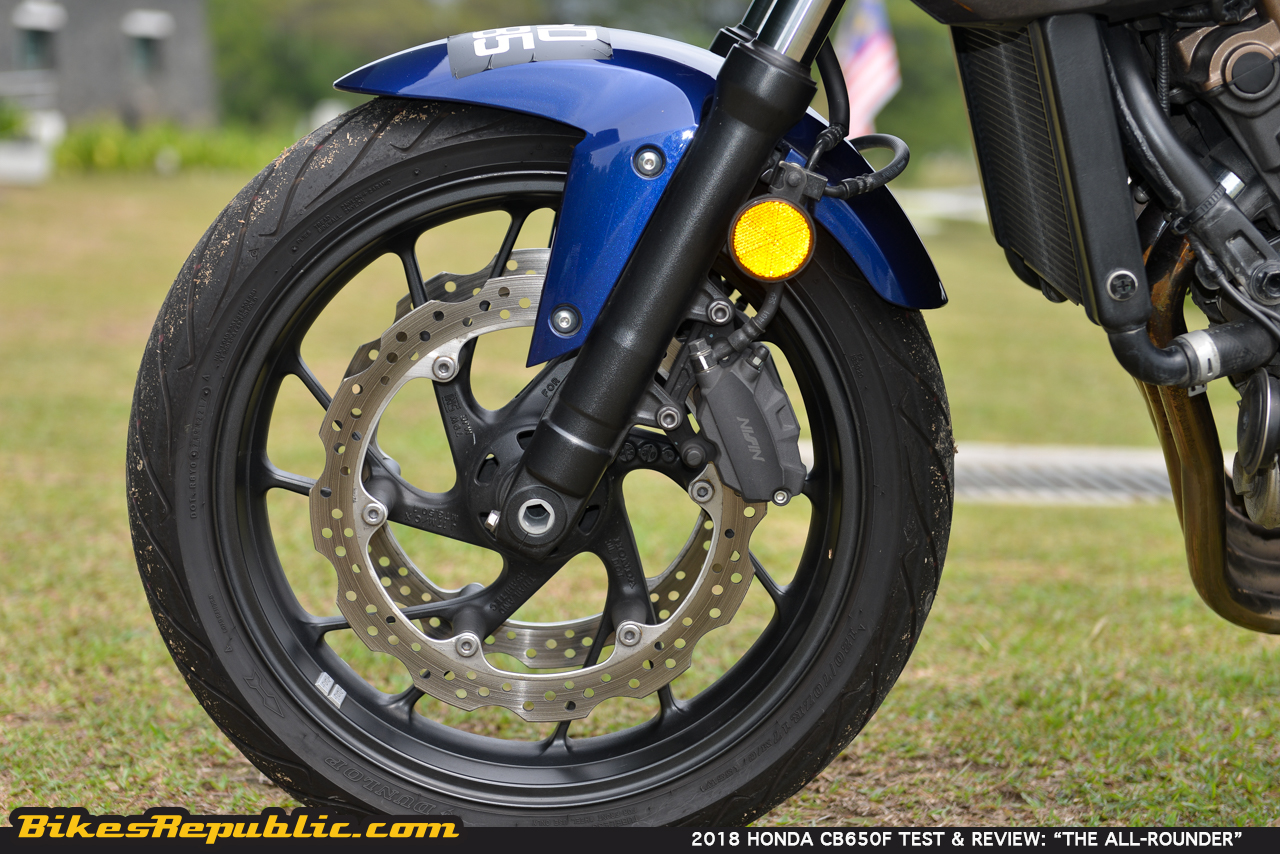
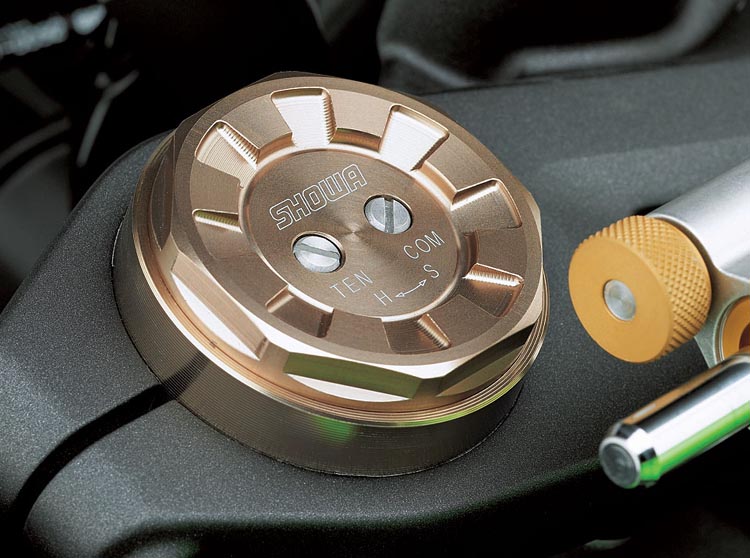
The bike never protested when slammed it into corners considering the basic suspension package. The bike was suspended by the same non-adjustable Showa Dual Bending Valve Forks (SDBV) forks in front and a monoshock at the rear (adjustable for preload only). But the suspension definitely felt better on the CB650F as I didn’t have so much upper body weight on the front end.
The only thing I had to do was remind myself to hit corners with a gear higher as the engine’s torque results in heavy engine braking with the throttle off. However, this is just my personal preference as I prefer the bike to freewheel into corners. I would reduce a couple of teeth on the rear sprocket or install a slipper clutch if this bike was mine.
That brings me to what I didn’t like. The throttle was abrupt when it’s picked up from fully closed. Not from when the bike is idle, but when riding and shifting gears at low speeds, spoiling super smooth ride. I had to compensate by leaving some throttle on.
All-in-all, the 2018 Honda CB650F was a nice bike to ride around on a daily basis as it performed the role of an all-rounder remarkably well, whether it was commuting, long-distance blasting on the highway or weekend corner carver.
It’s offered at a price that’s hard to beat, considering that it has 90 bhp, great Honda build quality and comfortable, all at the same time.