Bikesrepublic

Latest News

  • As we’ve posted before, accident videos can help us learn.

  • In this video, two bikes crashed together through improper braking and target fixation.

  • We’re not criticizing anyone, but here are tips on how to avoid such tragedy.

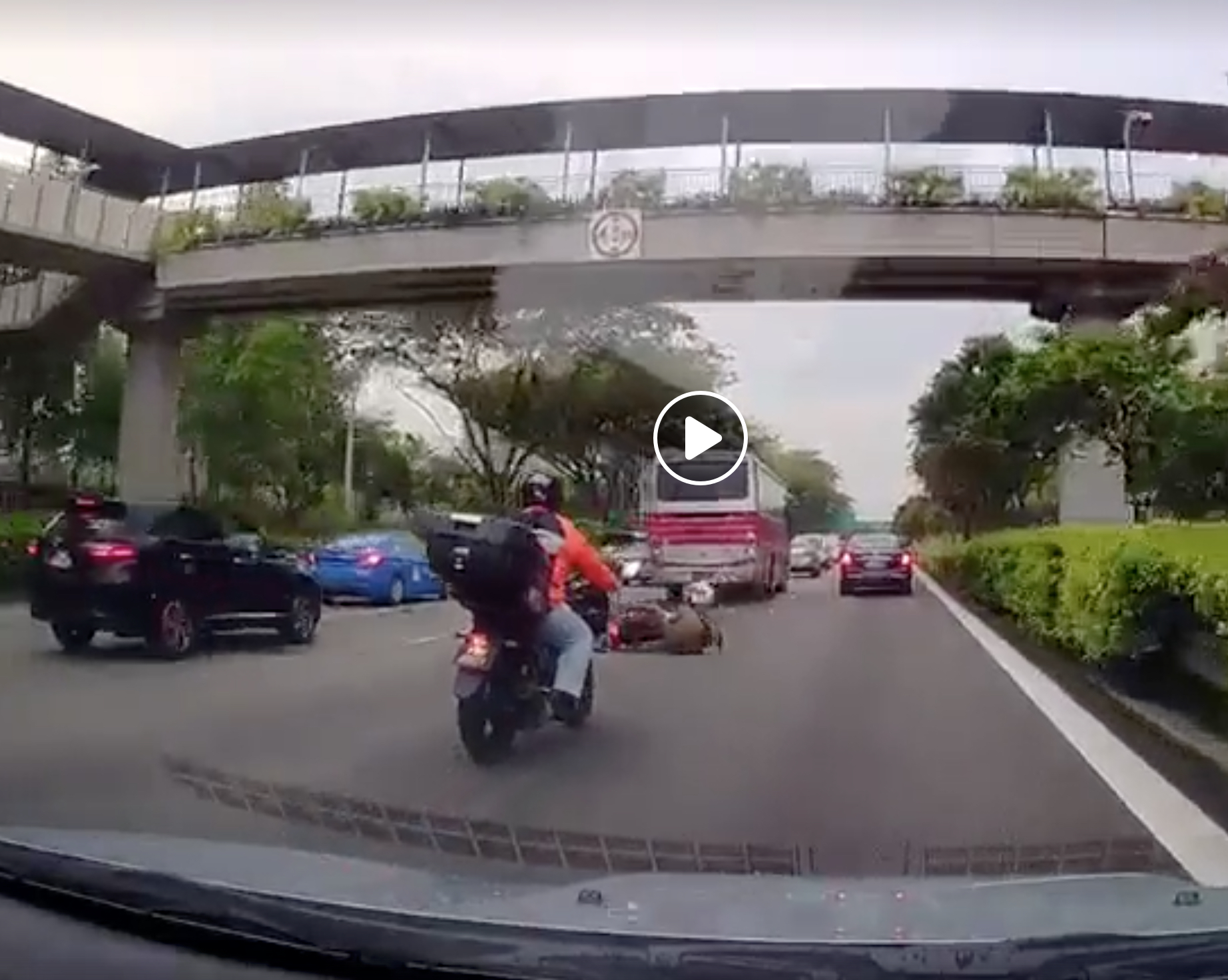
A Singaporean Facebook page shared a video of an accident involving two motorcycles this morning. But rather than just condemning the parties involved we could perhaps learn that target fixation and improper braking is dangerous for us motorcyclists.

We are not trying to be experts here either. But after years of practice and riding in the same situation at least three times per trip per day, one tends to learn.

Watch the video below:

Part 1 – First rider

First rider panicked as he was trying to slip between the bus and car. He grabbed his front brake with full power, resulting in the front tyre washing out.

First lesson: Overtaking
  • If you need to overtake, do it quickly to get out of the “sandwich zone.”
  • But don’t ride more than 40 km/h faster than the vehicles around you.
  • Too fast and you won’t have time to react.
  • We humans normally take 0.5 second to react.
  • A vehicle covers 13.8 metres in 0.5 second at 50 km/h, and 27.7 metres in 1 second at 100 km/h. You decide.
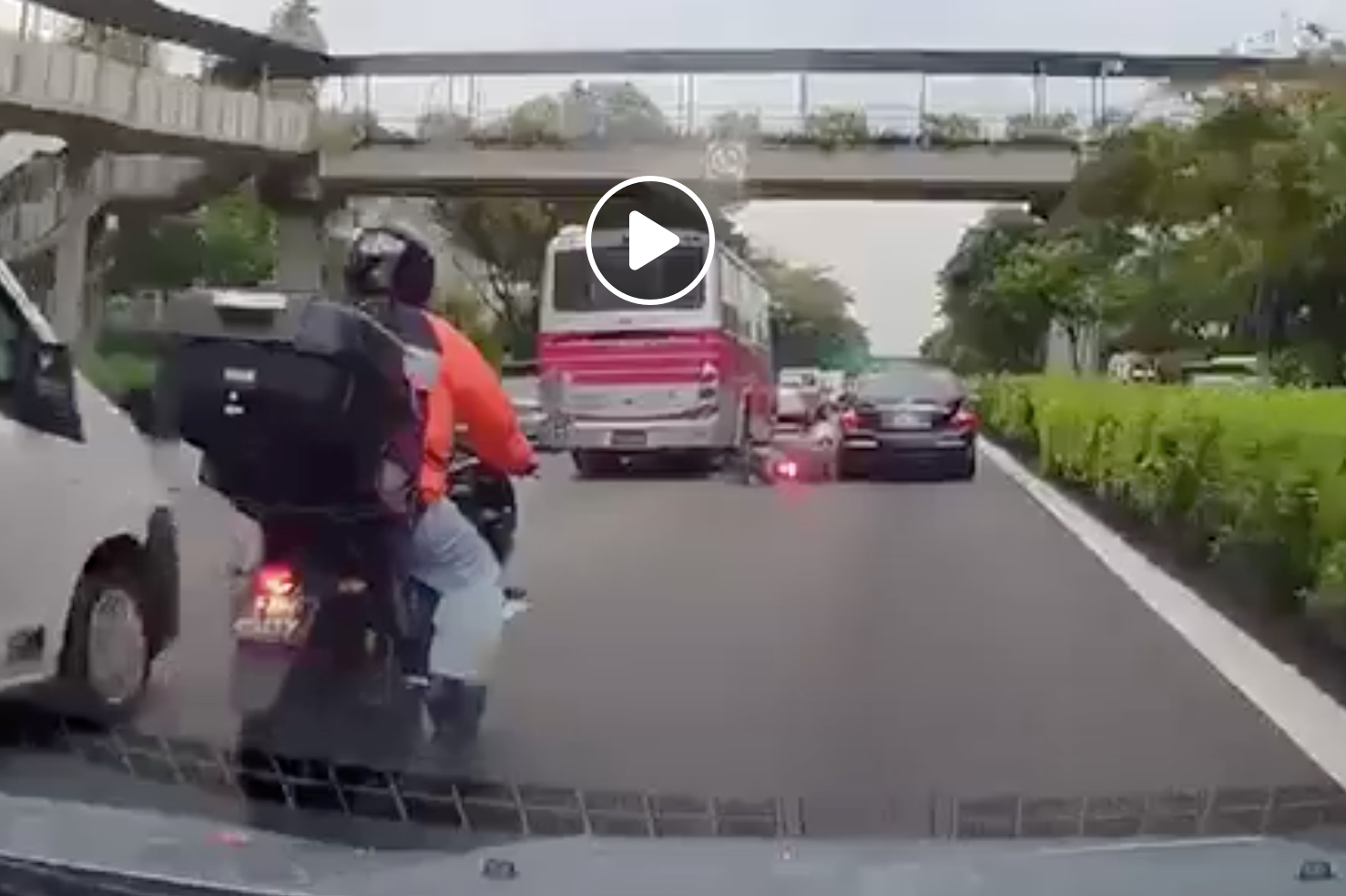
First rider applied brakes too hard
What if he didn’t overtake?
  • Better to just follow the car if you’re not confident enough of overtaking.
  • The best place to follow is NOT directly behind, but to the side where there’s a good chance of the driver picking you up in the rearview mirror.
  • Additionally, it gives you room to avoid the car should he brake suddenly.
How should we brake?
  • Never, ever grab your front brake lever full-on.
  • Always increase the braking pressure progressively even when under threat.
  • Applying the front brake progressively allows the front suspension and tyre to soak up the weight transfer progressively, as well.
  • Jamming on the brake, on the other hand, transfers weight abruptly, causing the weight transfer to overwhelm the suspension and tyre.
Solution:

We know it’s easier than it sounds, but every motorcyclist should practice emergency braking. And we’re not talking about dragging the locked rear wheel like in JPJ tests!

  • Find yourself a large and empty parking lot.
  • Ride to 30 km/h and pull in the front brake lever progressively harder and harder until the bike stops.
  • Increase the speed you being to brake from gradually if you feel confident enough.
  • If you always ride at 150 km/h, we suggest you practice stopping from that speed – a lot.
Would ABS have helped?

It may but the first bike looked like a kapchai/scooter, hence it probably isn’t equipped with ABS. Even then, the best way is to ease up on the pressure at the lever to let the bike’s momentum stabilize itself. This can be helped through practice.

But what if there’s ABS?
  • It doesn’t mean one can get away with crashing even if there’s ABS.
  • We must first learn how it feels like when ABS activates.
  • The lever will pulsate when ABS activates, surprising some riders to let go of the lever too abruptly and the system stops functioning.
  • Secondly, ABS keeps the previously locked wheel rolling in order to provide the chance of swerving away from danger. However, this is always defeated by target fixation (refer part 2 below).
  • Thirdly, ABS can cause some riders to keep holding on to the brake lever will full power until the bike stops dead. The rider will then lose balance and topple over (jatuh bodoh).
  • So, if the ABS activates, keep braking until you scrub off enough speed for you to still retain control of the bike and maneuver. But let go of the brakes progressively.

Part 2 – The following rider

The following rider saw the crashed bike ahead and applied his brakes a fraction later. Remember? A human’s nominal reaction time is 0.5 second. He kept braking but still ran into the poor man on the road.

What went wrong?
  • First and foremost (remember these words): Target fixation.
  • Keep in mind that the motorcycle goes where you look.
  • In this case, he was looking directly at the first rider (he didn’t turn his head at all).
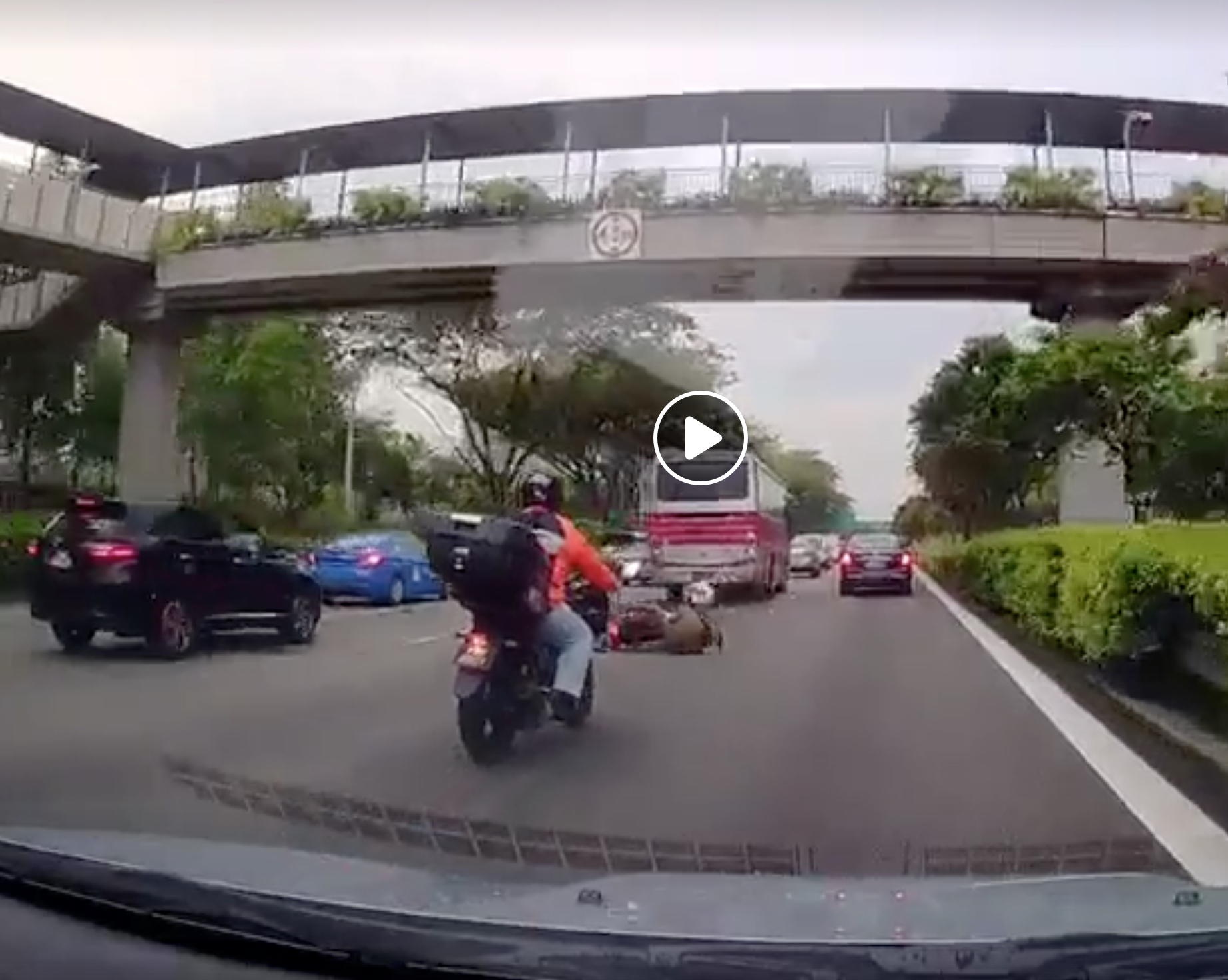
Target fixation sent second rider directly toward the fallen rider
What is target fixation?
  • Target fixation is a subconscious human instinct which instructs us to keep our eyes on a dangerous situation.
  • Yes, it helped us to survive through almost a million years, but it doesn’t agree when you’re riding or handling any vehicle at speed.
  • Being fixated on the first rider, he jumped on the brakes in panic, his body tenses up, his arms went straight.
  • Now he has no way of steering the bike even with the ABS on (see the front pogos up and down).
What should have been his response?
  • He should’ve looked to either side of the crashed rider ahead.
  • Both vehicles on either side have slowed down, leaving both lanes empty.
  • So, he could’ve swerved to avoid the fallen rider and apply some gas to get away, even without needing to slow down.
  • Situational awareness helps here, consequently he would know if either side were clear without needing too look.
  • Not tense up and lock his arms. Having relaxed arms allows the rider to steer even during hard braking. See how the MotoGP riders do it even when they’re braking from 330 km/h to 80 km/h to make a corner?
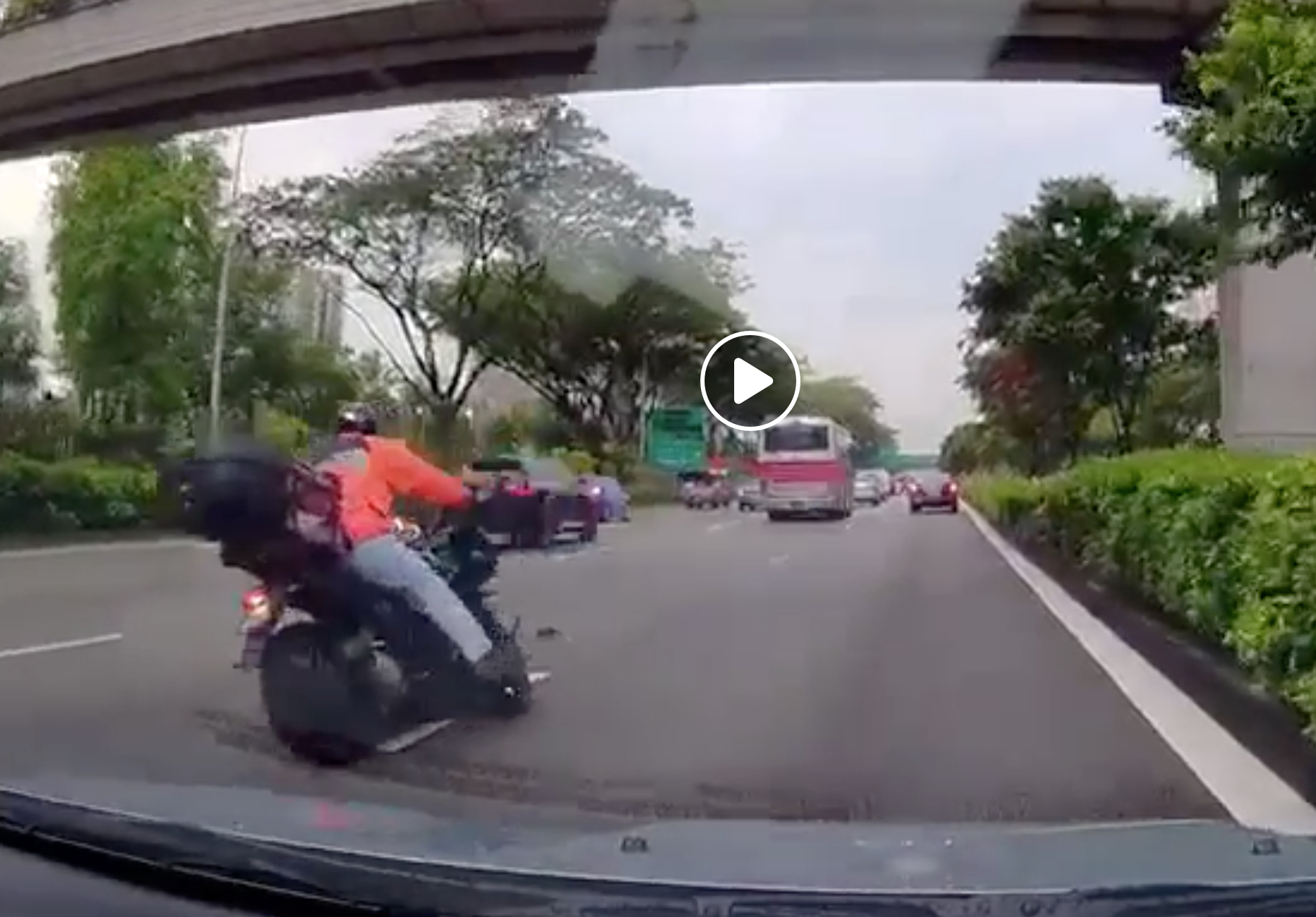
Second bike ran into first rider
What are the solutions to target fixation?
  • Overcoming target fixation needs practice.
  • Next time you come across a pothole, look to either sides and steer.
  • You’ll be surprised at how easy that was.
  • Keep practicing when traffic is clear.
  • You can even ride up to an imaginary hazard on the road, look to the sides and steer.
  • This practice will suppress your instinct to target fixate.
What are the solutions to braking hard and still being able to steer?
  • On braking and body position, do recall that fuel tanks have knee cutouts for a reason.
  • Hence, clamp your knees on the tank to support yourself and take the pressure off your arms and torso.
  • This way, you can brake much harder and have a better feel of the suspension and tyres’ limits.
  • Please refer above about brake practice.

Conclusion

Every rider needs to be critical about his/her own riding skills and learn. It’s far better than relying on others to give way.

Oh, and look up videos or articles on riding tips. It’s time and energy well spent rather than be like keyboard warriors who only know how to criticize.

Video source: Xianghui Chaw on ROADS.sg
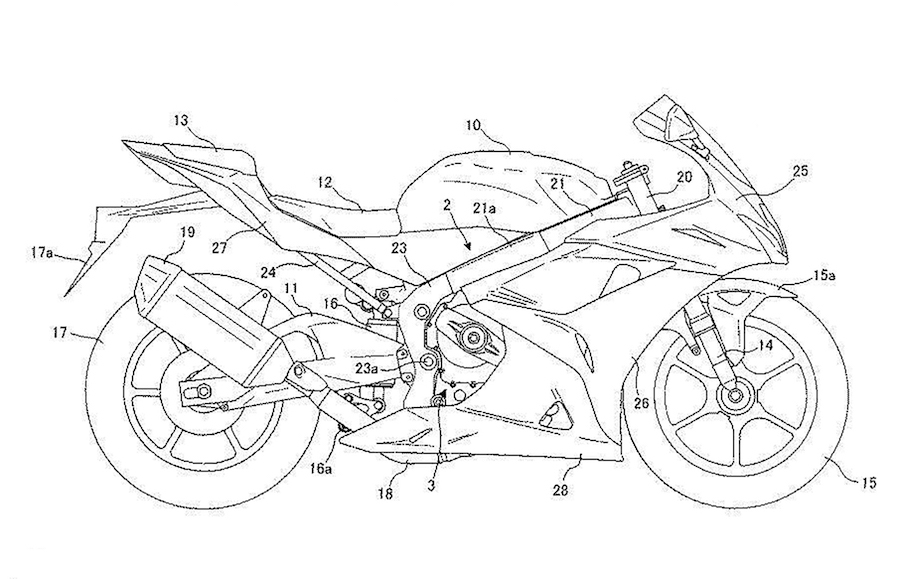


  • A patent filing for the new Suzuki GSX-R1000 was leaked online.

  • The chassis looks similar, but the bodywork sees some changes.

  • The real change should be the engine where it features a new VVT system.

It’s not surprise that a new Suzuki GSX-R1000 is on the way, given that the Euro 5 regulations are coming into effect in 2020.

But just what will be new in the new Suzook? The patent filed in Japan has been revealed.

The patents show a new outline for the new Gixxer. The fuel tank seems a little longer, the seat a bit thinner, there’s a new vent on the main fairing, the tailsection is slimmer and the nose is sharper plus lower. The frame and swingarm look identical to the current bike.

But the biggest change ought to be in the engine.

There was another Suzuki patent filing months ago, particularly for a new variable valve timing (VVT) system.

New Suzuki GSXR-1000 VVT patent

In the current GSX-R1000, Suzuki uses the centrifugal forces of the inlet camshaft to drive the advancer. To sum it up, the faster the camshaft spins, the longer the inlet valves stay open. Suzuki did this to circumnavigate MotoGP’s ban of electronic and hydraulic VVT systems.

The system seems to work better in MotoGP, since the riders usually utilize the upper RPM ranges. It’s a different story on the streets.

In that patent we mentioned earlier, the manufacturer may switch to a hydraulic system with actuates both inlet and outlet cams. The hydraulics are computer-controlled, in turn. This should cater for the wide range of RPM utilization on the streets which usually hovers in the low and mid RPM ranges.

We should be able to see the new bike at the Tokyo Motor Show in October, if bike is slated for 2020.

  • Like beauty is subjective, so is everyone’s preference for motorcycle exhaust note.

  • V-Four engines are among the best – if not the best – sounding.

  • Listen to this Yamaha YZF-R1 and Aprilia RSV4 RF.

Just as beauty is subjective, so is everyone’s preference for motorcycle exhaust note. To bikers, the exhaust note is another aspect which stirs the sould. However, V-Fours sound the best in our books as demonstrated by this Yamaha YZF-R1 and Aprilia RSV4 RF.

Yes, yes, the Yamaha R1 isn’t a V-Four but an inline-Four, instead. But I’m sure you already know that the “crossplane” crankshaft is arranged in such a way that the engine fires like a V-Four, hence sounding like one. Or like some say, sounds like Valentino Rossi’s YZR-M1 MotoGP bike.

The crossplane crankshaft spaces the crankpins at 90ofrom each other. Therefore, the R1’s firing order mimics the firing order of a V-Four with a 180ocrank, which gives it a 270o– 180o– 90o– 180oignition timing. The irregular firing order is what gives the bike its distinctive exhaust note compared to traditional inline-Fours.

The Aprilia RSV4, on the other hand, uses a 65oV-Four with a 180ocrankshaft. As such, the firing order is a regular 180o– 115o– 180o– 245o, giving it another distinctive and gloriously LOUD(!) exhaust note.

By the way, the numbers with degrees denote the crankshaft rotation angle.

NOTE: Please ride responsibly on public roads.

Video credit: SuperBike Racer

  • A car carrying ketum leaves collided with a motorcycle ridden by a mother sending her eldest child to kindergarten.

  • The collision killed all three motorcycle occupants.

  • Police discovered 150 kg of ketum leaves in the car.

A car carrying ketum leaves (kratom or Mitragyna speciose)collided with a motorcycle ridden by a mother sending her eldest child to kindergarten. Another younger child was also riding pillion at the time.

The high-speed front-end collision killed the mother Nor Zurita Shah Kadir, aged 26 and both children, Muhammad Adam Mukhriz Adnan, aged 5 and Siti Husna Qaisara, aged 4. Muhammad Adam’s kindergarten was only 3 kilometres away from home in Tanah Merah, Kelantan.

Investigators who arrived at the scene inspected the Wira Aeroback and discovered 150 kg of ketum leaves in the boot. They believed the product was on its way to be distributed in the Tanah Merah area.

Police deduced that the car had lost control while being driven at high speed, judging from the 50m-long skid marks on the road. The car then veered into the opposing lane and rammed the motorcycle. The Honda EX5 broke into two and was thrown into the bushes nearby, while all three motorcycle occupants were thrown 10m away.

The police also arrested the driver who tested positive for methamphetamine. He was a 25-year-old Thai national.

Source: Kosmo! Online

  • The Road Transport Department of Malaysia is implementing the Vehicle Entry Permit system for foreign-owned vehicles to enter the country.

  • It will be implemented in three phases.

  • Phase one covers vehicles entering from Singapore.

The Road Transport Department of Malaysia (JPJ – Jabatan Pengangkutan Jalan) will require all foreign owned vehicles to register for a Vehicle Entry Permit (VEP) to enter the country. The system will be implemented from October 2019.

The department will issue the VEP via an online “simple three-step action.” They also added that the program will be implemented in three phases.

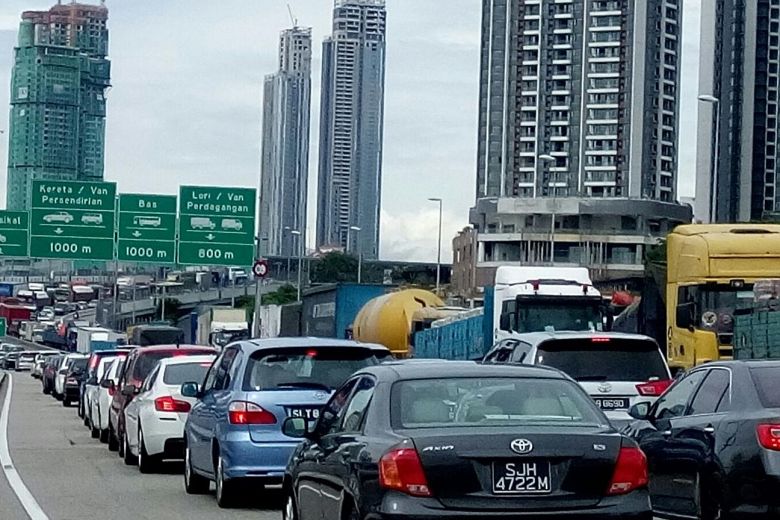
Phase one commences from 1stOctober 2019. It covers vehicles entering from Singapore through Bangunan Sultan Iskandar and Kompleks Sultan Abu Bakar in Johore. The VEP-RFID tag can be installed or collected at four designated areas in Johor Bahru:

  • Gelang Patah Southbound R&R;
  • Plaza Angsana open carpark;
  • Pandan R&R;
  • Lima Kedai Toll Plaza.

Phase two involves foreign-owned vehicles entering Malaysia from Thailand, while phase three covers vehicles entering through the Malaysia-Brunei border. These two phases will be implemented “in due course.”

Each VEP is valid for five years (RM 25), although drivers can apply for a one-off permit which costs RM 10.

The RTD aims to avoid cloned vehicles from entering and being sold in Malaysia. Additionally, it prevents vehicles with outstanding summonses from leaving the country.

  • Seven vintage motorcycles were found in a Los Angeles warehouse.

  • The discovery included six Vincent.

  • Vincents were renowed for the speed and quality.

You’re doing your laundry and checking through each pocket to make sure they’re empty. And suddenly, your hand pulls out a RM 50 note. Note the elation of that find. Now imagine discovering 7 rare vintage bikes – 6 of them being Vincent Motorcycles!

These following bikes were found in a Los Angeles warehouse after the passing of their owner. A liquidation firm has been nominated to auction the bikes and they told of an owner who had imported the bikes in the 1960s when he moved to the States. He also brought along a large cache of spare parts from the UK.

The Vincents discovered are:

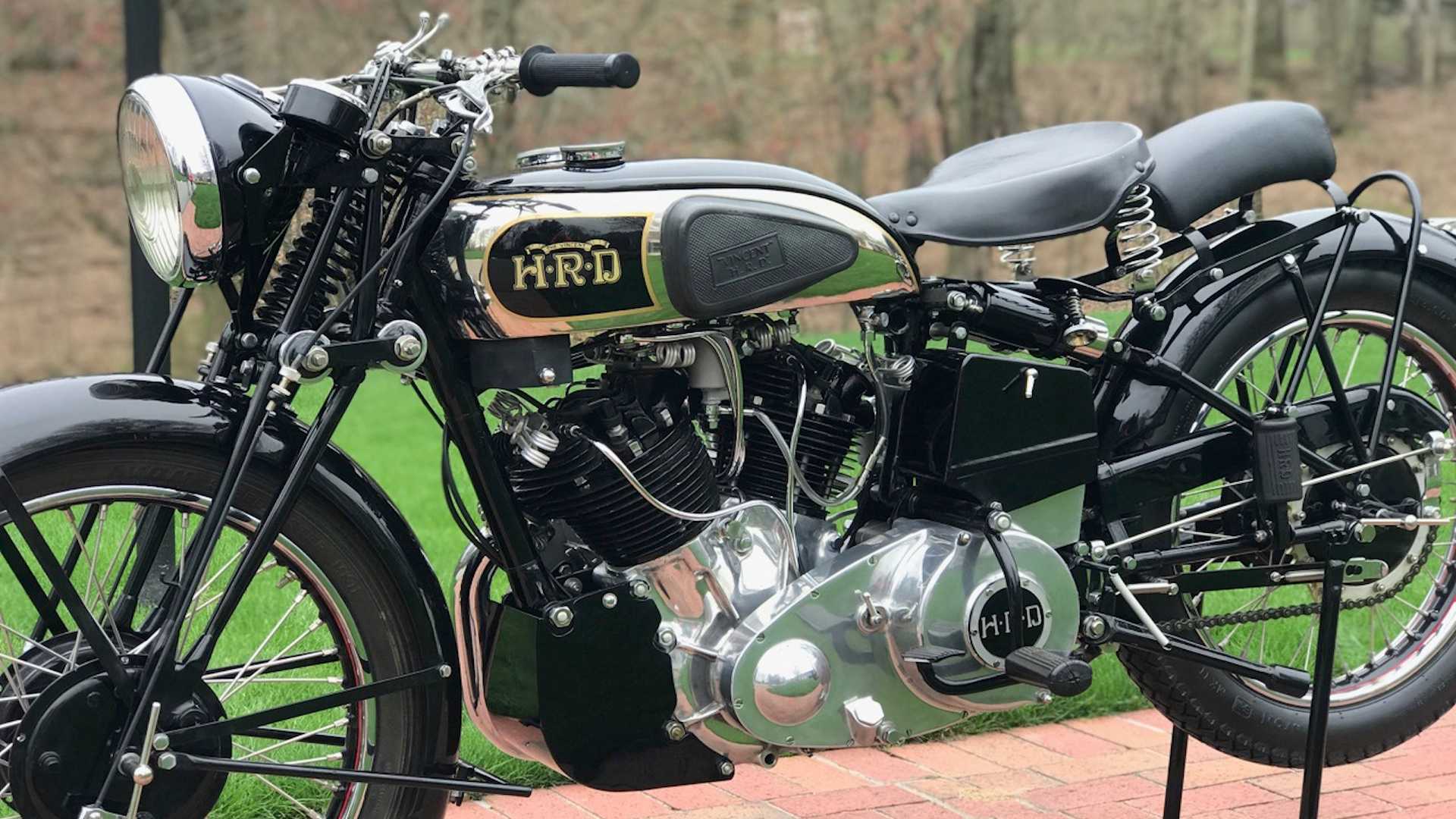
1938 Vincent Series-A HRD Twin

1938 Vincent Series-A HRD Twin – Photo credit RideApart

Vincent stopped production of the Series-A in 1939 due to WW2, then resuming business in 1946. That makes this Series-A even rarer. Only 78 Series-A were ever made, with probably only 40 to 50 still intact.

1948 Vincent Series-B Rapide

What made Vincents so much sought after? Performance. The Series-B Rapide already had a top speed of 177 km/h right out of the crate! It was the world’s fastest motorcycle of the era. Remember that this was at a time when motorcycle tyres were just a little wider than those on bicycles. Company owner Phillip Vincent and his genius chief engineer Phil Irving modified the Rapide event further, resulting in the latter Rapide which hit 201 km/h.

1950 Vincent Comet (basket case)

The liquidation company reported this bike as a basket case.

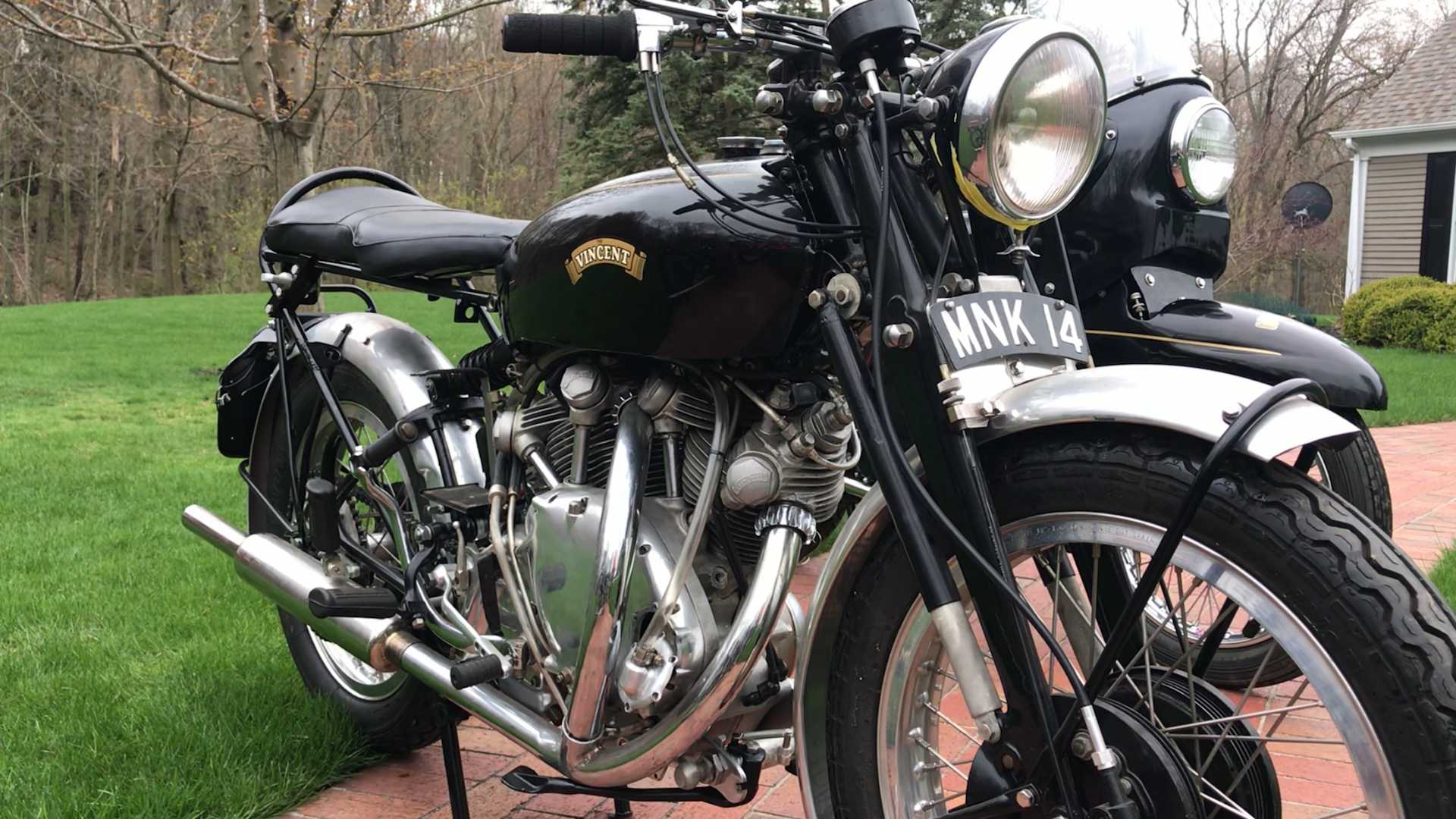
1953 Vincent Series-C “Black Shadow”

1953 Vincent Series-C Black Shadow – Photo credit RideApart

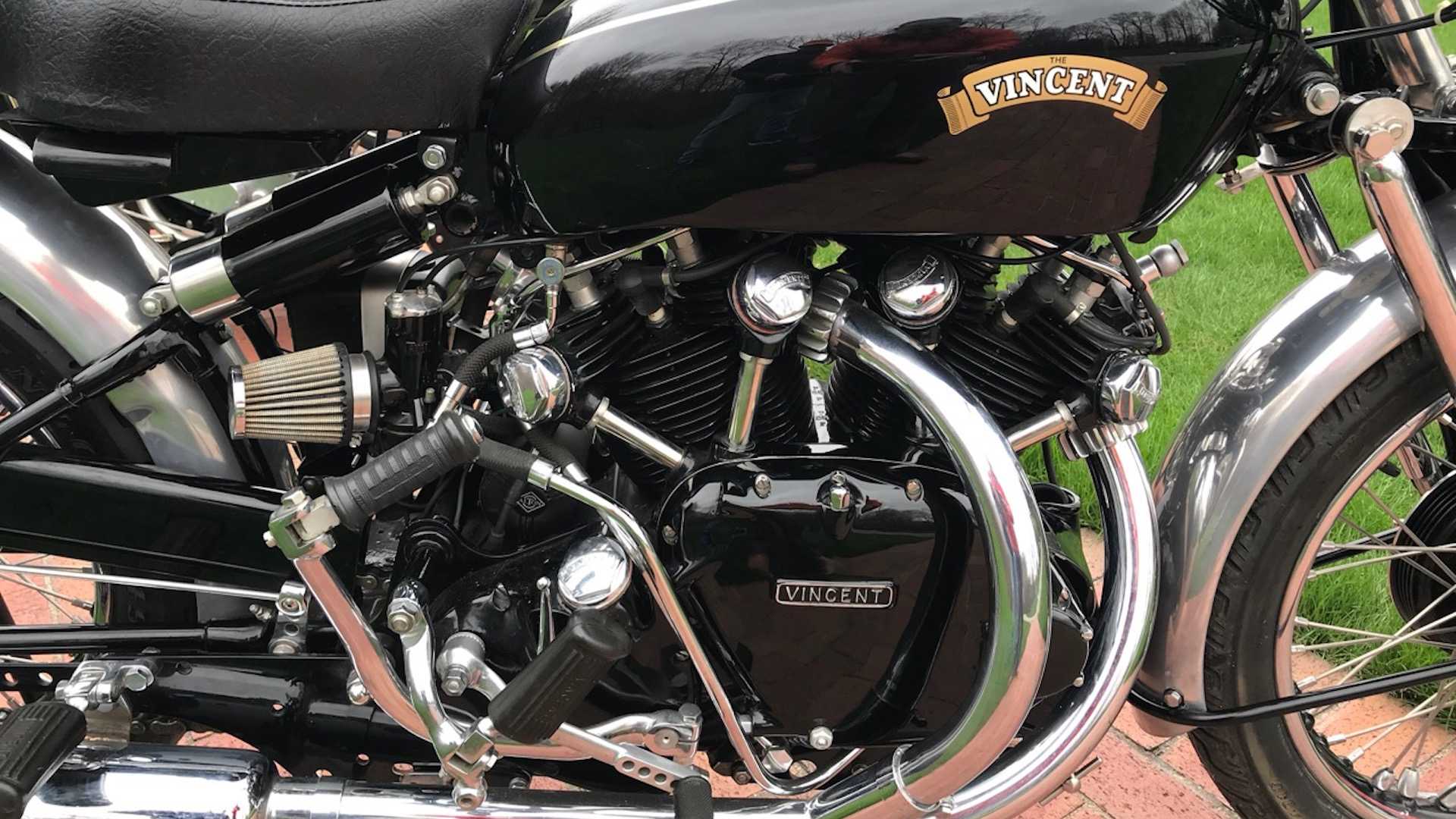
The Black Shadow and its Black Lightning racing counterpart are probably the best-known Vincents. It was a groundbreaking motorcycle when it was launched, especially in terms of its suspension and detailed quality work that’ll make modern bikes cry. Check out the picture. Vincent made only 42 Series-C, reported each at a loss to the company.

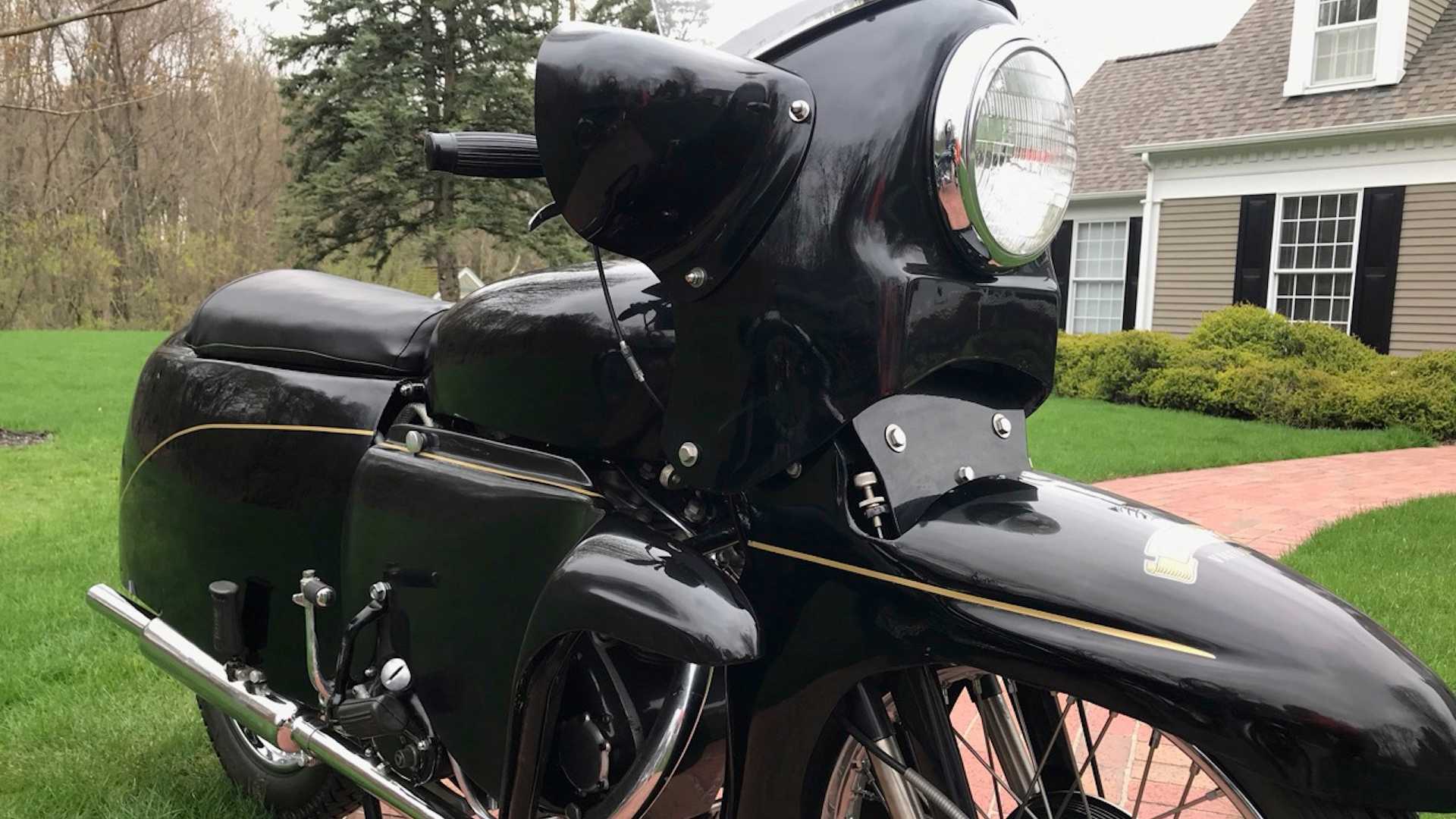
1955 Vincent Victor (replica)

1955 Vincent Victor Replica – Photo credit RideApart

If you do some research on Vincent motorcycles, you’d find that the company’s true passion was pushing the boundaries of motorcycle technology. They already experimented with a full fairing back in 1955. There were three models: The Black Knight based on the Rapide, Black Prince based on the Shadow, and Victor based on the Comet.

The concept was too far ahead of its time, so Vincent made only 1 Victor. This owner probably couldn’t obtain one, thus he modified his Comet into this “Victor.”

1954 Vincent Rapide D/C

1954 Vincent Rapide D:C – Photo credit RideApart

These were produced one year before Vincent went under. But that didn’t mean the bike was under-built for it was still imbued with Vincent’s legendary built quality, technology and performance. Vincent kept losing money because their bikes were expensive to build and were priced much higher than the competition.

Source: RideApart

Archive

Follow us on Facebook

Follow us on YouTube