Bikesrepublic

Latest News

  • Motorcycle drag racing is fun to participate in and watch.

  • This video shows how fast modern bikes can be even in the hands of non-pro riders.

  • Some of these modified beasts hit 100 km/h in 1 second!

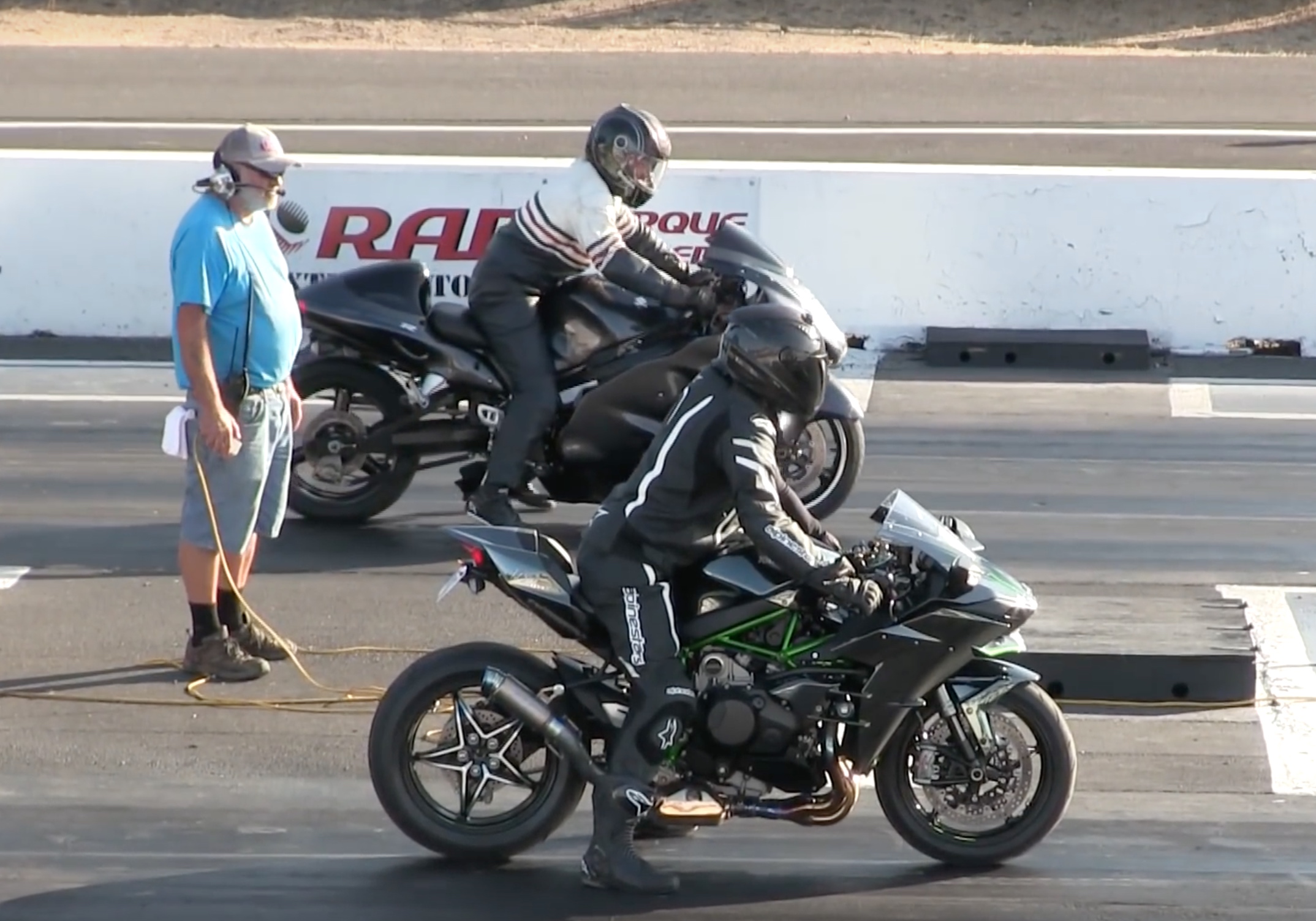
We know, the first day of Ramadhan is always the hardest shock to our bodies. But here’s a motorcycle drag racing video to cheer us up. Make sure you turn up your speakers!

There isn’t much description except for the models of motorcycles taking part in the ultimate contest of acceleration. But it appears to be a “run what ya brung” race, where competitors enter what they rode to the event. So, you can see a variety of motorcycles that are stock, modified, turbocharged, equipped with nitrous oxide system (NOS), “dropped ‘n’ stretched,” have anti-wheelie bars installed, etc.

Some of these modified beasts hit 100 km/h in 1 second!

But we would like to highlight a number of details here:

  • The timed length is 1/4-mile, which is equivalent to 400 metres.
  • There are timing and speed sensors at different intervals along the length of the track.
  • Those numbers displayed after the finish line are the elapsed time (ET) above and speed in miles-per-hour (mph). So, you need to multiply them by 1.61 for the km/h number i.e. 167 mph X 1.61 = 268.76 km/h.
  • The starting lights are called the “Christmas tree.”
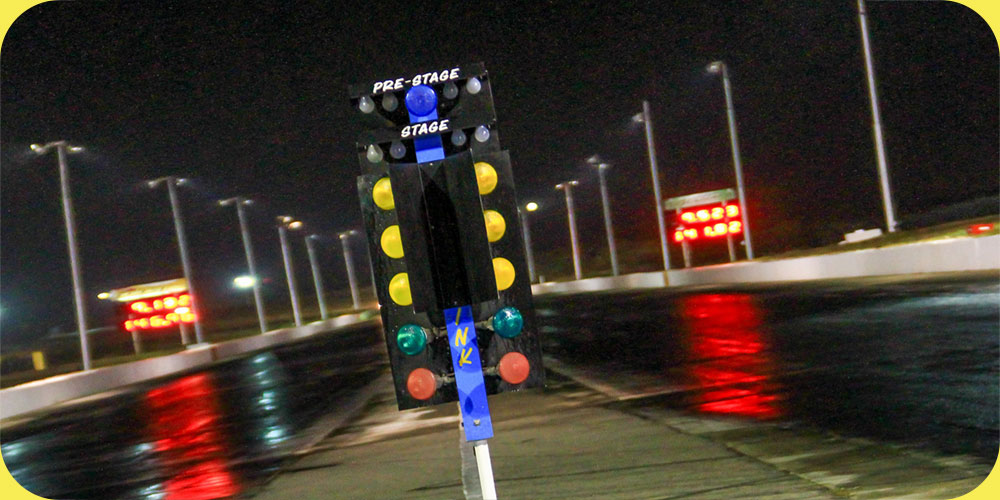
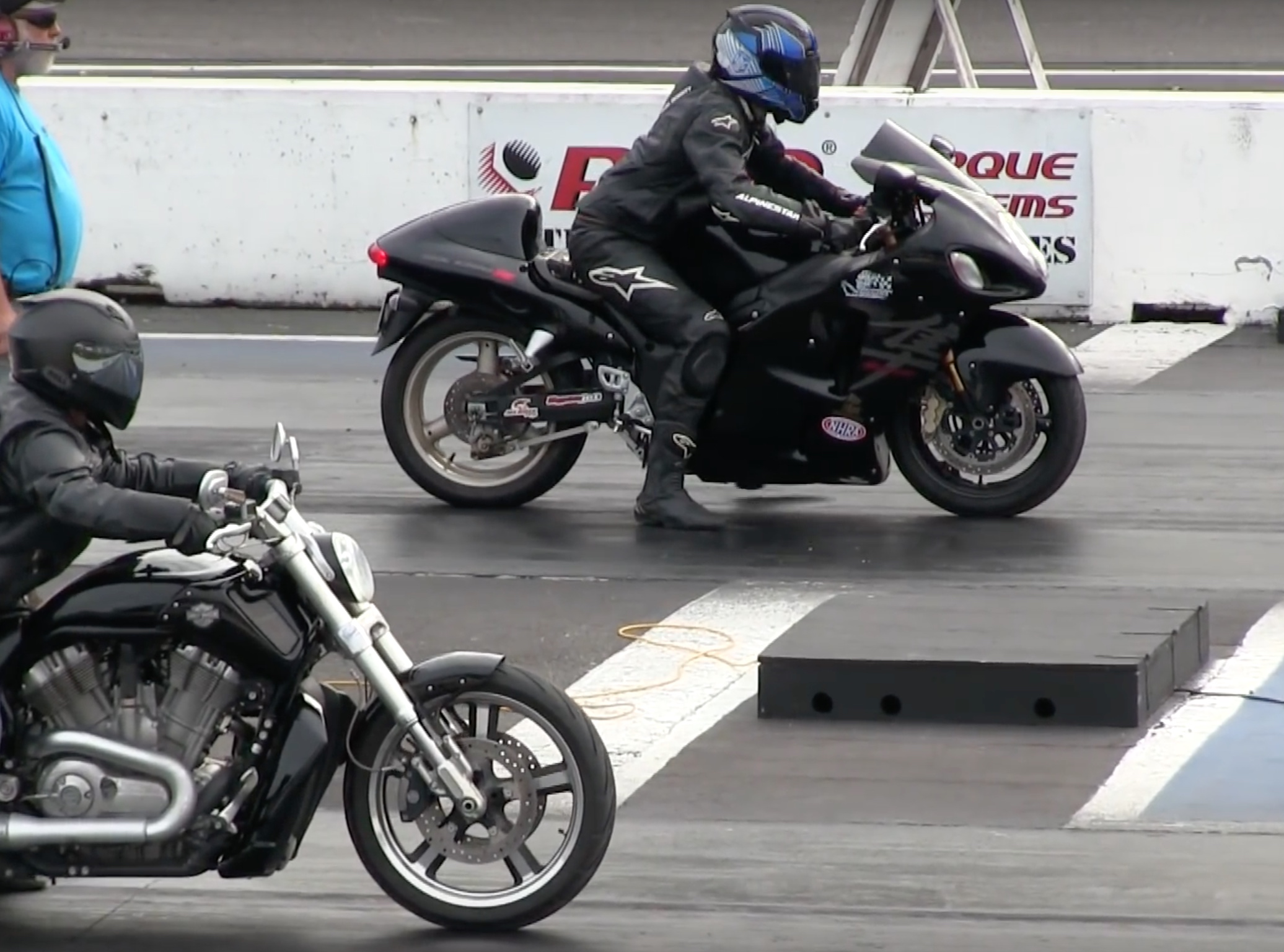
  • In professional-organized races such as these, the riders “stage” their bikes before being released.
  • Notice the box with the three holes next to rider? There’s a light/laser beam coming out of the holes.
  • There are two lines on each lane. Crossing the first line will have the front wheel cutting off the light/laser beam. This is when the bike is “pre-staged” and the PRE-STAGE lights will illuminate on the Christmas tree.
  • Moving forward a little more to cover the second hole will trigger the STAGE lights, meaning the rider is ready to go.
  • Now the Christmas tree will begin its countdown.
  • The rider launches when the green light comes on (obviously).
  • The third hole detects whether the rider crossed the light beam and white line before or after the green light came on.
  • If the rider crossed the light beam before the green light, he will be disqualified (red light on the Christmas tree).
  • The beam provides an accurate way to determine if one or both competitors jumped the start.
  • The “RT” (reaction time) is calculated electronically as the time between when the green light illuminated and rider shot past the light beam.
  • The “ET” at the end of the run stands for “elapsed time” i.e. the time between the rider took off and crossed the finish line.

It sounds complex, but it’s pretty simple. Get going as soon as the green light comes on and hold on for dear life. Motorcycle drag racing isn’t as easy as it seems, because the bikes tends to wheelie when charging hard off the line. With the front tyre bereft of weight, it’s up to the rider to shift his weight around to control the bike’s direction.

Anyhow, enjoy the video and Ramadan Mubarak from us a BikesRepublic.com.

Video source: Wheels YouTube Channel
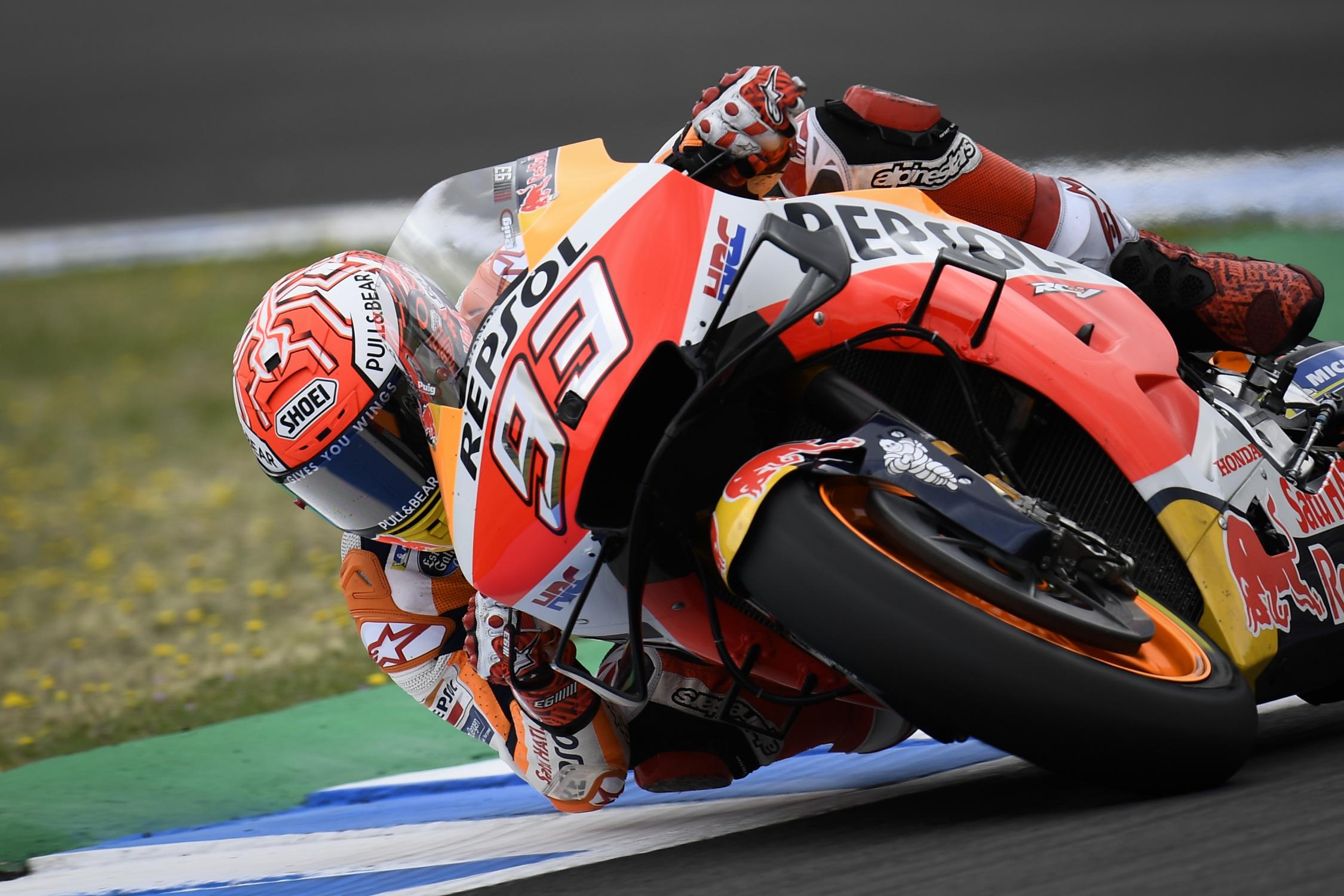
  • Marc Marquez won the Spanish MotoGP 2019.

  • Polesitter Fabio Quartararo had gone as high up as 2nd but had to retire with mechanical problems.

  • Alex Rins finished 2nd on the Suzuki.

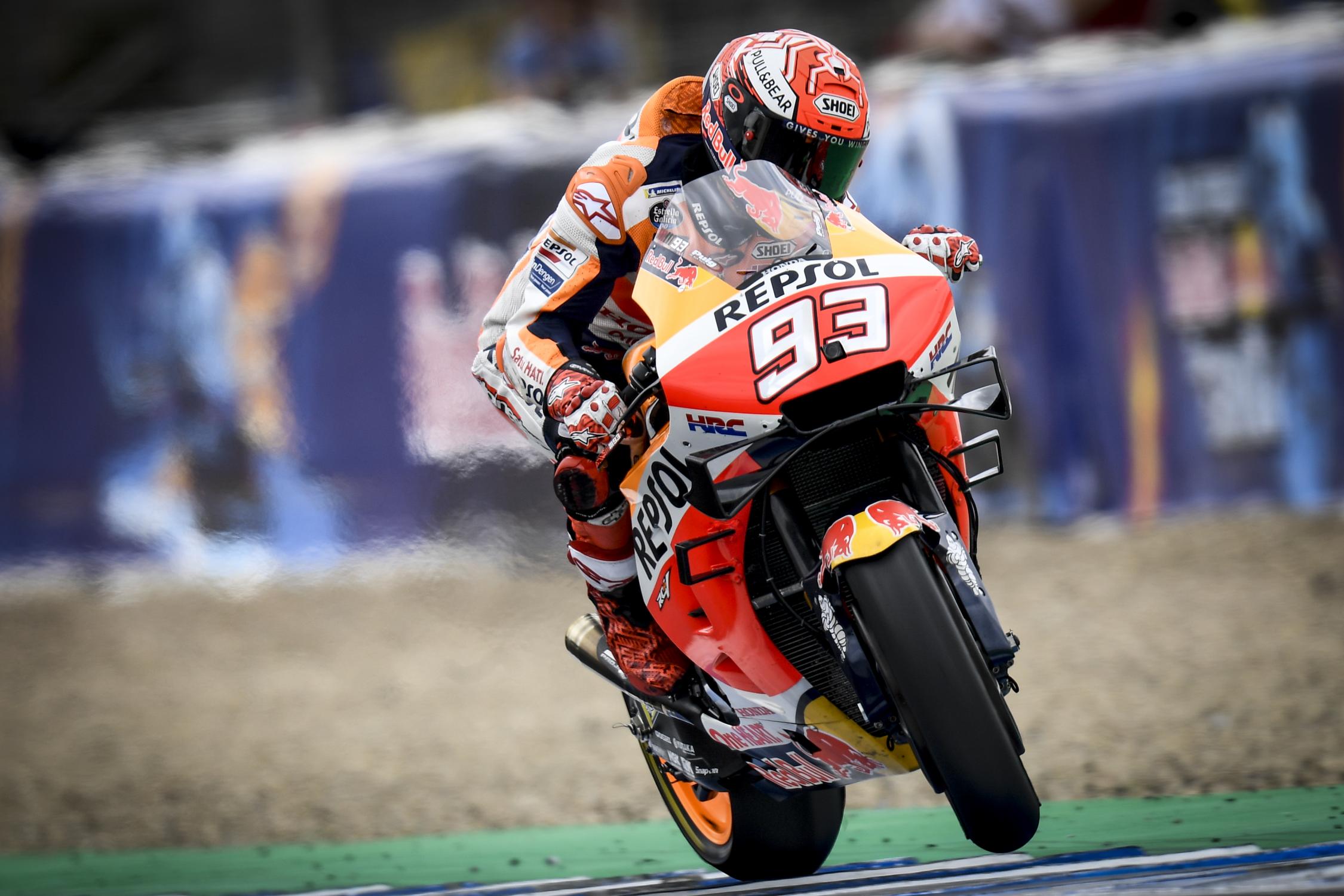
Marc Marquez (Repsol Honda) won the Spanish MotoGP 2019 race convincingly, but it was a heartache for Fabio Quartararo (Petronas Yamah SRT).

Staring from 3rd on the grid, Marquez blasted into the lead with the two Petronas Yamaha SRT riders, polesitter Quartararo and Franco Morbidelli trailing behind into Turn 1.

As Marquez controlled the race from the front, both satellite Yamaha riders followed closely. But on Lap 8, the reigning world champion upped his pace and started to drop the pursuing duo.

But it wasn’t long before Morbidelli’s started dropping into the clutches of his teammate Quartararo and Maverick Vinalez (Monster Energy Yamaha). Quartararo passed Morbidelli in the next lap and hunted down Marquez. Alex Rins (Suzuki Ecstar) once again rode his way up the field and passed Vinalez for 4th.

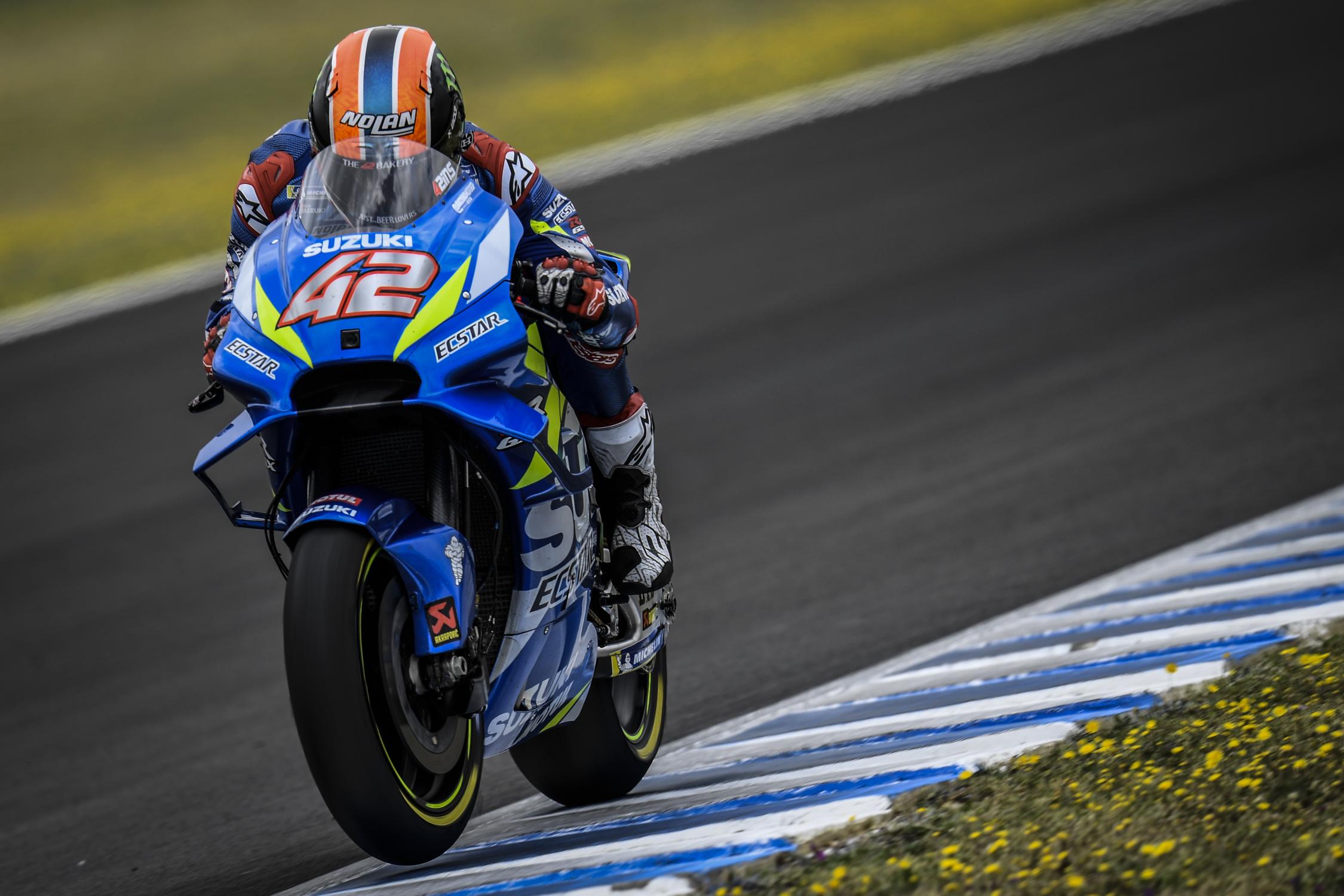
Alex Rins – Photo credit MotoGP.com

Although the Frenchman was only 0.1s slower than Marquez, the latter had opened up a 2-second lead.

Suddenly, Quartararo’s bike began to slow on Lap 16 and he pulled off the circuit to a stop. It was revealed later that his quickshifter had broken. With no way to reset the system to manual shifting, his and the team’s dream evaporated underneath the Spanish sunshine.

In the meantime, his Petronas Yamaha teammate Morbidelli started to slow drastically down the order to 6th. Rins had overtaken him by that point into 2nd while Vinalez had to defend from Andrea Dovizioso (Mission Winnow Ducati).

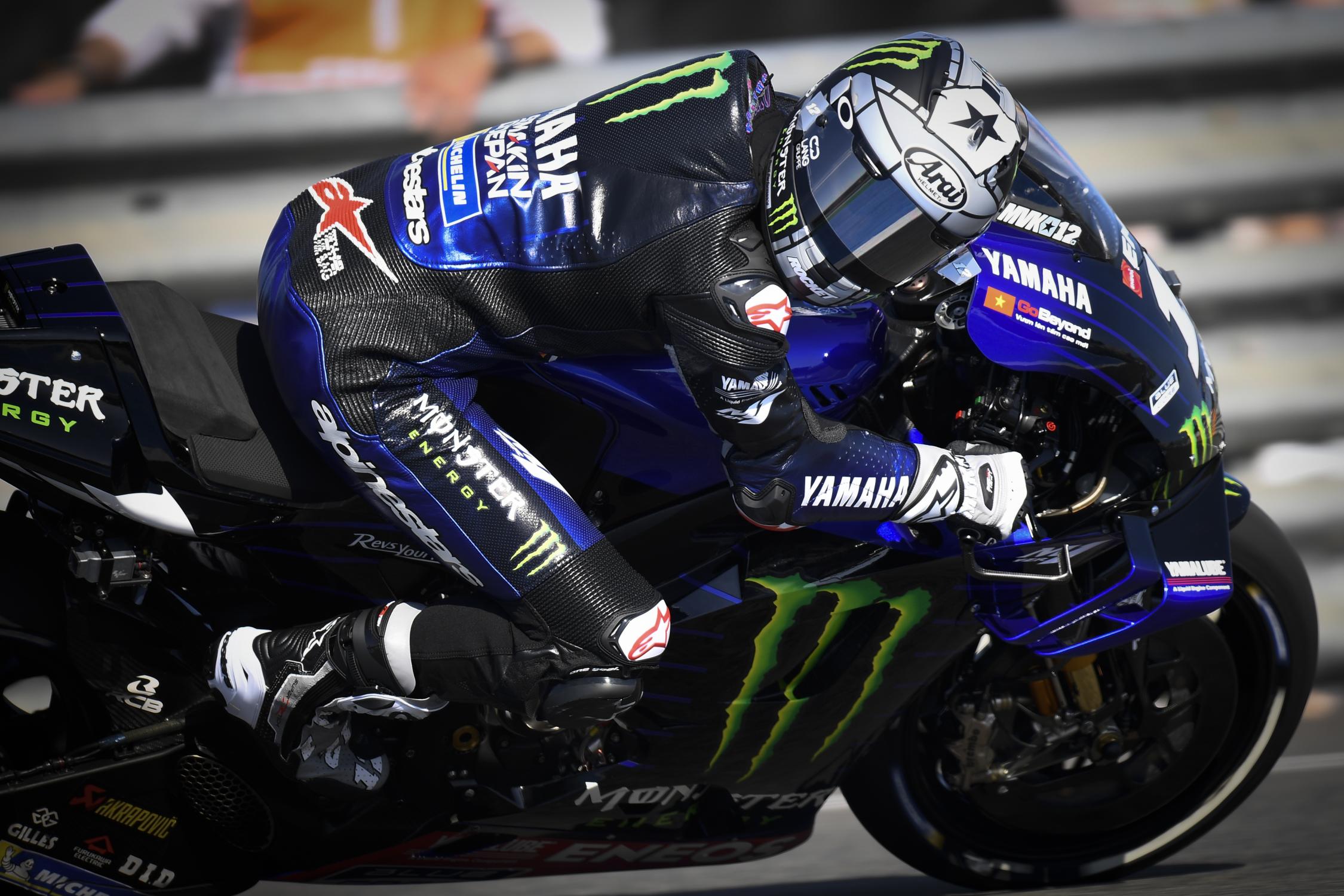
Maverick Vinalez – Photo credit MotoGP.com

Vinalez held on to his nerve and position at the flag to complete the podium positions.

Dovizioso finished 4th, followed by his teammate Danilo Petrucci to complete the Top 5.

Valentino Rossi (Monster Energy Yamaha) worked his way up to 6th after a disastrous qualifying which saw him starting from 13th on the grid. Morbidelli finally crossed the line in 7th; Cal Crutchlow (LCR Honda) in 8th; his teammate Takaaki Nakagami in 9th; and wildcard rider Stefan Bradl rounded out the Top 10.

It was a race to forget for KTM as the Red Bull KTM Factory Racing riders Pol Espargaro came home in 13th followed by his teammate Johann Zarco in 14th. The Red Bull KTM Tech 3 Racing riders Miguel Oliveira took the flag in 18th in front of Hafiz Syahrin in 19th.

All pictures from MotoGP.com

  • Fabio Quartararo and Franco Morbidelli qualified 1st and 2nd at the Spanish MotoGP 2019.

  • It was the first pole position and 1-2 qualifying result for the new Petronas Yamaha SRT team.

  • Quartararo also became the youngest rider to score a pole position.

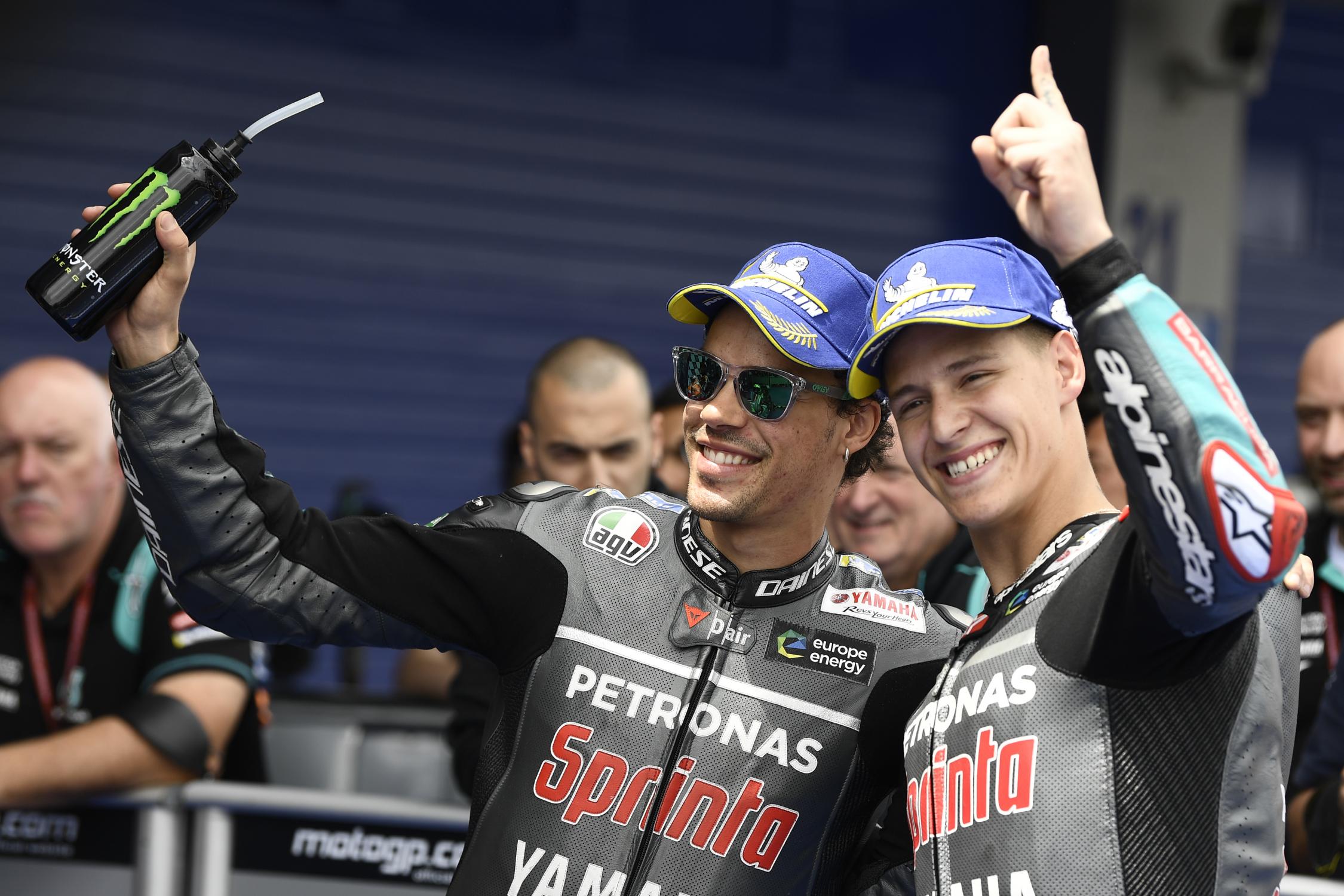
Rookie Fabio Quartararo and Franco Morbidelli qualified 1st and 2nd for today’s Spanish MotoGP. It was the first 1-2 qualifying result for the new Petronas Yamaha SRT outfit.

The results gave the fledgling team much to cheer about in just their fourth race. Both riders had been strong through the practice sessions, with Quartararo setting the leading pace.

In doing so, it was the first pole position in MotoGP for the youngster. Additionally, it reset the records as the youngest rider to achieve the feat, which was formerly held by Marc Marquez.ni

Speaking to MotoGP.com, Quartararo said that he had improved his braking from being his weakest point to his strongest.

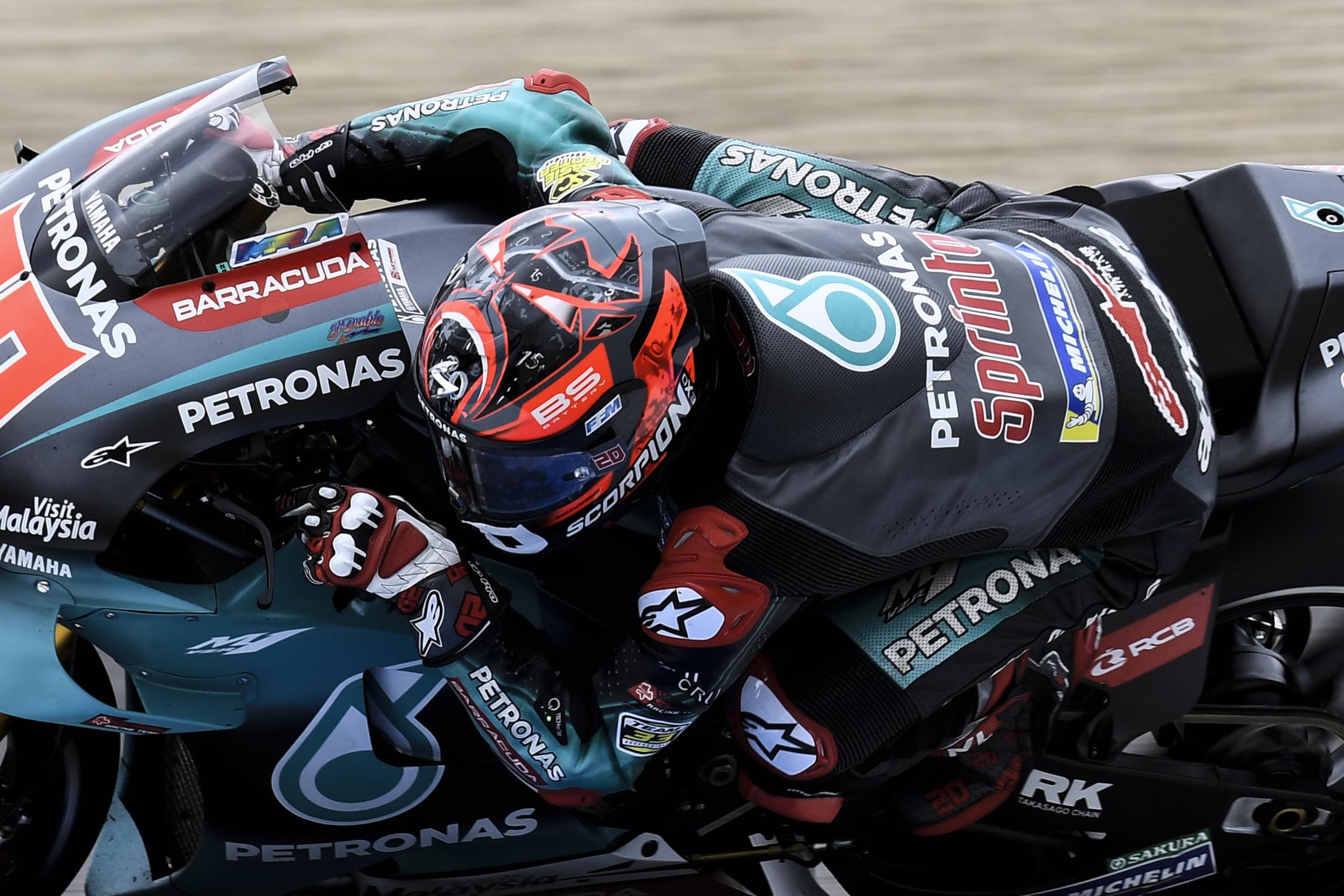
Fabio Quartararo – Photo credit MotoGP.com

The Petronas Yamaha SRT team is using the same 2019 Yamaha YZR-M1 as the Monster Energy Yamaha factory team, but they are the B-spec bikes with lower rev limits.

Quartararo’s time of 1:36.880s was almost 8/10 quicker than the old record 1:37.653s set by Cal Crutchlow in 2018.

Morbidelli put in his fastest lap of 1:36.962s, followed by Marc Marquez (Repsol Honda) at 1:36.970s, just 0.008s behind to round out the Top 3.

Andrea Doviziso (Mission Winnow Ducati) did well to qualify in 4th with a time of 1:37.018s despite the Ducati Desmosedici’s traditional dislike of the Jerez Circuit’s layout.

Marc Marquez – Photo credit MotoGP.com

Maverick Viñalez (Monster Energy Yamaha) had struggled throughout the first three practice sessions but managed to qualify 5th. The M1 still displaying a sensitivity to changing conditions. Qualifying was carried in cooler temperatures which benefitted the tyres.

Rounding out the Top 10 are Cal Crutchlow (LCR Honda), Danilo Petrucci (Mission Winnow Ducati) Takaaki Nakagami (LCR Honda), Alex Rins (Suzuki Ecstar), Francesco Bagnaia (Pramac Ducati).

The first 16 riders qualified faster than the previous year’s lap record, showing how far MotoGP progresses by the year.

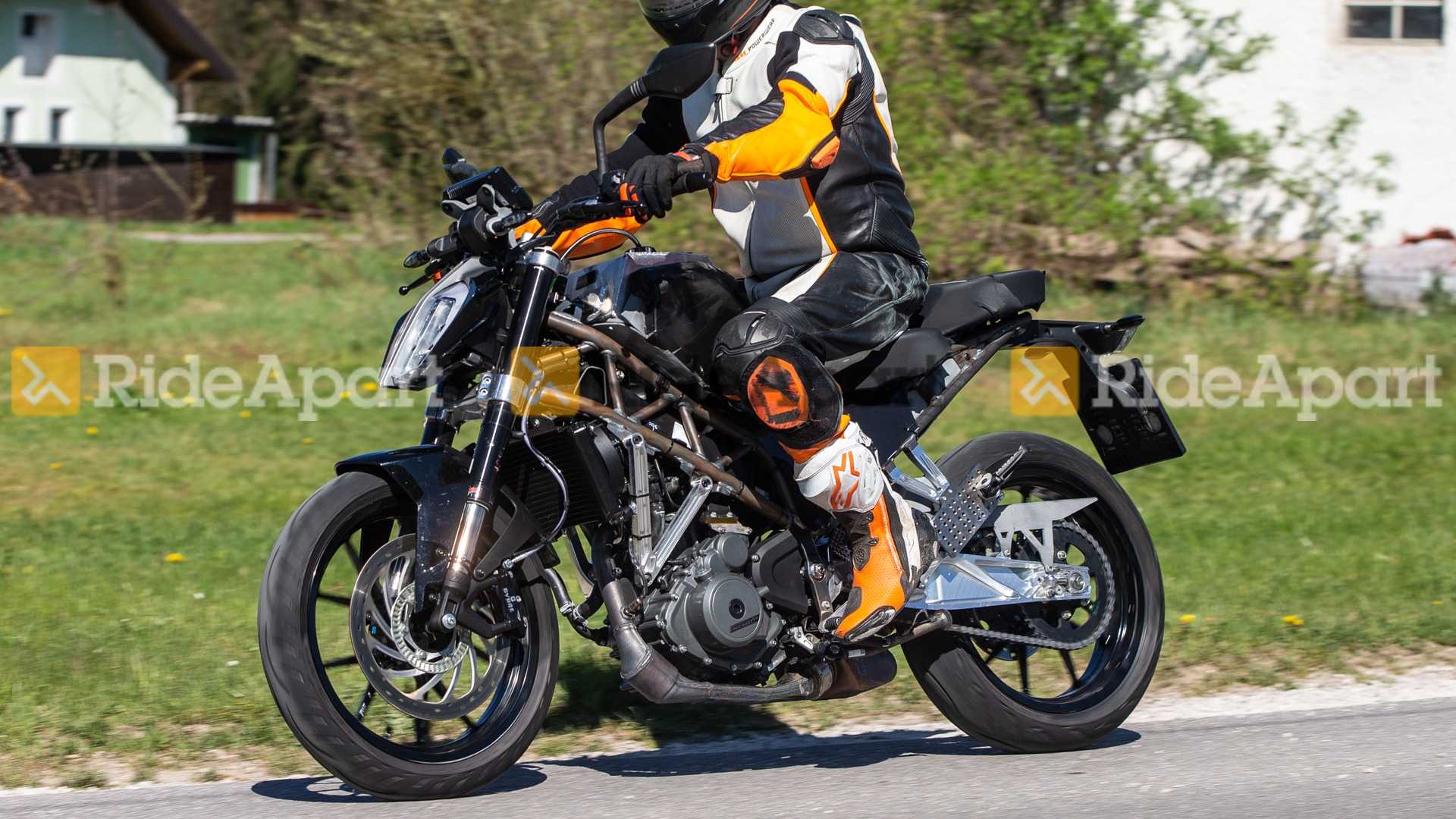
  • A prototype KTM 390 Duke was caught testing on the road.

  • The pictures show revised frame and chassis.

  • It is believed to be the 2021 model.

The KTM 390 Duke is one of the most rip-roaring bikes we’ve tested. Small as it may seem, the 2018 model rode more like a 500cc bike rather than a 372cc single-banger.

There isn’t others like it as most of its peers are dual-cylinder machines. But KTM made the 390 Duke in their “Ready to Race” spirit, hence the ability to use it for the daily commute and at a trackday. Many riders agree and it is actually KTM’s best-seller throughout the world.

And while we don’t see a reason to upgrade it, the manufacturer thinks otherwise, apparently.

Recently, RideApart reported that the prototype of the 2021 version was spotted testing.

Check out the photo. There’s a new headlight and TFT screen up-front. The front turnsignals are attached to the meter’s mount. Look closer and you’ll see the new frame and the engine is mounted on V-shaped hangers rather the single “bone” we see on the current model. The lower triple clamp behind the headlight is massive, hinting towards a change in geometry. Further back, the swingarm is likewise different.

The seats look thicker and bigger in the picture but they are probably dummies used during testing.

Source and picture: RideApart

  • The new Triumph Rocket III TFC has been officially unveiled.

  • The engine is now 2500cc, producing 167hp and 221Nm.

  • Its electronics, chassis and suspension are also upgraded.

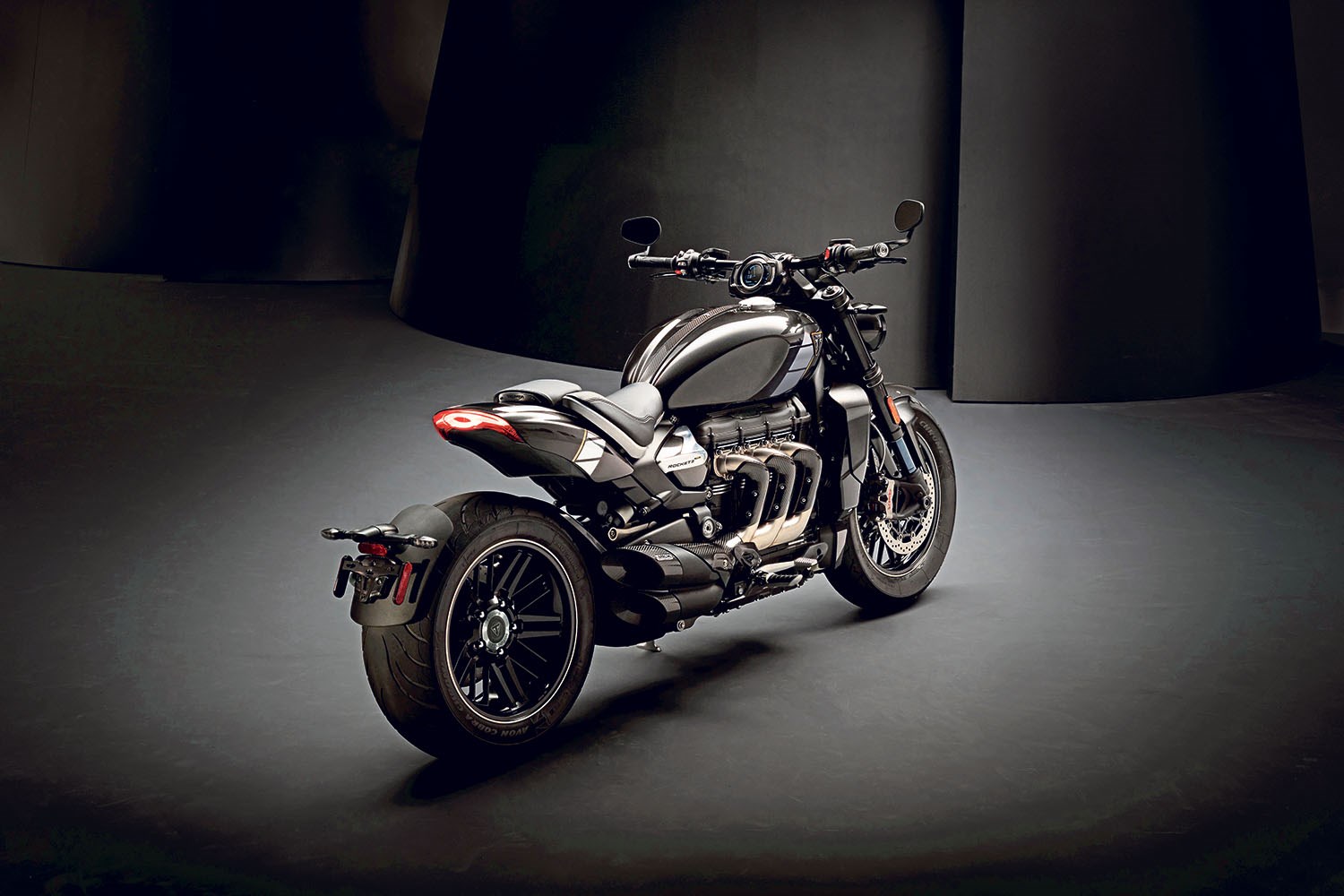
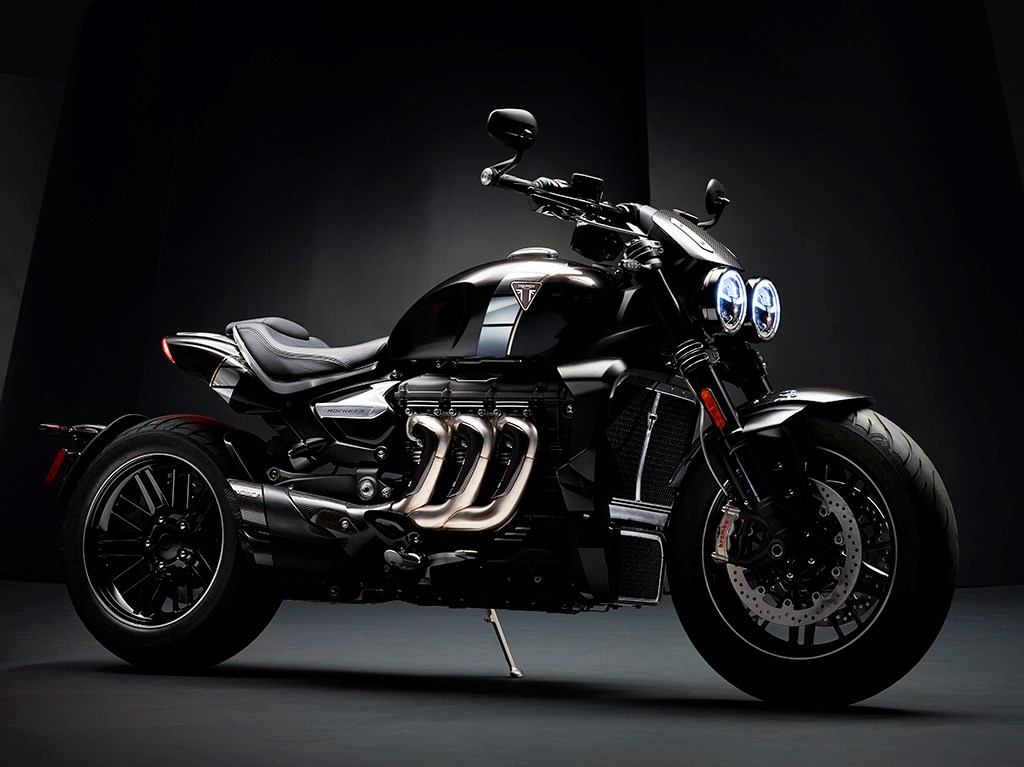
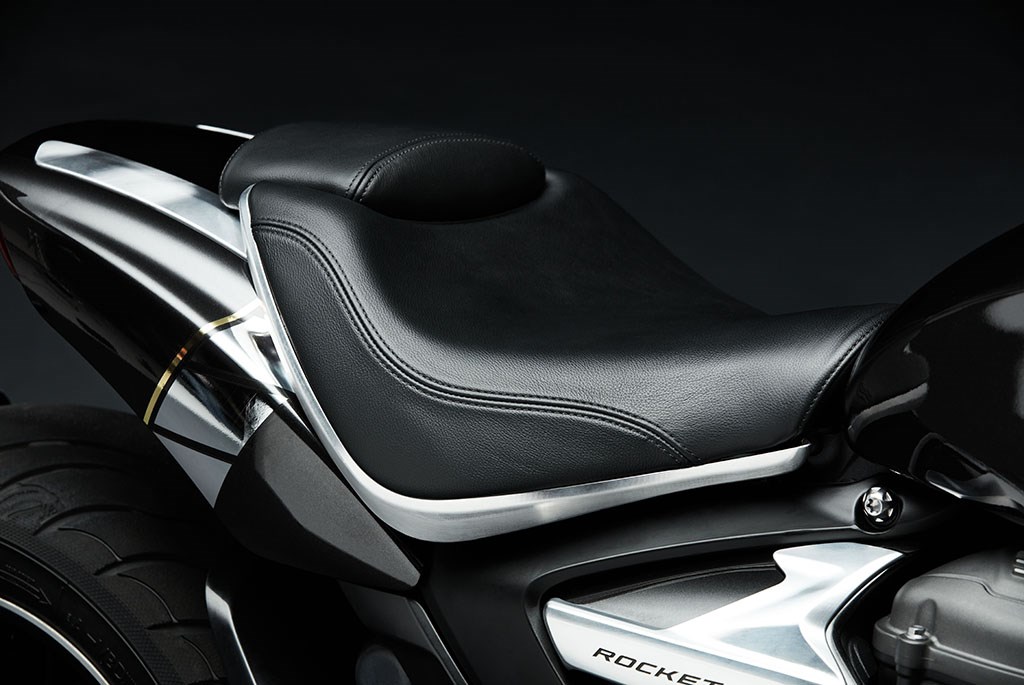
After teasing us earlier this year, besides the launch of the Thruxton R TFC, the Triumph Rocket III TFC has been officially unveiled.

Besides wearing the TFC (Triumph Factory Custom) badge, the Rocket III also claims the record as the biggest volume-production engine. Triumph upped the capacity from 2282cc to a whopping 2458cc. Thus, the new powerplant produces 167 hp and get this: 221 Nm of torque! If you’ve never pitied the rear tyre, now’s the time to do so.

However, it wasn’t just the extra cubes that contributed to the extra ponies. The manufacturer also reworked the head and gave it titanium valves. The carbon-tipped Arrow silencers also helped.

Reining in that massive power is a new electronic suite consisting of lean-angle sensitive traction control and ABS, in addition to four ride modes. Oh, there’s also a quickshifter with auto-blipper.

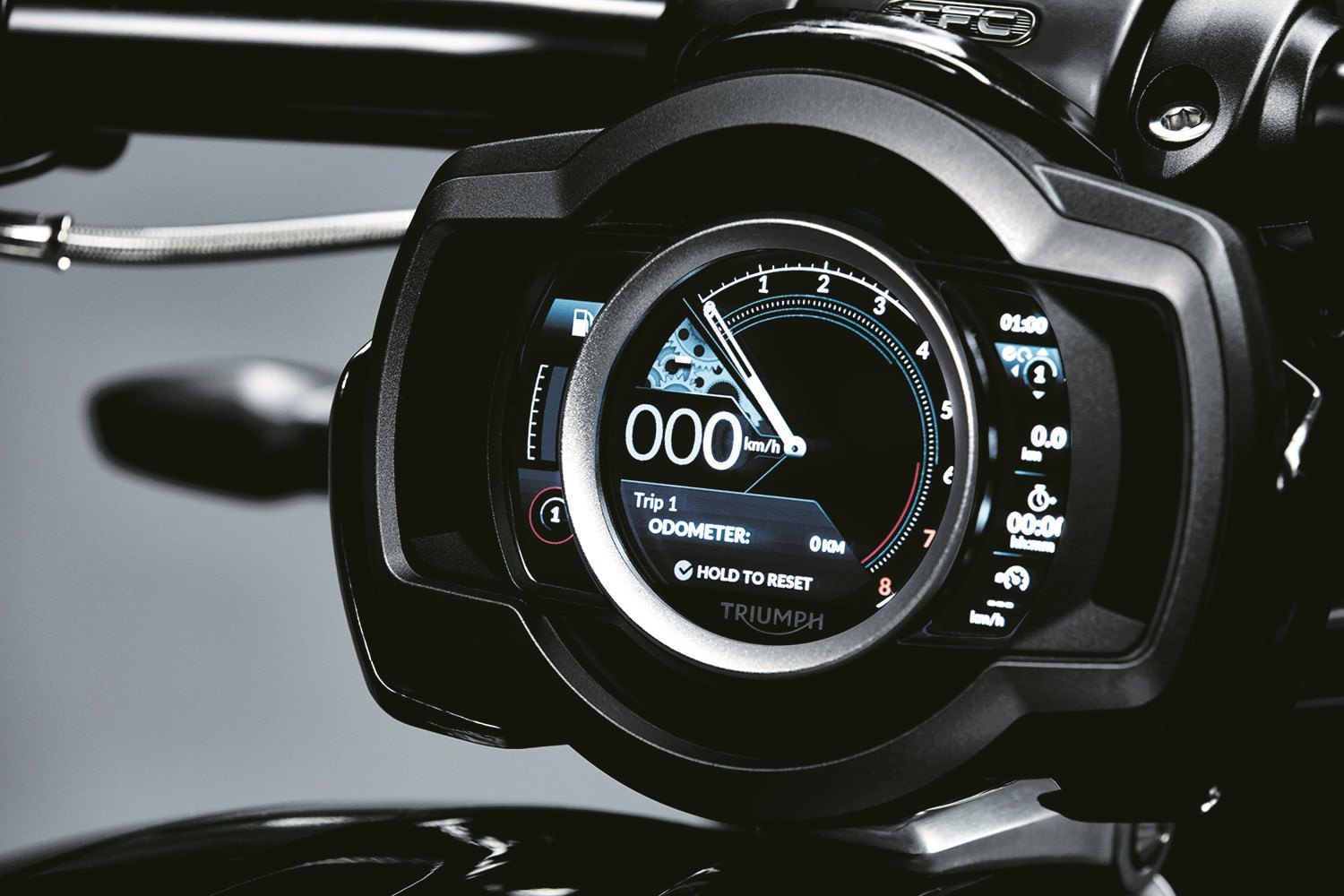
Other electronics include hill hold control, cruise control, keyless ignition and tyre pressure monitoring. The full-colour TFT display/instrument panel is the latest which appeared on the Triumph Scrambler 1200 XE. As such, it ought to include integration with not only your phone but also your GoPro camera.

The chassis and suspension have also been upgraded. At the front are 41mm cartridge Showa forks and a rear shock with piggyback reservoir. The front brakes consist of Brembo Stylema calipers, just like those on the Panigale V4 range.

The updates have turned the Rocket III into a serious power-cruiser to challenge the Ducati Diavel and Harley-Davidson V-Rod. Gone is the sedate-looking “old man’s cruiser” with a big engine.

Before we forget, Triumph will only build 750 units of the Rocket III, priced at £22,000 each.

But will there be a regular, non-TFC new Rocket III? We’d like to think so!

  • A video surfaced of an Aprilia RS660 being tested at Imola.

  • While it wears the RSV4’s bodywork, the video is titled as RS660.

  • Will we see the revival of the middleweight supersport class?

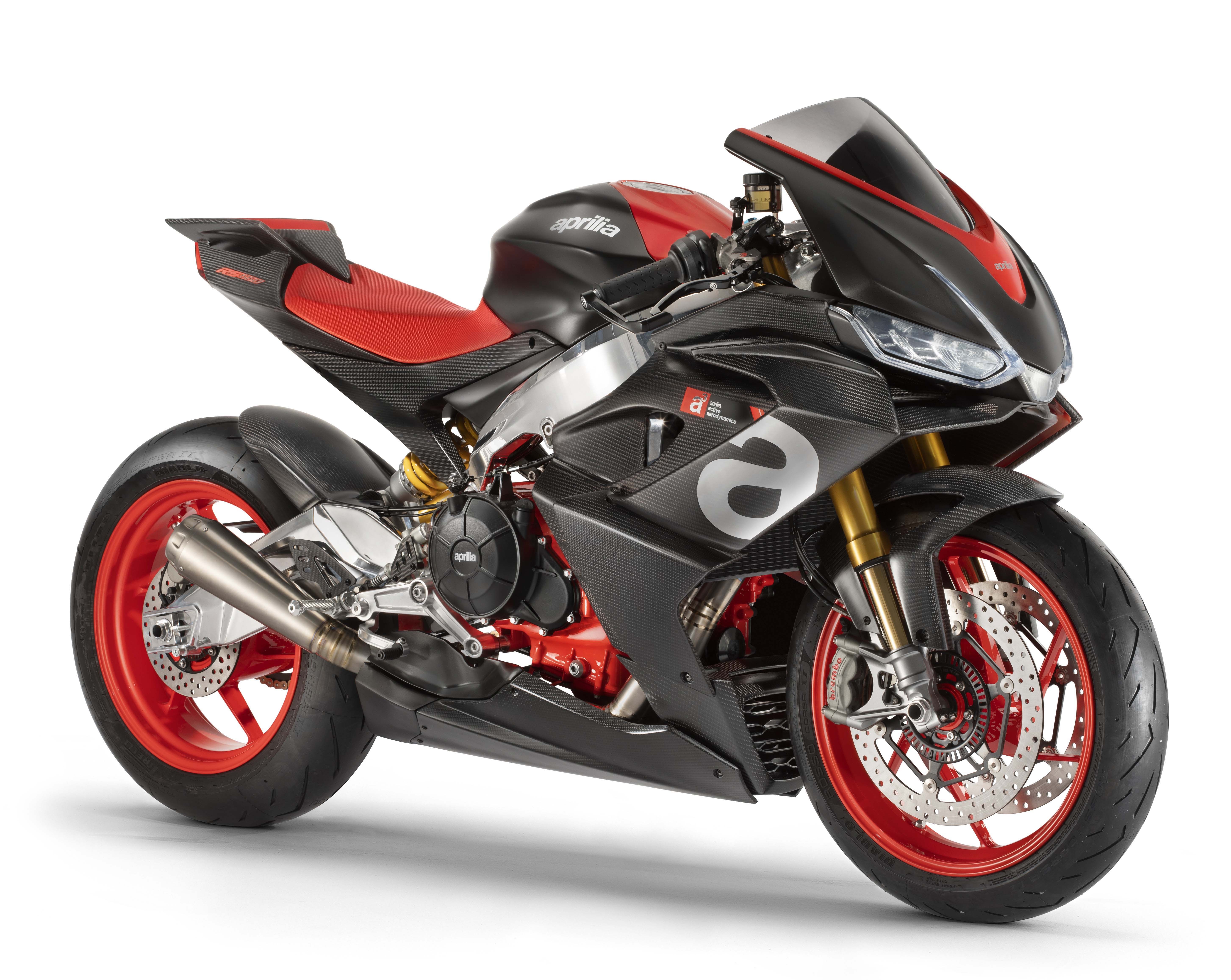
The upcoming Aprilia RS660 middleweight supersport bike garnered plenty of attention and anticipation since its unveiling at EICMA 2018.

As the Noale-based manufacturer said before, it’s basically an RSV4 minus the rear two cylinders. That turns the engine into a parallel-Twin.

Since then, Aprilia confirmed that the bike will make production and slated for 2020. That just leaves months to go before Intermot and EICMA 2019 for the purported official launch. So, there’s still plenty of work to do.

Lately, a video surfaced in the Aprilia Cup Facebook page claiming to be the RS660 prototype undergoing testing at the Imola racetrack. You can check out the video by clicking on the link below:

https://www.facebook.com/ApriliaCup/videos/2577483428964228/

However, we’d like to point out that the bike sounded a whole like a V-Four and the fairing is that of an RSV4. However, if you could spot a rough-looking parallel-Twin just ahead of the rider’s shin. Our conclusion is that it could very well be the test mule for the RS660. Furthermore, the video is titled RS660.

As the 1000cc superbike market keeps shrinking, we are hoping to see the revival of middleweight supersport class. Not only that they are cheaper than the 1000s, their level of power is more accessible to a wider range of riders. Fingers crossed for the RS660 to be priced reasonably.

Archive

Follow us on Facebook

Follow us on YouTube