Top view (more…)
Top view (more…)
 Launching of Honda icon 110 AT
 PDRM(Malaysian Royal Police) New Mitsubishi Evolution X
I was surfing to read about car at paultan.org and stumble upon this post. I guess this car is going to be used to chase illegal racer and mat rempits around Malaysia. So, be careful and race in track only.
Actually this car is going to be used to guide VVIP and may also likely to be used in high speed highway chase.
This car has been exempted from tax so it is well worth the money to buy it.
Maybe the next car for PDRM is Nissan GTR?
The original post is here http://paultan.org/forum/index.php/topic,1154.0.html
 The colour is white and Petronas green with the number 46
 This bike is surely from Labuan by the plate number LC 36XX
 The helmet should also be in white and Petronas green colour
 Great mod with great exhaust
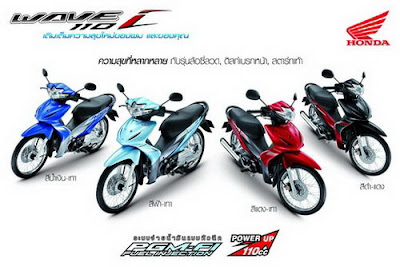 Honda Wave 110i (PGM-Fi)
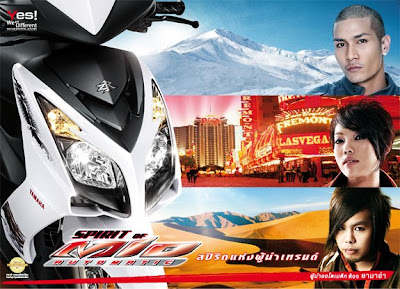 Yamaha Mio MX (a.k.a Yamaha Ego in Malaysia)
Two new bikes has been recently launched in Thailand. Expect these bikes to come to Malaysia soon.
I guess Yamaha Mio MX (a.k.a Yamaha Ego) will definitely makes it entry to Malaysia. Yamaha Mio MX is the new version of previous Yamaha Ego S (Yamaha Mio Soul anywhere else) here in Malaysia. Maybe the name in Malaysia is Yamaha Ego MX?
Also, Thailand have another Fi bike that is Honda Wave 110i. Previously, Honda have introduced Honda Wave 125i with Fi which is the first Fi cub bike. I also think this bike will make it to Malaysia since the Boon Siew Sdn Bhd is taken by Japanese entity that is Honda Motor Co. The new company is named Boon Siew Honda Sdn Bhd.
I really hope we can see lots of changes in motorbike environment in Malaysia since we are really way behind our neighbouring country like Thailand.
Some says that Malaysia motor market is not big, that’s why most manufacturer tends to focus their new model on country that have much larger market like Vietnam, Thailand, Philippine and Indonesia.
Some burning question here, will the price of the Fi bike higher than carburetted bike? What about repair, will it cost much higher?
For more information, click here
Read also about fuel injection bikes here
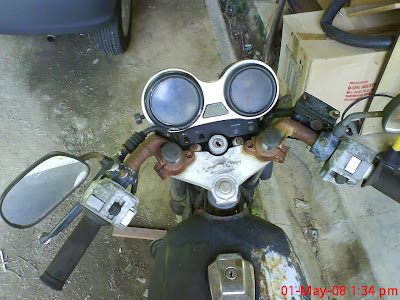 1997 6-Speed RX-Z Restoration Project
 Newly painted engine cover but the kick starter has not been replaced yet since there is no stock for the original one
 Carburetor is new since the old one is very dirty and hard to clean
 New rims, tyre, hub, rear footrest but old exhaust painted to black
 Definitely restored to full glory
 Nicely done in black with green stripe
There is nothing more satisfying other than looking at the bike that once is hedious and teribble but now looking like new and full of spirit.
Remember to read the previous look of this bike here!

1. Colourless or slightly blue smoke from exhaust
This means that your bike is very good condition. What you can assume is your fuel/air mixture is at the right composition and everything is well burnt is your combustion chamber.
 Honda Air Blade-i
 Honda CBR-125i
 Honda Click AT-i
 Honda CZ-i 110
 Yamaha Spark 135i
 Suzuki Shogun 125 Fi
 Honda Wave 125S PGM-Fi (the first cub to have Fi)
I hate to write about this post because it made me feel that we in Malaysia live in old time. People in Thailand got all the bike featured here, but none of them is available in Malaysia. Why? What is wrong with Fi bike in accordance with the rules and regulation here in Malaysia?
But, there is one thing that make me happy for using carburetor type cub bike, look at the Honda Wave specification below:
Specifications Honda Wave 125
* Engine type: SOHC 2-valve 4-stroke air-cooled 124cc engine
* Displacement: 124.9 cc
* Bore x Stroke: 52.4 x 57.9 mm
* Compression Ratio: 9,3:1
* Max Power: 9.3 PS @ 7,500 rpm (carburetor type),
9,18 PS @ 7.500 rpm(Fi)
* Max Torque: 1.03 kgf.m @ 4,000 rpm (carburetor type),
0,99 kgf.m /5.000 rpm(Fi)
* Max speed: 115 km/h
* Transmission: 4-speed
* Clutch: Wet multi-plate centrifugal
* Starter: Kick and electric starter
* Frame Type: Underbone steel tube
* Suspension (F): Telescopic
* Suspension (R): Swingarm
* Brake (F): Disc/Mechanically actuated drum
* Brake (R): Leading trailing drum/Disc
* Fuel tank capacity: 3.7 L
Read the one with bold font. As you can see the carburetor-type Honda Wave 125 is more powerful and torquey than Fi sibling. Also, the maintainance is low and easy to repair compared to Fi which used ECU. Still, we in Malaysia should have Fi bikes(we have one actually, that is Yamaha FZ-150i).
The special thing about Fi is about fuel efficiency. This is proven by the review of FZ-150i by Roda-Roda magazine in Malaysia September issue.
Self modification to fit your bike with Fi is actually possible but I think it is not worth the effort.
For more information, click here.
 Honda Wave 125X
 Suzuki Shogun 125 RR and Suzuki Shogun 125SP
I know this post is a little bit late. I was thinking whether to include this bike or not on this blog because this blog is mostly about Yamaha cub bikes but I can’t resist the temptation given by Shogun 125 SP by Suzuki. (more…)
 Yamaha RX-Z 135 16T Front Sprocket

 Yamaha RX-Z 135 428 Chain
“Sprocket Materials
Most standard sprockets are manufactured from steel. They can be made from many type of material, but the offerings from most manufacturers are based upon their own equipment limitations and the tooling available to cut the teeth.
Below is a listing of typical sprocket materials and their most frequent application environments.
Steel – Is considered the most typical construction material. It is available in different hardness levels (covered later) and is used in all types of applications.
Bronze – Is a metal used in non-magnetic applications where ‘no sparking’ is required. It can also withstand the abuse of some corrosive environments.
Brass – Is also a non-magnetic application material with the ability to stand up in a number of corrosive environments.
Stainless Steel – This is the most common material used for corrosive environments. It is widely applied throughout in the food processing industry and most manufacturers have types approved for direct food contact.
Titanium – Light weight and very strong, this metal is a silvery, dark grey colour and is designed for highly corrosive applications or direct chemical exposure such as in the electrical industry where printed circuit boards are cleaned.
Aluminium – Silvery, light weight metal that can resist corrosion but is restricted to light duty, light load applications. Typically used in belt and pulley applications (timing belts).
Nylon (Plastic) – As with roller chain, nylon is also used for anti-corrosive environments, as well as for quietness.
Nylon materials are also generally less expensive than metal. Nylon sprockets can be used in the food industry, as they hold up well in wash down situations. These plastic sprockets can be constructed from electro-conductive through heat resistant styles – similarly found in plastic chain.”
What is the sprocket that you are using now? Let’s share the knowledge!