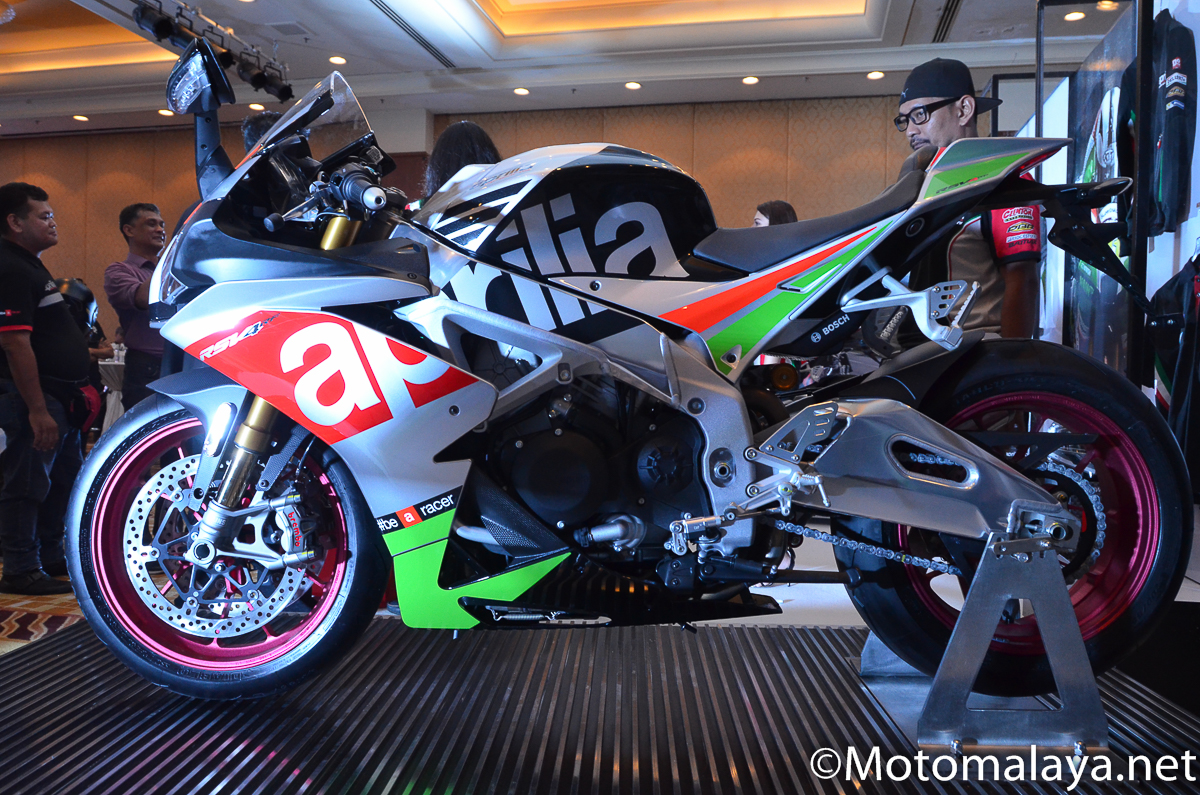
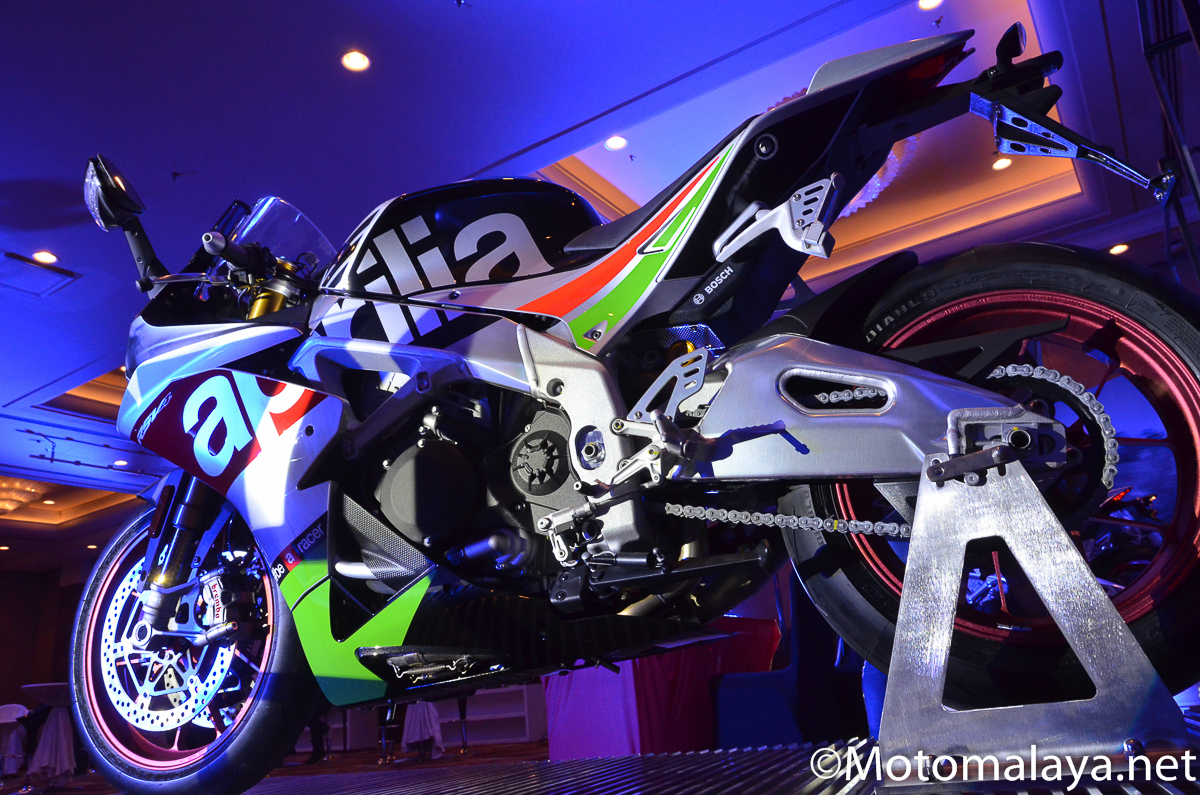
Following the statement released by Naza yesterday confirming that it will cease its Aprilia distributorship in Malaysia (you can read the statement here), the Piaggio Group has today confirmed that it has appointed Didi Resources Sdn Bhd (DRSB) as the new distributor for Aprilia in Malaysia.
The following is the statement released by The Piaggio Group:
Kuala Lumpur, 18 July 2018 – The Piaggio Group officially announces the appointment of Didi Resources Sdn Bhd in Malaysia, as the official distributor of Aprilia, one of the Group’s premium motorcycle brands.
Didi Resources Sdn Bhd will manage Aprilia in substitution of the previous distributor, Naza Premira Sdn Bhd. The Piaggio Group wishes to thank Naza Premira for the continuous effort and support since 2013.
Mr. Gianluca Fiume, Chairman & General Director of Piaggio Vietnam cum Executive Vice President Asia Pacific 2 Wheeler, said, “The appointment of Didi Resources is part of Piaggio’s business strategy to group the motorcycle brands of Aprilia and Moto Guzzi under a single entity to maximize efficiencies across all aspects of the business and reinforce customer commitment in Malaysia. With Aprilia and Moto Guzzi under one roof, we are able to better offer a wider range for potential customers who seek a unique Italian motorcycle experience backed by superior performance and rich heritage of these brands. We look forward to collaborating closely with Didi Resources to propel both Aprilia and Moto Guzzi to greater heights.”
Under the management of Didi Resources, the Gasket Alley at Petaling Jaya will house a dedicated showroom for both Aprilia and Moto Guzzi brands, an aftersales and a service workshop with a new team equipped with specialized technical skills and expertise, fully trained by Aprilia. Customers are assured of a seamless transition in customer care and service support.
According to Mr. Rewi Hamid Bugo, Chairman of Didi Resources Sdn. Bhd, “We are very honoured to be presented with this opportunity to manage Aprilia, a prestigious Piaggio Group brand for the Malaysian market. This complements the Moto Guzzi range which we have established since August 2017 and completes our premium Italian motorcycle product range under Piaggio. Through this acquisition, Didi Resources is firmly committed to building the Aprilia brand through a dedicated aftersales support, strengthening of the Aprilia community and ensuring that engagement with the brand is continuous in the light of a competitive 2-wheel environment in Malaysia.”
The official appointment of Aprilia under Didi Resources will take into effect from 1 August 2018. A series of media and customer engagement activities and service support campaigns for Aprilia are currently in the pipeline to bolster brand building efforts.
DRSB is also the distributor for Harley-Davidson and Moto Guzzi in Malaysia, and has a proven track record of maintaining unique brands. Based at The Gasket Alley in PJ, the team at DRSB have all previously had links to Aprilia in one way or another. So Aprilia owners can rest assured that their machines are in good hands.
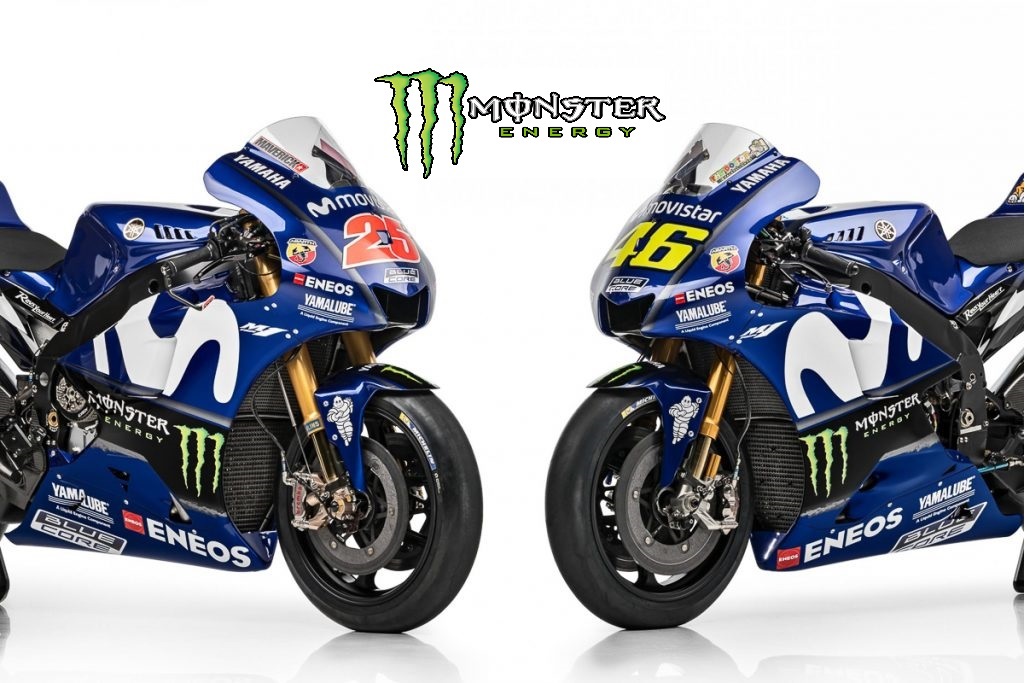
The Yamaha MotoGP team has signed a new agreement with Monster Energy as their new title sponsor starting 2019.
Starting next season, the Yamaha factory squad will be known as the Monster Energy Yamaha MotoGP squad.
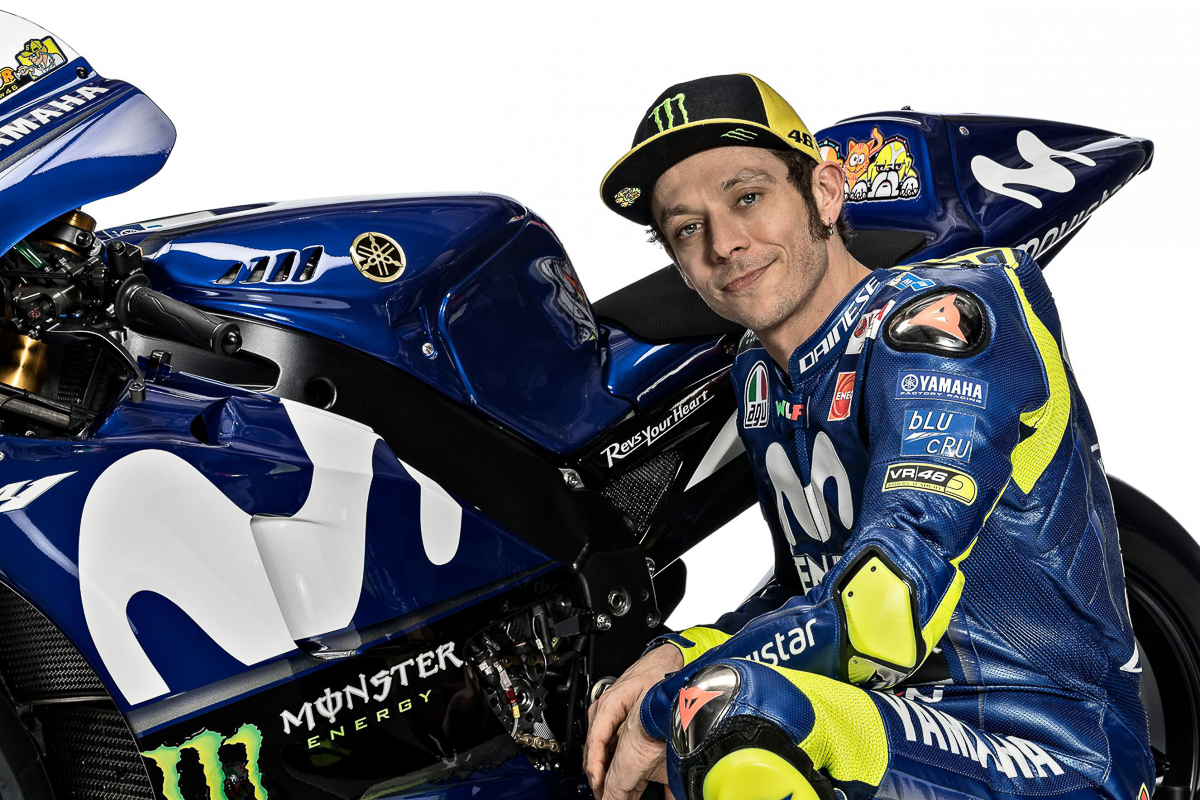
Both Valentino Rossi and Maverick Vinales are already Monster Energy athletes.
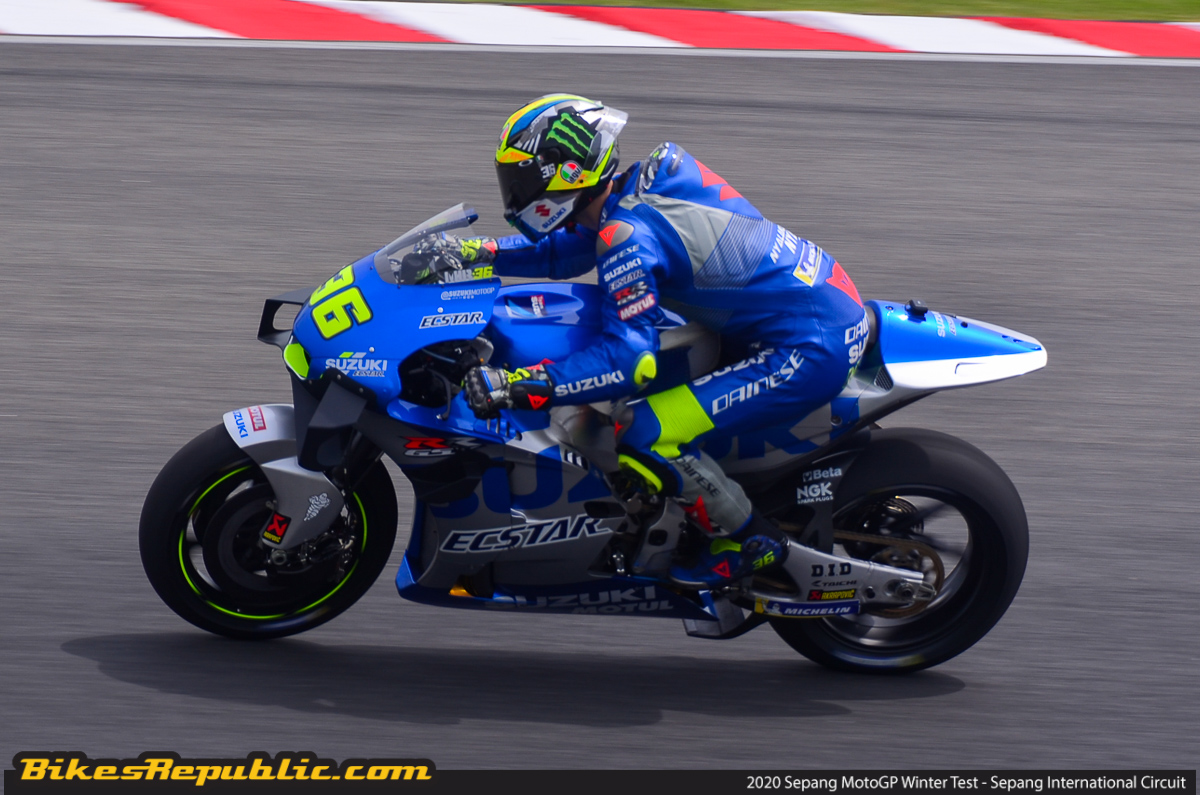
The Yamaha MotoGP team will see a big change for the 2019 season as they’ve signed a new agreement with Monster Energy drink as their new main sponsor. Starting next season, the team comprising of Valentino Rossi and Maverick Vinales will be known as the Monster Energy Yamaha MotoGP team. (more…)
Naza Premira Sdn Bhd has released an official press statement regarding their distributorship status for Aprilia here in Malaysia.
After a mutual decision with Piaggio Group, they’ve decided to cease its operation as the brand’s official distributor starting 31 July 2018.
With that being said, Naza Premira Sdn Bhd will continue to represent Piaggio and Vespa brands in Malaysia.
It’s been a while since we last heard anything regarding Aprilia and its presence here in Malaysia. In fact, the last major event organised by them was the official launch of the amazing 2017 Aprilia RSV4 RF and Tuono 1100 V4 held last year in conjunction with the Shell Malaysia Motorcycle Grand Prix (MotoGP). (more…)
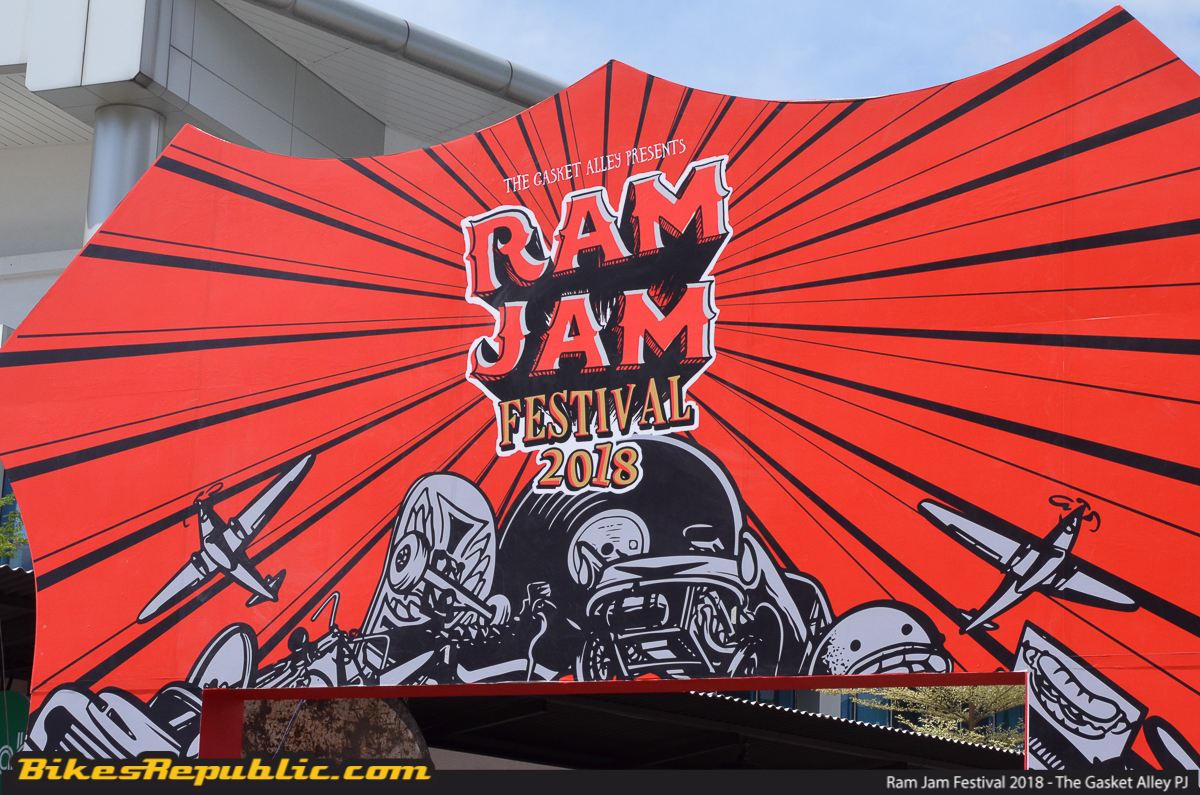
The Ram Jam Festival 2018 concluded its first-ever event last Sunday at the Gasket Alley, PJ.
Major highlights of the festivities were Museumoto, Miss Bombshell, music, food, and many more.
Thousands attended the event where it was concluded with some of the finest artists and the World Cup finals live viewing.
The first ever Ram Jam Festival 2018 was successfully conducted yesterday at the renowned Gasket Alley located in Petaling Jaya, Selangor. Thousands flocked to the venue where a collection of art, music, classic bikes and cars plus fashion all gathered at this one-of-a-kind event. (more…)
As more cars are being fitted with anti-collision systems, Ducati is also developing theirs.
Developed together with Audi, the system uses the 5G network.
The system will warn the rider about upcoming danger but may apply the brakes automatically in the future.
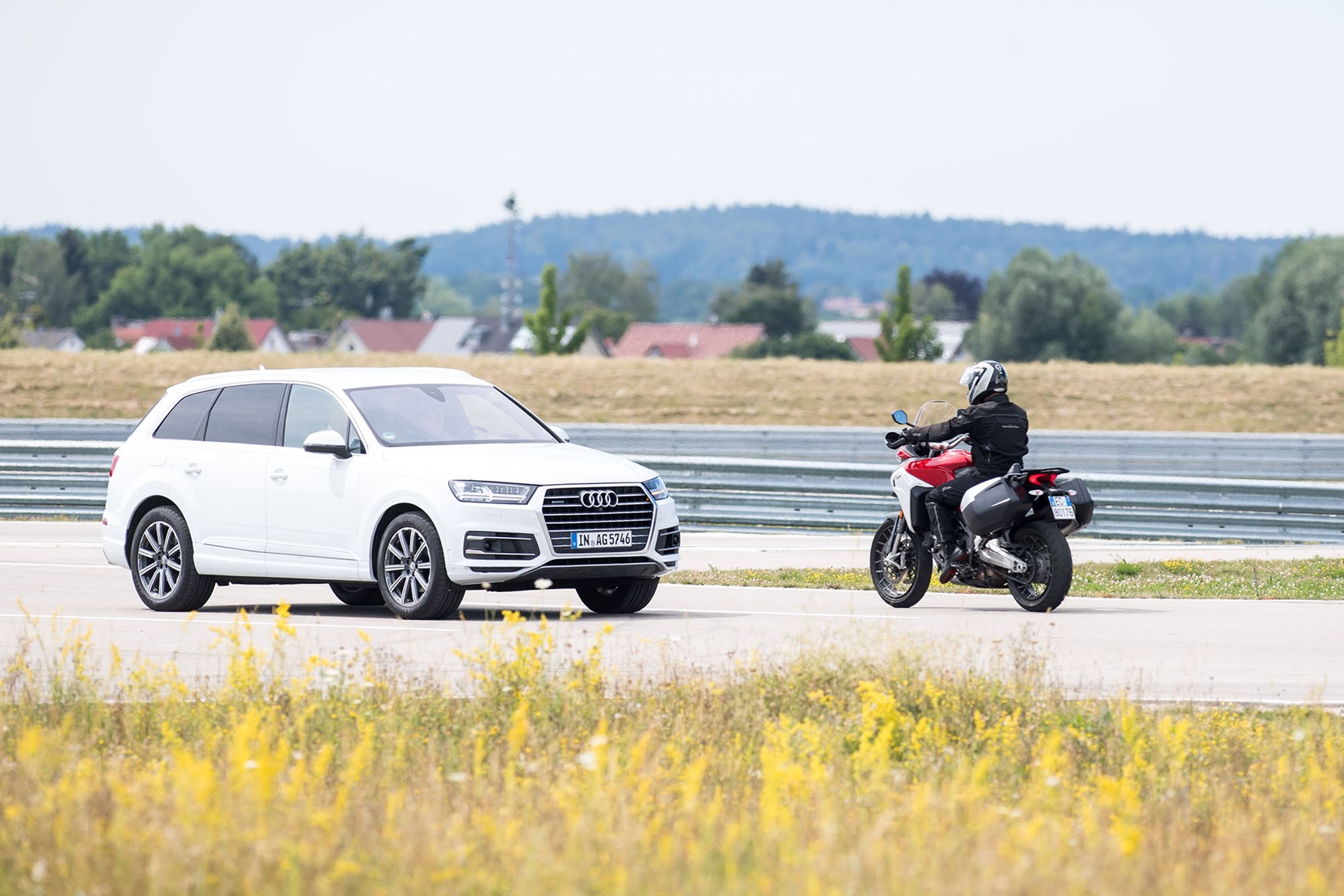
Every motorcyclist knows that a collision with another vehicle sucks, but we push the thought to the back of our minds, like smokers who are aware of the dangers of smoking. Ducati aims to reduce the number of collisions with a new technology they developed together with Audi.
Called the Cellular Vehicle-to-Everything (C-V2X) tech, it builds a picture of vehicles in the vicinity to provide situational awareness. It works over the developing 5G mobile network.
Ducati and Audi recently demonstrated the system’s controlled collision avoidance by using a Multistrada and two cars. The vehicles communicated with each other to avoid the impending disaster. There were two types of assistance, called Intersection Collision Warning and Across Traffic Turn Collision Risk Warning.
Key points of C-V2X
Ducati Advanced Radar Assistance System reads the road and monitors multiple vehicles simultaneously.
It senses slowing vehicles and warns the rider of a potential problem. It may reduce speed or brake automatically in the future.
A rear radar system detects obstructions in the rider’s blind spot and highlights it in the rear-view mirror.
Ducati and Audi say all vehicles will communicate with each other in the future and avoid collisions autonomously.
The technology also seeks to communicate with roadside obstacles such as traffic lights, road signs and speed limits.
The system provides warning to the drivers and rider of the dangers at this moment, but further development could see vehicle autonomy being gradually fitted to motorcycles. Autonomous cars are starting to come into the market as we reported previously (click on the link below for more information).
The systems in cars automatically applies the brakes to avoid a potential collision even before the driver is aware of a problem. This solution is not only available in luxury cars as the new Perodua Myvi is equipped with an earlier iteration of the system.
While pundits may be scoff about autonomy, remember that the ABS was also derided when it first came into the market. But it is now the single component that had saved the most lives.
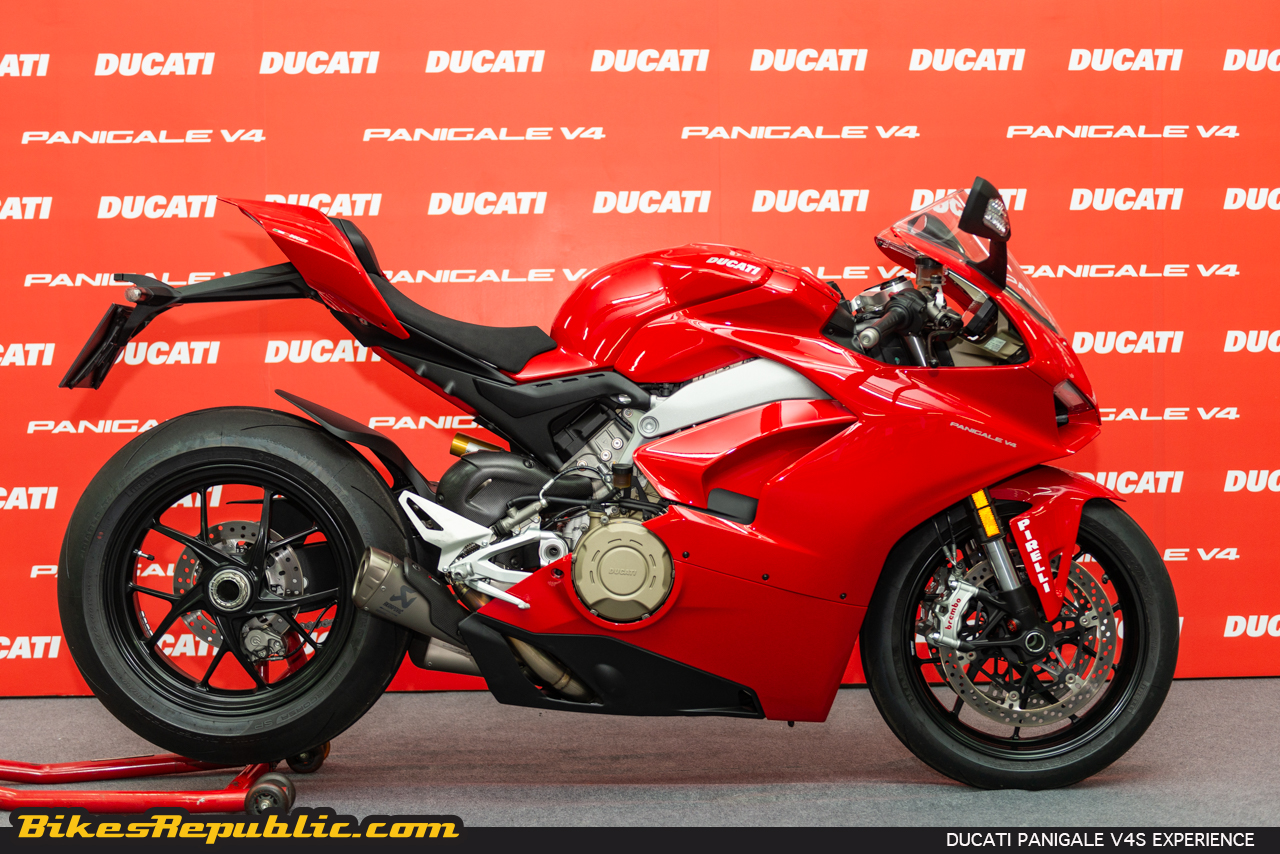
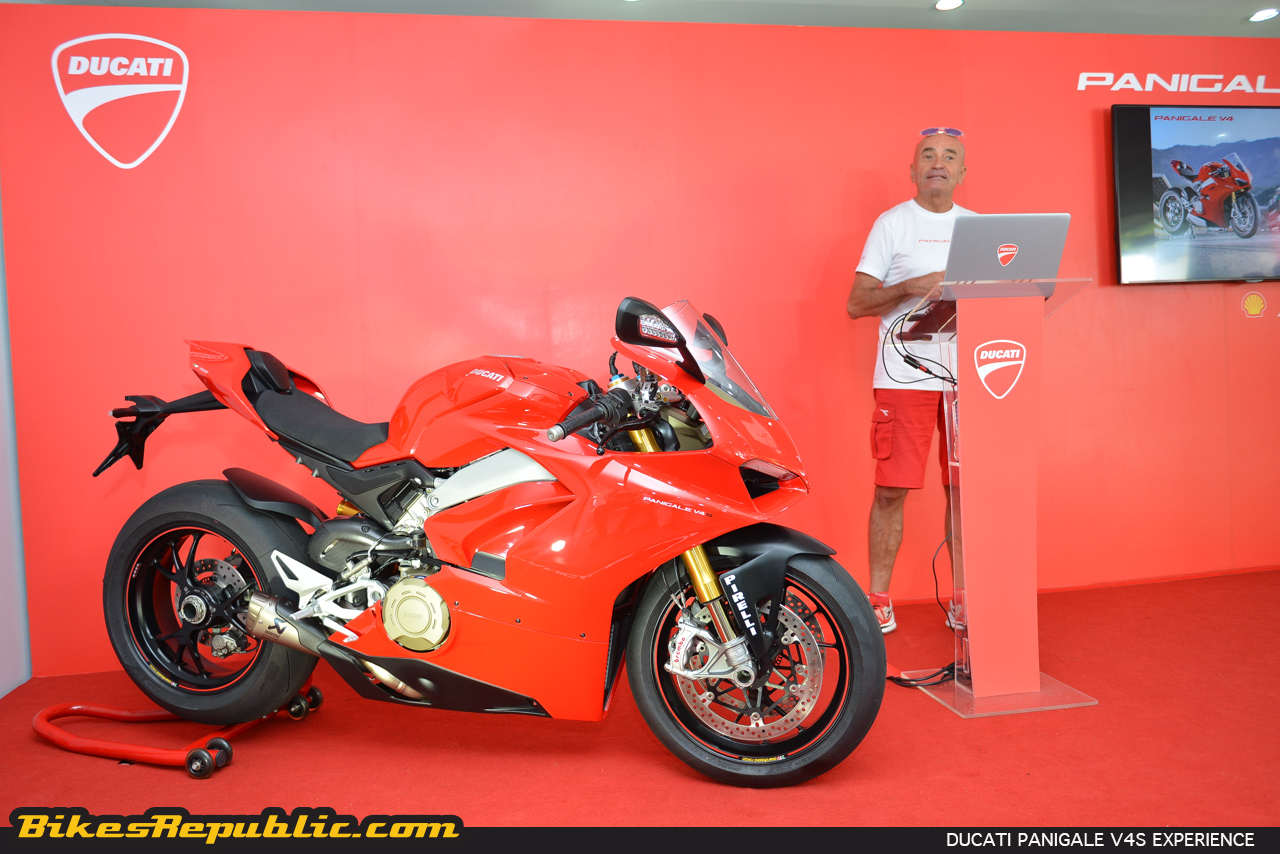
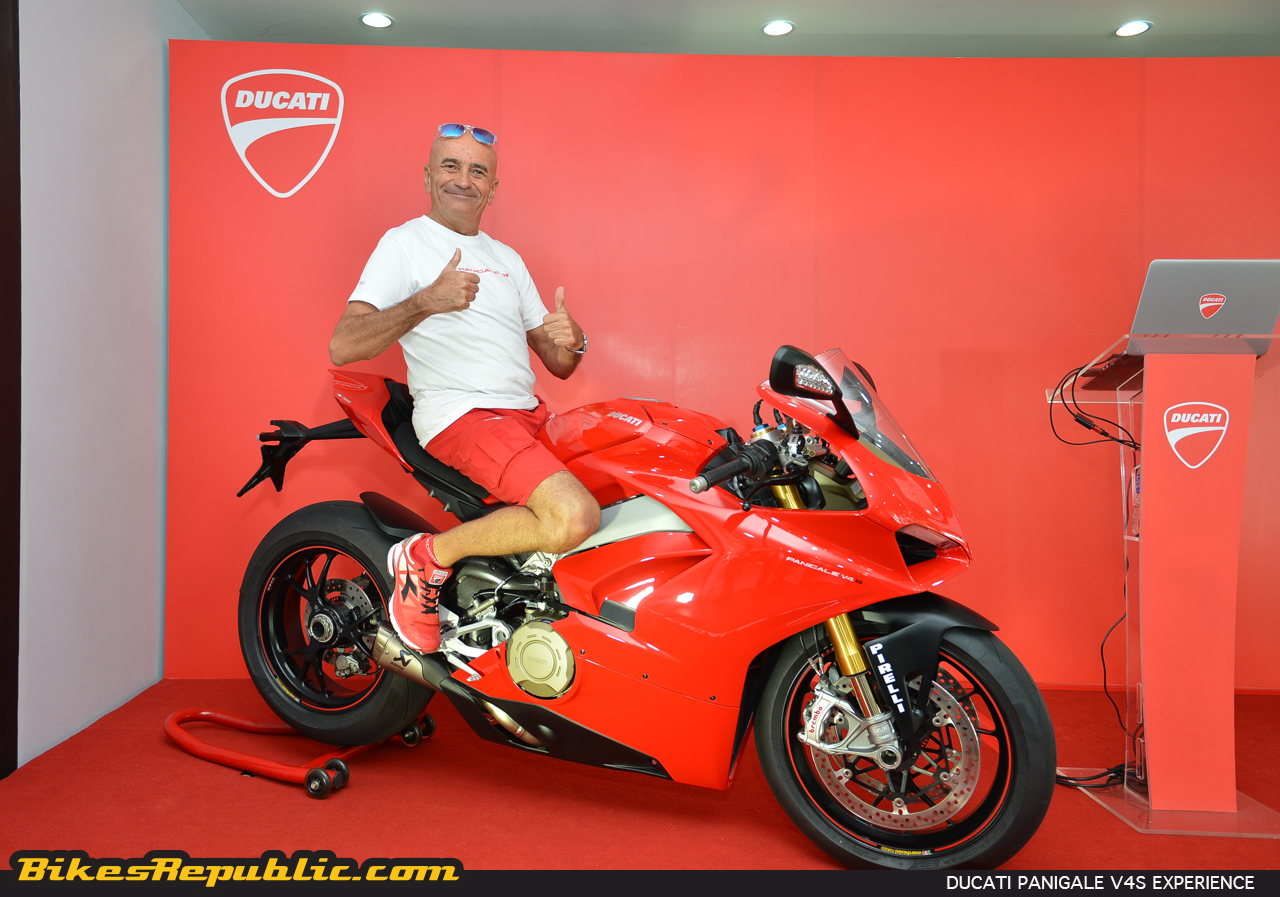
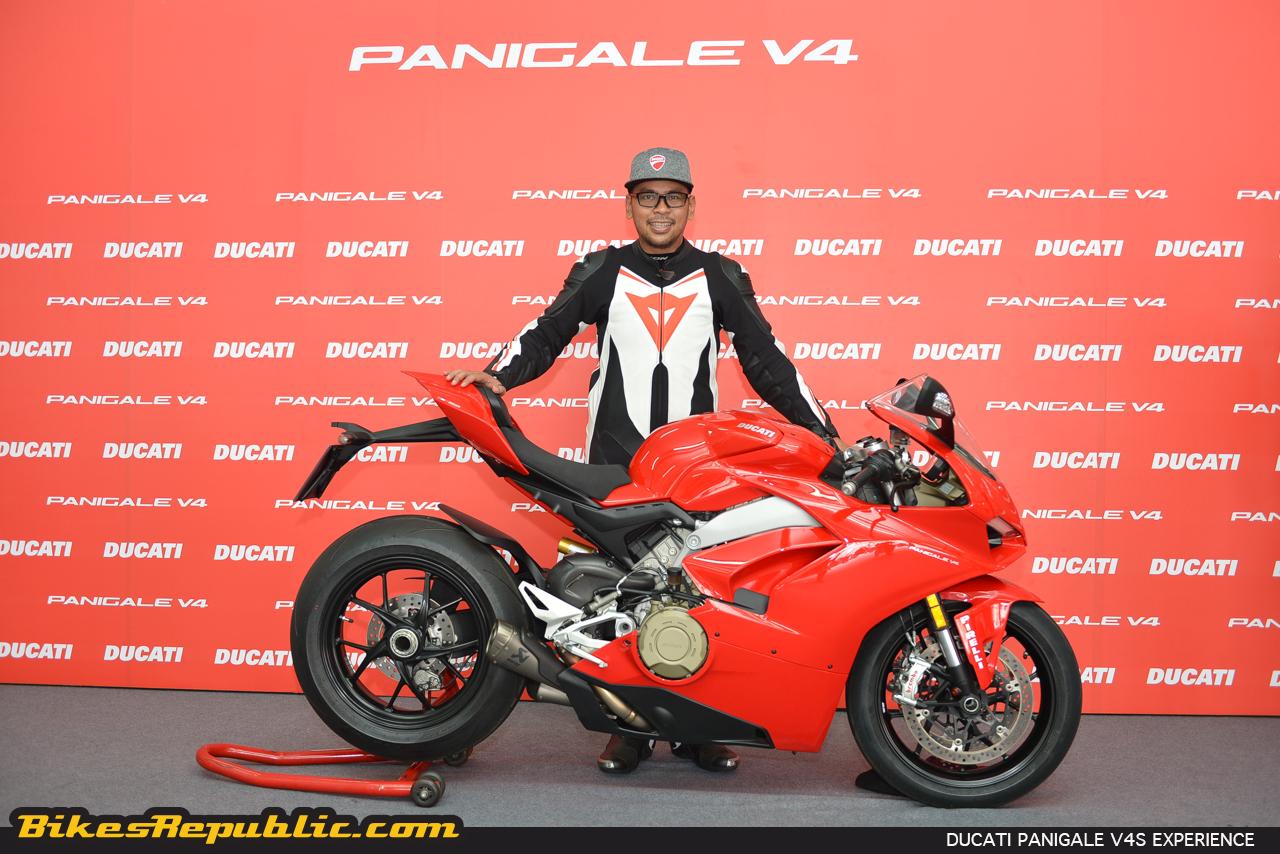
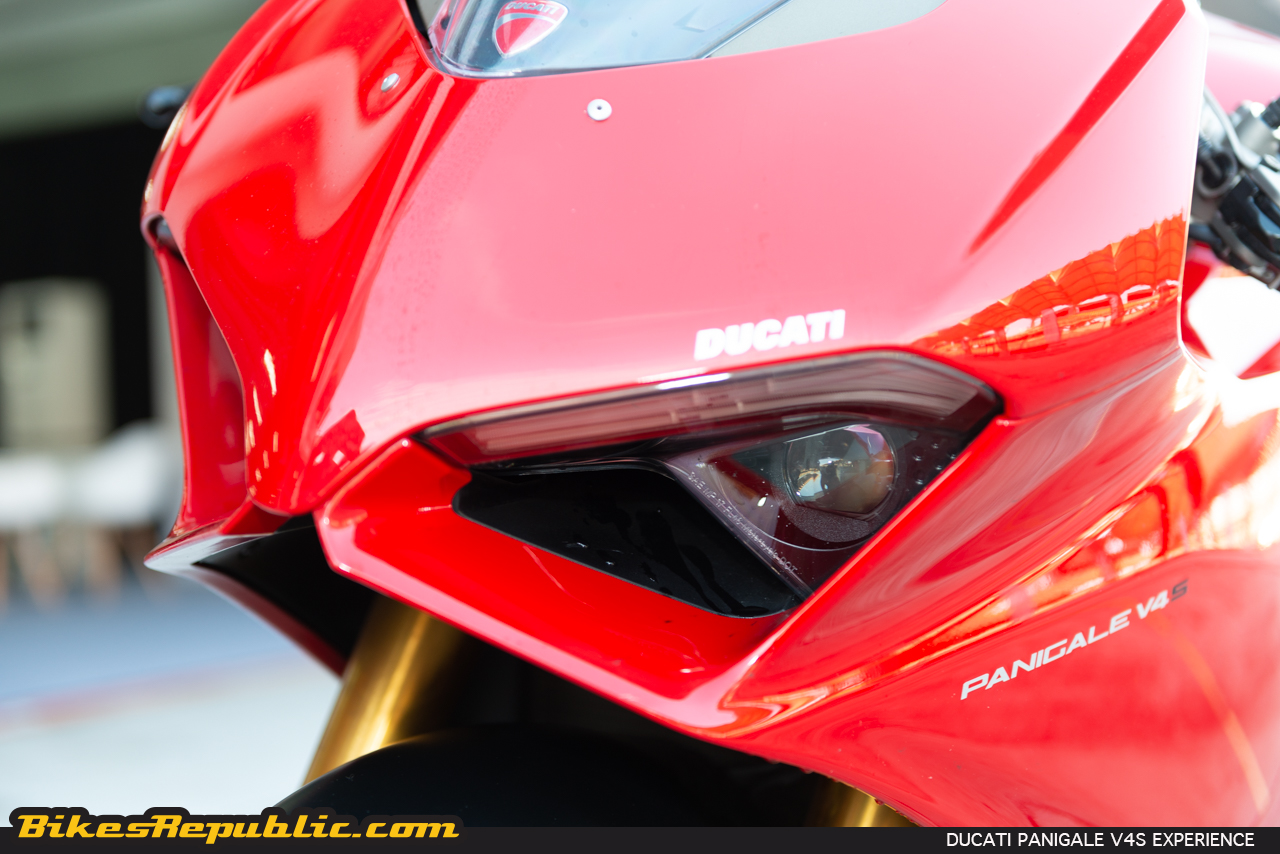
The new Ducati Panigale V4, V4S, V4 Speciale mark the manufacturer’s departure from their trademark V-Twin sportbikes.
The Panigale V4 is set to bring the Superbike World Championship title back to Italy.
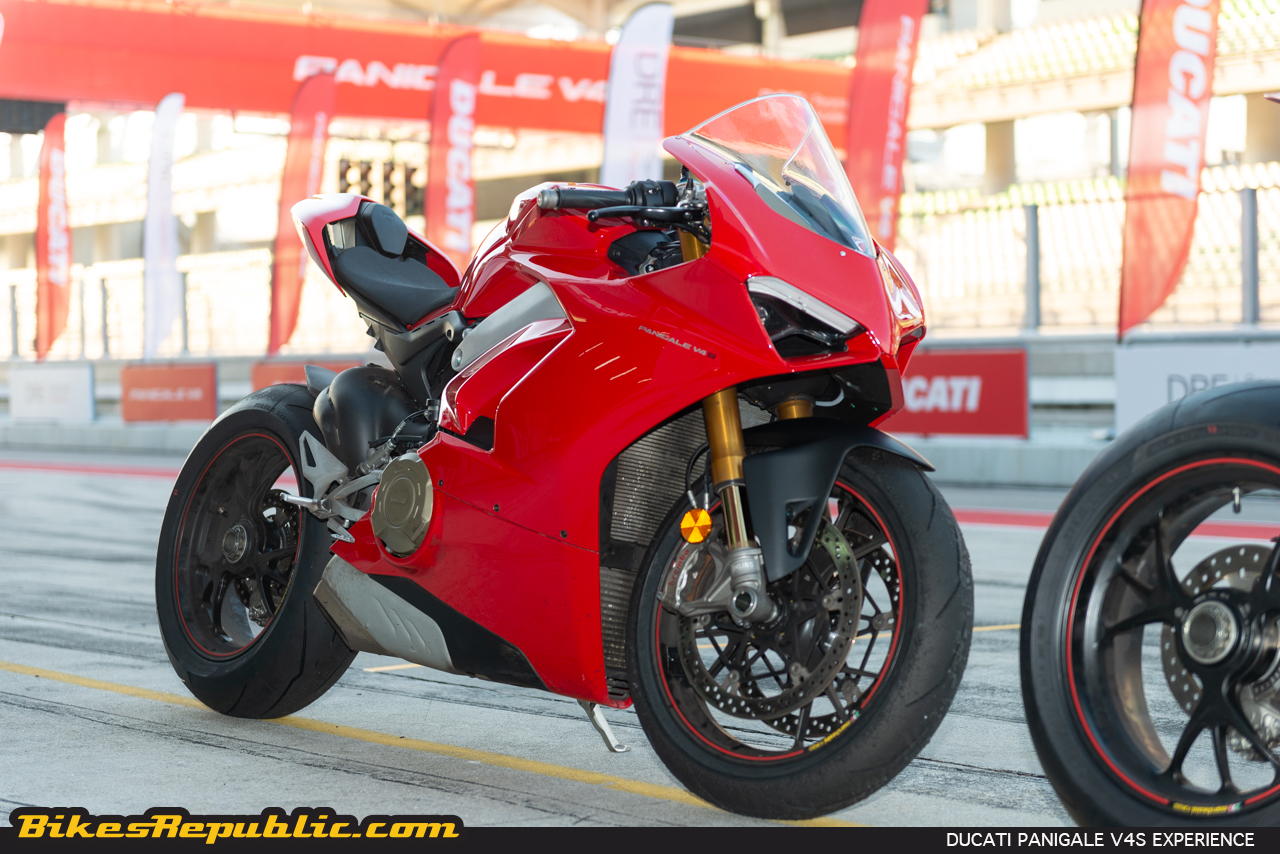
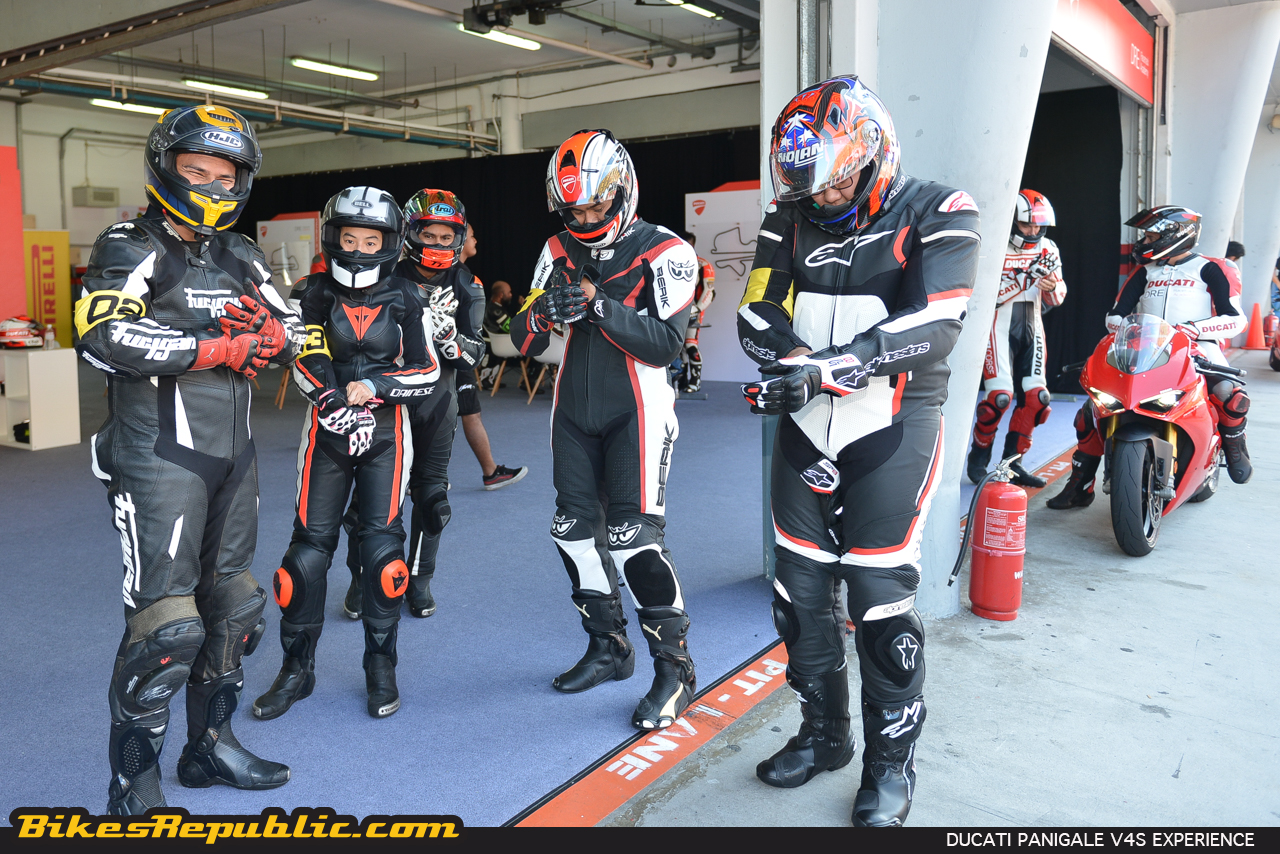
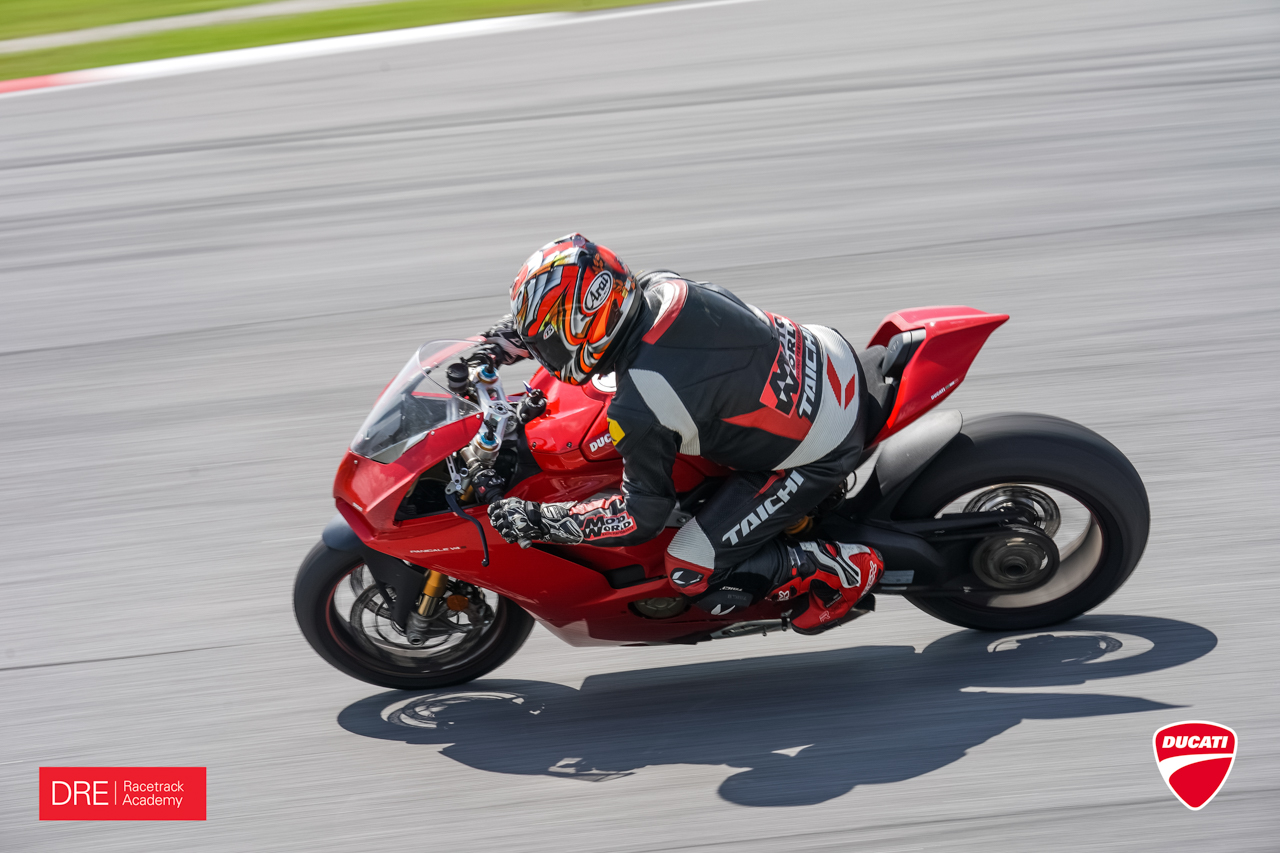
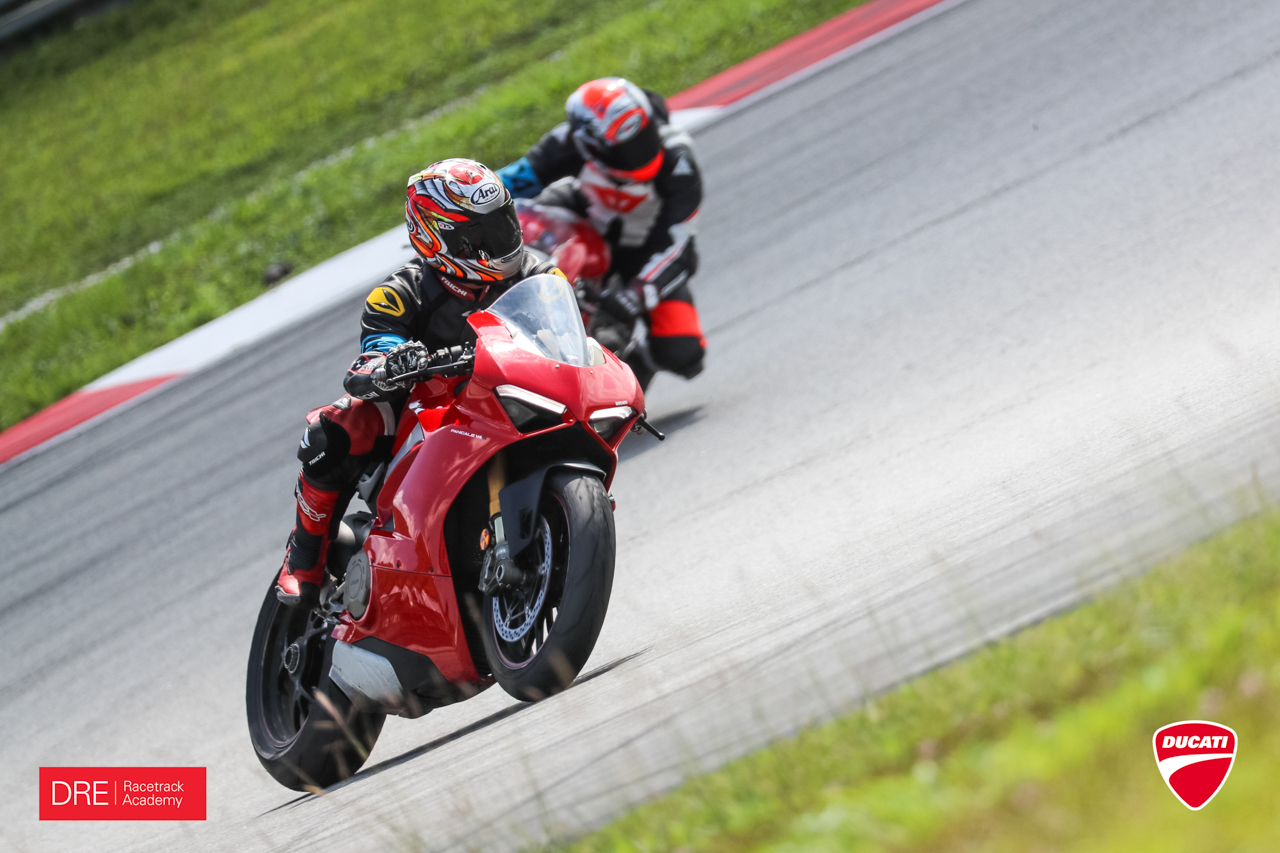
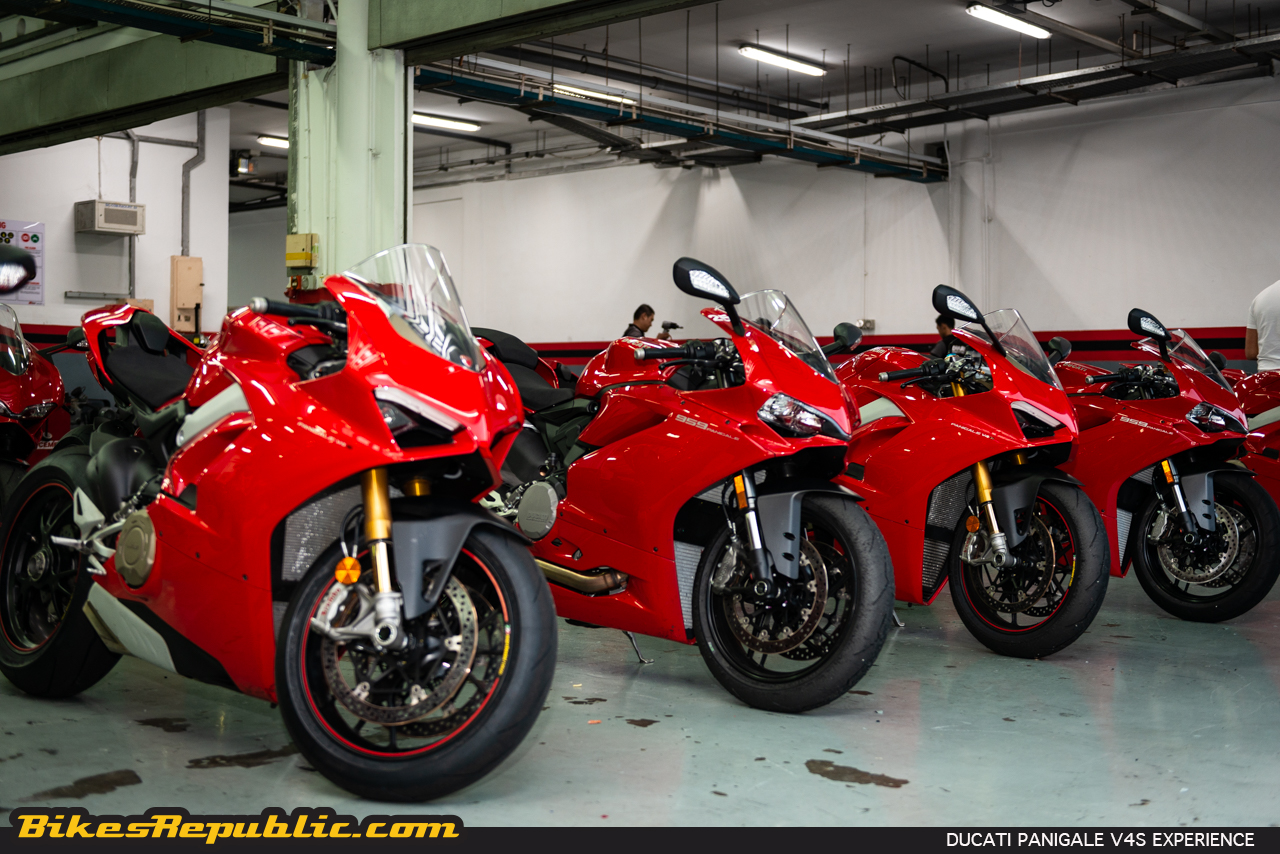
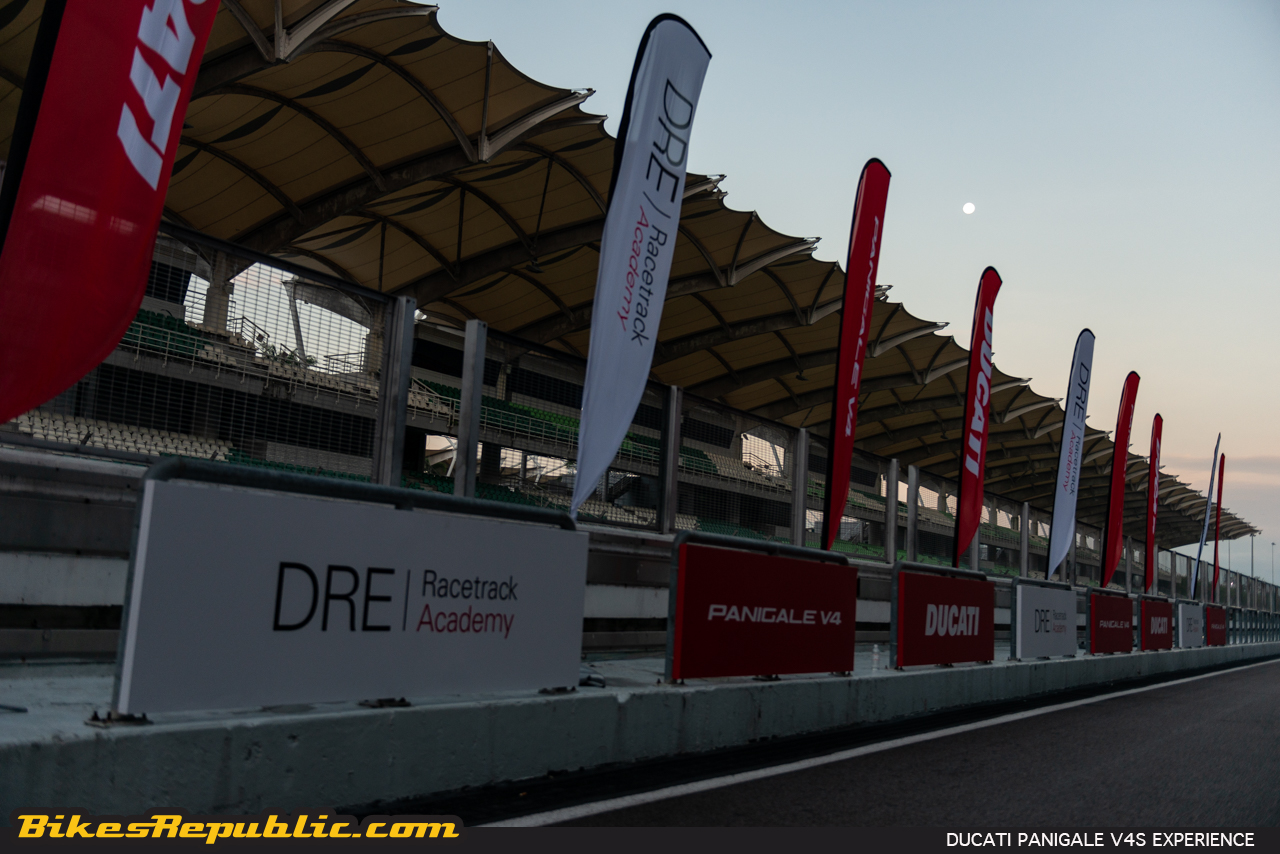
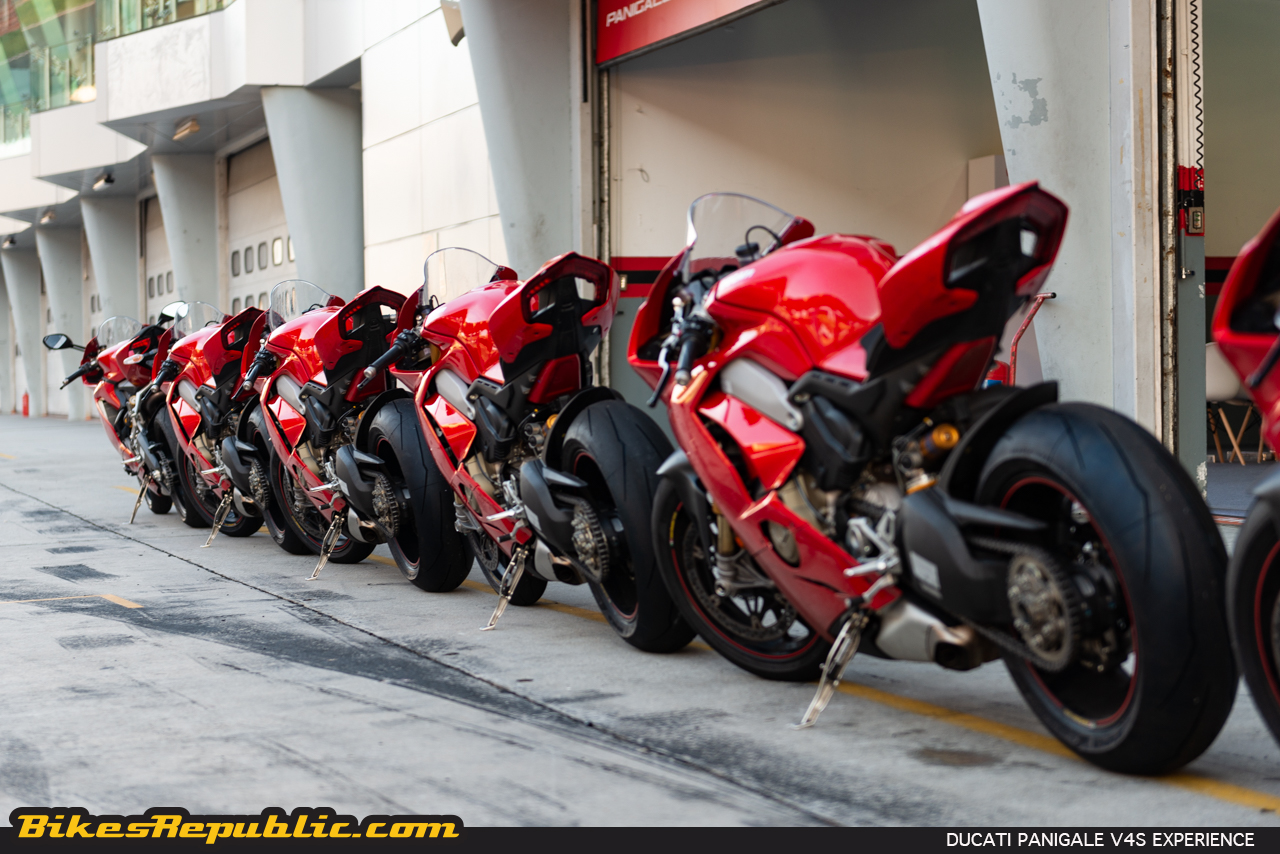
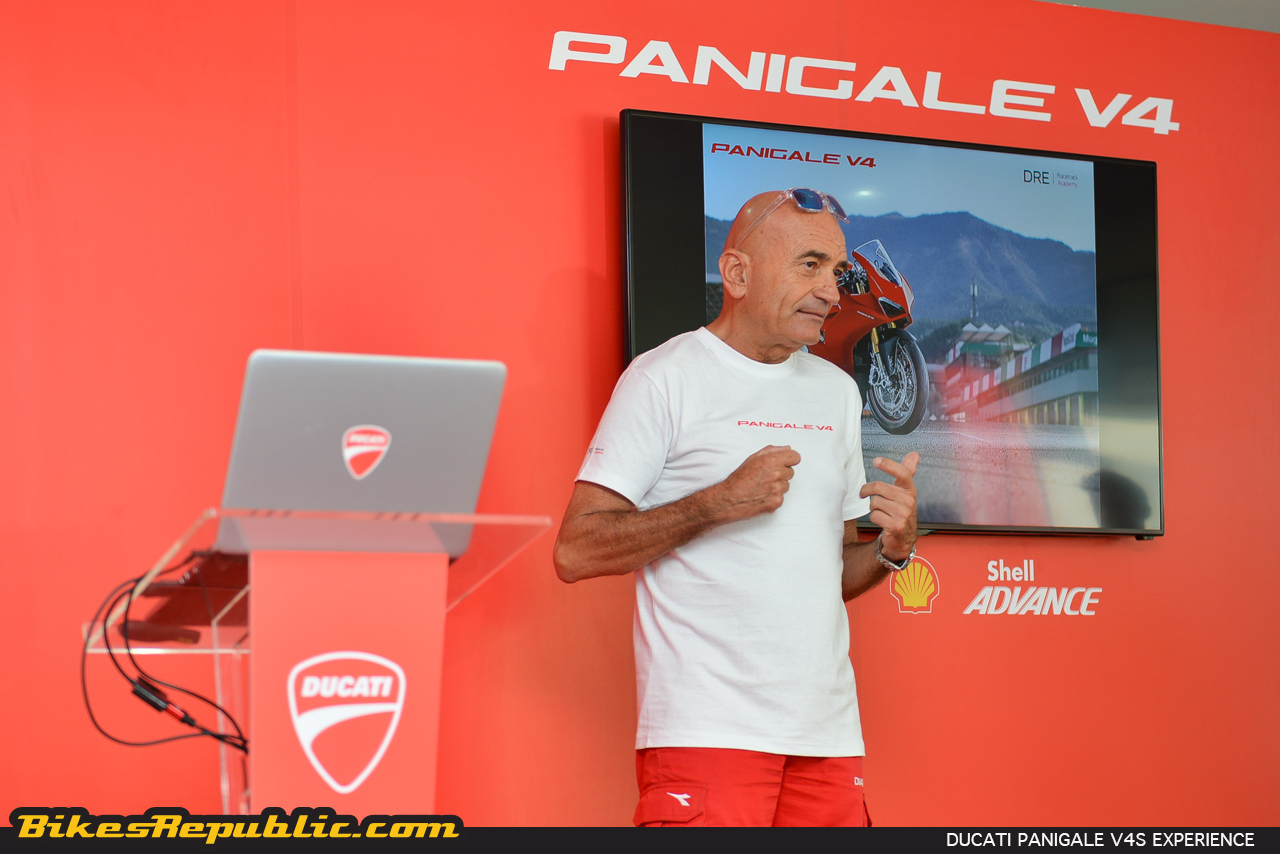
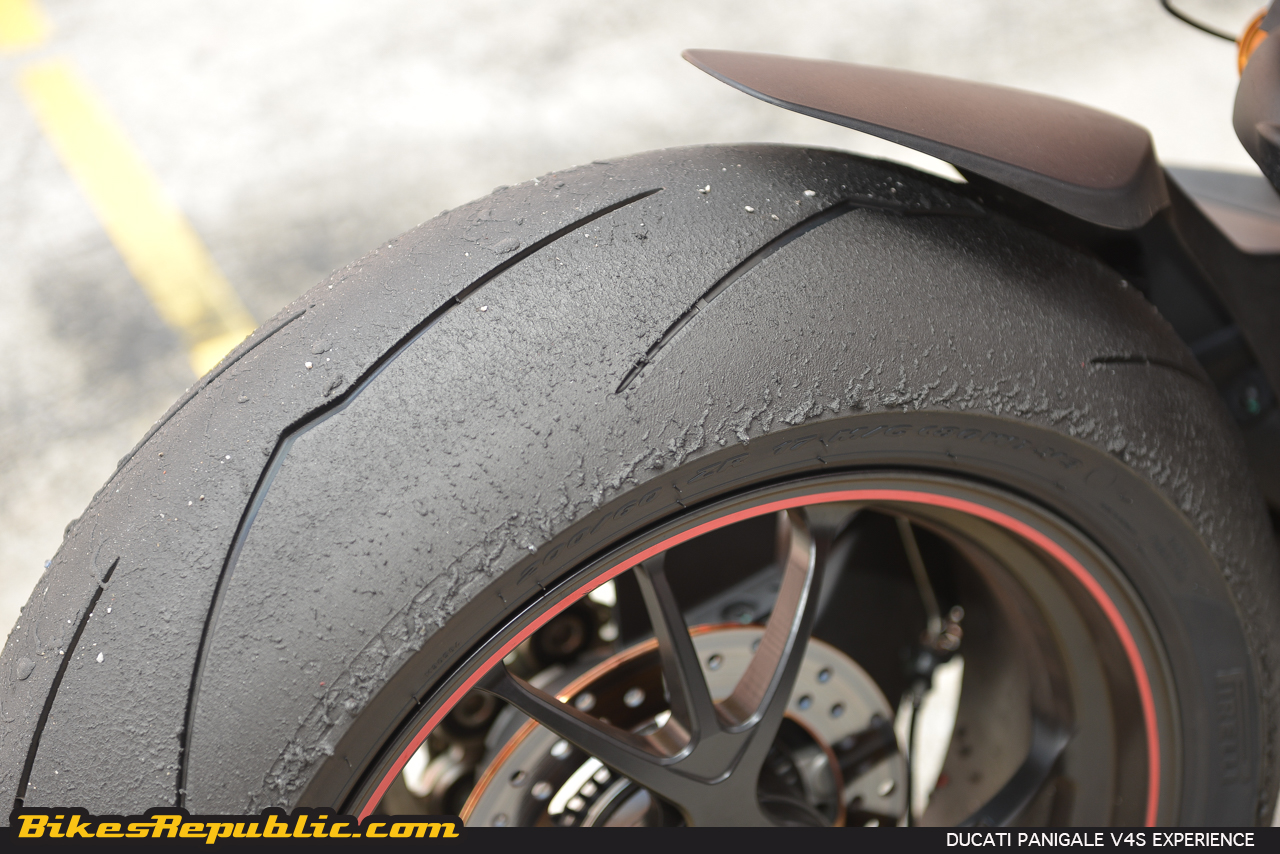
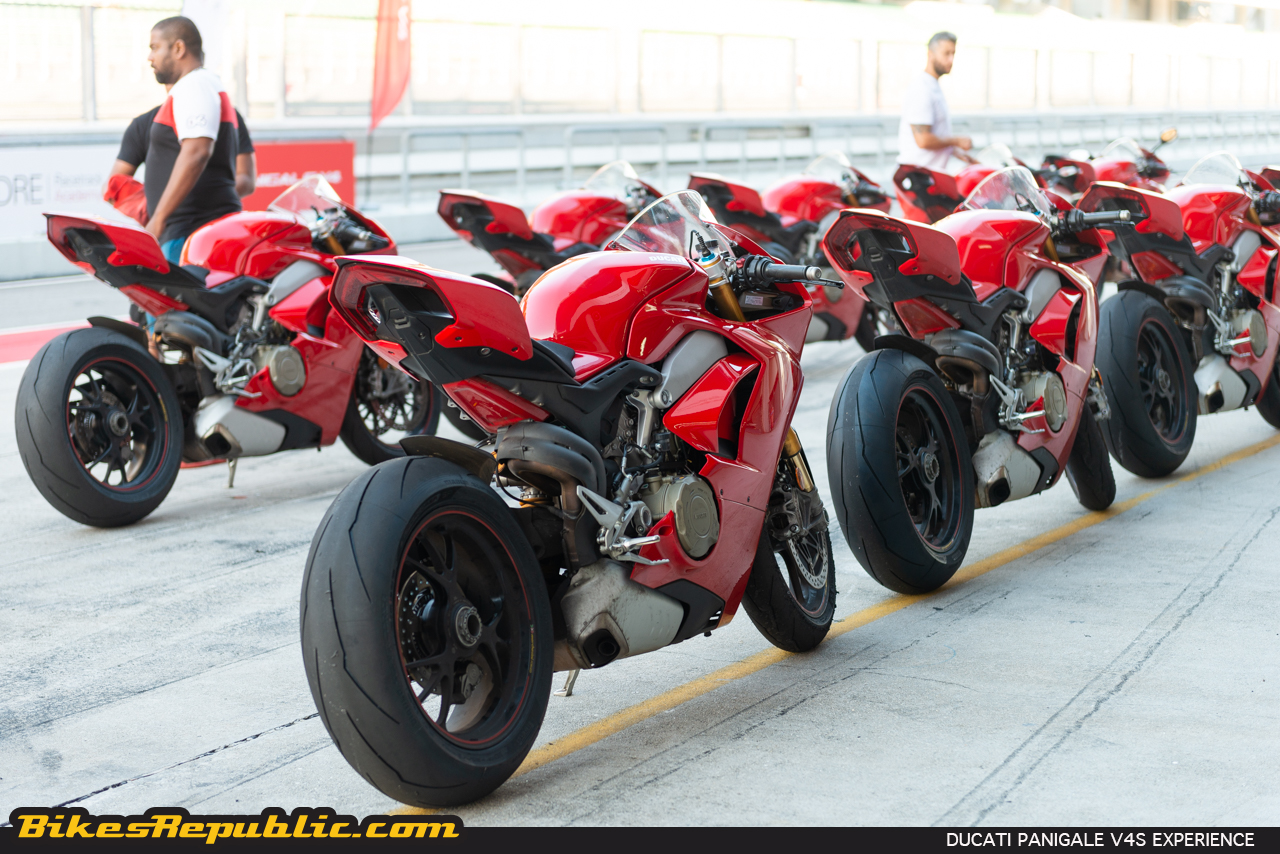
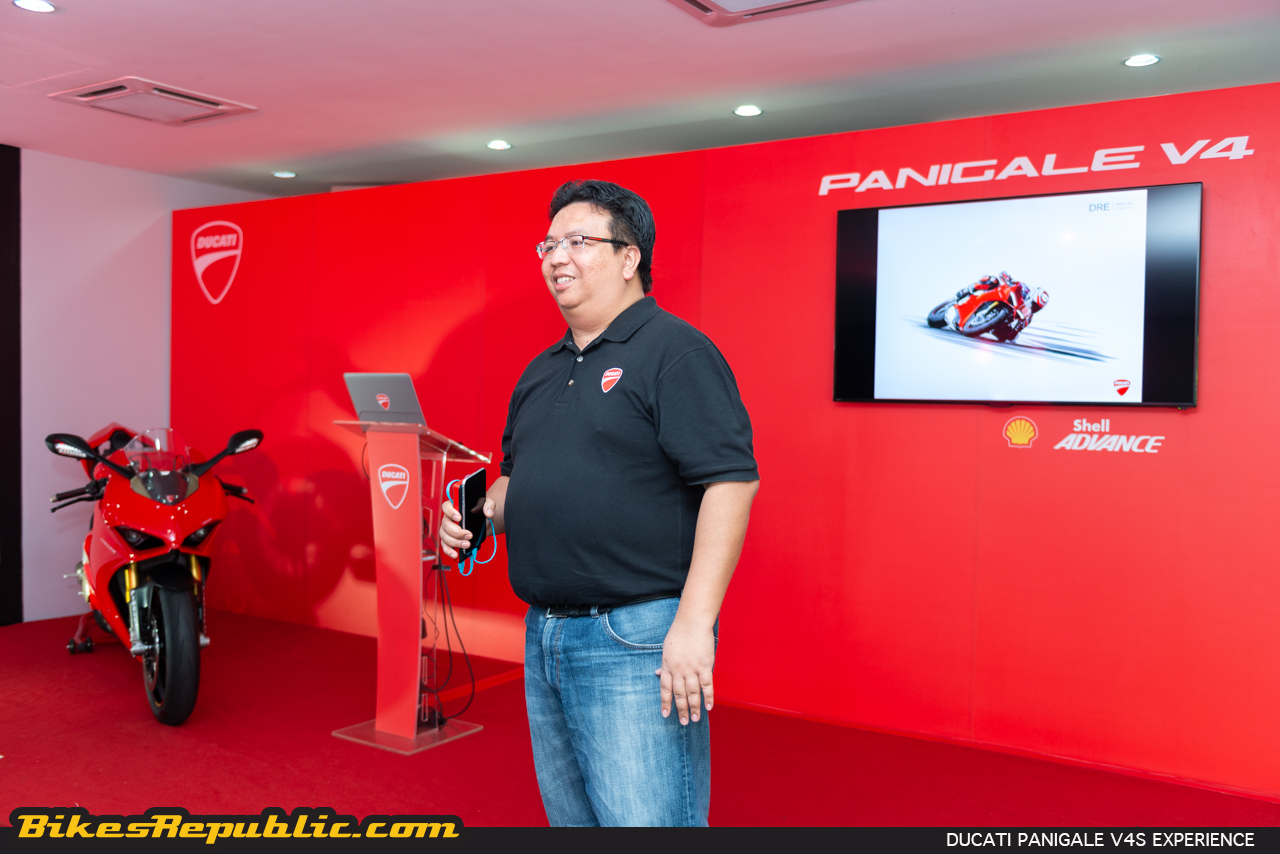
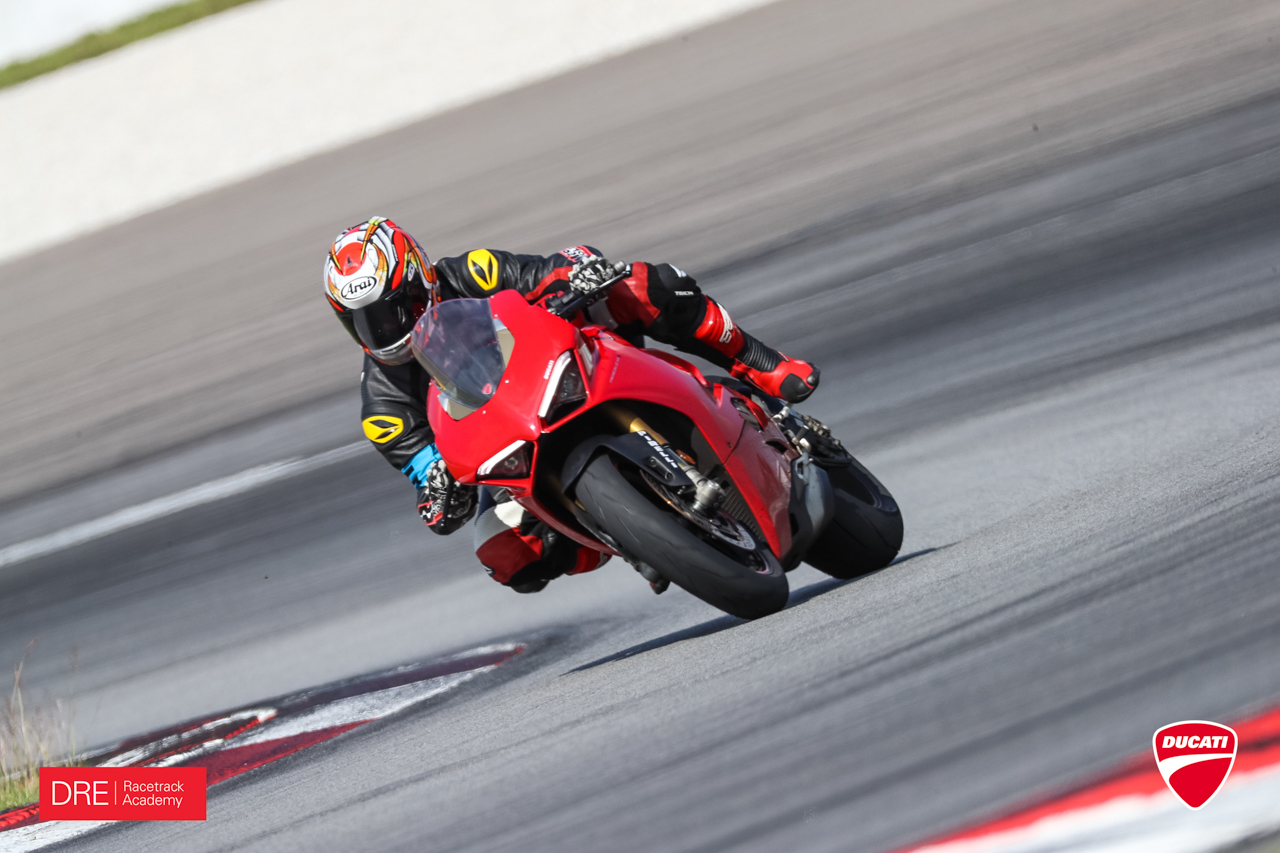
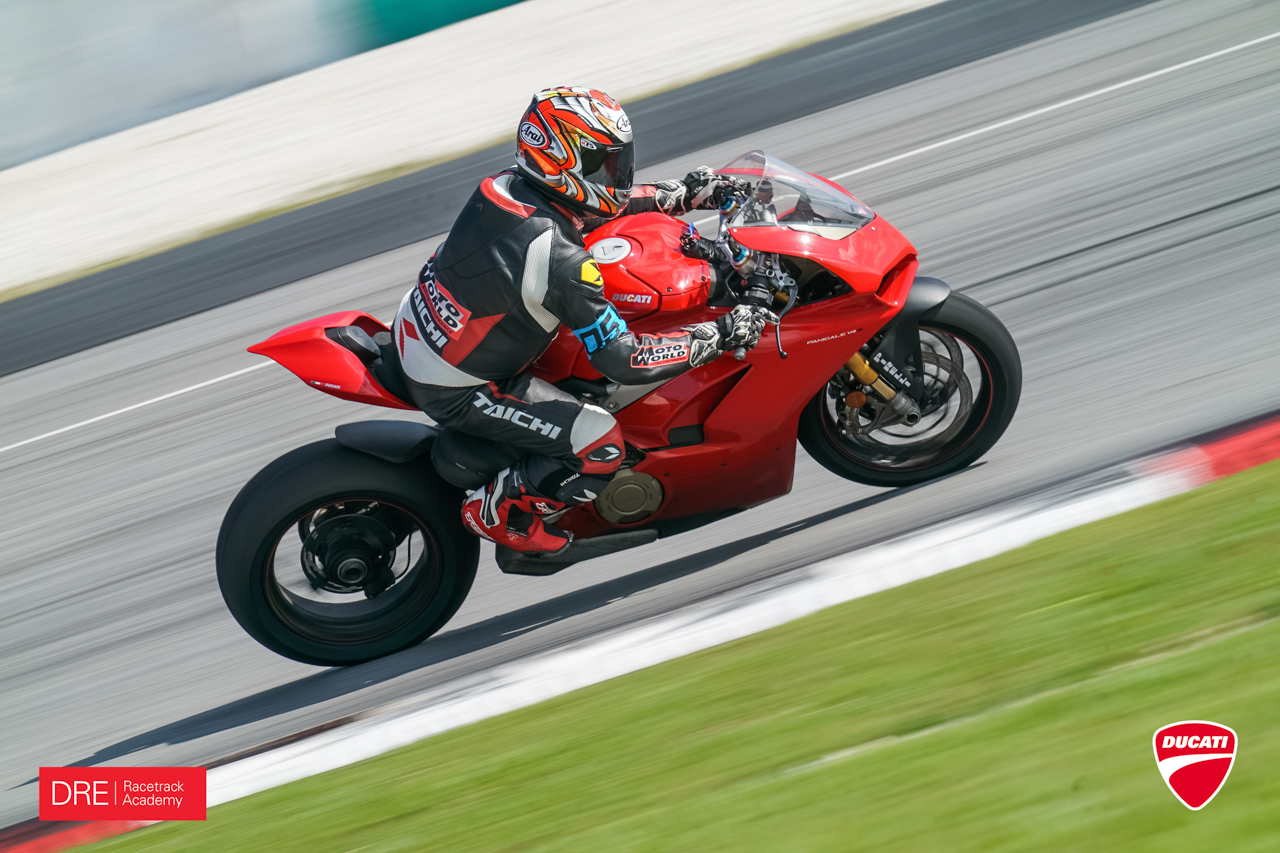
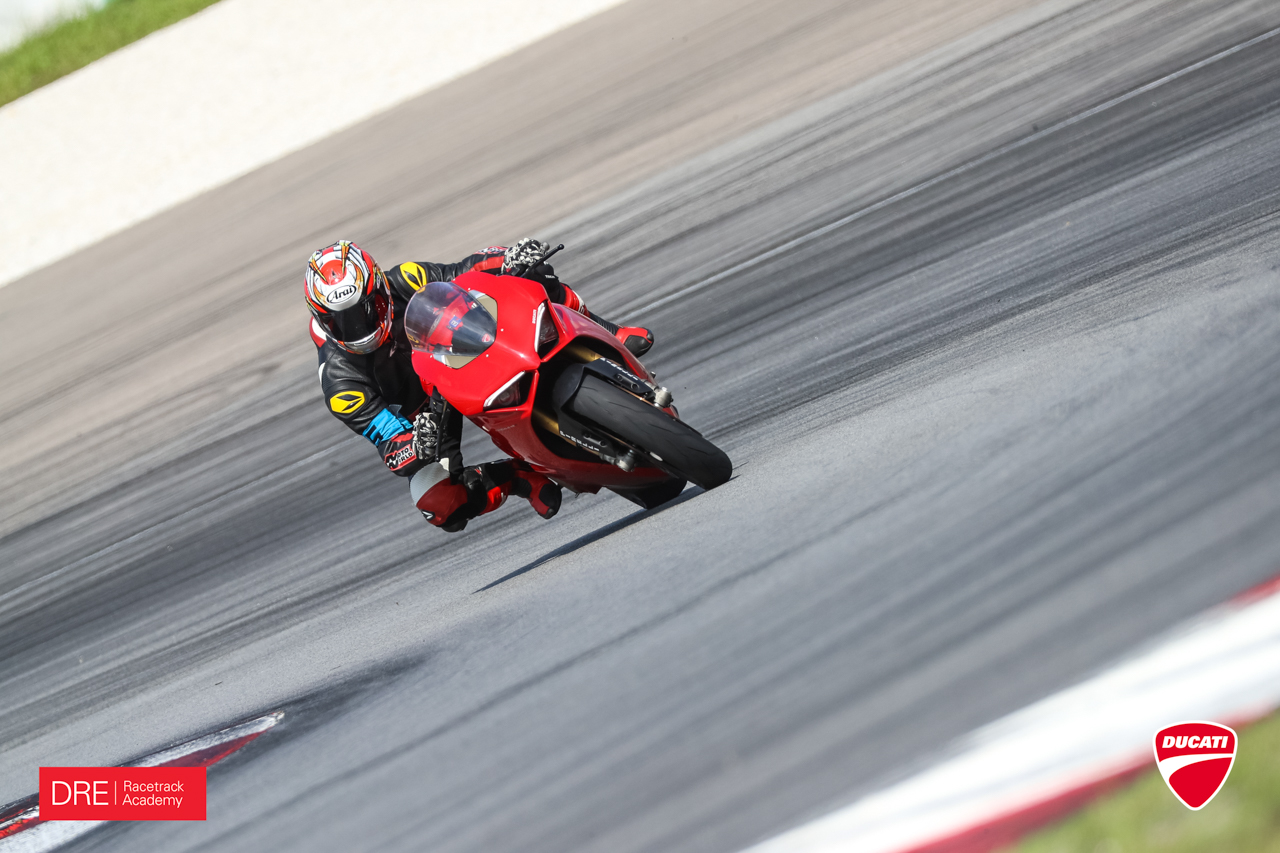
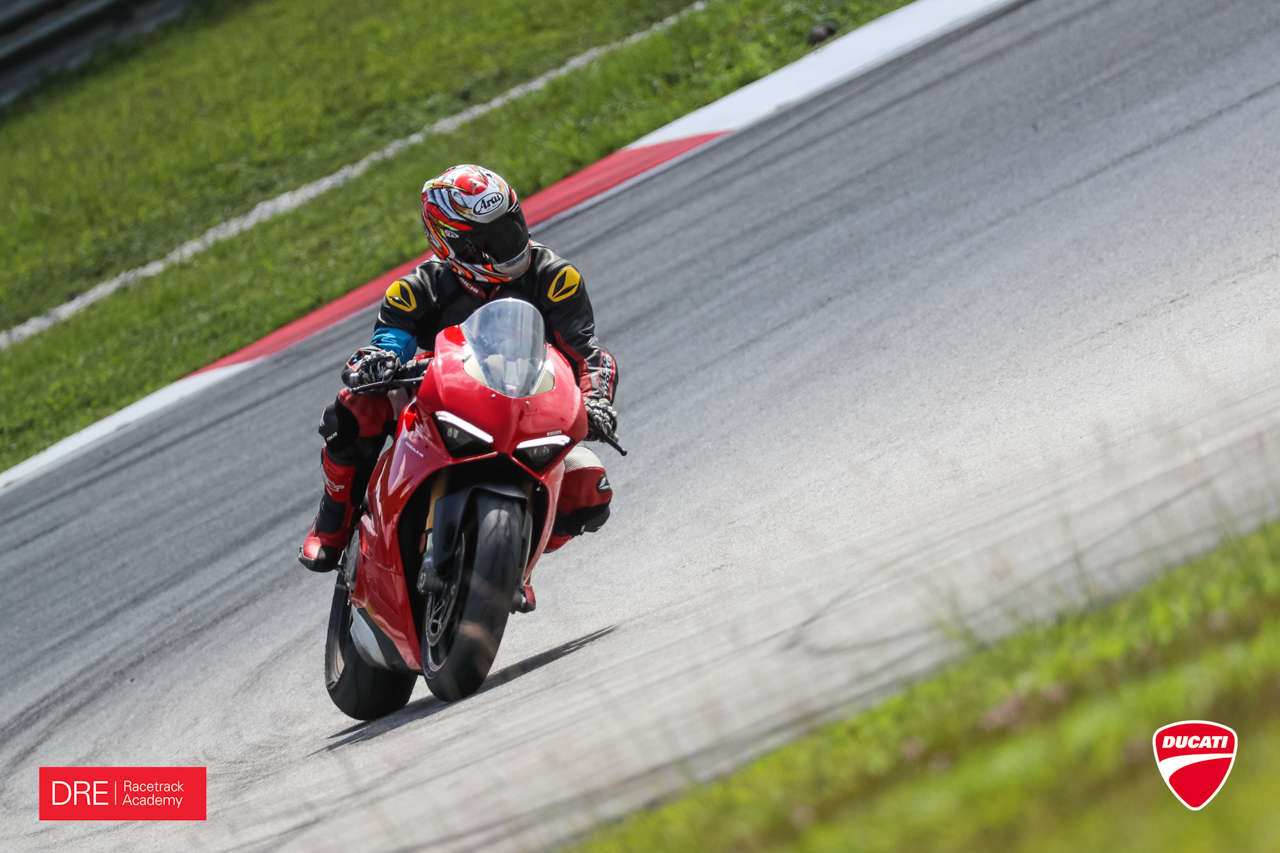
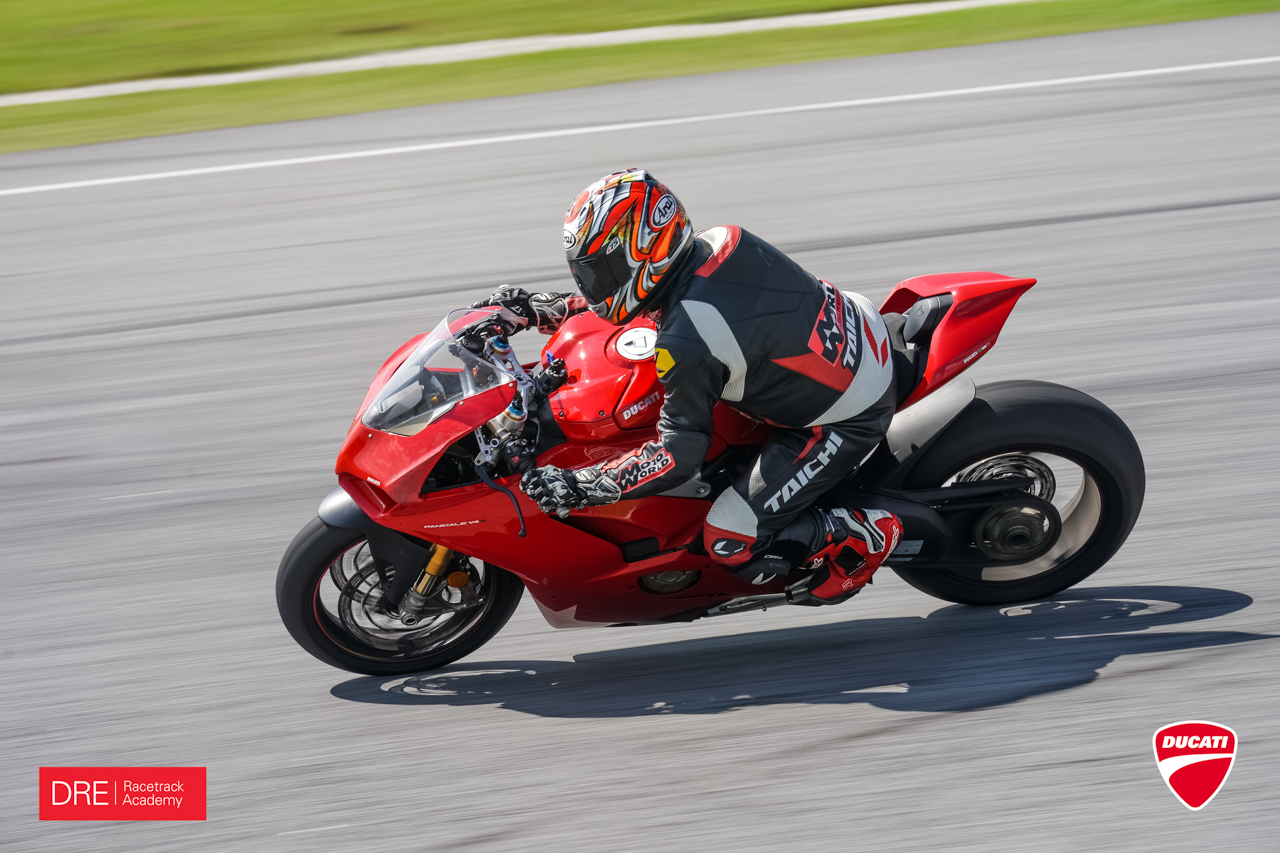
We tested the Panigale V4S during the Ducati Racing Experience (DRE) at SIC.
Standing before the Ducati Panigale V4S in the Sepang Circuit pitlane, am having trouble inserting my earplugs. It had seemed like my ear holes constricted in the last 30 seconds.
I looked at my hands. They were quivering, while the blood red Ducati seemed to squint and taunt, “Ride me if you dare.”
It’s probably a well-known fact to the extent of being passé now. The Ducati Panigale V4 is the Borgo Panigale-based manufacturer’s weapon for reclaiming the coveted Superbike World Championship title.
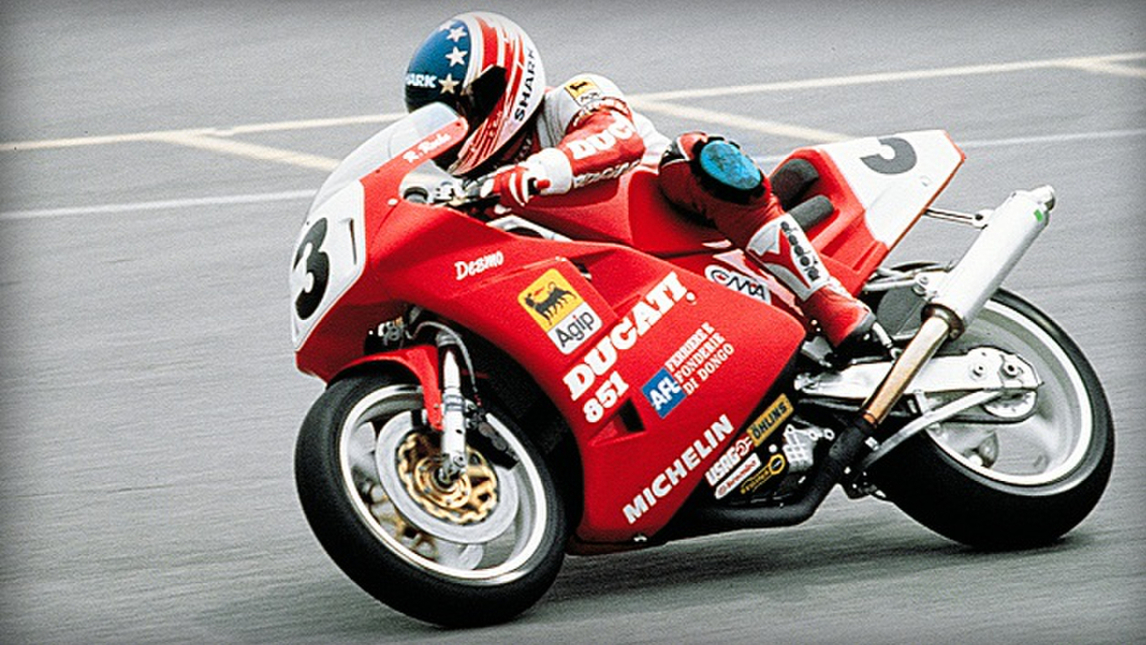
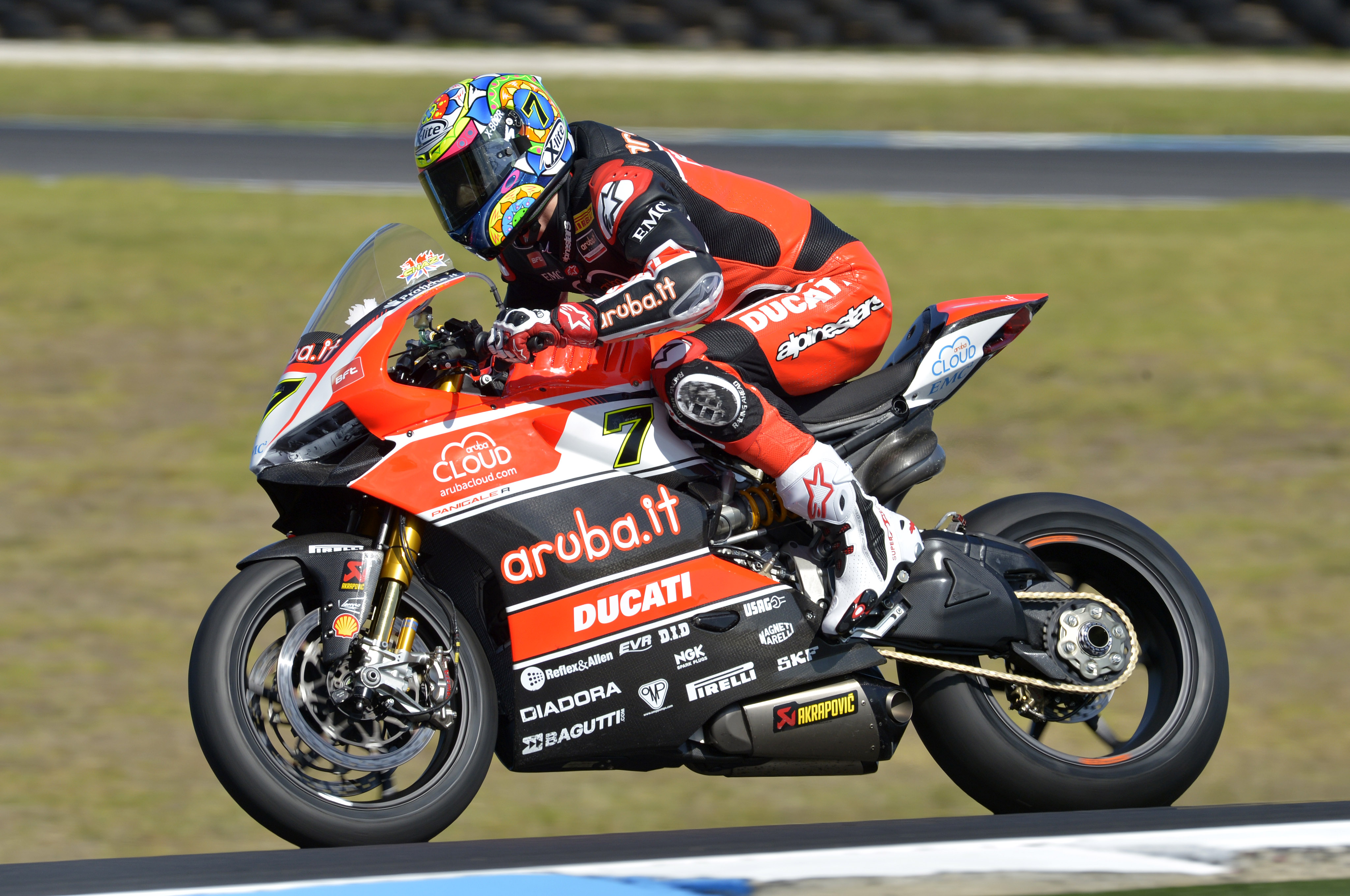
Ducati had dominated the production-based championship with the V-Twin engine. Beginning with Raymond Roche’s first title win on the 851 in 1990 and the last by Carlos Checa on the 1098R in 2011, Ducati won 14 rider and 17 manufacturer titles during those 24 years.
However, rule changes in the series had swung the favour back towards 4-cylinder motorcycles. Current Ducati riders kept finding themselves outgunned on many occasions and had resorted to over-committing to compensate for the lack of power.
Well, Ducati isn’t one to sit still while allowing their supremacy being stomped on.
In terms of out-and-out power production for a specific capacity, the V-Twin had reached the end of its development path. Ducati had probably tried all the possible solutions in wringing the last bit of performance over the years, apart from retaining the engine format as a signature, but there’s just no way to push on something that will not yield.
So, turning to their race winning experience in MotoGP, Ducati decided to go the V-Four route.
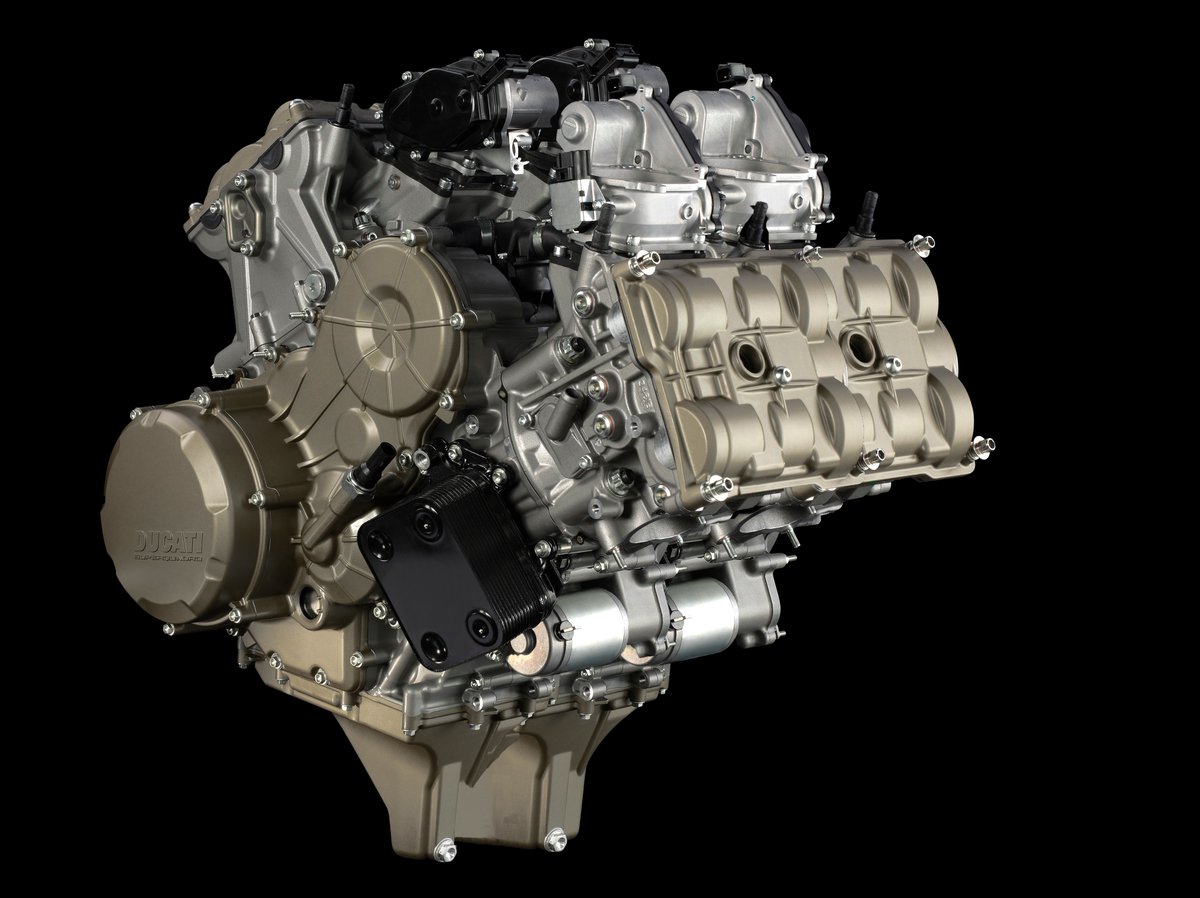
There will be two engines, one for road use and another for racing which will be unveiled later for the 2019 SBK season. The former which we tested here is hence called “Desmosedici Stradale” meaning Desmodromic 16-valves (“sedici” in Italian) Road.
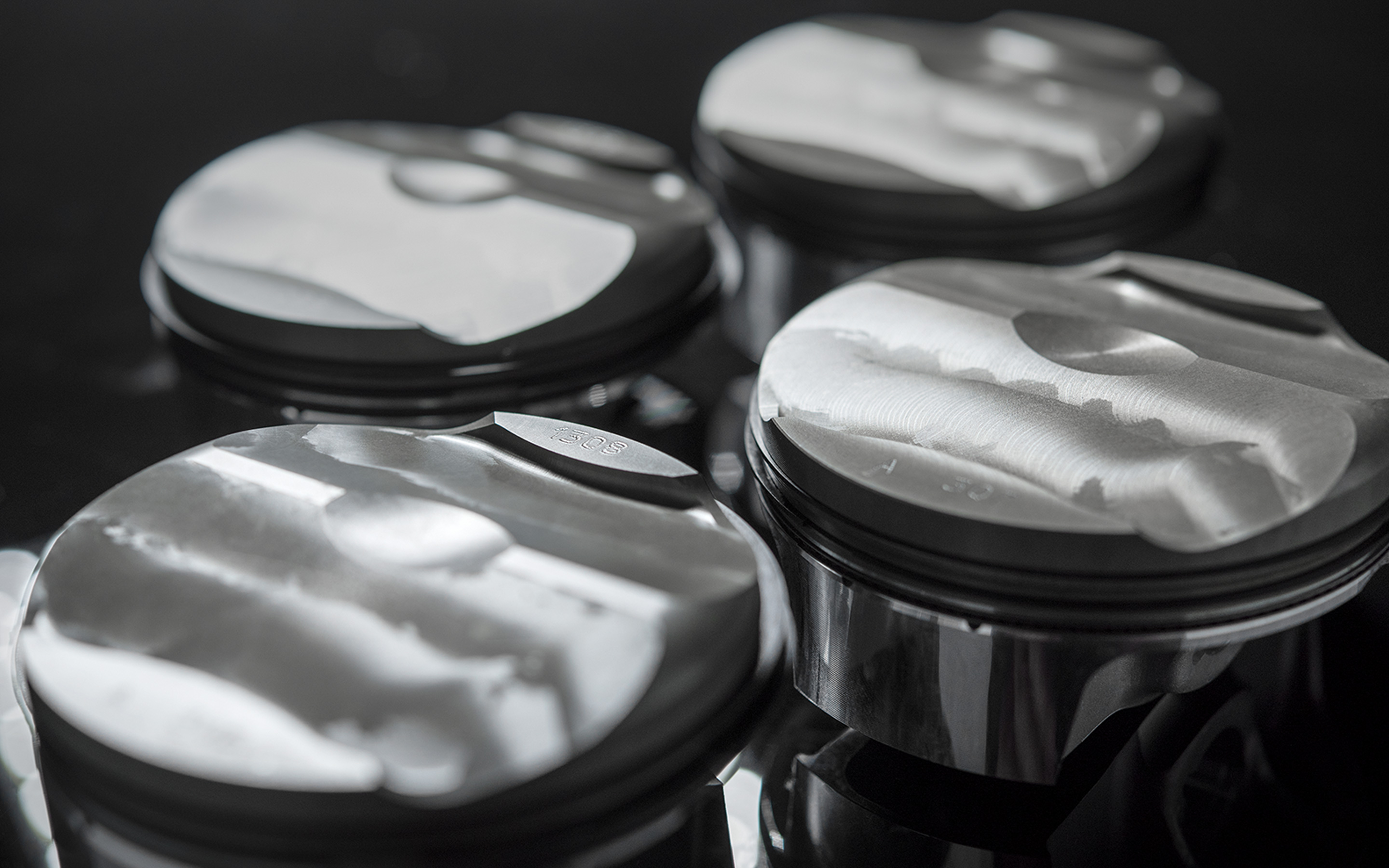
The Desmosedici Stradale displaces 1103cc and produces a whopping 214 bhp @ 13,000 RPM (226 bhp with race kit) and 124 Nm @ 10,000 RPM. That’s a great 3,000 RPM spread between peak torque and horsepower, meaning that the engine has a flexible power curve, instead of being peaky like the 1299 it replaces.
Being a 90o V4 means it has a natural balance it and doesn’t incur power and weight penalties from using balancer shafts. It also makes the engine much more compact, allowing the engineers to place the engine for more optimal weight distribution within the frame.
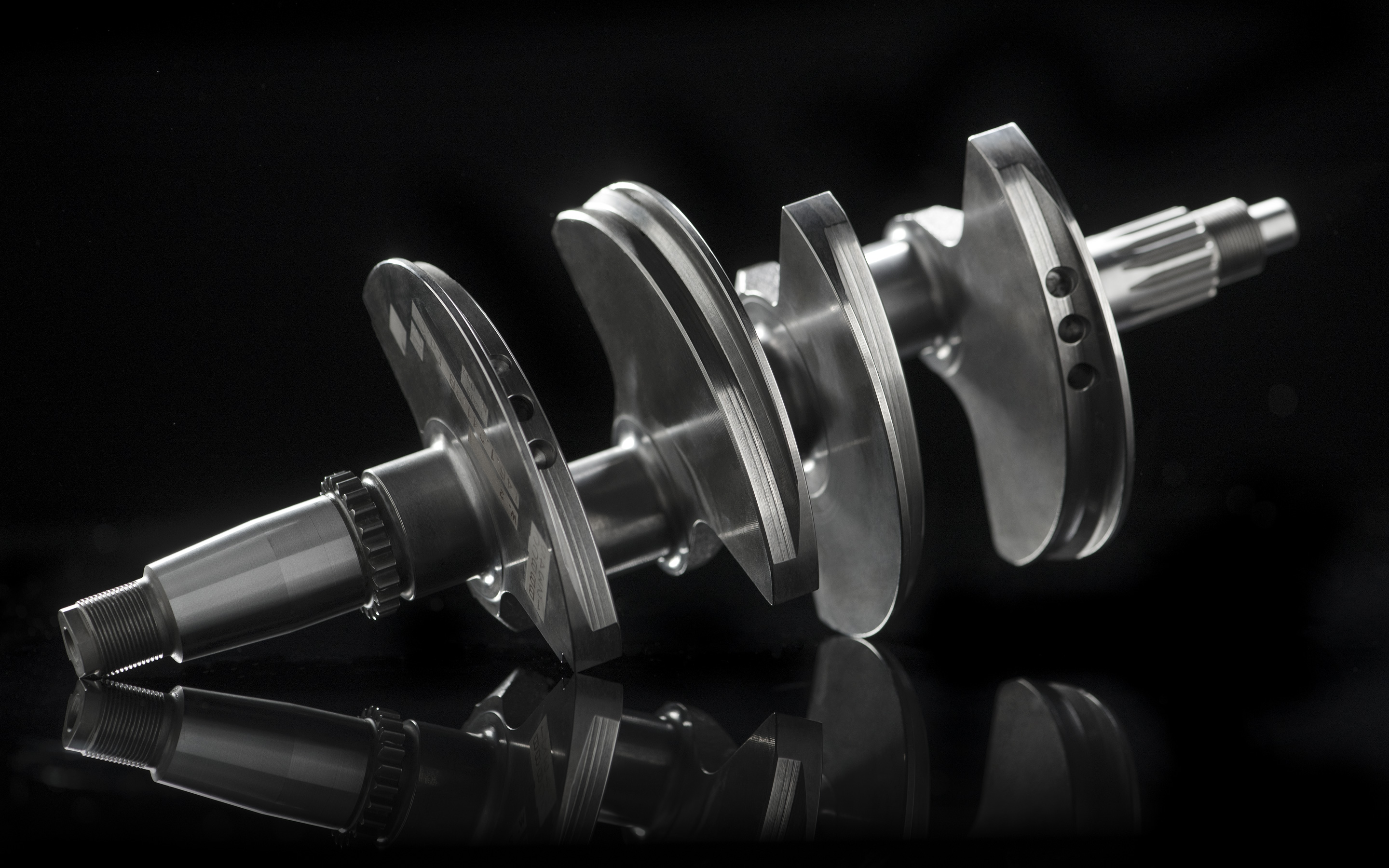
The crankshaft counter-rotates, spinning “backwards,” opposing the rear tyre’s rotation. This is a direct influence from Ducati MotoGP’s bikes. The spinning and reciprocating masses inside and engine create their own inertia and gyroscopic effect, adding to the rear tyre’s. Having a counter-rotating crank hence negates some of these forces, resulting in a bike that is easier to turn and rein in that raw power from inducing wheelies. GP aficionados will tell you that Honda did exactly this on their NSR500 two-stroke GP beast.
Ducati calls the new engine’s firing order “Twin Pulse” as it fires first the left bank of cylinders, then the right, replicating a V-Twin’s. It gives the bike a unique aural and handling character.
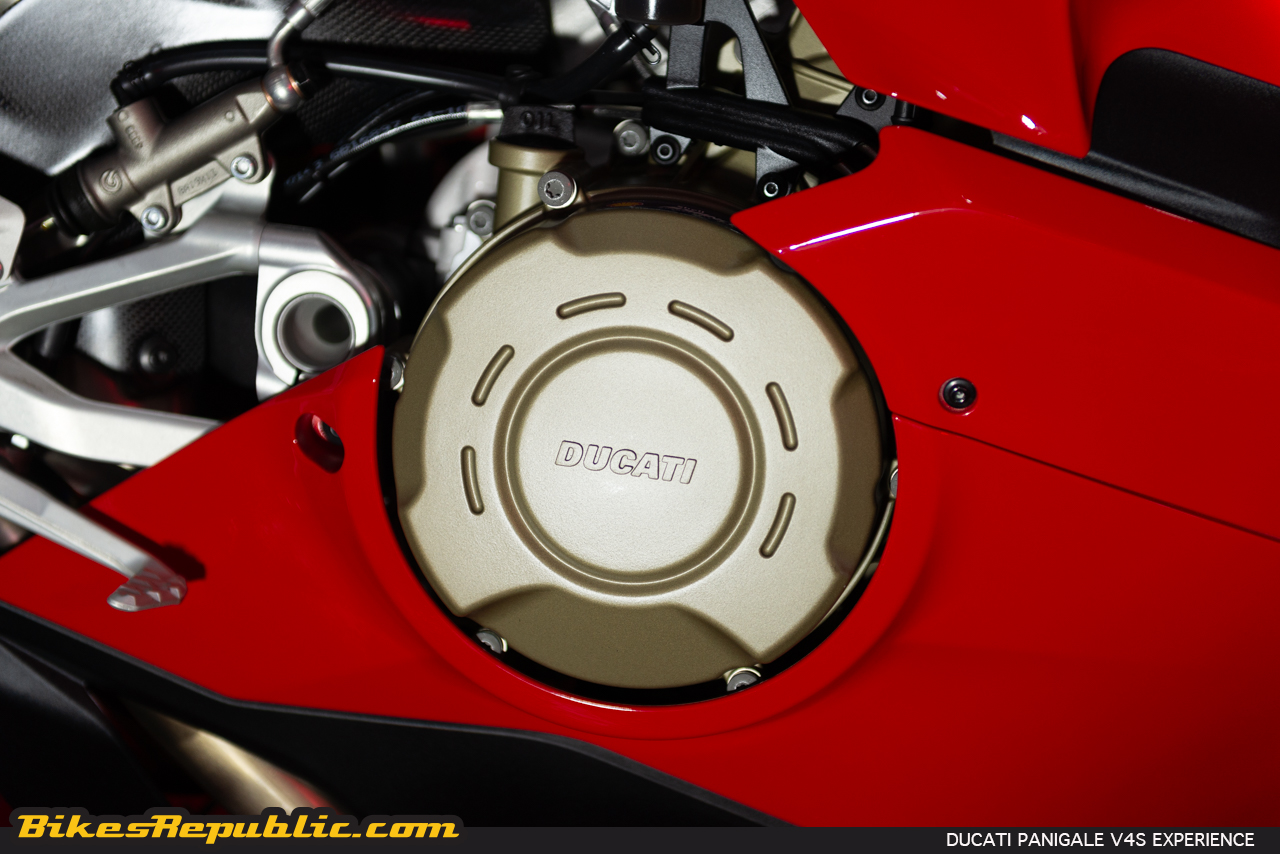
Ducati wanted a compact engine despite gaining two extra cylinders, so they turned to magnesium alloy covers for the cylinder head, clutch, stator and oil sump. They ended up with an engine that’s only 2kg heavier than the V-Twin 1285cc Superquadro.
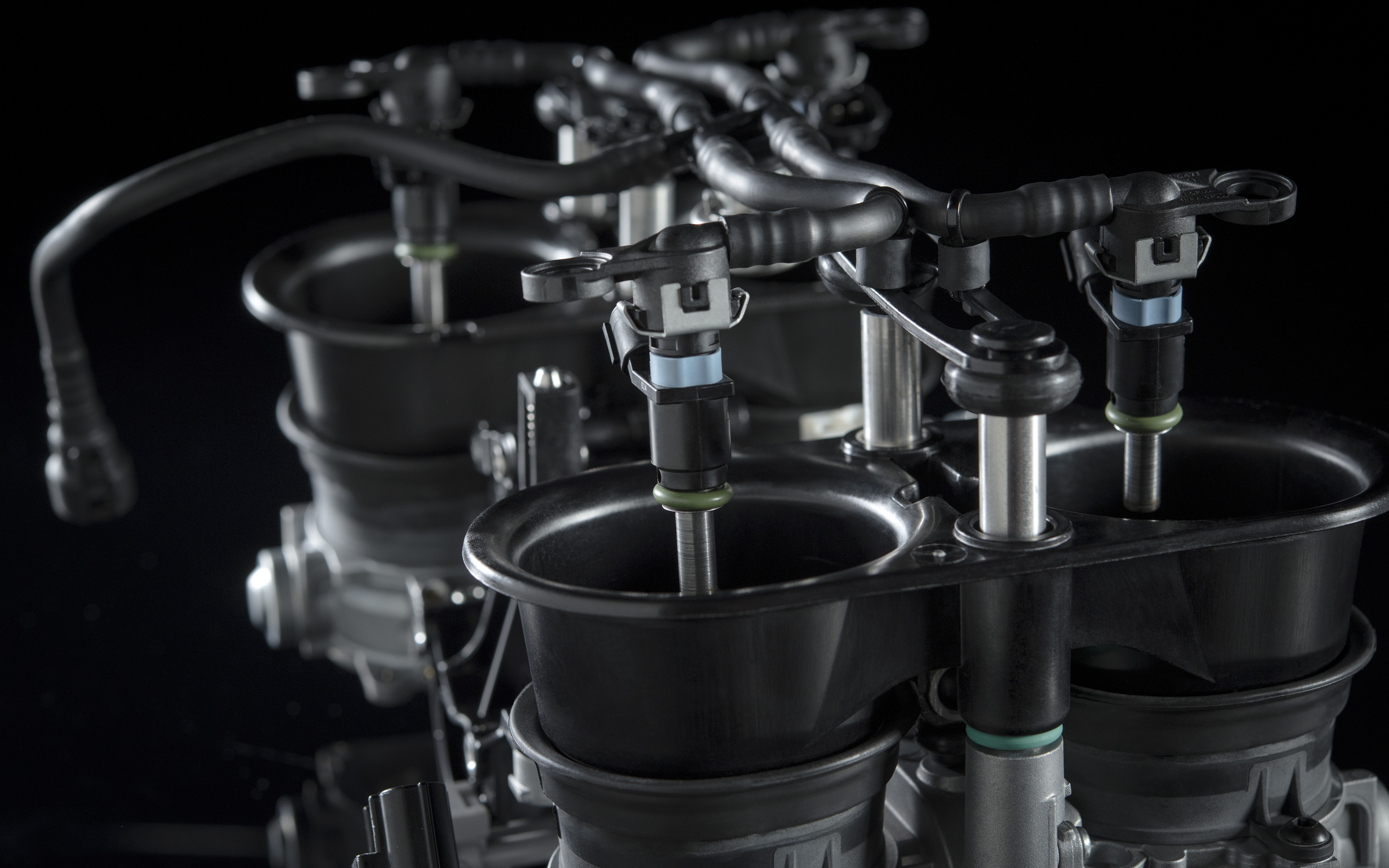
Other features include variable length intake funnels, dual injectors per throttle body and oval throttle bodies.
The chassis department has also received changes, accordingly.
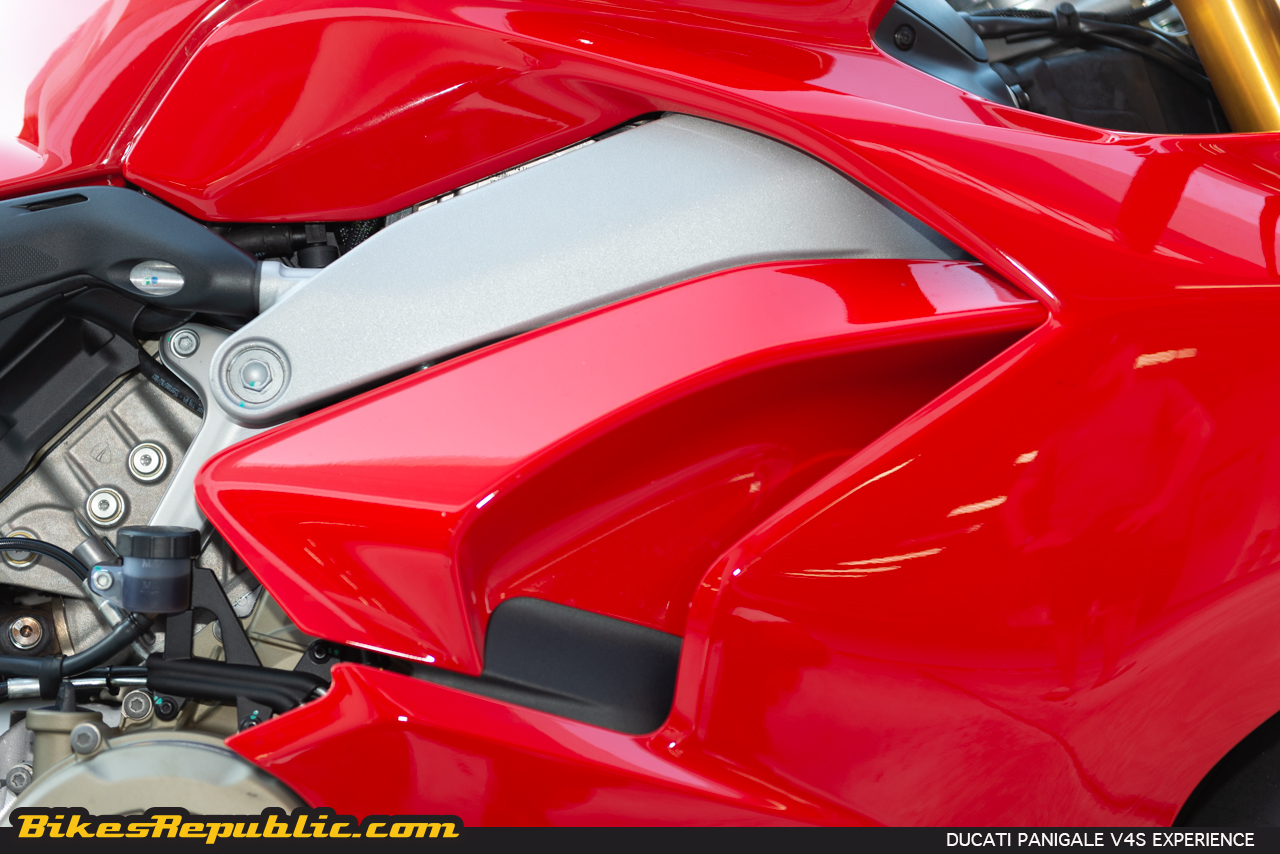
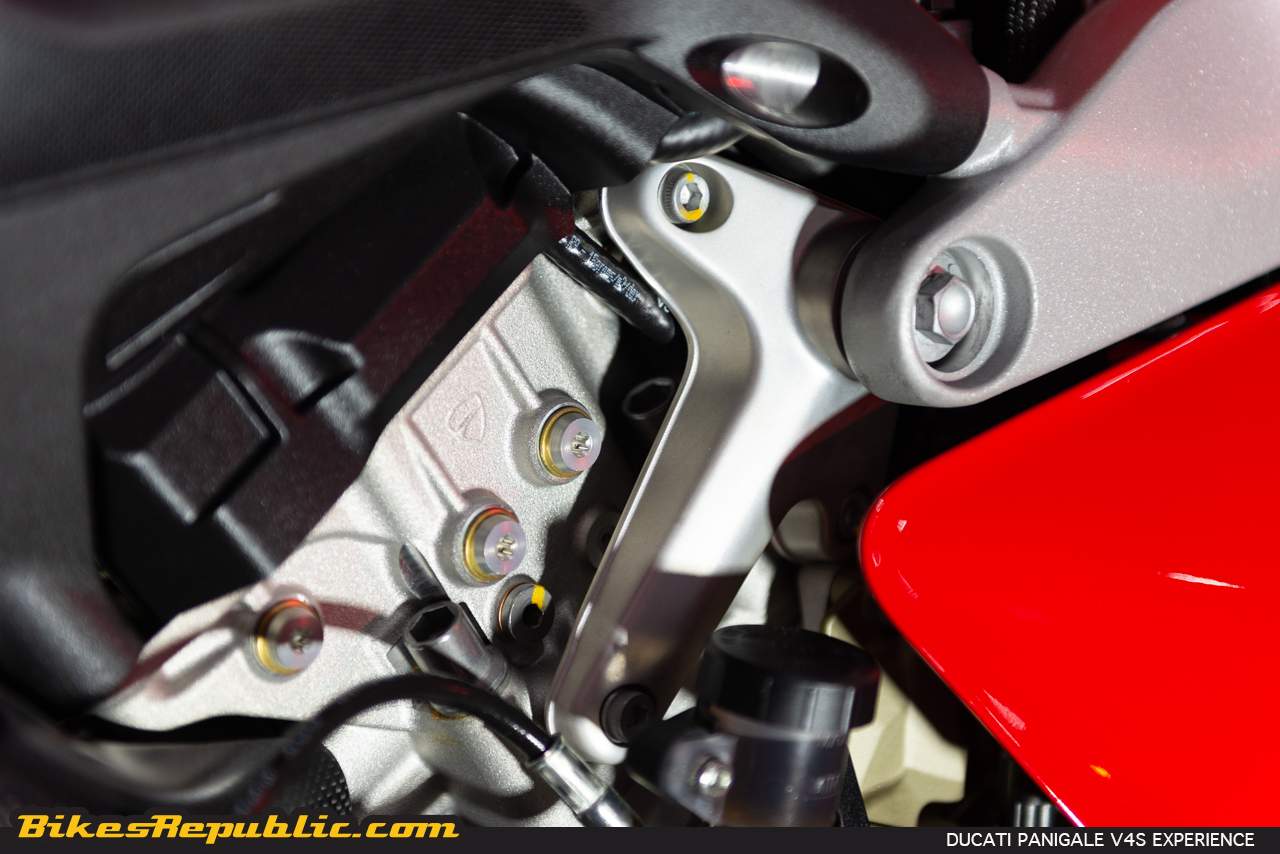
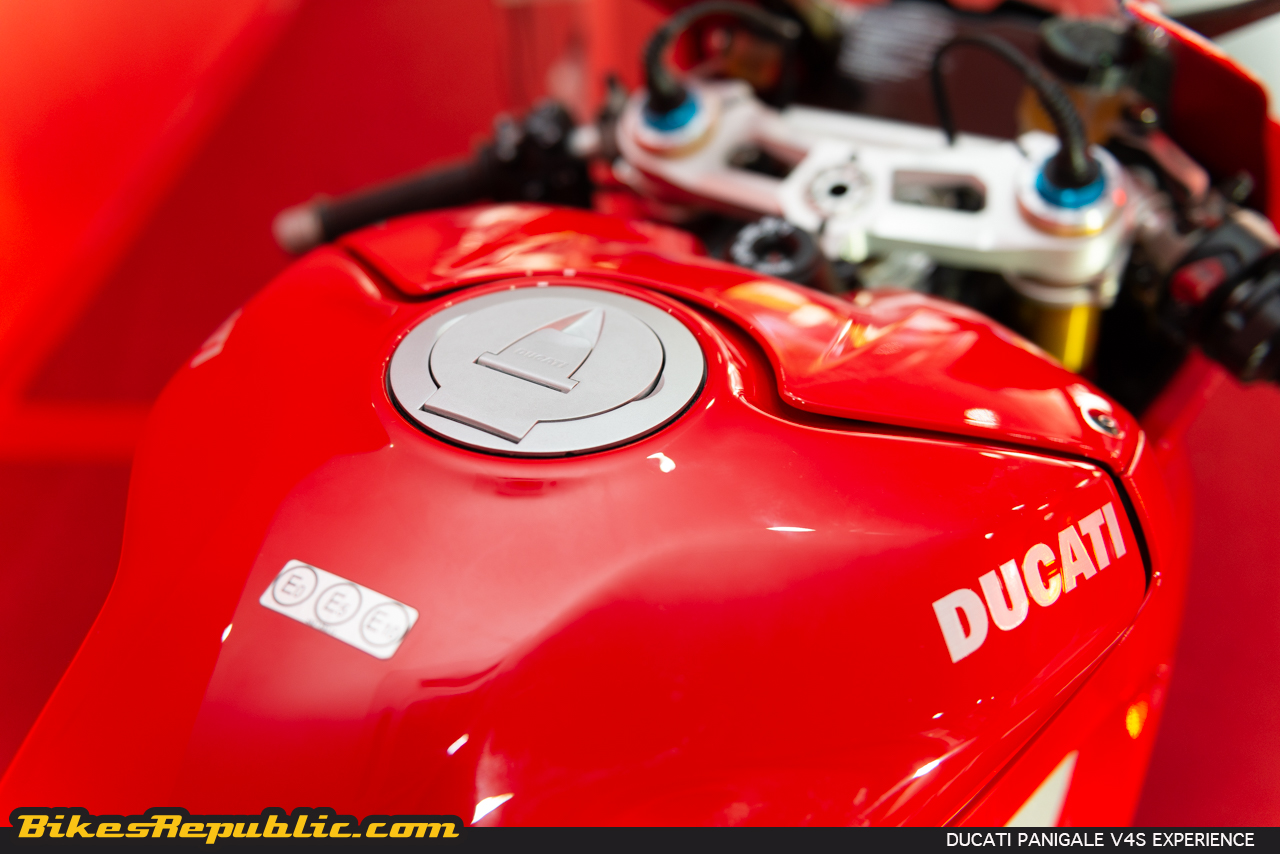
Instead of the monocoque design used by earlier Panigales, there is a now an aluminium “beam frame.” But it only extends a short way from the headstock.
A peek inside sees the engine being rotate upwards (by 42o). As such, the entire engine could be moved further forward, allowing for a longer swingarm. A longer swingarm promotes stability by keeping the front tyre on the road longer, allowing the bike to hug the chosen line even when power is applied.
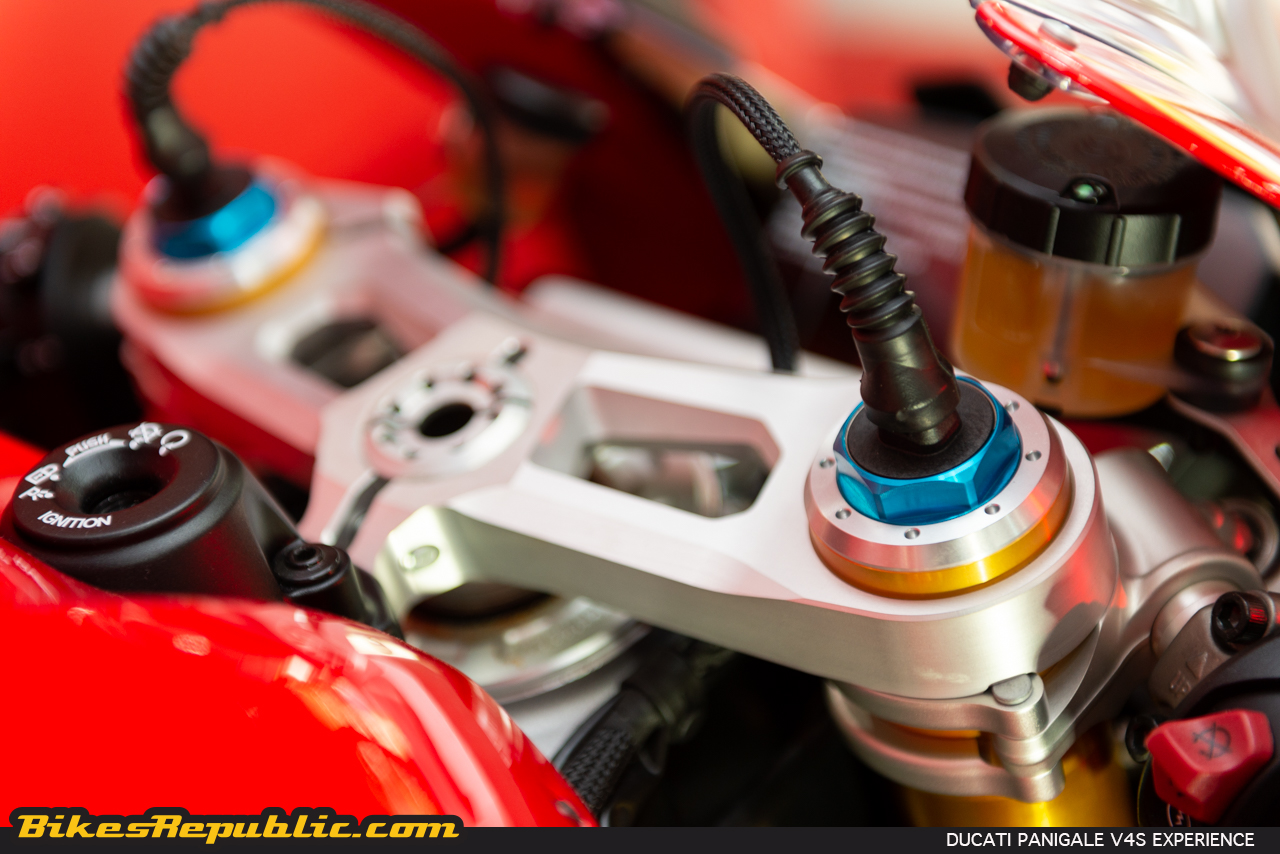
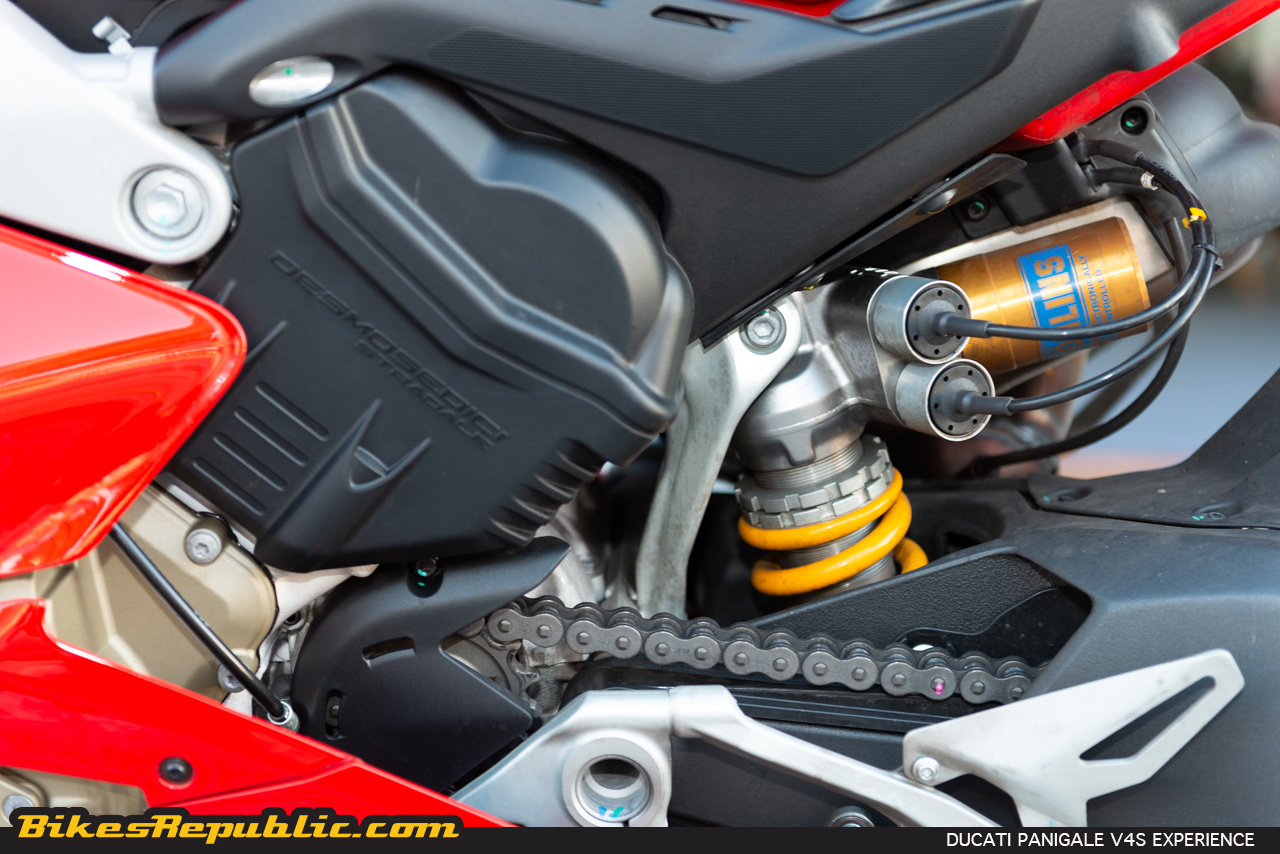
Since this is the “S” version, it uses the electronically-controlled Öhlins suspension front and rear. The system monitors suspension movements and damping up to 100 times per second. Sure, that’s what most electronic suspensions do these days, but here’s the main difference. Instead of just letting the ECU choose the rates based on ride mode, the Panigale V4S’s system lets you work on objectives i.e. what do you want to achieve. For example, you could specify more stability under eye-popping hard braking, plus more stability in mid-corner, less rearward weight transfer under hard acceleration, etc. On a “manual” suspension, on the other hand, you could only tune the suspension for one, maybe two characteristics while the rest are compromises at best.
The rear shock has been moved to the traditional central position, since there’s more space.
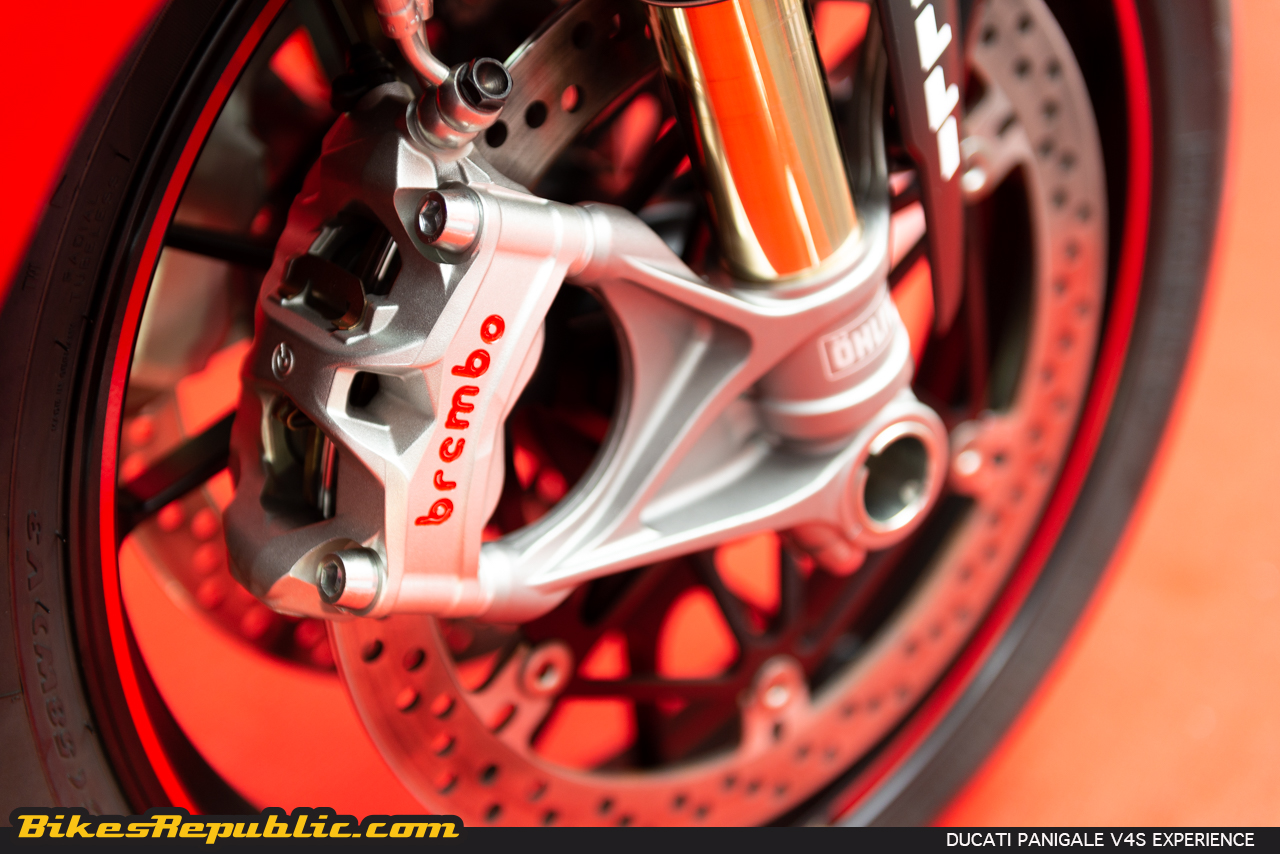
The front brakes use the latest Brembo Stylema monobloc calipers that are 70g lighter per caliper, yet more rigid. They grip massive 330mm discs.
Enough. Enough of tech talk (yaaawwwnn), let’s ride.
I took a long hard breath to calm my nerves and stuck the earplugs in, at last. Riding a sub-200 bhp superbike is already crazy enough, this one is above 200 bhp.
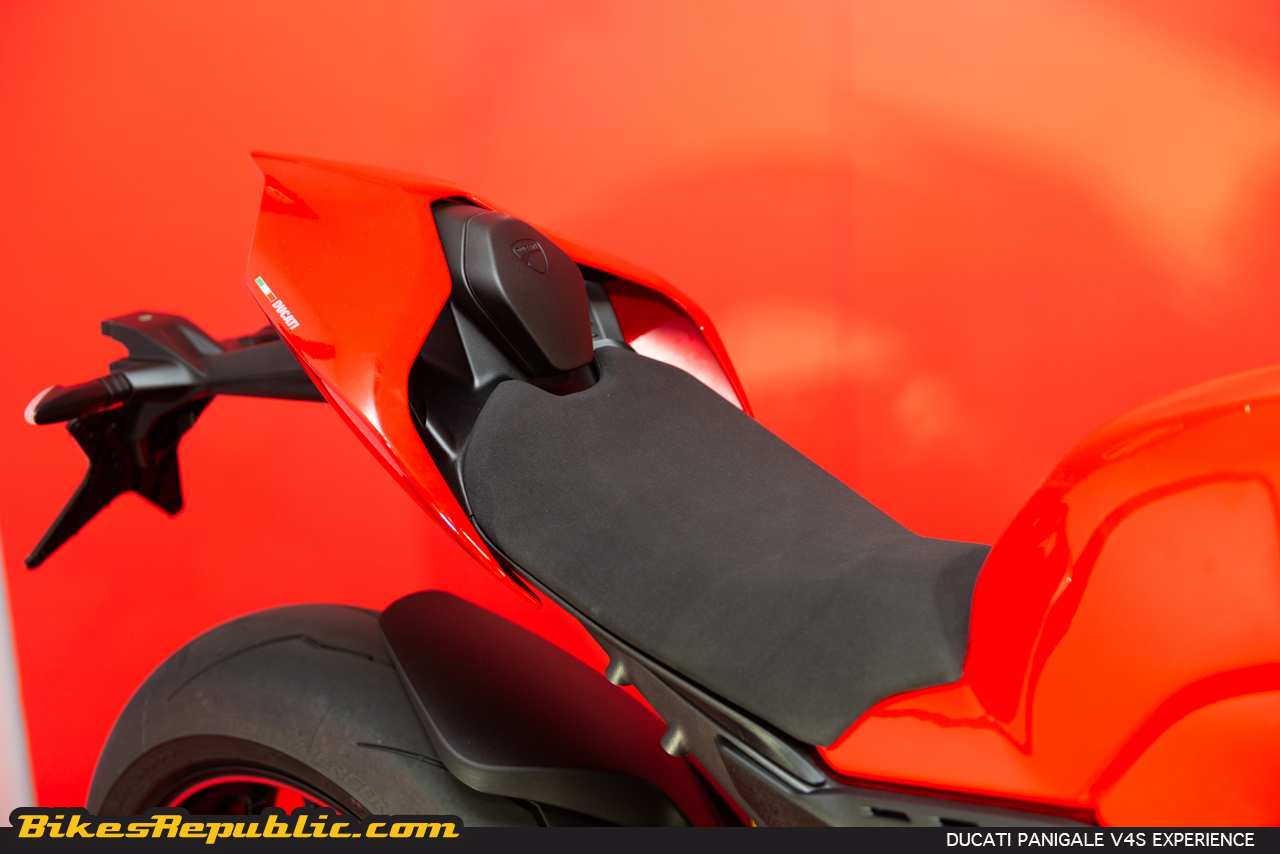
Sitting position is bang-on Panigale, so you won’t feel out-of-place if you switched over from the V-Twin. The seat was much suppler, however.
The V4 fired up and sounded… wait, have DRE put me on the wrong bike? Why did it sound like a Twin? I looked down and my gaze met a massive aluminium structure below the top triple clamp. Owh, it was the V4. When Ducati said the engine fires like a V-Twin times 2, they weren’t joking. The ride mode was set to “SPORT.”
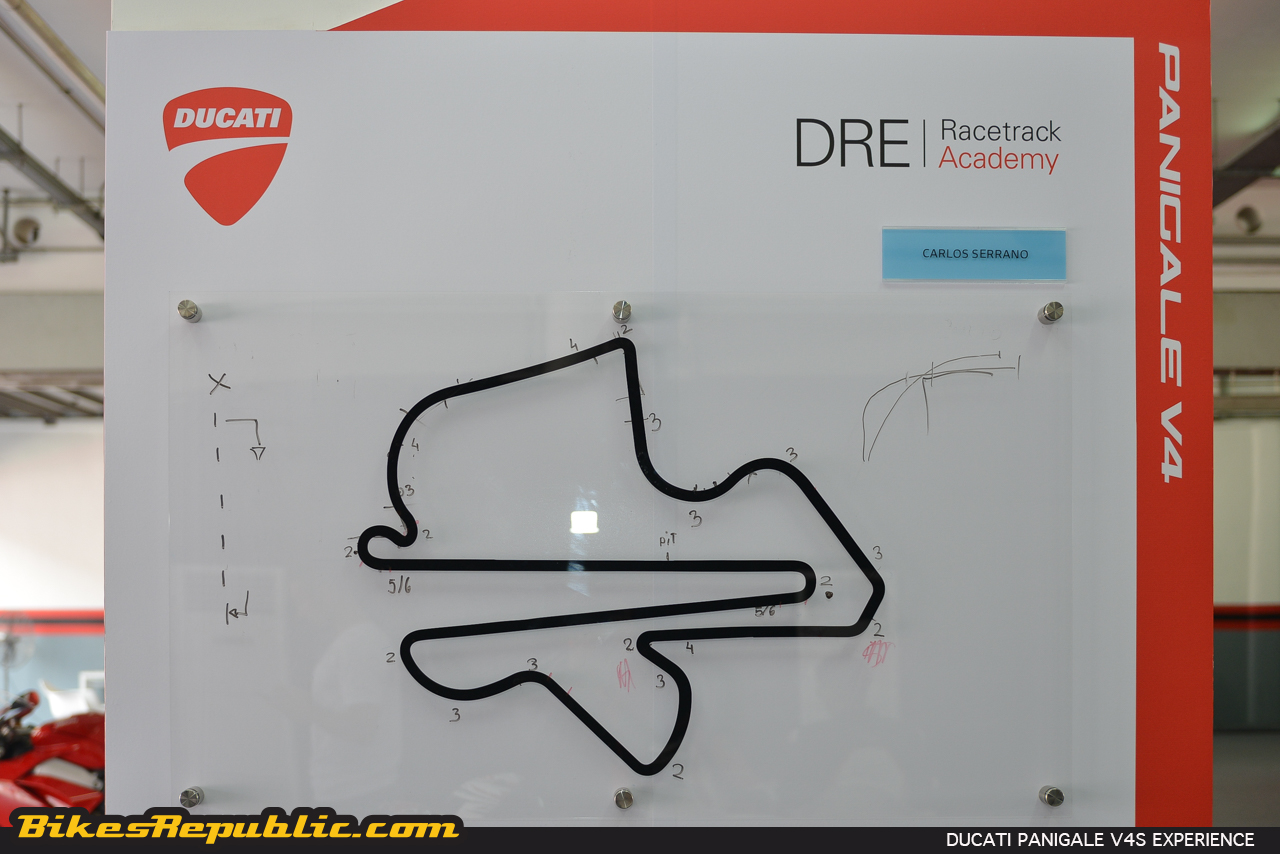
My group’s Ducati Racing Experience (DRE) instructor, one uproarious Spanish racer named Carlos Serrano flashed a thumb’s up and we were underway.
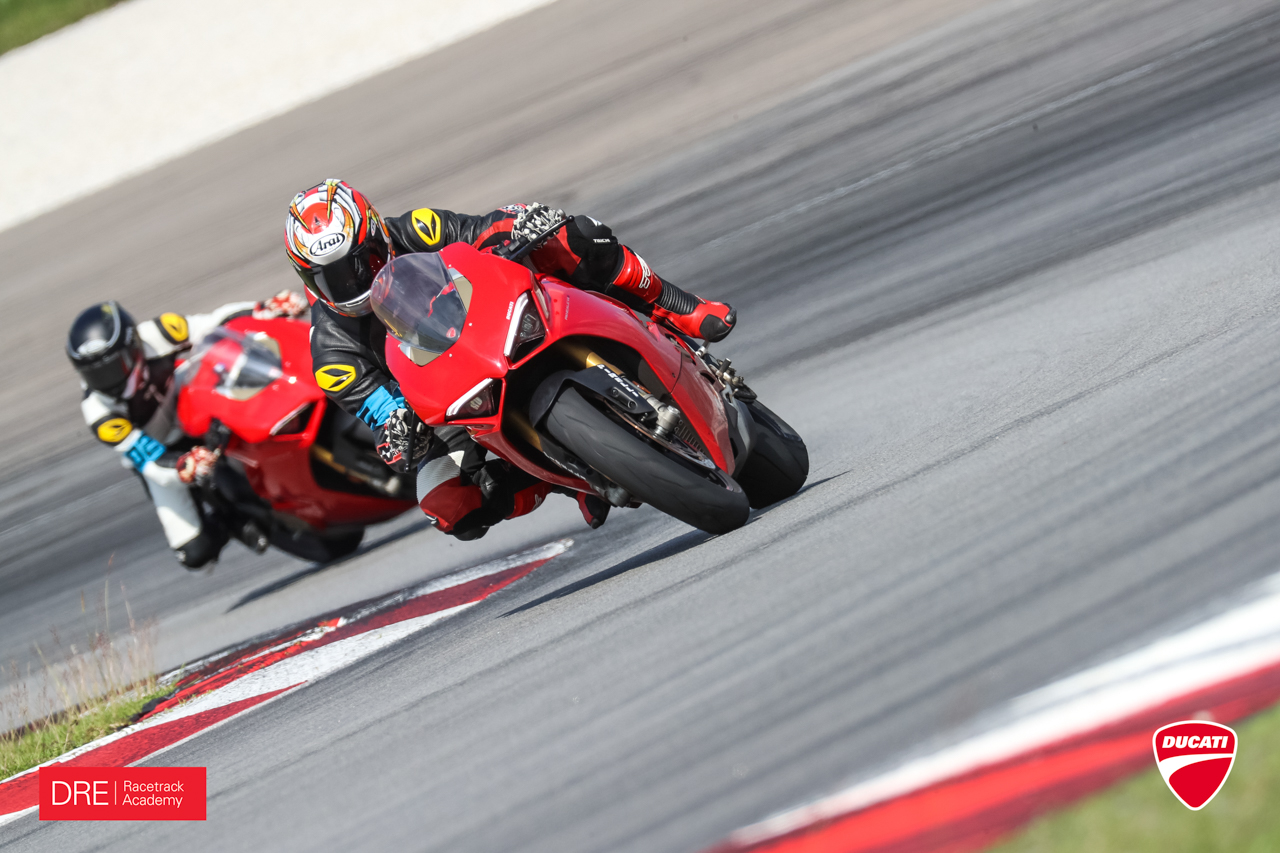
The bike pulled hard but err… smoothly from the pit exit and we leaned into Turn One without touching the brakes. Turn Two had always scared me due to the bumps at the braking point/entry and the blind apex, so I approached it with some trepidation, but the Panigale V4S ran over those bumps and holes like a sport-tourer. What the…? I had expected to be bumped around the seat and my arms punched into the shoulder sockets.
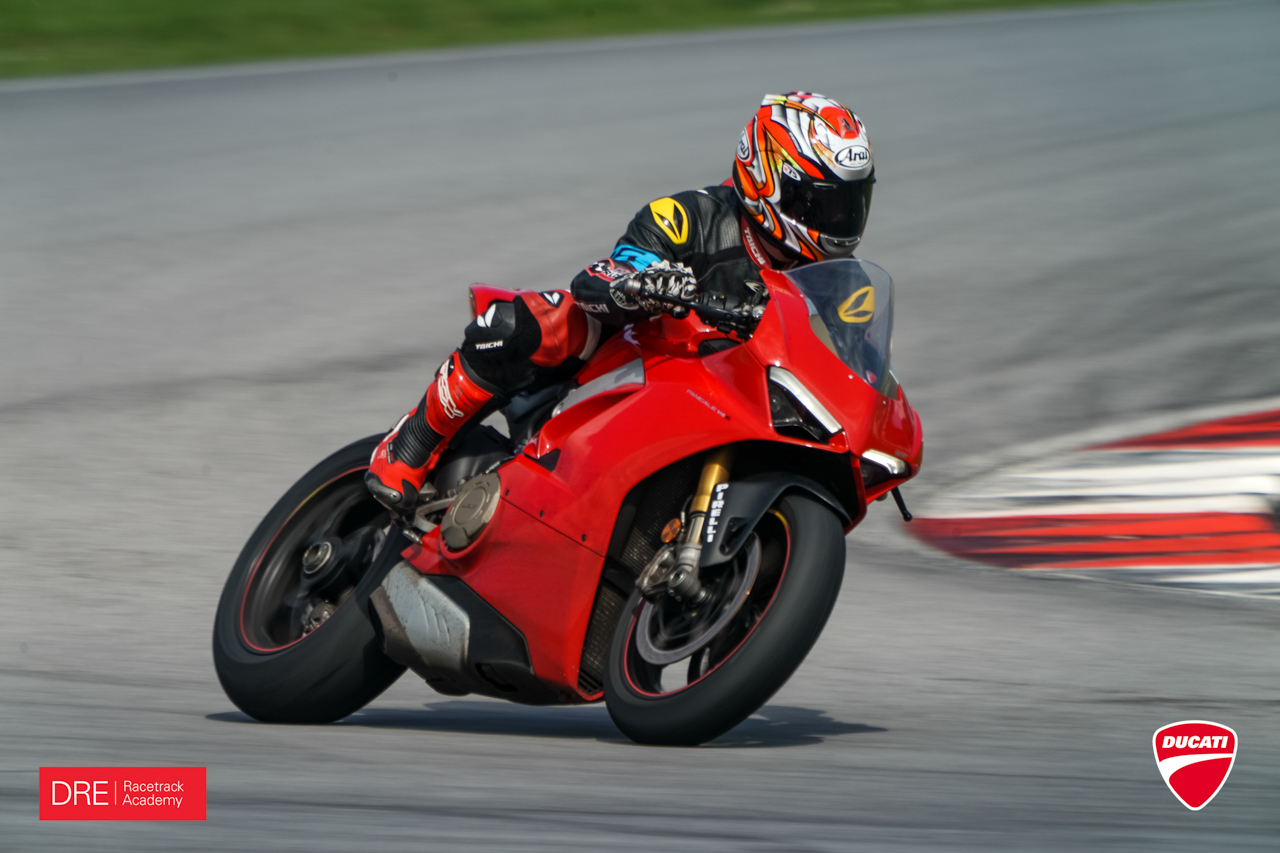
Through the faster turns, i.e. 3, 5, 7, 8, 10, 12, and 13, I had already gone faster than I even did before, but it was as if those were just straights with the bike leaned over. I fed in power smoothly as on other bikes but the bike actually yawned!
There were still a few wet patches hugging the inner parts of the turns but the bike flew over them as if they weren’t there.
Down into hard braking areas such as Turns 1, 4, 9, and 15, a single-finger pull on the brake lever was enough to haul the bike down from insane speeds. I found myself constantly over-braking and too early in the first session.
And did I mention the bike actually felt… comfortable? Where were the mid-corner bumps in Turns 2 and 9? Did SIC resurface the track last night?
I felt disoriented as we headed into the pit entrance after 5 laps.
As with every DRE, critique and instructions followed after every session. Serrano commented that we were turning into corners too early. One participant commented that aiming for the apex that late meant that we had to quick flick the bike, risking losing the front. Serrano smiled, closed his eyes and wagged his head, “No, no, don’t worry, this bike can do it. Just snap it over.”
He also mentioned that we were slow in getting back on the throttle. All of us spoke up that it’ll either cause the bike (read: other than the Panigale V4S) to overshoot or slide the rear tyre. Serrano repeated his smile-close-eyes-wag-head routine, “Don’t worry, just open.”
Okay. Flick in late, open throttle early. Got that.
Out on track for the second session, all of us “just open.” Oh my. The bike picked up so much speed in mid-corner that would have other bikes jumping the curbs and headed to KLIA in a hurry.
And I was still braking too hard, too early! Grrrr! I didn’t matter if we were blasting down the back straight at 280+ km/h, braking just after the 200m marker was a waste of time. I had to get back on the throttle by the 50m mark. Besides that, I’d usually trail the rear brake a little to keep the rear in check, but it was optional on the Panigale V4S.
I was upset at myself for being so slow when we went back in again. Truth is, I was sure I had gone faster than ever before yet, I just couldn’t find the limits of the bike. It actually boiled down to being too used to sportbikes that are akin to holding onto The Rock as he thrashes around.
No, it wasn’t about lack of feedback on the V4, for there was plenty. But it was how compliant it felt that fully confused me. Make no mistake, this is a positive point for regular sportbike riders and track day junkies. As opposed to other bikes, the Panigale V4S doesn’t wear you down.
I switch to race mode for the next session. This time, the bike’s acceleration was absolutely brutal, even in mid-corner! Don’t get the wrong impression, though, because while it accelerated like rocket sled, it was incredibly smooth, unlike something which left your brain 100m behind. Now you know why I was confused.
I was confident enough to trail brake into the corners and the feedback at the brake lever and handlebar was solid. The bike waggled a little as I sat up for Turns 15 and 1 but it never ever felt like things were going to get out of hand. Forget the internet, this was way more entertaining.
But we only had the morning session and I almost did an extra lap during the last session as I have having so much fun. I walked away feeling a little unsatisfied, however, as I never managed to sniff, much more explore, the bike’s astronomical limits.
The conclusion I could safely draw is this: The Ducati Panigale V4S is easily the fastest superbike out there, but it’s also the easiest to ride (super) fast.
For more pricing details and to view the bike, please visit Ducati Malaysia.
PICTURE GALLERY
Aluminium has replaced the monocoque structure on the Ducati Panigale V4