Bikesrepublic

English

Riding the 2025 BMW R 12 nineT was interesting – to say the very least – on several levels. It was not only due to mechanical factors but external ones, too. And questions. Many questions from others. Probably questions from you too, our readers.

What is the 2025 BMW R 12 nineT?

It began in 2014, when BMW Motorrad introduced the R nineT to commemorate the 90th anniversary of BMW motorcycles. Designed by both BMW Motorrad together with custom bike legend, Roland Sands, the R nineT was decidedly modern classic in design by drawing a connection to the BMW “R” Boxer lineage.

First to be produced was the R nineT, followed by several variants based on the same platform: Urban GS, Racer, Scrambler, and Pure.

So, 10 years later, BMW introduced the new R 12 platform as a continuation of the R nineT’s legacy. Following its ancestor, the nineT variant was the first to be introduced.

The R12 nineT is a roadster/standard/naked, built around the same 1170cc Boxer engine, but brings forth several new features. The engine was as far as it went in terms of similarities with its predecessor.

Highlights and features
  • 1170cc, air/oil-cooled, horizontally-opposed-twin (Boxer), which produces a maximum power of 109 hp at 7,000 RPM and a peak torque of 115 Nm at 6,500 RPM.
  • Newly designed exhaust system with twin chrome mufflers.

  • Engine power is transmitted through a single disc dry clutch, and then through a six-speed gearbox.
  • Marzocchi 45mm upside-down forks up front, adjustable for spring preload, compression damping, and rebound damping.

  • Monoshock with a progressive spring at the back, adjustable for spring preload and rebound damping.
  • As with all BMW Boxer-engined models, the R 12 nineT utilises a single-sided Paralever swingarm, but now stouter.

  • Twin 310mm front brake discs, gripped by twin four-piston calipers.
  • Single 265mm brake disc at the back.

  • The brakes are supported by BMW Motorrad Integral ABS Pro.
  • New tubular steel frame.

  • Aluminium fuel tank.
  • 795mm seat height.

  • Three riding modes namely Rain, Road and Dynamic.
  • Electronic rider aids include Dynamic Engine Brake Control, Dynamic Traction Control, Hill Hold Control.
Pre-Ride

Checking out the bike the first time, the bike looked similar but different. BMW did a great job of retaining the previous R nineT’s looks while packing the new model with so many updates.

Upon closer inspection, we noticed that the snail proboscis-like intake trumpet has been deleted. The seat was also visibly lower, with the rear portion of the bike sitting lower over the rear wheel, giving the bike a slightly stretched out and low-slung look.

Speaking of the wheel, our test bike’s wheels were cast aluminium, different from the wire-spoked wheels in BMW’s official pictures. The rear wheel drew lots of attention, as it looked like a shuriken.

The fuel tank was partly painted, while leaving the sides in polished aluminium. Yes, the previous R nineT had this, but it somehow looked better on the new bike.

The new R 12 nineT is a handsome bike when viewed from any angle. Pictures really do not do it any justice.

The twin clocks are beautiful, which had inset LCD screens. These screens may be small, but the characters displayed were big enough to be easily readable. Flipping through the data displayed and set up was achieved through the handlebar mounted switchgear and BMW Multi-Controller ring.

First ride

Firing up the Boxer had it punching to one side. Blipping the throttle also results in such sensation. Now, this is how a Boxer engine is supposed to be, which reminded us that it was alive. Such sensation had since been missing with the introduction of the “Water Head” (liquid-cooled) Boxer.

The new exhaust system sounded slightly softer than its predecessor’s, as a silencer box with catalytic converter sits below below the transmission, which negated the old decibel-controlling valve. Still, there was enough of the signature Boxer roar coming through.

Climbing on surprised us immediately. While we tip-toed on the old bike, both feet found the ground easily now. Reach to the handlebar was slightly far for this writer with short arms and legs but still natural. The handlebar was wide, which stretched out reach further when turning at low speeds.

With ROAD mode selected, we engaged first gear -and it clacked into place without mistake, including aurally.

We released the soft pull clutch lever and away we went, surfing on a wave of Boxer torque.

This was when the fun begins

It was immediately clear that the subject about horsepower versus torque will crop up when discussion this bike. While most people view horsepower figures like the holy grail, the real mover is engine torque. Torque is what gets the motorcycle (or any vehicle) moving, accelerates it and build revs to reach maximum horsepower.

And this was exactly when you have to give BMW credit for sticking to the Boxer. The bike just pulled and pulled through any gear, while serenading you with that distinctive Boxer drawl. We know, some may say that this “Oilhead” engine is “low-tech” compared to the 1300cc, liquid-cooled, and ShiftCam-equipped Boxer of the R-series, but all that notion got blown away every time we opened the throttle. This engine has character.

Soon, we found ourselves “cruising” down MEX Highway at 140 km/h (and above) on cruise control, while the engine just happily droned on between our legs.

Doing the twist

We generally take it very easy in corners with bikes that are low and long. Usually, such motorcycles do not like to attack corners, and instead prefer to be steered smoothly into long and wide curves.

However, steering the R 12 nineT into the sharp right and left corners on the off-ramp to Bukit Jalil had the chassis telling us that we were too slow, as the bike steered eagerly into the inside of those corners.

So, instead of turning into Seri Petaling, we decided to test out the two corners that led to the Sungai Besi Toll Plaza. Steering into the first turn, a long left, had the the suspension sink into its initial compression travel, letting the tyres bite hard into the road. With the confidence gained, we chucked the bike into the decreasing radius right under the tunnel with the throttle off through the apex, before gunning it hard on the exit. We kid you not, the R 12 nineT blasted that corner as good as any modern naked sport bike.

This came to us as a complete surprise as it the bike had no business in handling this good, given its low seat height and long wheelbase!

Yes, yes, the Boxer engine played a huge role in its agility. BMW detractors deride the cylinders hanging out the sides, but it is because of this that lowers the engine’s centre of gravity. This lower centre of gravity also provides a lot of stability, especially when riding at lower speeds. This is why BMW GS owners do not complain about the tall seat when negotiating traffic.

Anyway, we decided to do more corner testing and the best places were the SUKE Highway from Bukit Jalil to Genting Klang, before turning into the SPE, the onwards to the Kesas Highway and up “The Mountain.”

SUKE Highway is the perfect route to test how a bike’s chassis handles bumpy corners. Whereas one bikes hopped over bumps, the R 12 nineT was super smooth. This, without BMW’s Dynamic ESA electronic suspension.

The SPE, on the other hand, has several tight and narrow corners, which the bike dispatched without once threatening to run wide.

The Karak Highway is of course for holding speed through flowing corners, and we switched to DYNAMIC ride mode, which is akin to Sport. Now, the engine felt truly alive, letting us feel every bit of its power stroke and aggression. It was now, that the bike felt a lot more like a power cruiser as it swept through corners while we regulated the throttle, using the engine’s torque for braking and acceleration. Of course we did not bother to chase the 1000cc super bikes, but riders on lighter and more powerful naked bikes were shown the benefits of smooth riding.

Up the mountain, we had so much fun in fully utilising the bike’s superb brakes, quick steering, and Boxer torque, as we roared from one corner to the next. We hardly ever rowed through the gearbox all the way up, keeping the bike in fourth through most corners, while selecting second and third only very occasionally.

The only thing that discouraged us from being more aggressive was the fear of grounding the cylinder heads. In fact, the first accessory we would install if we owned this bike (should we suddenly get a call that a millionaire had us in his will) are cylinder head sliders.

Speaking of the transmission, it was the only downside of the 2025 BMW R 12 nineT. Releasing the clutch too hastily or using the Shift Assist (quickshifter) at slightly lower revs had the gears clunking during engagement, and could be heard all around. As aggressive as we were, we also wanted to portray any test bike in good light, so we learned to let the clutch lever out more progressively, and use the quickshifter only above midrange RPM.

Closing

Honestly, we felt sad to return the bike as we had not felt this way over test bikes for a long time. In fact, to be brutally truthful, we sometimes felt jaded after testing so many bikes. No, were are not saying that they were bad, in fact, almost every bike we tested in the last 5 years or so were excellent in almost every aspect. Instead, what made us love the BMW R 12 nineT was its character.

And oh, let us not forget the amount of stares and enquiries we received when we had the bike.

The 2025 BMW R 12 nineT is priced from RM124,500.

What is the price for kidneys in the black market these days…? (Asking for a friend.)

Photo gallery

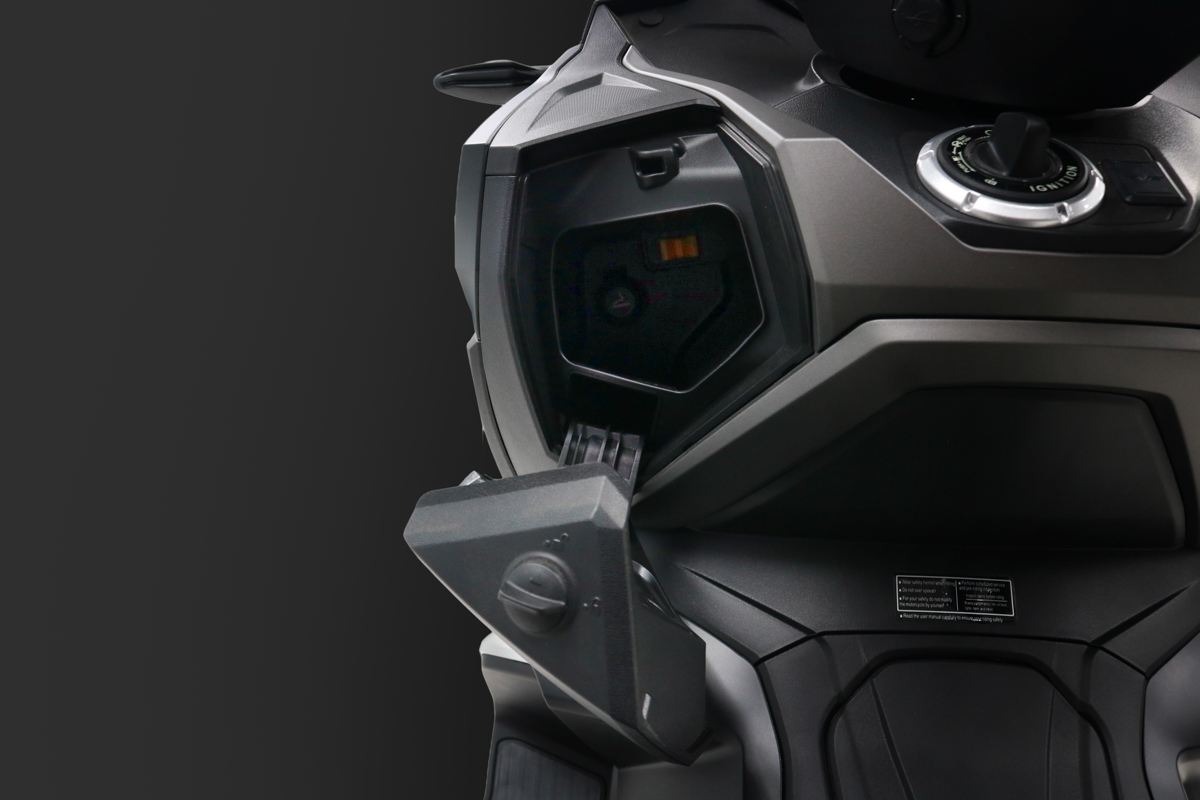
Retro scooters will always find a place in the hearts of enthusiasts everywhere. Although Vespa leads the way in this segment, just about every motorcycle manufacturer has a retro scooter model. Now, it is CFMoto’s turn, by debuting the CFMoto 150 Aura.

Its body’s silhouette may be reminiscent of a 1960’s Lambretta at first sight, but closer inspection reveals that the 150 Aura is packed to the gills with modern features.

Highlights
  • 150cc, liquid-cooled, single-cylinder engine which provides 15.8 hp and 14.2 Nm of torque.
  • Transmission is CVT, of course.

  • Both wheels are 12-inches.
  • Disc brakes on both ends, supported by dual-channel ABS.

  • A rectangle 6.2-inch TFT screen with all the obligatory features including tyre pressure monitoring, plus full-screen navigation via the Motoplay app.
  • Front and rear built-in dashcam. The footage can be downloaded via the Motoplay app.

  • Ignition is not only keyless but via NFC i.e. your phone.
  • The under seat storage space accommodates a full face plus open face helmet.

The source did not specify the CFMoto 150 Aura’s price, but expecting it to be around RM7,000 would probably be in the ballpark. The question now is whether the Malaysian distributor, MForce Bike Holdings will bring this to Malaysia. We are quite certain that it will find a big following besides many customised units.

Imagine entrusting your pride and joy to someone, only to find out (through social media) that the trustee had used the bike without your permission. That alleged unauthorised act has prompted an owner to sue his trustee.

The claim

It all began when the owner, Wee Yang, purchased the Ducati Panigale V4S for RM133,000 cash from a shop on 19 June. As he was overseas at the time, he could not complete the paperwork, thus he appointed a local contact to oversee the insurance process and store the bike.

According to Wee’s sharing on Facebook, he and the trustee had arranged to hold the bike until the former returned in July to collect it personally.

Alleged unauthorised use

However, Wee soon found out that the trustee began using the Panigale V4S without expressed permission or knowledge. In his Facebook posting, he claimed that the caretaker:

  • Posted promotional content on social media the day after taking delivery.
  • Riding videos were filmed for business pages on Instagram, Xiaohongshu, and Threads.
  • The bike was ridden to Desaru, Johor, for leisure trips.
  • A homemade license plate was used since the bike had no official registration.
  • The bike’s mileage increased from 26,827km to 27,007km.
Motorcycle towed to another location

Upon the discovery of the bike had been “illegally” used, Wee arranged for the motorcycle to be towed to another location.

In a post on 24 June, Wee also said that the trustee had passed only one key to the tow truck operator, only to hand over the other key when the tow truck driver insisted.

Inspection of the bike found that it was covered in dead insects and dust, which Wee insisted that the bike was used on the road and without proper care.

Settlement offer

Wee then offered two options to the trustee to settle the matter:

  1. Buy back the bike at the price he paid (RM133,000) and refund the insurance money (RM5,000).
  2. Public apology admitting wrongdoing, compensation for extra mileage, and payment for new license plates

Failure to accept the offer meant that Wee would pursue legal action.

Proceeding with legal action

Wee made another posting on 25 June, saying that the trustee had made an apology at 11.52pm, just two minutes after he (Wee) had called his lawyer to proceed with the case.

He stated that he is suing because:

  • His property (motorcycle) was used without authorisation for a business-related purpose, which also implicated the shop where the trustee works.
  • His property (motorcycle) was used without authorisation by an individual called “Evon Evon,” who is the caretaker’s girlfriend in riding videos and social media posts.

Wee’s lawyer had advised that the second individual could potentially be sued as an accomplice, although he acknowledged that “whether the case will succeed depends on the judge.”

However, Wee also stated that the door is still open for an out-of-court settlement.

Takeaways from this case

There have been several reported cases of workshops or shops staff were found to test or use customers’ vehicles without authorisation—such as using them for personal errands, sharing test-drive videos on social media without permission, or even installing fake license plates if registration was incomplete. In some of these instances, staff members drove customers’ vehicles and were involved in accidents.

Workshop owners can be held liable under Section 403 of the Penal Code for criminal breach of trust.

Based on the writer’s firsthand experience working in a workshop, some customers do insist on thorough test drives to ensure their vehicle issues are fully resolved. However, any test drive MUST be accompanied by:

  • Authorisation letter/form signed by the vehicle owner.
  • Pre- and post-test mileage records.
  • A detailed test report.

As a guideline for vehicle owners, before handing over your vehicle, you should sign a written agreement specifying:

  • Permitted use (e.g., “Test drive limited to 20 km”).
  • Prohibition on social media sharing.
  • List of authorized drivers.
  • Take photos of the odometer and vehicle condition.

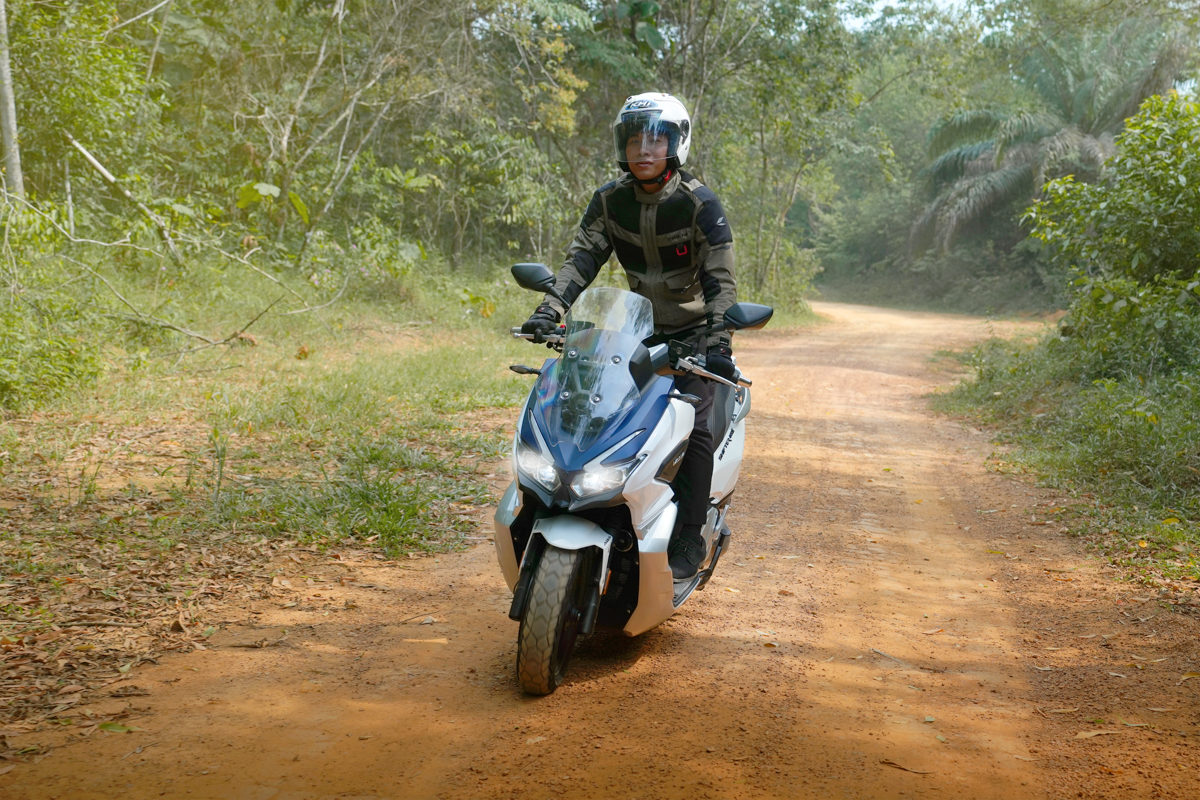
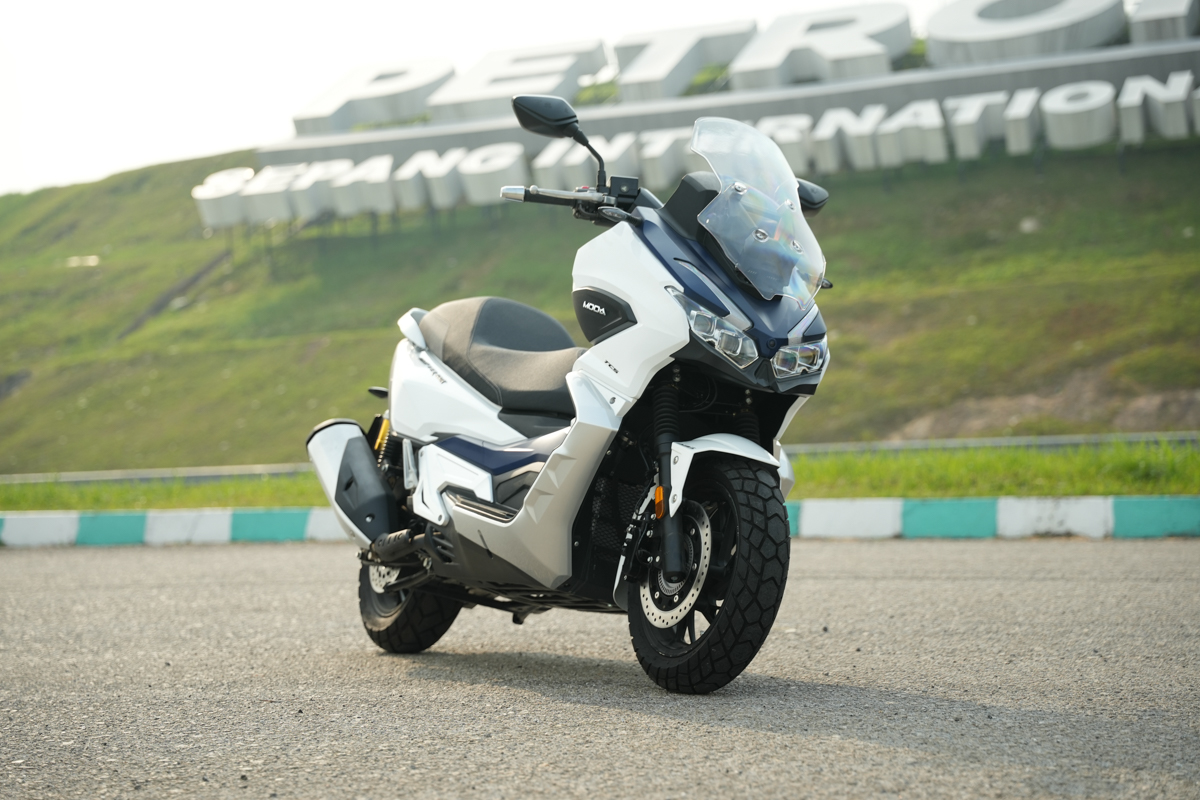
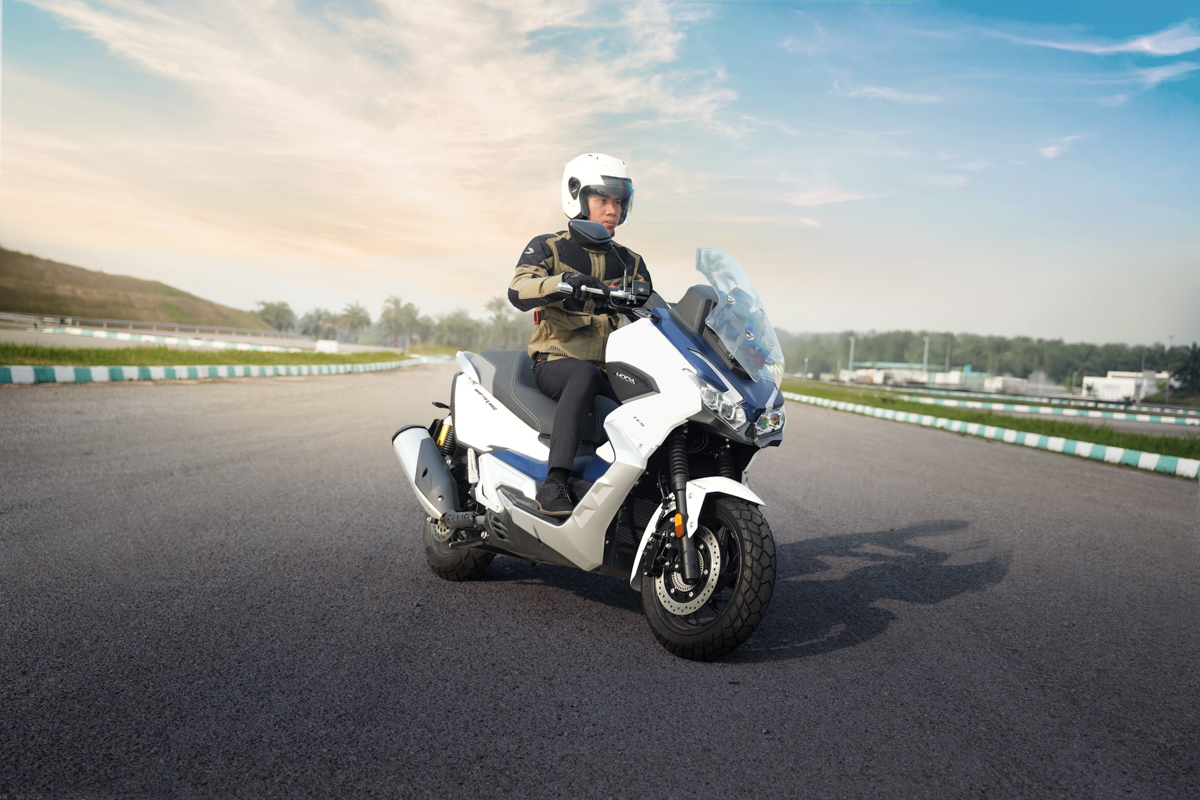
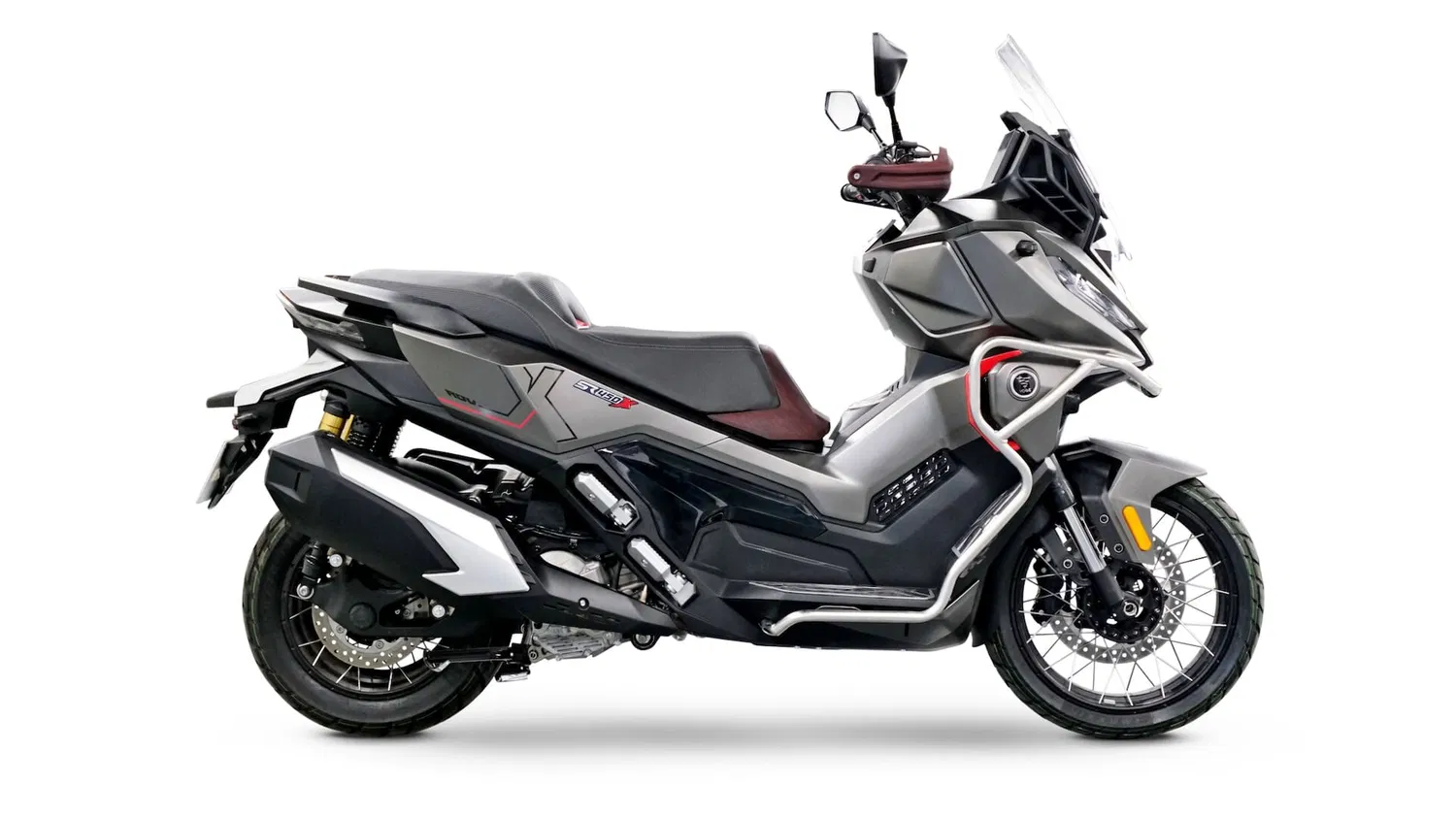
MDua Motor Sdn. Bhd. has unveiled another model to their line-up, called the MODA Shifter 400X, the latest addition to its lineup of scooters for the masses. The Shifter 400X scooter is a new entry in the trail adventure and touring segment, built to conquer both urban landscapes and rugged terrains.

The Shifter 400X carries the brand’s latest identity and philosophy – “Because I Can” – empowering riders to define their own journeys, chart their own paths, and ride on their own terms of lifestyle.

Highlights
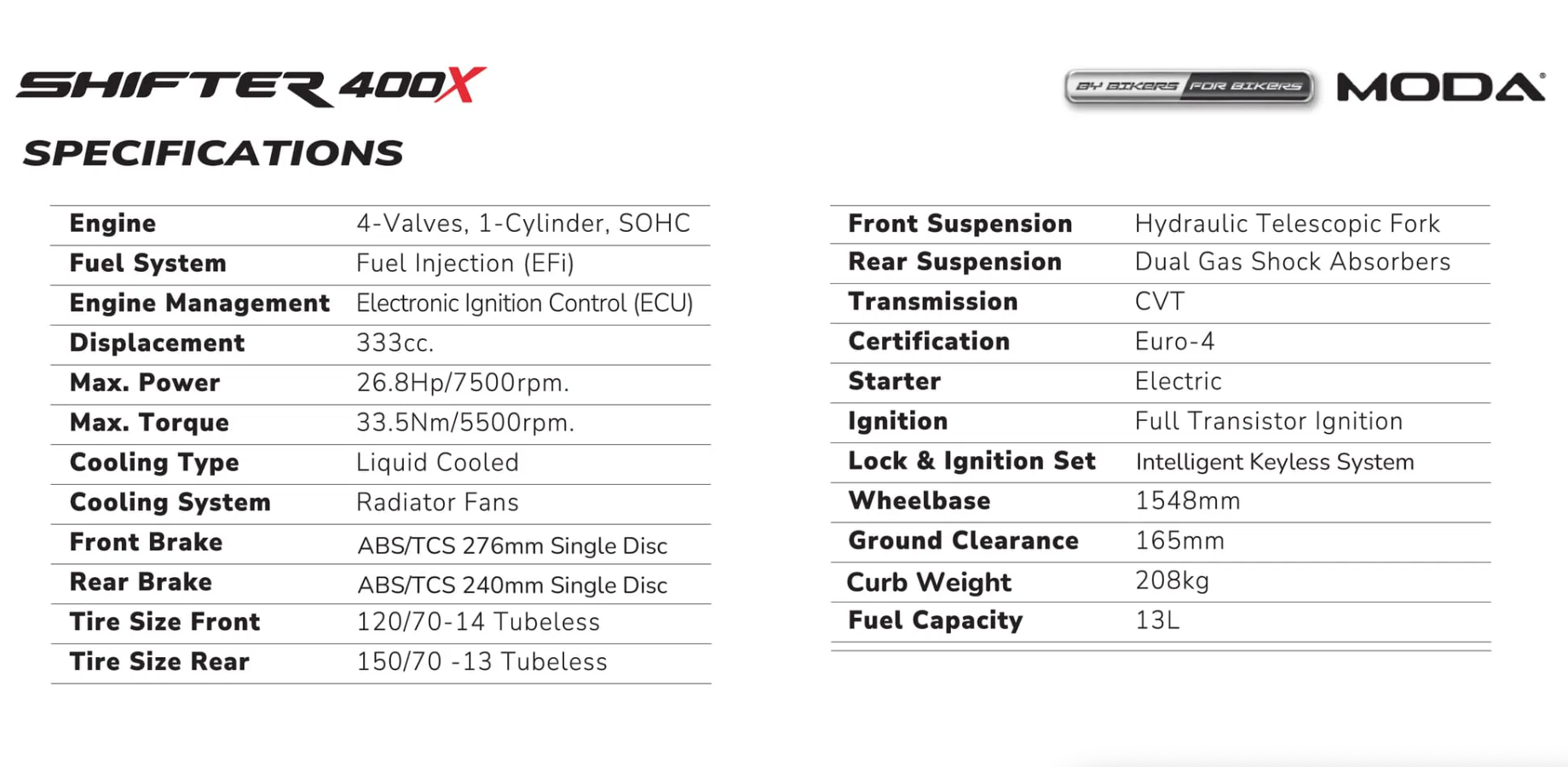
  • Powered by a 333cc, 4-valve, single-cylinder, SOHC engine, producing 26.8 hp @ 7,500 rpm 33.5 Nm @ 5,500 rpm.
  • Hydraulic telescopic forks up front, double gas shock absorbers at the back.

  • Single 276mm disc brake (front), single 240mm disc brake (rear).
  • ABS and TCS are standard features.

  • 14″ front and 13″ rear wheels fitted with “turtle back” profile for both highway cruising and light gravel routes.
  • Seat height of 775 mm.

  • 208 kg gross weight.
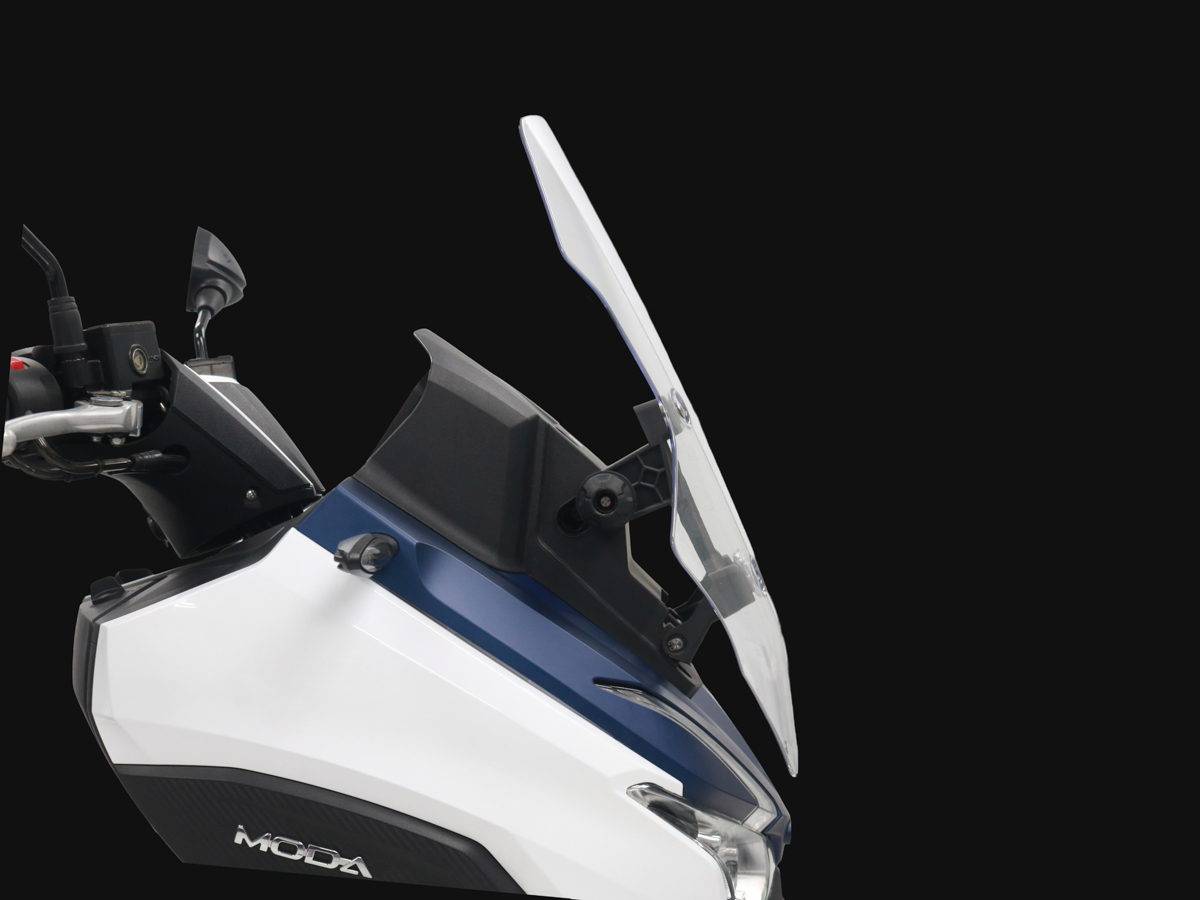
  • Two-step manually adjustable windshield.

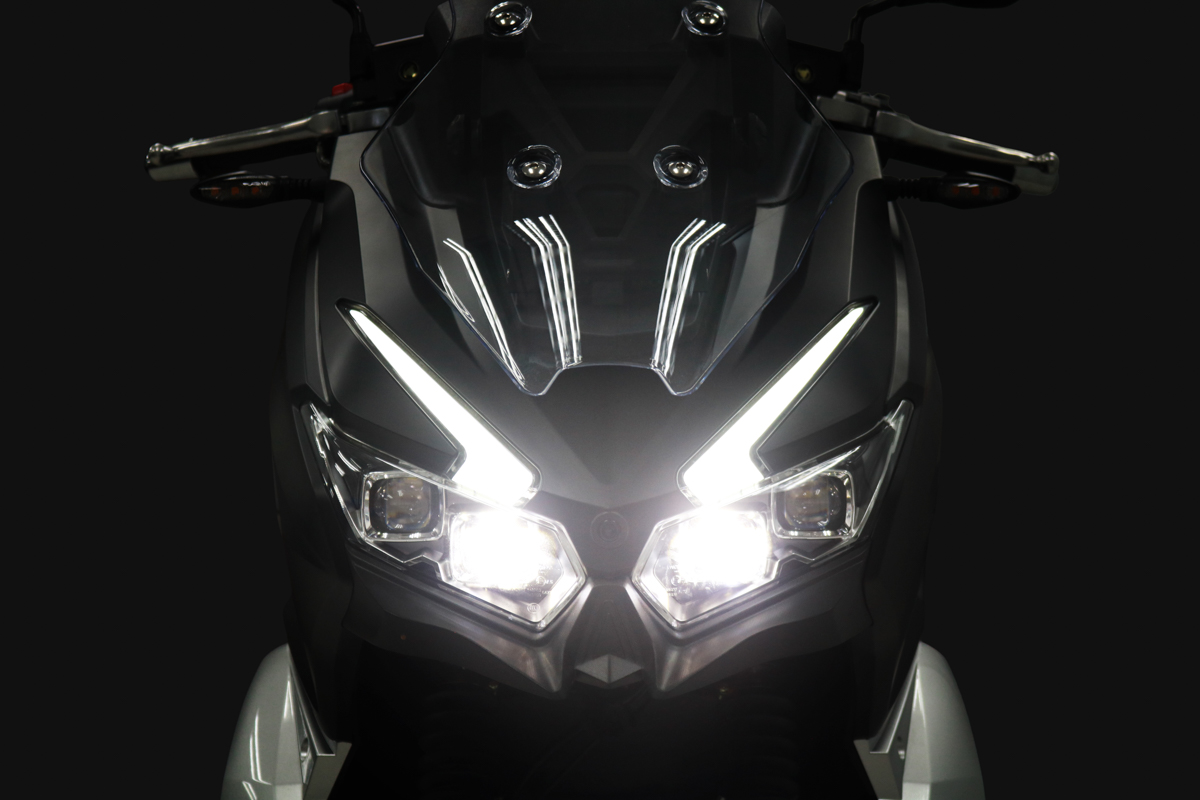
  • Four ‘lenticels’ LED headlights featuring AFS (Adaptive Front-lighting System) for brighter, dynamic illumination in low-light or cornering conditions.
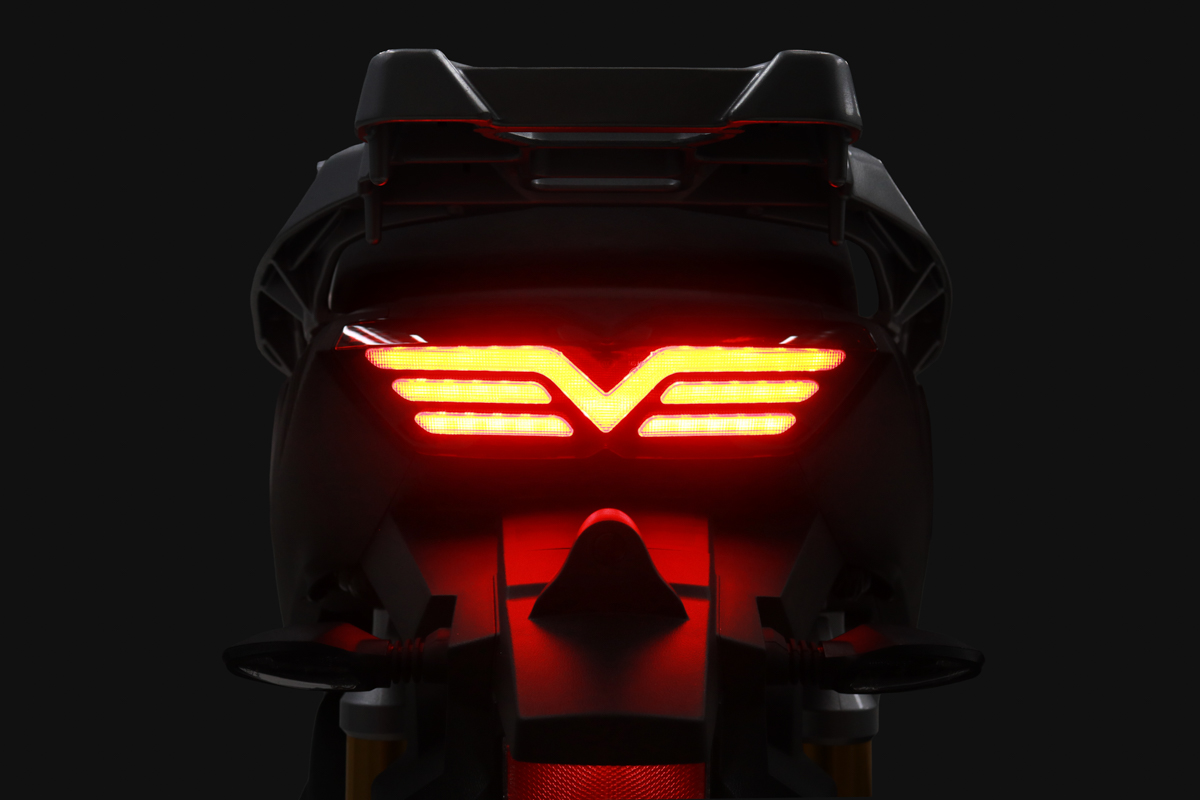
  • V-shaped LED tail light with ESS (Emergency Stop Signal) enhances safety by alerting others during sudden braking.

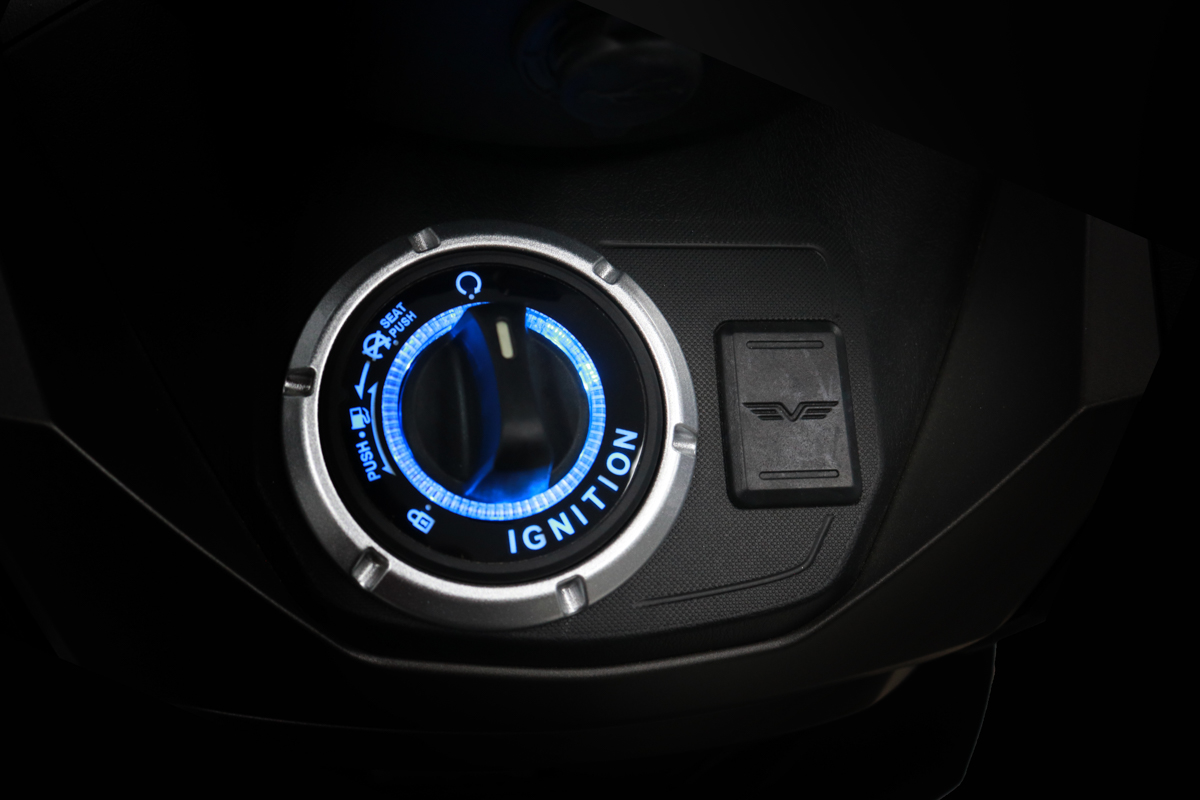
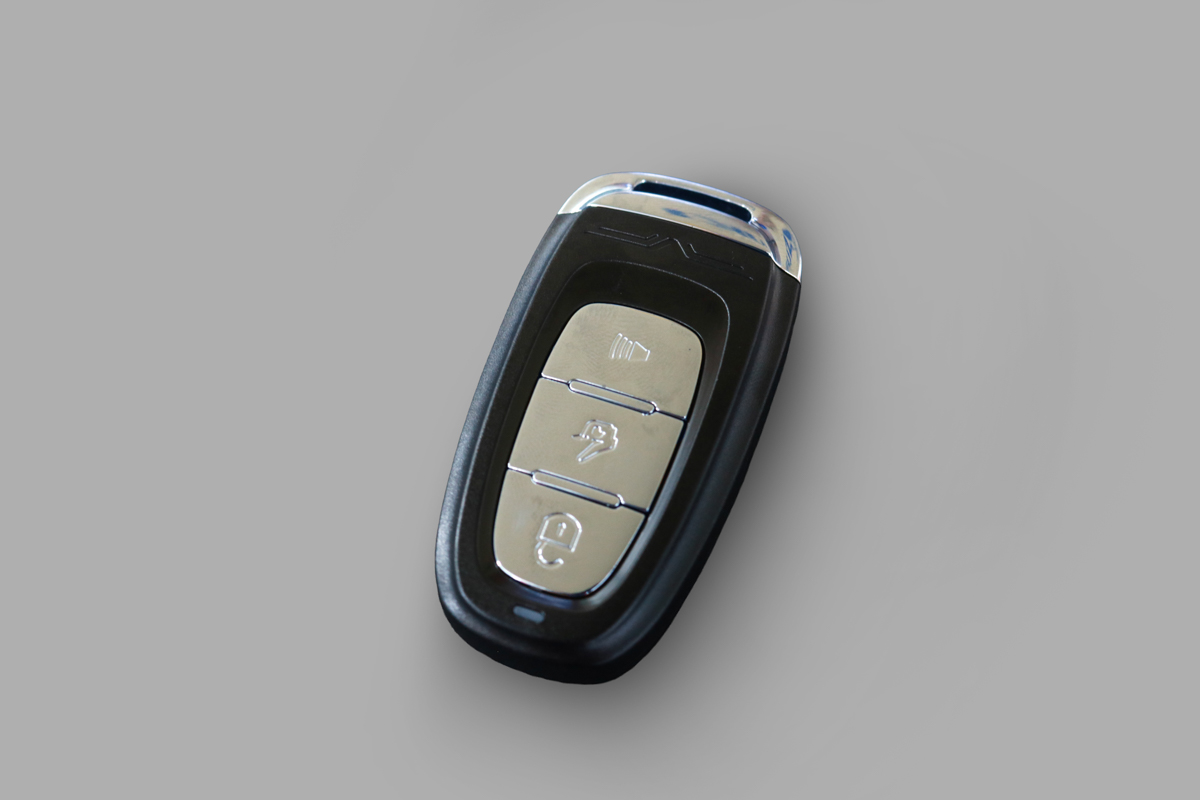
  • Intelligent keyless ignition system paired with a premium key fob.
  • The immobiliser key system features a built-in anti-theft protection and an electronic fence feature that alerts the rider if the scooter is moved beyond a preset range.

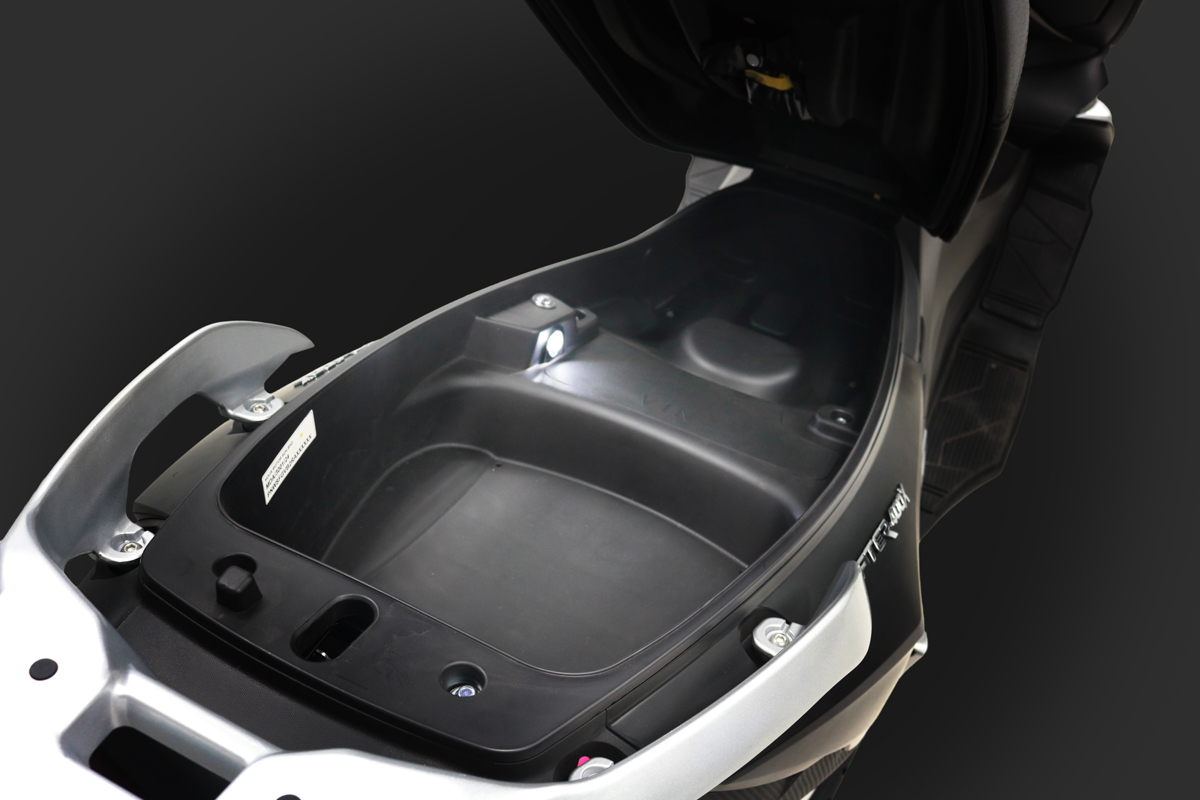
  • Illuminated, large under seat storage space.
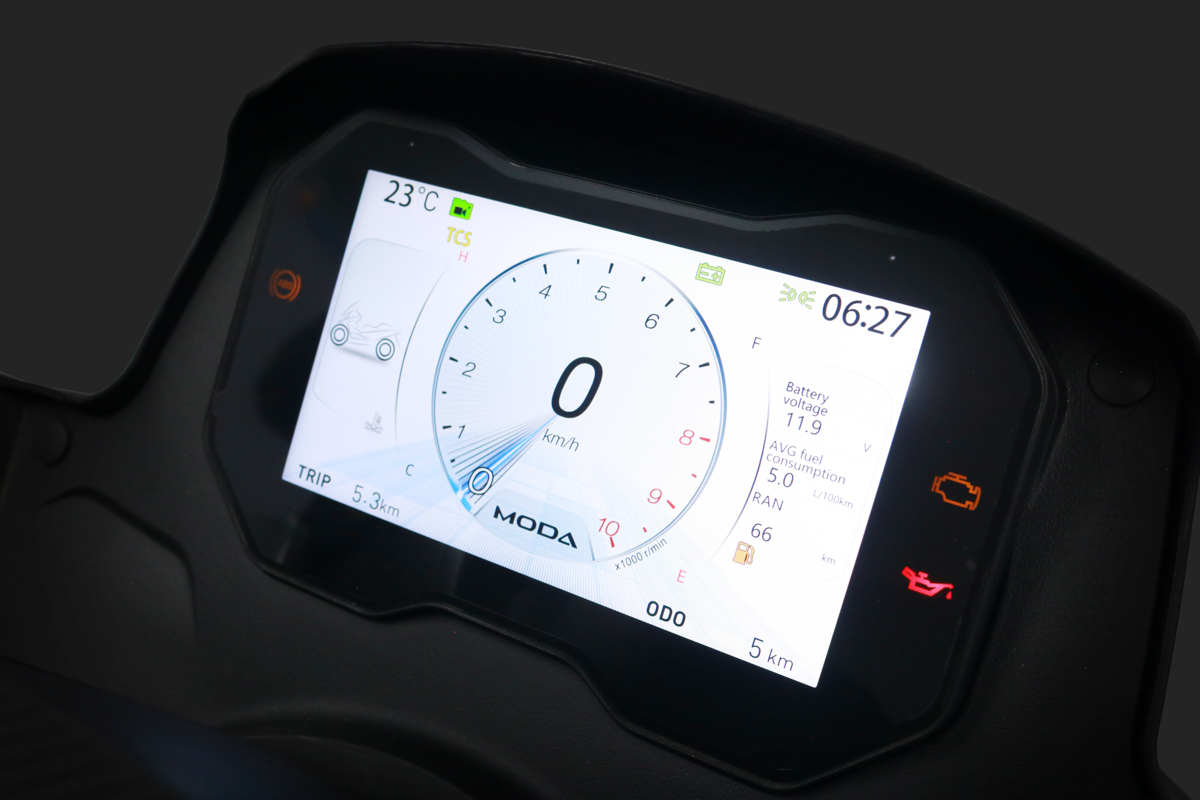
  • A 7-inch full-colour TFT instrument panel provides clear real-time data, including real-time Tyre Pressure Monitoring Sensor (TPMS), and the automatic brightness based on ambient lighting.

  • Two charging ports — a standard 12V USB and a 12V cigarette lighter socket.
  • Phone connectivity through Apple and Android devices is available for navigation and call pairing.

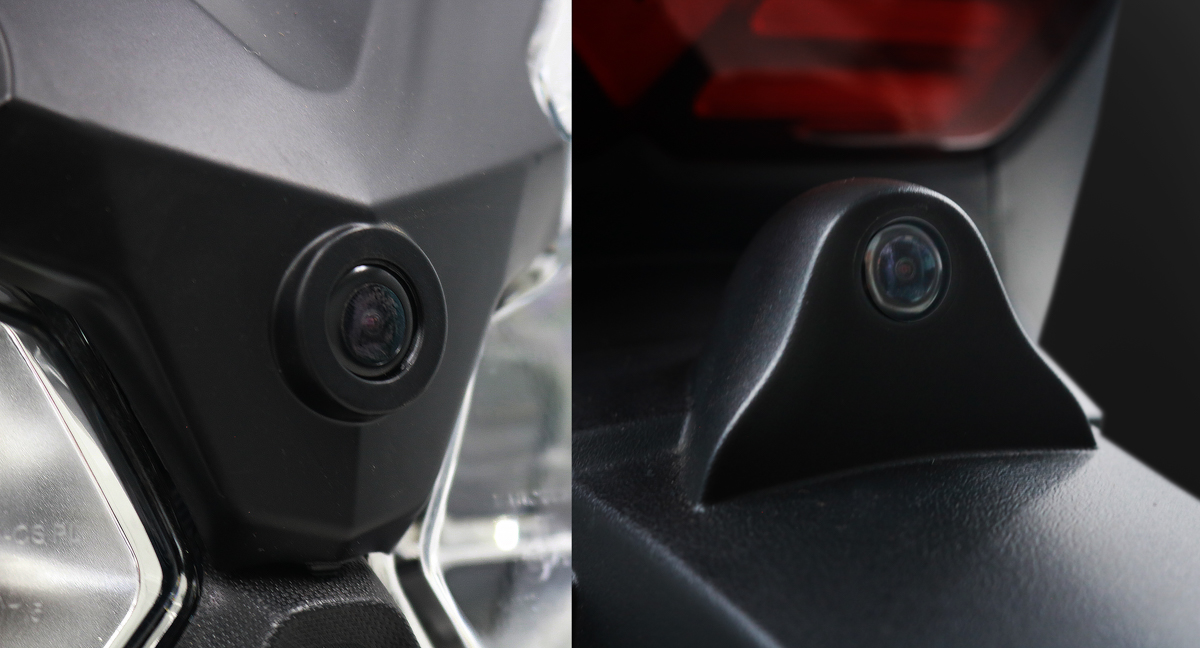
  • Dual-lens front and rear camera system, which records your journey and allows footage to be downloaded via a dedicated mobile app.

The MODA Shifter 400X is now available in two exhilarating colours: Ninja Black and Ultra White, and priced at an MRSP of RM23,888.00, excluding road tax, registration, and insurance.

For more information, explore our social media channels or visit the MODA Motorcycles official website at http://www.modamotorcycles.com/models/shifter-400x.

Photo gallery

The iconic brand Dainese has been sold for a symbolic EUR1 (1 Euro), after accruing a mountain of debt of around EUR300 million.

The sale was orchestrated by London-based funds Arcmont Asset Management and HPS Investment Partners (recently acquired by BlackRock), who took over from the Carlyle invesment fund. Carlyle, on the other hand, had acquired Dainese from Ivestcorp for EUR630 million in 2022.

The shocking news was reported by the Sport E Finanza magazine. However, Dainese themselves have not posted such news, and neither did Arcmont and HPS.

The Dainese brand had been struggling with debt after posting three consecutive years of losses, culminating in a EUR120 million deficit last year. That lacklustre performance saw its debt soar to EUR300 million over an EBITDA (earnings before interest, taxes, depreciation and amortization) of EUR20 million, which translates to a debt:EBITDA ratio of 15:1.

The new owners have stated their intention clearly: to strengthen Dainese’s financial structure and improve its flexibility after facing market challenges. However, there is yet news on the employees, suppliers, and customers of Dainese.

Only time will tell what the future holds for Dainese.

Source: Sport E Finanza

One motorcyclist dies every two hours. That was the alarming statistic revealed by authorities, who also said that it should not be treated as a normalcy any longer.

Malaysian Institute of Road Safety Research (Miros) Human Factors and Road User Behavioural Centre director Ir Ts Azhar Hamzah said motorcyclists continue to dominate road fatality statistics, accounting for nearly 70 per cent of all deaths. His words and recommendations came just hours before a fatal accident occured on the Seremban-Kuala Lumpur Highway which saw three motorcyclists killed.

Just imagine 12 people die every day. Every two hours, one person dies riding a motorcycle,” said Azhar during the Allianz Malaysia Media Forum held at Aloft Kuala Lumpur Sentral on Tuesday.

He said many of these deaths were preventable if the country took proactive steps in education, training and behaviour change.

The best safety for motorcyclists is prevention. You cannot rely only on post-incident measures. The best is prevention,” he said.

Azhar said motorcycles were originally intended for short-distance travel but have evolved into a primary means of transport across long distances in Malaysia, despite their limitations.

Azhar said Malaysia’s road culture has normalised risky behaviours such as weaving through traffic and speeding, adding that such actions remain a legal grey area under current road regulations.

In Malaysia, this has become the culture. Riders move through gaps in roads to maintain stability. Whether it’s right or wrong is unclear, as even the Road Transport Act is a bit vague,” he said.

He said changing rider behaviour and enforcing the use of personal protective equipment (PPE) were urgent priorities.

If we can’t eliminate motorcycles, then we must control them through better roads, more stable motorcycle designs, and stronger rules,” he said.

P-hailing riders spend five times longer on the road compared with regular motorcycle users. So, the risk is higher,” he said.

He added that slowing down was one of the fastest ways to reduce motorcycle fatalities.

If we reduce speed, we get an immediate reward. If you ride slower, you lower your risk right away,” he said.

Azhar urged government agencies, private companies and the public to act without delay.

If you ride a motorcycle, act now. Don’t wait,” he said.


Allianz Malaysia, MIROS, P-Hailing Platforms Join Forces to Safeguard Riders

Allianz Malaysia Berhad (Allianz Malaysia) has joined forces with the Malaysian Institute of Road Safety Research (MIROS) and leading p-hailing platforms Foodpanda Malaysia, Lalamove Malaysia, and Grab Malaysia to highlight the importance of rider safety particularly within the country’s rapidly expanding p-hailing industry. The initiative reinforces the shared duty of all stakeholders including government agencies, corporates, p-hailing riders, and the public to protect and support the well-being of these gig workers.

At the Allianz Malaysia Media Forum 2025 held here today, industry stakeholders gathered to discuss the challenges faced by p-hailing riders and explore collaborative strategies for a safer delivery ecosystem. The  forum underscored the vital role of p-hailing riders and the importance  of comprehensive safety strategies to support them.

The p-hailing industry, which includes food and parcel delivery services, has experienced significant growth in recent years. This is driven by strong demand for convenient and efficient delivery services, which has in turn spotlighted the safety of p-hailing riders, who are often exposed to the risks of road accidents.

As a leader in protection, Allianz Malaysia reaffirms its commitment to improving rider safety through strategic partnerships. The Allianz Malaysia Media Forum 2025 featured a panel discussion with  representatives from MIROS and leading p-hailing platforms, including Lalamove Malaysia, foodpanda Malaysia and Grab Malaysia. These industry experts exchanged valuable insights on the current challenges in the p-hailing sector and discussed collective efforts to uplift rider safety.

P-hailing riders play a pivotal role in society, serving as the backbone of the country’s growing delivery economy. From food and groceries to essential goods, riders ensure seamless access to everyday needs while helping small businesses expand their reach. Many are sole breadwinners of their families, braving daily road risks to support loved ones.

Recognising the contribution of p-hailing riders, p-hailing platforms have implemented various safety initiatives to support their well-being. However, protecting their well-being remains a shared  responsibility that calls for coordinated and sustainable action.

Allianz Malaysia MIROS P-Hailing

Allianz Malaysia Chief Executive Officer, Sean Wang said, “At Allianz Malaysia, we believe that rider safety is a shared duty. We are committed to not only providing insurance solutions but also actively contributing to the well-being of the community around us. Our efforts extend beyond profit, and in this particular instance, we strive to give back to society by implementing and supporting rider safety initiatives that will enhance safety and security for all road users.

Ir. Ts. Azhar Hamzah, Director of the Human Factors and Road User Behavioural Centre (HUB) at MIROS concurred, adding, “Our mission at MIROS is to ensure safe roads for everyone. We believe that road safety is a shared responsibility, and  through our research, we aim to uncover the risks and challenges faced by road users and identify potential solutions to enhance rider safety and support their families’ livelihoods. Together, we can transform insights into impactful actions.

In line with its commitment to enhancing rider safety, Allianz Malaysia is set to organise two training programmes in partnership with the Road Safety Marshal Club. The first programme will focus on rider safety training and road emergency survival with p-hailing companies, complementing their existing efforts, aiming to equip riders with essential skills and knowledge to navigate roads safely. The second programme will be tailored for public and private university students, fostering a culture of safety awareness among the younger generation.

Sean further commented, “Our collaboration with the Road Safety Marshal Club is a testament to our dedication to safeguarding road users and improving road safety knowledge. By empowering riders and educating students, we hope to create a safer environment for everyone on the road.

Allianz Malaysia remains steadfast in its mission to care for the future and enhance road safety through proactive measures and strategic partnerships. The Allianz Malaysia Media Forum 2025 and the upcoming training programmes are crucial steps toward creating a safer environment for Malaysia’s p-hailing community as well as the broader community.

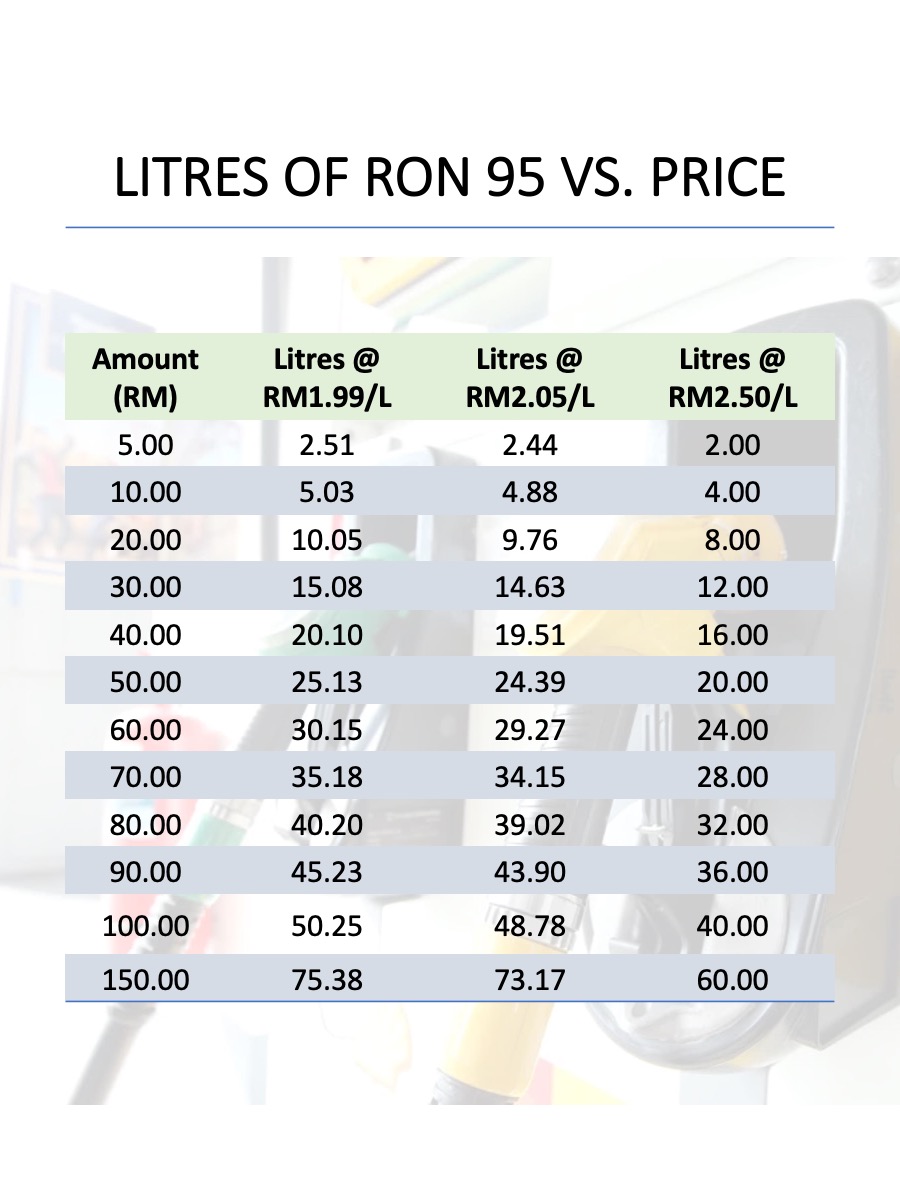
Malaysian Prime Minister YAB Datuk Seri Anwar Ibrahim (PMX) announced today that the price of RON 95 petrol will be reduced to RM1.99 per litre from the current price of  RM2.05 per litre.

In his special speech announcing several measures to ease the burden of the Rakyat, he said that the government’s RON 95 petrol target subsidy plan is still on track. The full details of the subsidy rationalisation will be announced by end-September 2025.

PMX also stressed that the majority of the Rakyat will be not be affected as the price of RON 95 will be reduced when the targeted subsidy plan begins.

This will certainly benefit around 18 million car drivers and motorcyclists, including youth as young as 16 years old and gig workers. This targeted approach is in line with the government’s efforts to optimise national resources for the benefit of the people, and reduce subsidy waste,” he said in his speech.

Subsidy removal will instead affect the ultra rich and foreign citizens – them having to pay the market price for fuel.

He added that in 2023 and 2024, the government spent some RM20 billion a year on RON 95 subsidy alone. Although world oil prices have declined this year, the price of RON 95 petrol without subsidy is still around RM2.50 per litre.

The Prime Minister did not reveal any detail of how the scheme will be implemented. However, it is expected the mechanism involves using the Malaysian National Registration Indentity Card (MyKad) when filling up. In this case, it should be linked to the tax database to determine a person’s income level. Will there be facial matching of the person filling up with his MyKad to avoid the use of another person’s MyKad? We shall see.

On another note, and giving credit where credit is due to the PMX and government, the actual amount of petrol we receive with the upcoming RM1.99/litre compared to the current RM2.05/litre will not be a lot more, unless we pump a large quantity. Instead, the biggest difference can only be seen when RM1.99/litre is compared with RM2.50/litre. Nevertheless, it is a start. Check out the table below:

The new and enhanced 2025 Honda ADV350 adventure scooter has arrived in Malaysia.

Honda says that these tech revisions are to give the ADV350 new features and better handling.

Highlights
  • 330cc, SOHC, single-cylinder, liquid-cooled engine with enhanced Smart Power+ (eSP+).
  • It delivers 28.8 hp (21.5 kW) at 7,500rpm and 31.8 Nm of torque at 5,250rpm.
  • Engineered with low-friction technologies, it offers smooth power delivery and economical fuel consumption of 28.6km/l.

  • The two-level Honda Selectable Torque Control (HSTC) traction control system is retained.
  • The front suspension consists of 37mm upside-down forks and 125mm of travel.
  • Rear suspension duty is handled by a pair of rear shocks with remote reservoir that are now adjustable for spring preload.

  • X-shaped 6-spoke cast aluminium wheels paired with block-pattern tubeless tyres.
  • Stopping power is provided by front and rear disc brakes, assisted by 2-channel ABS.
  • 5-inch full-colour TFT meter and now integrates the Honda RoadSync app, allowing riders to manage calls, music, and navigation via Bluetooth.

  • Backlit four-way toggle switch on the handlebar.
  • New auto-cancelling indicators, which automatically deactivate after a turn by reducing distraction and increasing convenience.
  • Emergency Stop Signal (ESS) remains as part of the safety package, flashing the indicators during sudden braking to alert following vehicles.

  • Four-stage adjustable windscreen with 133mm of travel.
  • Generous 48-litre under-seat compartment, which accommodates two full-face helmets.
  • A USB-C charging port is available in the glovebox.

  • 795mm seat height.
  • Honda Smart Key system remains, allowing riders to start the ignition, unlock the seat, and walk away as the scooter locks itself without needing to insert a physical key.
  • The indicator answer-back function also continues, flashing the indicators remotely to help riders locate their scooter easily in crowded parking areas.

Mr. Kunitomo Asano, CEO and Managing Director of Boon Siew Honda said, “The ADV350 carries forward the identity of the X-ADV where the ADV series is the pioneer of the unique  ‘adventure‘ identity in the two-wheeled world. The ADV series creates a new category that blends on-road convenience with off-road capability. With the introduction of Honda RoadSync following the X-ADV, we have expanded the joy of connectivity even further. Moving forward, we  will continue to stay close to our customers’ lifestyles and provide new experiences and value that enrich their everyday lives.

The 2025 Honda ADV350 will be available at Honda Big Wing dealers from the middle of August, at a recommended retail price (RRP) of RM33,999. There are three colour options, namely Moscato Red Metallic, Matte Pearl Agile Blue, Matte Gun Powder Black Metallic.

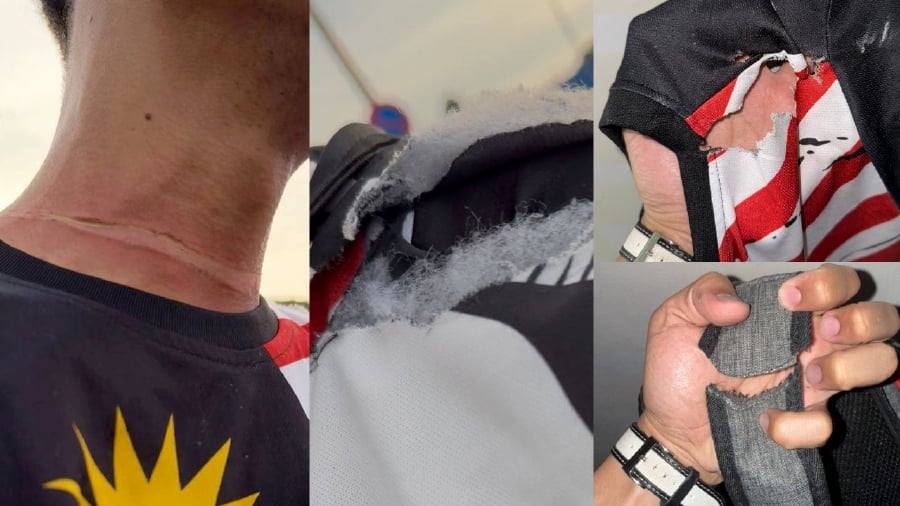
A motorcyclist nearly suffered a cut neck due to a kite string wrapping around it when he rode past Taman Tasik Metropolitan Kepong, yesterday.

Muhammad Faris Rosaidee, 27, recalled the terrifying moment in a Tik Tok video. He said that we travelling from Batu Caves on the Middle Ring Road 2 (MRR2) to meet a friend in to Bandar Sri Damansara, when suddenly felt something brushing against his body and tightened around his neck. It finally occurred to him that it was a kite string.

I didn’t see the string. I felt it first touch my body, then rise to chest level and finally around my neck.

“I couldn’t stop because there were cars on both sides. All I could do was slow down the motorcycle and wait for the string around my neck to snap on its own,”

I was wearing three layers of clothing at the time – a jacket, a shirt, and I had a backpack. All three were torn, and it scraped the skin on my shoulder slightly,” he told Harian Metro.

Fortunately, Faris was wearing a balaclava covering that reduced the severity of the injury.

The doctor said it only affected the outermost layer of skin, like a burn… there was no bleeding, and I’ve already been to a nearby clinic for treatment,” he said, adding that he has lodged a police report at the Gombak District Police Headquarters (IPD).

@beritaalhijrah114Seorang penunggang motosikal mendakwa dirinya telah terjerut tali layang-layang ketika melalui Lebuhraya Lingkaran Tengah 2 berhampiran dengan Taman Metropolitan Kepong. Kejadian itu mengakibatkan kecederaan di bahagian leher serta kerosakan beberapa barang peribadi mangsa.

♬ original sound – Berita AlHijrah

As the incident occurred within the Kepong area, police from the local station contacted him for further details and helped facilitate reports to Kuala Lumpur City Hall (DBKL) and the traffic police.

This morning, I went there and then proceeded to DBKL to file an official complaint. Alhamdulillah, all police reports have been submitted,” he said.

Faris said that this was not an isolated case, claiming others have reported similar incidents involving kite strings in the area.

He also returned to the scene and confronted two individuals near the string.

I asked them whose kite it was. They said they were only there to help… I didn’t suspect them of anything,” he said.

Faris is calling for designated kite-flying zones to prevent similar incidents and has encouraged other victims to come forward.

I made the video to raise awareness. For those asking about my condition – Alhamdulillah, my health is mostly unaffected. I’m just worried if it happens to someone else next time,” he said.

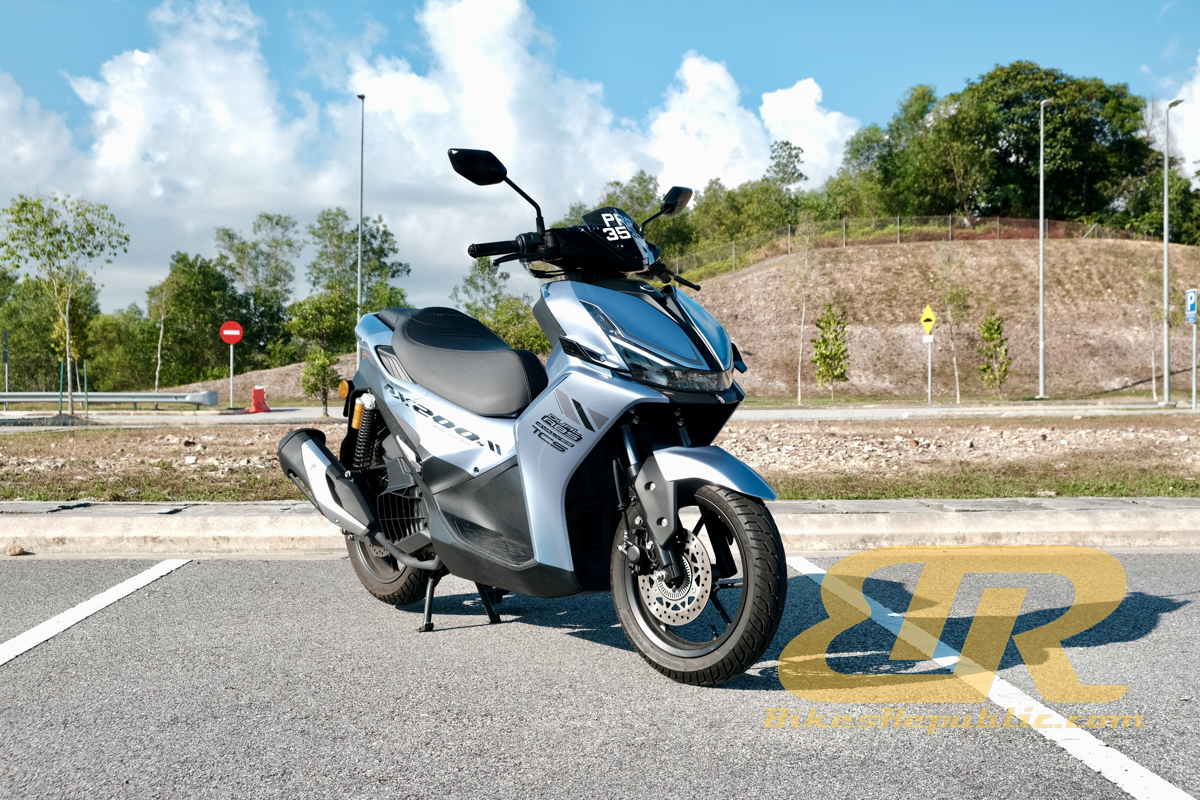
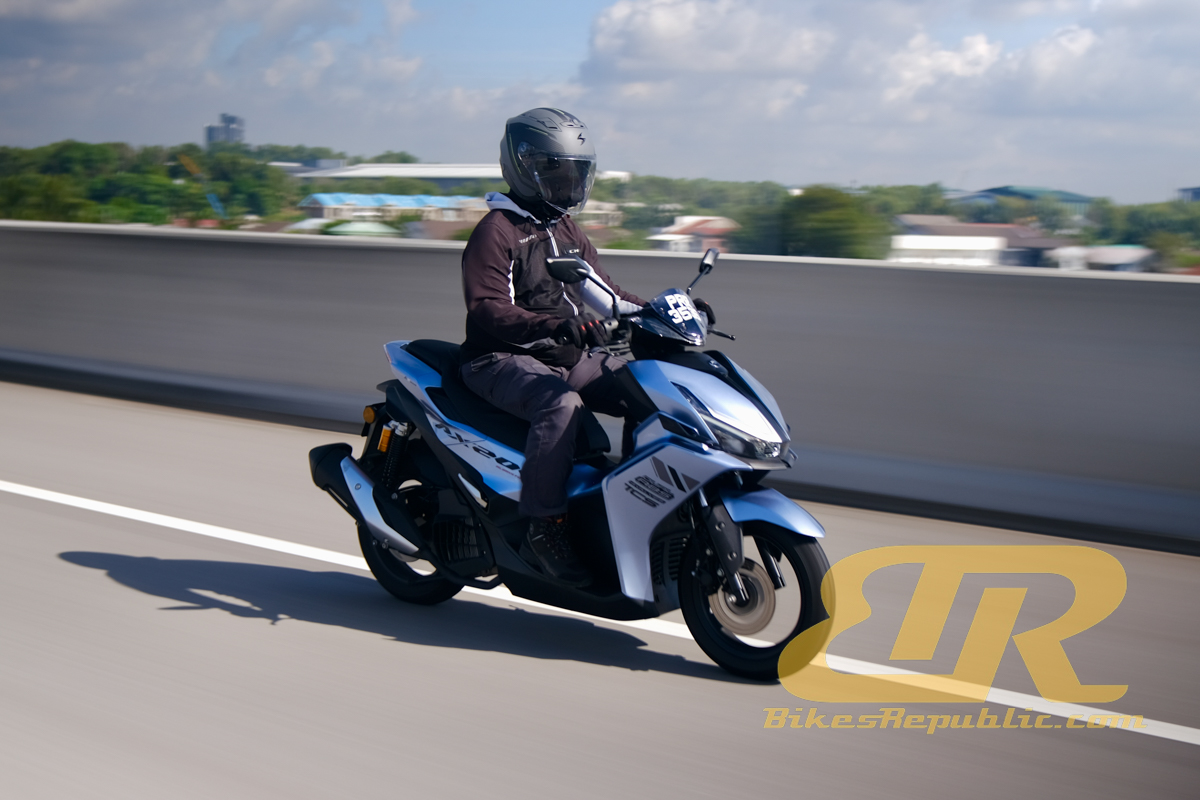
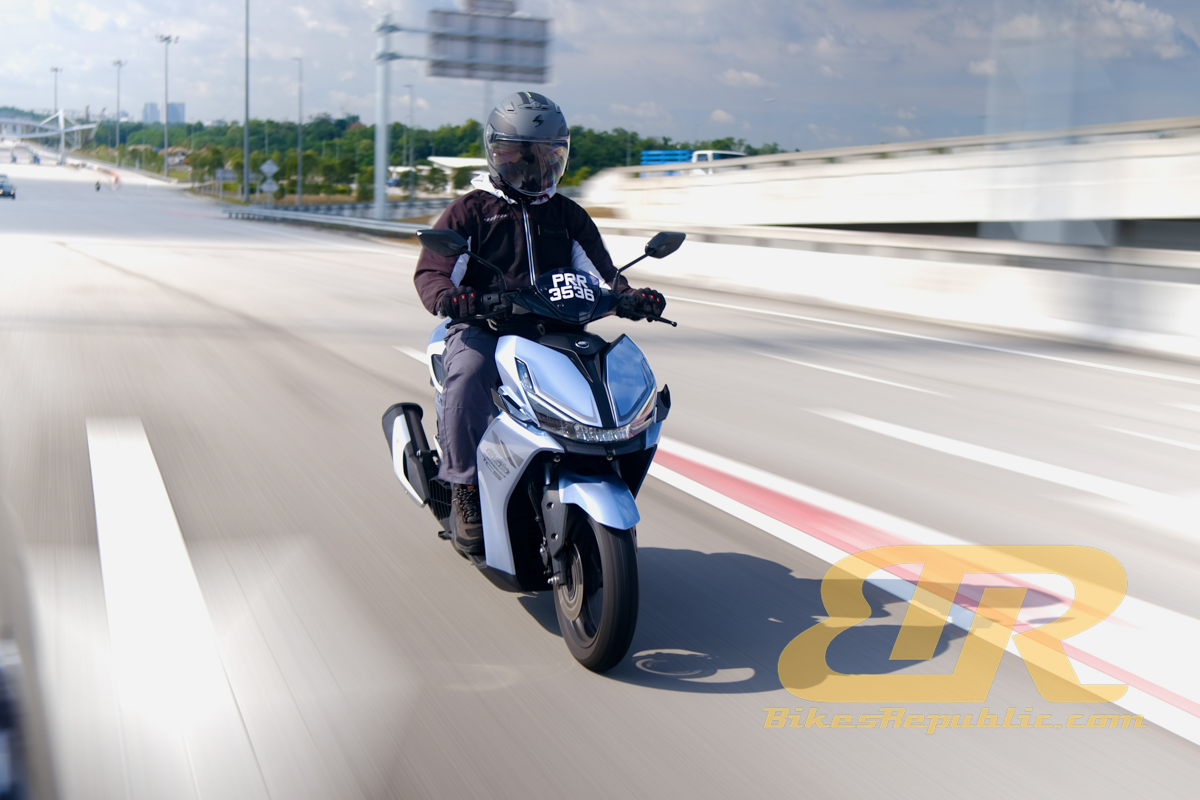
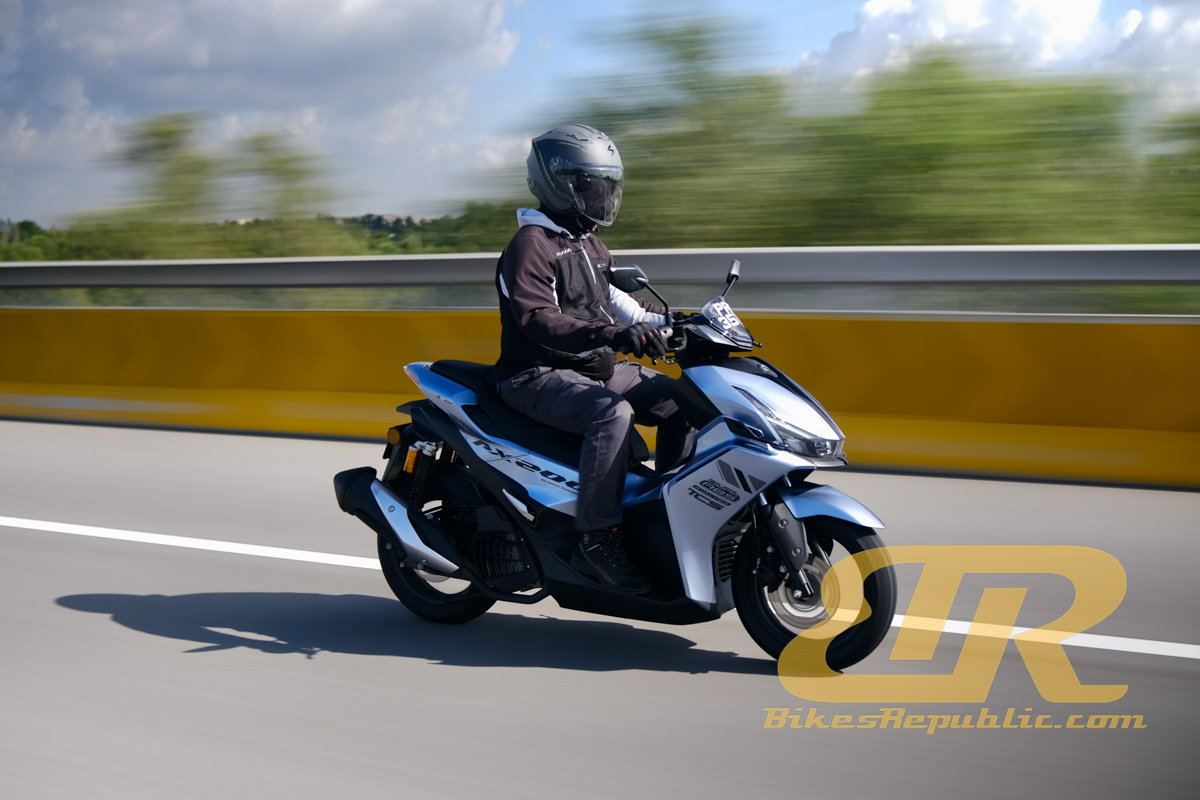
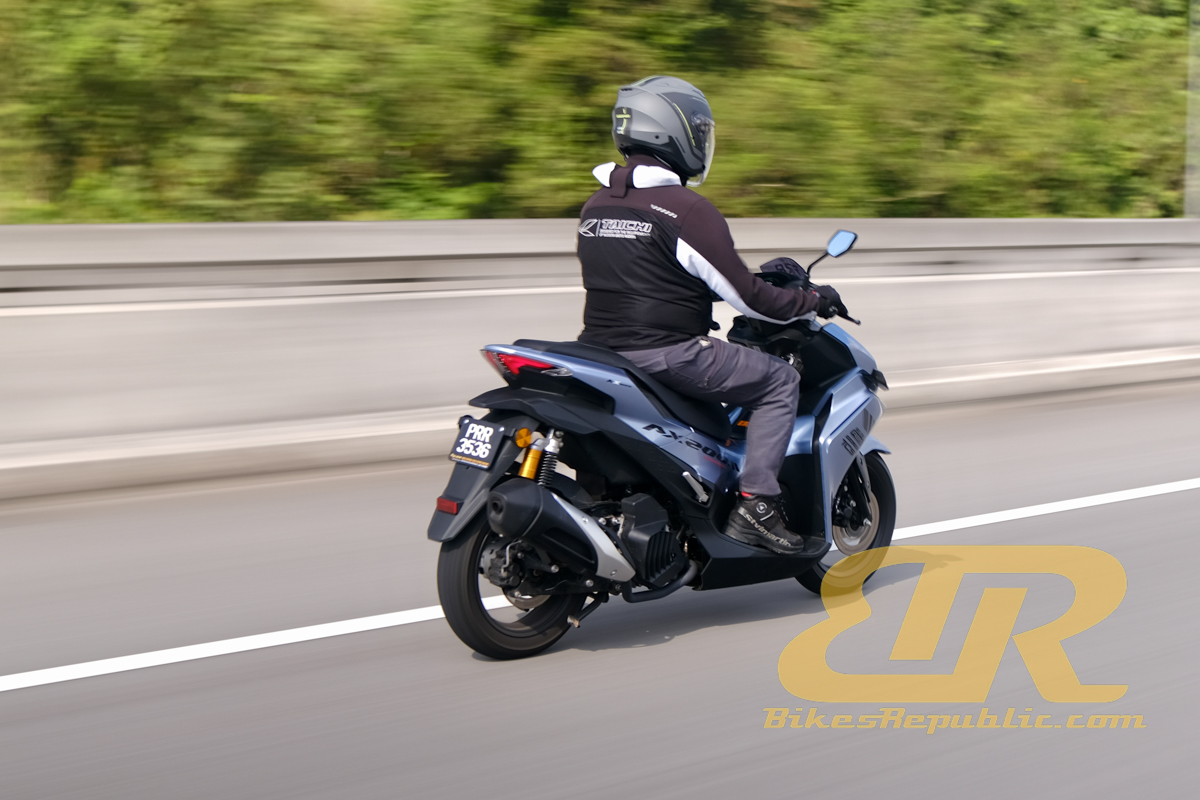
We have been testing scooter after scooter since December 2024, including in China and Taiwan. There have also been several launched in Malaysia during that period, one of which was the 2025 QJMotor AX200s.

Since then, the bike had garnered quite a reputation in the lightweight scooter segment with many comments attaching a whole bunch of (positive) superlatives to it; the most common word used was ‘mantap‘ in Bahasa Melayu which collectively meant “awesome.”

Thus, we were eager to find out for ourselves if those claims really held any water.

What is the 2025 QJMotor AX200s?

The AX200s was launched back in May 2025, as another model distributed by the mega distributor, MForce Bike Holdings.

QJMotor, also known as Qianjiang Motorcycle, is a Chinese motorcycle maker that founded in 1985. They have grown by leaps and bounds since then, and currently holds the Keeway and Benelli brands. QJ is also part of the Geely Holding Group. Harley-Davidson had partnered with QJMotor in 2019 to produce a 338cc bike for the Asian market.

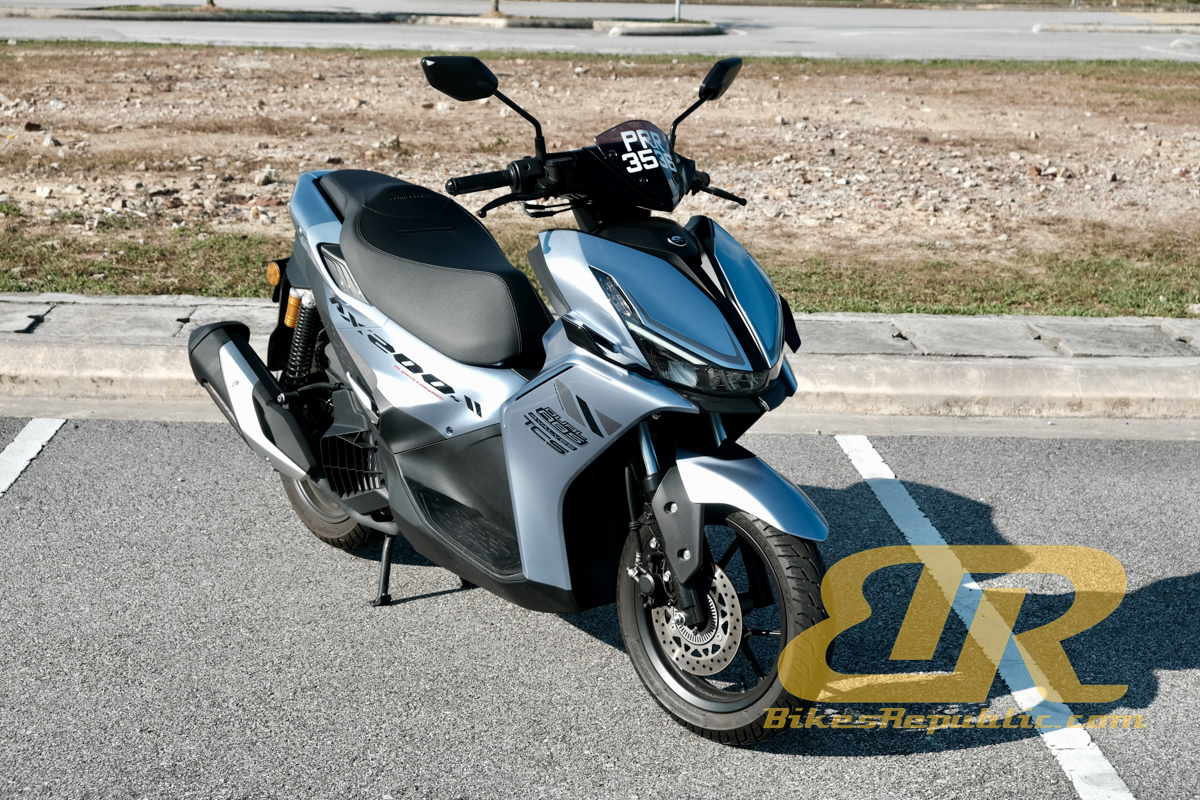
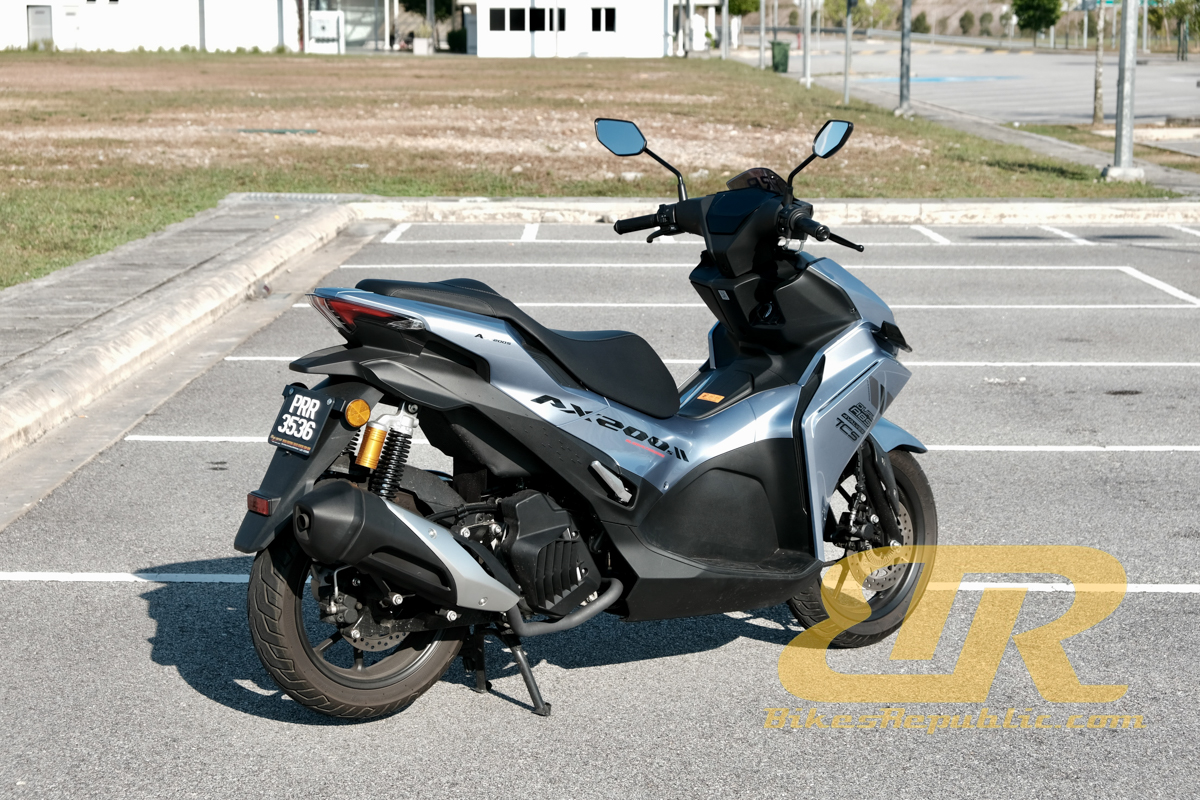
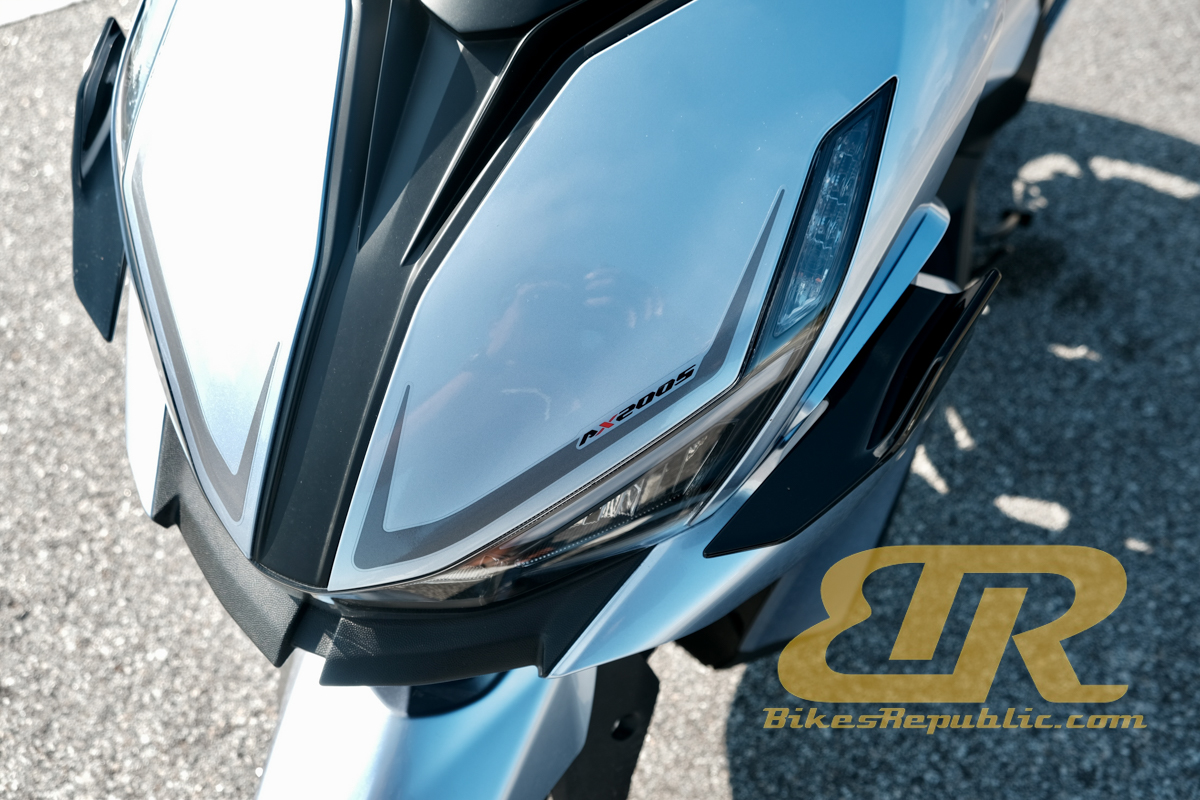
Over to the AX200s, it is a small capacity automatic scooter, but biased toward the urban-sport sub-segment, rather than an adventure scooter. As such, QJMotor did not hide the bike’s intentions by giving it a sharp and aggressive styling.

Let us not beat around the bush and say that it has found itself compared to the Yamaha NVX, mainly because of their similar styling.

Highlights of the 2025 QJMotor AX200s

  • 175cc, single-cylinder, SOHC, 4-valve engine which produces 17.0 hp (13.0 kW) at 8,500 RPM and 15.2 Nm at 6,500 RPM.
  • Front suspension utilises telescopic forks, while there are oil-damped twin shock absorbers at the back.
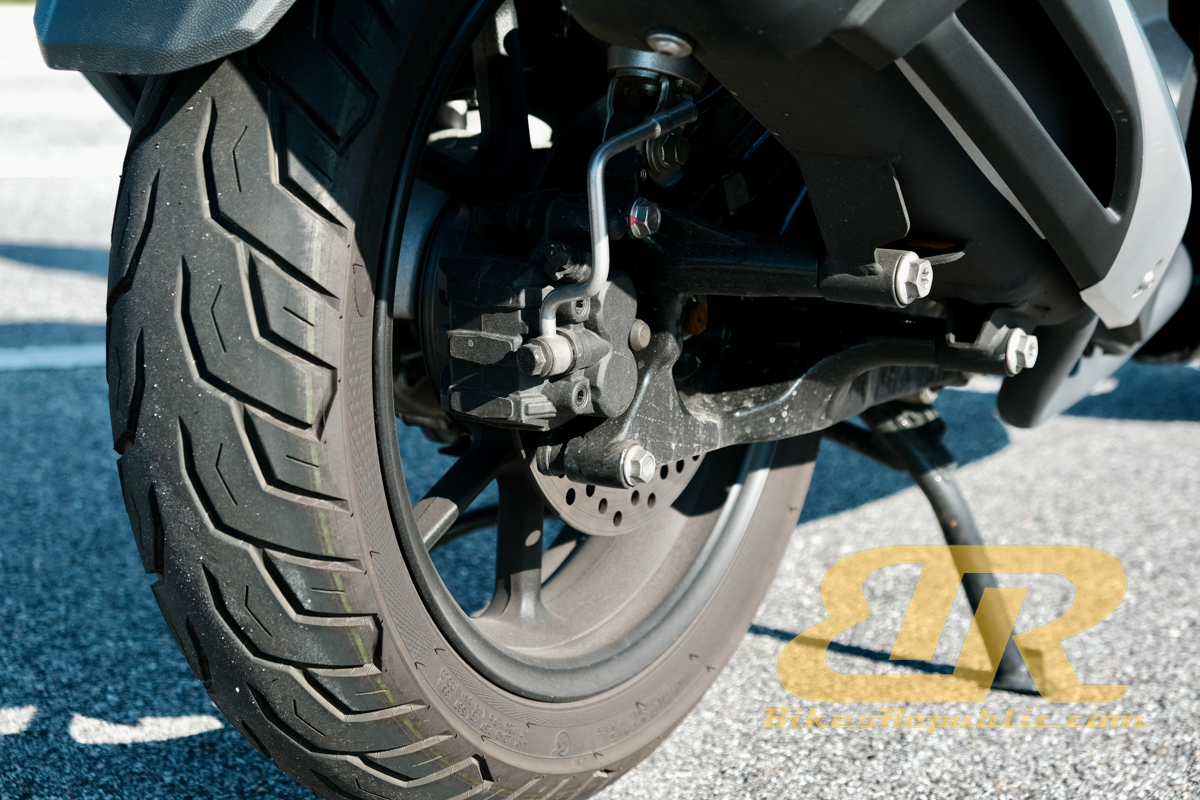
  • 230mm single brake disc up front, 220mm disc at the back.

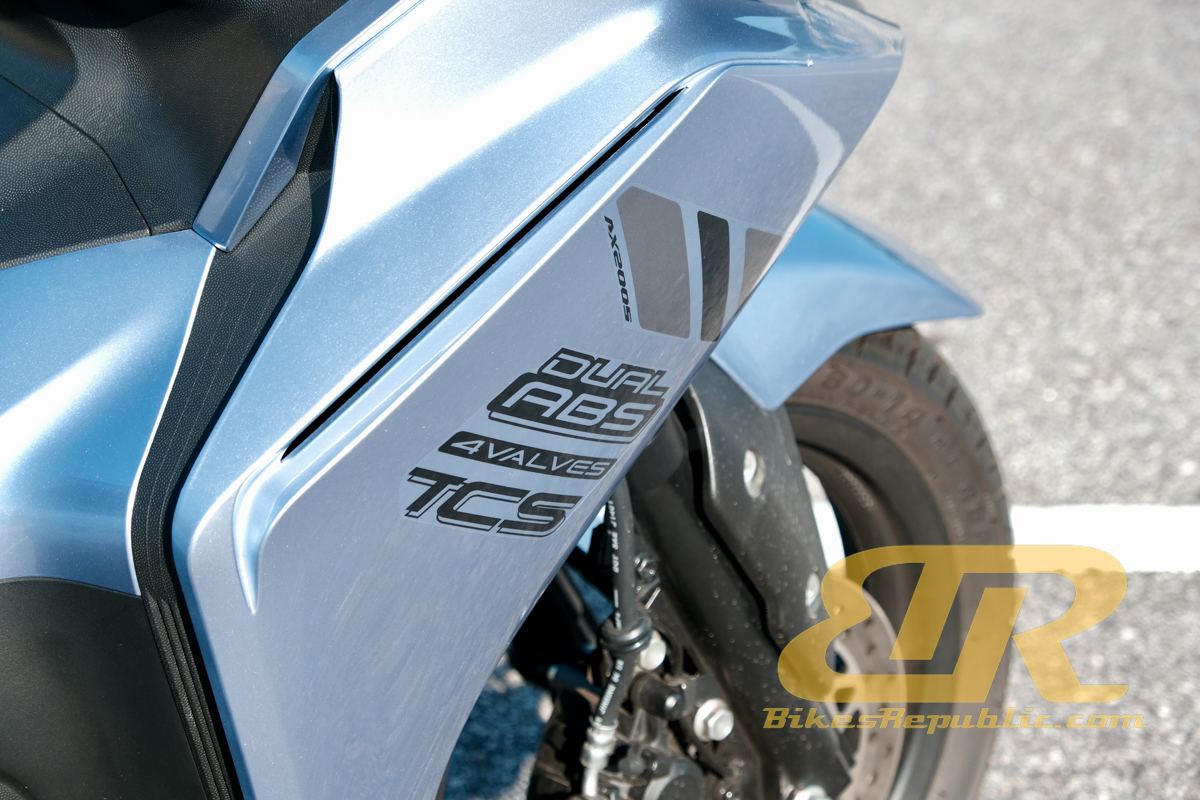
  • Dual-channel ABS and switchable TCS are standard features.
  • 100/80-14 front and 120/70-14 rear tyres.
  • 730mm seat height.

  • 10-litre fuel tank.
  • Dry weight of 127 kg.
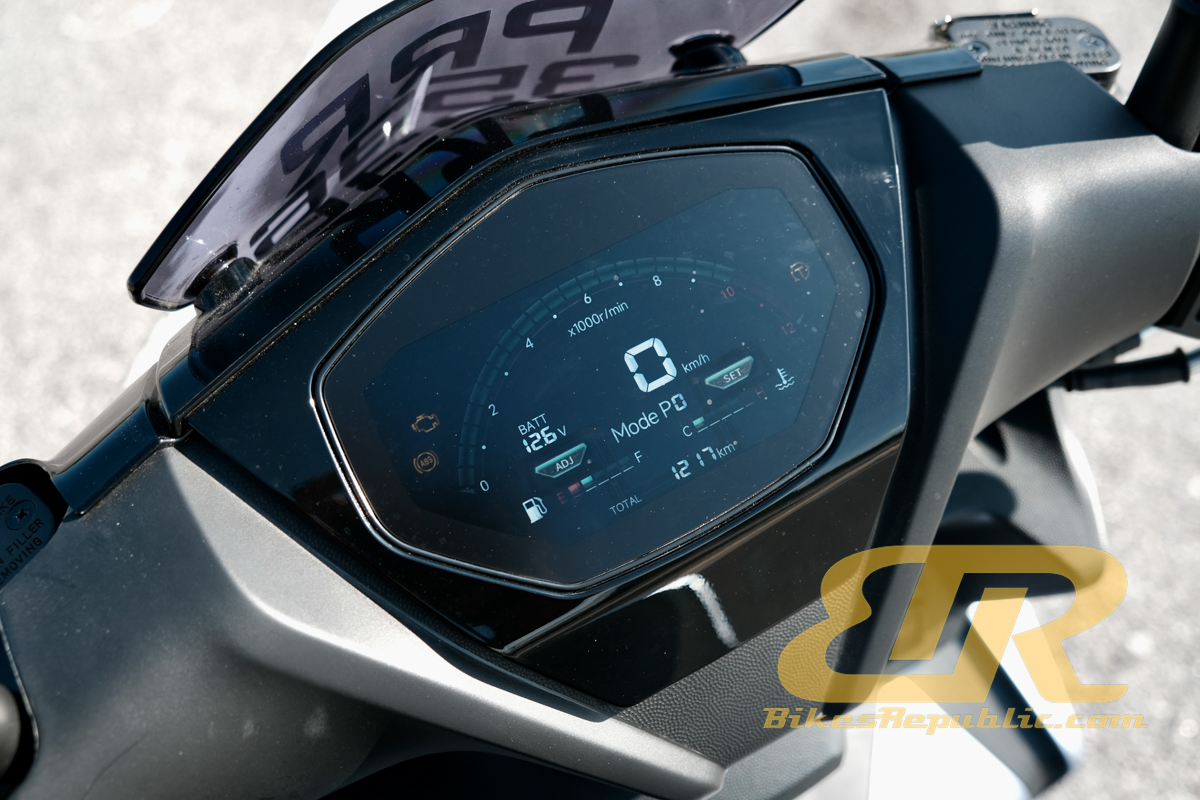
  • LCD screen with touchscreen “buttons.”

  • Idle stop function.
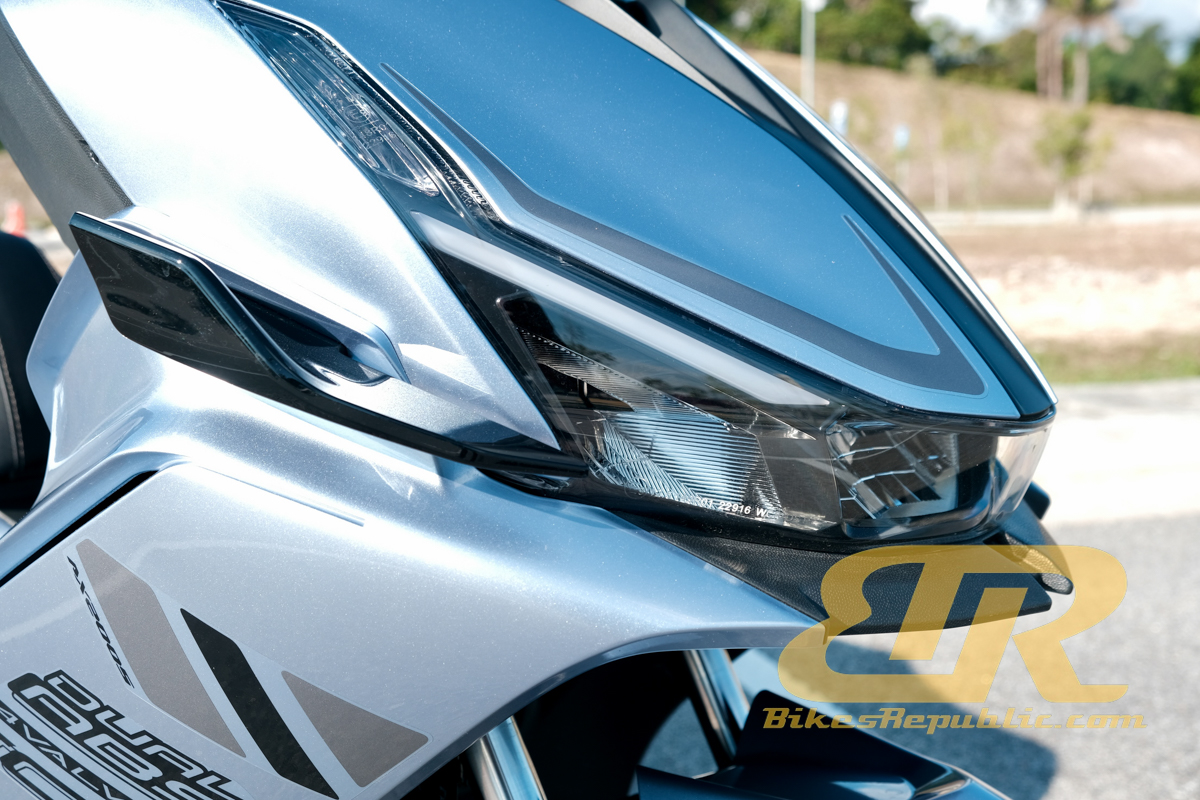
  • LED lighting.

On paper, the AX200s pulls ahead in several aspects, such as engine capacity hence maximum power and torque outputs, besides featuring a rear disc brake, bigger fuel tank, and touchscreen metre panel. What it lacks is a smartphone connectivity feature like the Yamaha Y-Connect, but we cannot have it all, can we?

Riding impressions

Pre-ride

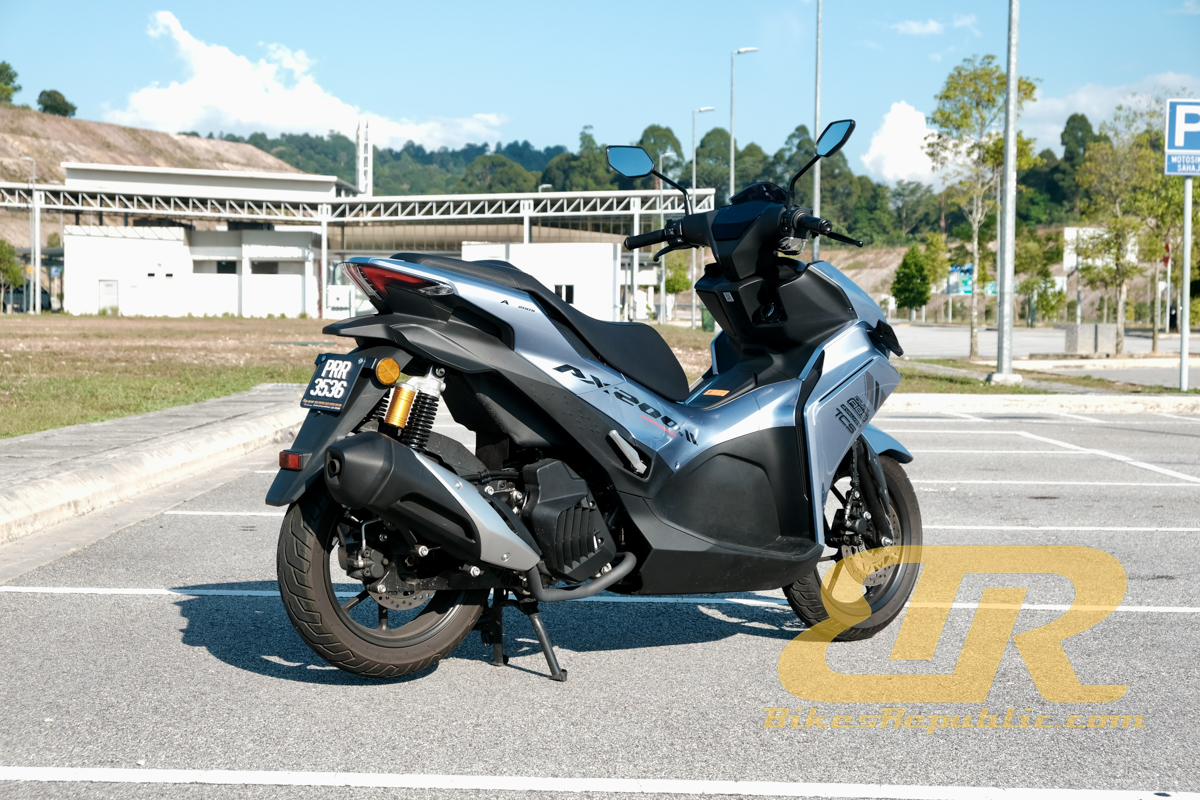
Our first impression of the QJMotor AX200s was how compact it is, so much so it could easily be mistaken for a 100cc scooter. It was short from headlight to taillight, had a narrow handlebar, and a diminutive passenger’s seat. That made it look both sporty and cute.

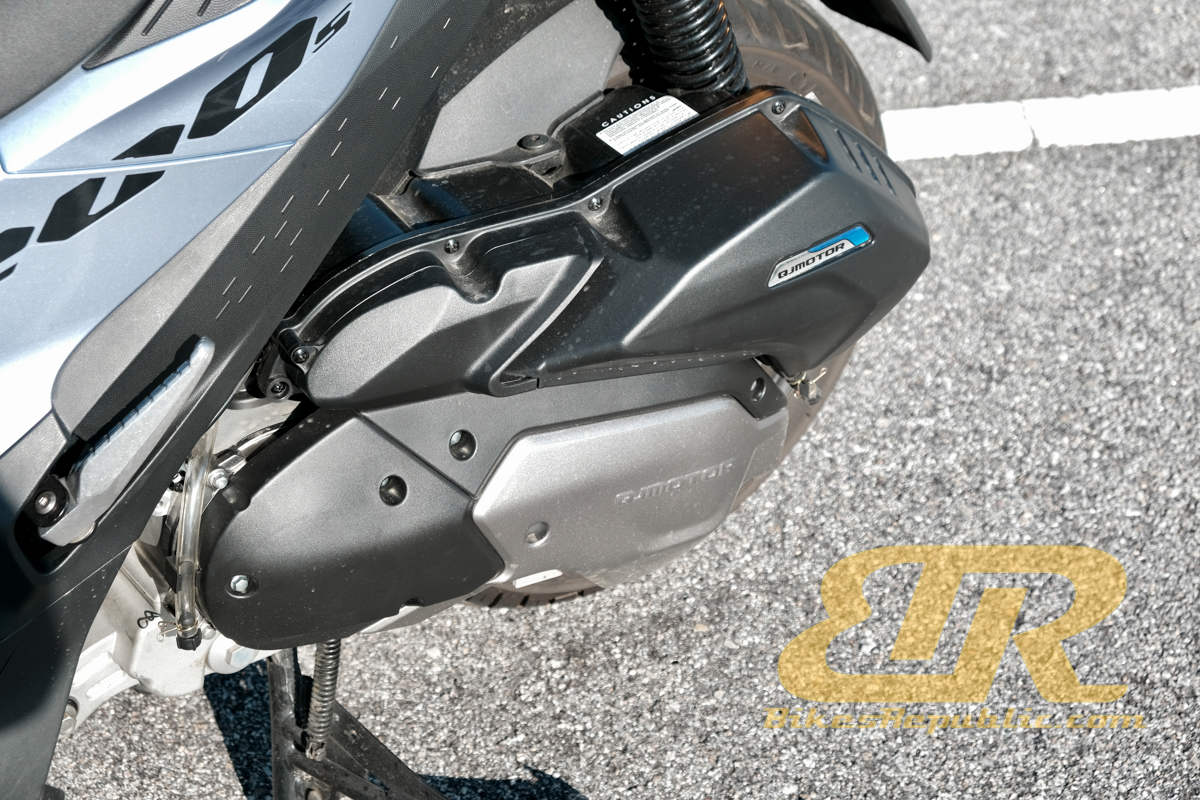
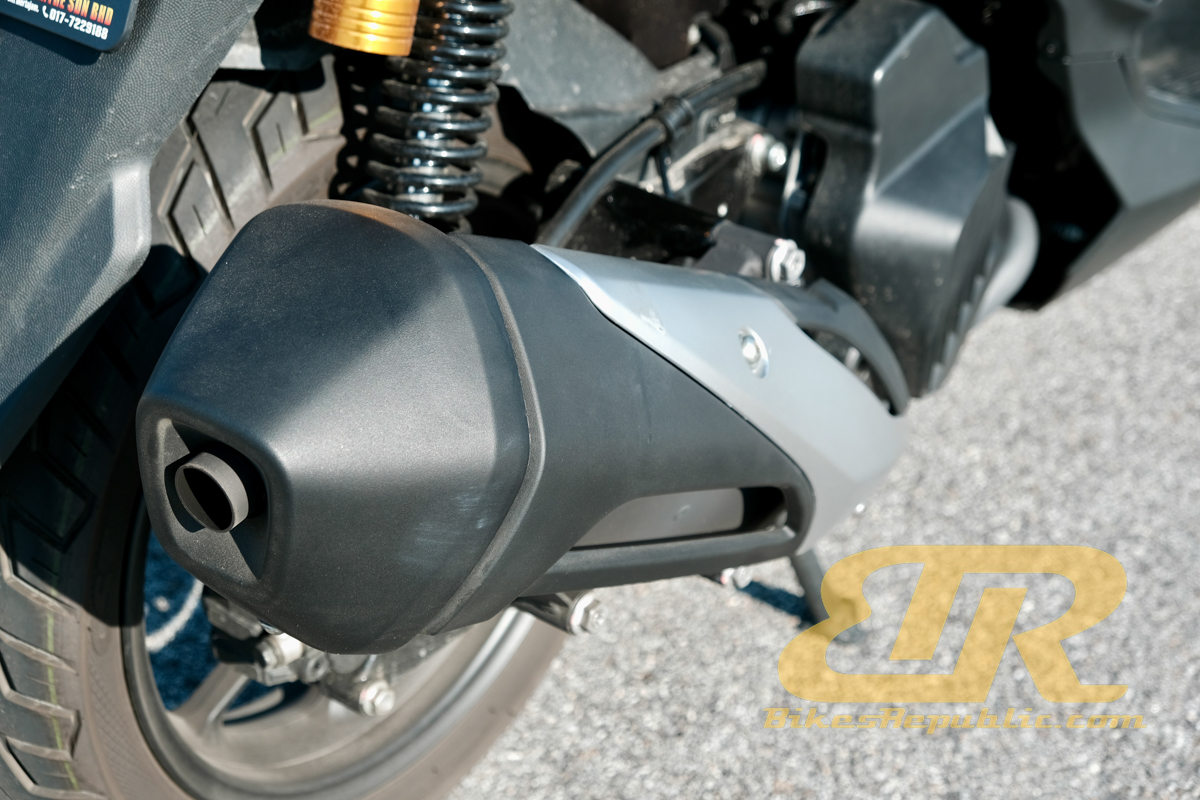
As with every scooter, everything was tucked away underneath a neatly designed bodywork. Speaking about neat, say all you want about Chinese motorcycle makers, but this bike oozed quality: The paint was flawless, there was no rough edge on the plastics, and metal parts had smooth finishing.

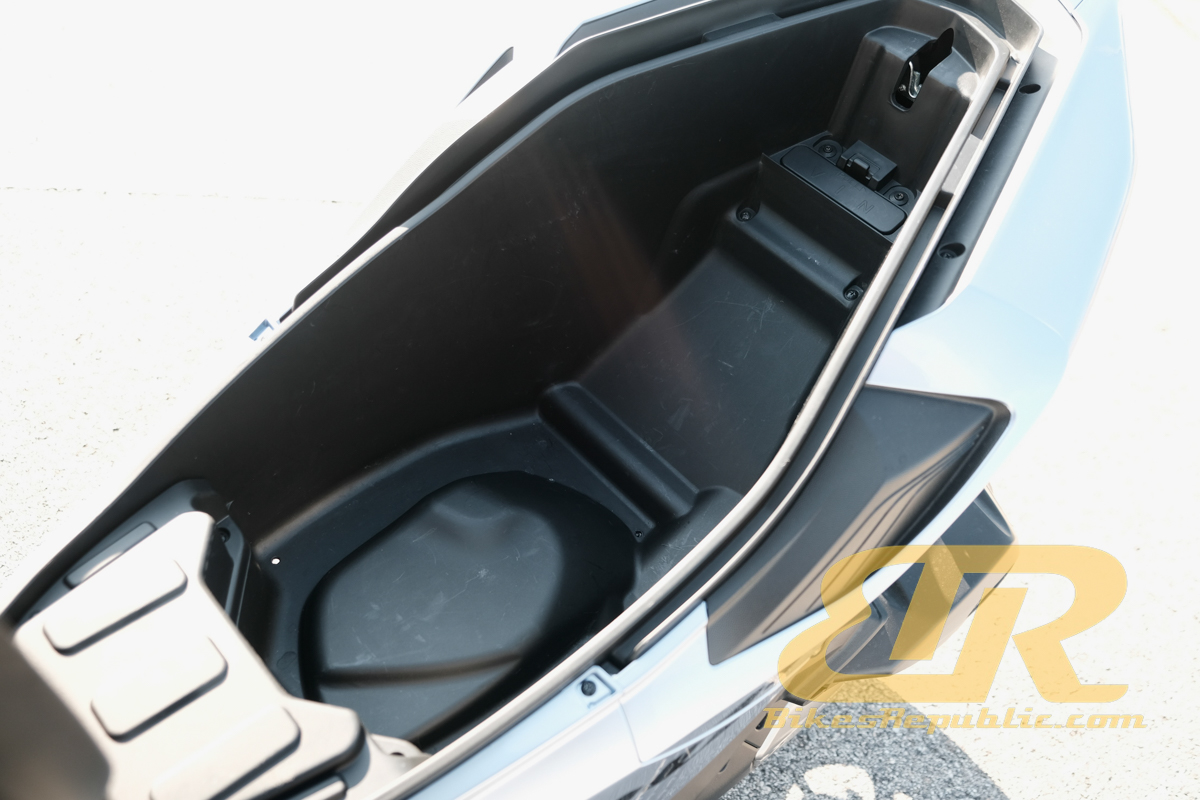
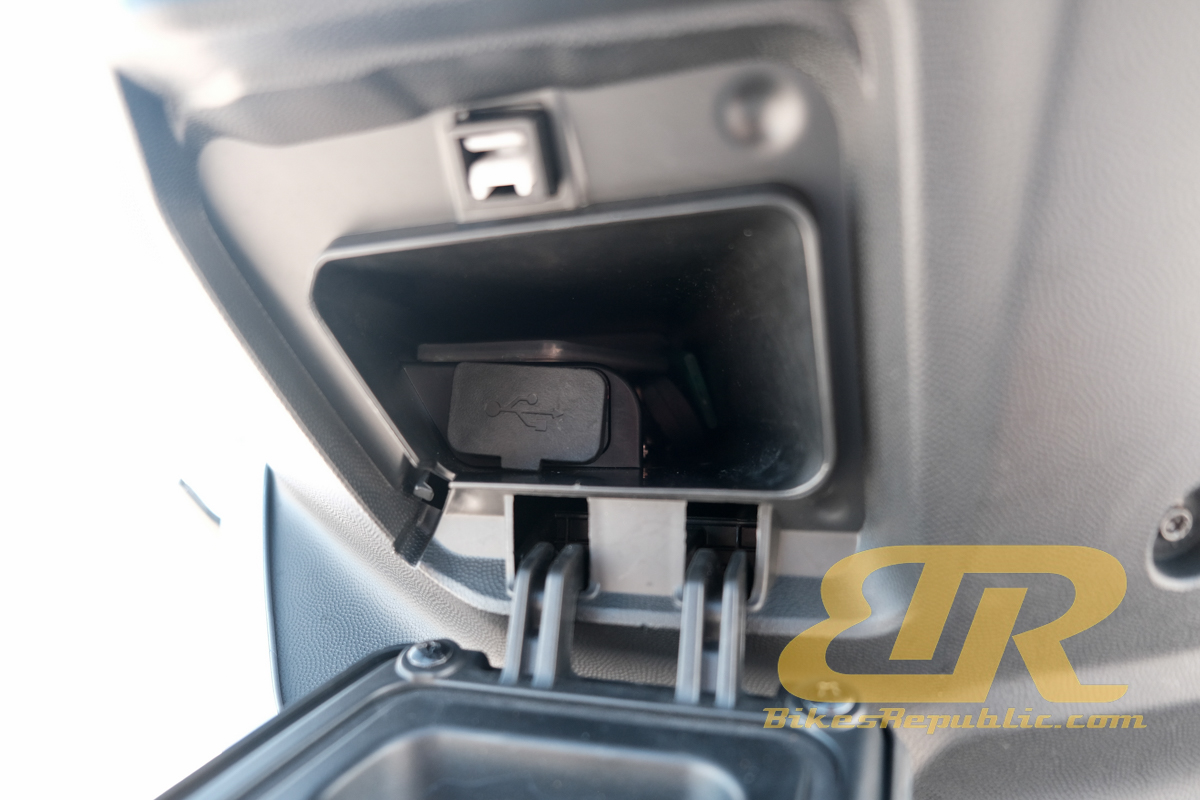
The front “glovebox” was small and had enough space for a standard-sized smartphone and a USB-C charging port. The underseat storage space was also rather small, due to the bike’s compact exterior.

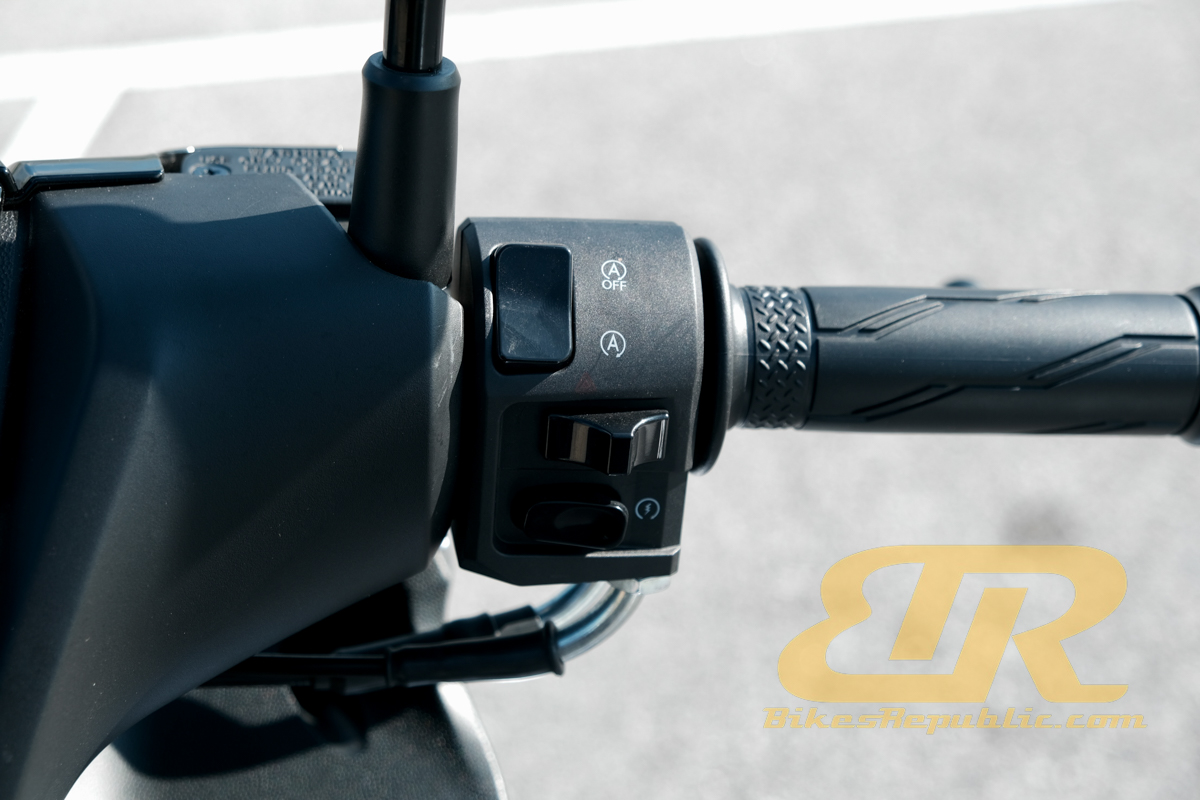
Moving onto the instrumentation, data was displayed on a beautiful colour LCD screen. The letters and icons are so sharp that some thought it was a TFT screen. There was no physical button to switch among the information and to turn the traction control off. Instead, you tap and hold the SET “button” until it blinks, then tap the ADJ icon to select. It works if you wear gloves with phone touch pads, too.

Daily riding

From the perspective of a 167cm rider with short legs and arms, his feet found the ground easily. A little bit of tip toeing, but not ballerina-like, due to the low seat and its shape which taperered sharply toward the front. In any case, the footprint was secure and we could immediately discern the bike’s lightness as it was easy to push around while seated, even up a slight slope.

The reach to the handlebar was (very) short, especially after hopping off a big bike to the AX200s, and we initially felt as if our elbows grew out of our torso. However, it became natural when we spread our elbows.

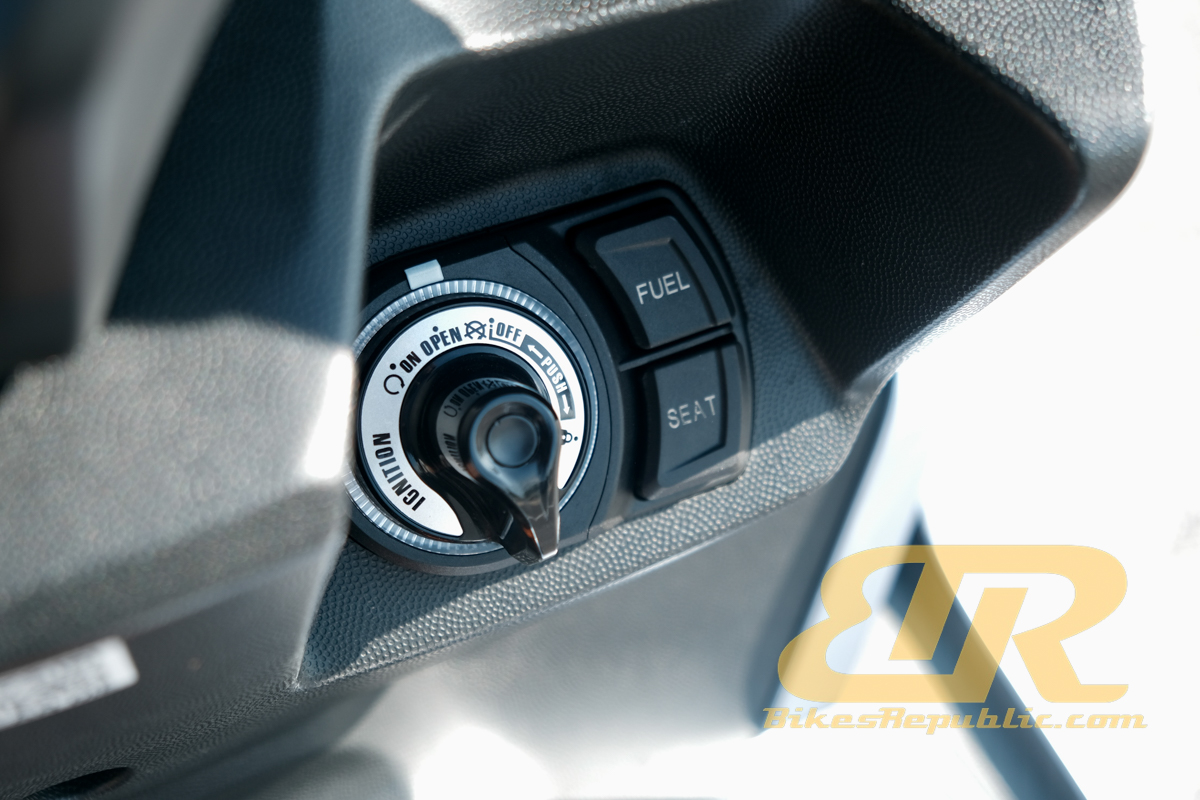
With all that out of the way, it is a simple scooter and all we had to do was climb on, twisted the Smart Key knob to the correct position, started the engine, twisted the throttle and off we went. There was no power mode or phone connectivity suite to fiddle with.

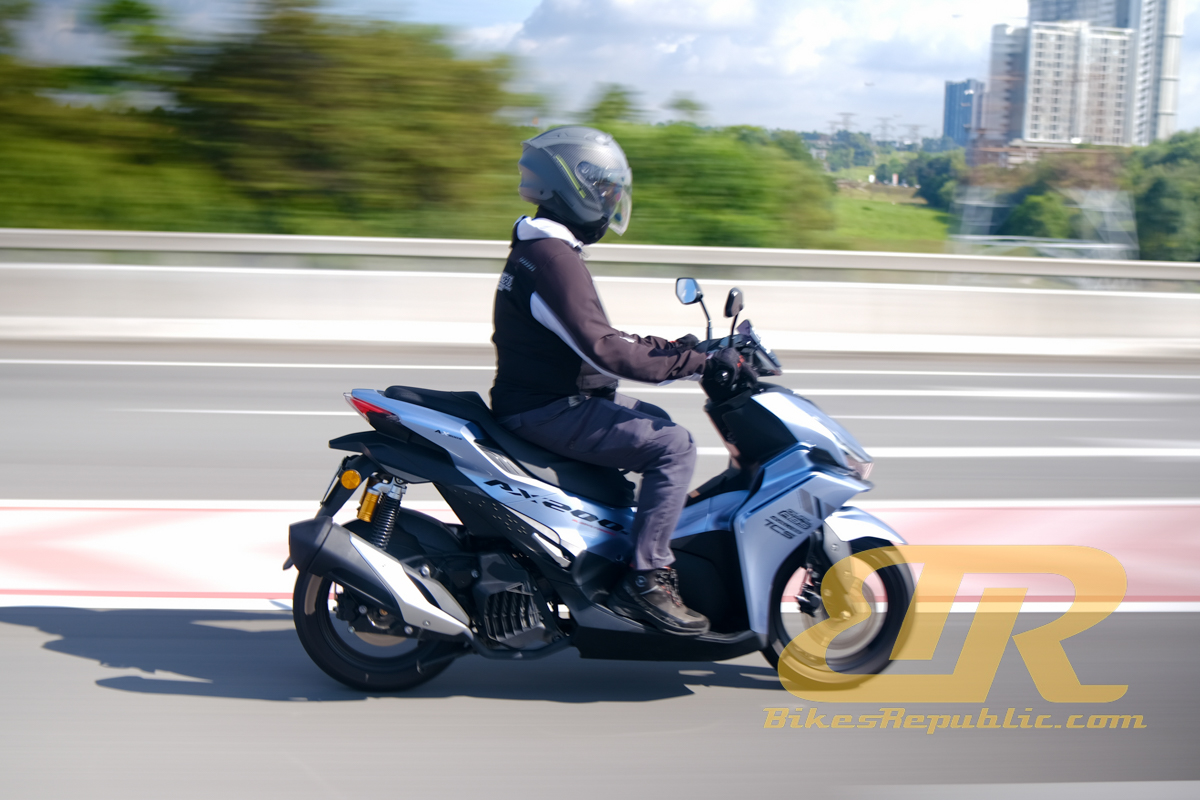
The AX200s jumped off the line quickly like a scalded cat (apologies for the expression) and kept going as long as the throttle remained open. Glancing in the rearview mirror showed that we had dumped everyone else behind at the traffic lights.

It was not limited to low-RPM torque only as the engine seemed to have much reserve torque anywhere in the RPM range up to its top speed. This quick-reacting torque made overtaking easy, whether on B-roads or highways. The bike’s top speed was also achieved rapidly.

On the other hand, chopping the throttle saw the engine’s back torque (engine braking) grabbing quickly, which pointed toward the bike being fitted with light roller weights.

As such, throttle feedback was a little snatchy when it was first cracked open and shut quickly, especially when we were riding in stop/start traffic. Regardless, we worked around this by holding the throttle very slightly open and dragging the brakes.

Speaking of the brakes, they were superbly strong. Scooters have most of their weight at the back, and therefore the AX200s’s rear brake was more powerful than the front, which was the correct brake force bias. But that did not mean the front brake was anaemic because using the front anchor alone was more enough to bring the bike to a stop without drama.

Another character we enjoyed was its handling. Granted, such scooters feature quick steering as part of their DNA but the AX200s was also stable through corners, unlike some that waggle their handlebars. As such, we ended up charging into and blasting out of corners as if it was a bigger bike. Adding to this attribute was the bike’s generous cornering clearance – we tried to see if it dragged a stand into corners but never succeeded despite throwing the bike into 90-degree corners at high speeds.

Contributing to the QJMotor AX200s’s admirable handling was its suspension and chassis. The forks looked basic but they do not dive like the Titan submersible even during hard braking that activated the ABS. The dual rear shocks provided a progressive damping characteristic, especially useful in corners.

However, there is only so much suspension travel for urban scooters compared to adventure scooters. Consequently, the AX200s’s suspension felt harsh over sharp bumps. Still, it was necessary and easy to live with compared to having a suspension that wallows like a boat.

Last but not least, that engine returned great fuel economy despite us wringing its neck and deactivating the engine idle stop feature. We filled up half a tank only once during our test period, after picking it up with the low fuel warning showing. Thus the full 10 litres should be able to carry you over a long distance.

Oh yes, talking about low fuel warning: The bike automatically flashed the emergency signal when the fuel level dropped too low, as a warning to the rider and other road users that the engine may flame out at any time. The said warning turned itself off after filling up.

Conclusion

We thoroughly enjoyed ourselves while testing the AX200s. It truly showed just why scooters are so popular at the moment – convenience being on the top of the list. However, the AX200s provided much more than convenience, making it a lot of fun, even for us jaded old timers.

Our only complaint was the small underseat storage space, but it was still enough to fit a three-day grocery bag. Looking at it objectively, not everyone rides along with their laptop computer everyday like us.

Overall, the 2025 QJMotor AX200s was a good product, worthy of the attention. At just RM7,988 (not on-the-road), it is certainly enticing.

Photo gallery

Open-class naked bikes. It is about aggressiveness, style, and performance. In other words, pure motorcycling. Granted, we are lucky to have many open class (1000cc) naked bikes in Malaysia, but the Japanese offerings seem to play the second fiddle to their European rivals in the minds of consumers. So, will this 2025 Honda CB1000 SP bring about a shift in this perception?

What is the 2025 Honda CB1000 SP?

Firstly, the CB1000 is also known as the Hornet 1000 in European markets, and therefore, we need to elaborate further.

The CB1000 range consists Honda’s open-class naked/roadster motorcycles, and it has two current models, namely this CB1000 and the CB1000R. A CB1000F prototype was  also revealed at the Tokyo Motorcycle Show this March and may be launched at the Suzuka 8 Hours Endurance Race in August.

Honda CB1000F

CB1000R: Honda calls it a Neo Café streetfighter, with a single-sided swingarm.

CB1000F: The upcoming variant is an homage to the CB750F/CB900F that Freddie Spencer campaigned in the AMA Superbike Championship in the late 70s and early 80s.

CB1000/CB1000 SP/Hornet 1000: A sporty streetfighter, with a conventional double-side swingarm. The SP version features several goodies.

All three variants share the same 1000cc, inline-four engine adopted from the 2017 Honda CBR1000RR Fireblade, albeit tuned for low to mid-range torque, plus the tubular steel frame.

To understand the CB1000’s philosophy further, the Hornet name is hallowed to Honda. The maker launched the first CB600F Hornet in 1998 for the European market. It was powered by the 599cc, inline-line four engine adopted from the CBR600F (and later CBR600RR) sportbike, and minus the higher-end components. Hence, The Hornet was more accessible, practical, and cheaper, becoming the most popular 600c motorcycle in the UK and Europe.

Coming back to the CB1000/Hornet 1000, it embodies the spirit of accessible performance, practicality, at a budget friendly price, wrapped up in a sharp, aggressive bodywork thereby distinguishing its character compared to its brethren.

Highlights of the 2025 Honda CB1000 SP

  • 1000cc, liquid-cooled, 16-valve DOHC inline-four delivers 155 hp (115.6kW) at 11,000rpm and 107Nm of torque at 9,000rpm.
  • The gain of 5.4 hp (4kW) and 2 Nm is achieved through the addition of a Revolutionary Controlled (RC) valve in the 7.1L exhaust muffler, compared to the non-SP version.
  • Fueling is managed via PGM-FI (Programmed Fuel Injection), supported by a 17L fuel tank.

  • Multi-plate assist & slipper wet clutch, and 6-speed transmission.
  • Adjustable quickshifter enables clutchless up/down shifts.
  • Twin LED projectors and a muscular-style tank.

  • Twin-spar steel frame.
  • Fully-adjustable 41mm Showa SFF-BP forks.
  • Fully-adjustable Öhlins TTX36 rear shock with Pro-Link.

  • Brembo Stylema front brake calipers and 310mm floating discs.
  • 5″ TFT display with Honda RoadSync supports calls, music, nav, and notifications via Bluetooth.
  • Emergency Stop Signal (ESS) system flashes hazard lights during sudden braking for added safety.

  • Three default ride modes (SPORT, STANDARD, RAIN) plus two customisable USER modes.
  • USER1 and USER2 modes allow the rider to tailor Adjustable Power and Engine Braking.
  • Four-level Honda Selectable Torque Control (HSTC) and Wheelie Control boost traction and stability across conditions.
  • 211 kg curb weight.

Riding the 2025 Honda CB1000 SP

Pre-Ride

Our first impression of the new CB1000, engine rumbling at idle with its heat washing over us got our pulse pumping. We have ridden the CB1000R several years ago but that did not have the same effect, for some reason… The new bike has sharper front end (which split opinion, yes), bulbous fuel tank, and sharp tail. The gold rims and forks offset the stealth fighter-like matte black bodywork, resulting in a luxurious look, like that of 70s racebikes and race cars.

Speaking about the front end, we have had comments that it is similar or even identical to the Kawasaki Z1000 and Ducati Streetfighter. What we could say is it looked so very different in the flesh.

We always begin our initial test rides with familiarising ourselves with the bikes’ conrols and settings, to avoid getting confused and distracted while riding.

The 5-inch TFT panel was the same as the one on the NSS250 scooter we just dropped off, and it was a welcome sight, given its sharp and vivid colour display. Every icon, number, and graph were easily discernible and digested. Toggling through the data and features was through “joystick” on the left handlebar. So, we paired our Bluetooth devices by adding another bike in the Honda RoadSync App, customised our display settings, set the riding mode, and quickshifter modes through the TFT screen.

The CB1000 not only use the same TFT screen, its software is also identical as the NSS250’s. We feel that this is a good thing because it makes it easy to configure all the Honda motorcycles in your garage. (In our wildest dreams, of course, judging by how much we make.)

First ride

Throwing a leg over the bike had us discovering its low seat height. Yes, it looked tall in pictures and in real life but we could place both feet on the ground securely. Honda listed the seat height at just 810mm, while most open-class naked motorcycles feature seat heights in the 830mm region.

Helping with that was the bike’s thin “waist” where the seat met the fuel tank. The profile at  the front of the tank was wide, thinned down in the middle, then the passenger’s seat widened out again, giving the motorcycle the profile of a hornet when viewed from the top.

We started out in STANDARD ride mode and the bike made it vividly clear to us that it was tuned for aggression. Slipping out the clutch in first gear and opening the throttle slightly was enough to have the bike roaring down the road. It was enjoyable to blow away absolutely everyone else when taking off from the traffic lights, along with the exhaust that was surprisingly loud for a stock unit.

Daily riding

As much as we loved that low and mid-RPM torque, which made it feel a lot more like a triple rather than a traditional inline-four, it was apparent that the engine was very eager to go. Trying to split lanes at low speeds and in STANDARD mode had the bike lunging forward as soon as the throttle was cracked open, while rolling off ever so slightly resulted in strong engine braking.

We tried to lower engine braking further in the USER1 and USER2 modes to no avail. In the end, we resorted to using the clutch a lot more.

We soon discovered that the best mode to navigate through heavy traffic was RAIN. Switching to this mode had the engine calm down aurally, and the throttle response and engine braking became very smooth.

But do not get us wrong, the CB1000 was still a huge pleasure to ride and ride quickly in urban surroundings, given that we have so many highway on and off ramps!

The Mountain

The “Mountain” is our regular test route as it offers everything the Malaysian road system could muster: Fast sweepers on the highway, tight and bumpy corners on the way up and down.

We switched to SPORT mode before leaving the BHP Gombak petrol station. The engine sounded like it was burning rocket fuel now – louder, rawer, more visceral – even before we got moving.

Pulling out of the station’s forecourt and onto the highway had our arms stretched straight as the engine gave a mighty kick, so much so that the handlebar became light and started to waggle. We were grateful that the HSTC package included Wheelie Control and could hear the engine dragging a little like the clutch being slipped. Otherwise, we would probably be pulling a crossed up wheelie.

Also thankfully, the bike’s suspension and chassis are up to the task, despite looking basic. On the highway, the bike’s sharp steering had it hitting every point we pointed it without hesitation or drama. We could change our line through corners despite being leaned way over without the chassis and tyres tying itself up in knots. Bumps on the highway felt non-existent. The only difficulty was trying to hang on due to the wind blast at elevated speeds.

Up the mountain road, we charged into corners regardless of radius or camber and let the engine’s torque carry us out to the next one. However, the suspension, especially the rear shock felt stiffer when faced with the bigger bumps and potholes. Three clicks off the TTX36’s rebound damping solved it. From here on, no bump could upset our chosen cornering line.

The brakes were also awesome. They provided amazing stopping power along with a superb feel at the lever. When push came to shove, we used that feedback to trail brake into corners which surprised several supersport riders.

Adding to the visceral feel of the bike was the RC exhaust valve which beings to open at 5,700 RPM. Riding the bike below that point, we hear the growling exhaust note. From 5,700 RPM and above, the exhaust note became a howl which stood the hairs on the back of neck up.

However, do keep in mind that 5,700 RPM in sixth gear had the bike running at over 130 km/h…

It suddenly dawned upon us about how easily we could contradict (read: fool) ourselves. This tester had said to himself that riding a slower bike or scooter was relaxing, and questioned who needs a powerful bike, only to giggle in his helmet like a schoolgirl when the Honda CB1000 SP blew everyone away. When they said power corrupts, it really does.

Conclusion

The 2025 Honda CB1000 SP reminded us that a powerful, but controllable motorcycle was always fun to ride. It is this kind of motorcycle that makes you want to go out and just ride. And ride. Repeat.

Of course, it was not perfect due to the abrupt throttle response in some riding modes but we overcame that in the first few minutes riding the bike. But it was this kind of character that imbues the bike with the two distinct personalities of a (sassy) pussycat and a tiger, depending on your preference and mood.

Also, upshifting with the quickshifter was not as smooth in the first three gear despite us playing around with different RPMs, modes, and settings. But so what? We still shift gears manually on every motorcycle (not scooters, of course!) anyway.

At just RM69,999 (RRP, not on-the-road), Boon Siew Honda had brought in another winner, and yes, it can rival the European bikes by offering great handling and accessibility.

Our final advice: Do not test ride the bike unless you are willing to suffer the adrenaline withdrawal like we did.

2025 Honda CB1000 SP Specifications

Model CB1000 Hornet SP
ENGINE
Type 1,000cc liquid-cooled, 27.6º inclined, inline-four, four-stroke
Valve Train DOHC; 4 valves per cylinder
Bore x Stroke 76.0mm x 55.1mm
Compression Ratio 11.7:1
Induction PGM-FI fuel injection with 44mm throttle bodies (ride by wire throttle)
Ignition Full transisterized
Starter Electric
Transmission 6-speed manual
Clutch Multiplate wet
Final Drive #525 Chain; 15T/45T
SUSPENSION
Front 41mm Showa Separate Function Front Fork Big Piston (SFF-BP) with adjustable preload and compression/rebound damping; 5.1 in. travel
Rear Pro-link system with Öhlins TTX36 shock absorber, adjustable preload, compression, and rebound damping; 130mm travel
BRAKES
Front Dual Brembo Stylema radial-mount four-piston hydraulic calipers with 310mm floating discs; ABS
Rear Single Nissin one-piston hydraulic caliper with 240mm disc; ABS
TIRES
Front 120/70-17
Rear 180/55-17
MEASUREMENTS
Rake (Caster Angle) 25º
Trail 98 mm
Length 2141.22 mm
Width 792.48 mm
Height 1087.12 mm
Ground Clearance 134.62 mm
Seat Height 810.26 mm
Wheelbase 1455.42 mm
Fuel Capacity 17 litres (incl. 3.78 litres reserve)
Curb Weight 210.92 kg
OTHER
Colour Matte Black Metallic

Photo gallery

Archive

Follow us on Facebook

Follow us on YouTube