Bikesrepublic

Latest News

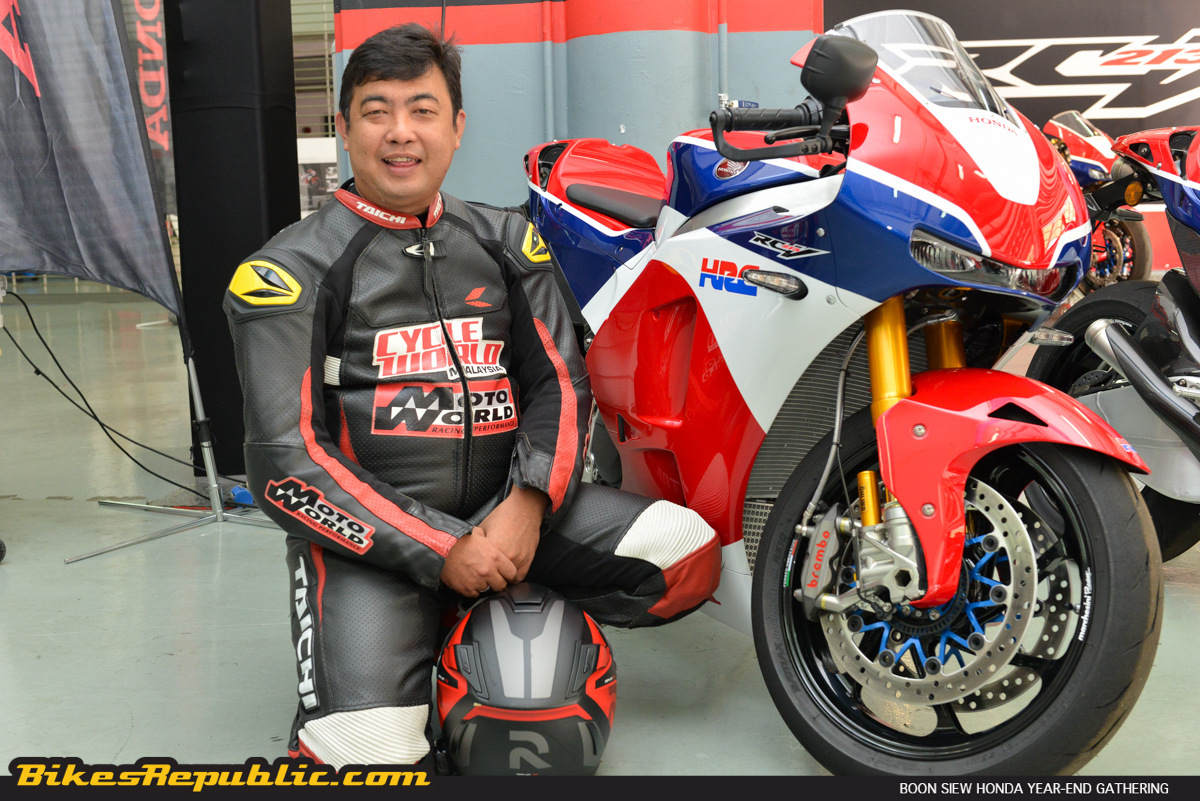
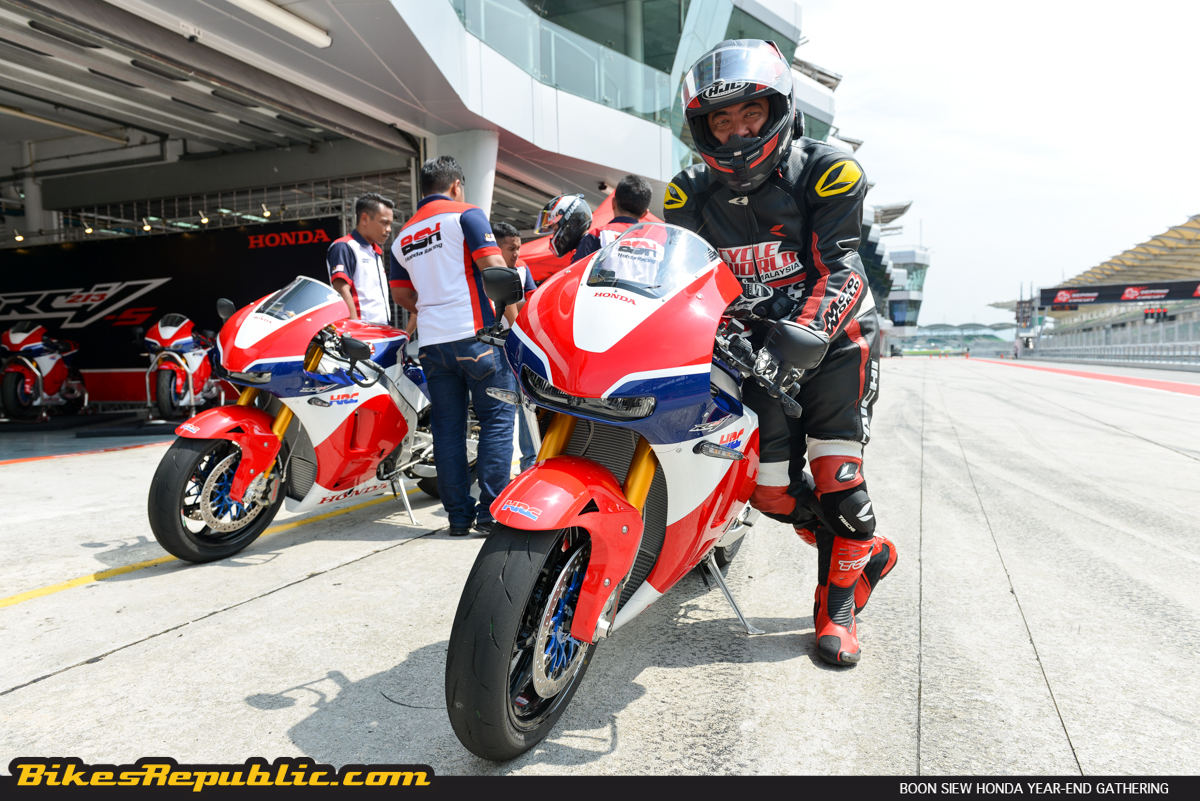
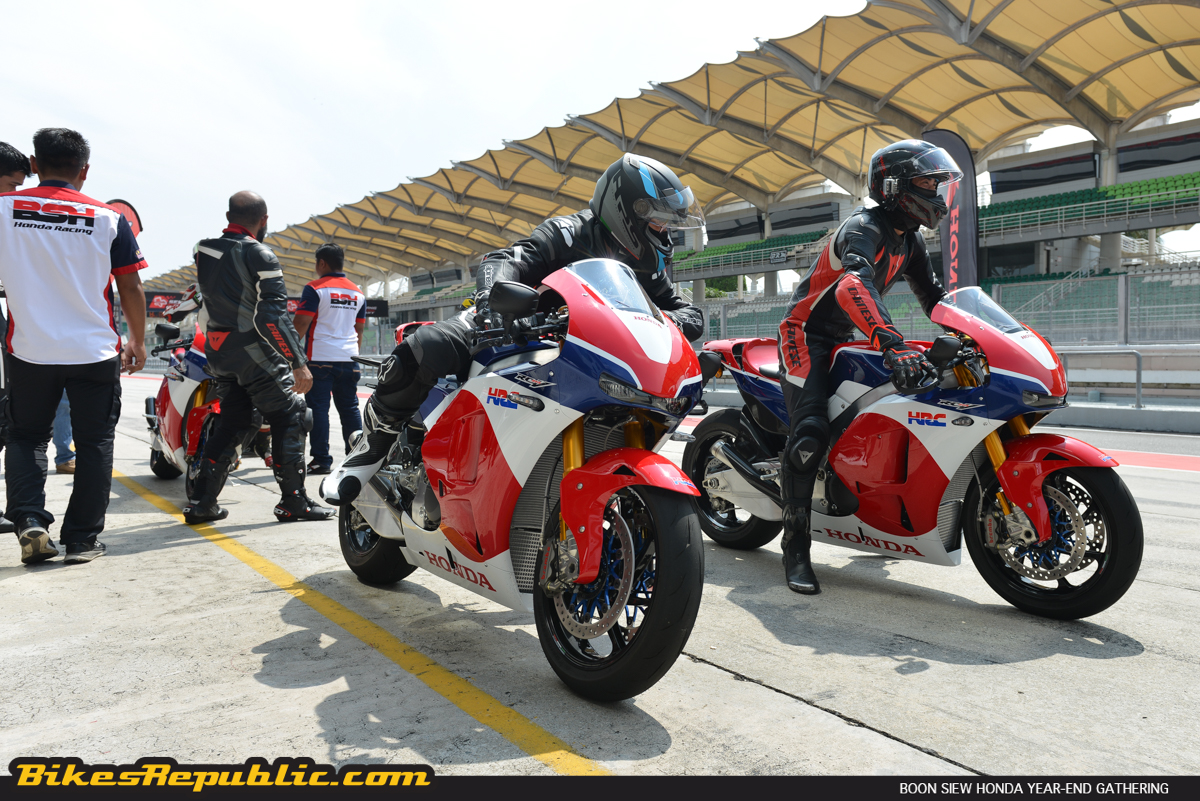
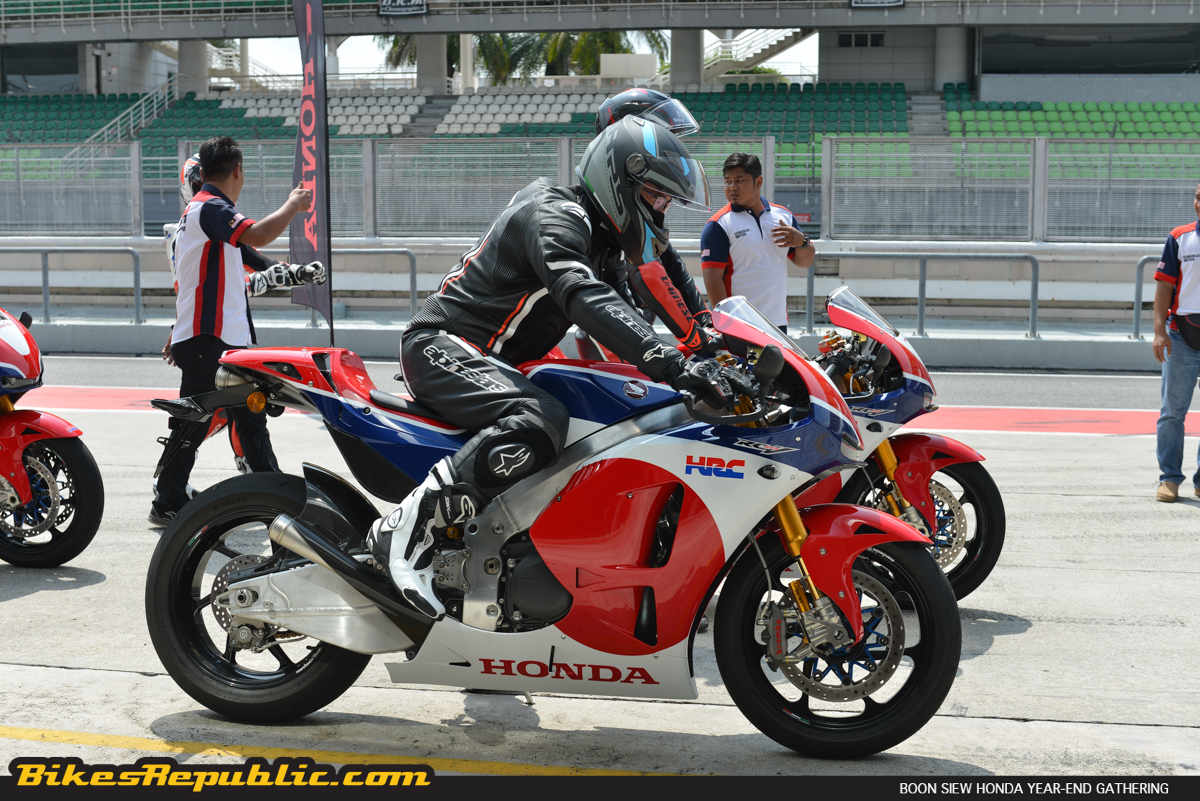
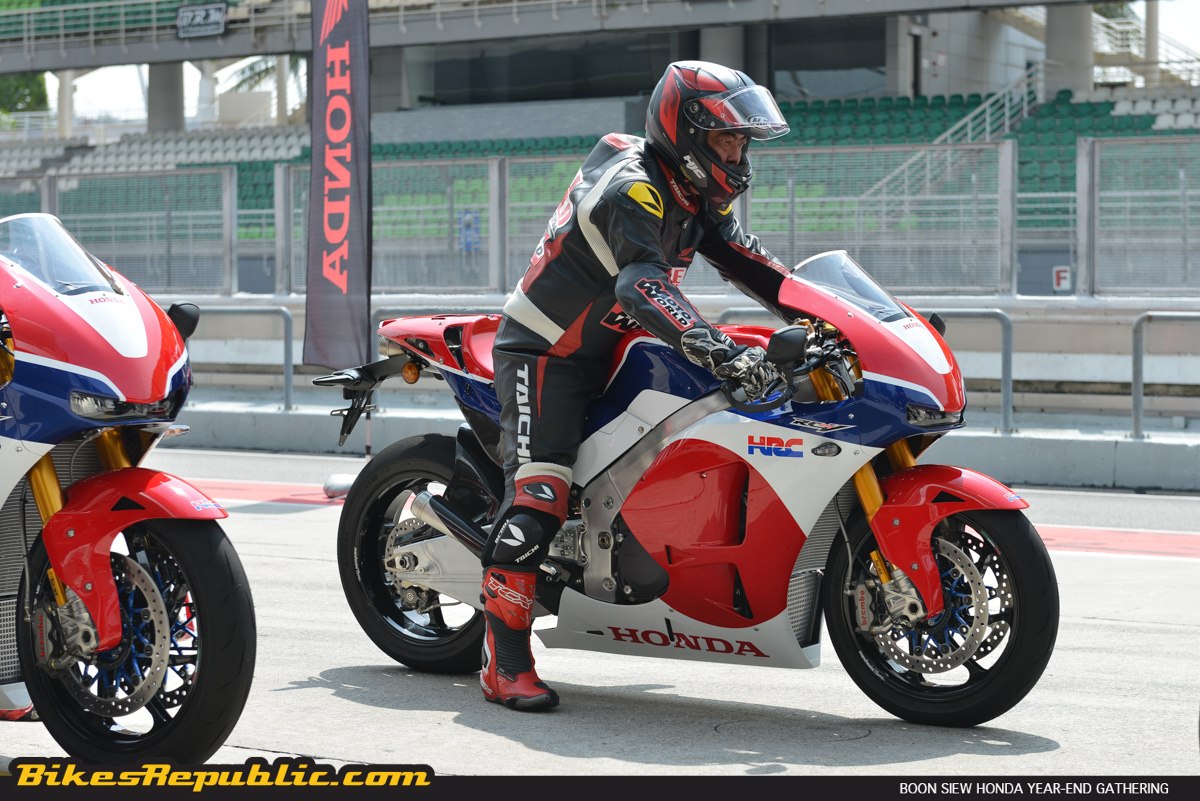
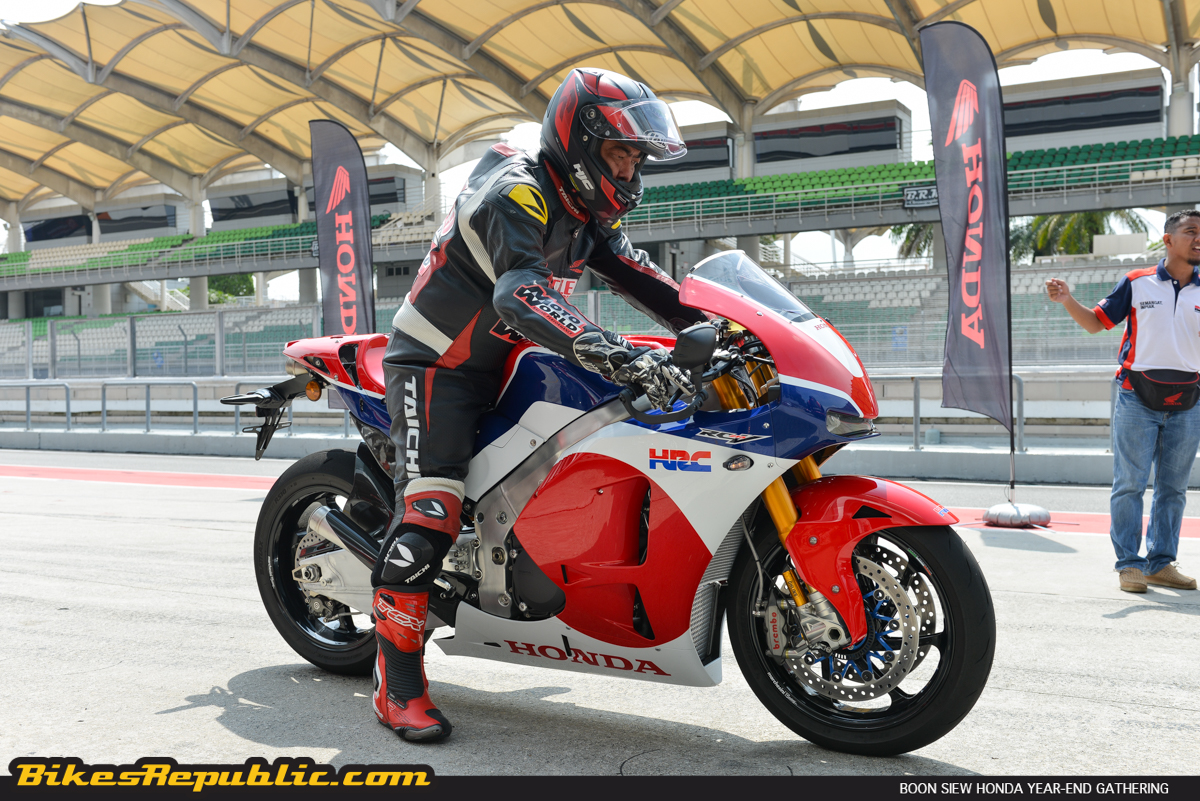
  • We had the opportunity to ride the Honda RC213V-S MotoGP replica.

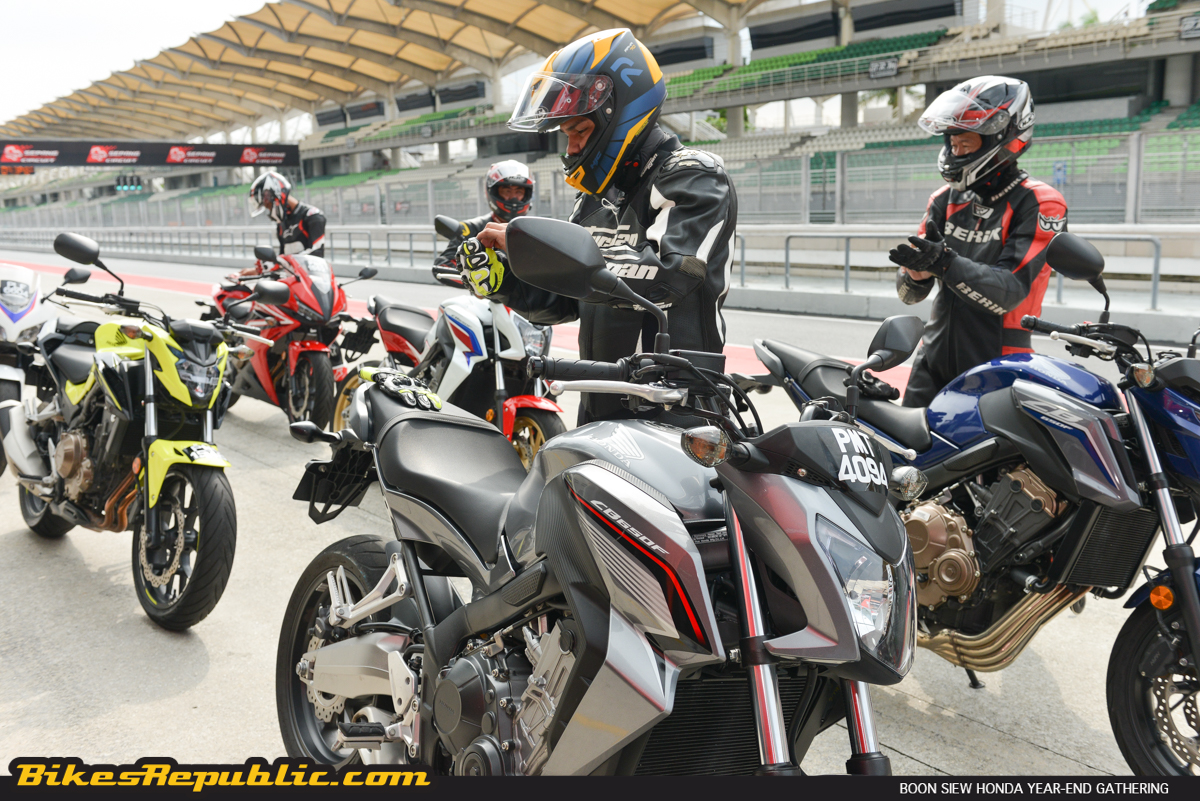
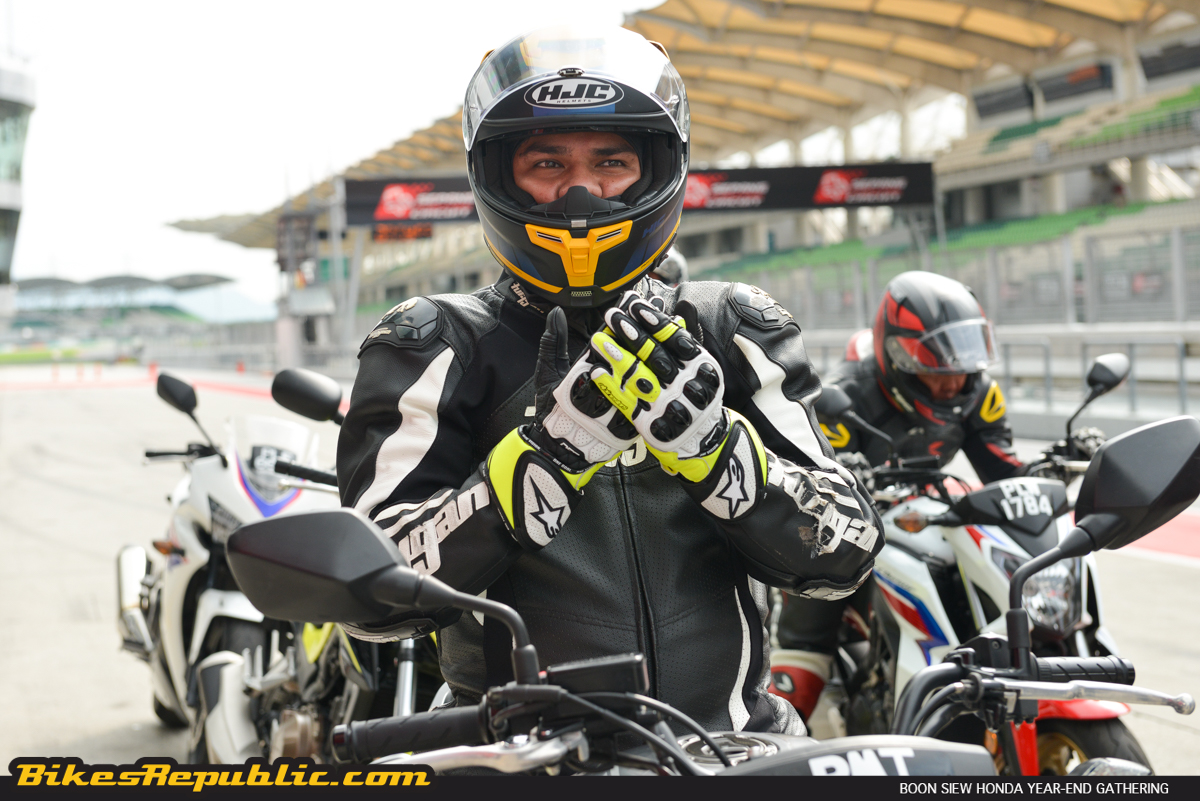
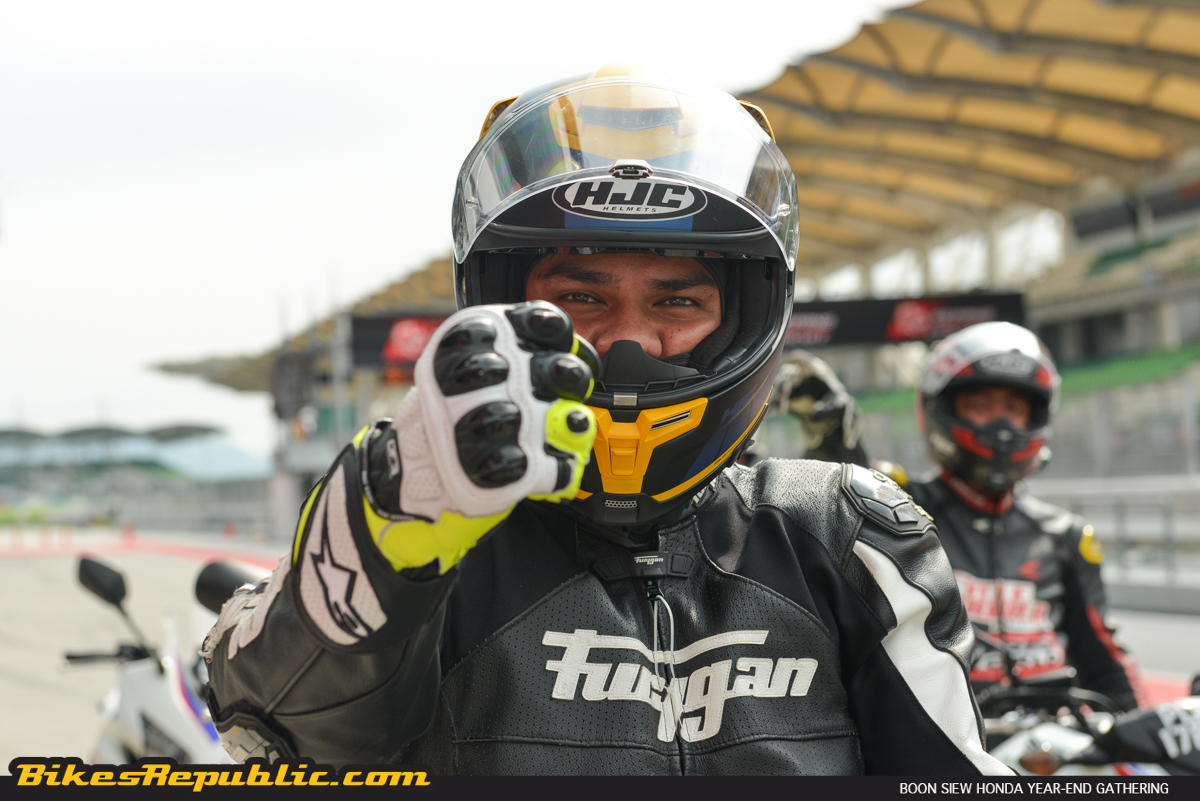
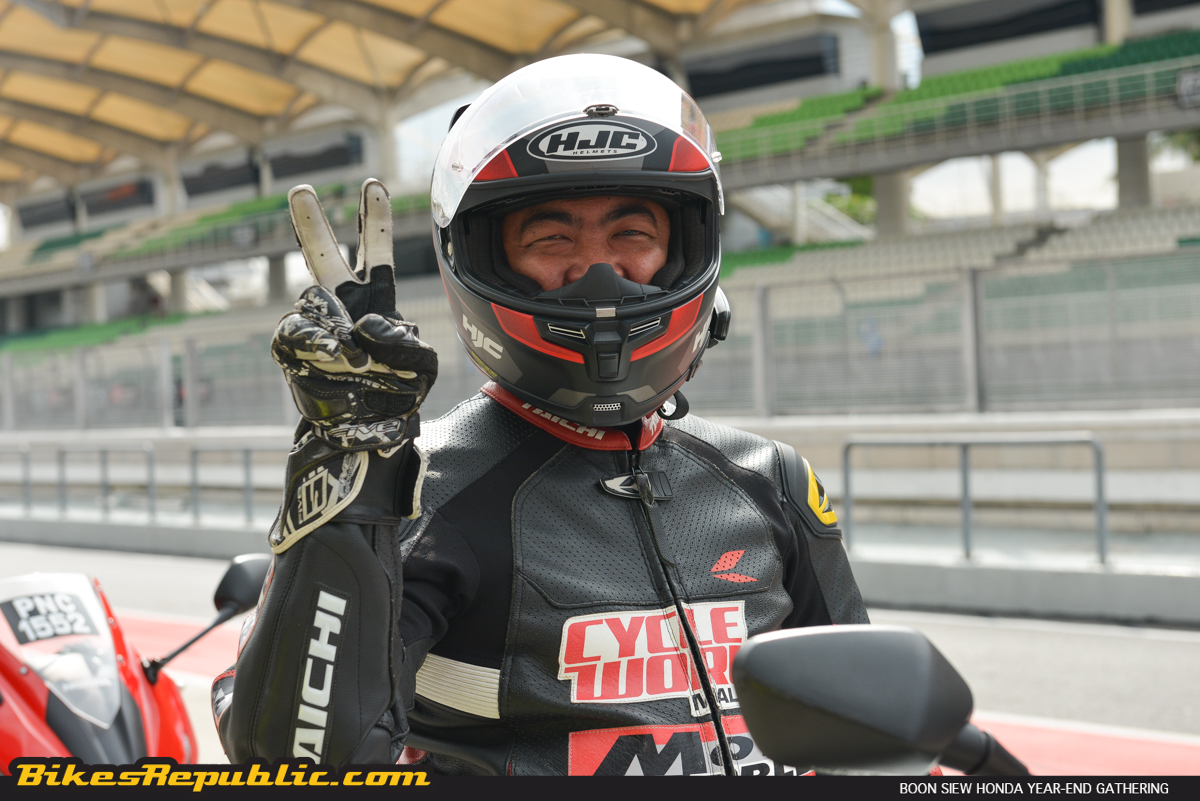
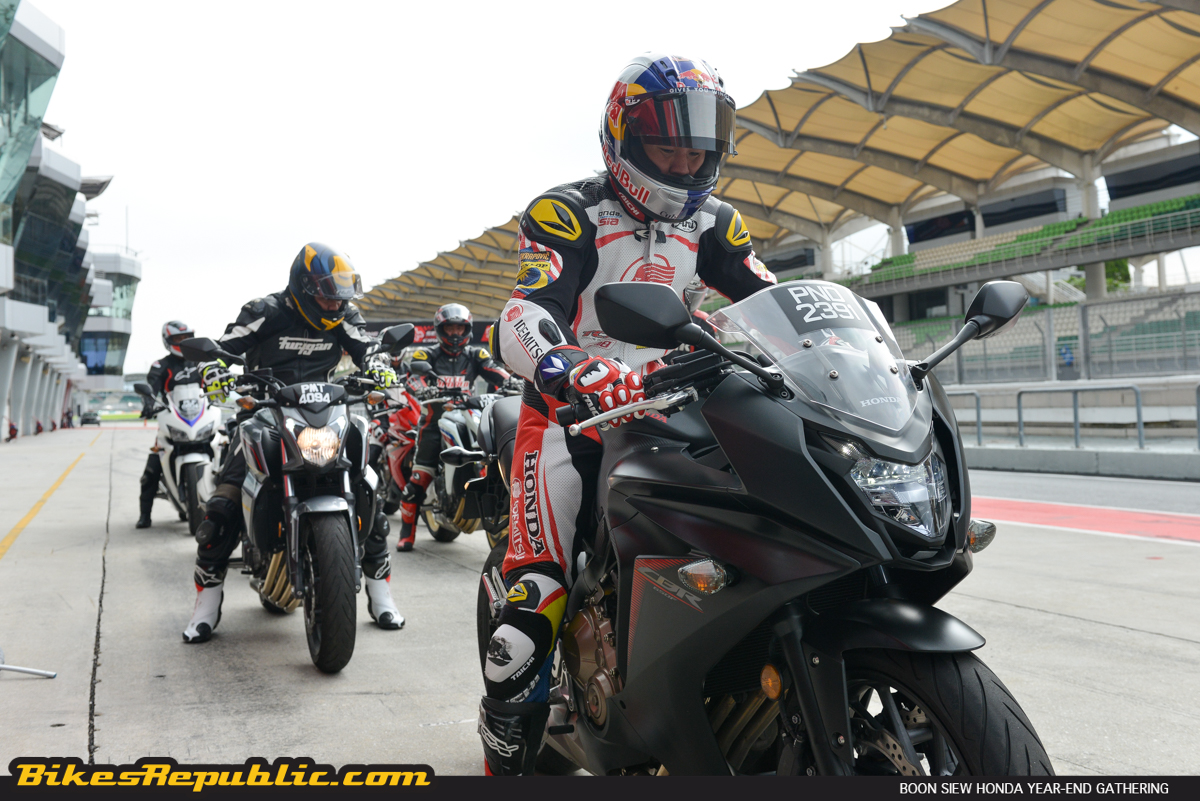
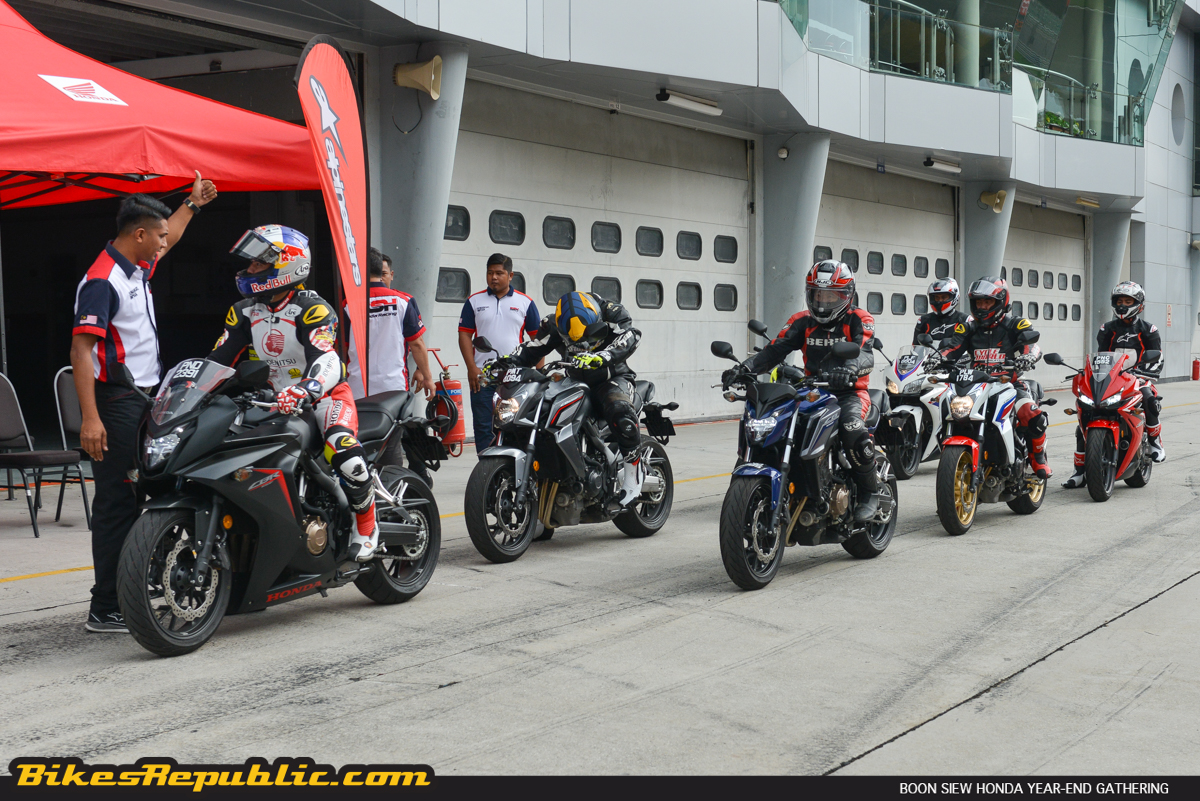
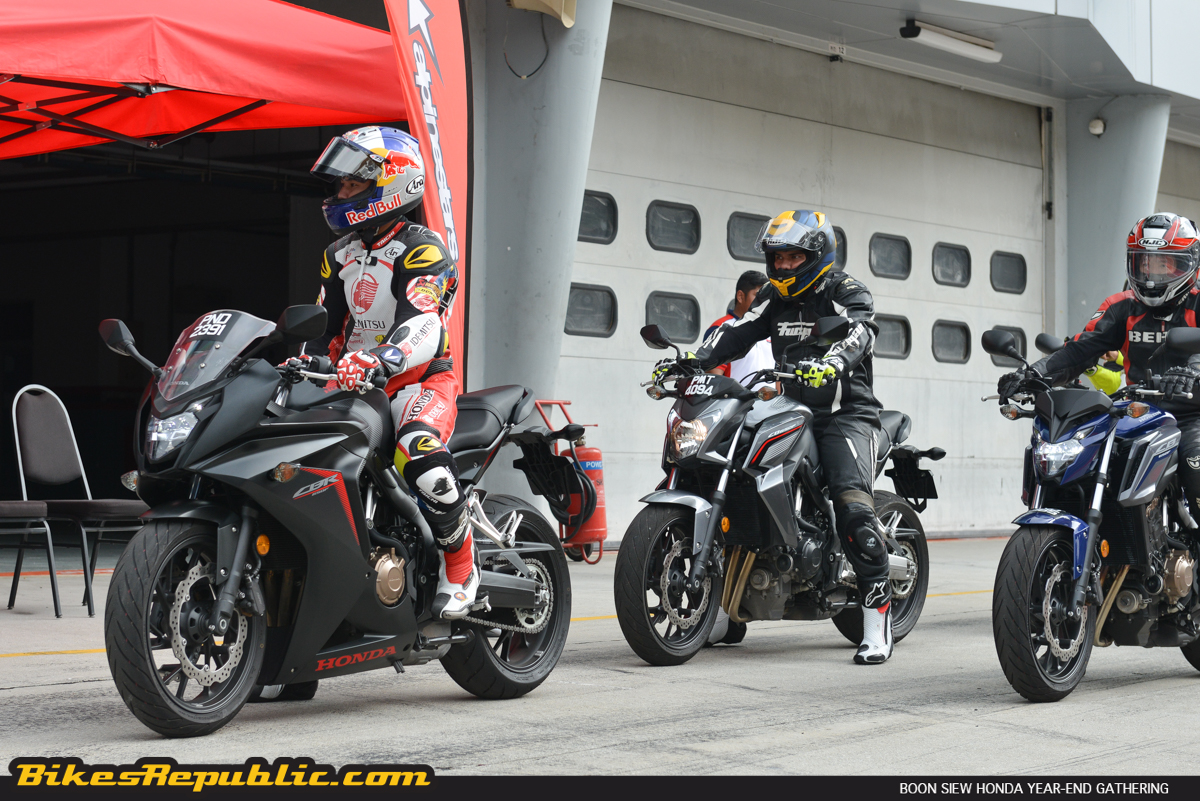
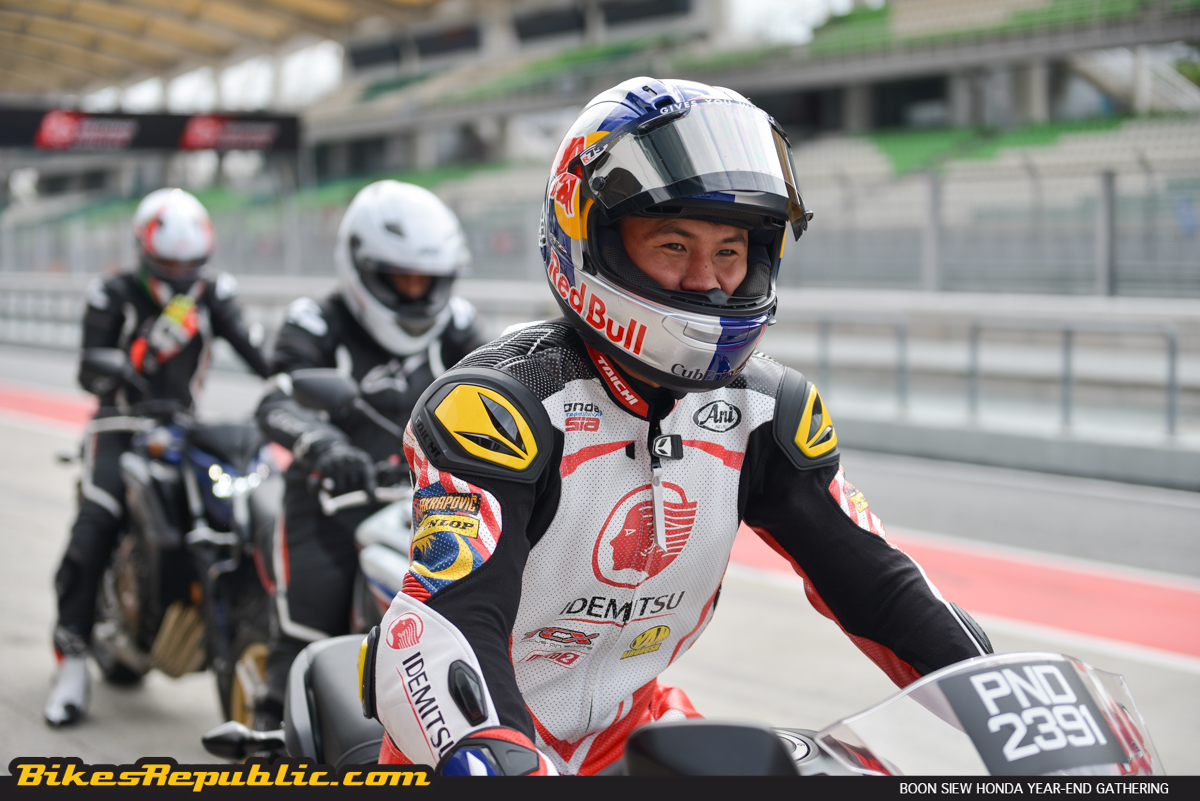
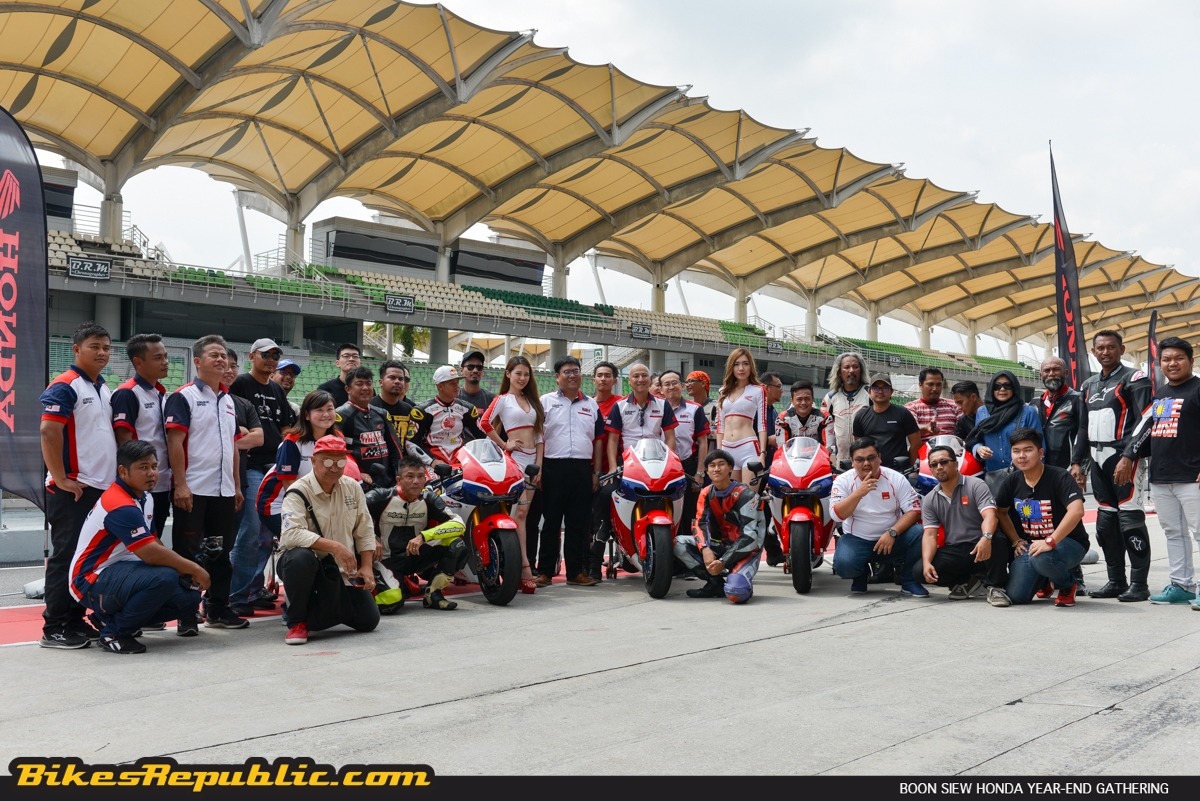
  • It was part of Boon Siew Honda’s Year-End Gathering for the media.

  • The RC213V-S was unlike no other motorcycle on the planet.

When it comes to motorcycle racing, I still romanticise what many regard as the “Golden Age of Motocycle GP.” Yes, those times were exciting, seeing riders getting spat off their 500cc two-stroker beasts without warning.
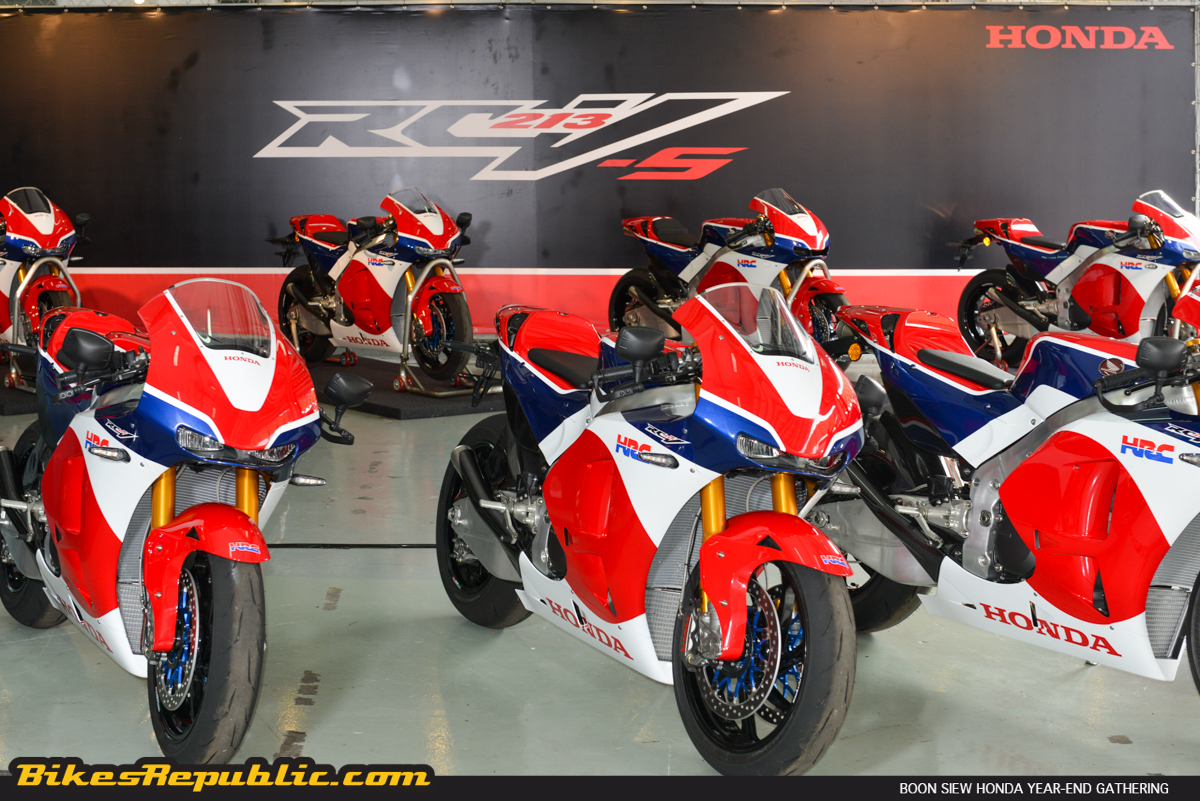
The modern-day four-stroke MotoGP machines look tamer on the other hand, but would any of us mere mortals dare claim they’d be easy to ride? So, when Sep informed that we were invited to ride the million-Ringgit (EUR 188,000) RC213V-S at SIC, every nerve cell hit the rev limiter.
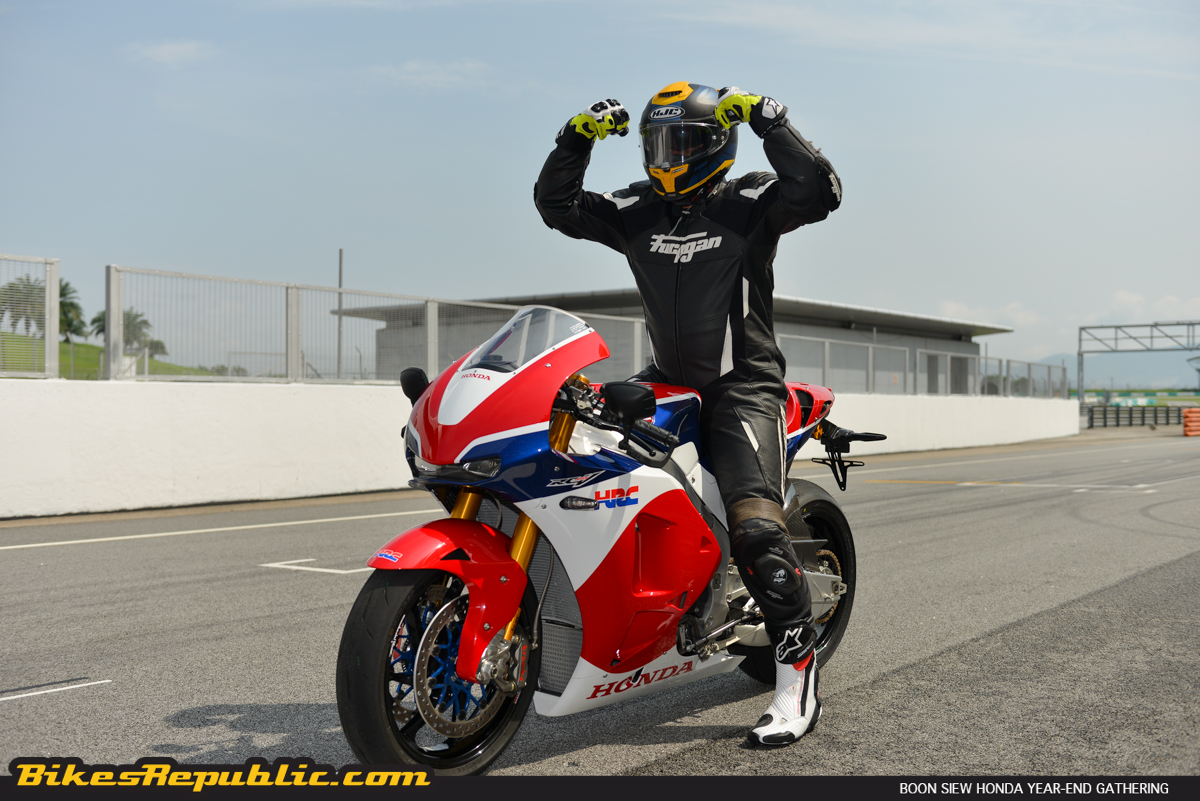
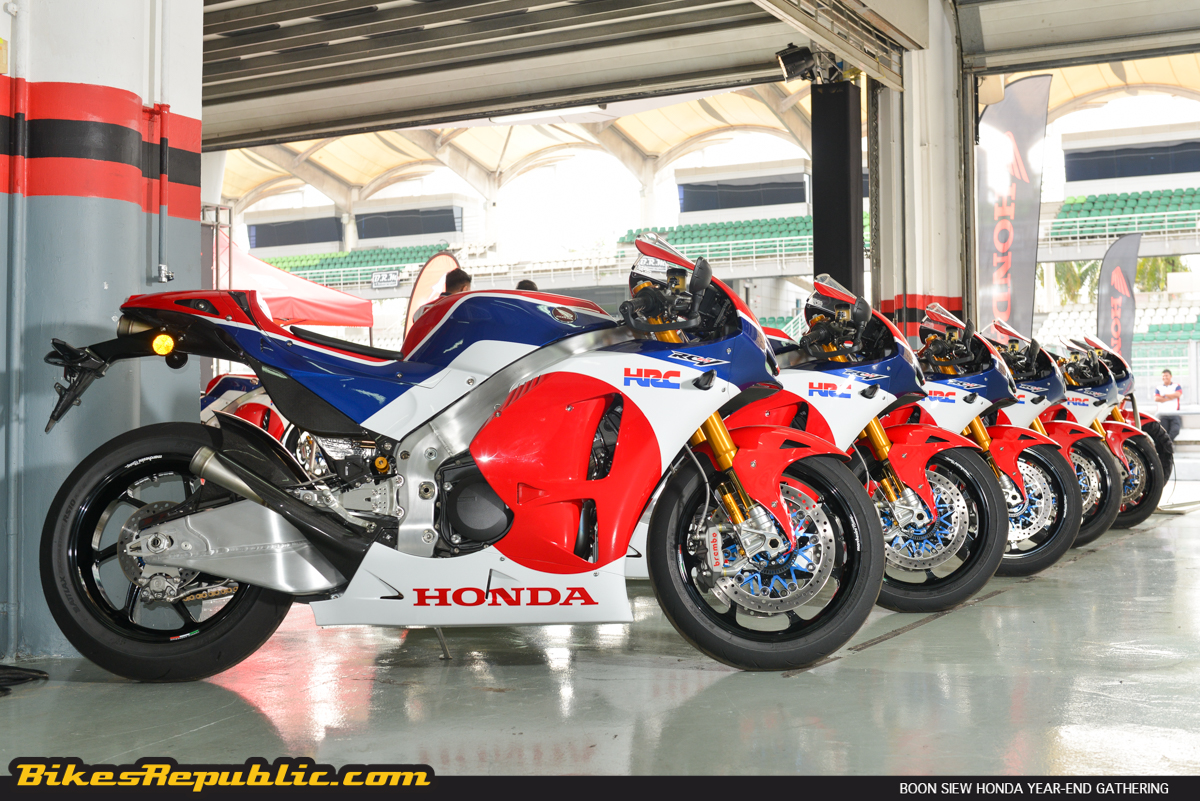
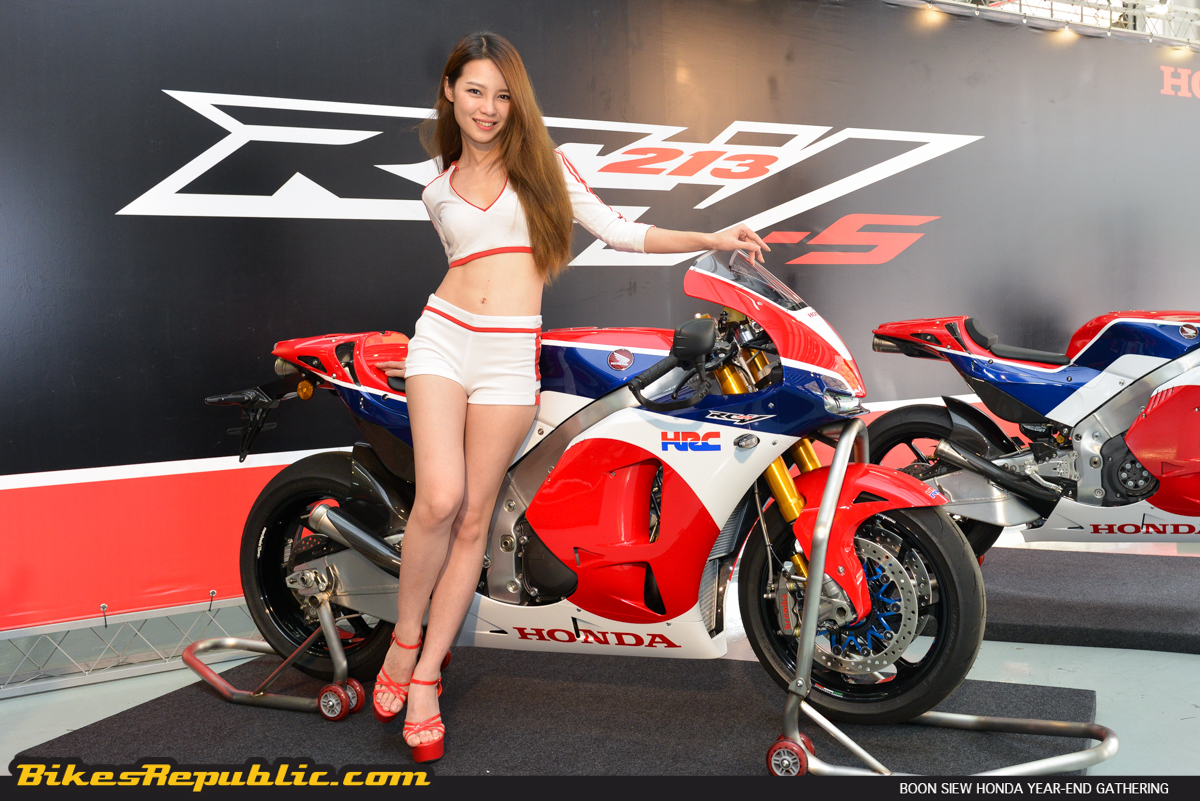
Honda introduced the RC213V-S during EICMA in 2015. Hailed as the closest replica to the bikes ridden by works riders Marc Marquez and Dani Pedrosa, it was a MotoGP bike for the masses.
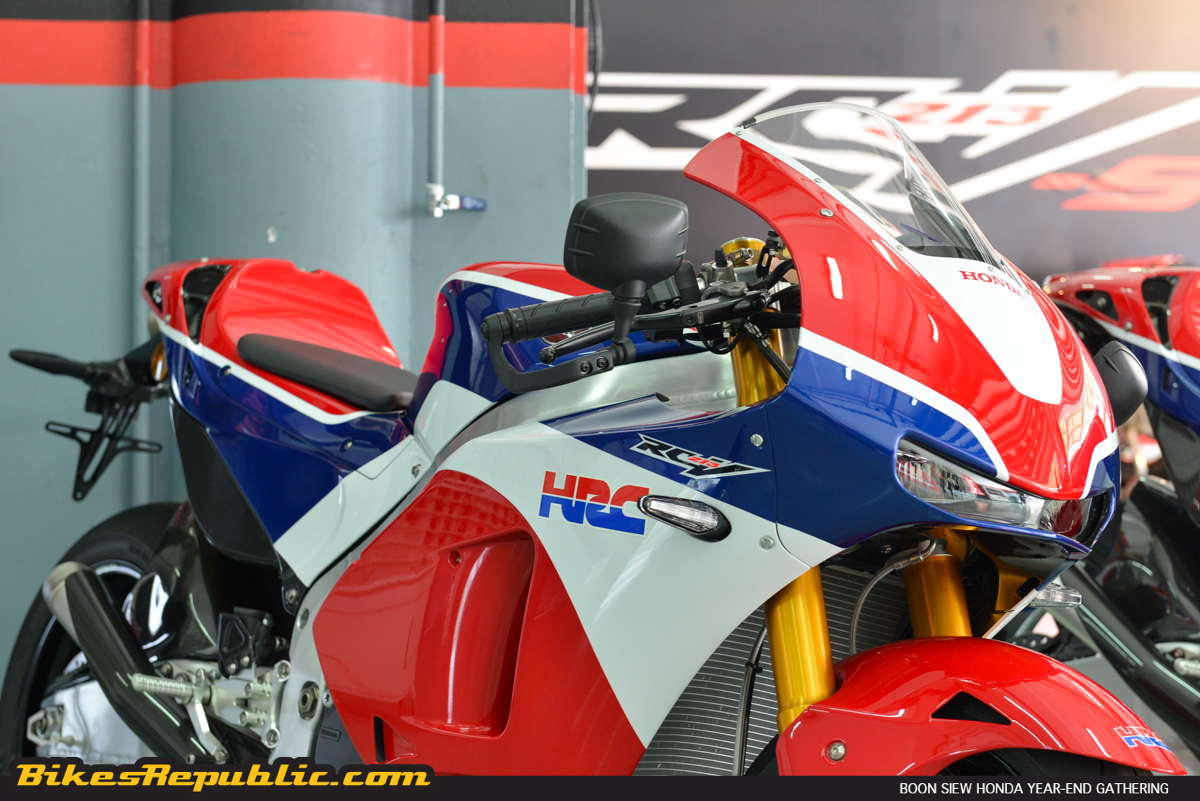
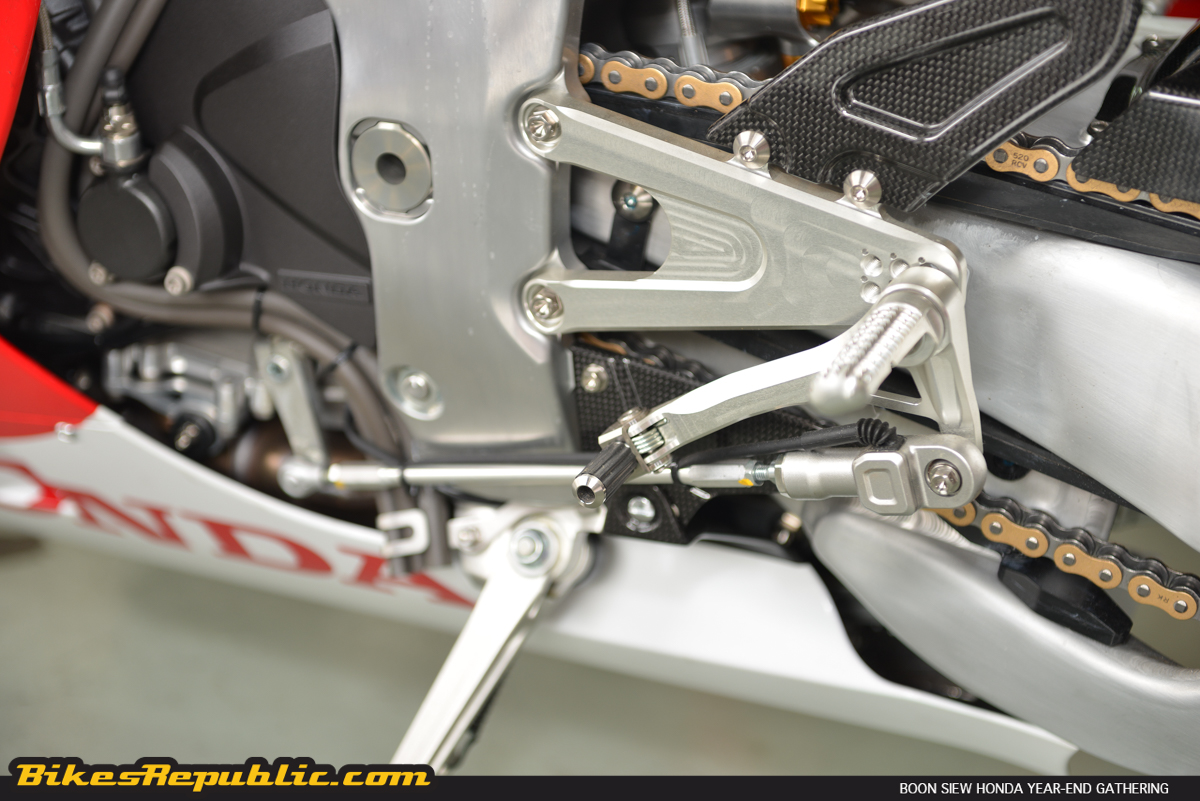
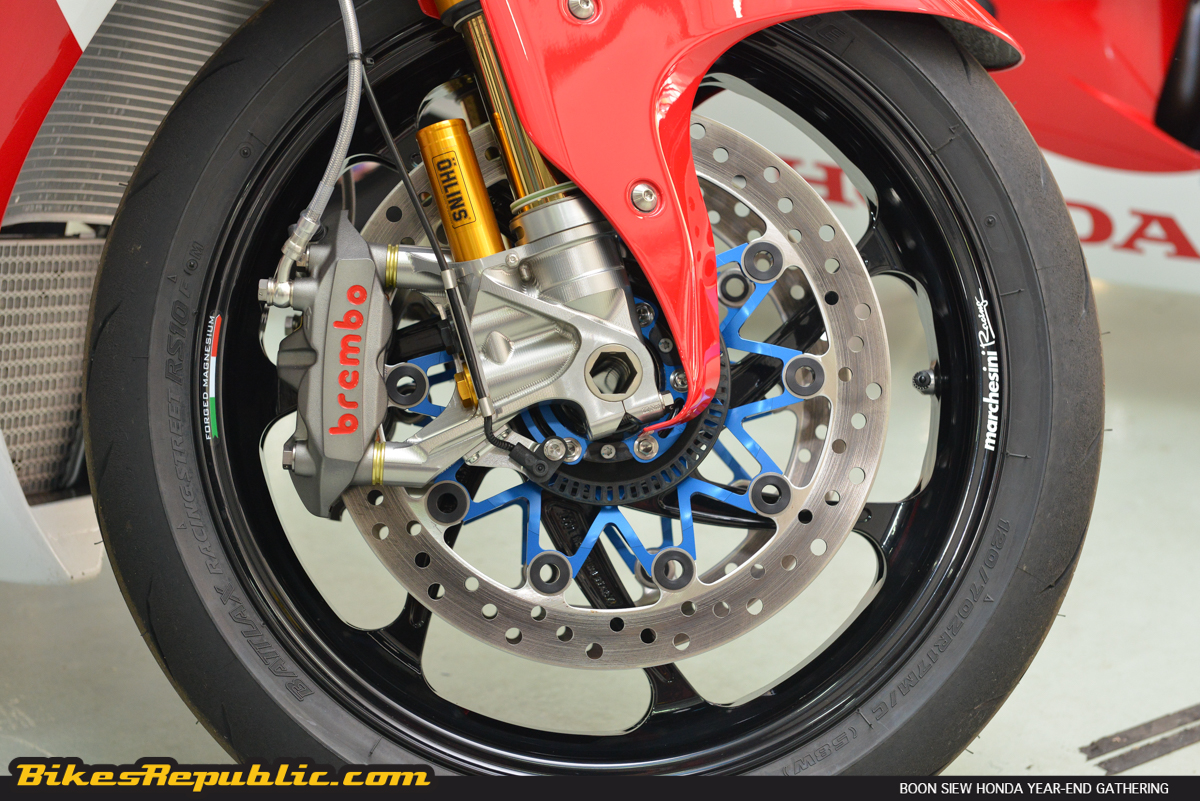
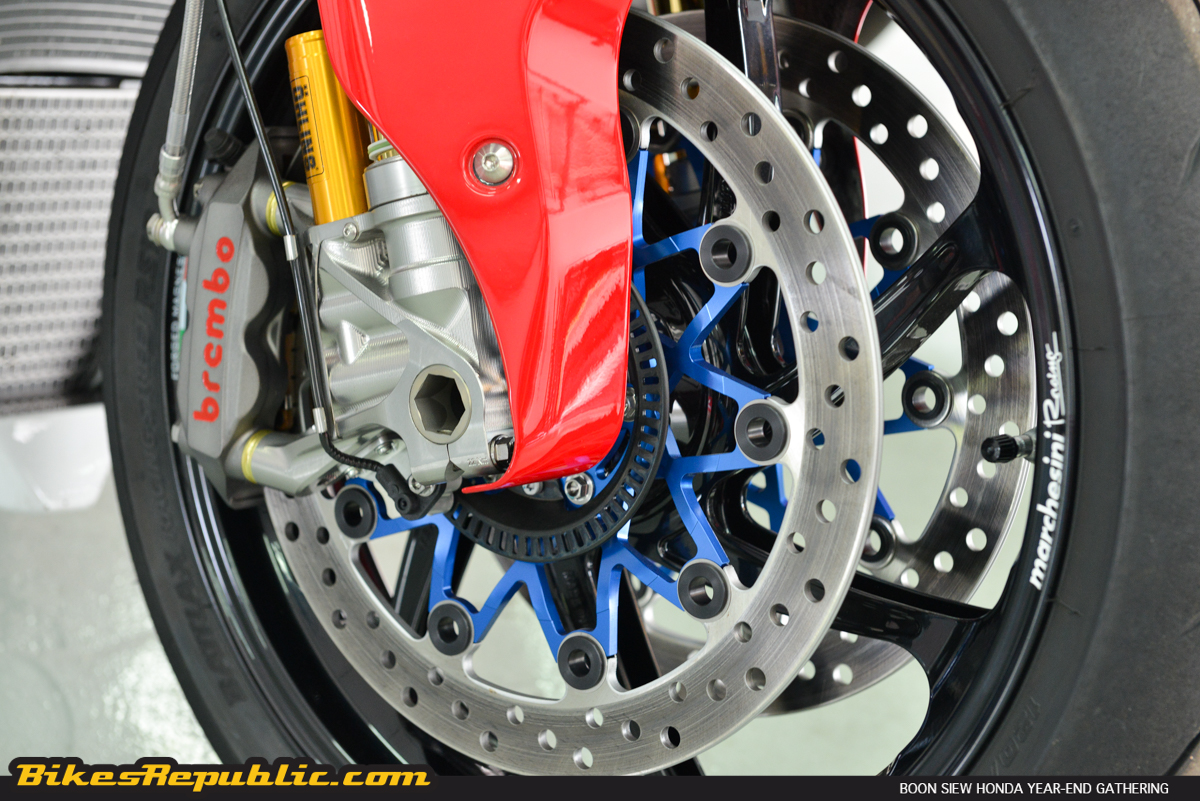
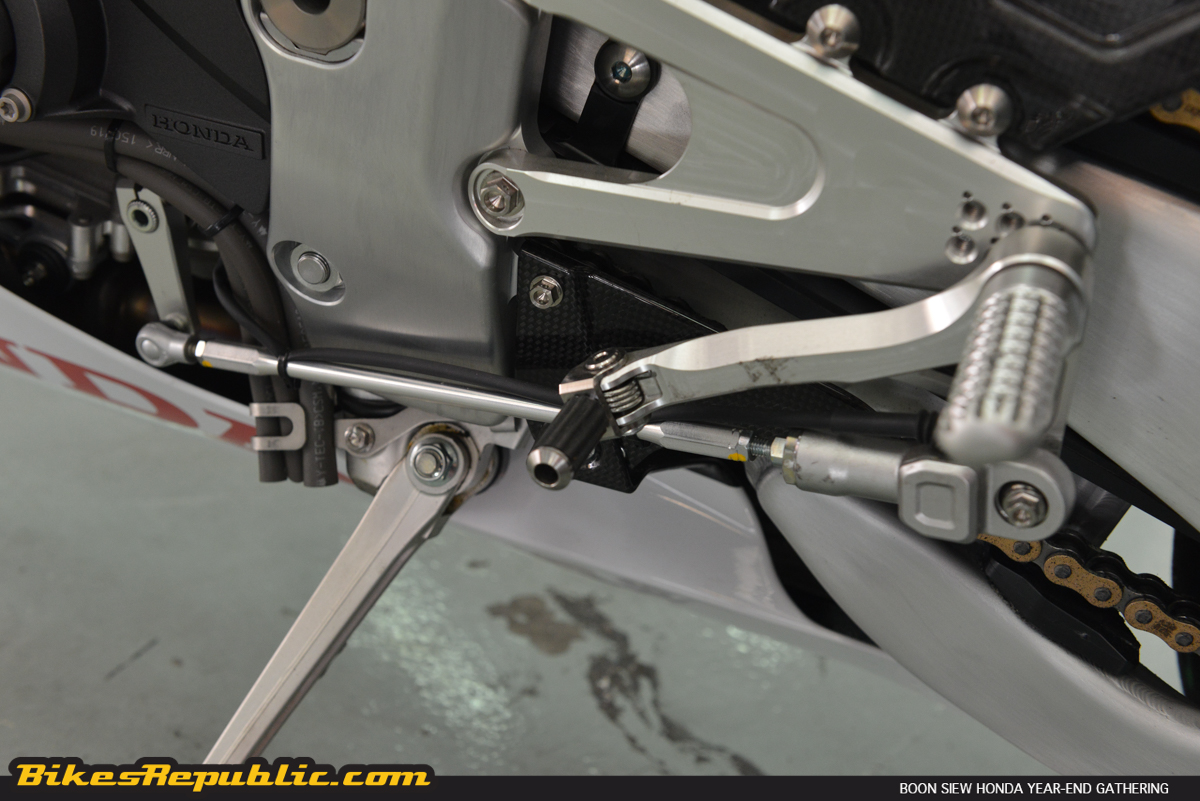
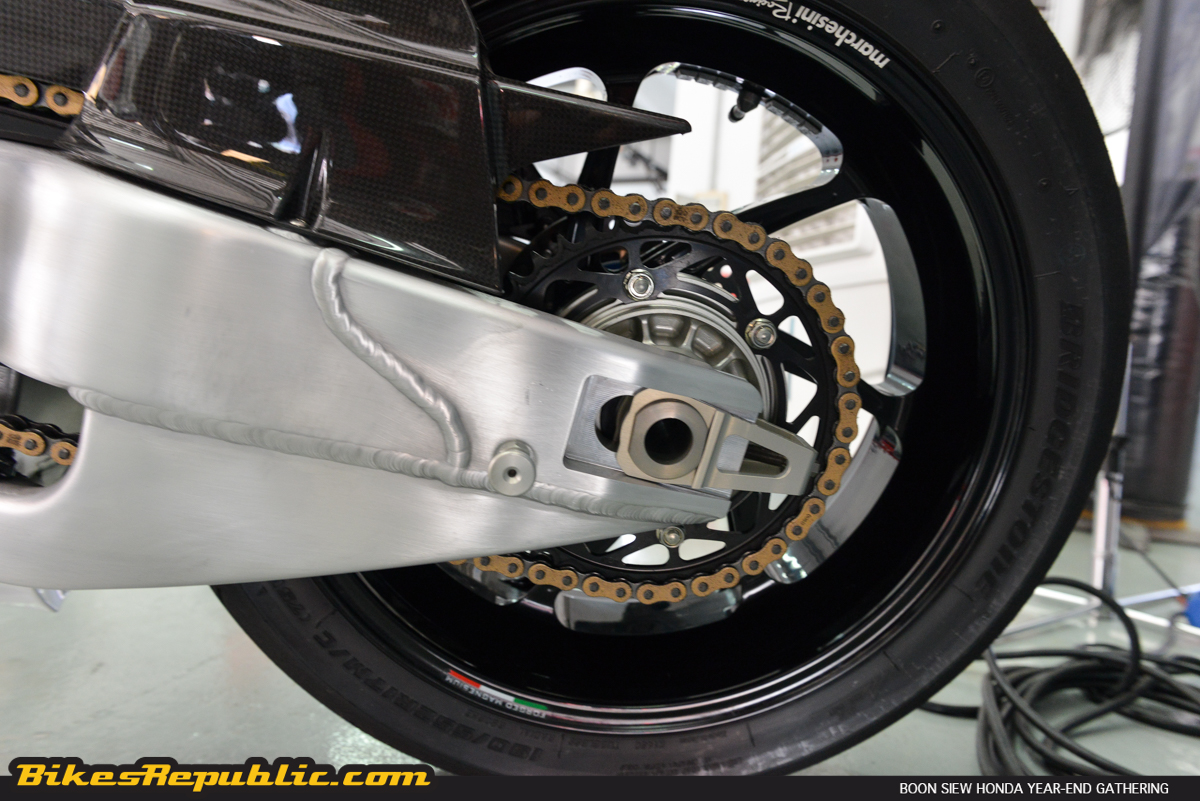
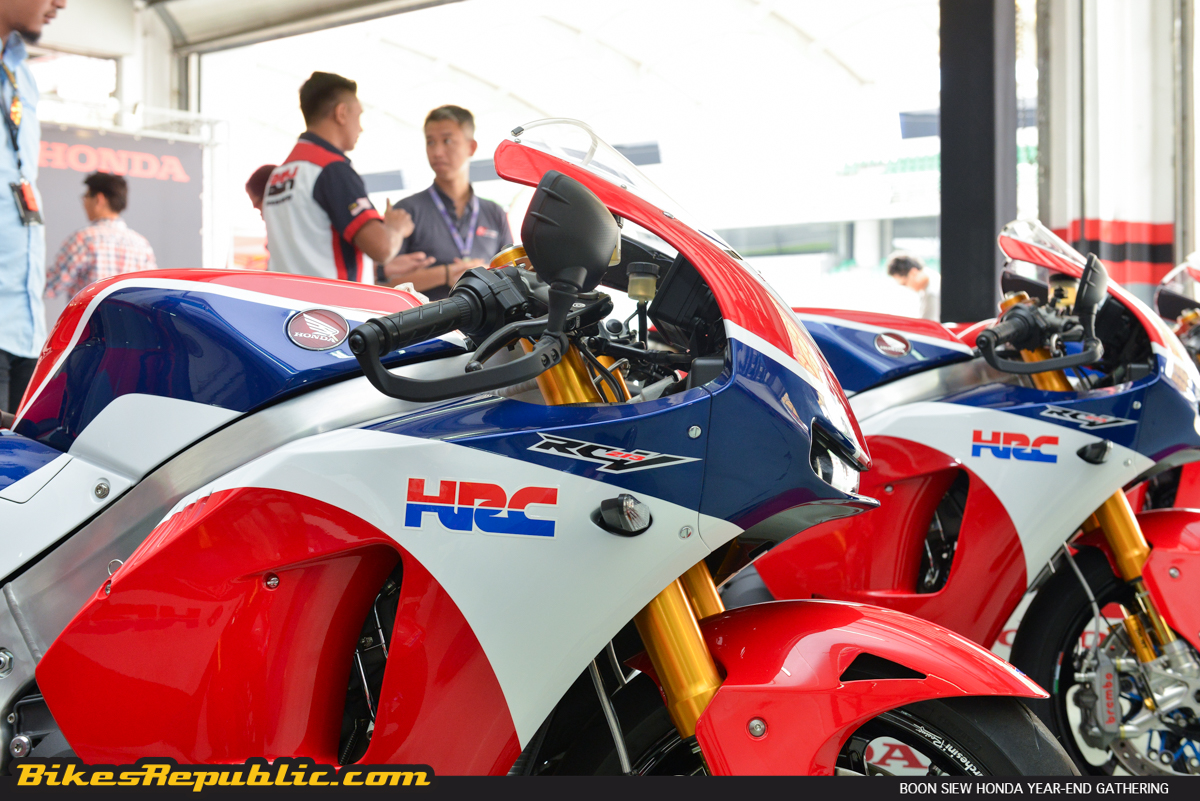
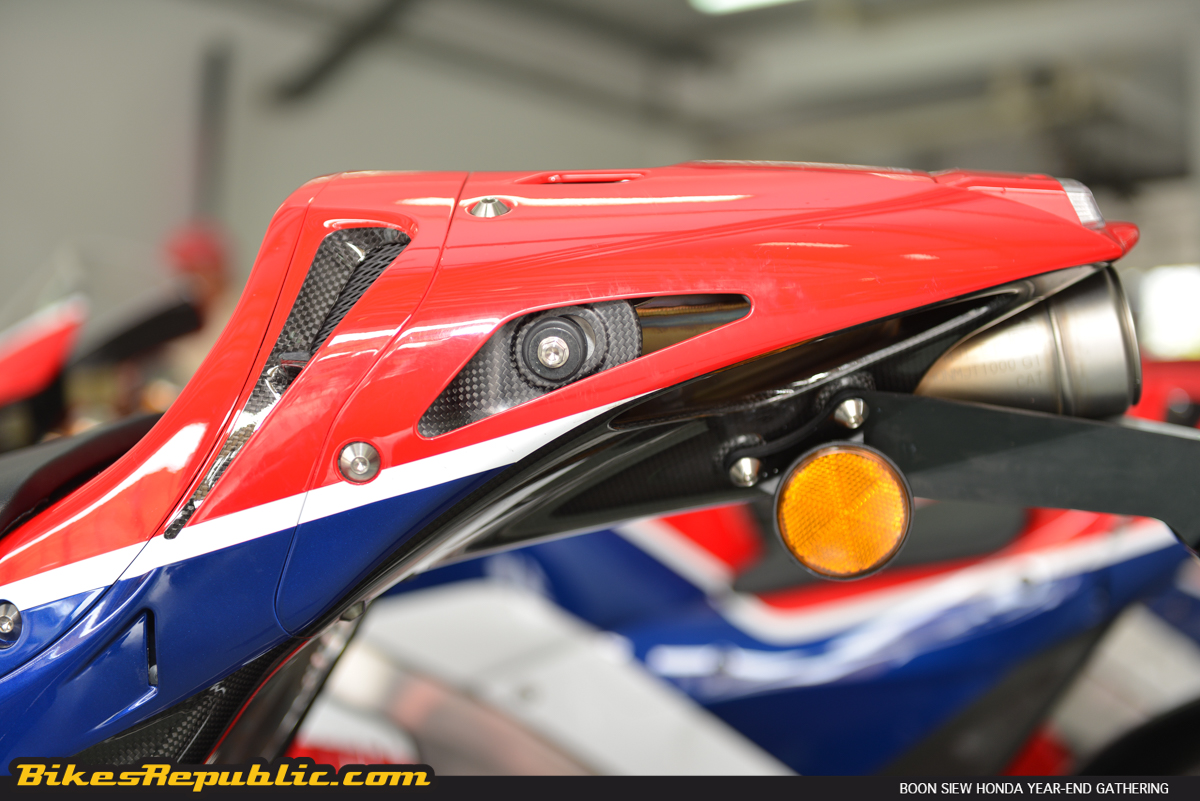
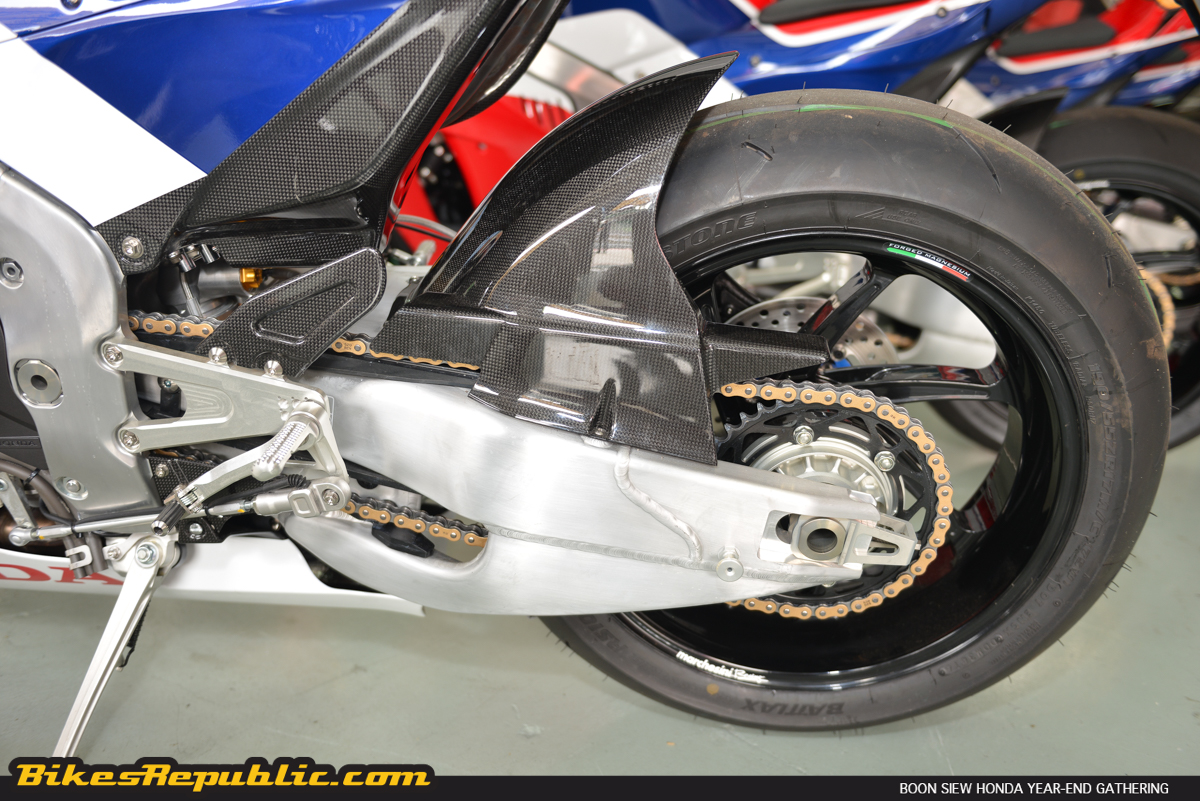
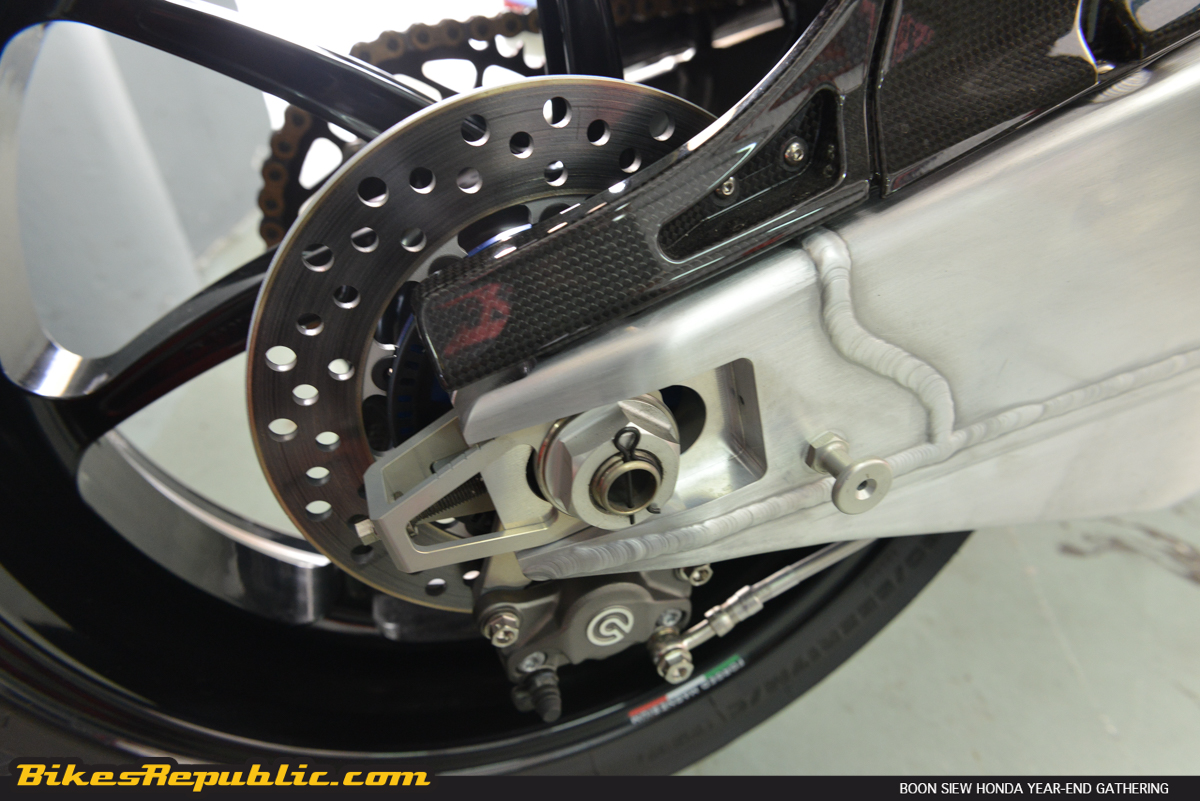
Each RC213V-S is hand-built in a special workshop in the Kumamoto factory, with some parts sourced directly from the MotoGP bike like the swingarm, slipper clutch, magnesium alloy 17-inch Marchesini wheels, Öhlins forks, adjustable footpegs and pedals, and parts of the Brembo brakes. Other directly trickled down tech include the (partly) underseat fuel tank, and carbon-fibre reinforced plastic bodywork which is fastened with titanium bolts.
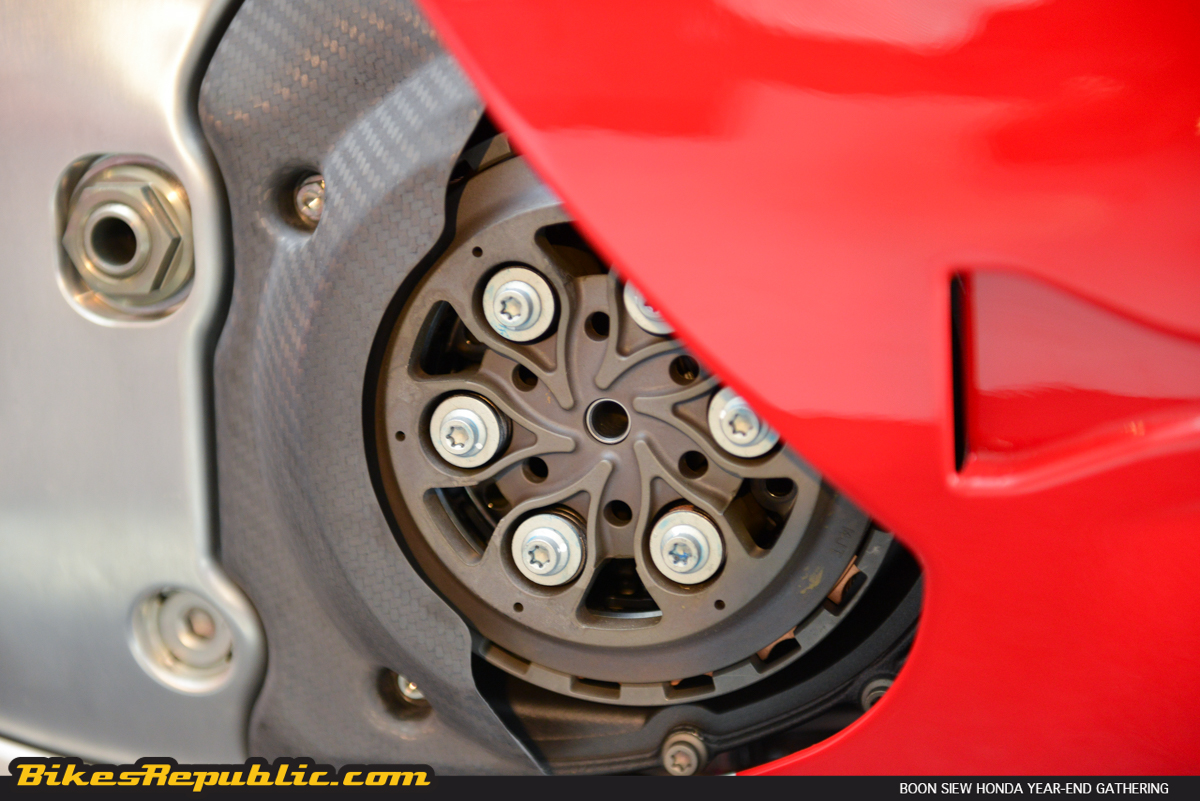
Besides those, the RC213V-S also features ride-by-wire throttle, power modes, traction control, engine-brake control, and position detection. The engine has the same configuration as the MotoGP too, a 990cc V-4 with titanium conrods, the only difference being the seamless transmission (a mainstay of MotoGP bikes) pioneered by Honda, and conventional valve springs in place of pneumatic ones.
Another difference is of course the brake discs. They are steel items on the road bike, instead of carbon.

It’s worth mentioning that the 80 percent of the parts on the RC213V-S are interchangeable with the full-on race machine. As it is, the RC213V-S is sold (or was sold if they’re sold out) to rev up to 12,000 RPM (US models rev up to 9400 RPM only due to noise restrictions). Customers could shell out another EUR 12,000 for a race kit that takes it up to 14,000 RPM.
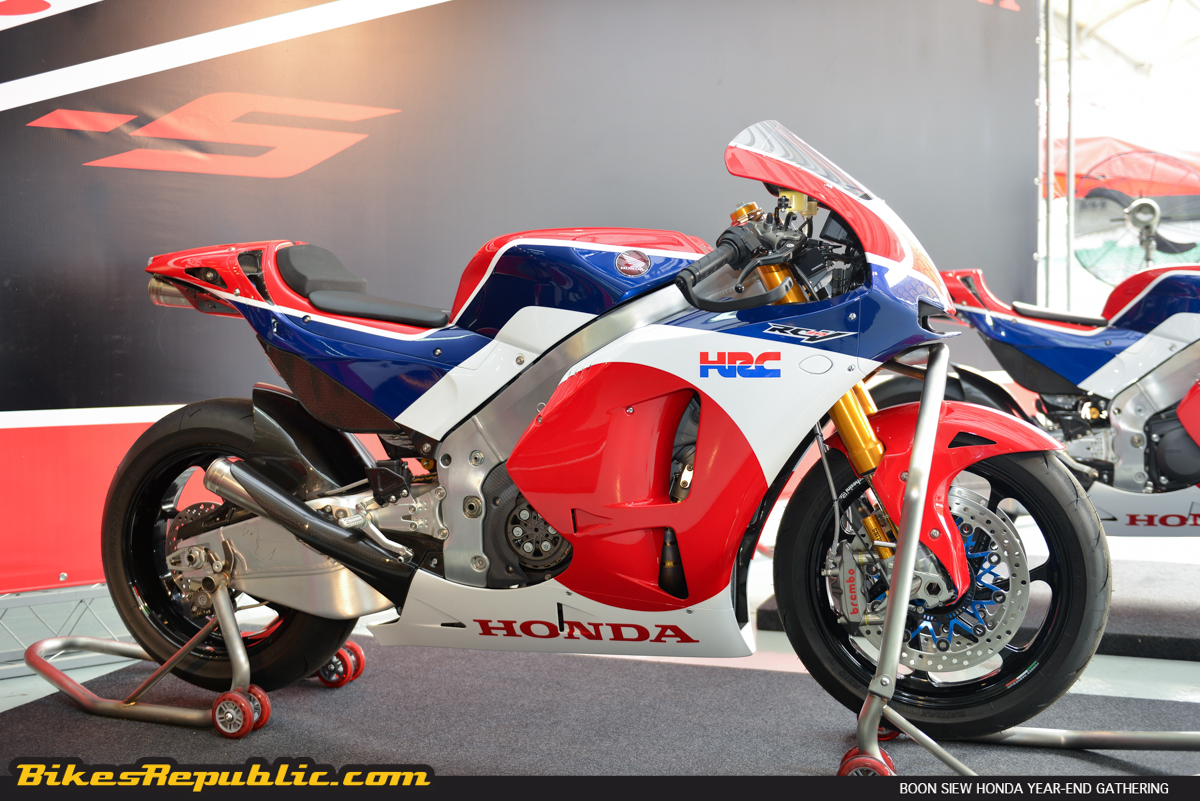
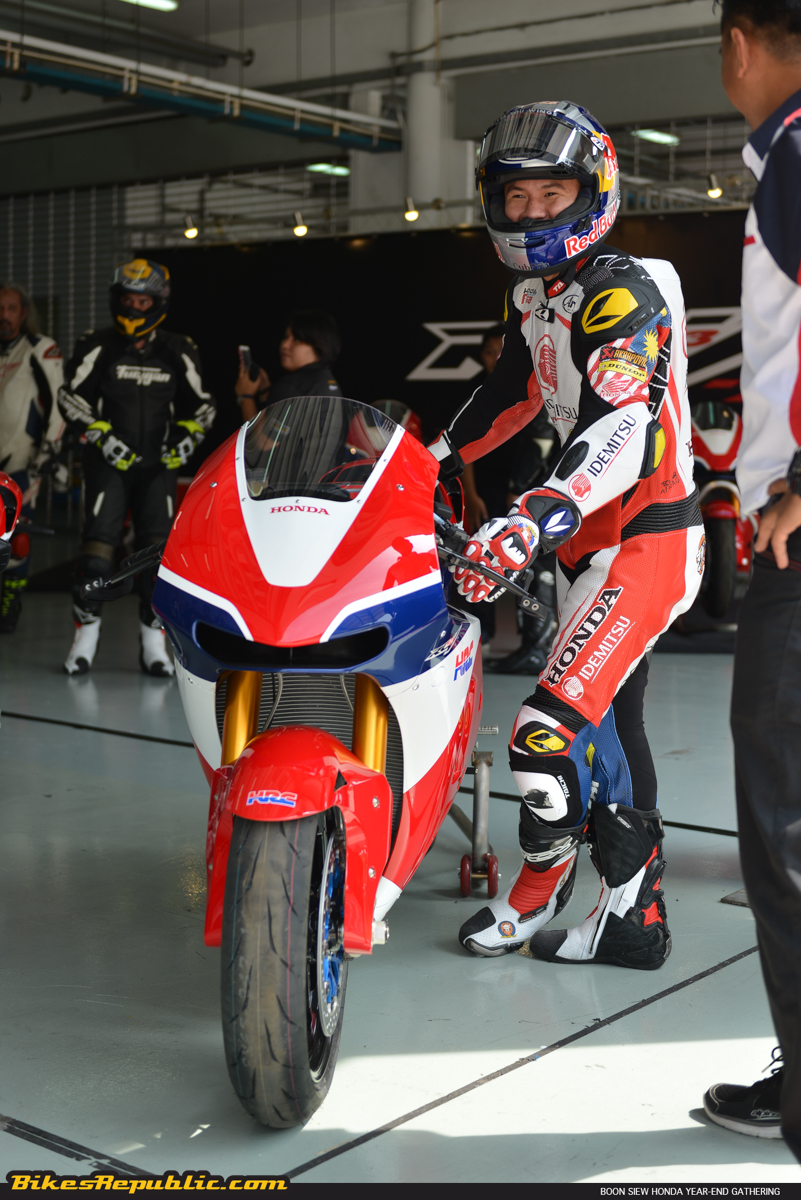
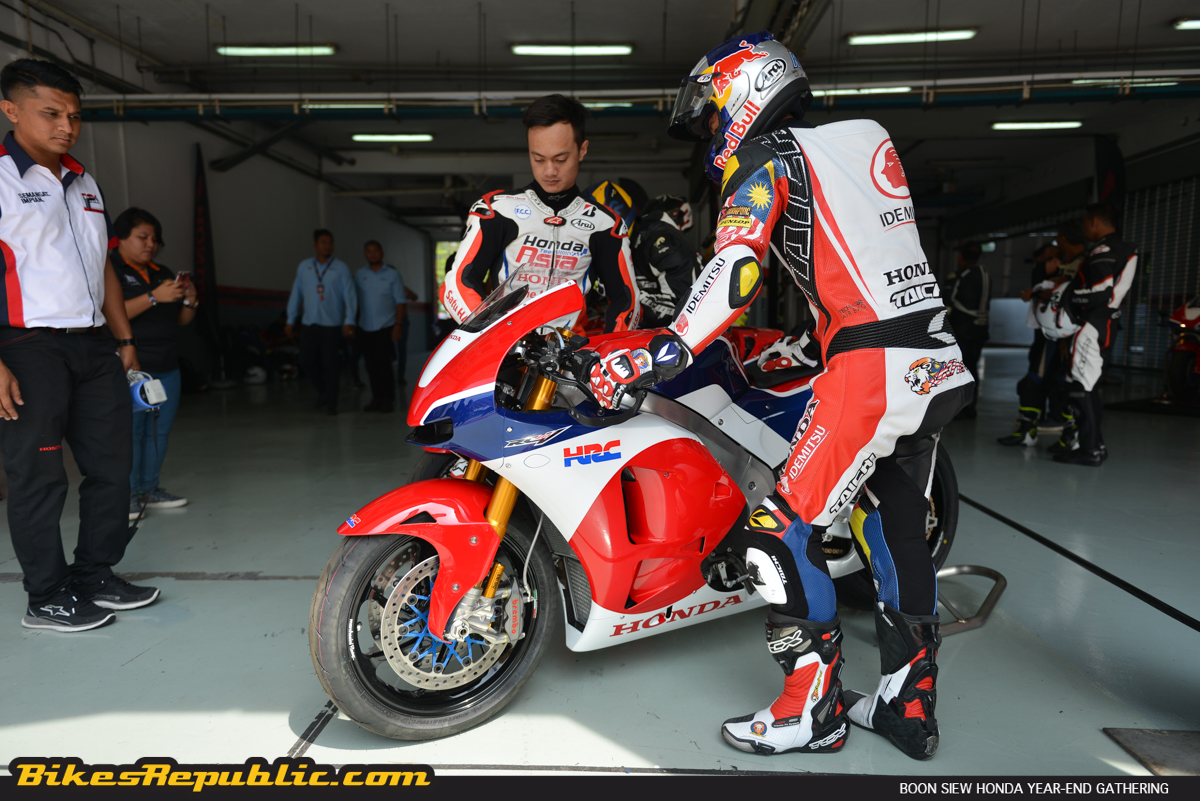
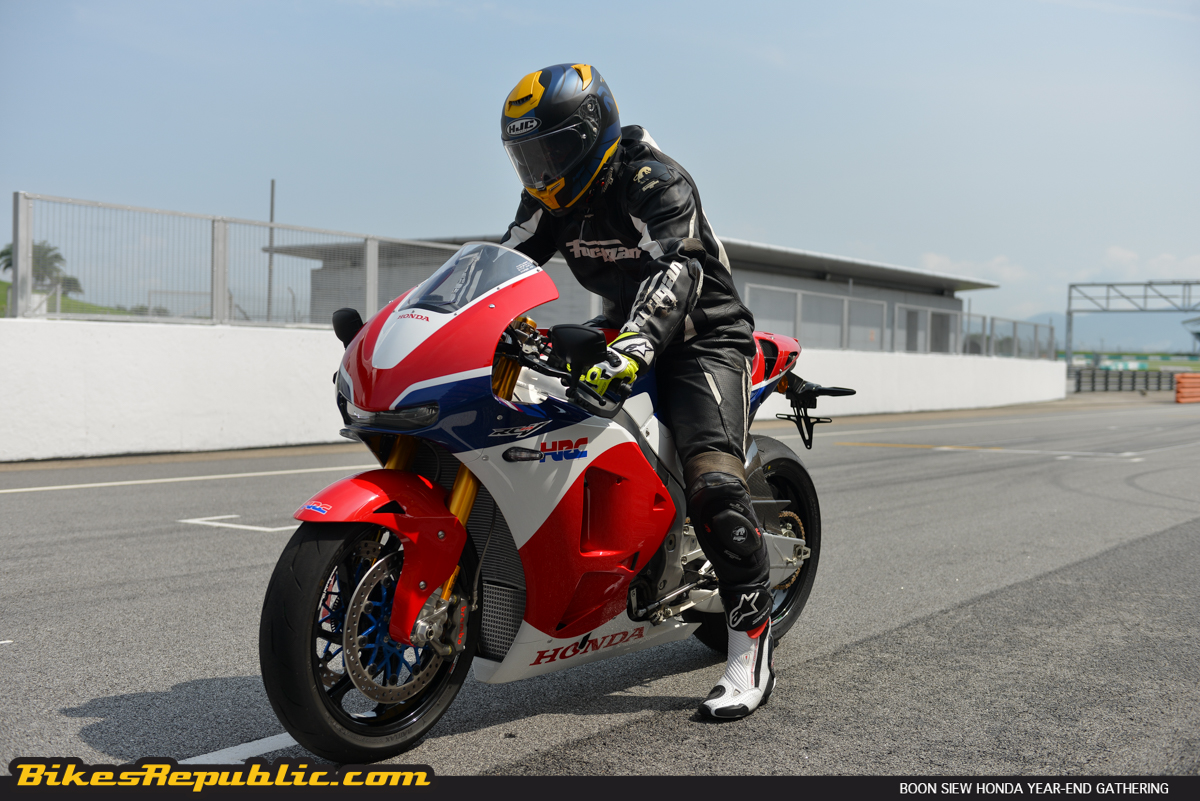
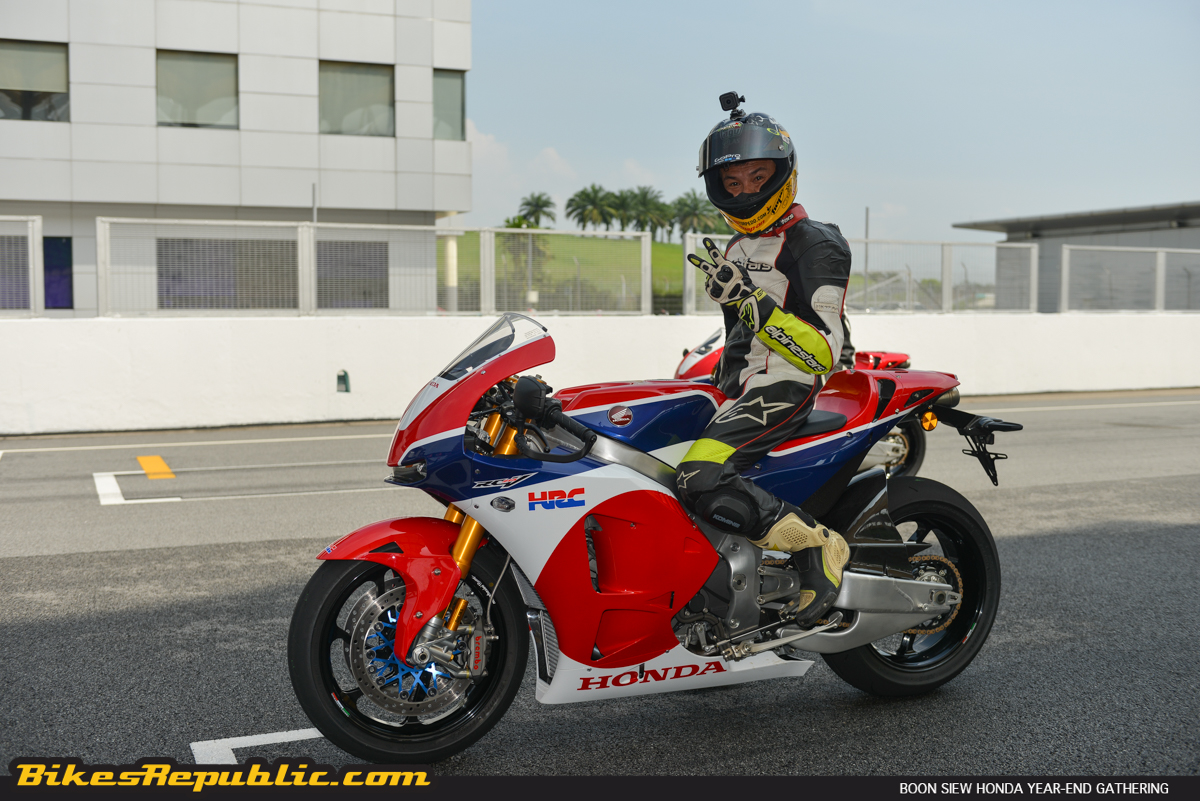
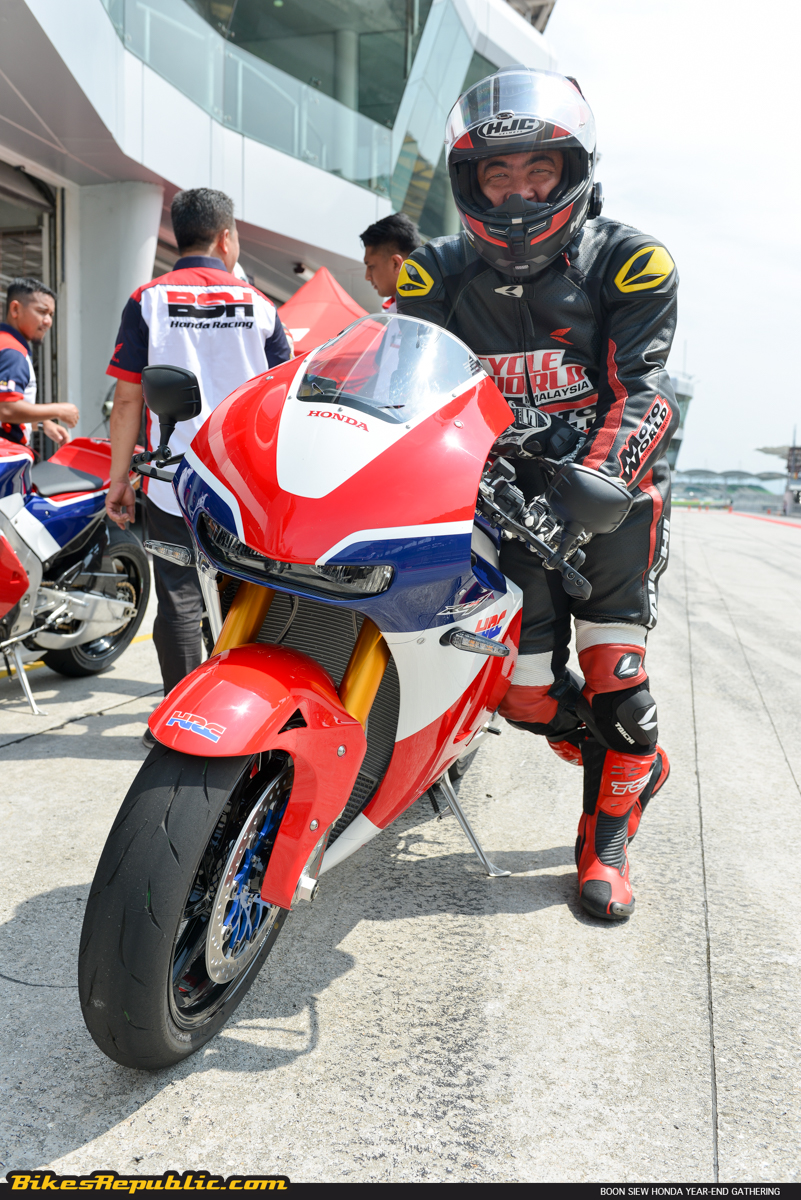
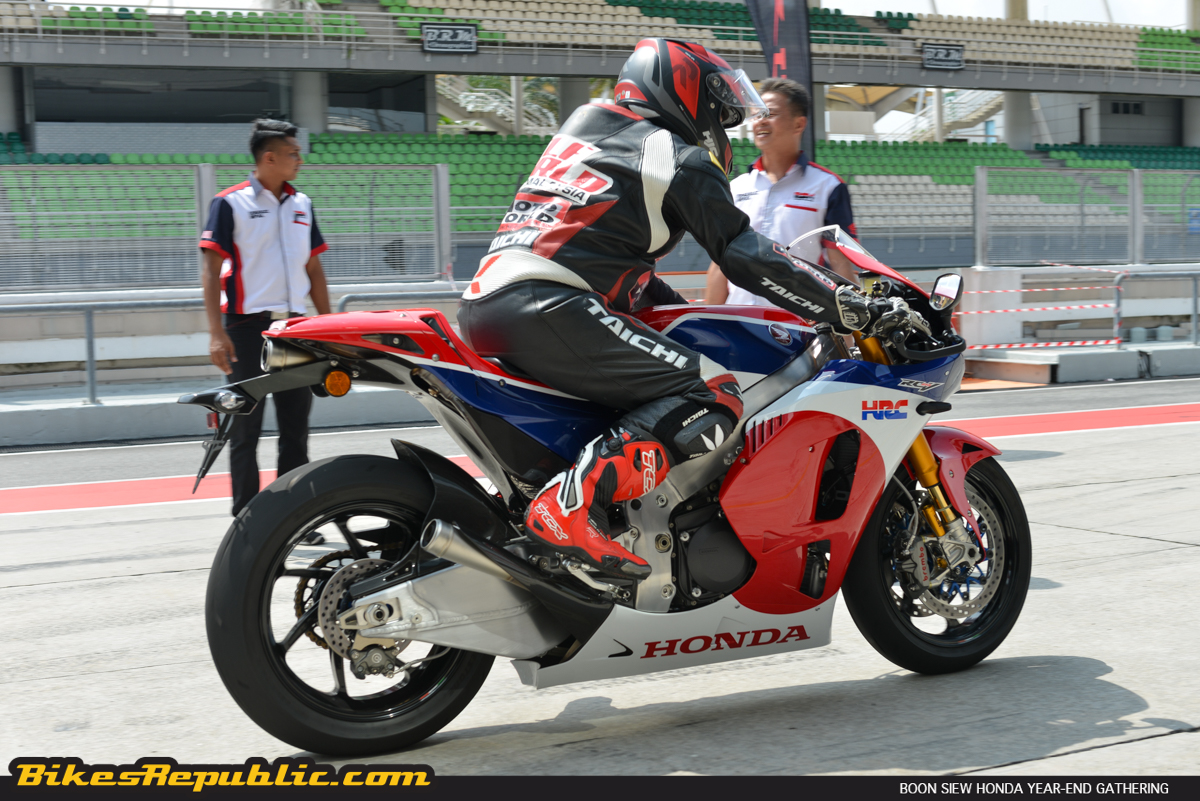
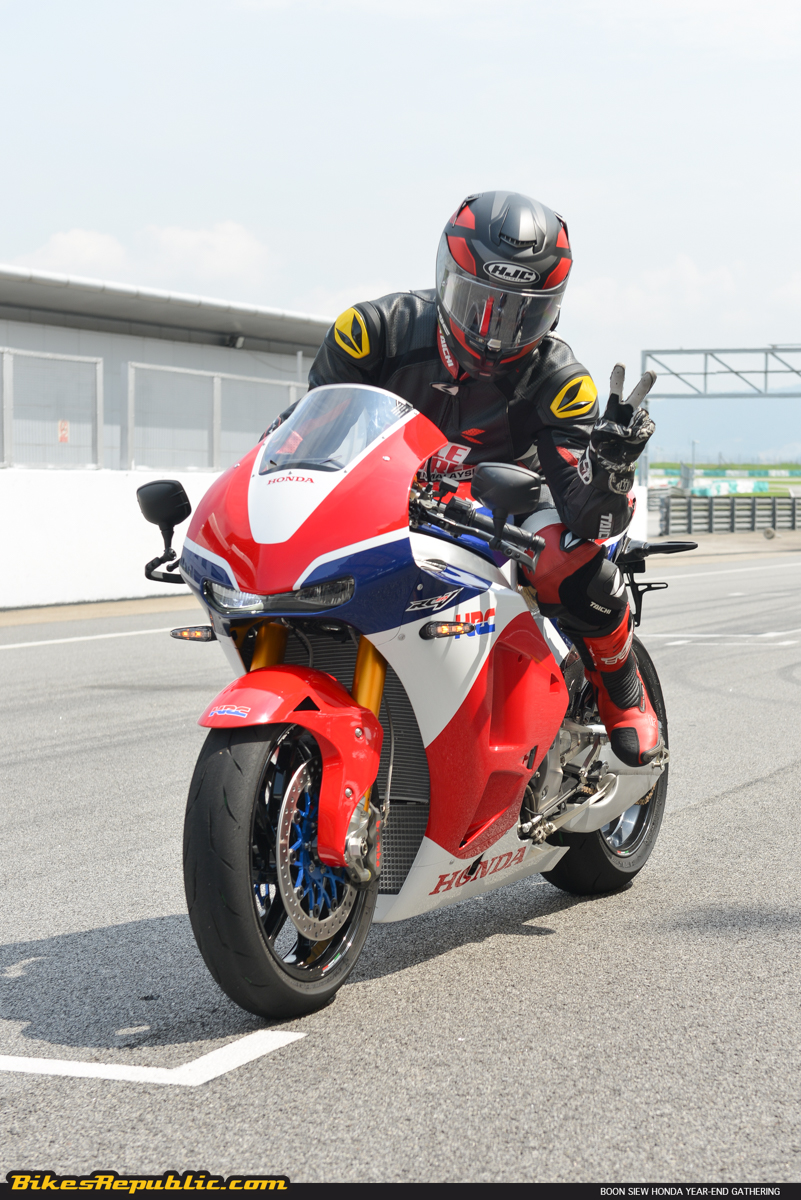
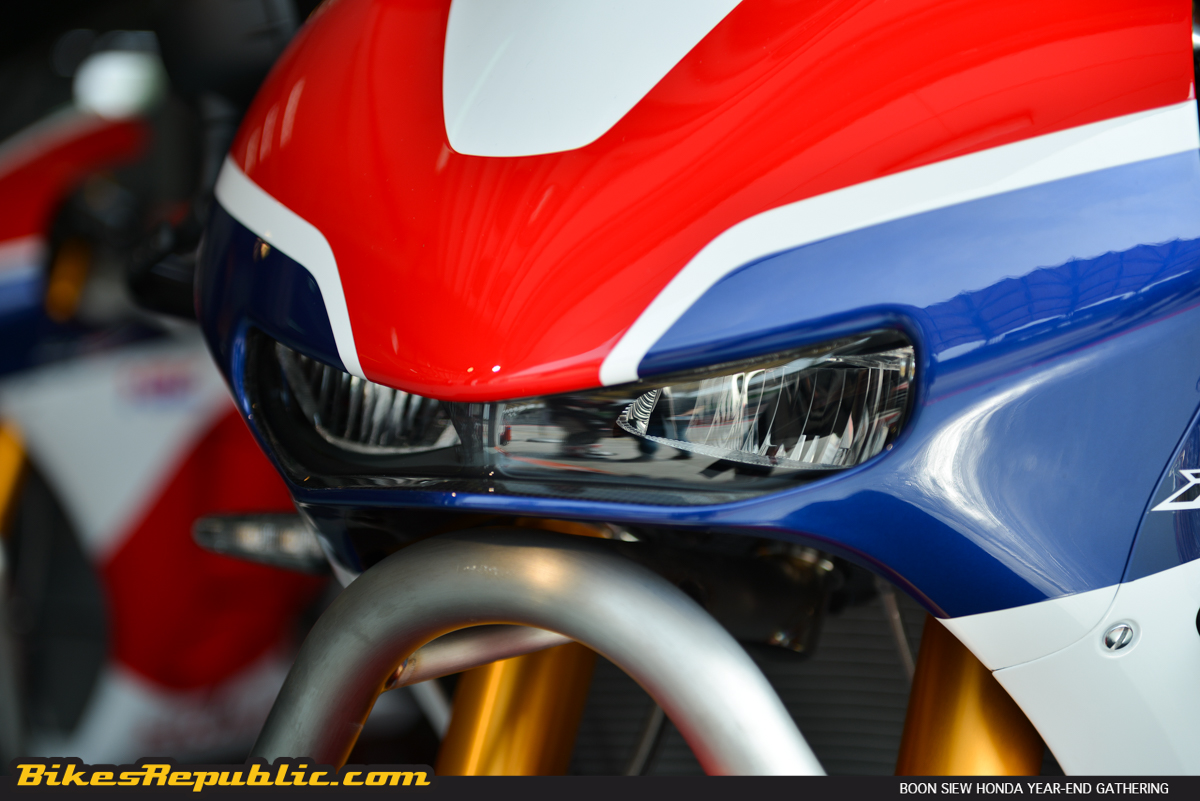
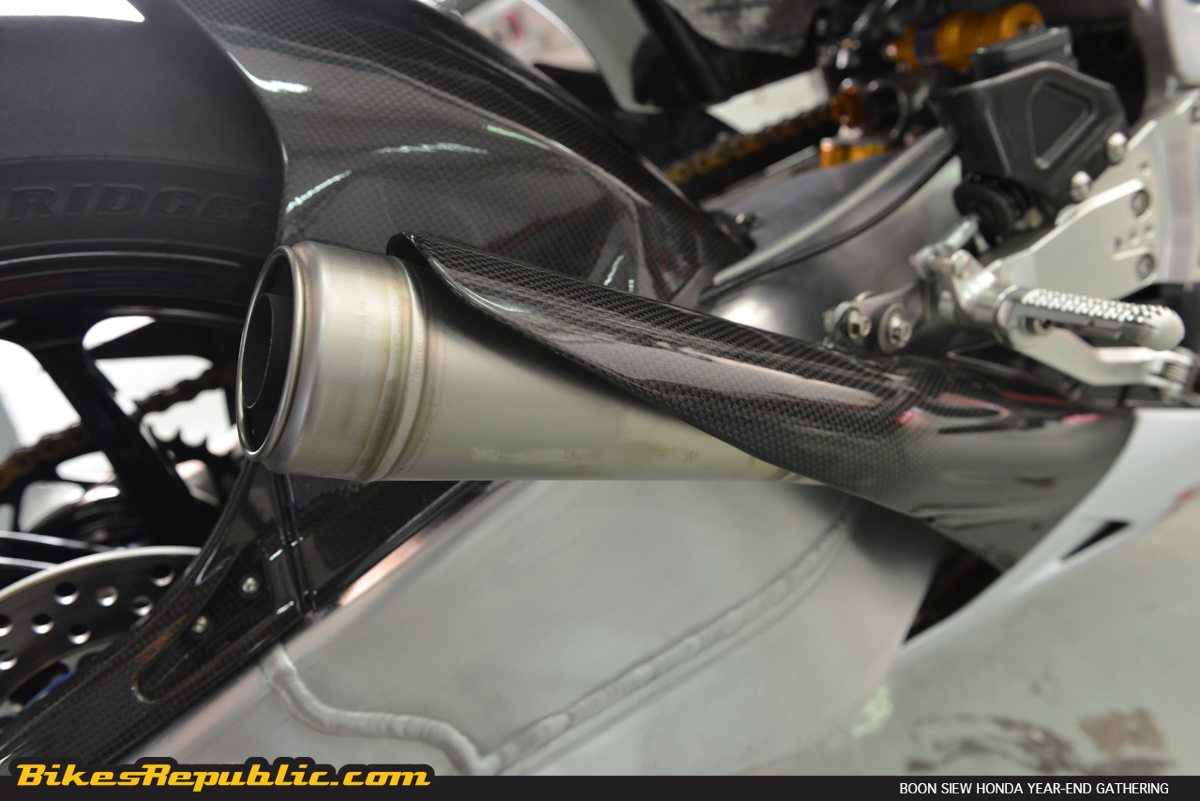
Outwardly, and apart from not wearing the orange Repsol paint scheme, the bike looked no different from the bikes Marc and Dani used to destroy the competition. The headlights are installed into the gaping intake at tip of the upper fairing, but everything else like the exhausts and tail section screamed Honda MotoGP.
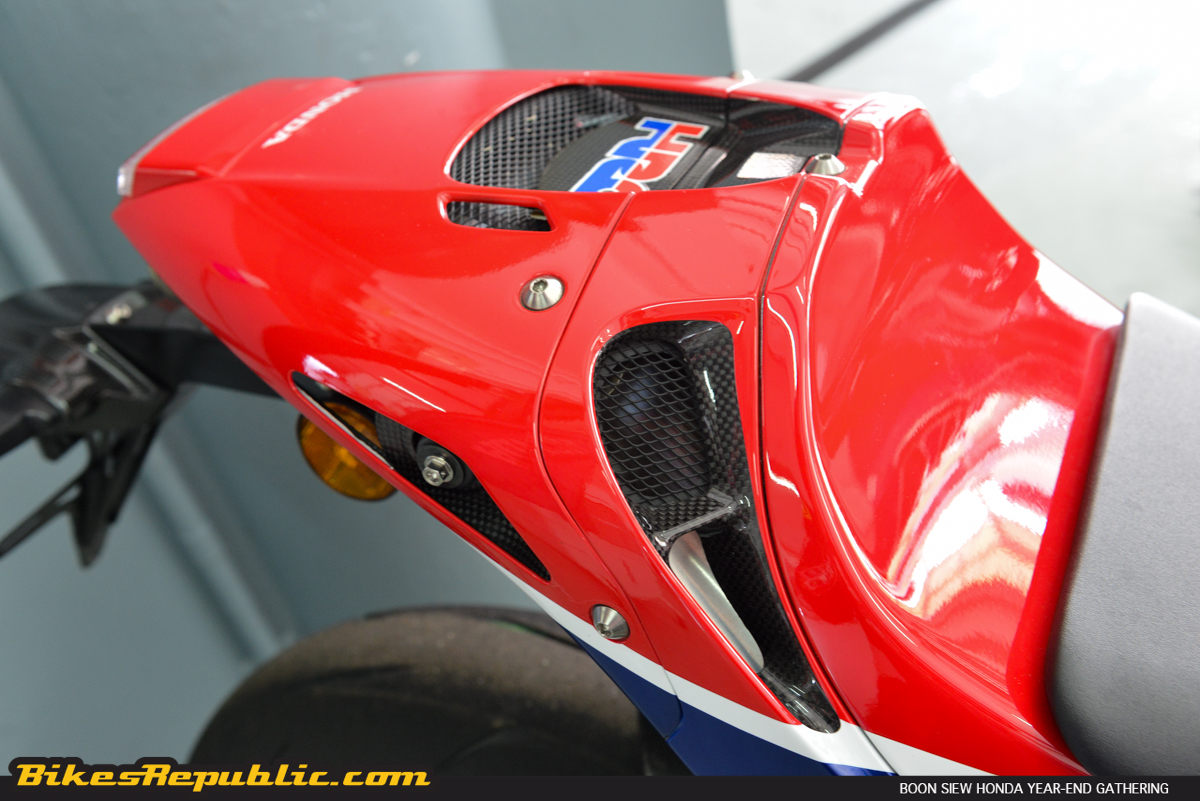
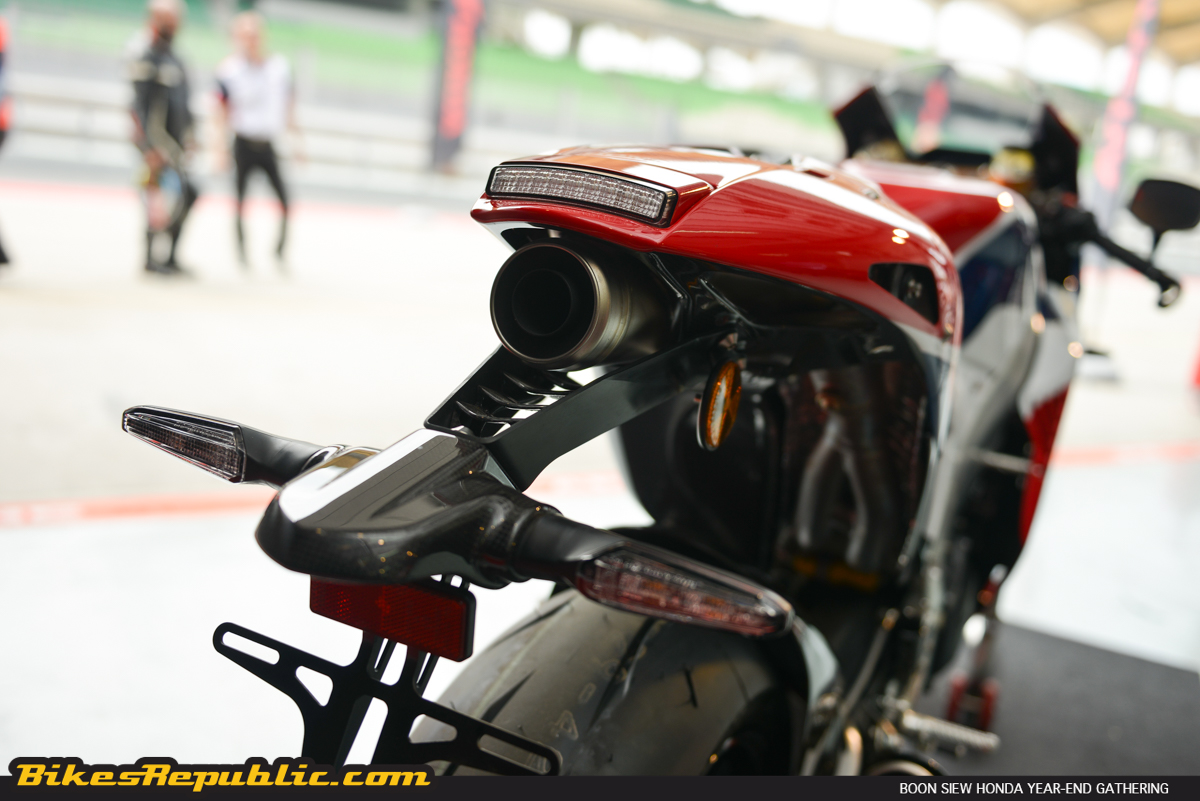
The front pair of cylinders vent exhaust gases through a pipe down low on the right side, while the rear pair exit through a pipe under the seat.
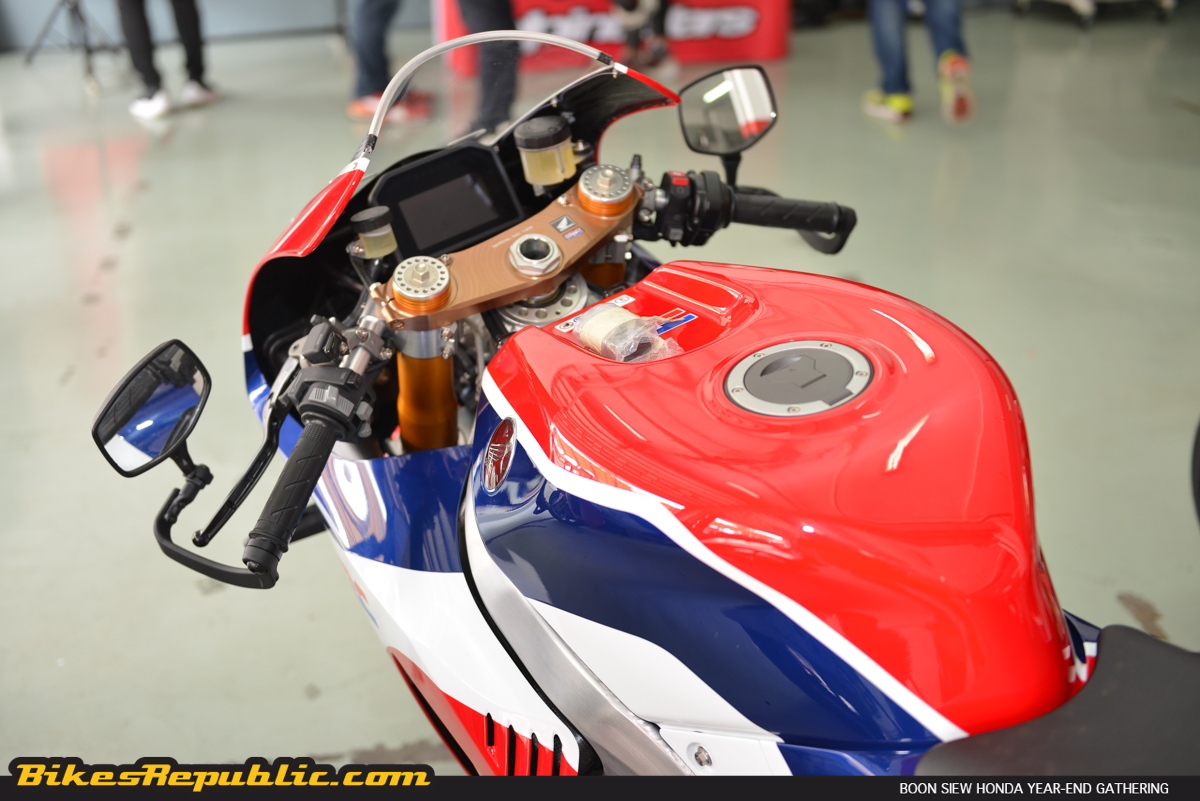
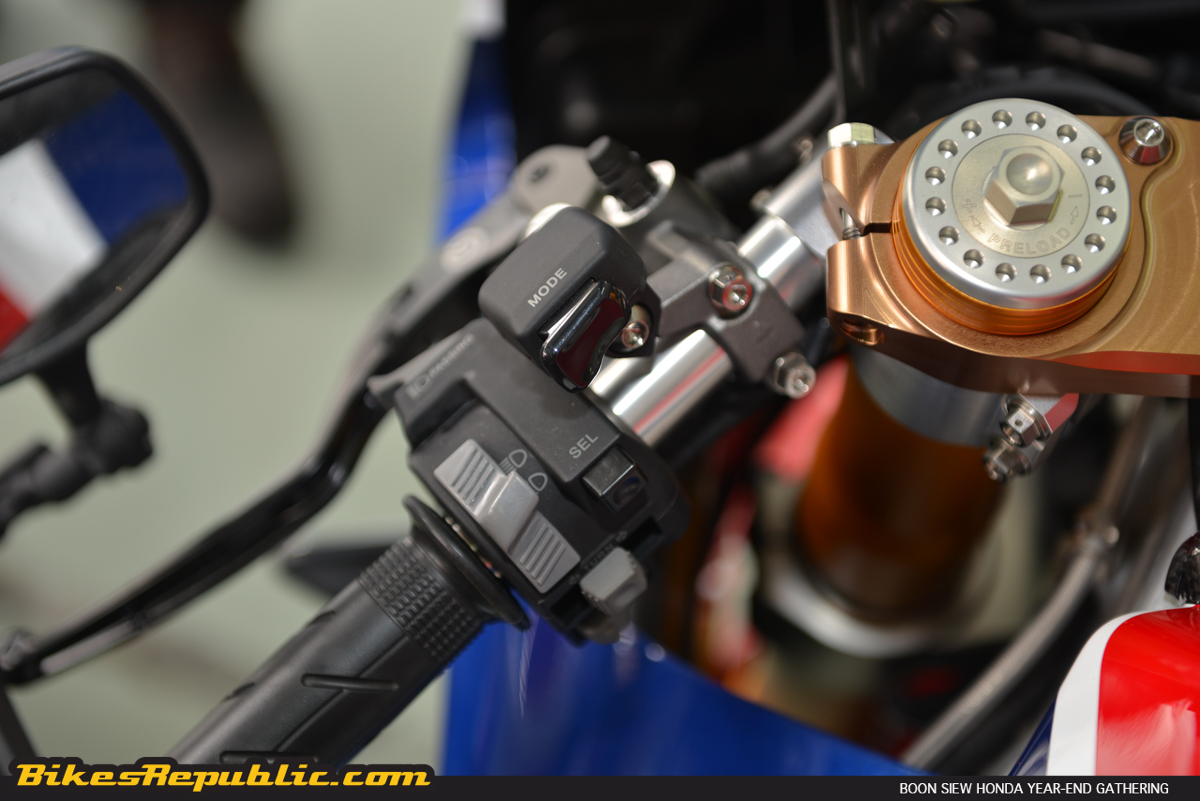
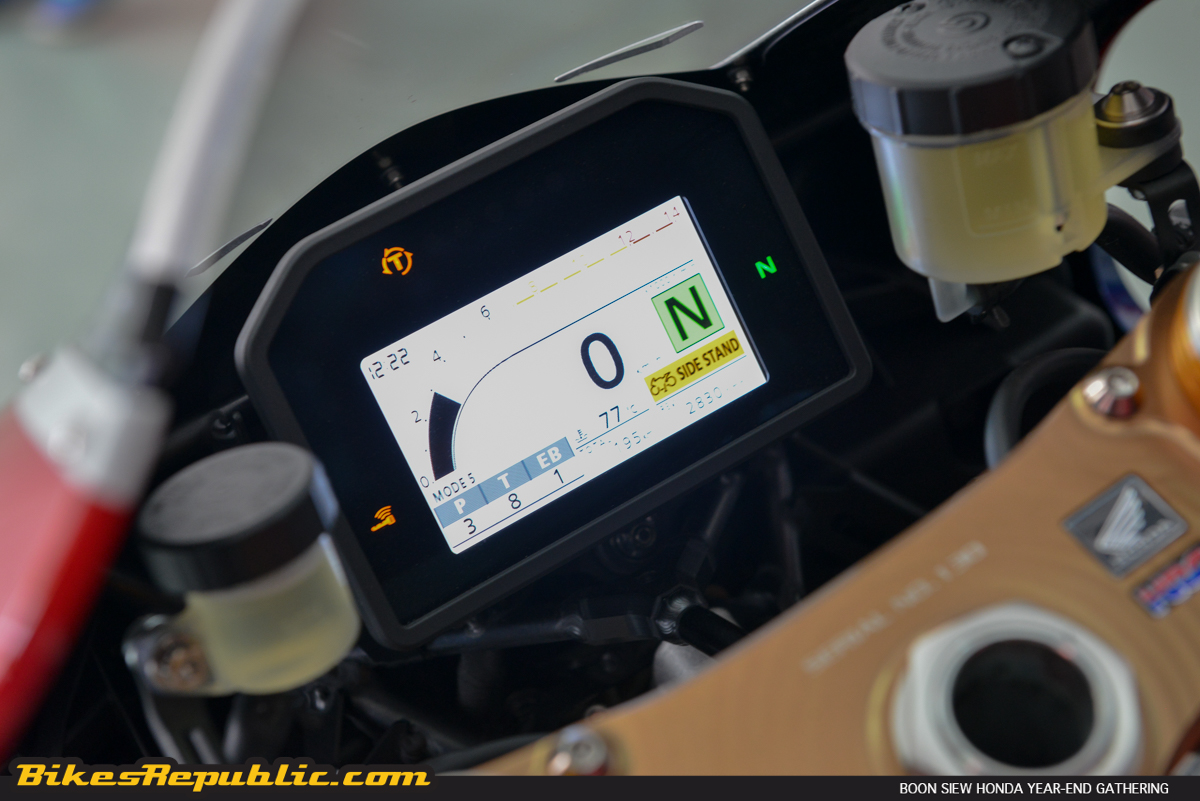
Up top, the controls on the handlebars were simple, devoid of the colourful Playstation-like buttons and a small LCD is placed up front. The handlebars are attached to the forks with beefy clamps below the beautifully finished top triple clamp which has the production number stamped on it. The rearview mirrors are attached to the ends of the handlebars.
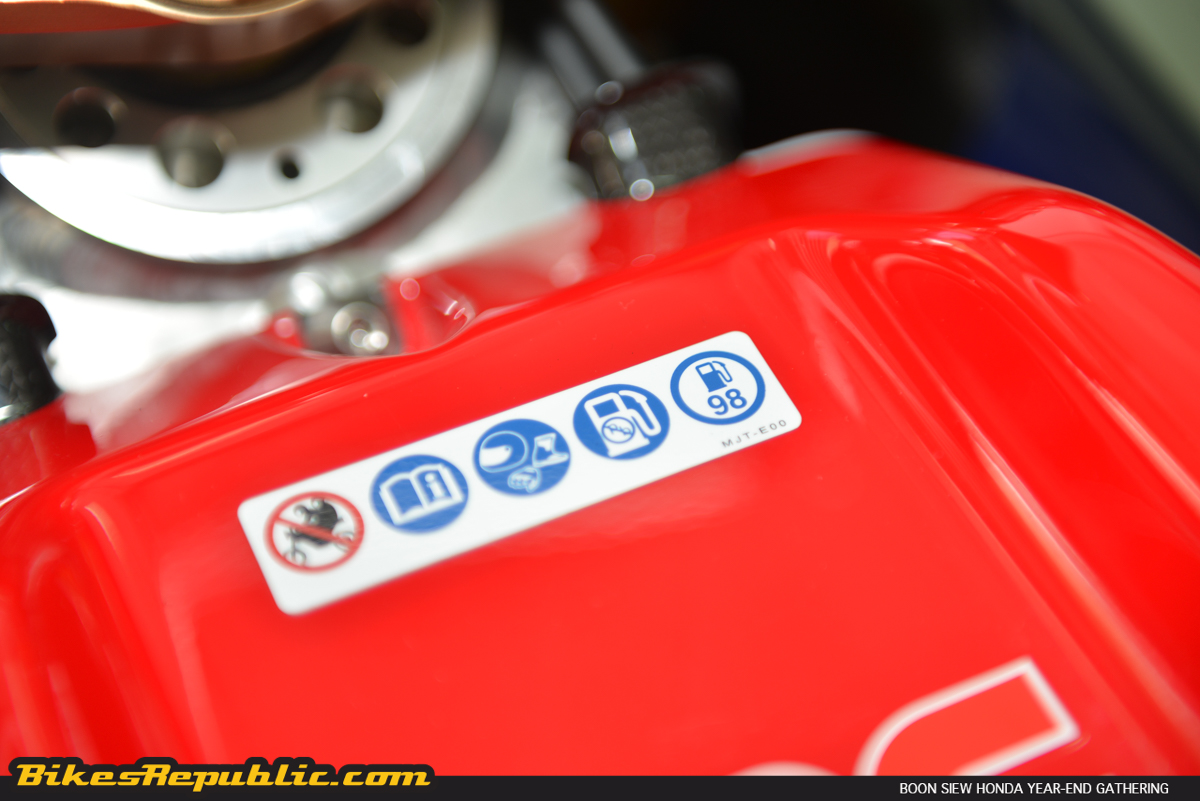
That’s when I noticed the warning sticker on the tank. Right at the end was a symbol that says, “RON 98.” It means that an owner in Malaysia could only fill up with RON 100 at Petron or Shell’s V-Power Racing. And bring along a few bottles of X-1R Octane Booster.
Oi, enough talk. How was it to ride?

It’s definitely much, much smaller than how it appeared in any photo. Sitting on it felt like sitting on a CBR250, but when I grabbed the bar and sat up straight, I found myself looking over the top of the screen. Everything has been packed close to the rider for mass centralization. But it was surprisingly not uncomfortable. Racebikes of years past were uncomfortable, but the RC213V-S felt like any roadgoing sportbike. Heck, it felt a lot like the CBR1000RR Fireblade with racing footpegs.

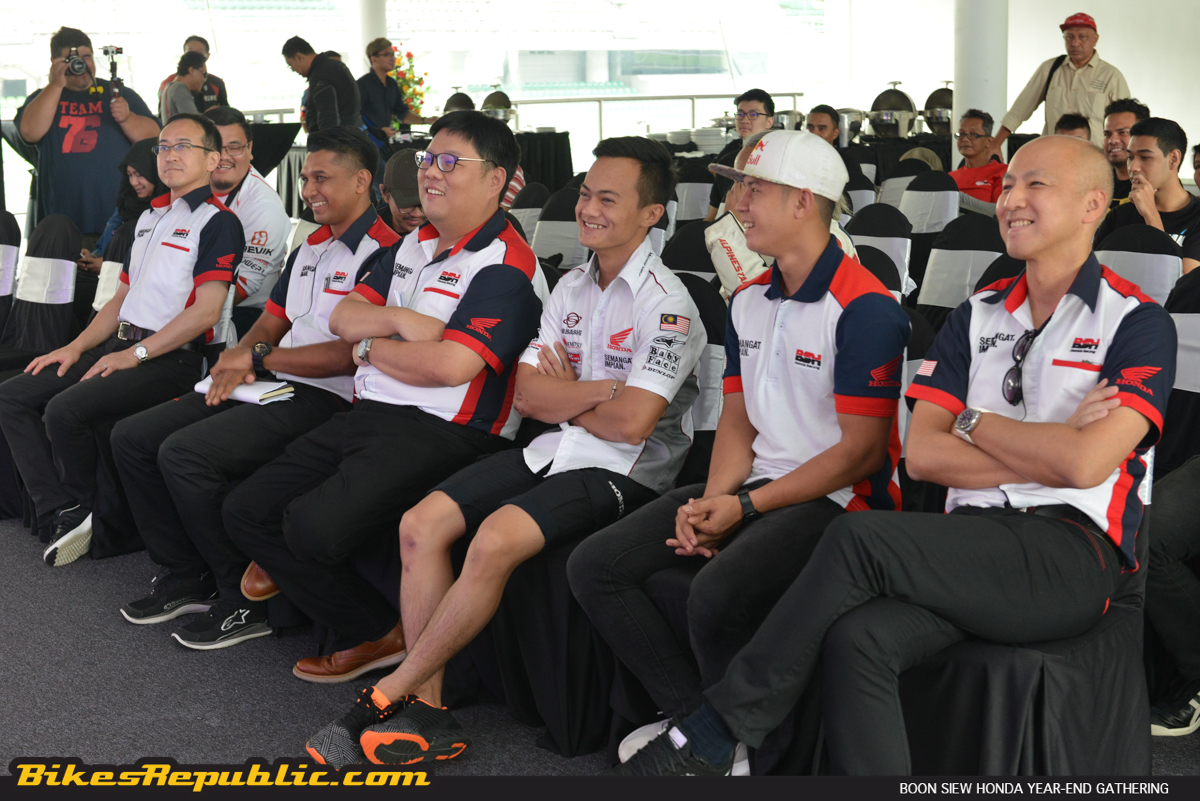
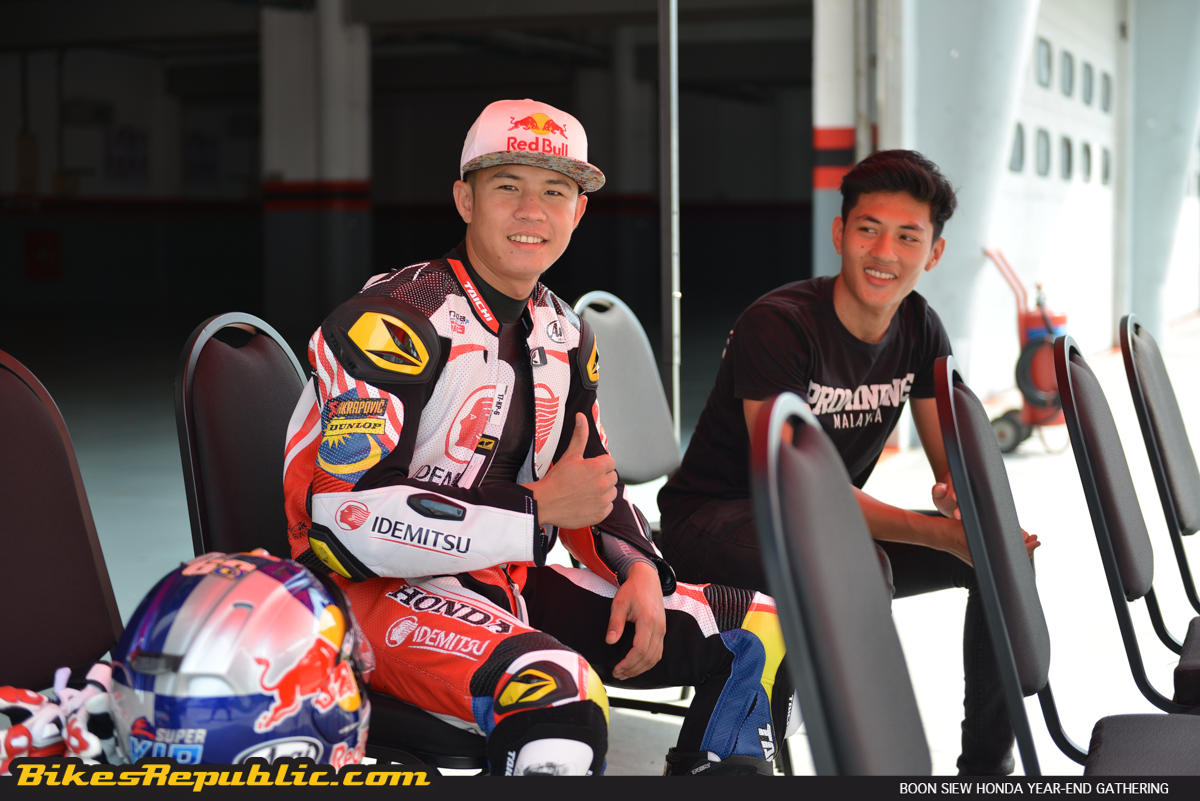
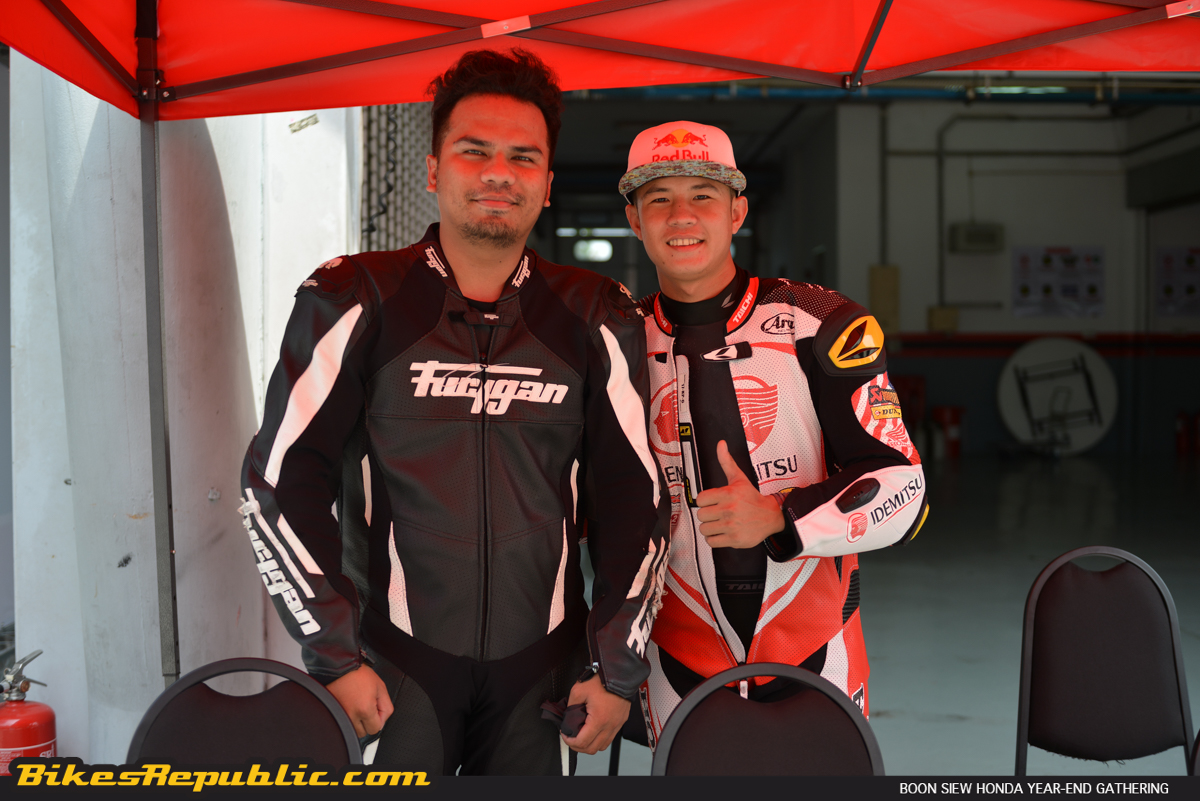
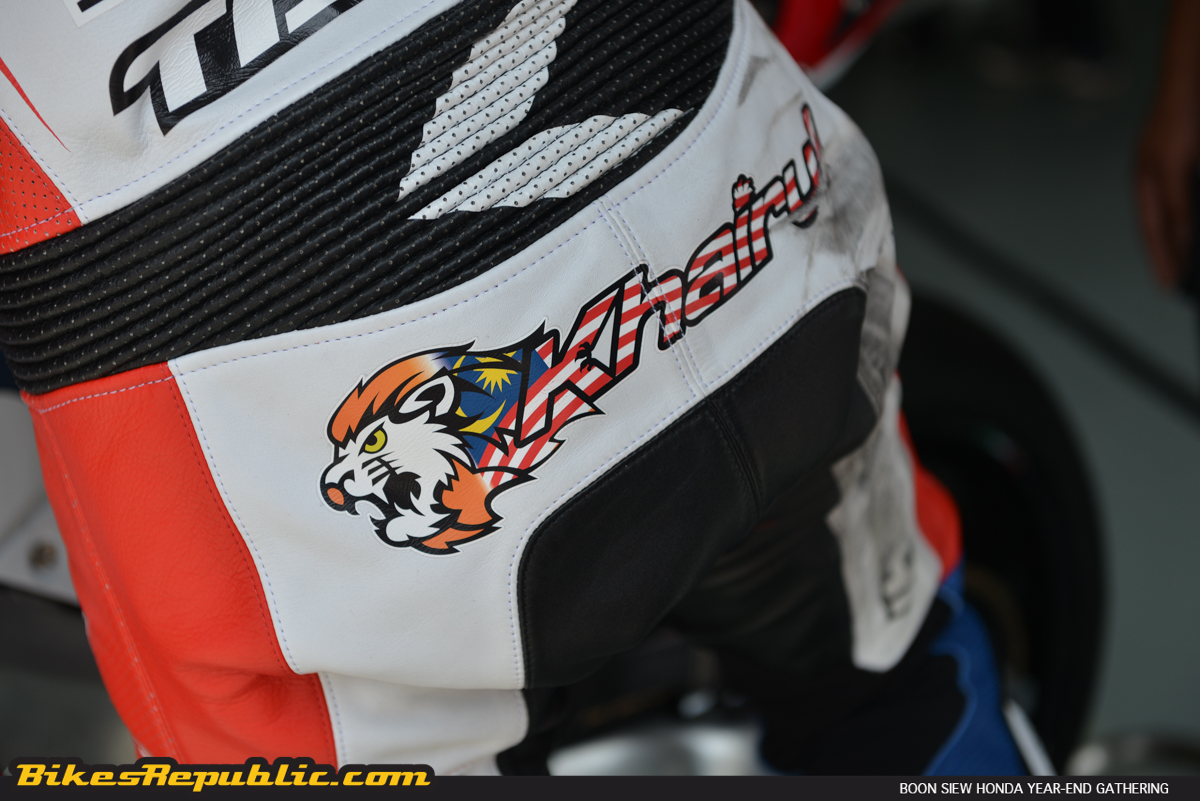
While we ogled at the street version, Boon Siew Honda crew fired up a race-spec RC213V. You see, BSH had invited Khairul Idham Pawi and Zahqwan Zaidi as guest riders and they were given the opportunity to ride the real deal (the RC213V, not the MotoGP bike, though).
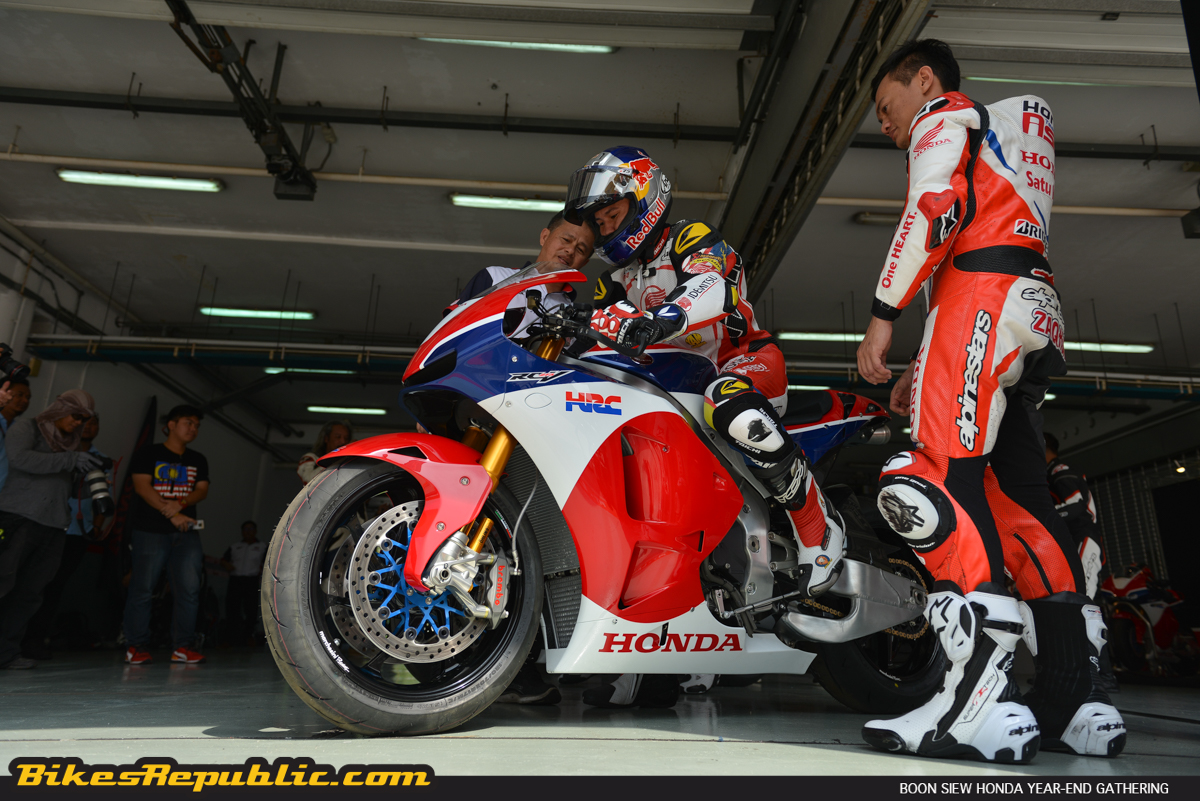
Everyone dropped whatever they were doing and rushed to over to bear witness! Khairul got off the bike and a BSH crew started blipping the throttle to warm it up. We’ve heard the Honda MotoGP bikes from the Grandstand and around the track, but this was the first time we were up close. That rasp and bark from the exhausts plus the mechanical sounds couldn’t be properly described in words, but it sure gouged itself into everyone’s brains. (Check out the video below.)

It was time to head out, with Zahqwan leading my group.
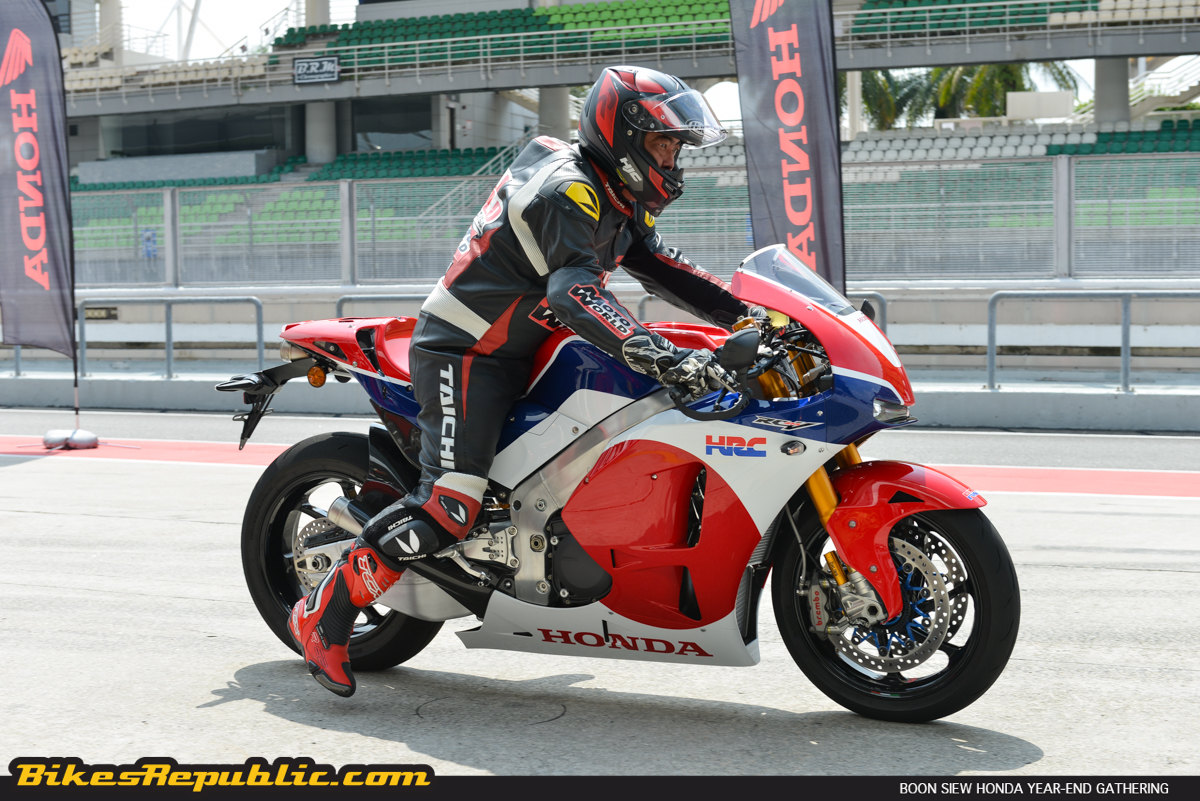
The Honda RC213V-S uses a proximity switch so they key fob had to be carried in my suit. Thumbed the starter button the first time and the LCD screen came to life. Thumbed it the second time and…. It fired up… While I wasn’t expecting the bark of the RC213V, I didn’t expect the RC213V-S came to life so subtly like a… a… very soft CB650F that I rode in the morning. What the…  but still, I’m on a MotoGP replica, so who’s to complain?
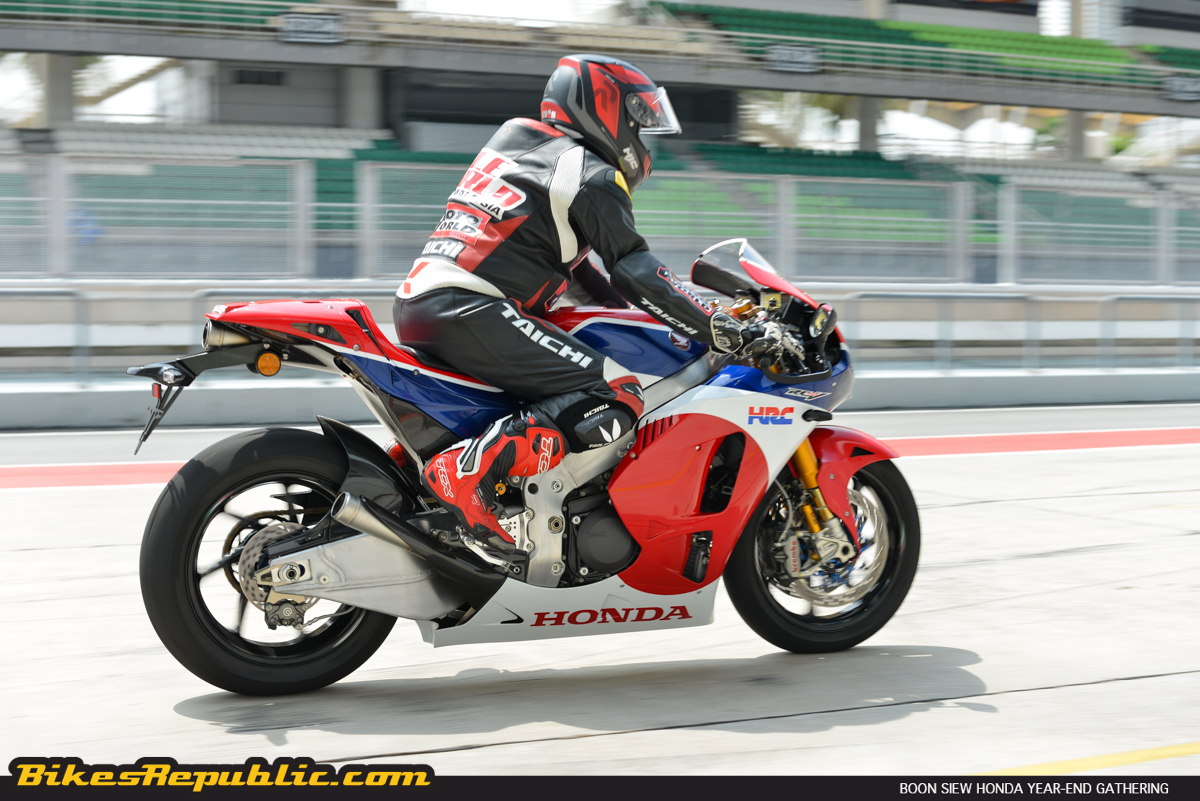
With all the BSH brass and crew looking on, and telling myself not to wheelie over backwards, I slipped out the clutch lever so carefully that I almost stalled it. It hadn’t been necessary as the bike was so smooth on pick up.

Out on the warm up lap, the RC213V-S was so easy to turn and burn, although we were taking it easy to warm the tyres up and acquaint ourselves to the bike.

We had a mock start from the grid. Zahqwan just blasted off into the horizon, leaving his exhaust note reverberating around inside our helmets.
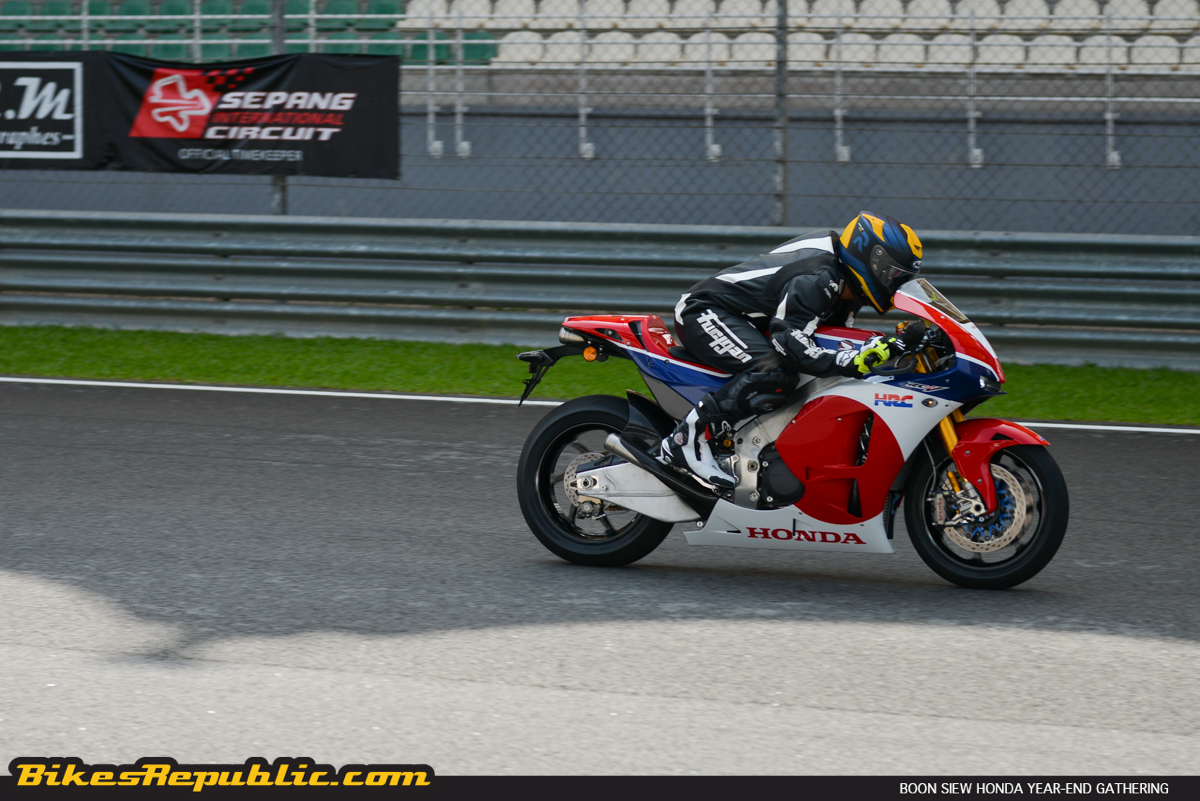
The RC213V-S felt slow leaving the line, but whoa! It felt like I ran into a brick wall just almost as soon as I left the line. Other journos who had ridden the bike during the Honda Asian Journey Ride not long ago had warned us about the rev limit being capped. The bike I was on was limited to 7000 RPM, while there were a few others that revved to 9000 RPM.
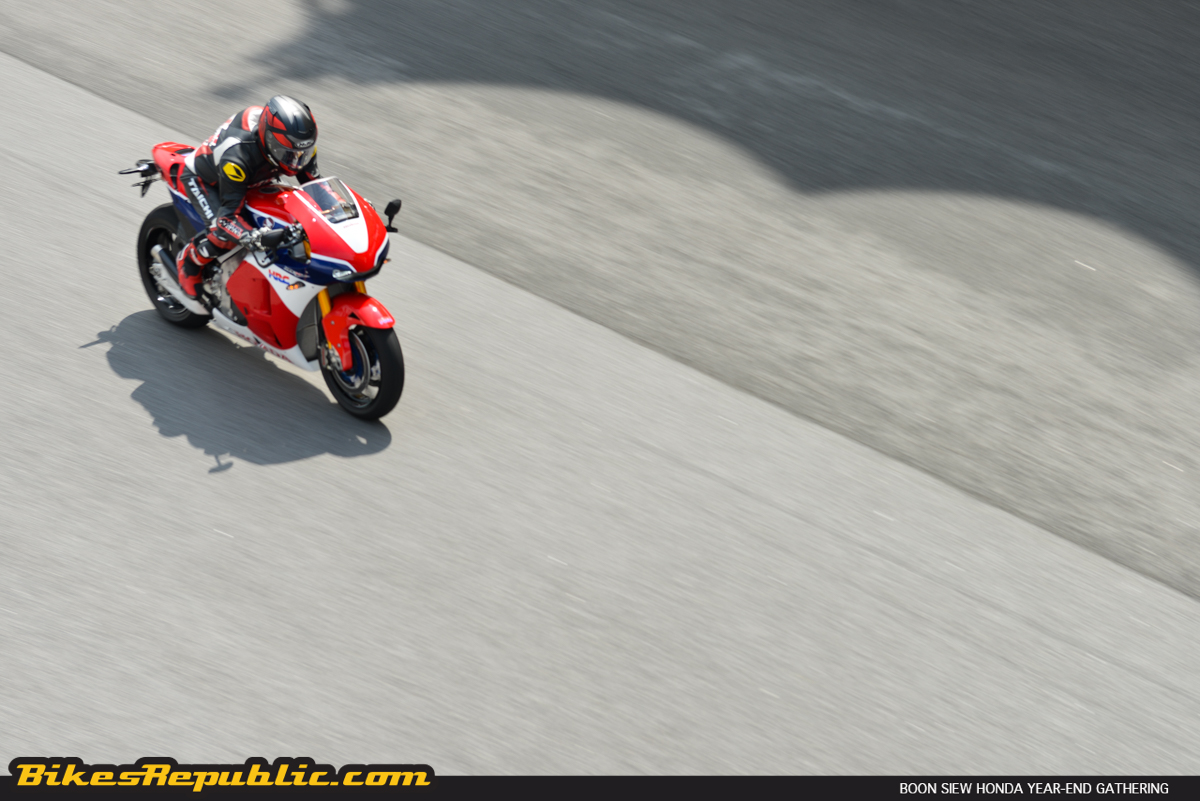
But no matter, while it felt slow, it was actually picking up speed deceptively fast! And with the rev limit being blocked, I went through the gears like there’s no tomorrow.
Accelerating out of Turn 2, it was like short-shifting to third, fourth and fifth for the sweeping Turn 3. The bike just tipped over on its side even with the power fully on as I engaged the gears. The quickshifter was ultra-ultra-smooth so much so I didn’t even give two thoughts about it. I had wondered if I got to experience the seamless gearbox!
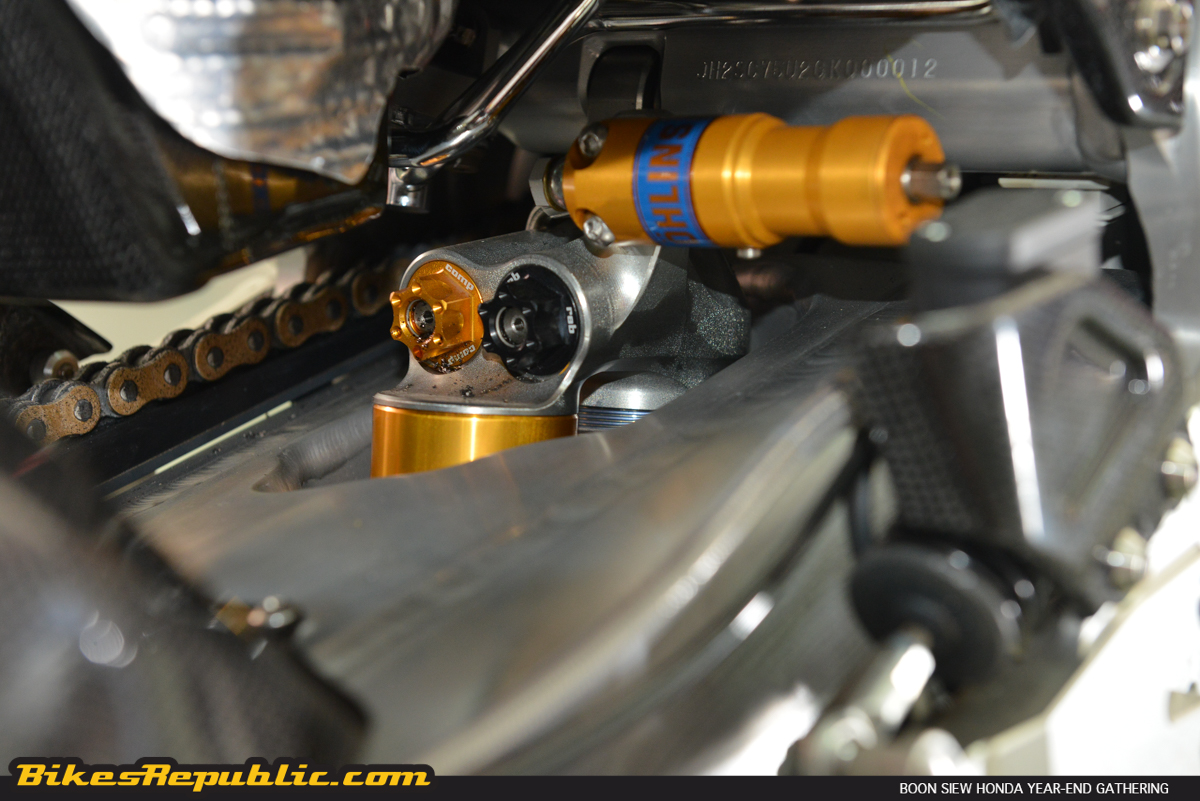
Braking for Turn 4 with two fingers had the front brakes bled off too much speed, so the bike dropped into the corner like an MX bike.
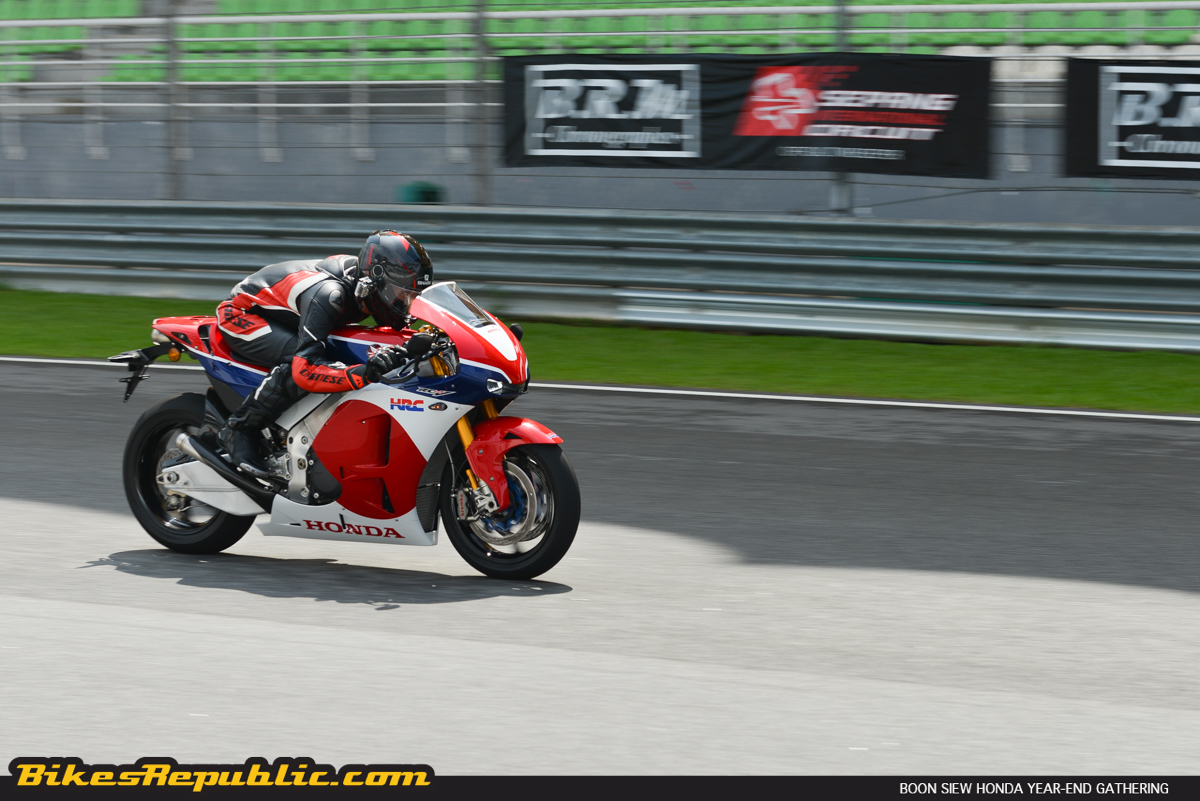
Sweeping through Turn 5 in fifth, I kept rolling on the throttle, having forgotten about the rev limiter. It cut in just as the bike neared the apex. Now, on any other bike, having the power cut i.e. chopping the throttle or hitting the rev limiter, is bad news as it’ll cause an abrupt weight transfer and change of traction, usually resulting in the bike wobbling or worse, standing up. But it didn’t happen on the RC213V-S, I just hugged its line as if nothing happened.

Now I started to worry about the rev limiter so I slowed down for the corners and decided to just blast down the main straight.

Since we were only using the North Track, I gunned the throttle as soon as I cleared the extra corner after Turn 6 all the way onto the straight. The bike ate up all the gears as fast I could feed it and I was already on the limiter just before halfway on the straight, which read 180 km/h.

The RCV213V-S felt slow, but its engine had plenty of kick and revved really quickly. Conversely on the CBR650F earlier, it only hit 179 km/h in sixth about 300m to Turn 1. Was I experiencing Einstein’s Theory of General Relativity firsthand?
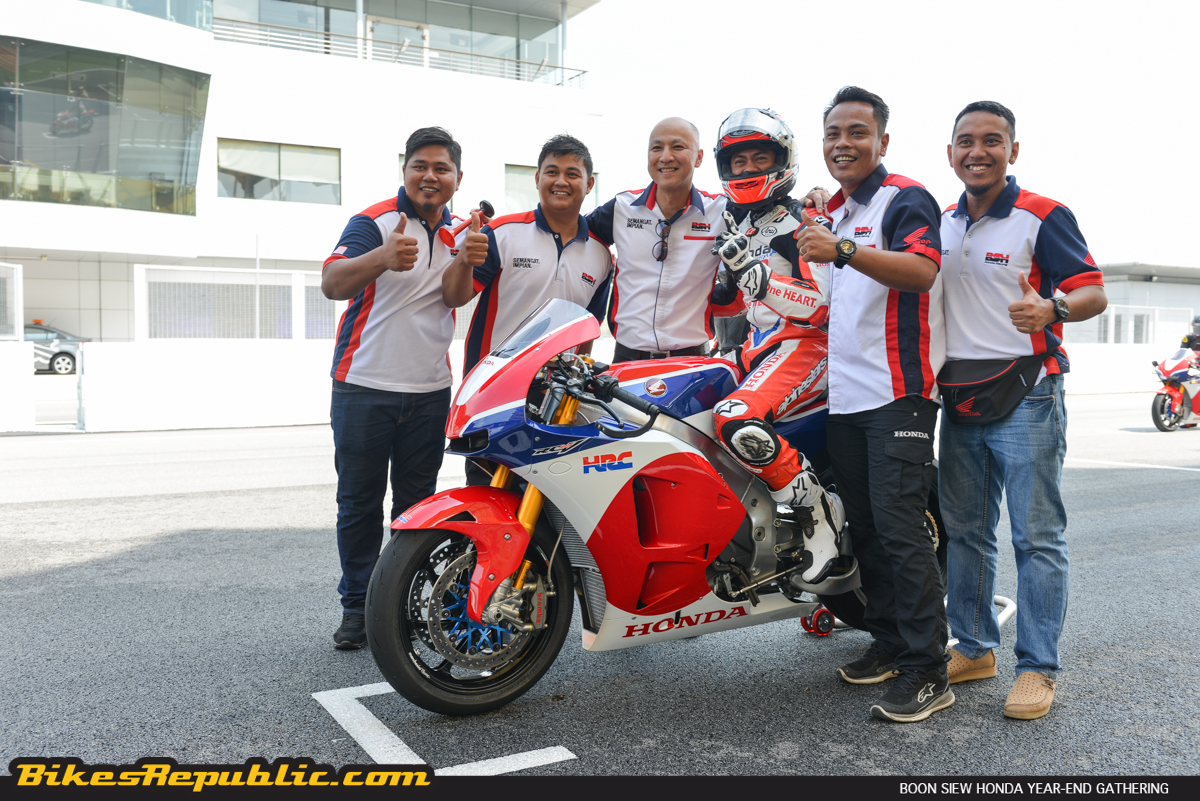
How I wished Honda had raised the rev limit a little higher, say to 10,000 RPM.

We pulled into the pits four laps later. Although I was very thankful to have sampled the bike, I was also unsatisfied that I couldn’t go faster from worrying about the rev limiter.

The conclusion is this: The Honda RC213V-S is a superlative bike that’s unlike any other. I’ve never experienced a bike which t feels benign at high speed, that’s for sure.

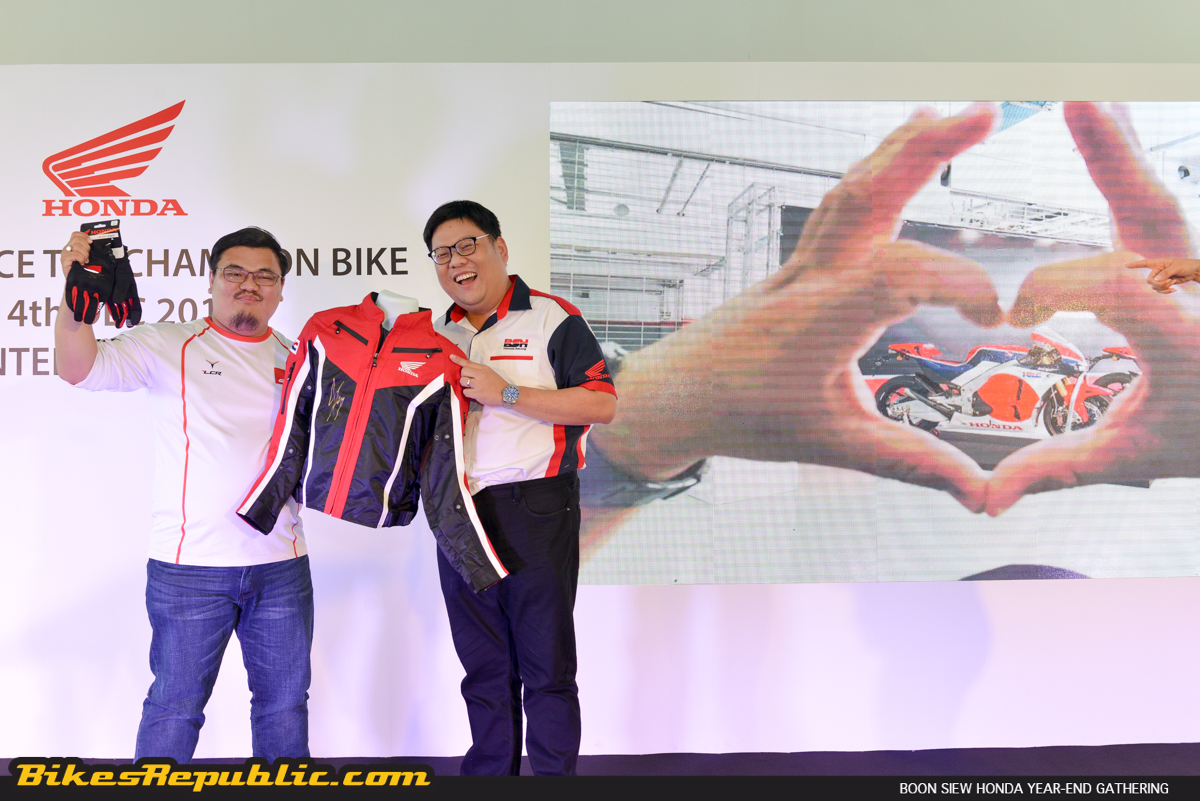
The test session was a special event as part of Boon Siew Honda’s year-end gathering for the media, after having just celebrated their 60th anniversary in Malaysia.
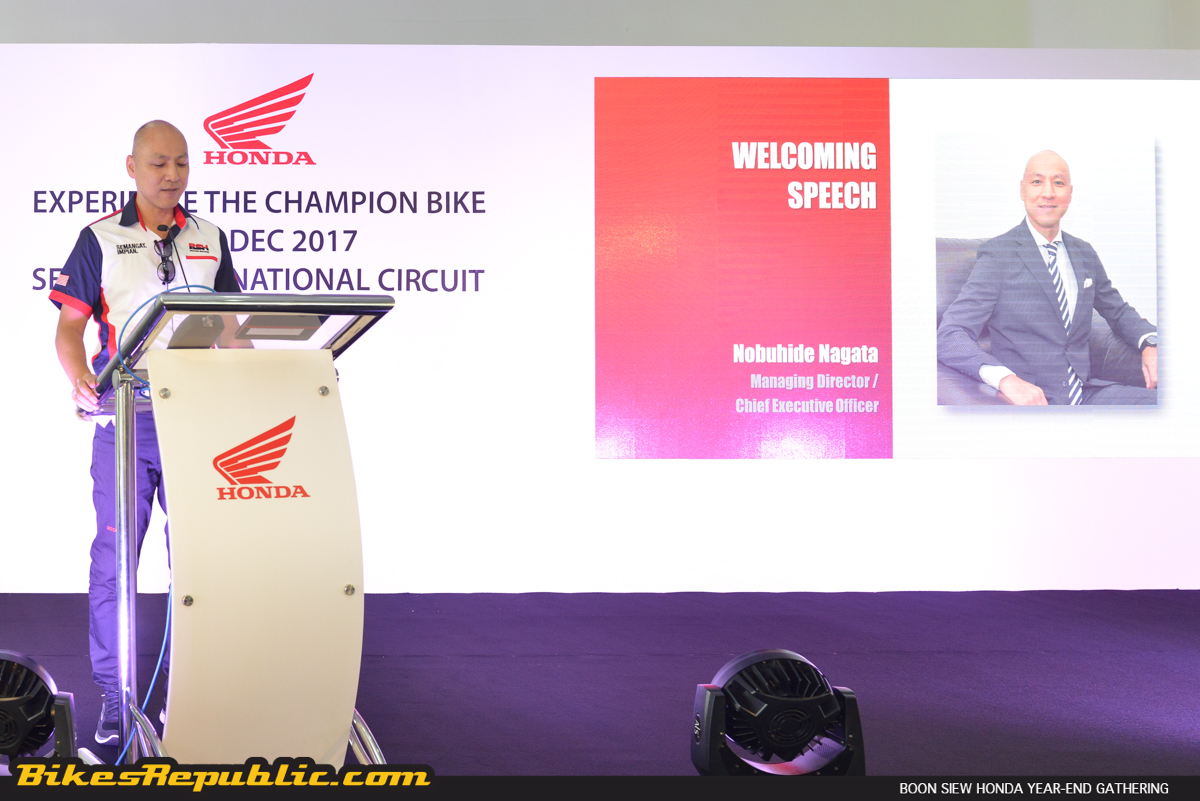
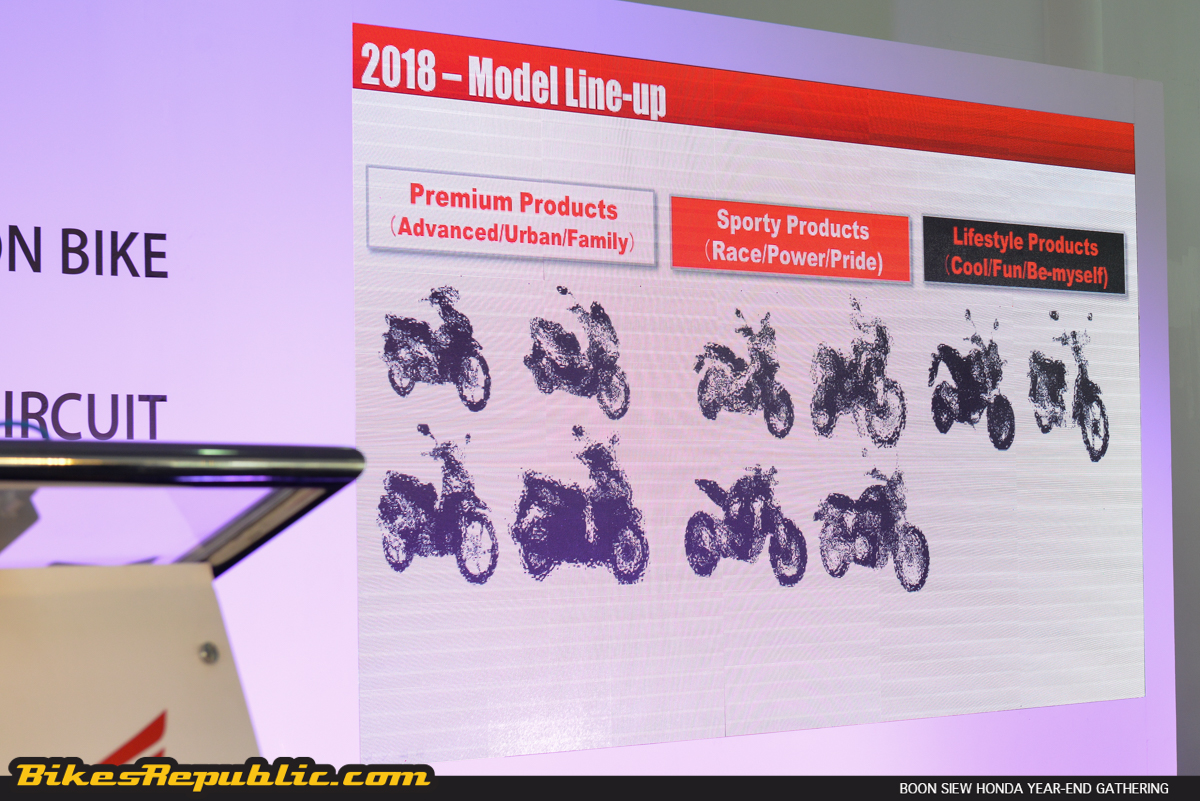
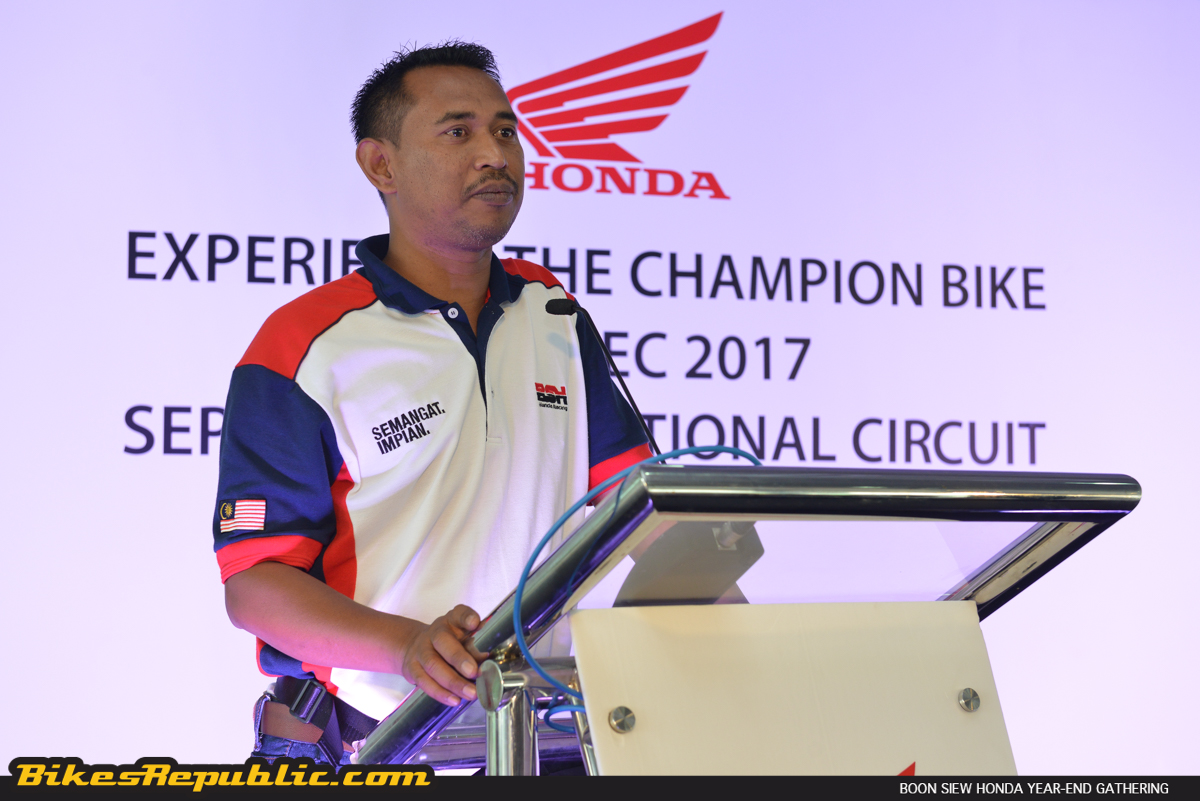
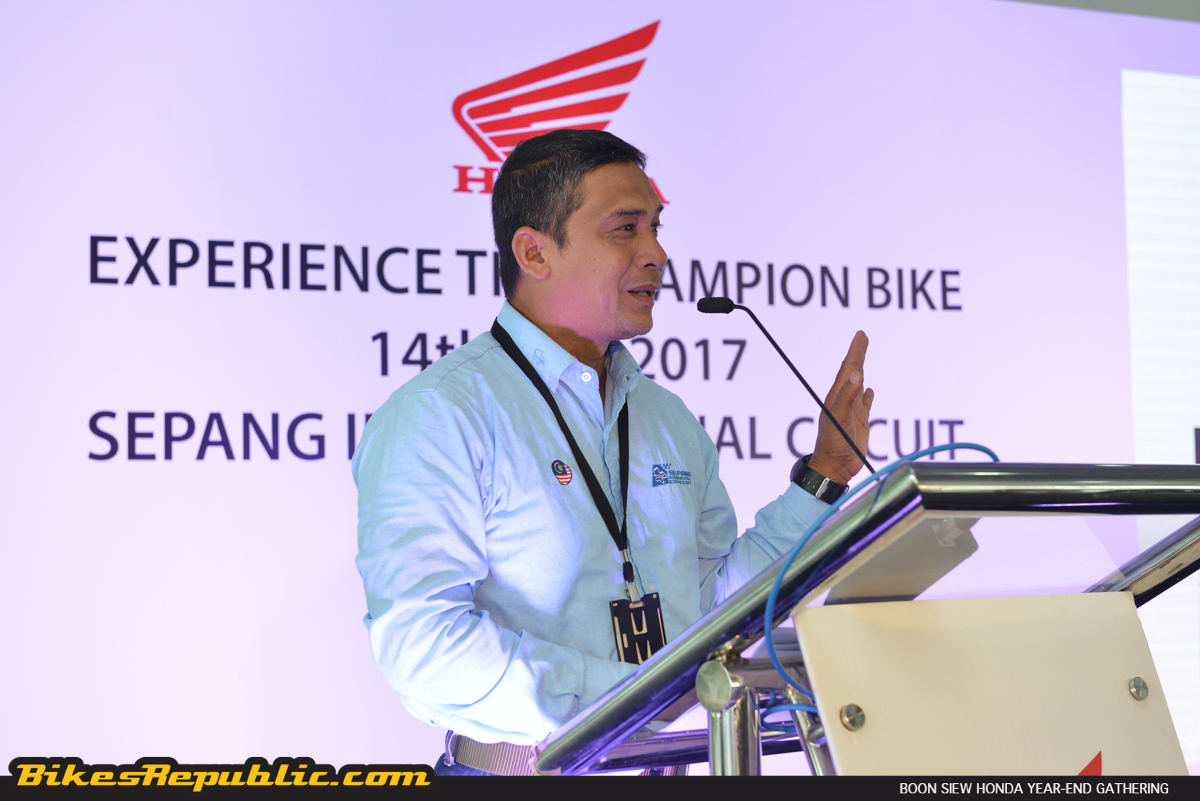
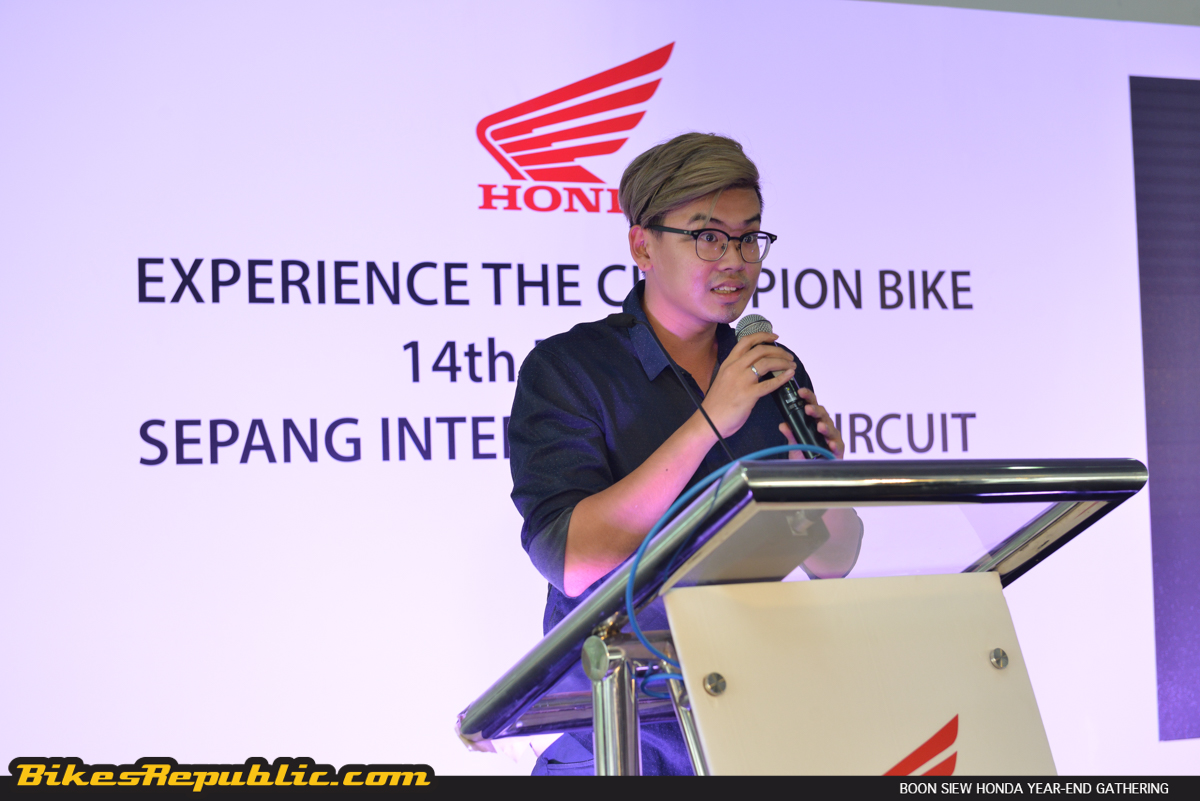
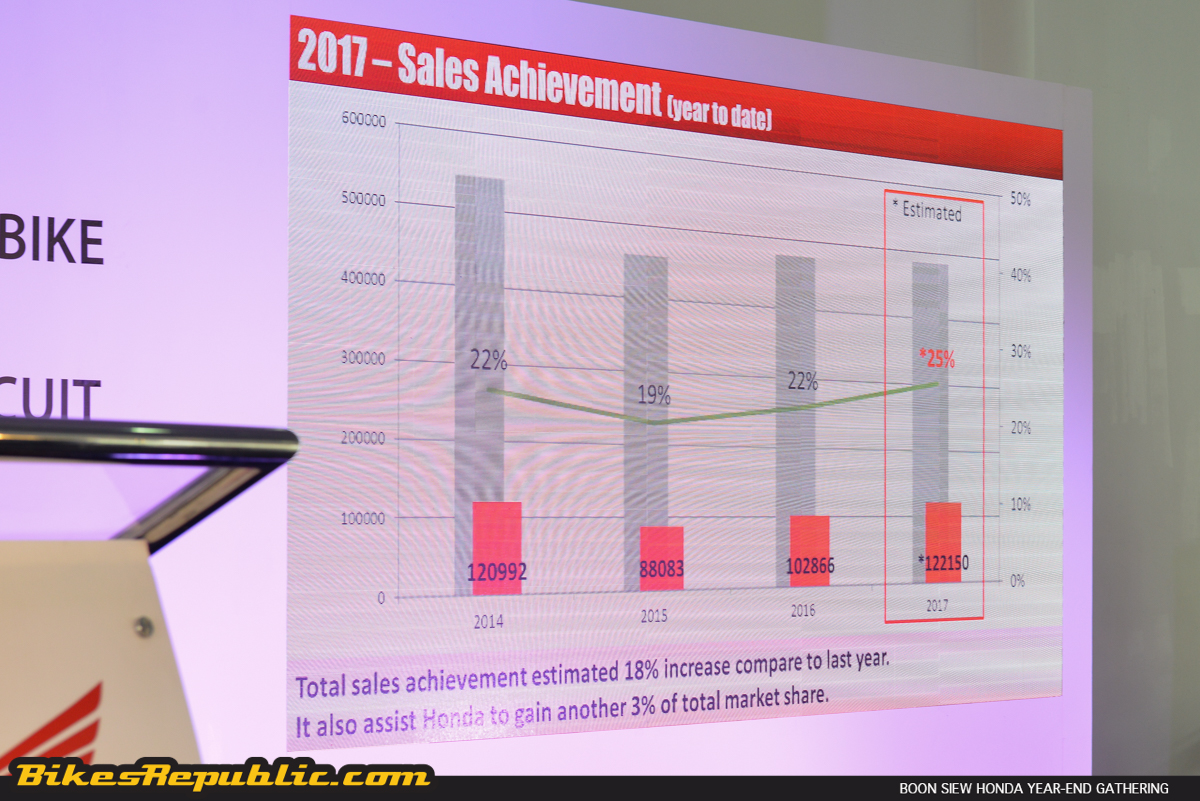
During the welcoming session, BSH announced that sales had increased by 18% in 2017 from the previous year, having move 122,150 number of motorcycles (as of date of the event). But moving forward to 2018, BSH hopes to recapture its former Number One position in the market.
Datuk Sri Datuk Wira Tan Hui Jing, Deputy Chairman and Deputy Chief Executive Officer of Boon Siew Honda provided the outline, “We are targeting to introduce 10 new models and will certainly surprise everyone with our product lineup.”

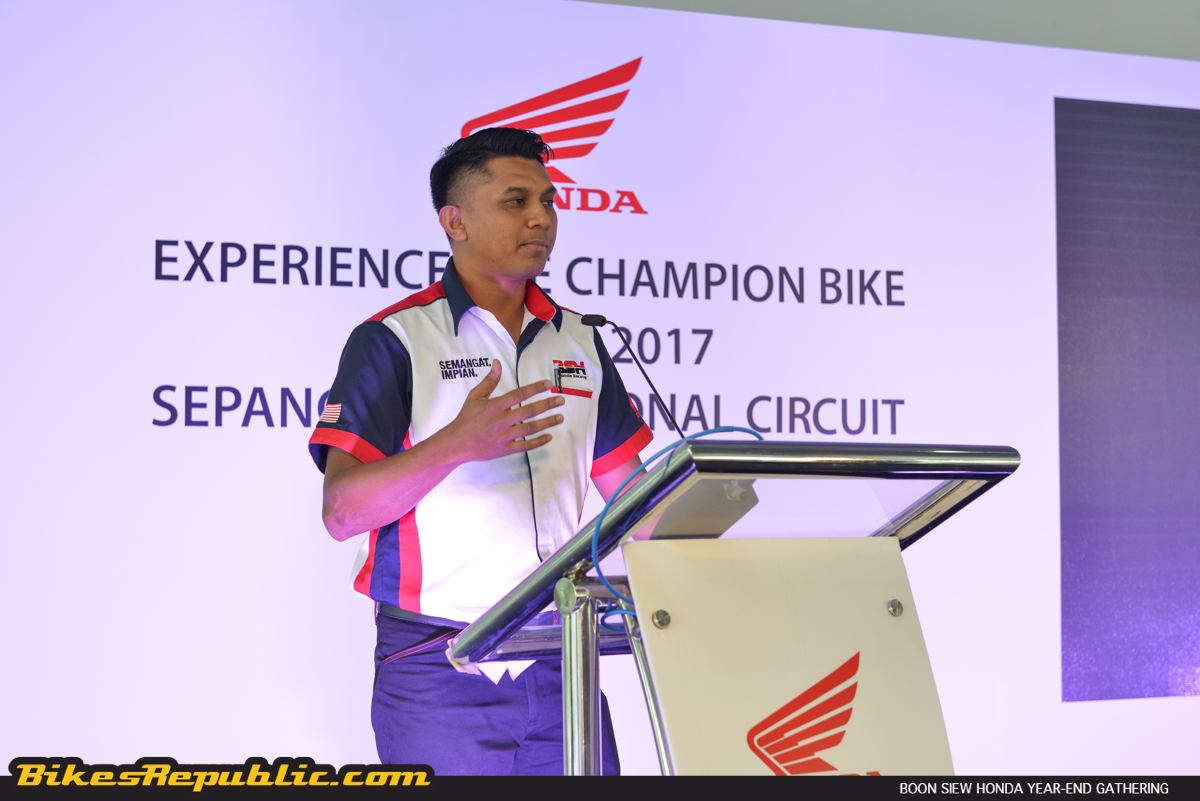
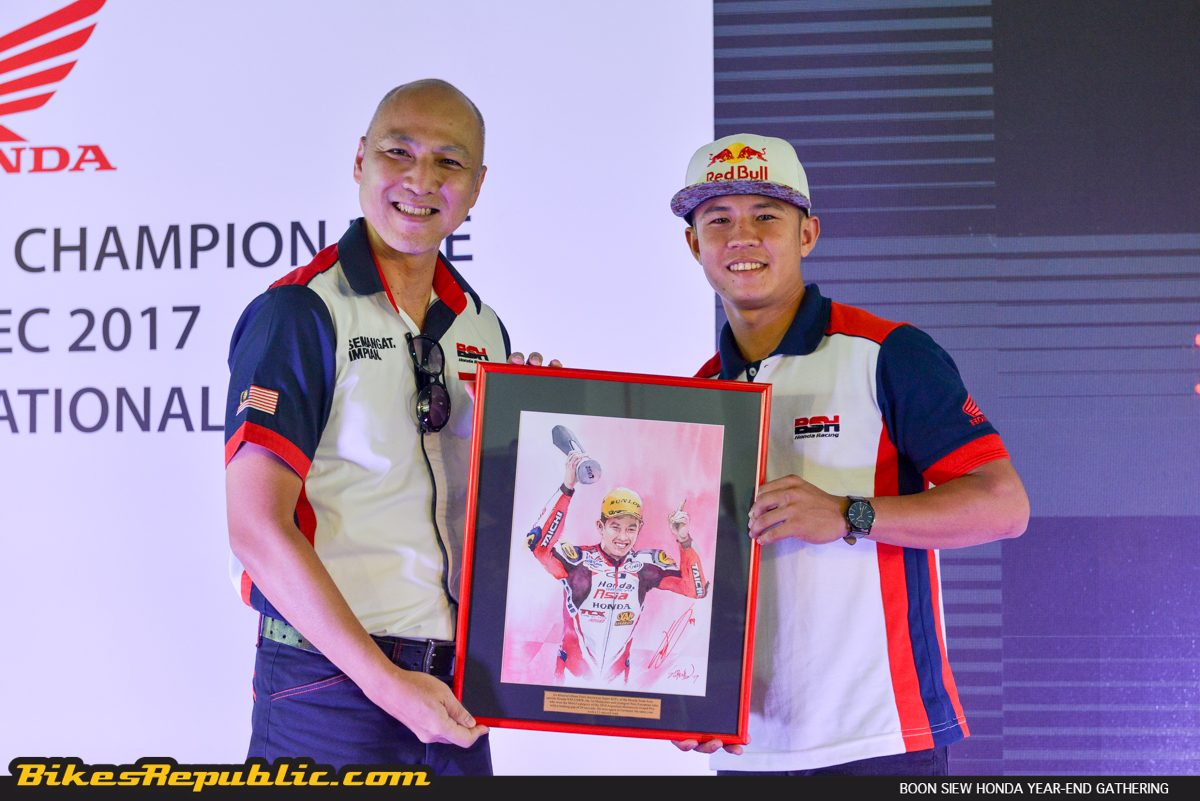
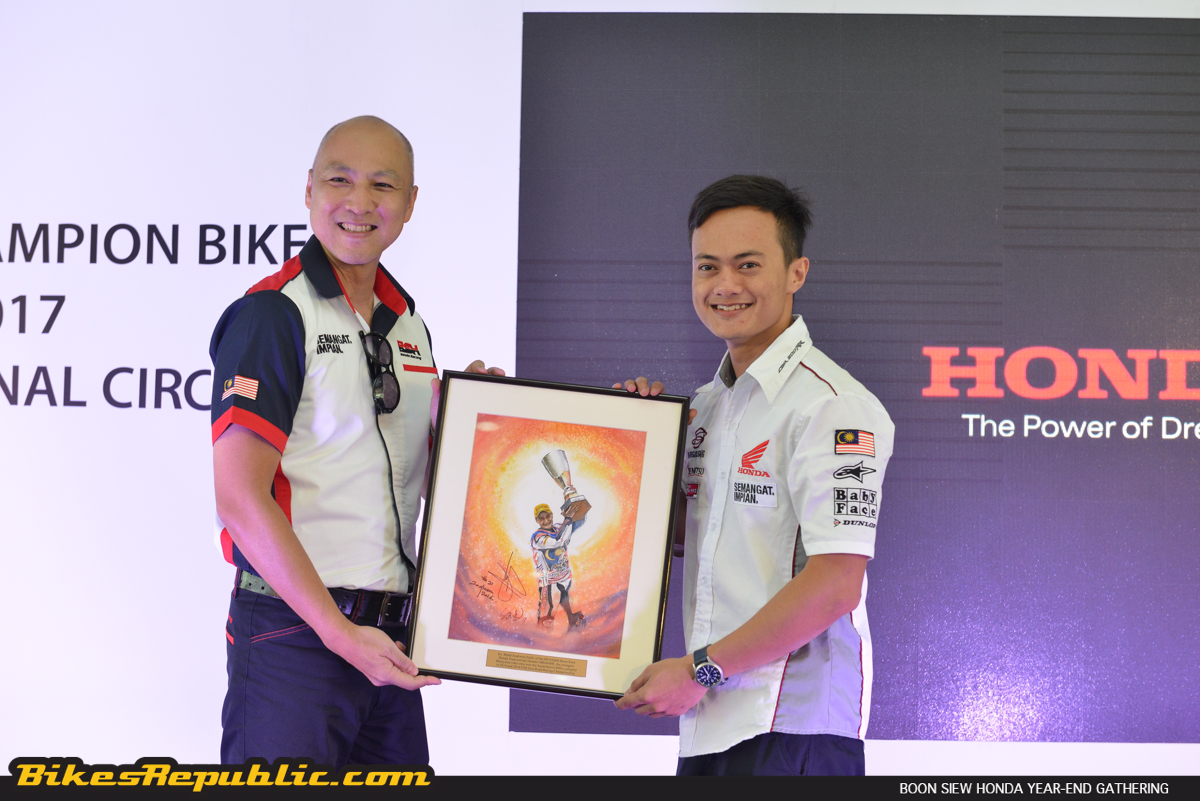
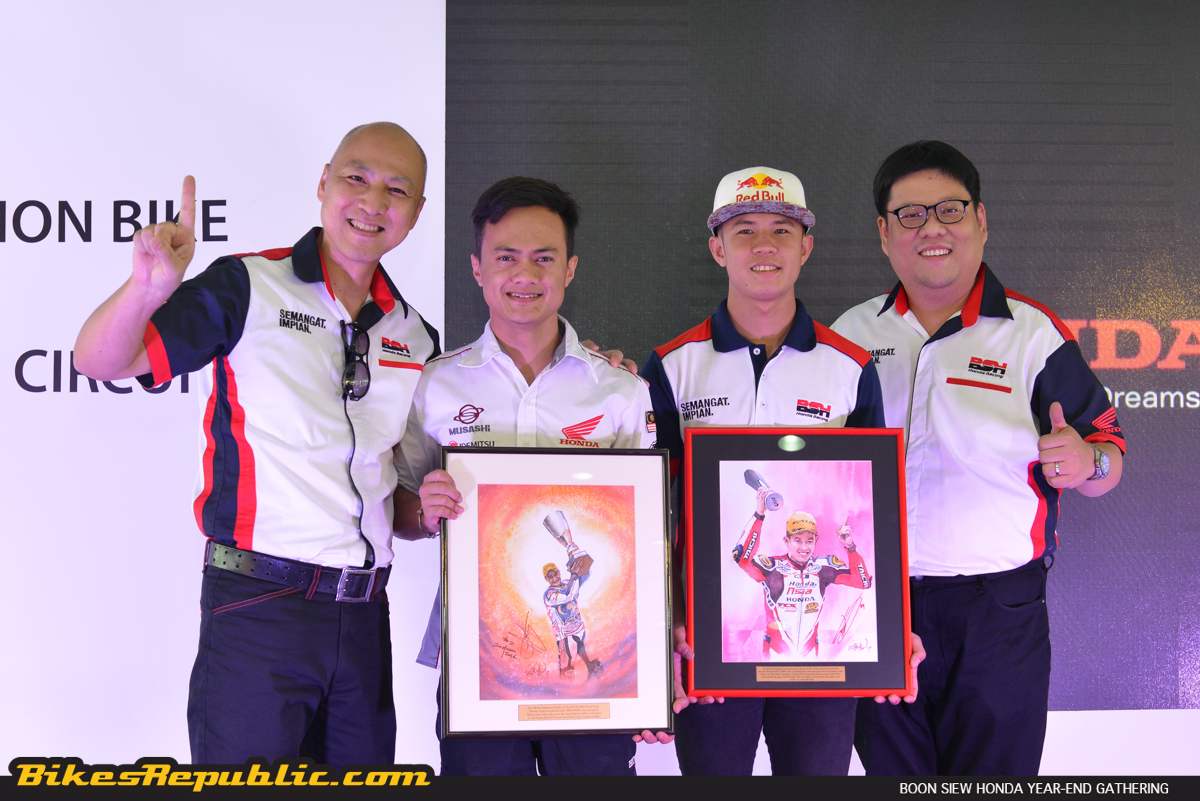
As mentioned earlier, Zahqwan Zaidi and Khairul Idham Pawi were present during the event after campaigning in the Asia Road Racing Championship (ARRC) and Moto2 seasons, respectively. Mr. Nobuhide Nagata, Managing Director and Chief Executive Officer of BSH announced that Zaqhwan will move up to the All Japan Road Race Championship (JSB1000) next year.
Also revealed was BSH’s plans to build the first Honda Big Wing exclusive one-stop sales and service centre in 2018 in the Klang Valley, followed by Penang, Selangor and Johor.

PICTURE GALLERY

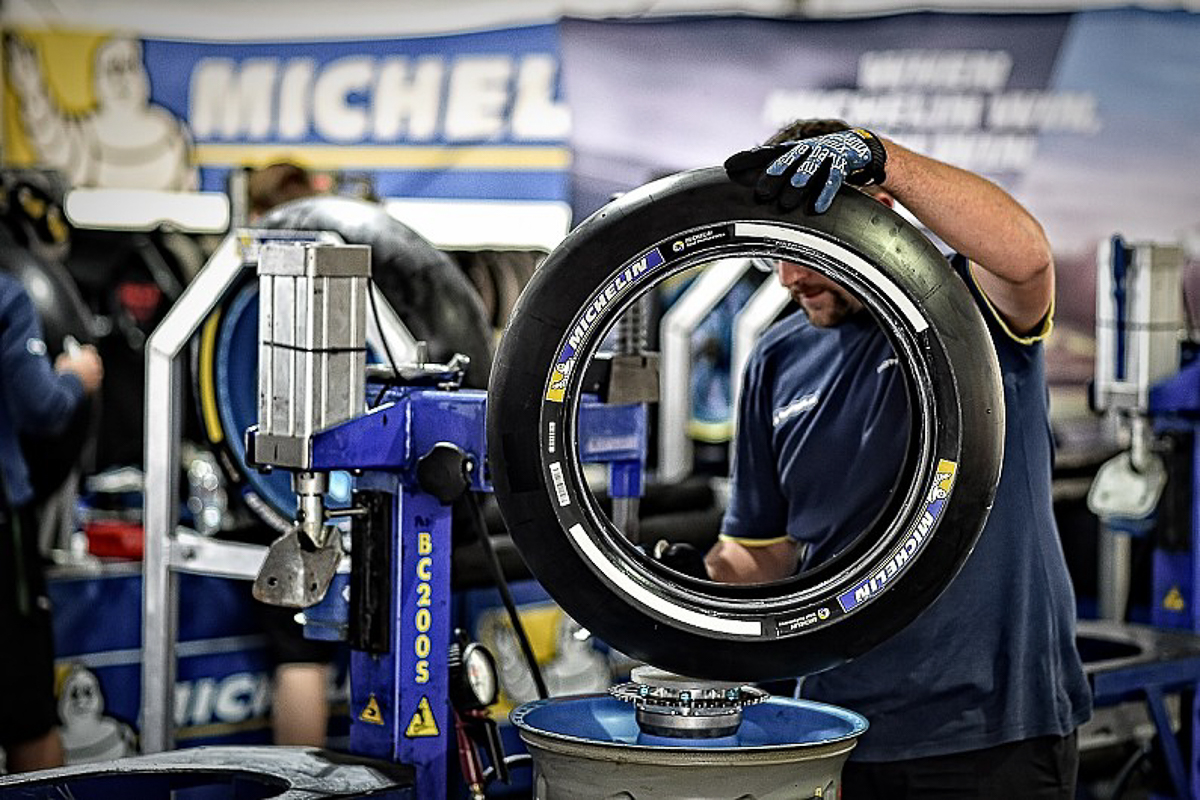
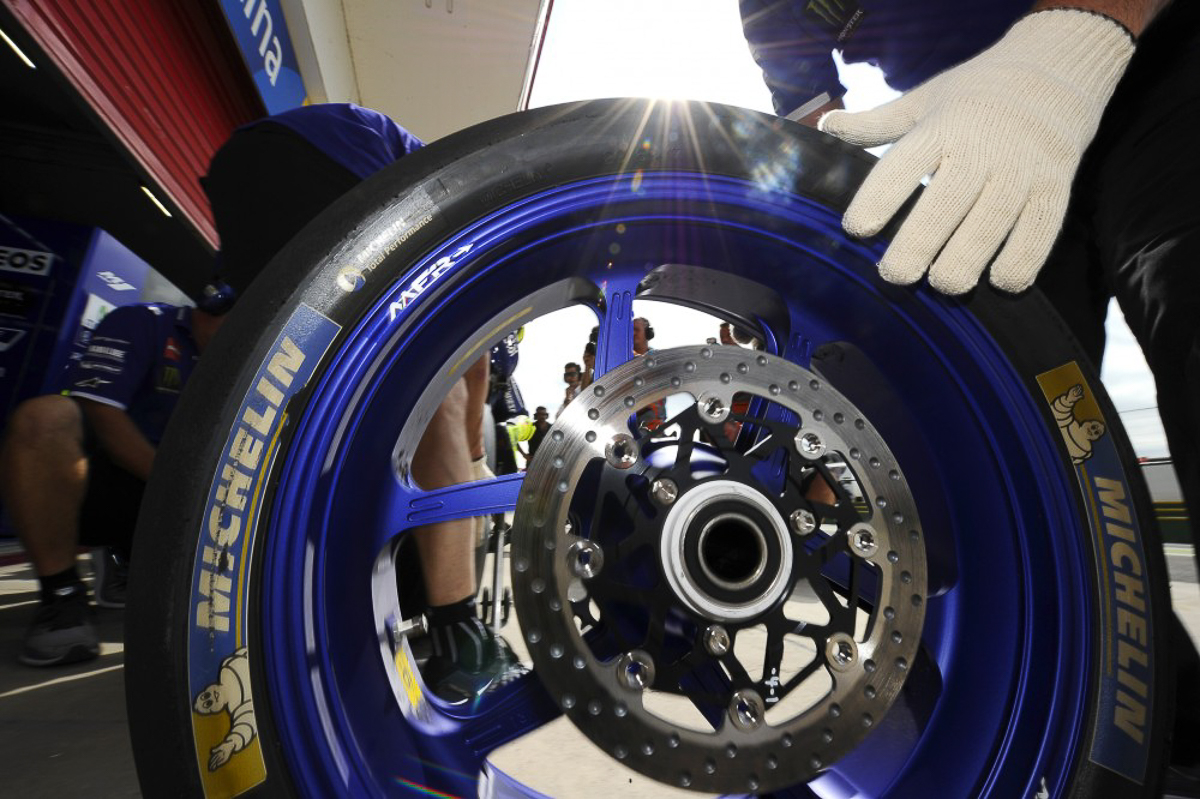
Dorna has announced that Michelin will be the official tyre supplier for the 2019 FIM Moto-e World Cup series.

Powered by Energica electric race bikes, the world’s first ever electric motorcycle racing series will have some serious support from the official tyre supplier of MotoGP.

Considering that the electric race bikes may push well over 140hp and 200Nm of torque, it is only logical that Michelin was chosen for this monumental task.

Image source: Cycle News

Following the announcement of Energica as the official company to supply the electric race bikes for the 2019 FIM Moto-e World Cup series, Dorna made the follow-up broadcast that Michelin will be the official tyre supplier for the first ever electric motorcycle racing series in the world. (more…)

  • The new MV Agusta Brutale 800 is now much more refined.

  • Quality has also improved, along with driveability.

  • The new Brutale 800 is much easier to live with and enjoyed.

MV Agusta’s Brutale lineup has always represented the Italian company’s vision of naked sportbikes. According to MV’s philosophy, the Brutale should be uncompromising yet beautiful at the same time.

As such, most, if not all, Brutales, needed a high level of skill and no less amount of bravery to be ridden well. And for them to work well, they needed to be ridden fast and hard. But I’ve always loved how MV Agustas look (examples: Brutale 800 Dragster RR, Veloce Turismo, F4 Tamburini). Almost no other manufacturer could design something so bold.

With that experience in mind, I approached this new MV Agusta Brutale 800 with some mixed expectations. I had a sense of trepidation intermingled with excitement.

Like that bad girl your mother warned you about.

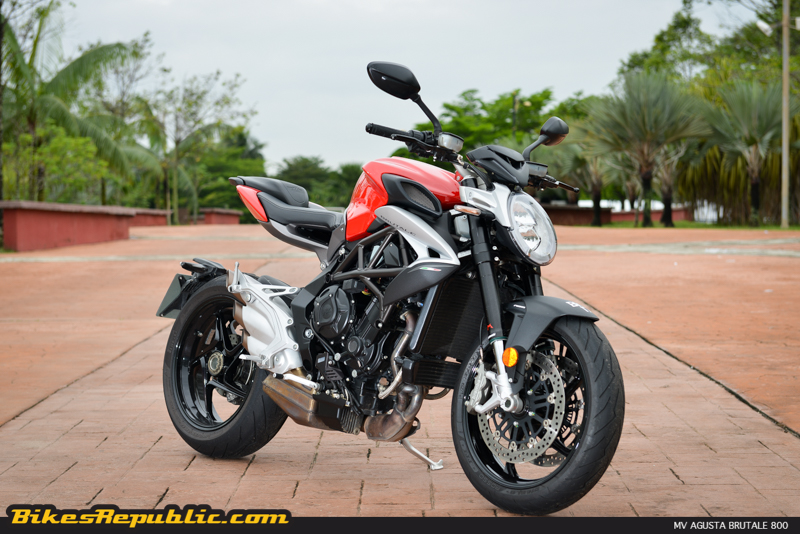
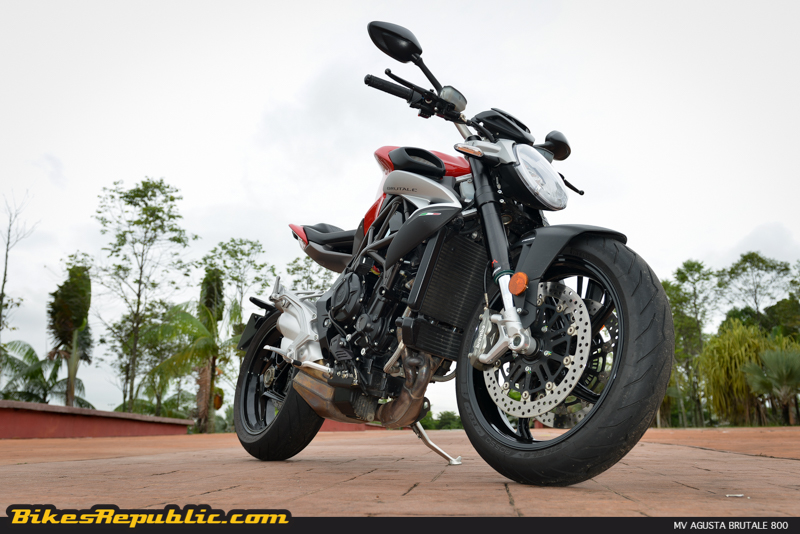
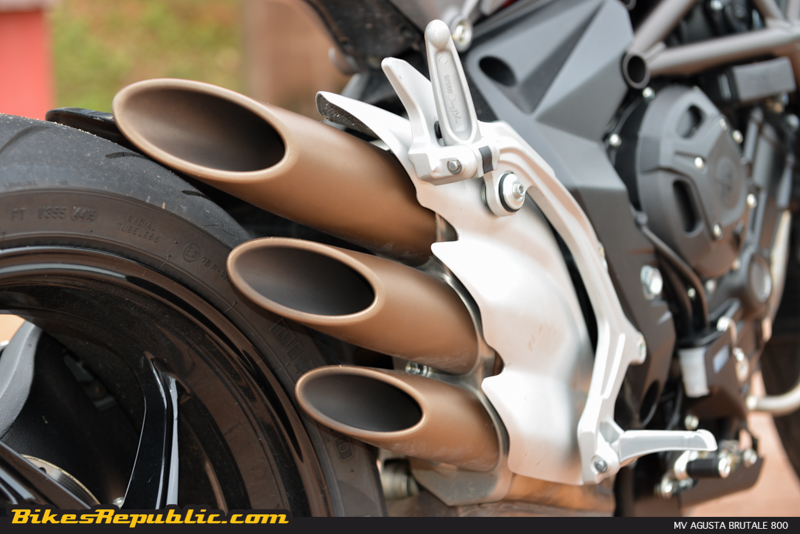
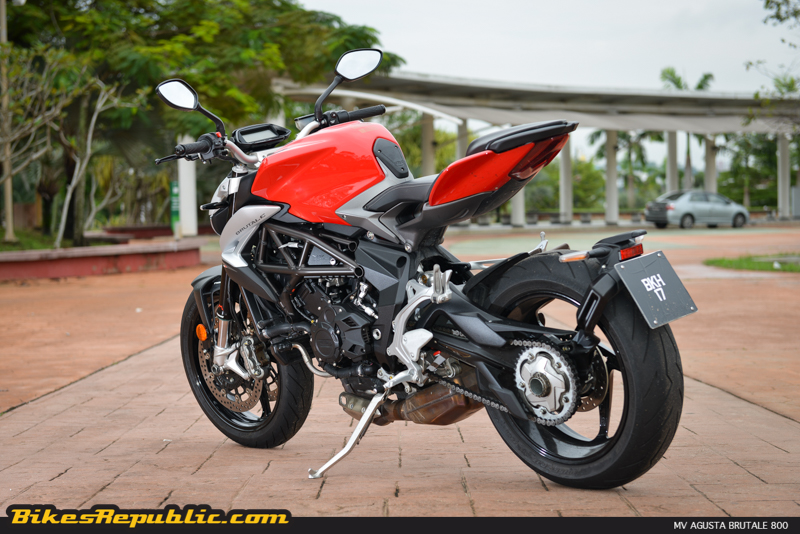
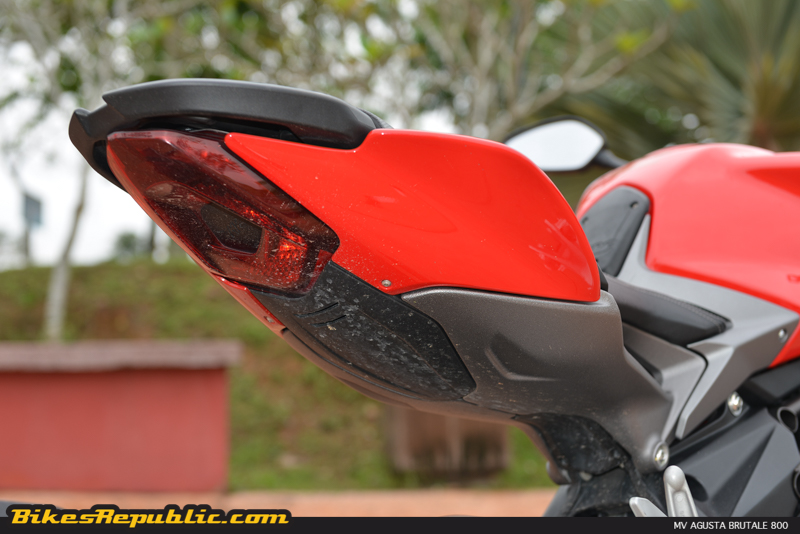
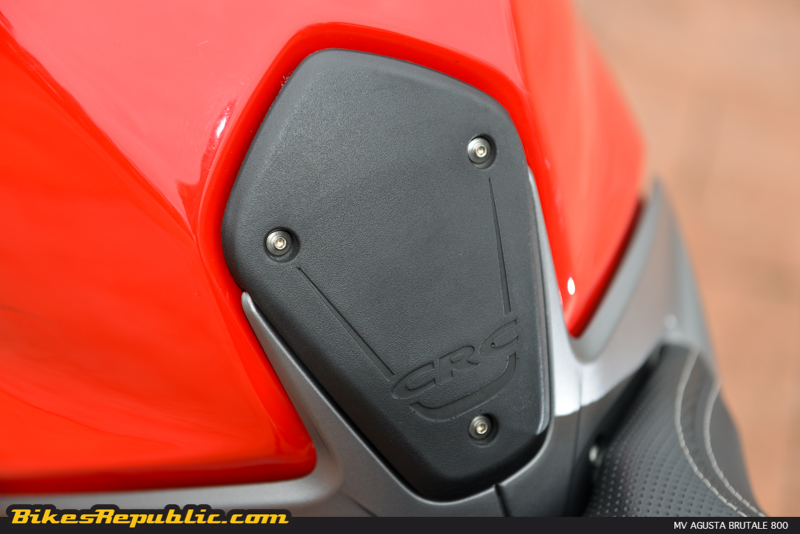
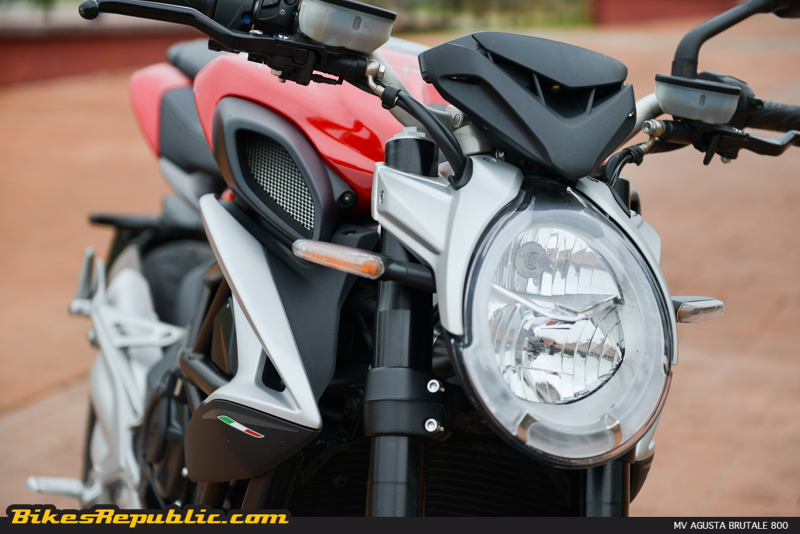
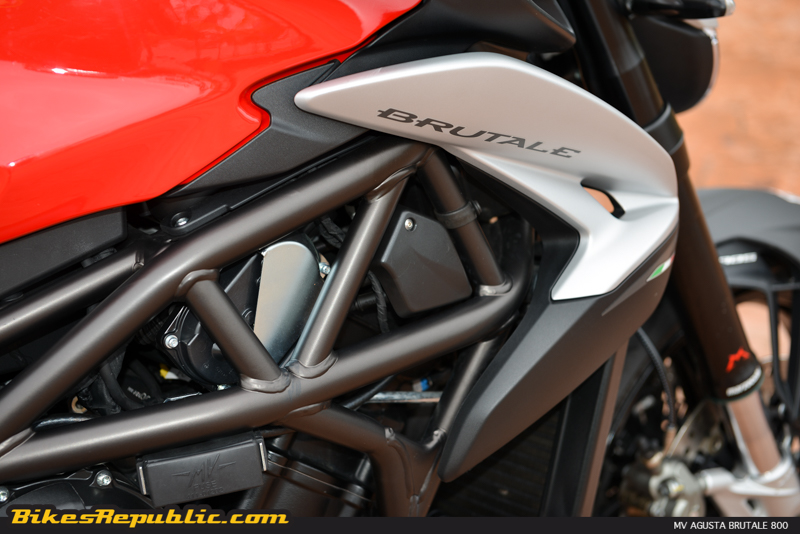
This new Brutale 800 sure looked awesome, the voluptuous tank in fire engine red, with a diminutive waist which had a hole in it, just like the Veloce Turismo. From the rear three quarters, it looked like wasp – ready to sting. MV Agusta calls it, “The big chest, small waist profile.” Sounds good to any man.

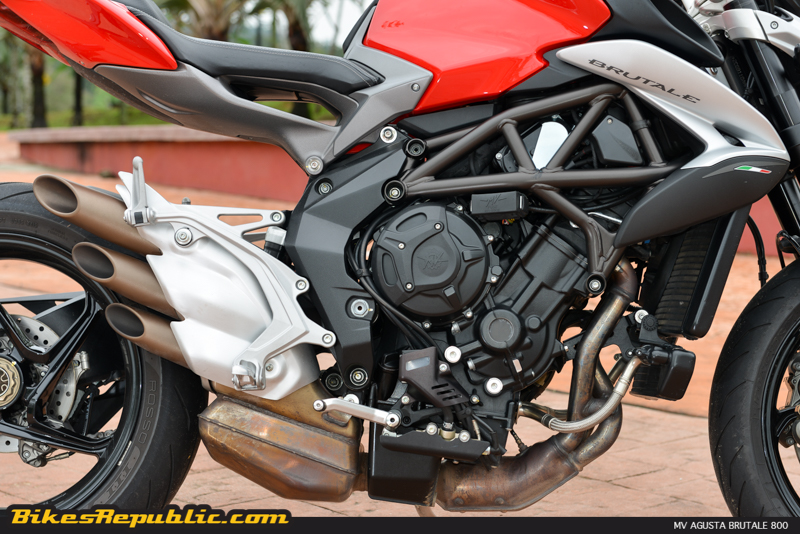
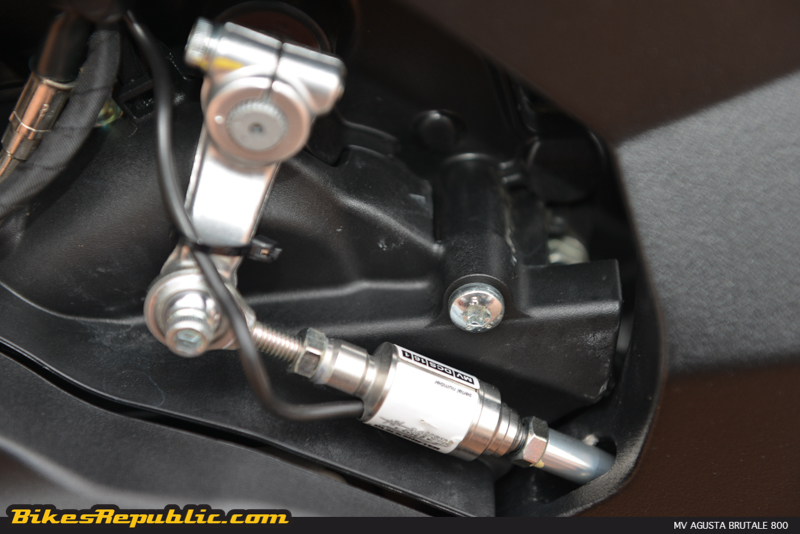
The engine dangled under the tank with everything tightly packed around it, looking like the guts of a monster. But I couldn’t locate the battery. There is a reason for this, though, in the interest of mass centralization.

But something caught my attention the first time I laid eyes on it. The panels, quality of the finish, fitment and components looked way better than MV Agustas of past.

The 800cc, DOHC, 12-valve, Triple still took a bit of cranking to get it fired up. But once it does, it sounded guttural, slightly primitive even. It lets you know it’s alive.

The seat is much taller now, as the top part of the subframe had to be designed taller to produce that hole. However, I was surprised that the seat was actually rather comfy, instead of feeling like I was sitting on a leather-covered plank. The waist where the subframe joined the tank was really slim, allowing my short legs easier reach to the ground.

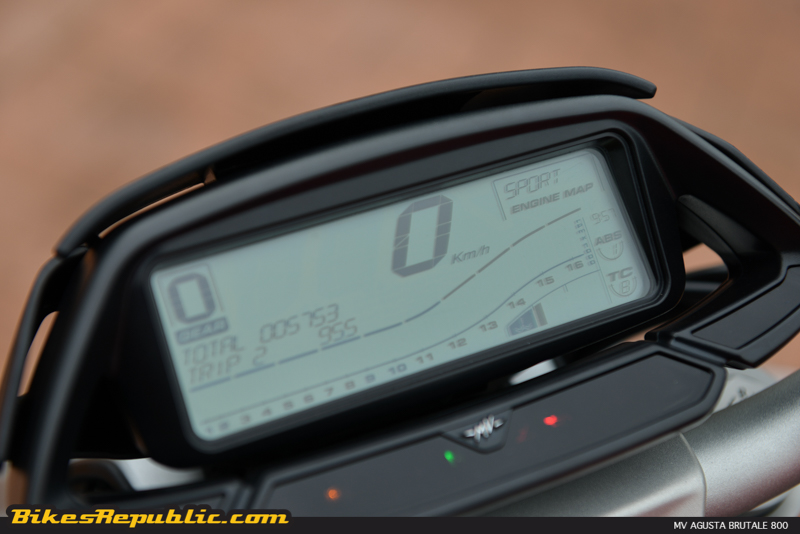
The fully LCD display was crammed with every information you need, except surprise, a fuel gauge, although you could ride about 60 km more when the low fuel amber light comes on. There’s also a large gear indicator, but my only hope is that MV Agusta will place the tachometer bar on the top, rather than below everything else. On the other hand, I really do liked the fact that MV Agusta’s LCD screens hardly reflect direct sunlight.

There are four riding modes: SPORT, NORMAL, RAIN and CUSTOM. SPORT gives you full power and torque; NORMAL cuts power to 100 bhp (good for long distance riding), RAIN cuts power and torque further; and CUSTOM means you could set your own preferences. There are 8 levels of traction control which you could dial and the ABS is switchable.

Starting in NORMAL, a bit of throttle and slip of the clutch got the show going. Give it more throttle and the Brutale 800 took off and it didn’t stop pulling. The rush of speed was accompanied by a soundtrack that could only come from an MV Agusta Triple.

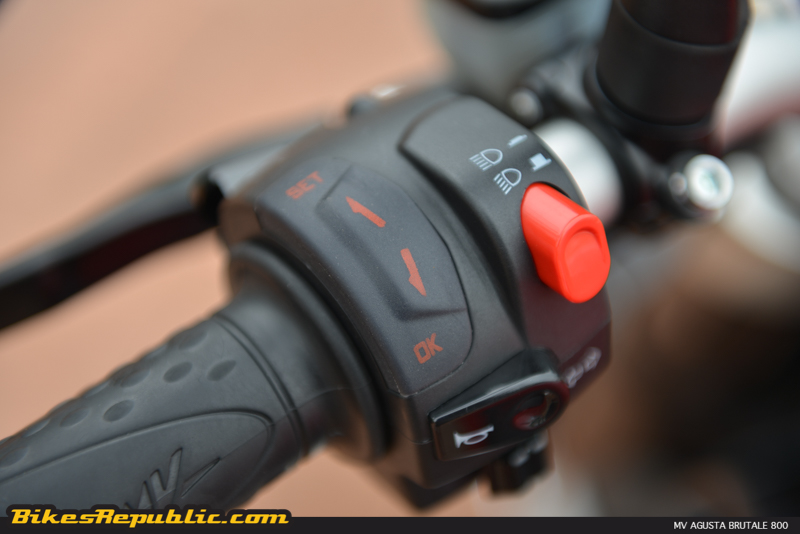
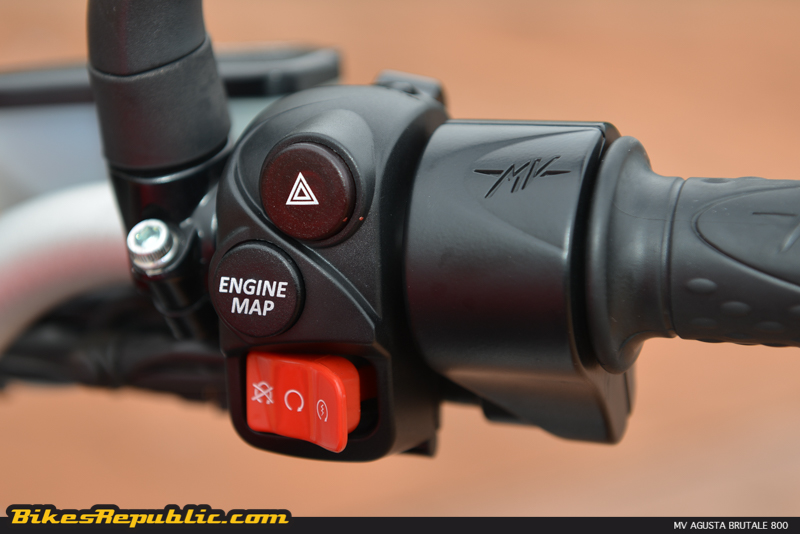
The switch for the riding modes was via a large button on the right handlebar. All you need to do is hold it down until the indicator blinks in the LCD and you can start selecting the mode you desire, without needing to shut off the throttle. That said, the placement of the button on the right side needed some getting used to, but you’ll get it soon enough without needing to relocate your right thumb.

But SPORT mode is where the bike truly shines. The new generation MVICS 2.0 ECU’s fuelling is crisp and accurate, while the throttle isn’t abrupt anymore. Along with the newly mapped ECU, the quickshifter is one of the best on any bike I’ve sampled.

It kicks in the next gear immediately without feeling like you’ve chopped the throttle, nor did it lag. Every gear was hammered home without delay, plus it works on the downshift too, with the throttle being blipped just the right amount. There was no wheel hop even when I experimented with downshifting right down to first without the clutch.

However, the quickshifter works on the upshift and downshift only in SPORT, while only upshifts are available in the other modes.

The next thing I liked about this new Brutale 800 was the suspension. Sure, it’s still stiff but it isn’t harsh anymore. Previously, a bump in the middle of a corner was sufficient to kick the wheels into the air and cause you to lose your line. Now, you could still feel the road but you don’t get displaced off your chosen line.

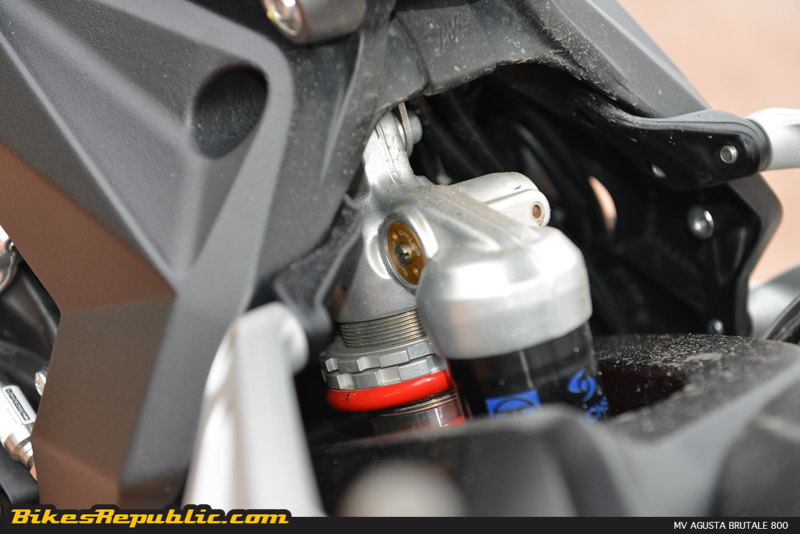
Besides that, while the previous suspension didn’t seem to respond to any adjustment, decreasing compression damping by three turns and increasing rebound damping in the rear by two turns did wonders for my 80kg weight.

With the suspension sorted, it was time to turn and burn.

The handlebar was placed higher than previous Brutales and was wide. That meant plenty of leverage from your arms to steer the bike quickly in any direction. Adding to the quick steer character was the rake of 24.5 degrees. But the Brutale 800 wasn’t nervous at all especially when accelerating hard, courtesy of the 103.5mm trail.

Combined with the engine’s serious punch and the bike’s light weight, and you’ve a bike that gets away from it all in the blink of an eye.

All in all, I’m glad to see that MV Agusta is still going and the Brutale 800’s big steps in refinement is definitely reassuring.

In closing, the MV Agusta Brutale 800 does make you feel good about yourself.

TECHNICAL SPECIFICATIONS

ENGINE
Engine type Liquid-cooled, 4-stroke, DOHC, 4-valves, inline-Triple
Compression ratio 12.3 : 1
Bore X Stroke 79.0 mm X 54.3 mm
Displacement 798 cc
Fuel system Eldor EM2.0 electronic fuel injection
Maximum power 109 bhp (81 kW) @ 11,500 RPM
Maximum torque 83 Nm @ 7600 RPM
TRANSMISSION  
Clutch Hydraulically activated with slipper clutch
Gearbox 6-speed with quickshifter
CHASSIS
Front suspension Marzocchi 43mm USD forks, adjustable for preload, compression damping and rebound damping, 125 mm travel
Rear suspension Sachs single progressive shock, adjustable for preload, compression damping and rebound damping, 124 mm travel
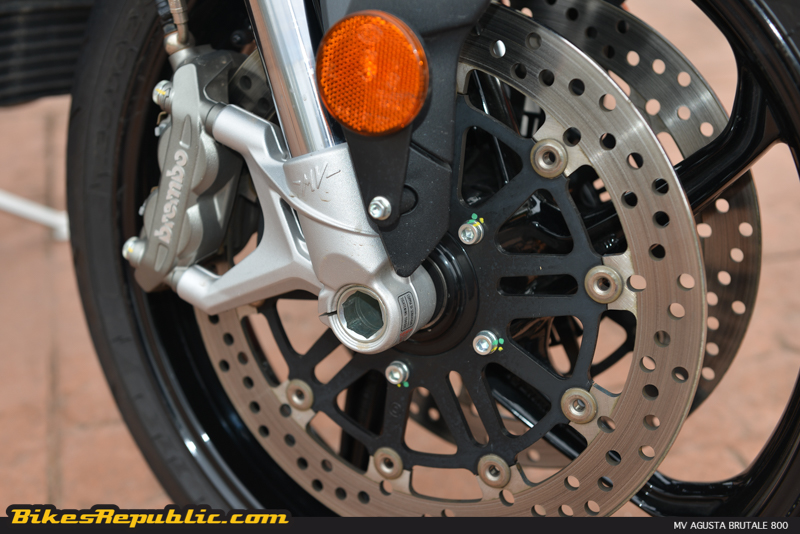
Front brakes Dual 320 mm floating discs, dual four-piston radially mounted Brembo caliper
Rear brake Single 220 mm disc, two-piston Brembo caliper
ABS Bosch 9 Plus with Rear Lift-up Mitigation (RLM), swtichable on/off
Front tyre 120/70-ZR17
Rear tyre 180/55-ZR17
FRAME & DIMENSIONS
Frame ALS steel tube trellis, aluminium swingarm pivot
Swingarm Single-sided, aluminium alloy
Trail 103.5 mm
Rake 24.5 degrees
Wheelbase 1400 mm
Seat height 830 mm
Dry weight 175 kg
Fuel capacity 16.5 litres

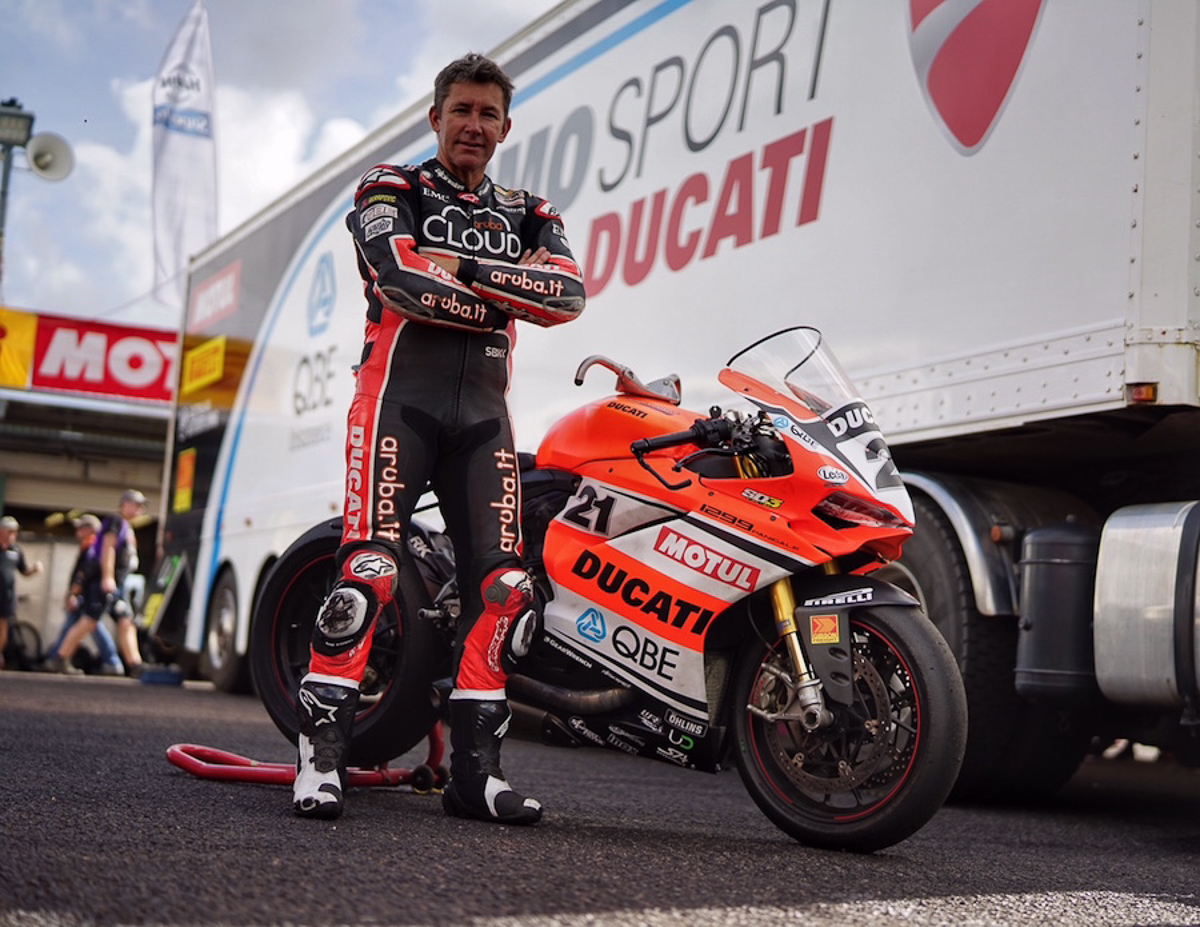
Three-time WorldSBK world champion Troy Bayliss will be returning to racing superbikes full-time beginning of next year.

The 49 year old Australian will be racing domestically in the 2018 Australian Superbike Championship.

Together with the Desmosport Ducati team, Bayliss will be racing on board the 2017 Ducati 1299 Panigale R.

Remember Troy Bayliss, the three-time WorldSBK world champion? The 48 year old Australian has announced that he is coming out of retirement to race full time in the 2018 Australian Superbike Championship next season. (more…)

  • Study confirms that passengers are more prone to injury.

  • It’s the rider’s responsibility to ensure the passenger is fully geared up.

  • At least a good helmet is necessary.

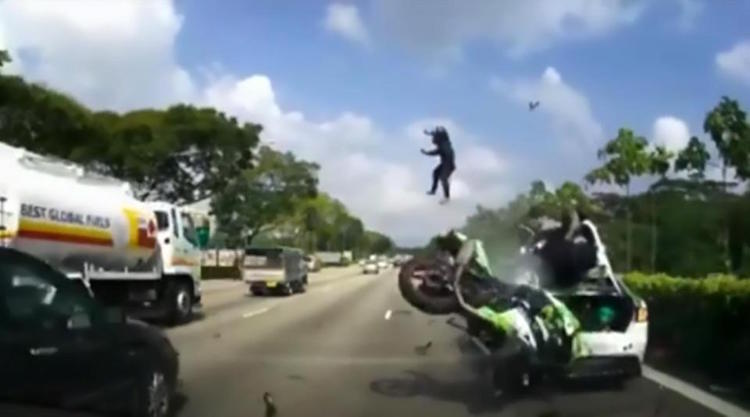
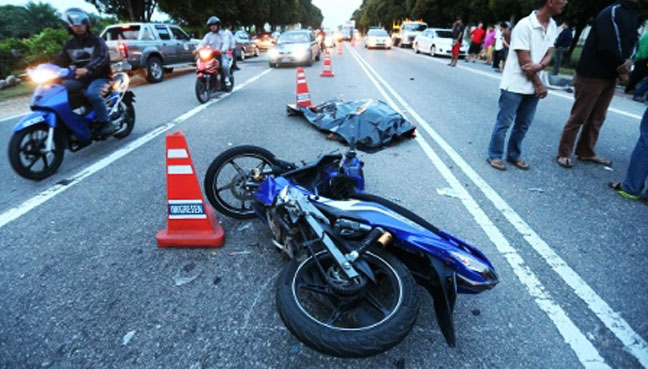
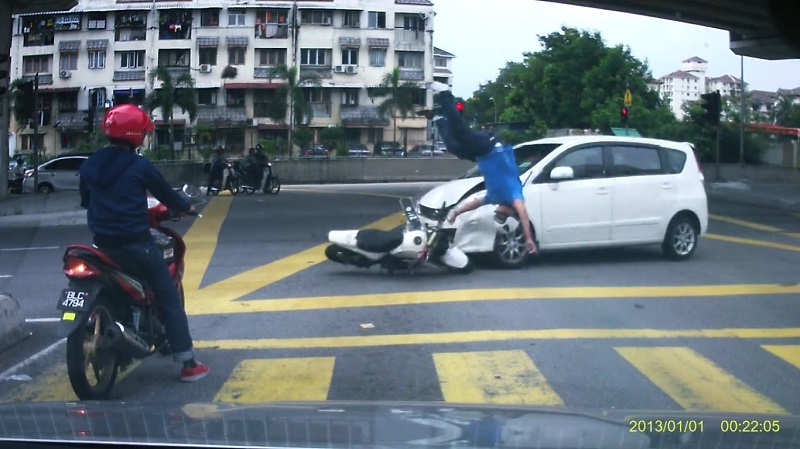
Remember that video which went viral? Most riders already knew that it’s the passenger who usually comes out the worse in the event of an accident.

Unfortunately, we still see many riders who don’t equip their passengers adequately when riding. The rider may be cladded in armoured jacket and pants, a good helmet, gloves and boots, but the passenger looks like he or she just got back from the beach, and wearing a helmet seemingly made when Allahyarham Tun Hussein Onn was Prime Minister.

Hope this research changes your mind.

Published in Reuters Health, it is confirmed by researchers that passengers are likely to suffer more traumatic injuries compared to riders.

Even with helmets on, 36 percent of the passengers suffered traumatic brain injury, compared to 31 percent among riders.

Dr. Tyler Evans of the Indiana University School of Medicine said, “We believe that in certain accidents, the passenger is more likely to be ejected from the motorcycle.” This is the likely scenario why passengers face a higher risk of brain injury, he added.

You can read the source of the report here.

While riders face lower risks since they could hold on to the handlebar and fuel tank, and protected by the windscreen in some cases, passengers don’t have such luxury since they have little to hold onto. This is especially advantageous for the riders since they know what’s happening and could brace themselves.

Courtesy of freemalaysiatoday.com

In Malaysia, there were 39,744 deaths resulting from motorcycle accidents between 2005 to 2014.

The knowledge gained from this study means that the rider should always provide the best helmet and riding gear he or she could afford for the passenger. Come to think of it, the passenger should be better equipped than the rider!

Courtesy of says.com


  • The KTM 1290 Adventure S was launched to a great following.

  • As a special year-end promotion, KTM Malaysia offers the Travel Pack as a complimentary package.

  • The promotion is available via authorized KTM Malaysia dealers.

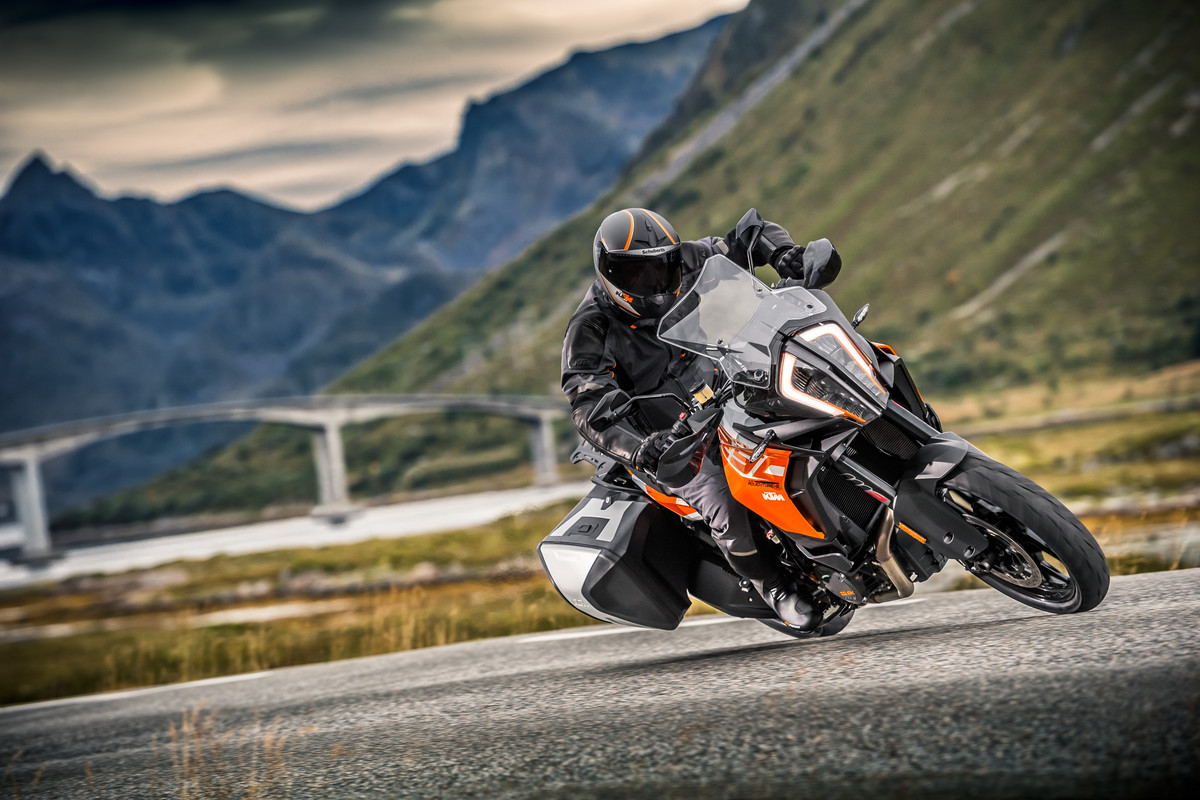
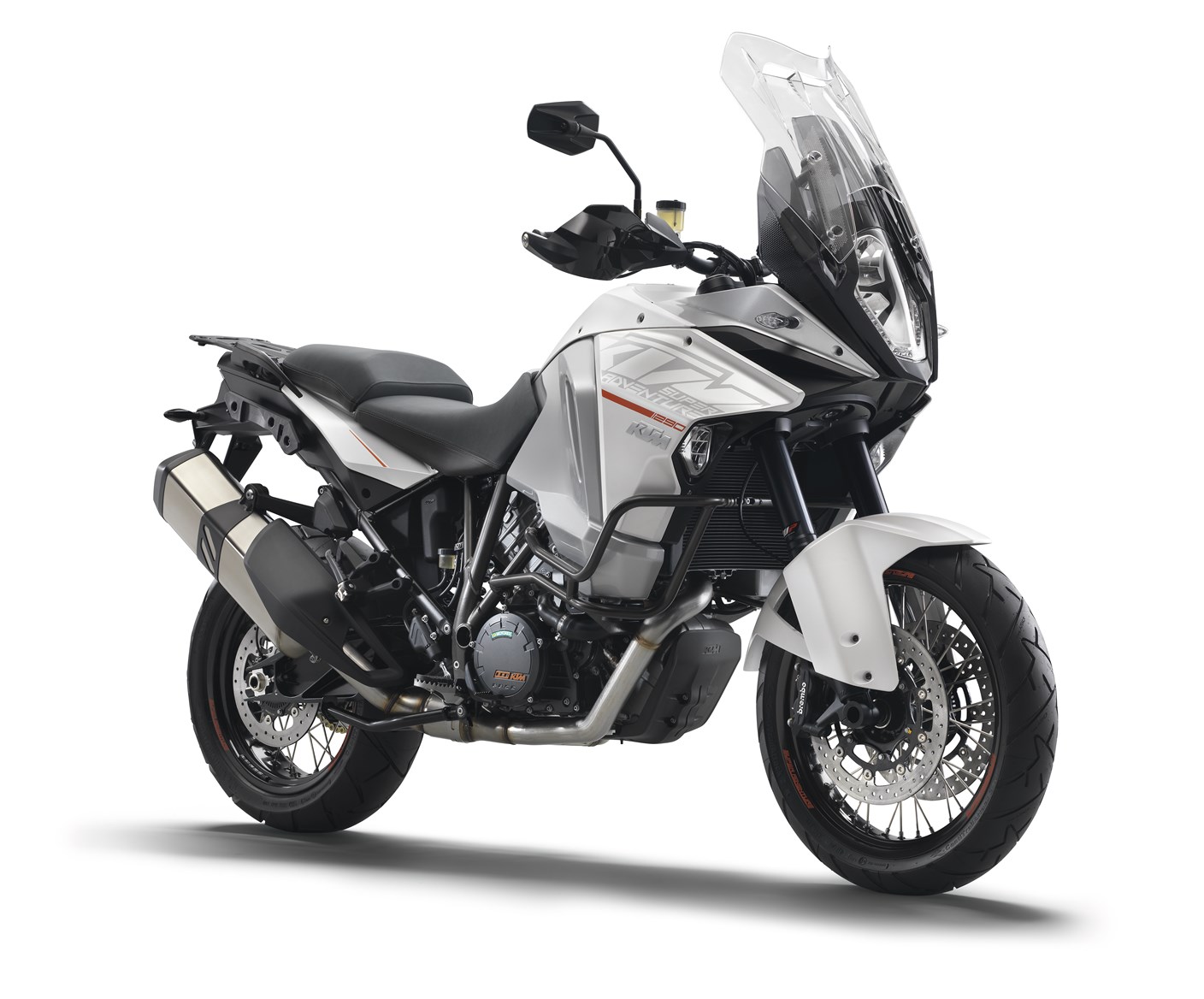
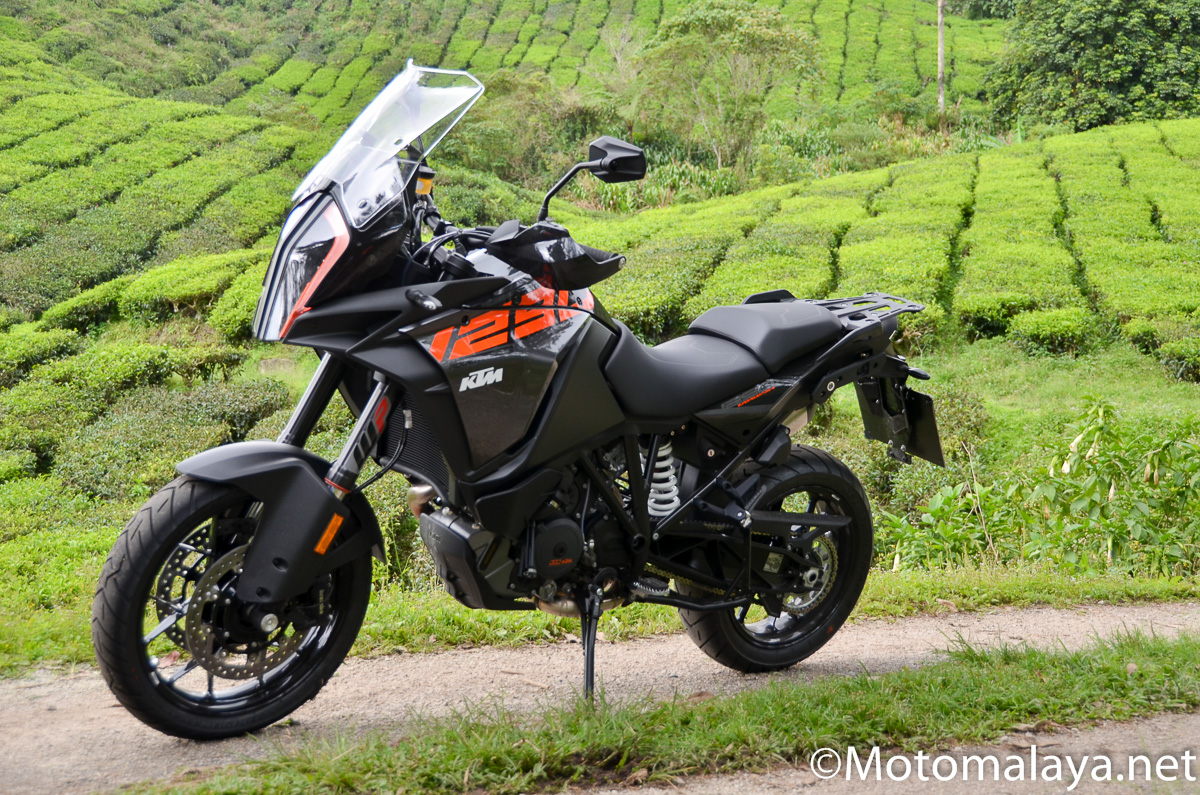
The 2017 KTM 1290 Super Adventure S was launched in Malaysia just a few months back and has already enjoyed a huge following among adventure-touring enthusiasts.

KTM already has a winner when the Austrian and largest European manufacturer launched the 1290 Super Adventure (later renamed as “Model T”) in 2015. It was promptly named the “Best Adventure Touring Motorcycle” by many reputable motorcycle publications around the world.

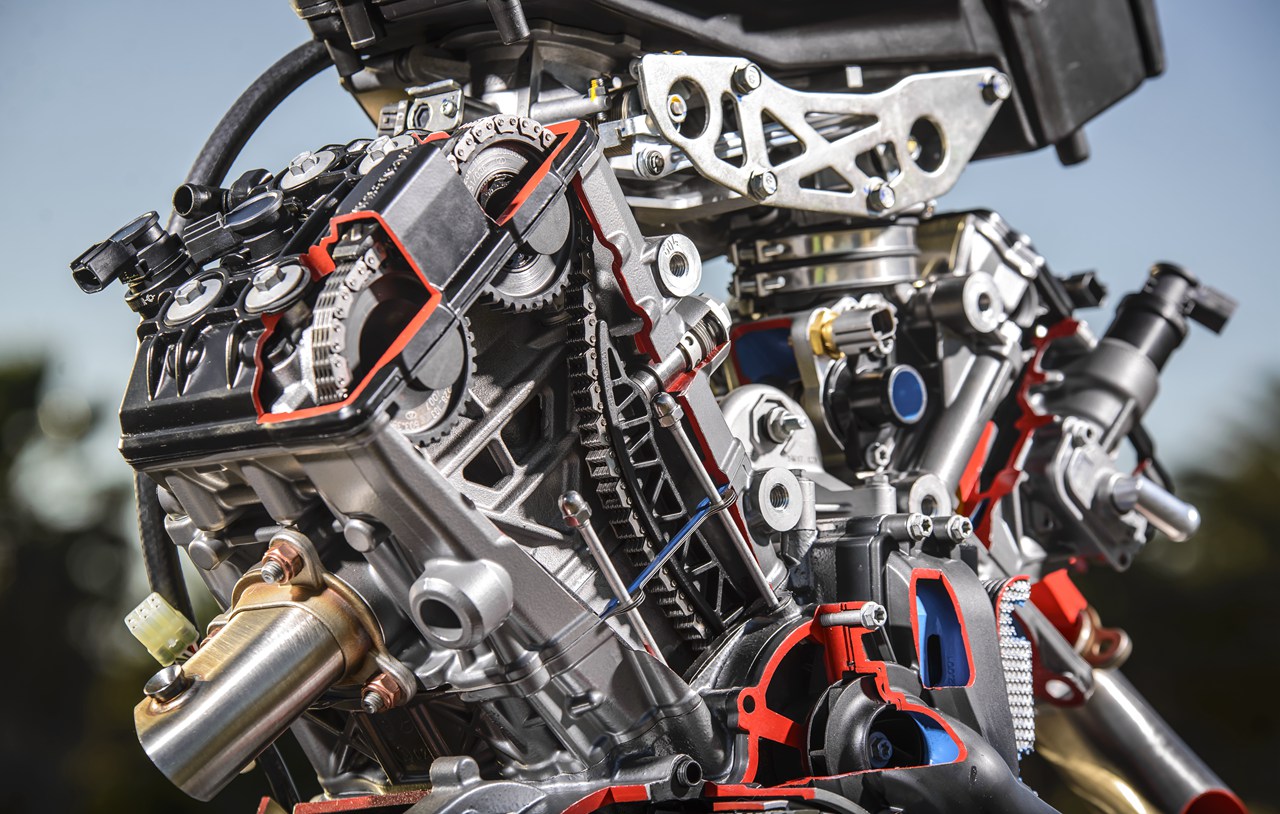
The 1290 Super Adventure T was both a mechanical and technological marvel, and became THE high-performance adventure-tourer, bar none. It was also the basis for the 2017 1290 Super Adventure S and 1290 Super Adventure R. The 1301cc, DOHC, 8-valve, 75-degree, LC8 engine (based on the insane 1290 Super Duke R) punches out a whopping 160 bhp and 140 NM of torque. But that’s just part of the story because the engine is already producing 108 Nm at 2500 RPM. That’s why the bike pulled like the clichéd freight train.

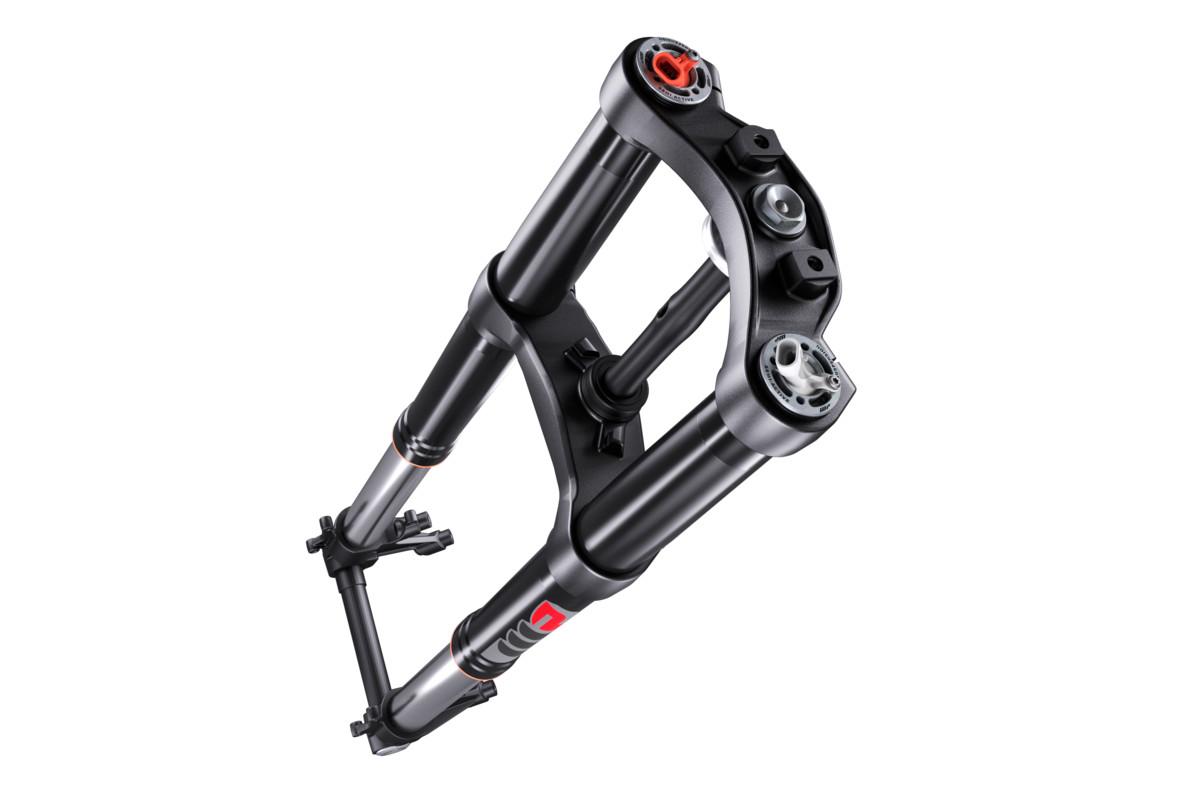
The bike features technological advancements such as MTC (Motorcycle Traction Control), MSC (Motorcycle Stability Control), ABS, LED Cornering Lights, and WP’s Semi-Active Suspension.

The 2017 KTM 1290 Super Adventure S utilises the same, albeit uprated features. But more telling, it had been totally redesigned to reflect a new KTM identity, starting with the headlight.


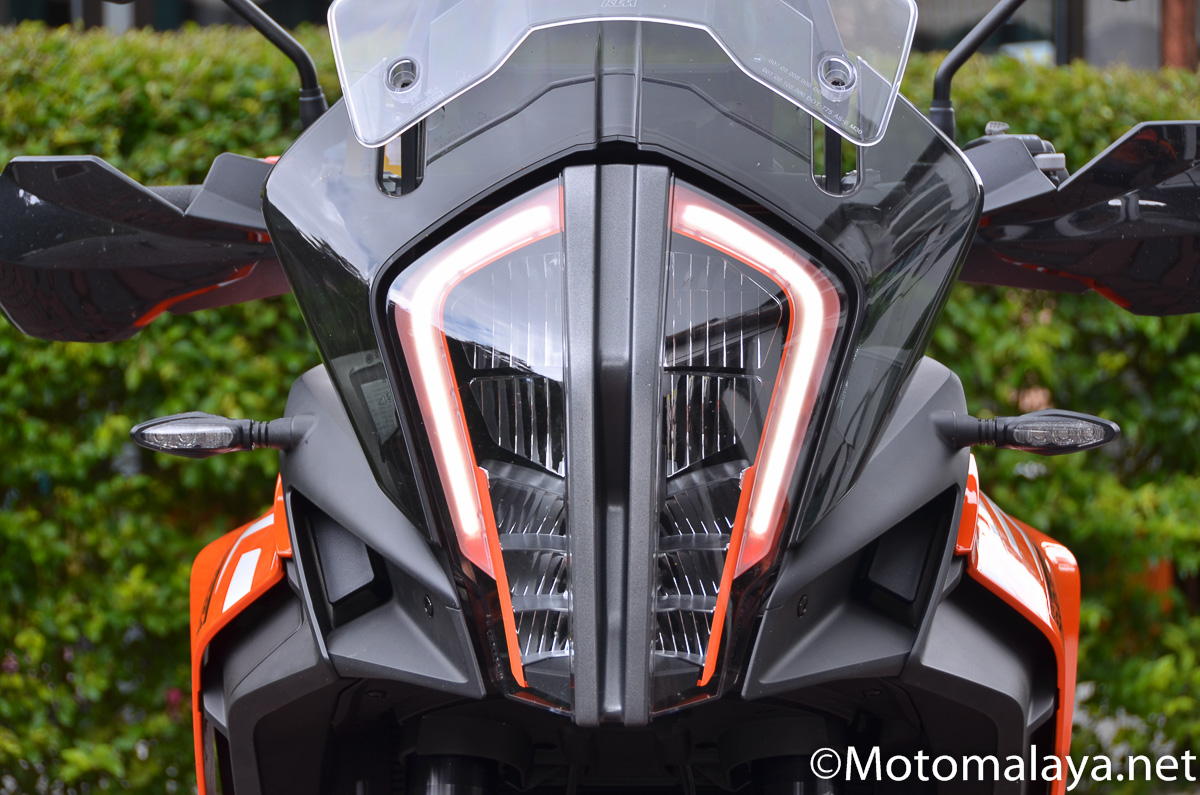
The headlight is now split into two sides with a cooling “channel” in between to address concerns of the LEDs getting too hot. The consequence of this redesign produced a headlight design unlike any other motorcycle in the market, and for KTM themselves, as well.

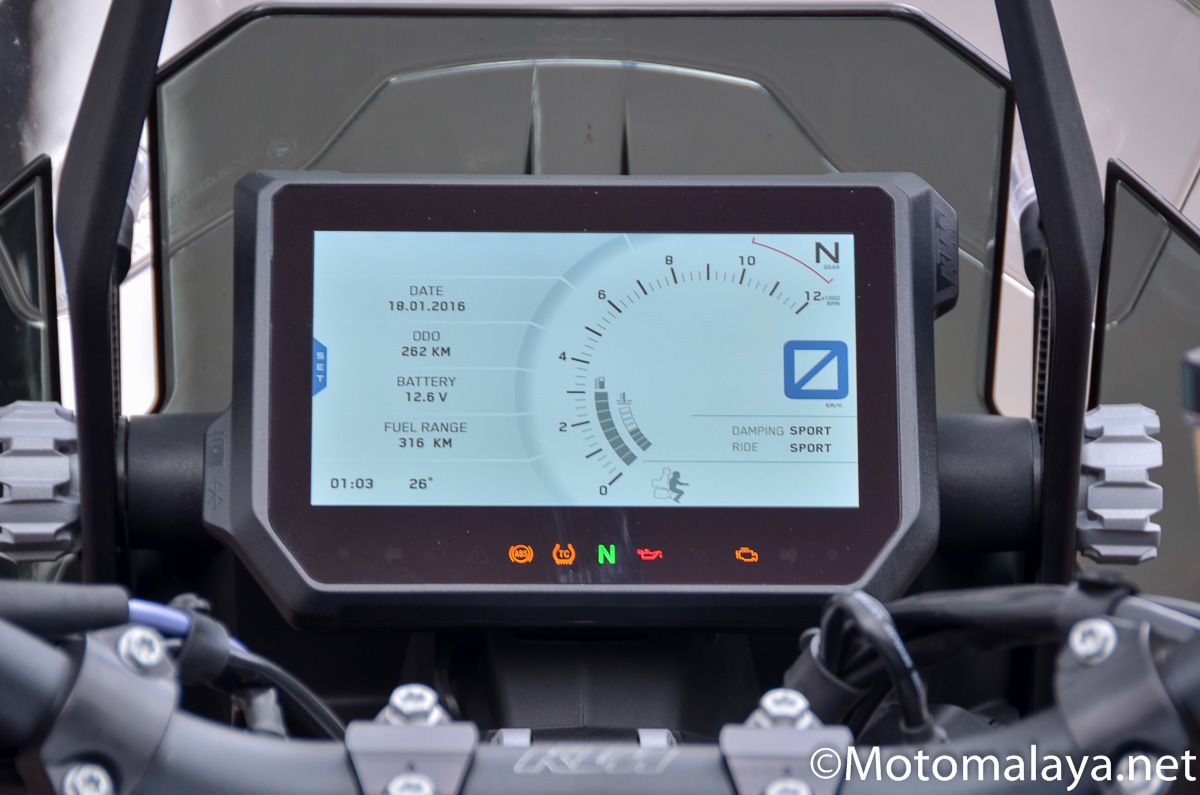
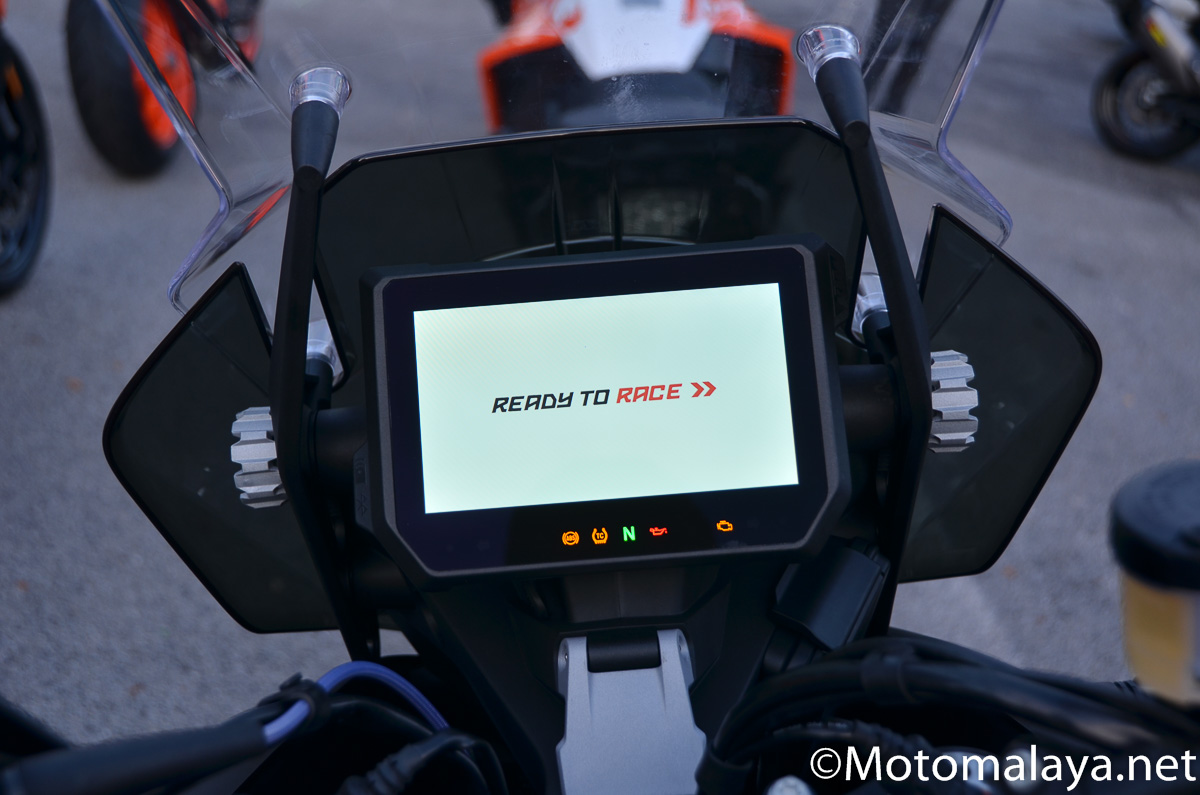
Other features were uprated, including the engine and electronics for more refinement and even more reliability. New for the 1290 Adventure S is the 6-inch TFT display, which the owner may install the My Ride option which includes hands-free audio playback via Bluetooth.

The latest TFT meter panel for the 2017 KTM 1290 Super Adventure S

All these electronics make the KTM 1290 Super Adventure S sensitive, right?

Not so. We saw how reliable they were firsthand during the recent KMOG Borneo Ride 2017. Not a single bike broke down despite being trashed in arduous riding conditions including earthquake-damaged roads, no road, mud, gravel, sand, rain or shine. They just kept going and comfortable for the riders and passengers to boot!

As 2018 looms, KTM Malaysia is offering the 1290 Super Adventure S with a special promotion.

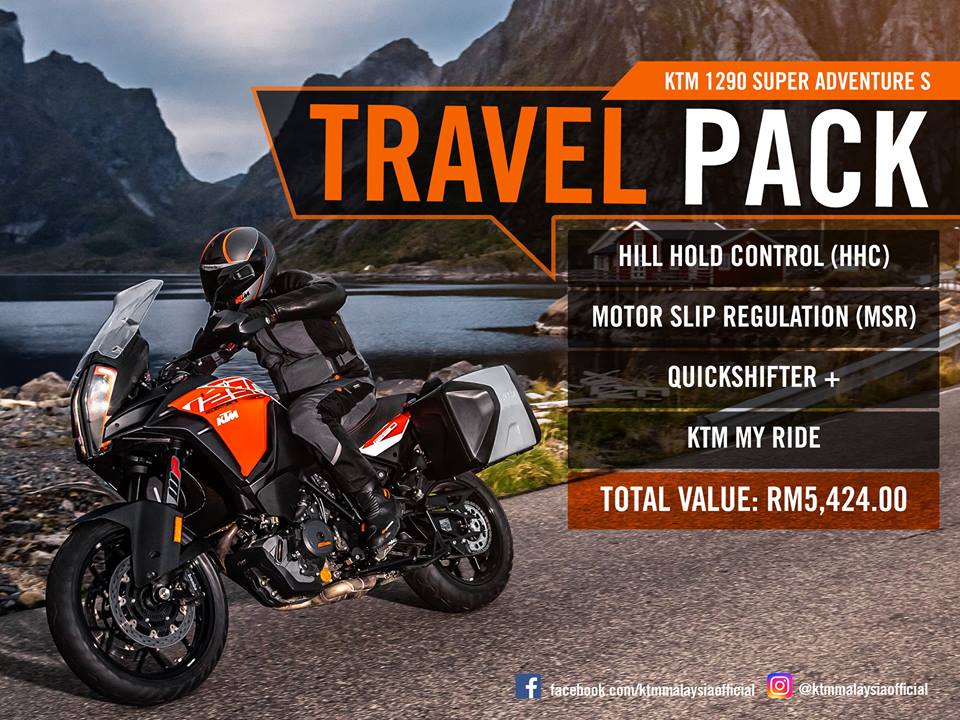
For a limited time only, KTM Malaysia is throwing in the Travel Pack option, worth RM 5,424 – FREE! With the purchase of a new 1290 Super Adventure S.

The Travel Pack includes the aforementioned My Ride, Quickshifter+, Hill Hold Control (HHC) and Motor Slip Regulation (MSR).

My Ride allows the rider to connect his mobile phone to bike via Bluetooth, allowing for music streaming and making/receiving calls hands free.


Quickshifter+ is an evolution of the run-of-the-mill quickshifter. It allows for smoother and positive clutch-less gear changes not only for upshifts but for downshifts as well. A novel feature of KTM’s Quickshifter+ is the absence of an “activator” on the shift connector shaft.

As any veteran rider can tell you, taking off on an incline is never easy, requiring the rider hold on to the front brake and slip the clutch like mad! Hill Hold Control (HHC) holds the bike on a slope during idle, even if the transmission is neutral. This is a very useful feature especially on a tall bike, laden down with luggage and passenger.

Motor Slip Regulation works in tandem with the other traction control features for a safer ride. While the MTC and slipper work to relief the rear wheel from hopping, MSR limits back-torque to the rear wheel by increasing the engine’s speed. A useful feature in low-grip situations. (It’s akin to riding MX, where the rider needs to keep the engine spinning at higher RPM for more consistent traction compared to fully shutting off – no doubt learned from KTM’s heavy involvement and success in offroad competition.)

The Travel Pack features bring additional safety and entertainment to an already great bike, so hurry to your nearest authorized KTM dealer today!

For more information please visit KTM Malaysia’s official Facebook page.

Archive

Follow us on Facebook

Follow us on YouTube