Bikesrepublic

Latest News

Suzuki proudly announces the return of The King of Superbikes — the iconic GSX-R1000R, now reborn as the 2026 Suzuki GSX-R1000R M6. This latest evolution not only represents the  cutting edge of motorcycle engineering but also commemorates an extraordinary milestone, the 40th anniversary of the legendary GSX-R lineage.

Since its ground-breaking debut in 2001, the GSX-R1000 has reshaped the sportbike world with performance that dominates both streets and racetracks. As the undisputed champion of production-based superbike, superstock, and endurance racing, the GSX-R1000 has captured no fewer than 15 FIM Endurance World Championship titles—a true testament to  its legacy of reliability, innovation, and victory.

The 2026 GSX-R1000R M6 continues that heritage with updates that meet the latest emissions and noise regulations while enhancing rider experience through a host of advanced electronic control systems. These include rider-assist features designed to refine performance based on individual riding preferences and road or track conditions by ensuring that the GSX-R1000 remains synonymous with “Designed to Perform, Built to Thrill.”

To mark this historic 40-year milestone, the new GSX-R1000R M6 is available in three heritage-inspired livery options, each evoking the soul of legendary GSX-R colour schemes.

These striking designs are further commemorated with exclusive 40th Anniversary insignias on the fuel tank, side fairings, key mascot, seat cowl, and muffler. All of these shall be the proud visual tribute to four decades of supremacy.

Built for the street and born from the track, the 2026 GSX-R1000R M6 is the ultimate embodiment of Suzuki’s uncompromising pursuit of performance, a machine that continues to ignite passion and deliver exhilaration with every ride.

The Legend Returns. And it’s faster, sharper, and more thrilling than ever.

Photo gallery

Riding the 2025 BMW R 12 nineT was interesting – to say the very least – on several levels. It was not only due to mechanical factors but external ones, too. And questions. Many questions from others. Probably questions from you too, our readers.

What is the 2025 BMW R 12 nineT?

It began in 2014, when BMW Motorrad introduced the R nineT to commemorate the 90th anniversary of BMW motorcycles. Designed by both BMW Motorrad together with custom bike legend, Roland Sands, the R nineT was decidedly modern classic in design by drawing a connection to the BMW “R” Boxer lineage.

First to be produced was the R nineT, followed by several variants based on the same platform: Urban GS, Racer, Scrambler, and Pure.

So, 10 years later, BMW introduced the new R 12 platform as a continuation of the R nineT’s legacy. Following its ancestor, the nineT variant was the first to be introduced.

The R12 nineT is a roadster/standard/naked, built around the same 1170cc Boxer engine, but brings forth several new features. The engine was as far as it went in terms of similarities with its predecessor.

Highlights and features
  • 1170cc, air/oil-cooled, horizontally-opposed-twin (Boxer), which produces a maximum power of 109 hp at 7,000 RPM and a peak torque of 115 Nm at 6,500 RPM.
  • Newly designed exhaust system with twin chrome mufflers.

  • Engine power is transmitted through a single disc dry clutch, and then through a six-speed gearbox.
  • Marzocchi 45mm upside-down forks up front, adjustable for spring preload, compression damping, and rebound damping.

  • Monoshock with a progressive spring at the back, adjustable for spring preload and rebound damping.
  • As with all BMW Boxer-engined models, the R 12 nineT utilises a single-sided Paralever swingarm, but now stouter.

  • Twin 310mm front brake discs, gripped by twin four-piston calipers.
  • Single 265mm brake disc at the back.

  • The brakes are supported by BMW Motorrad Integral ABS Pro.
  • New tubular steel frame.

  • Aluminium fuel tank.
  • 795mm seat height.

  • Three riding modes namely Rain, Road and Dynamic.
  • Electronic rider aids include Dynamic Engine Brake Control, Dynamic Traction Control, Hill Hold Control.
Pre-Ride

Checking out the bike the first time, the bike looked similar but different. BMW did a great job of retaining the previous R nineT’s looks while packing the new model with so many updates.

Upon closer inspection, we noticed that the snail proboscis-like intake trumpet has been deleted. The seat was also visibly lower, with the rear portion of the bike sitting lower over the rear wheel, giving the bike a slightly stretched out and low-slung look.

Speaking of the wheel, our test bike’s wheels were cast aluminium, different from the wire-spoked wheels in BMW’s official pictures. The rear wheel drew lots of attention, as it looked like a shuriken.

The fuel tank was partly painted, while leaving the sides in polished aluminium. Yes, the previous R nineT had this, but it somehow looked better on the new bike.

The new R 12 nineT is a handsome bike when viewed from any angle. Pictures really do not do it any justice.

The twin clocks are beautiful, which had inset LCD screens. These screens may be small, but the characters displayed were big enough to be easily readable. Flipping through the data displayed and set up was achieved through the handlebar mounted switchgear and BMW Multi-Controller ring.

First ride

Firing up the Boxer had it punching to one side. Blipping the throttle also results in such sensation. Now, this is how a Boxer engine is supposed to be, which reminded us that it was alive. Such sensation had since been missing with the introduction of the “Water Head” (liquid-cooled) Boxer.

The new exhaust system sounded slightly softer than its predecessor’s, as a silencer box with catalytic converter sits below below the transmission, which negated the old decibel-controlling valve. Still, there was enough of the signature Boxer roar coming through.

Climbing on surprised us immediately. While we tip-toed on the old bike, both feet found the ground easily now. Reach to the handlebar was slightly far for this writer with short arms and legs but still natural. The handlebar was wide, which stretched out reach further when turning at low speeds.

With ROAD mode selected, we engaged first gear -and it clacked into place without mistake, including aurally.

We released the soft pull clutch lever and away we went, surfing on a wave of Boxer torque.

This was when the fun begins

It was immediately clear that the subject about horsepower versus torque will crop up when discussion this bike. While most people view horsepower figures like the holy grail, the real mover is engine torque. Torque is what gets the motorcycle (or any vehicle) moving, accelerates it and build revs to reach maximum horsepower.

And this was exactly when you have to give BMW credit for sticking to the Boxer. The bike just pulled and pulled through any gear, while serenading you with that distinctive Boxer drawl. We know, some may say that this “Oilhead” engine is “low-tech” compared to the 1300cc, liquid-cooled, and ShiftCam-equipped Boxer of the R-series, but all that notion got blown away every time we opened the throttle. This engine has character.

Soon, we found ourselves “cruising” down MEX Highway at 140 km/h (and above) on cruise control, while the engine just happily droned on between our legs.

Doing the twist

We generally take it very easy in corners with bikes that are low and long. Usually, such motorcycles do not like to attack corners, and instead prefer to be steered smoothly into long and wide curves.

However, steering the R 12 nineT into the sharp right and left corners on the off-ramp to Bukit Jalil had the chassis telling us that we were too slow, as the bike steered eagerly into the inside of those corners.

So, instead of turning into Seri Petaling, we decided to test out the two corners that led to the Sungai Besi Toll Plaza. Steering into the first turn, a long left, had the the suspension sink into its initial compression travel, letting the tyres bite hard into the road. With the confidence gained, we chucked the bike into the decreasing radius right under the tunnel with the throttle off through the apex, before gunning it hard on the exit. We kid you not, the R 12 nineT blasted that corner as good as any modern naked sport bike.

This came to us as a complete surprise as it the bike had no business in handling this good, given its low seat height and long wheelbase!

Yes, yes, the Boxer engine played a huge role in its agility. BMW detractors deride the cylinders hanging out the sides, but it is because of this that lowers the engine’s centre of gravity. This lower centre of gravity also provides a lot of stability, especially when riding at lower speeds. This is why BMW GS owners do not complain about the tall seat when negotiating traffic.

Anyway, we decided to do more corner testing and the best places were the SUKE Highway from Bukit Jalil to Genting Klang, before turning into the SPE, the onwards to the Kesas Highway and up “The Mountain.”

SUKE Highway is the perfect route to test how a bike’s chassis handles bumpy corners. Whereas one bikes hopped over bumps, the R 12 nineT was super smooth. This, without BMW’s Dynamic ESA electronic suspension.

The SPE, on the other hand, has several tight and narrow corners, which the bike dispatched without once threatening to run wide.

The Karak Highway is of course for holding speed through flowing corners, and we switched to DYNAMIC ride mode, which is akin to Sport. Now, the engine felt truly alive, letting us feel every bit of its power stroke and aggression. It was now, that the bike felt a lot more like a power cruiser as it swept through corners while we regulated the throttle, using the engine’s torque for braking and acceleration. Of course we did not bother to chase the 1000cc super bikes, but riders on lighter and more powerful naked bikes were shown the benefits of smooth riding.

Up the mountain, we had so much fun in fully utilising the bike’s superb brakes, quick steering, and Boxer torque, as we roared from one corner to the next. We hardly ever rowed through the gearbox all the way up, keeping the bike in fourth through most corners, while selecting second and third only very occasionally.

The only thing that discouraged us from being more aggressive was the fear of grounding the cylinder heads. In fact, the first accessory we would install if we owned this bike (should we suddenly get a call that a millionaire had us in his will) are cylinder head sliders.

Speaking of the transmission, it was the only downside of the 2025 BMW R 12 nineT. Releasing the clutch too hastily or using the Shift Assist (quickshifter) at slightly lower revs had the gears clunking during engagement, and could be heard all around. As aggressive as we were, we also wanted to portray any test bike in good light, so we learned to let the clutch lever out more progressively, and use the quickshifter only above midrange RPM.

Closing

Honestly, we felt sad to return the bike as we had not felt this way over test bikes for a long time. In fact, to be brutally truthful, we sometimes felt jaded after testing so many bikes. No, were are not saying that they were bad, in fact, almost every bike we tested in the last 5 years or so were excellent in almost every aspect. Instead, what made us love the BMW R 12 nineT was its character.

And oh, let us not forget the amount of stares and enquiries we received when we had the bike.

The 2025 BMW R 12 nineT is priced from RM124,500.

What is the price for kidneys in the black market these days…? (Asking for a friend.)

Photo gallery

Retro scooters will always find a place in the hearts of enthusiasts everywhere. Although Vespa leads the way in this segment, just about every motorcycle manufacturer has a retro scooter model. Now, it is CFMoto’s turn, by debuting the CFMoto 150 Aura.

Its body’s silhouette may be reminiscent of a 1960’s Lambretta at first sight, but closer inspection reveals that the 150 Aura is packed to the gills with modern features.

Highlights
  • 150cc, liquid-cooled, single-cylinder engine which provides 15.8 hp and 14.2 Nm of torque.
  • Transmission is CVT, of course.

  • Both wheels are 12-inches.
  • Disc brakes on both ends, supported by dual-channel ABS.

  • A rectangle 6.2-inch TFT screen with all the obligatory features including tyre pressure monitoring, plus full-screen navigation via the Motoplay app.
  • Front and rear built-in dashcam. The footage can be downloaded via the Motoplay app.

  • Ignition is not only keyless but via NFC i.e. your phone.
  • The under seat storage space accommodates a full face plus open face helmet.

The source did not specify the CFMoto 150 Aura’s price, but expecting it to be around RM7,000 would probably be in the ballpark. The question now is whether the Malaysian distributor, MForce Bike Holdings will bring this to Malaysia. We are quite certain that it will find a big following besides many customised units.

Imagine entrusting your pride and joy to someone, only to find out (through social media) that the trustee had used the bike without your permission. That alleged unauthorised act has prompted an owner to sue his trustee.

The claim

It all began when the owner, Wee Yang, purchased the Ducati Panigale V4S for RM133,000 cash from a shop on 19 June. As he was overseas at the time, he could not complete the paperwork, thus he appointed a local contact to oversee the insurance process and store the bike.

According to Wee’s sharing on Facebook, he and the trustee had arranged to hold the bike until the former returned in July to collect it personally.

Alleged unauthorised use

However, Wee soon found out that the trustee began using the Panigale V4S without expressed permission or knowledge. In his Facebook posting, he claimed that the caretaker:

  • Posted promotional content on social media the day after taking delivery.
  • Riding videos were filmed for business pages on Instagram, Xiaohongshu, and Threads.
  • The bike was ridden to Desaru, Johor, for leisure trips.
  • A homemade license plate was used since the bike had no official registration.
  • The bike’s mileage increased from 26,827km to 27,007km.
Motorcycle towed to another location

Upon the discovery of the bike had been “illegally” used, Wee arranged for the motorcycle to be towed to another location.

In a post on 24 June, Wee also said that the trustee had passed only one key to the tow truck operator, only to hand over the other key when the tow truck driver insisted.

Inspection of the bike found that it was covered in dead insects and dust, which Wee insisted that the bike was used on the road and without proper care.

Settlement offer

Wee then offered two options to the trustee to settle the matter:

  1. Buy back the bike at the price he paid (RM133,000) and refund the insurance money (RM5,000).
  2. Public apology admitting wrongdoing, compensation for extra mileage, and payment for new license plates

Failure to accept the offer meant that Wee would pursue legal action.

Proceeding with legal action

Wee made another posting on 25 June, saying that the trustee had made an apology at 11.52pm, just two minutes after he (Wee) had called his lawyer to proceed with the case.

He stated that he is suing because:

  • His property (motorcycle) was used without authorisation for a business-related purpose, which also implicated the shop where the trustee works.
  • His property (motorcycle) was used without authorisation by an individual called “Evon Evon,” who is the caretaker’s girlfriend in riding videos and social media posts.

Wee’s lawyer had advised that the second individual could potentially be sued as an accomplice, although he acknowledged that “whether the case will succeed depends on the judge.”

However, Wee also stated that the door is still open for an out-of-court settlement.

Takeaways from this case

There have been several reported cases of workshops or shops staff were found to test or use customers’ vehicles without authorisation—such as using them for personal errands, sharing test-drive videos on social media without permission, or even installing fake license plates if registration was incomplete. In some of these instances, staff members drove customers’ vehicles and were involved in accidents.

Workshop owners can be held liable under Section 403 of the Penal Code for criminal breach of trust.

Based on the writer’s firsthand experience working in a workshop, some customers do insist on thorough test drives to ensure their vehicle issues are fully resolved. However, any test drive MUST be accompanied by:

  • Authorisation letter/form signed by the vehicle owner.
  • Pre- and post-test mileage records.
  • A detailed test report.

As a guideline for vehicle owners, before handing over your vehicle, you should sign a written agreement specifying:

  • Permitted use (e.g., “Test drive limited to 20 km”).
  • Prohibition on social media sharing.
  • List of authorized drivers.
  • Take photos of the odometer and vehicle condition.

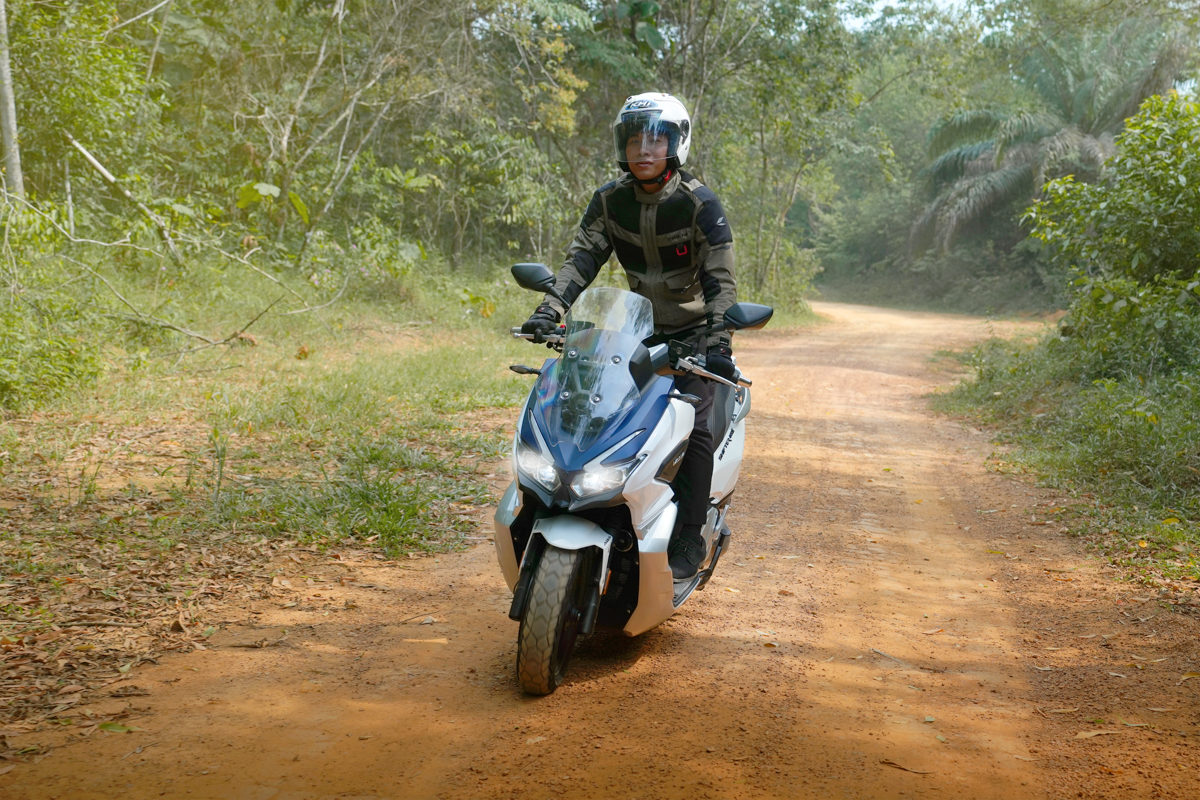
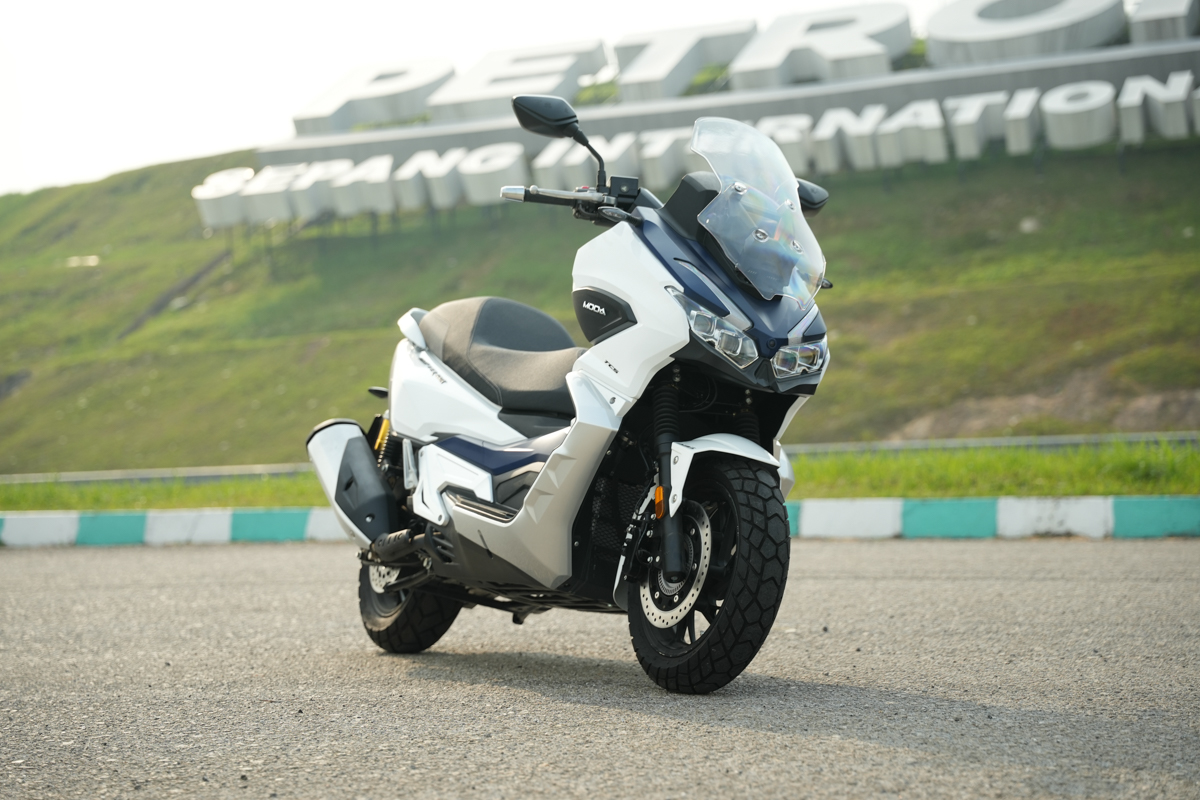
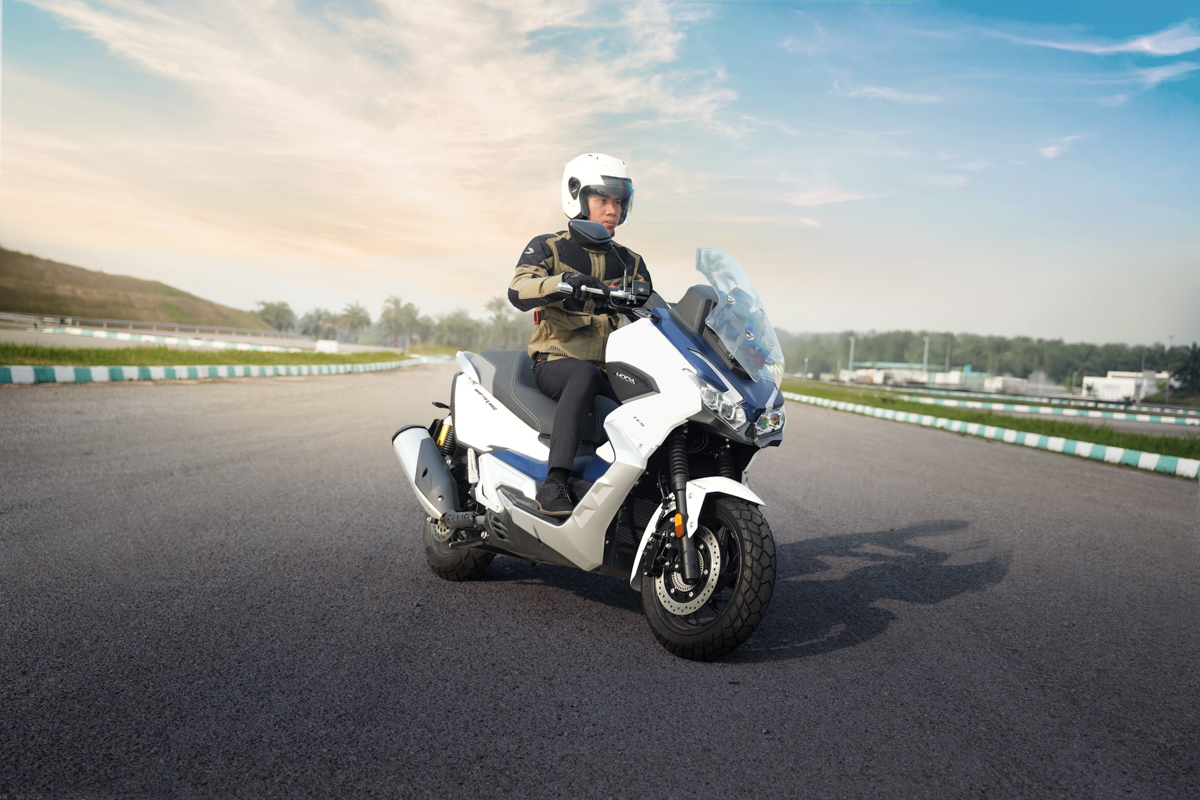
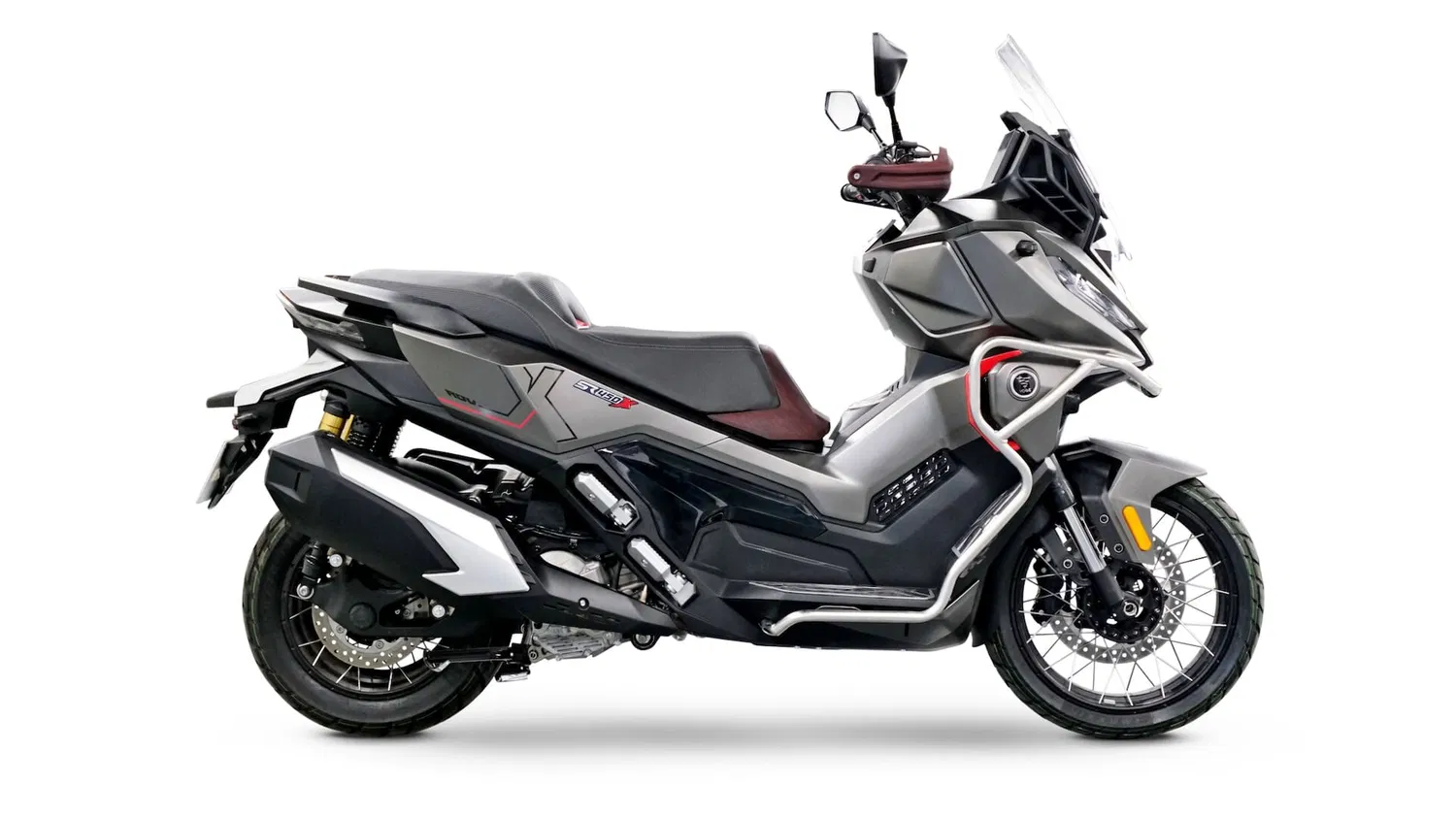
MDua Motor Sdn. Bhd. has unveiled another model to their line-up, called the MODA Shifter 400X, the latest addition to its lineup of scooters for the masses. The Shifter 400X scooter is a new entry in the trail adventure and touring segment, built to conquer both urban landscapes and rugged terrains.

The Shifter 400X carries the brand’s latest identity and philosophy – “Because I Can” – empowering riders to define their own journeys, chart their own paths, and ride on their own terms of lifestyle.

Highlights
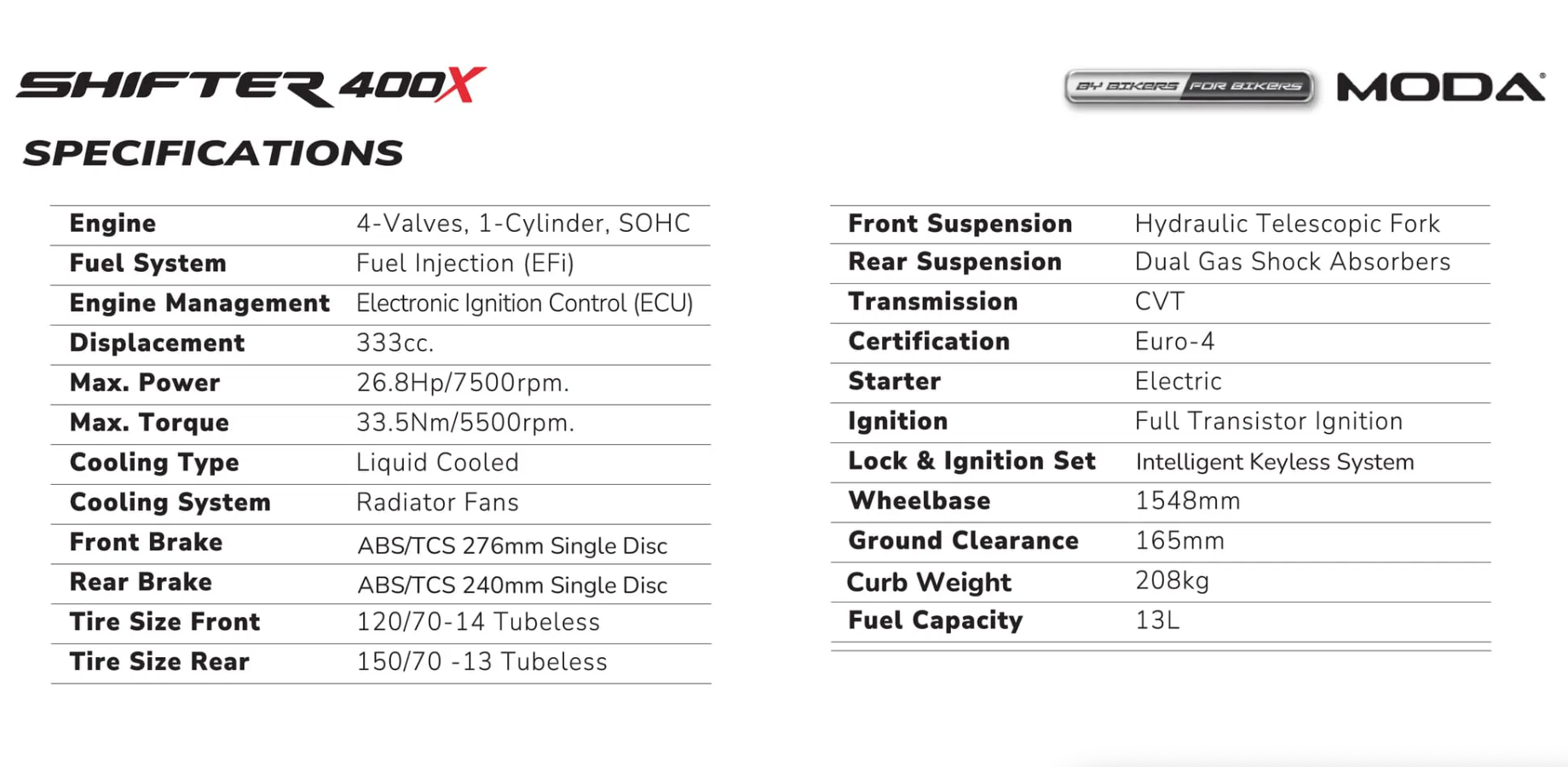
  • Powered by a 333cc, 4-valve, single-cylinder, SOHC engine, producing 26.8 hp @ 7,500 rpm 33.5 Nm @ 5,500 rpm.
  • Hydraulic telescopic forks up front, double gas shock absorbers at the back.

  • Single 276mm disc brake (front), single 240mm disc brake (rear).
  • ABS and TCS are standard features.

  • 14″ front and 13″ rear wheels fitted with “turtle back” profile for both highway cruising and light gravel routes.
  • Seat height of 775 mm.

  • 208 kg gross weight.
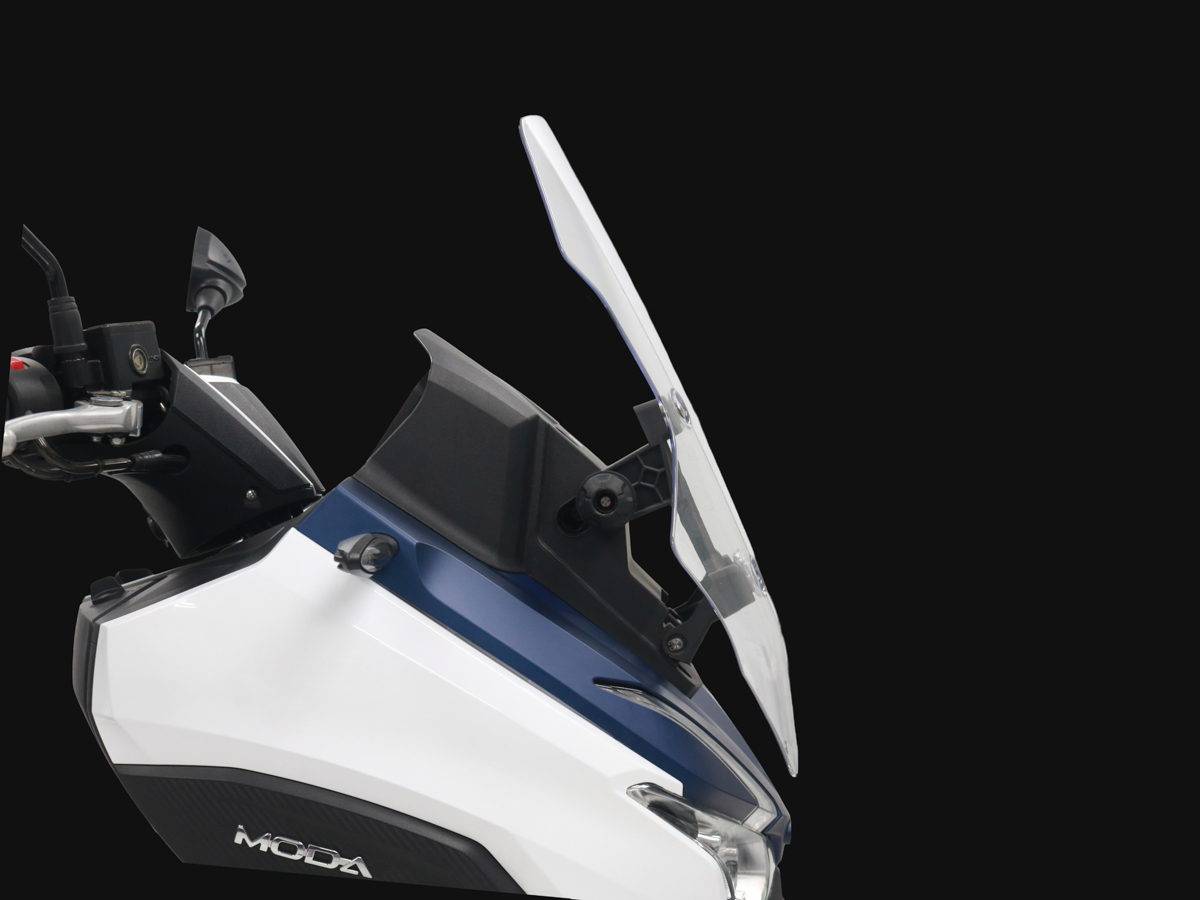
  • Two-step manually adjustable windshield.

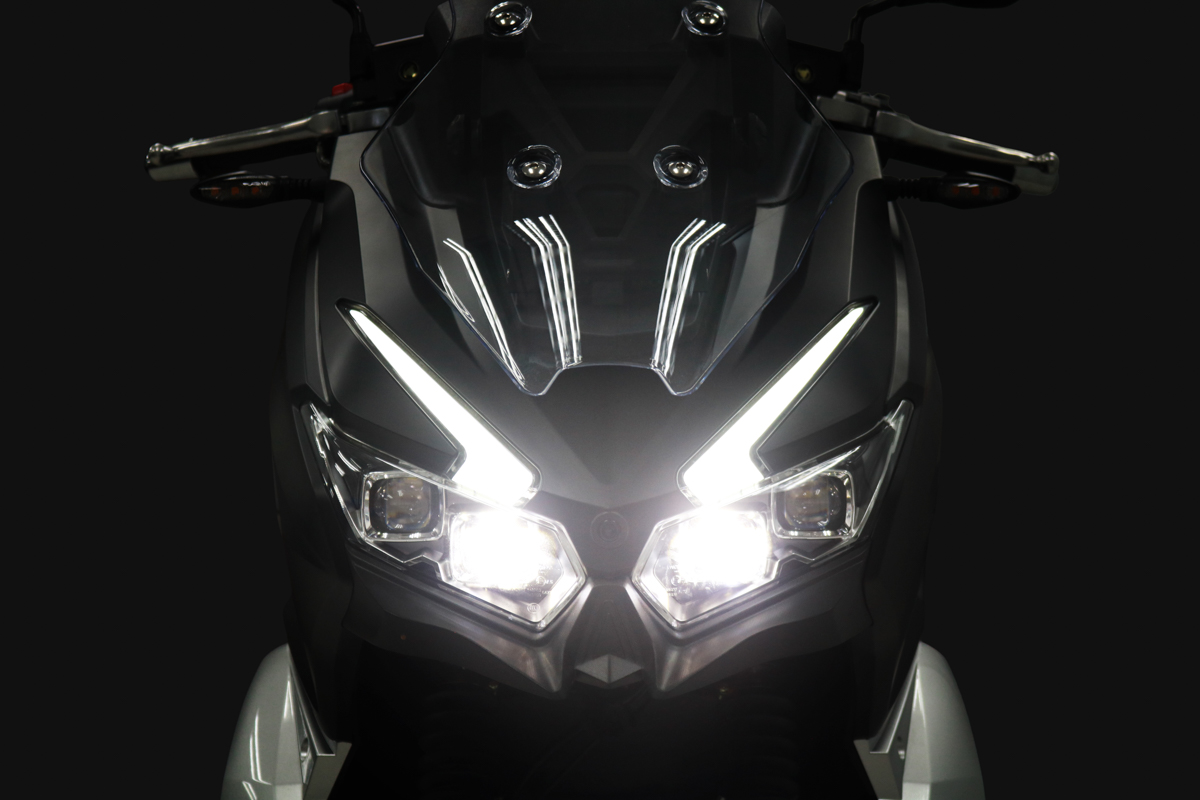
  • Four ‘lenticels’ LED headlights featuring AFS (Adaptive Front-lighting System) for brighter, dynamic illumination in low-light or cornering conditions.
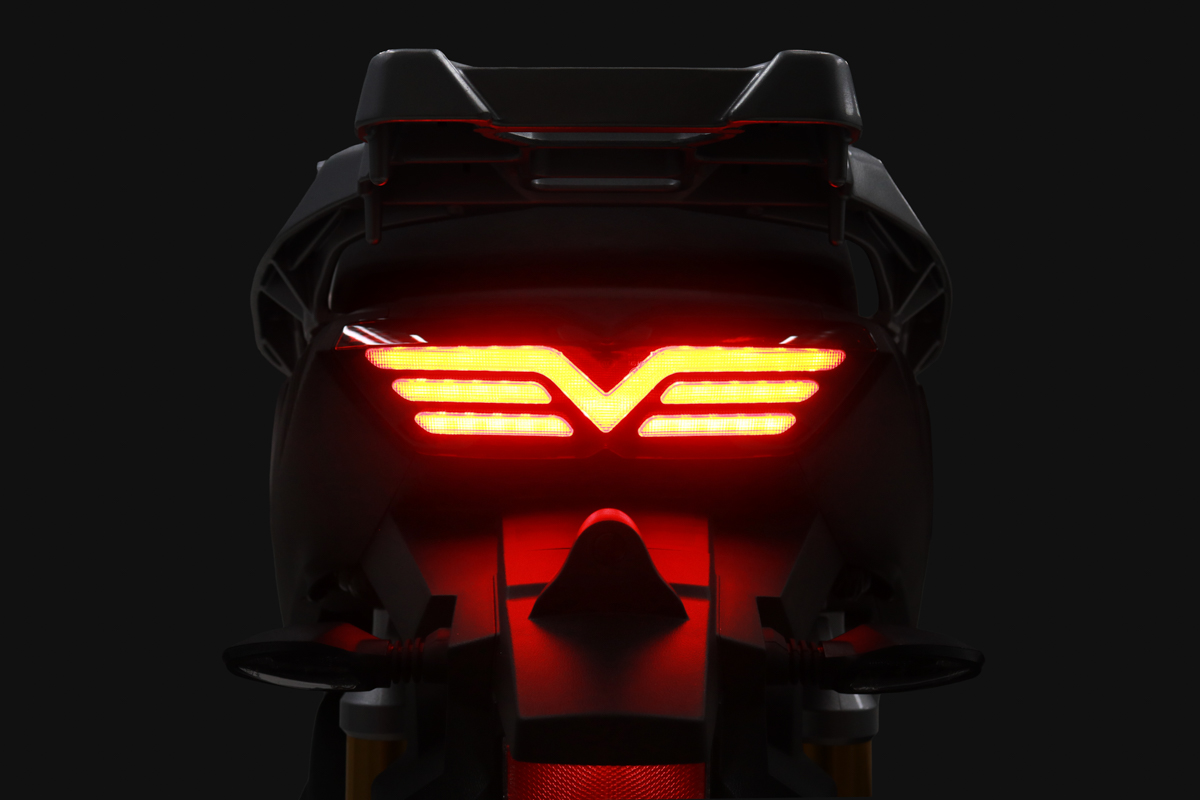
  • V-shaped LED tail light with ESS (Emergency Stop Signal) enhances safety by alerting others during sudden braking.

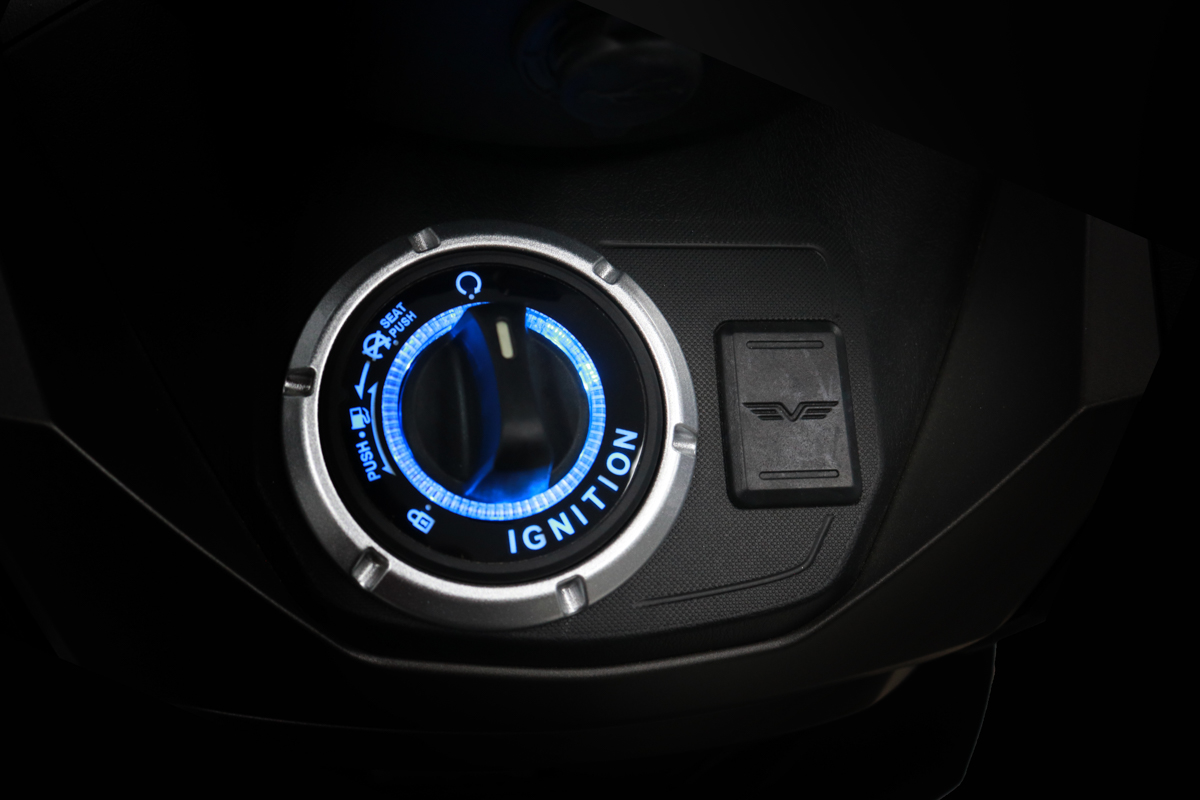
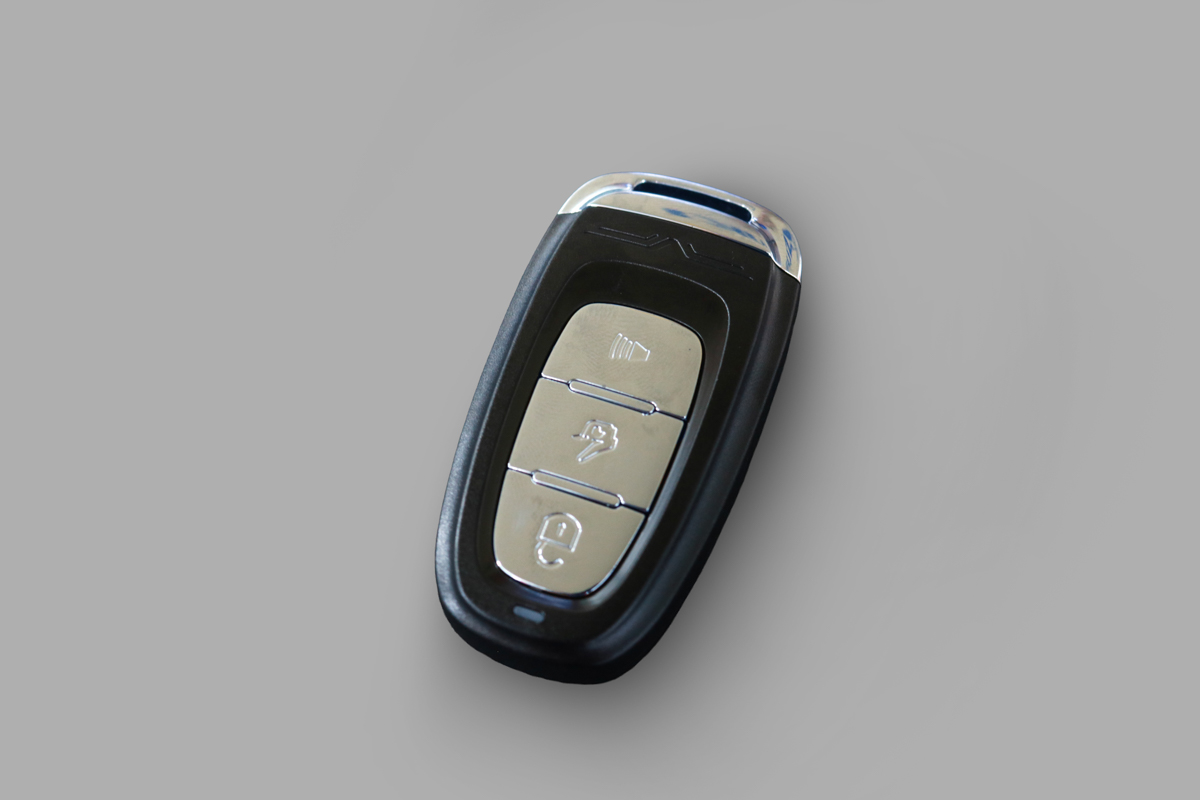
  • Intelligent keyless ignition system paired with a premium key fob.
  • The immobiliser key system features a built-in anti-theft protection and an electronic fence feature that alerts the rider if the scooter is moved beyond a preset range.

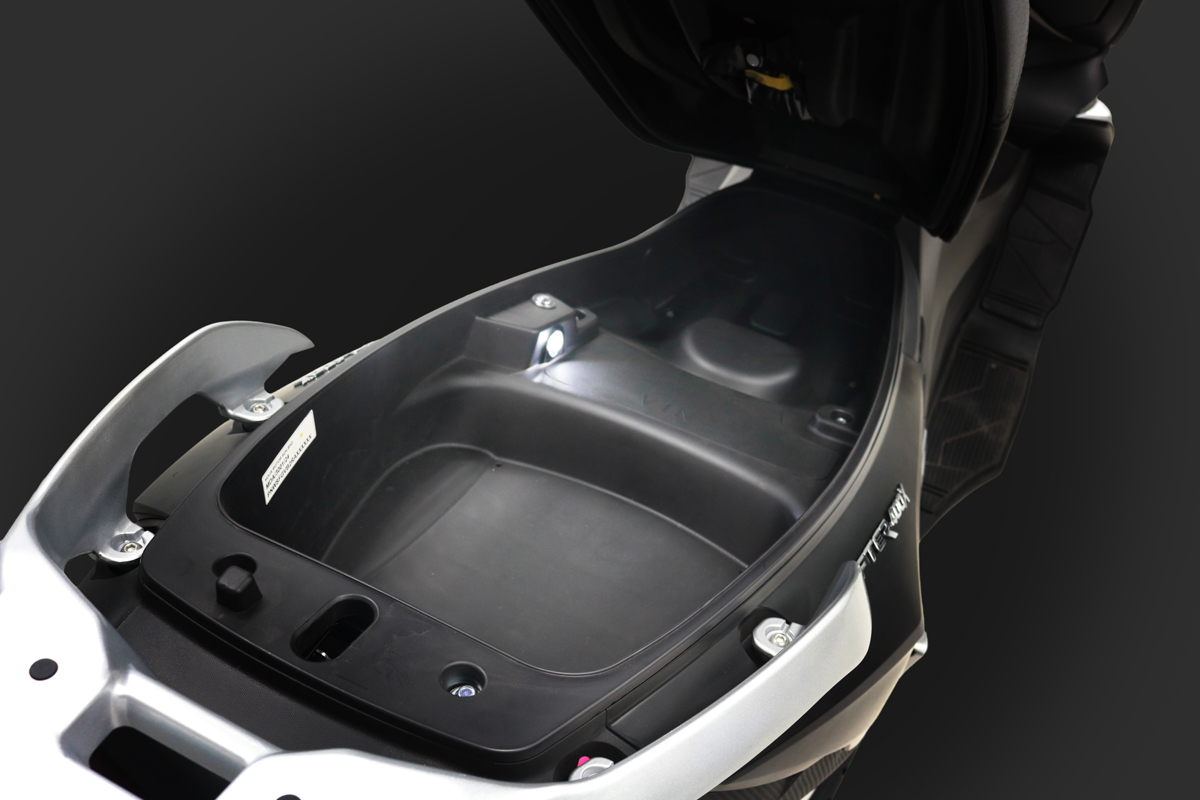
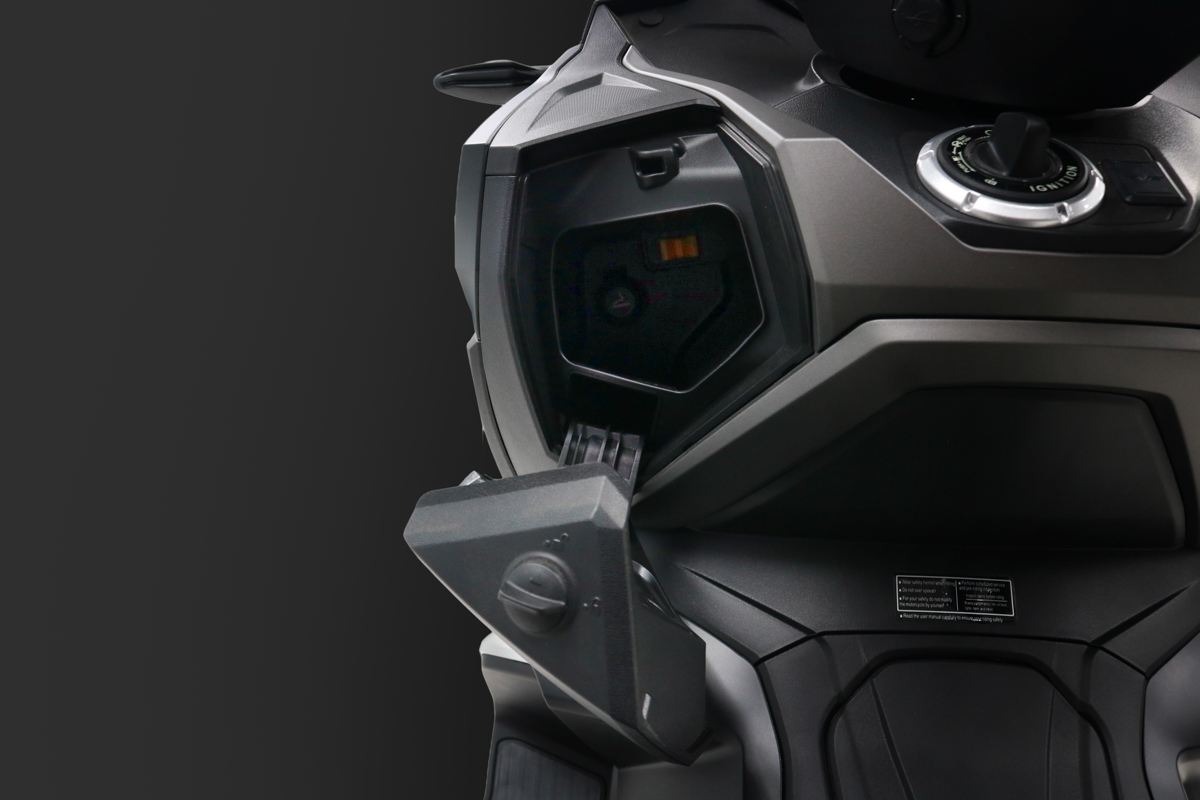
  • Illuminated, large under seat storage space.
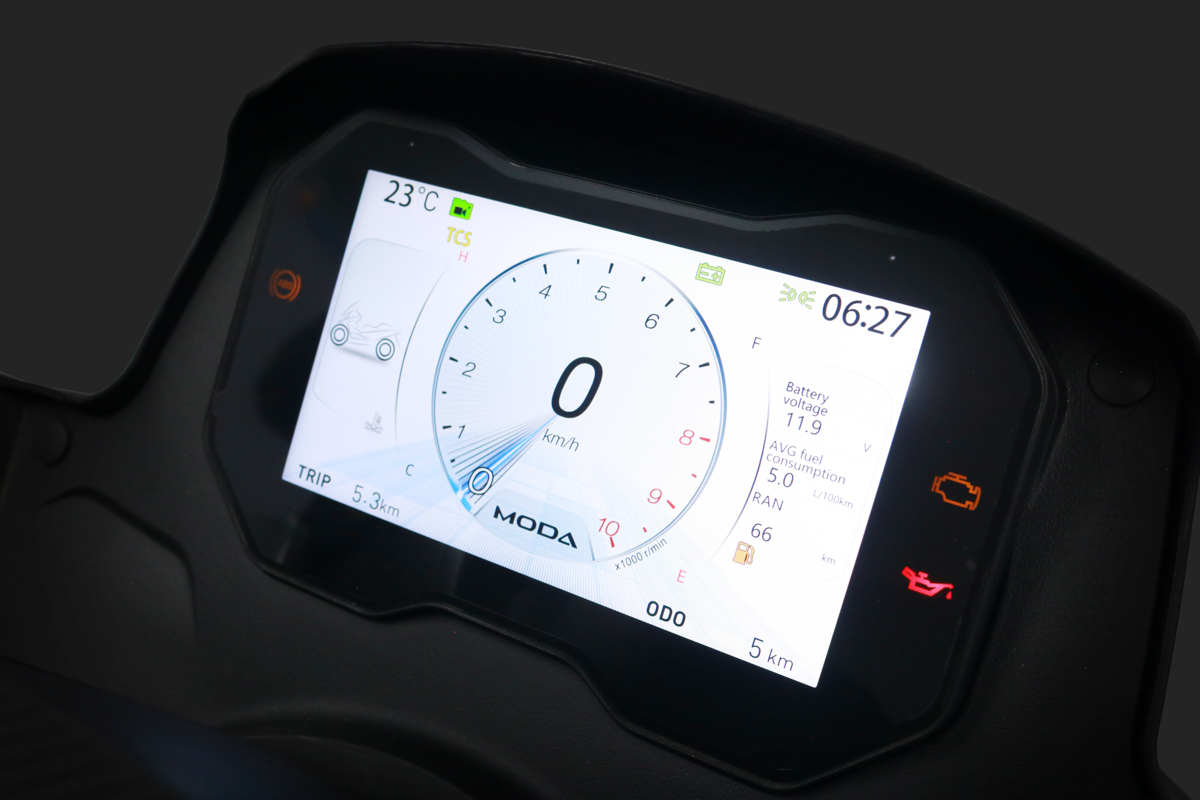
  • A 7-inch full-colour TFT instrument panel provides clear real-time data, including real-time Tyre Pressure Monitoring Sensor (TPMS), and the automatic brightness based on ambient lighting.

  • Two charging ports — a standard 12V USB and a 12V cigarette lighter socket.
  • Phone connectivity through Apple and Android devices is available for navigation and call pairing.

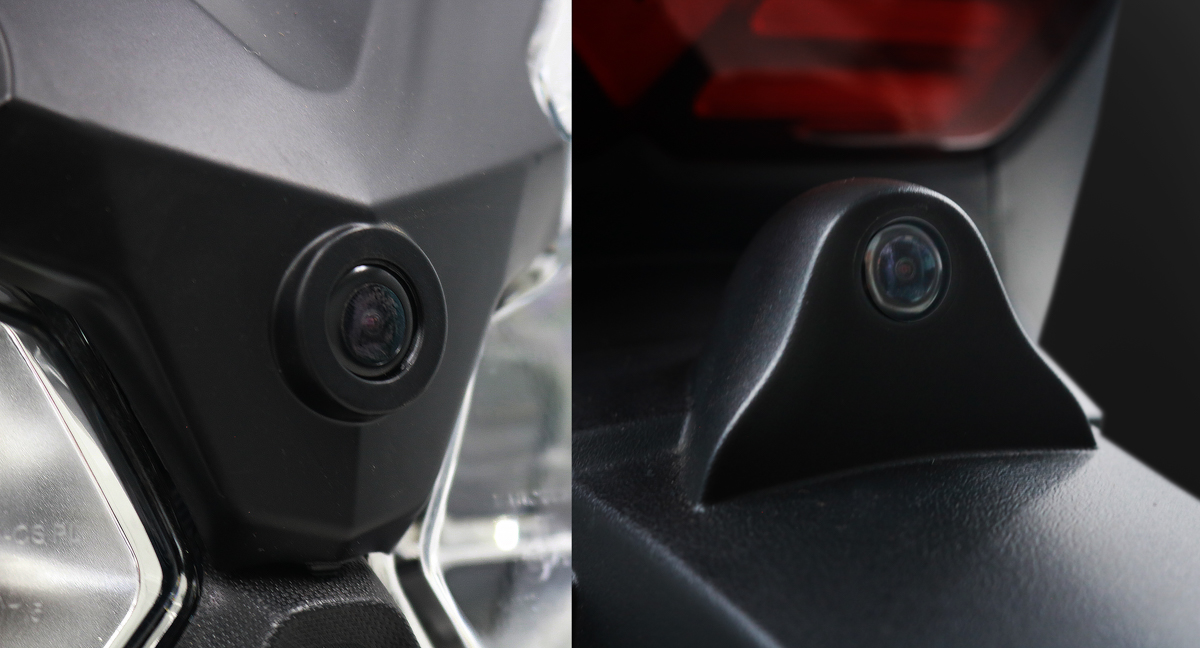
  • Dual-lens front and rear camera system, which records your journey and allows footage to be downloaded via a dedicated mobile app.

The MODA Shifter 400X is now available in two exhilarating colours: Ninja Black and Ultra White, and priced at an MRSP of RM23,888.00, excluding road tax, registration, and insurance.

For more information, explore our social media channels or visit the MODA Motorcycles official website at http://www.modamotorcycles.com/models/shifter-400x.

Photo gallery

The iconic brand Dainese has been sold for a symbolic EUR1 (1 Euro), after accruing a mountain of debt of around EUR300 million.

The sale was orchestrated by London-based funds Arcmont Asset Management and HPS Investment Partners (recently acquired by BlackRock), who took over from the Carlyle invesment fund. Carlyle, on the other hand, had acquired Dainese from Ivestcorp for EUR630 million in 2022.

The shocking news was reported by the Sport E Finanza magazine. However, Dainese themselves have not posted such news, and neither did Arcmont and HPS.

The Dainese brand had been struggling with debt after posting three consecutive years of losses, culminating in a EUR120 million deficit last year. That lacklustre performance saw its debt soar to EUR300 million over an EBITDA (earnings before interest, taxes, depreciation and amortization) of EUR20 million, which translates to a debt:EBITDA ratio of 15:1.

The new owners have stated their intention clearly: to strengthen Dainese’s financial structure and improve its flexibility after facing market challenges. However, there is yet news on the employees, suppliers, and customers of Dainese.

Only time will tell what the future holds for Dainese.

Source: Sport E Finanza

Archive

Follow us on Facebook

Follow us on YouTube