Bikesrepublic

Reviews

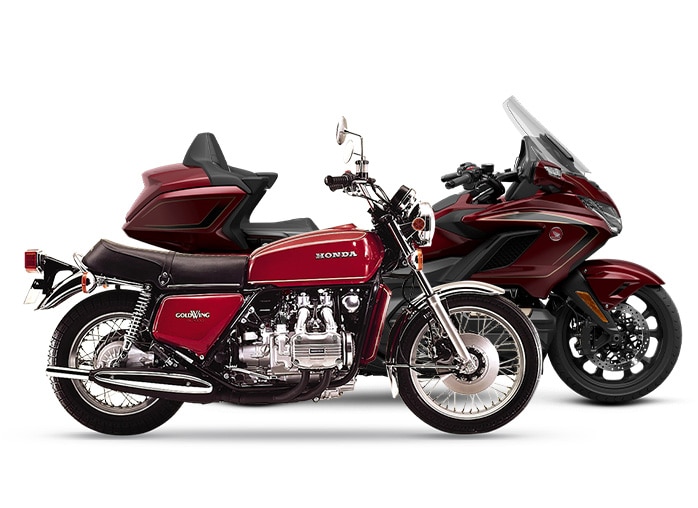
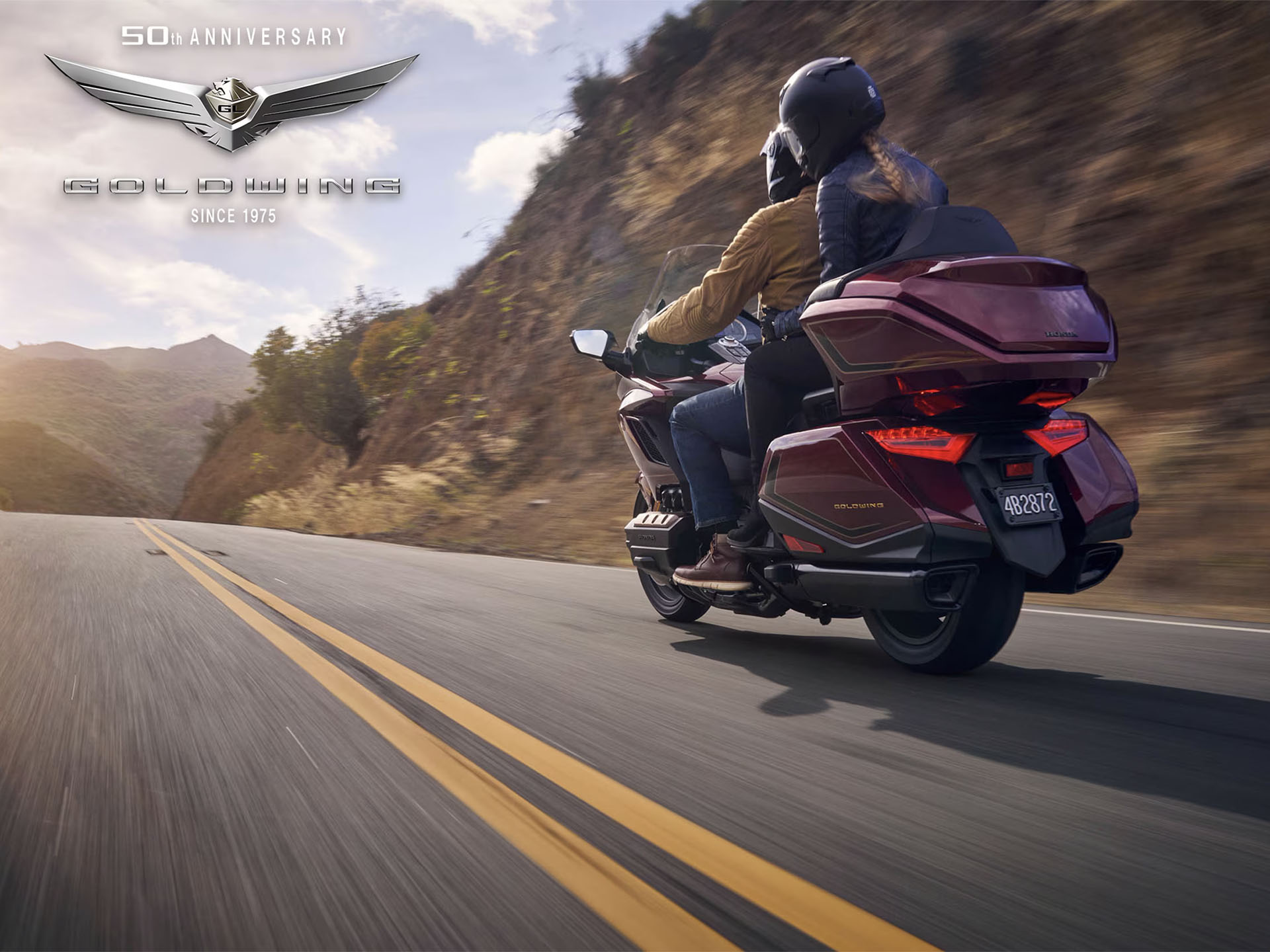
2025 marks the 50th anniversary – the Golden Jubilee – of the Honda Gold Wing. 50 years is a long time for any motorcycle model production, and the Gold Wing has been through several significant moments in history.
 Honda Gold Wing

In the pantheon of motorcycling icons, few machines command the respect and admiration of the Honda Gold Wing. It is the undisputed monarch of the long-distance touring realm, a two-wheeled institution synonymous with comfort, innovation, and continent-devouring capability. Yet, its journey to the throne was anything but predictable. The evolution of the Gold Wing is a fascinating tale of a motorcycle that repeatedly reinvented itself, evolving from a purist’s sport-tourer into a technological flagship that continues to define the luxury touring category.

The Genesis: A “Naked” Superbike (1975-1979)
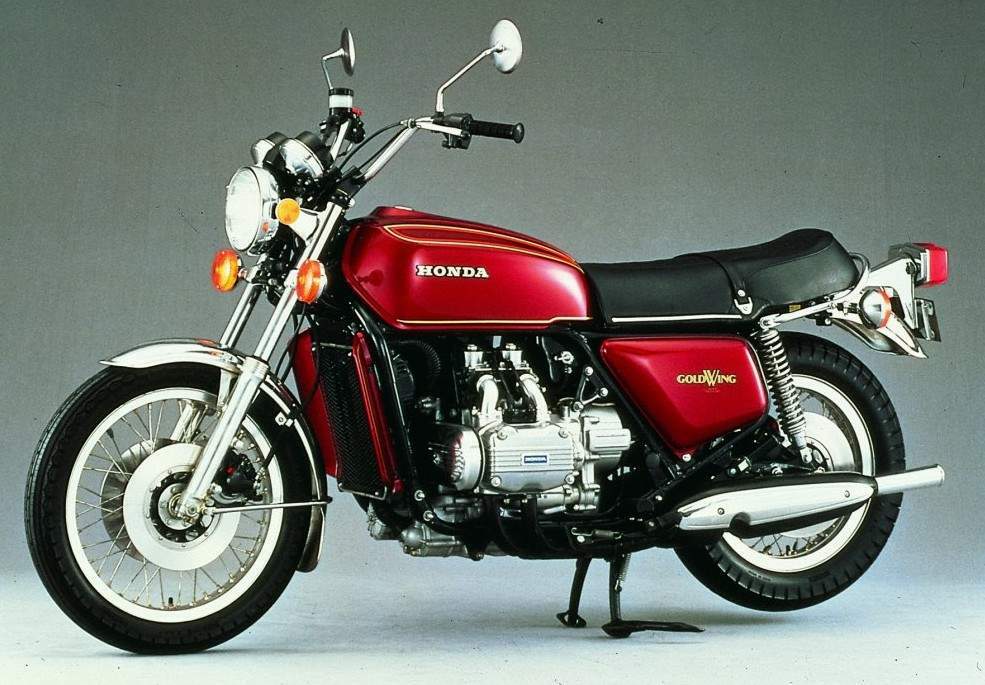
The story begins not with the fairing-clad behemoth we know today, but with a revolutionary engineering exercise.

When Honda unveiled the GL1000 in 1975, the motorcycling world was stunned. At its heart lay a masterpiece: a liquid-cooled, horizontally opposed four-cylinder engine. This “flat-four” configuration, reminiscent of a sports car’s powertrain, provided a incredibly low center of gravity and an exceptionally smooth, vibration-free power delivery. With nearly 1000cc and 80 horsepower, it outperformed many contemporary superbikes, including Honda’s own CB750, which was universally called “the world’s first superbike.”
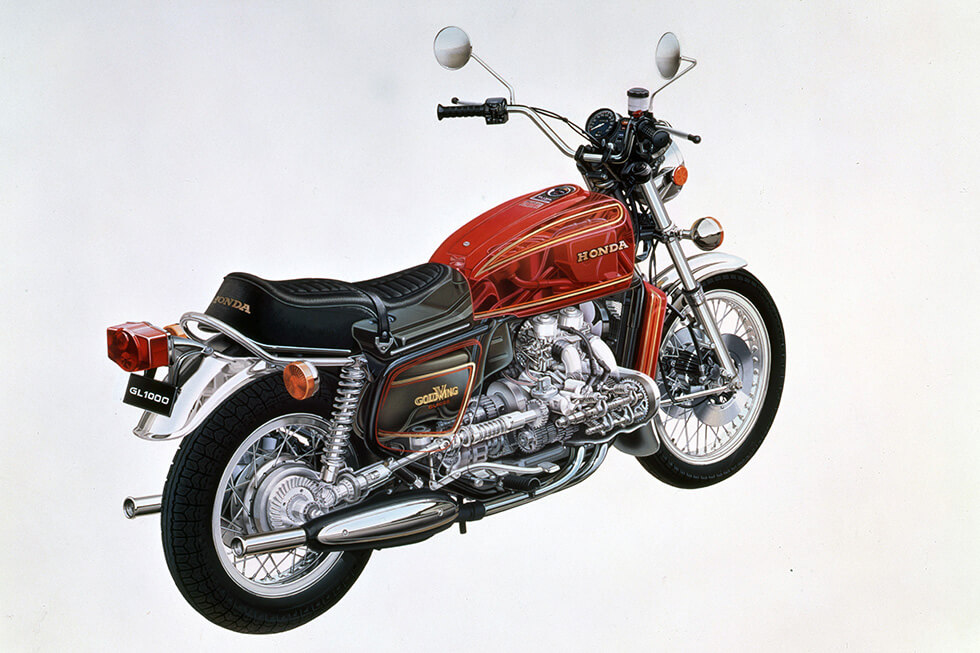
Surprisingly, the original Gold Wing was a minimalist. It arrived without a fairing, sporting only a simple fuel tank (though the actual tank was hidden under the seat to lower weight) and a solitary, dual-purpose seat. It was a “high speed tourer” according to Honda, a sleek and potent machine that enthusiasts quickly recognized as an unparalleled platform for long-distance travel. Riders began to customize them, adding aftermarket fairings and saddlebags, signaling to Honda a latent demand they had not yet fully anticipated.

The Transformation: Becoming the Tourer (1980-1983)
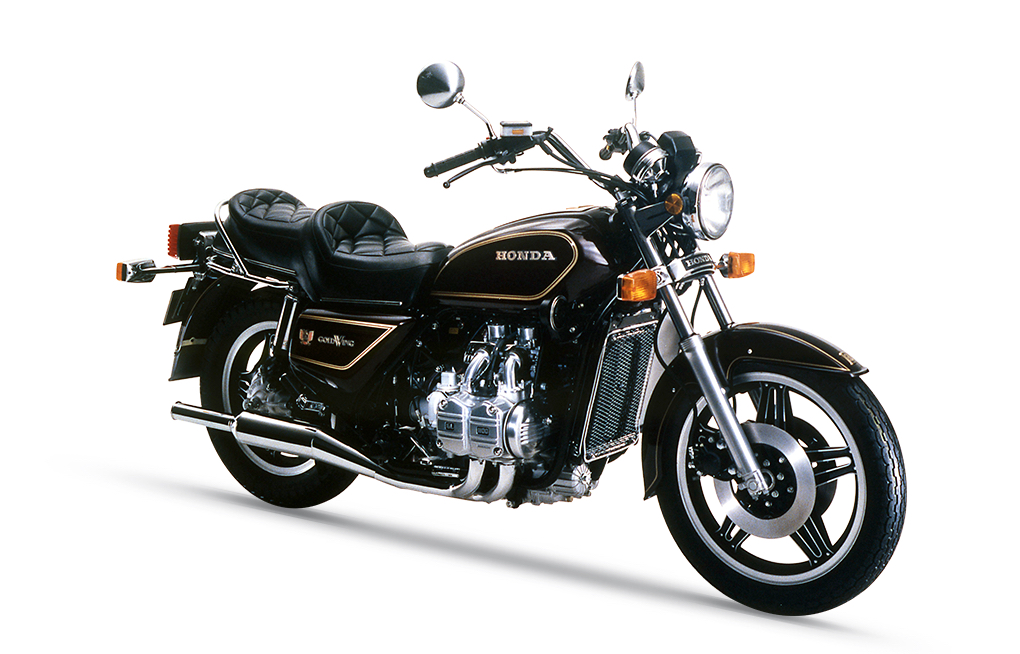
Honda is a company that listens, and the 1980s marked the Gold Wing’s definitive shift in identity, and in doing so, differentiate itself from the performance-oriented CB range.

The GL1100, introduced in 1980, was offered from the factory with optional factory-fitted fairings and luggage.

The Shape of the Future: The Full-Dress Tourer Debuts (1984-1987)

The market responded overwhelmingly to the GL1100 and by 1984, the GL1200 series had cemented the Gold Wing’s new silhouette. The Interstate model provided the full-dress experience, while the Aspencade added luxury touches like a digital dashboard and a premium sound system.
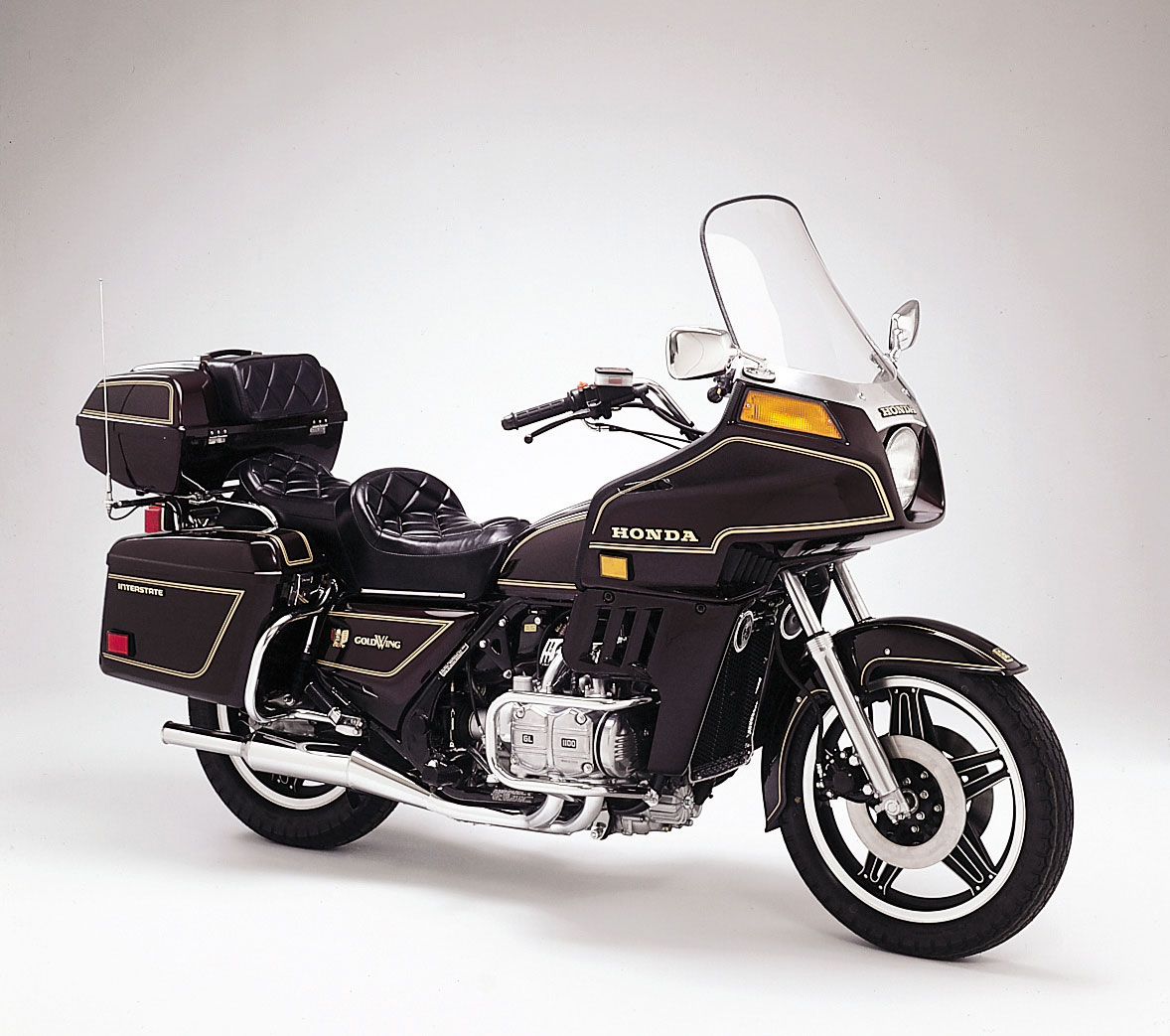
GL1200 Gold Wing Interstate

This was no longer just a motorcycle; it was a rolling living room. Comfort became paramount. The engine grew in displacement and refinement, designed not for peak horsepower but for a broad, seamless wave of torque. The riding position became more relaxed, and the chassis was engineered to handle the increasing weight of the amenities. The Gold Wing had found its calling: to isolate its rider and passenger from the hardships of the road, transforming a cross-country journey into a serene, effortless event.

The Apex of Analog: The Mighty Six-Cylinder Era (1988-2000)
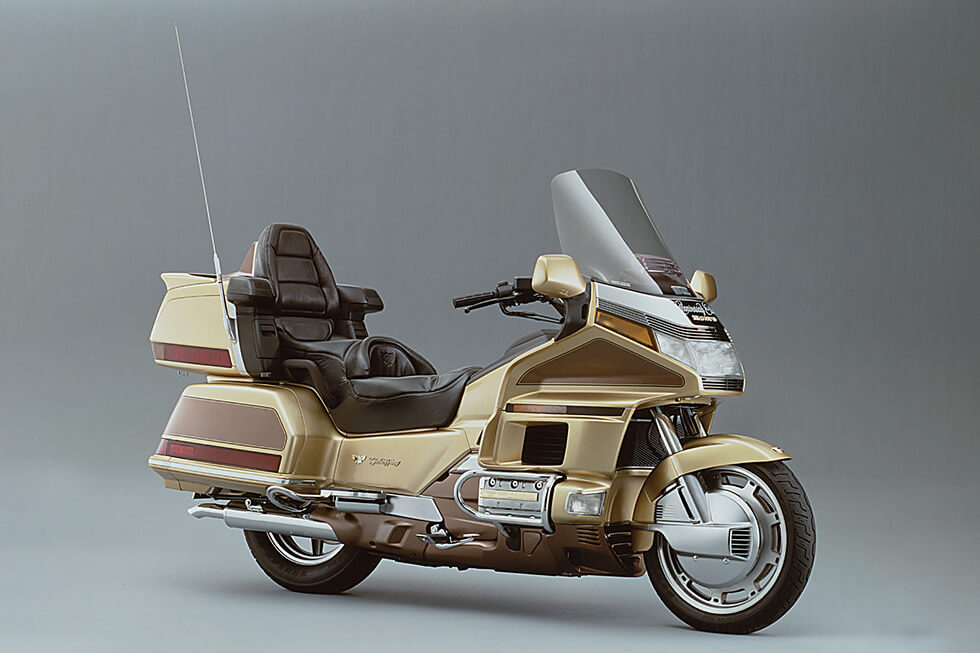
If the 1200cc model solidified the concept, the 1988 GL1500 perfected it. This was a monumental leap. Honda replaced the flat-four with a majestic, 1520cc horizontally opposed six-cylinder engine. The increase in cylinders translated to an otherworldly level of smoothness and torque. The motorcycle’s profile became broader, more authoritative, and undeniably grand.

The GL1500 was a marvel of pre-digital analog engineering. It featured a complex, multi-speaker audio system, cruise control, reverse gear, and enough storage capacity to rival a small car. It was the ultimate expression of the “bigger is better” philosophy, a machine that prioritized supreme comfort and presence above all else. For over a decade, it reigned supreme, facing little competition and building a cult-like following among touring purists.

The 21st Century Flagship: The Technological Leap (2001-2017)
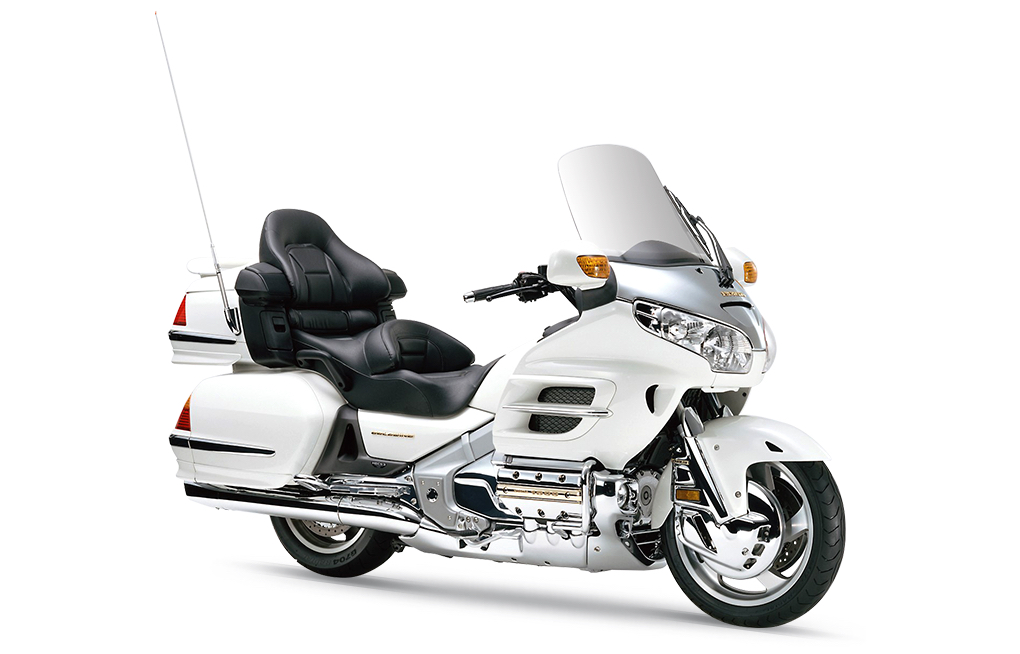
In 2001, Honda unveiled the GL1800, a machine that was as much a feat of structural engineering as it was a motorcycle. The new 1832cc flat-six engine was now a stressed member of the frame, which was a single-piece, die-cast aluminum unit. This resulted in a stiffer, lighter chassis that transformed the bike’s handling, making the colossal machine feel surprisingly agile.

The GL1800 became the new benchmark for two decades. It incorporated cutting-edge technology, including optional satellite navigation and, in a world-first for production motorcycles, an optional airbag. Its audio system was concert-hall quality, and its weather protection was absolute. It was the pinnacle of the fully integrated, all-in-one touring package, a technological fortress on two wheels.

The Modern Rebirth: The Agile Grand Tourer (2018-Present)
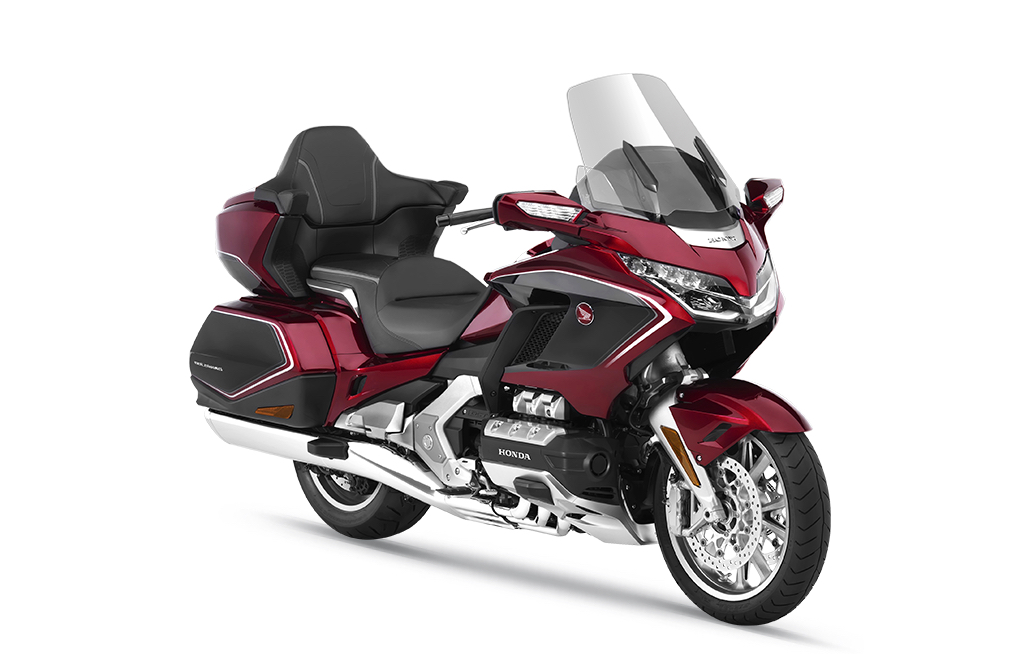
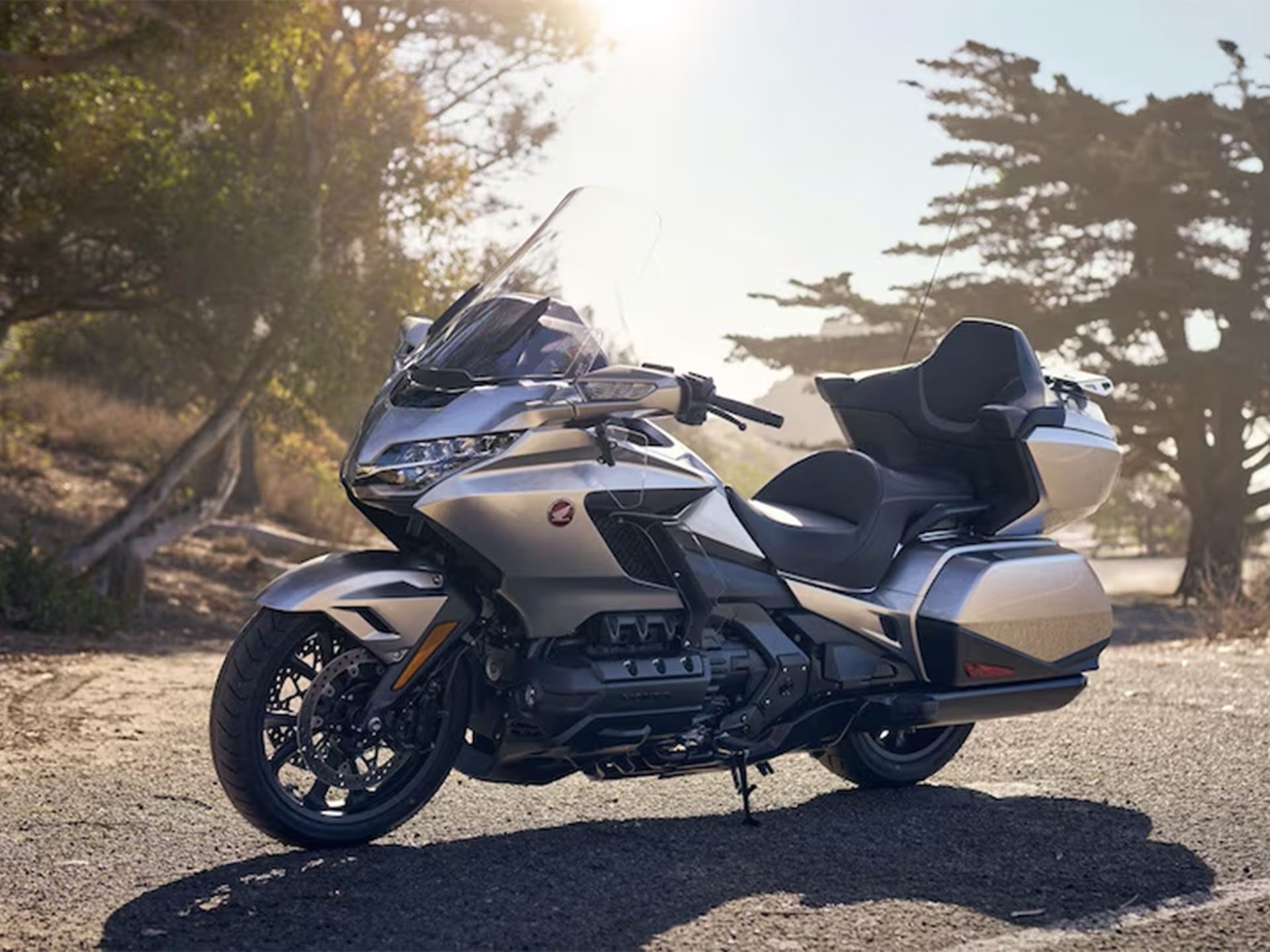
By the 2010s, the touring market was changing. Riders, including an aging core demographic, sought lighter, more manageable machines. Honda’s response in 2018 was a comprehensive and daring redesign. The new Gold Wing underwent a dramatic diet, shedding nearly 50 kg. The most radical change was at the front, where a double-wishbone suspension system replaced the traditional telescopic fork, improving handling and reducing front-end dive under braking.

Most significantly, the cockpit was catapulted into the modern age. A full-color TFT display became the command center, integrating with Apple CarPlay and Android Auto. Multiple riding modes, hill start assist, and a 7-speed DCT automatic transmission option broadened its appeal. Honda had successfully re-engineered a legend, preserving its core luxury and comfort while gifting it with a newfound spirit of agility and modern connectivity.

And, finally, the 2025 Honda Gold Wing 50th Anniversary
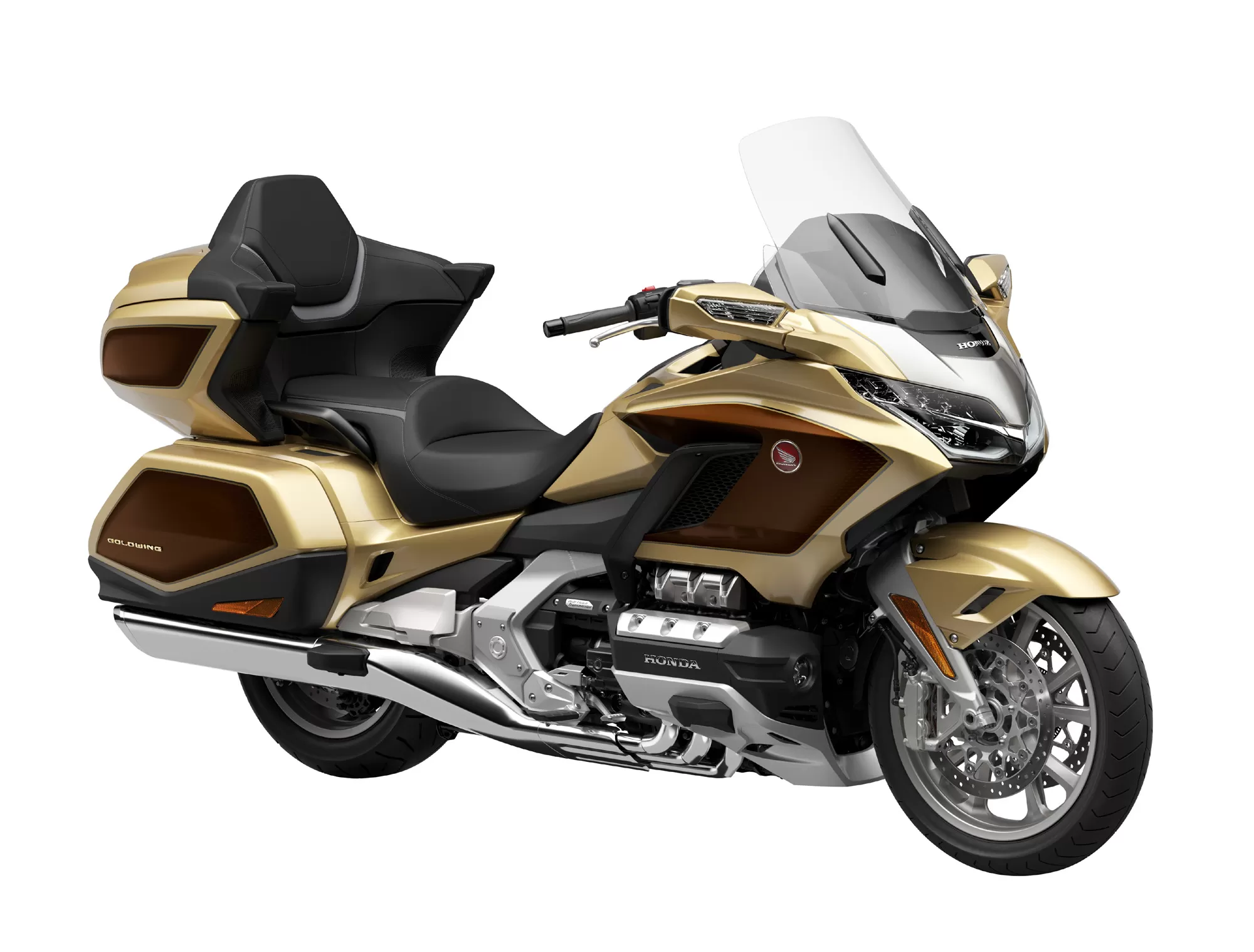
The 2025 Honda Gold Wing 50th Anniversary is a rolling monument to a half-century of touring supremacy. To honour this legacy, Honda has adorned its flagship tourer with two stunning Eternal Gold and Bordeaux Red Metallic paint scheme, a direct and elegant homage to the iconic colours of the original 1975 GL1000. This visual tribute is complemented by exclusive 50th Anniversary badging on the saddlebags and fuel tank, along with gold-coloured alloy wheels and meticulously embroidered seats, ensuring that its celebratory status is recognised at every glance.

Conclusion
The Honda Gold Wing’s evolution is a masterclass in listening to riders and daring to lead. It has grown from a sophisticated engine in search of a purpose to the most complete and capable touring machine on the planet. It is a testament to Honda’s engineering philosophy, proving that even a legend can continue to evolve, ensuring that the king of the tourers remains as relevant tomorrow as it was half a century ago.

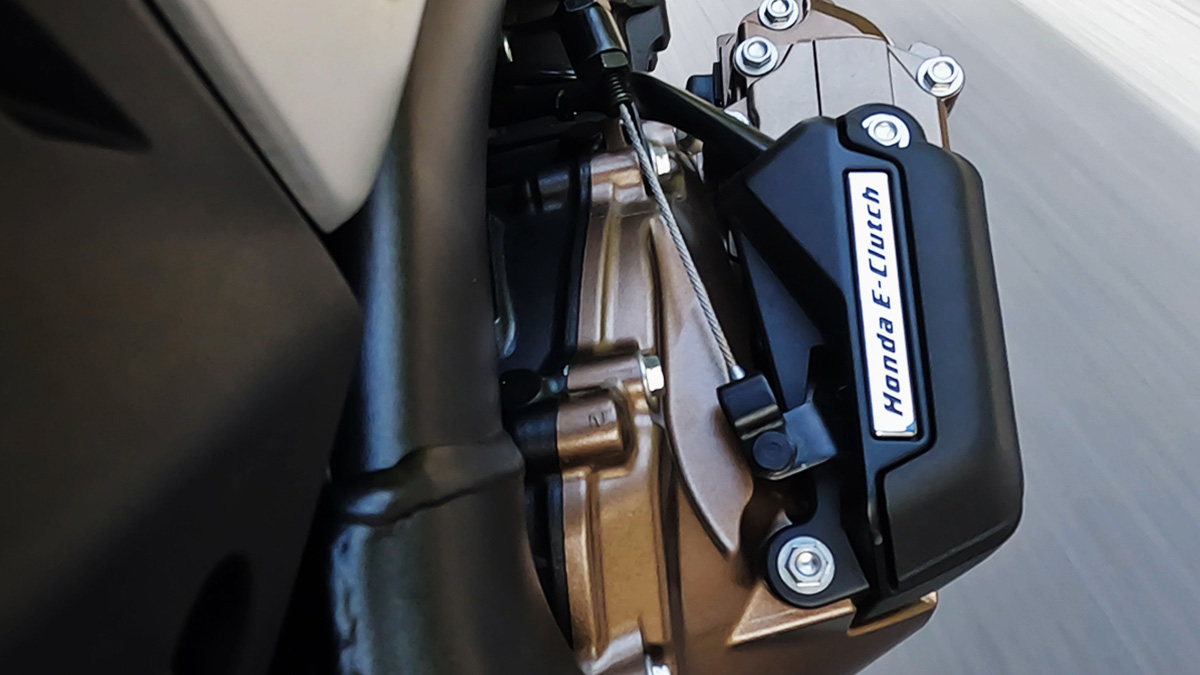
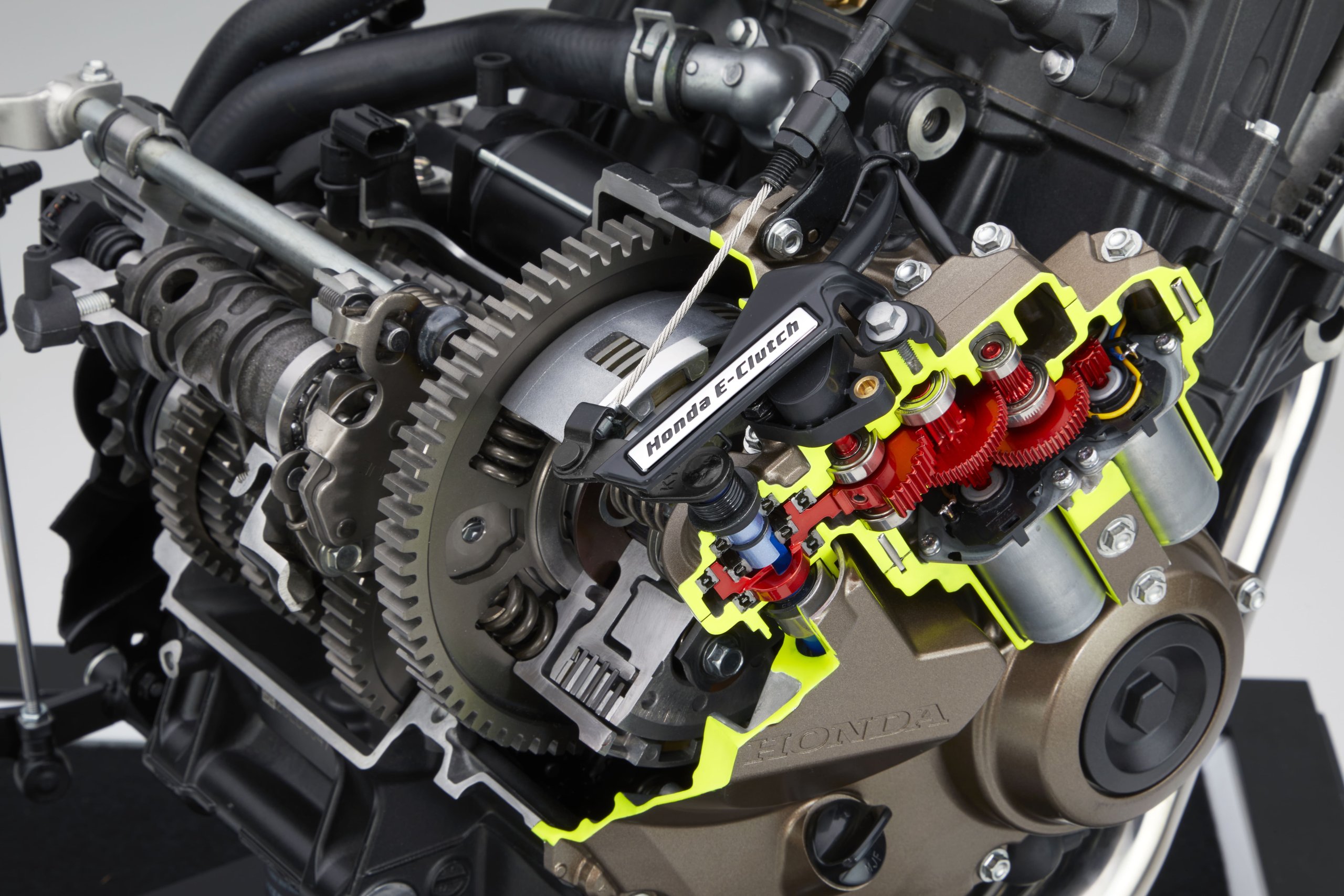
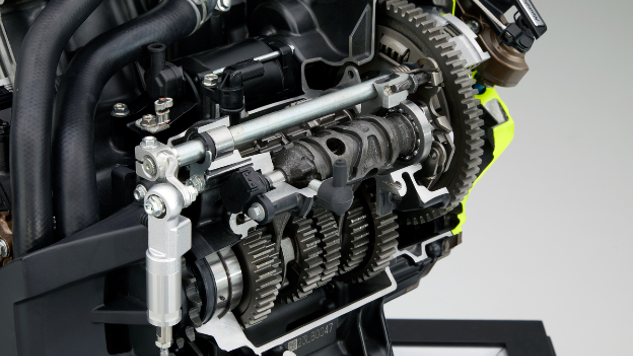
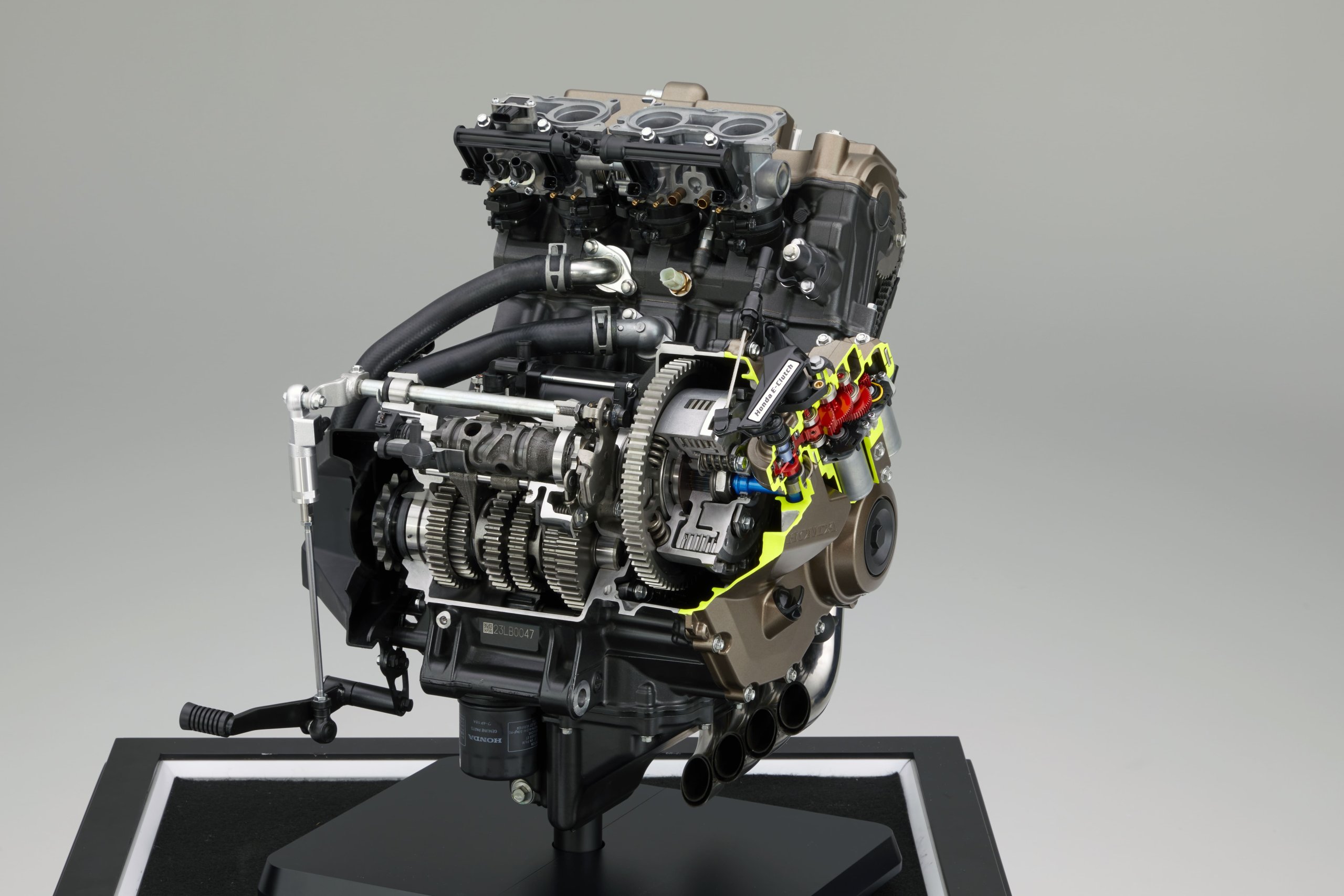
This is probably a little late, but better late than never, right? The Honda e-Clutch has been in the market for a while now, but there still exists some confusion among motorcycle enthusiasts. So we decided to describe how the system actually works. It turns out that such system is fitted to several of the manufacturer’s cars, too.

The Core Concept: A Robot for Your Clutch Lever

In simple terms, the Honda e-Clutch system is an add-on electro-mechanical system that operates the clutch pedal for you on a traditional manual transmission. Unlike Honda’s own Dual Clutch Transmission (DCT) the e-Clutch does NOT change the gears for you—you still have to move the gear lever yourself.

Think of it as a robot that sits on the left handlebar and presses the clutch lever with perfect timing and smoothness, every single time. You get the engagement and fun of shifting your own gears, but without the physical effort or the risk of stalling – useful for navigating a congested urban landscape.

Key Components of the System

To make this magic happen, the system uses several key components:

  1. Clutch Actuator: This is the heart of the system. It’s an electric motor and gear mechanism physically attached to the clutch lever arm. When activated, it pushes or pulls the arm to engage or disengage the clutch.

  2. Stroke Sensor: This sensor monitors the position of the clutch lever. It tells the motorcycle’s computer (ECU) how far you’re pressing the lever, allowing for manual override.

  3. Gear Position Sensor: This tells the ECU which gear you are currently in or if you are in neutral.

  4. Engine Control Unit (ECU): The brain of the operation. It processes data from all the sensors and decides when and how to command the clutch actuator to engage or disengage.

 How It Works in Different Riding Scenarios

Here’s where the system truly shines, making riding with a manual transmission incredibly easy.

1. Starting from a Stop (The #1 Reason People Stall)

This is the system’s most useful feature. In a normal manual car, you have to carefully balance the clutch and throttle to move off without stalling.

    • With e-Clutch: You simply press the gear lever, select first gear, and then press the accelerator. The system automatically engages the clutch smoothly to get the bike moving. It’s impossible to stall. Once you’re moving, you can shift to second gear without pulling the clutch lever, nor do you need to back off the throttle, as the system turns into a quickshifter.

    • In this mode, the clutch lever’s cable tension goes slack. For long-time motorcycle riders, it is as if the cable came loose. But not to worry here, because it is the e-Clutch system telling you that it is now working.

2. Normal Gear Shifting (Utilising the clutch lever)

When you are riding and want to change gears, the process is seamless:

    • Move the gear lever into the next gear (do not touch the clutch lever).

    • You do not have to roll out of the throttle, just keeping it open is fine.
    • The system detects your gear lever movement and automatically disengages the clutch for a split second to allow the shift.

    • Once the new gear is selected, it automatically re-engages the clutch smoothly.

3. Coming to a Stop

    • As you slow down, the system will automatically disengage the clutch just before the engine RPM gets too low, preventing a stall.

    • You can come to a complete stop, and the motorcycle will remain in gear without stalling. You then simply put it in neutral or keep it in gear.

4. Manual Override & “Traditional” Mode

This is a crucial feature for driving purists. The physical clutch lever is still there. You can pull it at any time to take full manual control, just like in a traditional manual motorcycle. The system immediately disengages and lets you drive as you normally would with the bonus of a quickshifter.

Benefits of the Honda e-Clutch
  • Impossible to Stall: The bike’s computer prevents it, making it ideal for stop-and-go traffic and new learners.

  • Reduced Rider Fatigue: No constant clutch work in heavy traffic makes for a much more relaxed ride.

  • Retains Riding Engagement: You are still physically changing gears, maintaining the connection and fun of a manual transmission.

  • Smoother Operation: The system can engage the clutch more smoothly than most human drivers, leading to a more refined feel.

  • Great for Learning: It’s a perfect tool for teaching someone how to ride a manual motorcycle, as it removes the fear of stalling while they learn gear patterns and timing.

What It Is NOT

It’s important to understand the limitations:

  • It is NOT an Automatic Transmission: It does not select gears for you. You must move the gear lever for every shift.

  • It is NOT a Single-Clutch Automated Manual (like an older Smart car): Those systems often have jerky shifts because they control both the clutch and the gearshift robotically. With the e-Clutch, the human provides the smoothness and decision-making for the gear change.

  • It is NOT a Dual Clutch Transmission (DCT): Honda’s DCT is actually an automatic-manual transmission. It consists of all the gears of a manual transmission instead of the CVT found on scooters. However, the system is fully clutchless and the bike does not even have a clutch lever. Thus the rider can select AUTO and leave it to shift by itself, or choose MANUAL and shift using buttons.
Summary

The Honda e-Clutch is a clever, pragmatic technology. It removes the most tedious and difficult parts of riding a manual motorcycle (stalling, traffic jams) while preserving the joy and control that enthusiasts love. It’s the best of both worlds for many riders.

As of now, Honda has fitted the e-Clutch to the CB650R, CBR650R, and Rebel 300. There are plans to expand this option to other models in the catalogues.

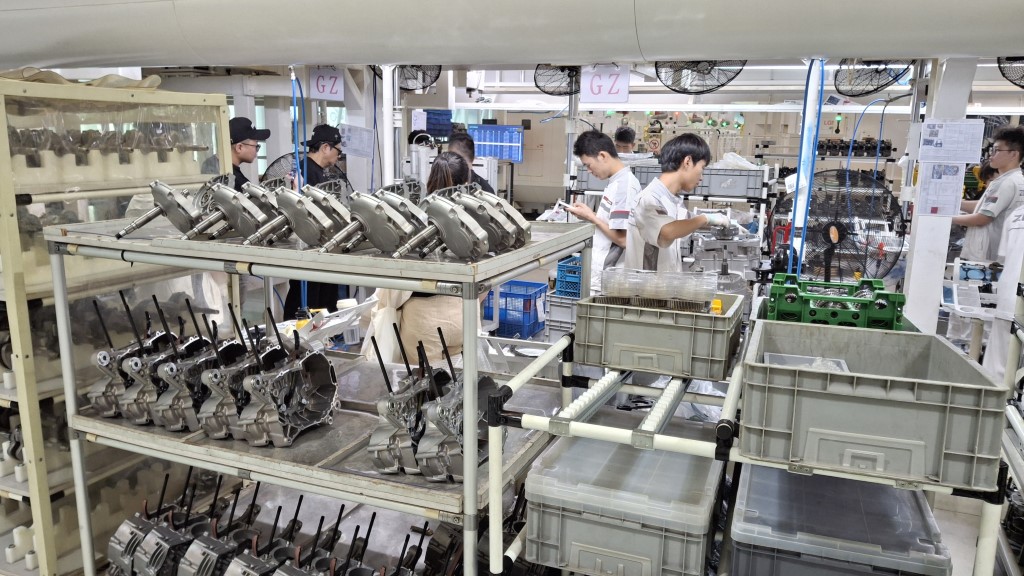
If you do not know that China’s motorcycles are beginning to dominate or have already dominated certain markets, then we say, “Welcome home” from your travels through the multiverse. China has been a global manufacturing powerhouse for more than 20 years now, and riding this wave is their automotive industry.

History

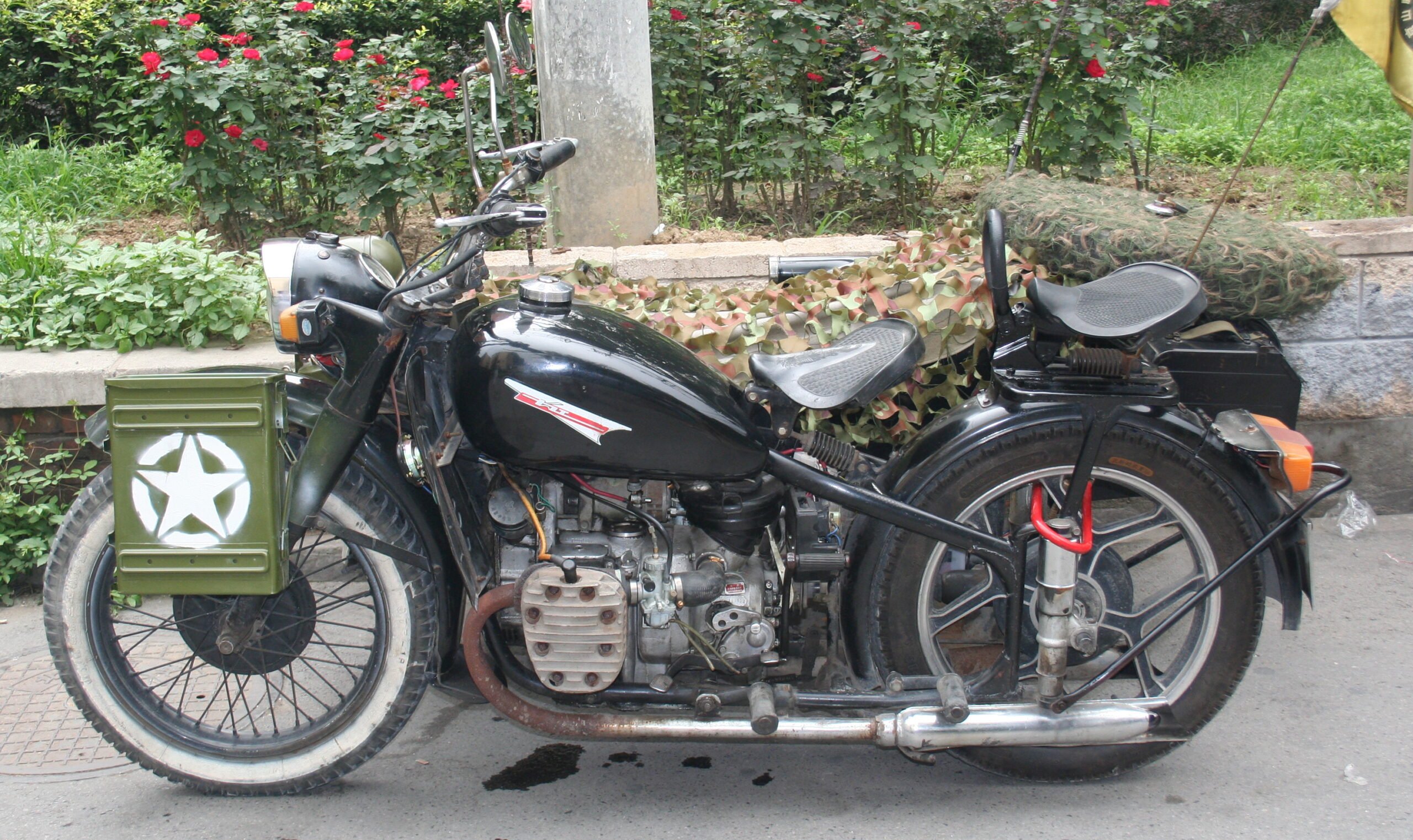
Motorcycle manufacture in China first began in 1951, when the People’s Liberation Army began producing a 500cc motorcycle to meet the country’s military requirements during the Korean War. It was developed on the lines of the K500, a German model used in World War II.

Before the end of the 1970s, motorcycles produced in China were mainly used by the military services. However, the Beijing Motorcycle Factory, produced motorcycles for the general public that were based on the German pre-war BMW R71, and Russian Ural and Dnepr (in turn, based on the R71) from 1958 onwards.

People’s Liberation Army motorcycle, Picture by Gabriele Battaglia

In 1979, in Chongqing city, military munitions factory China Jialing Industrial Company began to independently manufacture motorcycles for civilian use, ushering in the modern era of Chinese motorcycle production. In 2000, the Chinese industry took over as the biggest motorcycle producer in the world, a position that it has maintained.

Manufacturing: The World’s Motorcycle Factory

China’s manufacturing scale is immense. In 2023, the country produced over 18.3 million motorcycles. Driven by strong domestic and international demand, production is projected to reach close to 20 million units in 2024 and maintain this upward trajectory into 2025.

A key feature of this output is the clear split between traditional and electric models. While gasoline engines remain important for export, a massive and growing portion of production is dedicated to electric two-wheelers, cementing China’s status as the global hub for both segments.

Domestic Sales: The Electric Kingdom

Within China, the story is overwhelmingly electric. The domestic market is fueled by affordable, convenient electric scooters and light motorcycles. These vehicles are not for recreation but are essential tools for daily life, serving as the primary mode of transport for millions of commuters and the backbone of the country’s vast delivery and logistics networks.

Sales figures closely mirror production, with tens of millions of units sold annually. The demand for electric models continues to surge, driven by urban mobility needs, supportive government policies for EVs, and a well-established charging infrastructure.

Exports: Conquering the World on Two Wheels

China is also the world’s top exporter. In 2023, it shipped 8.83 million motorcycles abroad. Data from the first half of 2024 shows an 11% increase, putting the country on track to export over 9.5 million units for the full year (the 2024 figures are not confirmed yet). This momentum is expected to continue, with annual exports projected to reach 11-12 million units by 2026.

These exports serve two distinct global markets:

  1. Gasoline for Developing Economies: Reliable, low-cost motorcycles are shipped in huge numbers to countries across Asia, Africa, and Latin America for everyday transport.

  2. Electric for Developed Markets: Exports of electric scooters to Europe and North America are the industry’s fastest-growing segment, with growth rates exceeding 36% as global demand for clean urban mobility explodes.

Top Brands and Manufacturers: The Key Players

There are some 200 motorcycle manufacturers in the country, consisting of a mix of state-owned giants, powerful private firms, and emerging premium brands.

  • Major Electric-Only Brands:

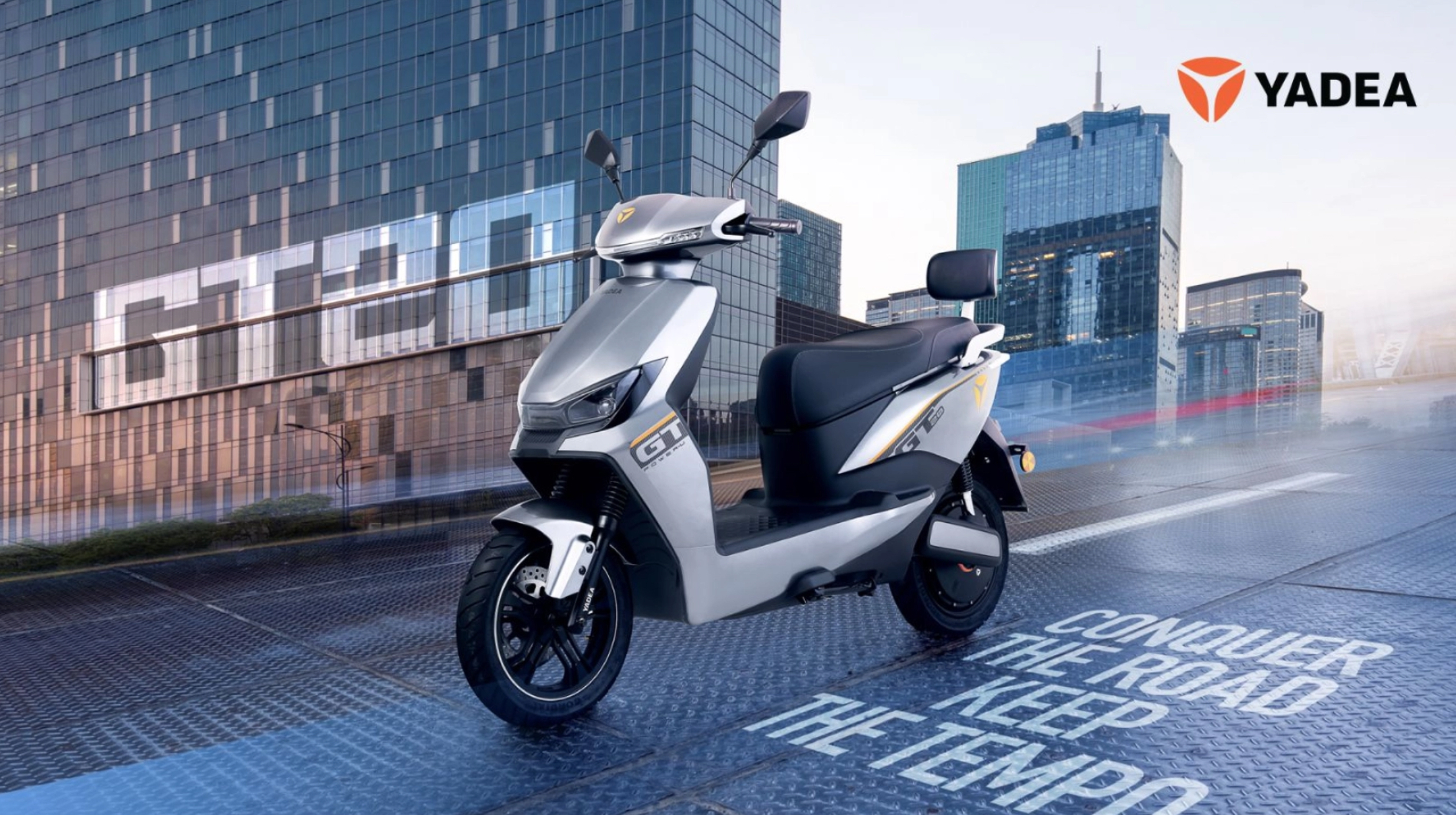
    • Yadea: A global leader in electric two-wheelers, known for its extensive range of scooters and bikes, dominating both the domestic market and international exports.

    • Aima: Another electric vehicle giant, competing directly with Yadea for market share in China and abroad with a focus on innovation and affordability.

    • Niu Technologies: Known for its smart, premium electric scooters with connectivity features, Niu has a strong presence in China and a growing footprint in Western markets.

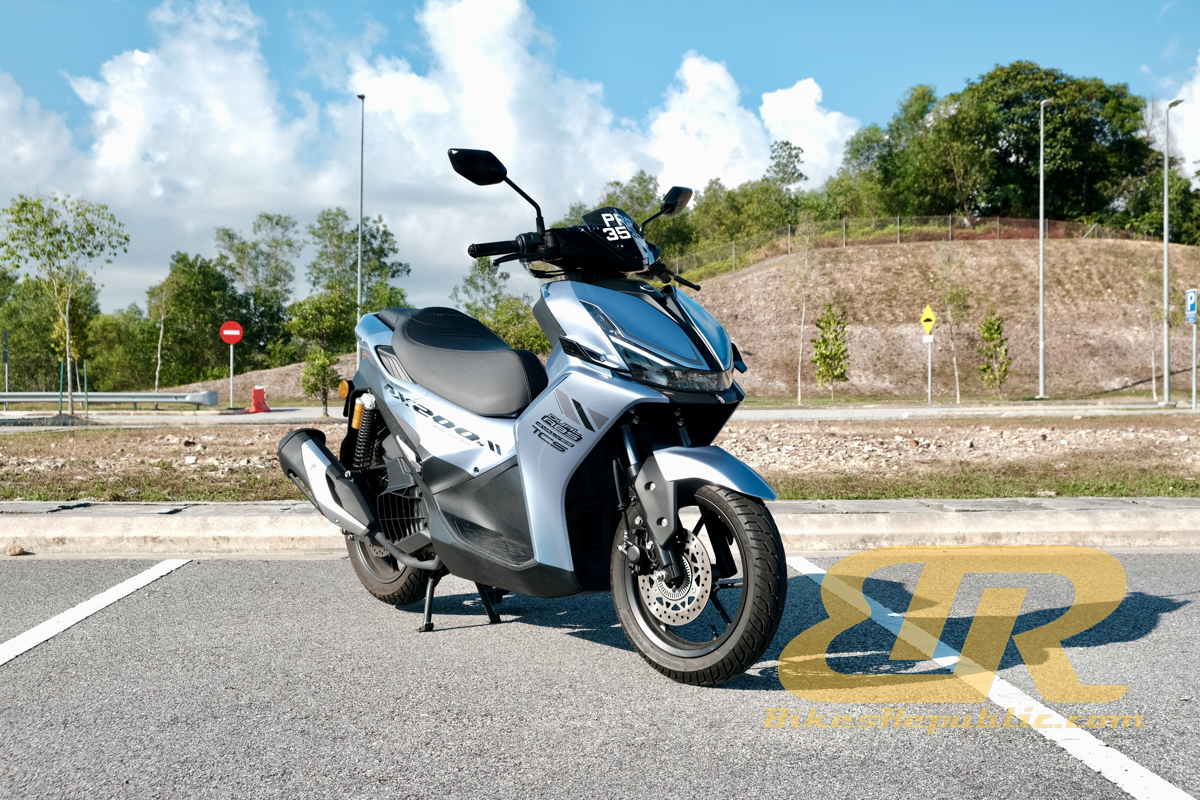
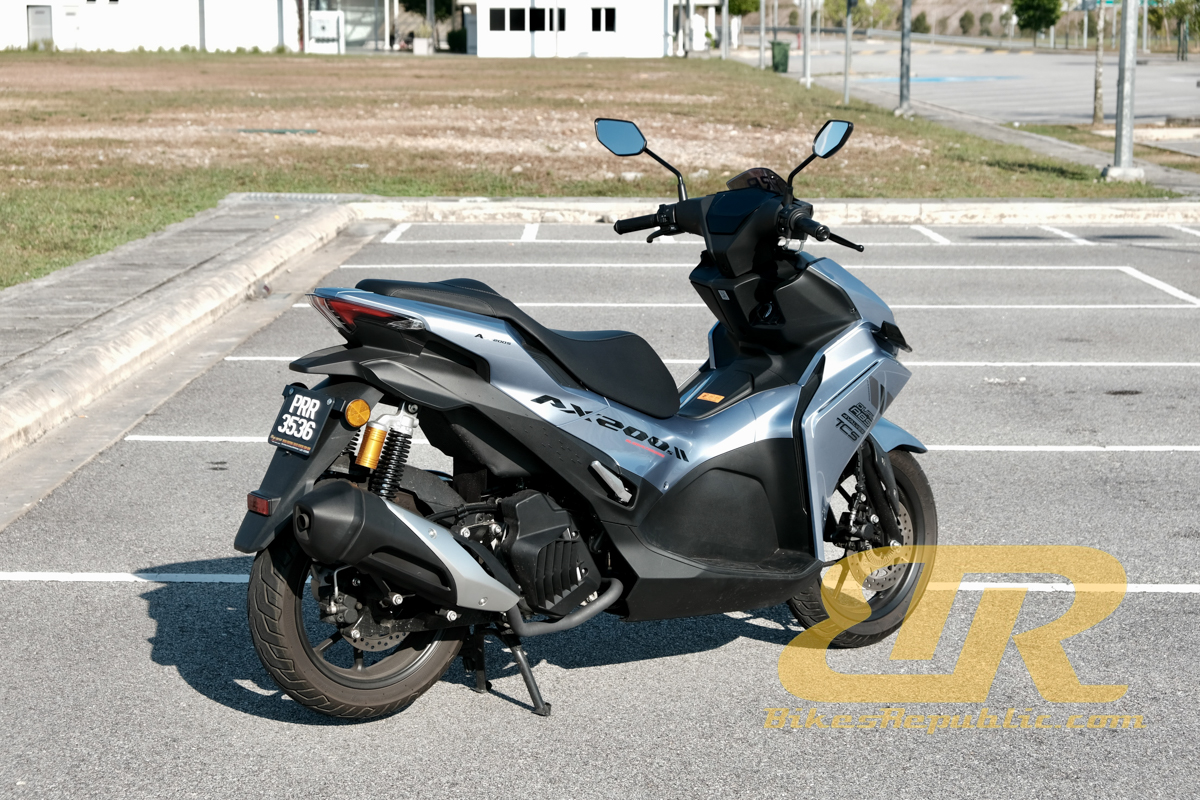
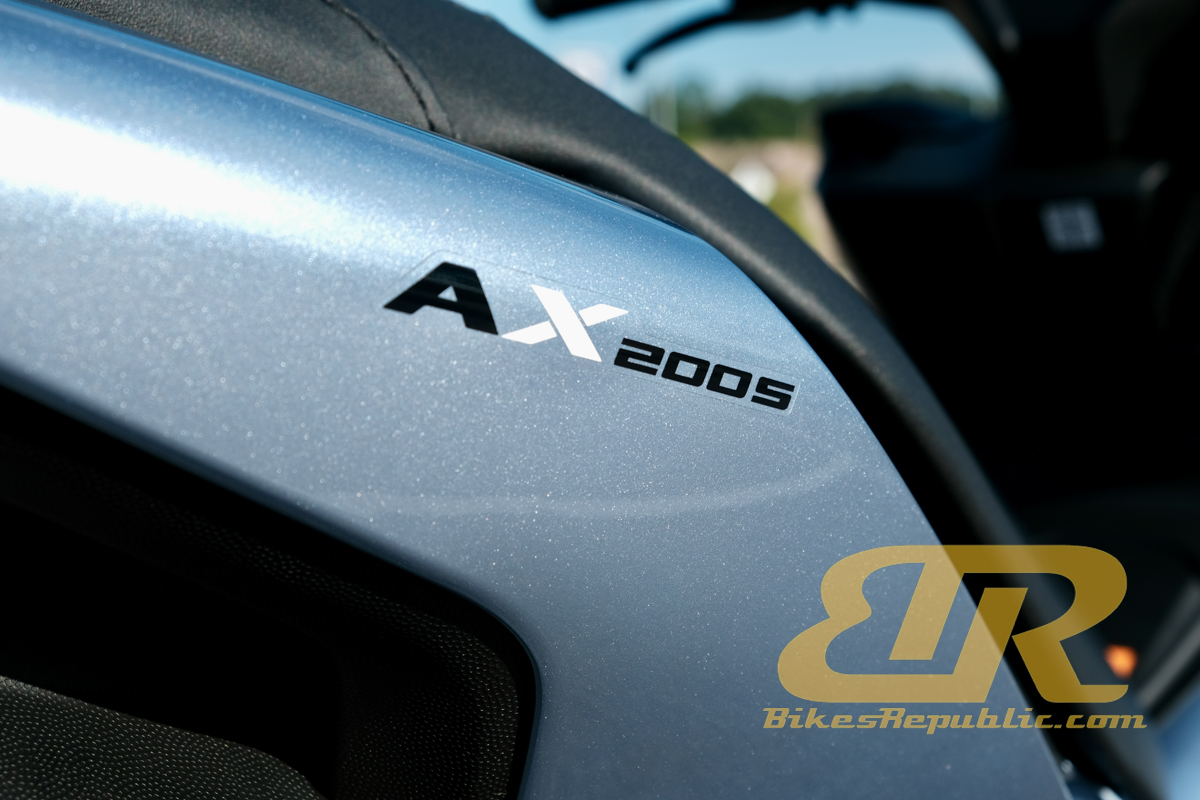
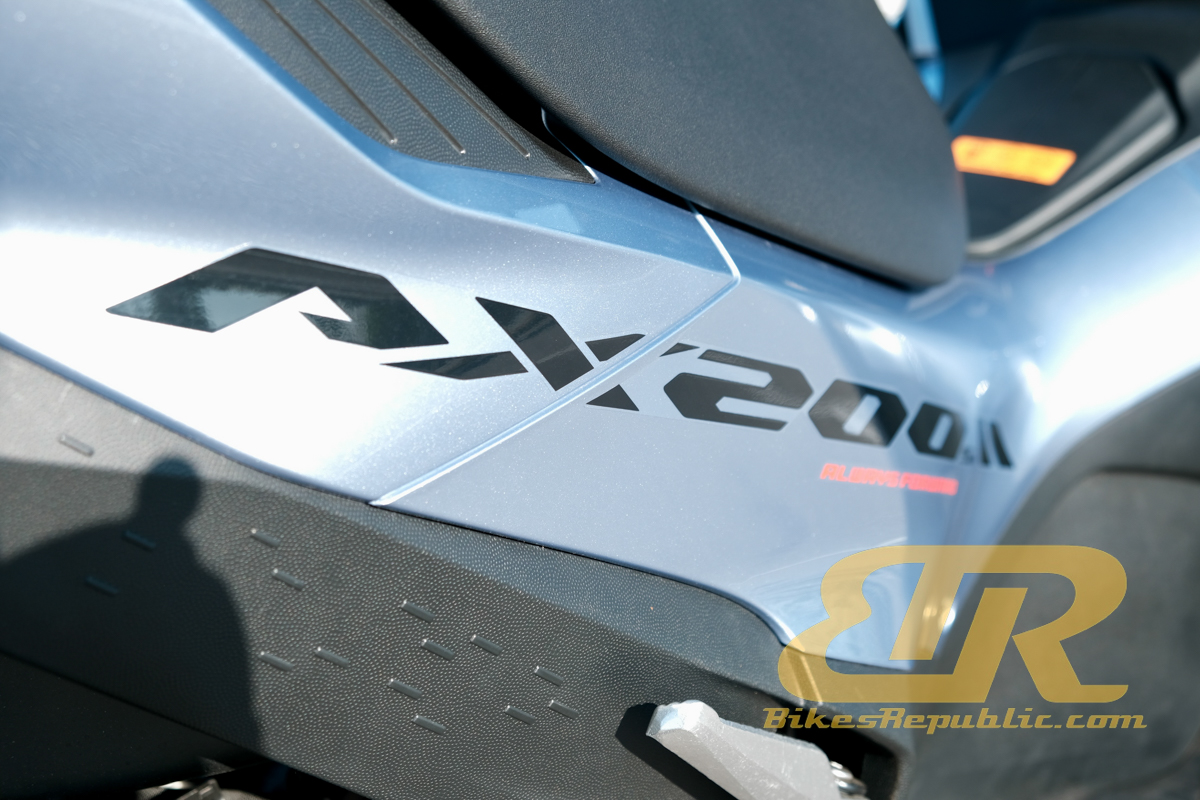
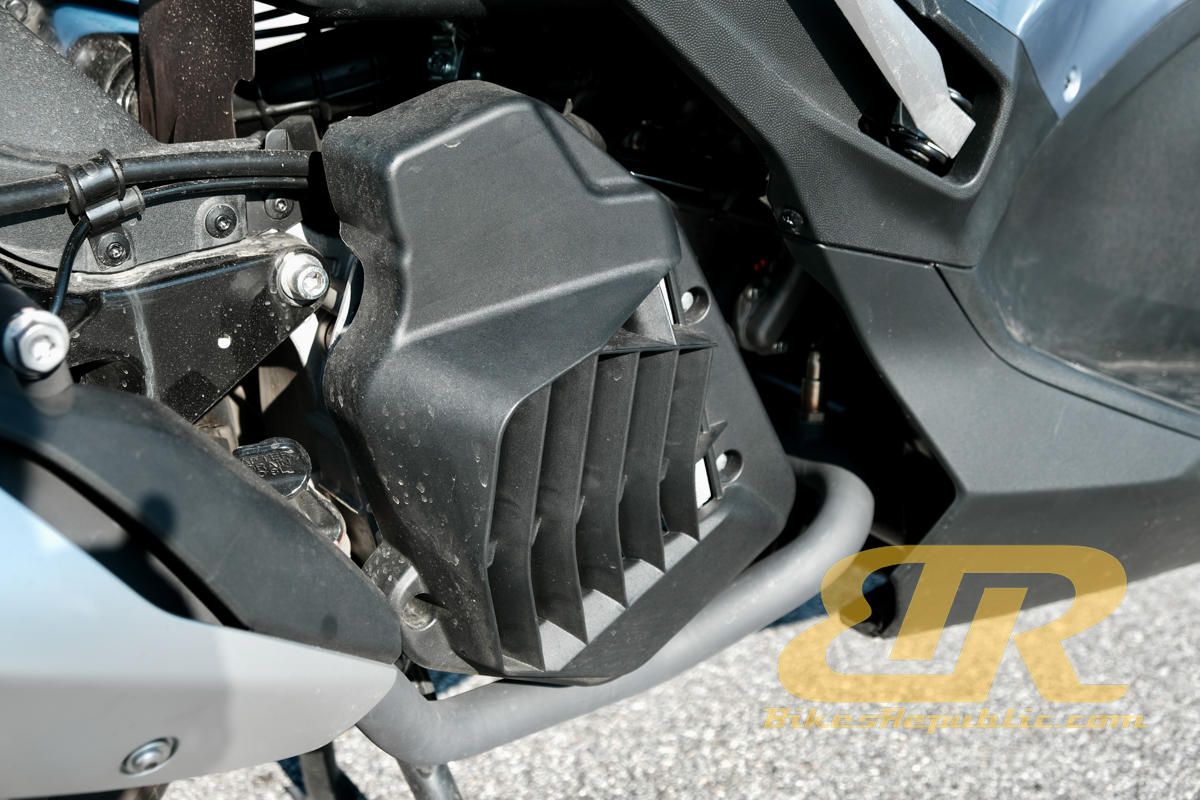
2025 QJMotor AX200s

  • Major Gasoline and Mixed Manufacturers:

    • Loncin: A massive manufacturer that produces millions of engines and vehicles annually. It is also a key production partner for international brands like BMW Motorrad.

    • Zongshen Industrial Group: A powerhouse in engine and motorcycle manufacturing, with a strong export business and a growing presence in the electric vehicle sector.

    • Lifan: A long-established player in the industry, producing a wide range of motorcycles, particularly known in export markets.

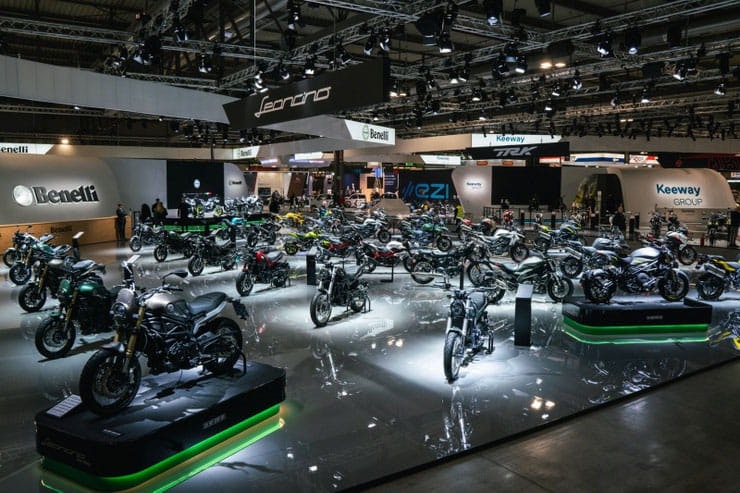
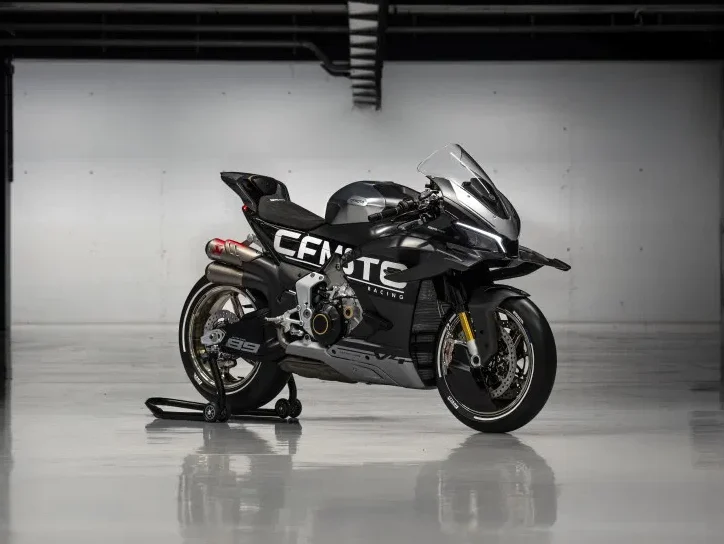
    • CFMoto: A standout brand that has successfully moved upmarket. CFMoto manufactures high-quality, larger-displacement motorcycles and is a direct competitor to established Japanese and European brands. It also has a renowned partnership with KTM.

2025: Smarter, Greener, and More Global

Looking ahead, the Chinese motorcycle industry’s strategy is clear:

  • Moving Upmarket: Brands like CFMoto are leading the charge, showing that Chinese manufacturers can compete on quality and technology, not just price.

  • Smart Technology Integration: Features like app connectivity, advanced battery management, and rider aids will become standard, even on mid-range models.

  • Sustainable Dominance: The global shift towards electrification plays directly into China’s strengths, ensuring its position as the world’s essential source for electric two-wheelers for years to come.

The Road to 2026: Smarter, Connected, and Quality-Focused

The journey through 2026 will be defined by three key trends:

  1. Intelligent Connectivity: Motorcycles will become seamlessly integrated into the “Internet of Things.” Expect features like geo-fencing, anti-theft tracking, ride analytics, and over-the-air updates to become standard, even on mid-range models.

  2. Brand Building and Premiumization: Chinese manufacturers will continue to shed their budget-image. Following CFMoto’s lead, more brands will invest in R&D to launch premium, high-performance models that compete on a global stage for quality and design.

  3. Supply Chain Dominance: China’s control over the battery and EV supply chain will make it the most cost-effective producer of electric two-wheelers, creating a significant and lasting competitive advantage through 2026 and beyond.

In conclusion, the Chinese motorcycle industry is not just maintaining its title as the world’s two-wheeled workshop; it is evolving into its innovation lab. By 2026, it will be recognized as a sophisticated, technology-driven industry that sets the global standard for electric mobility and challenges established players with its own high-quality brands.

Next up: A quick look at the top Chinese motorcycle manufacturers.

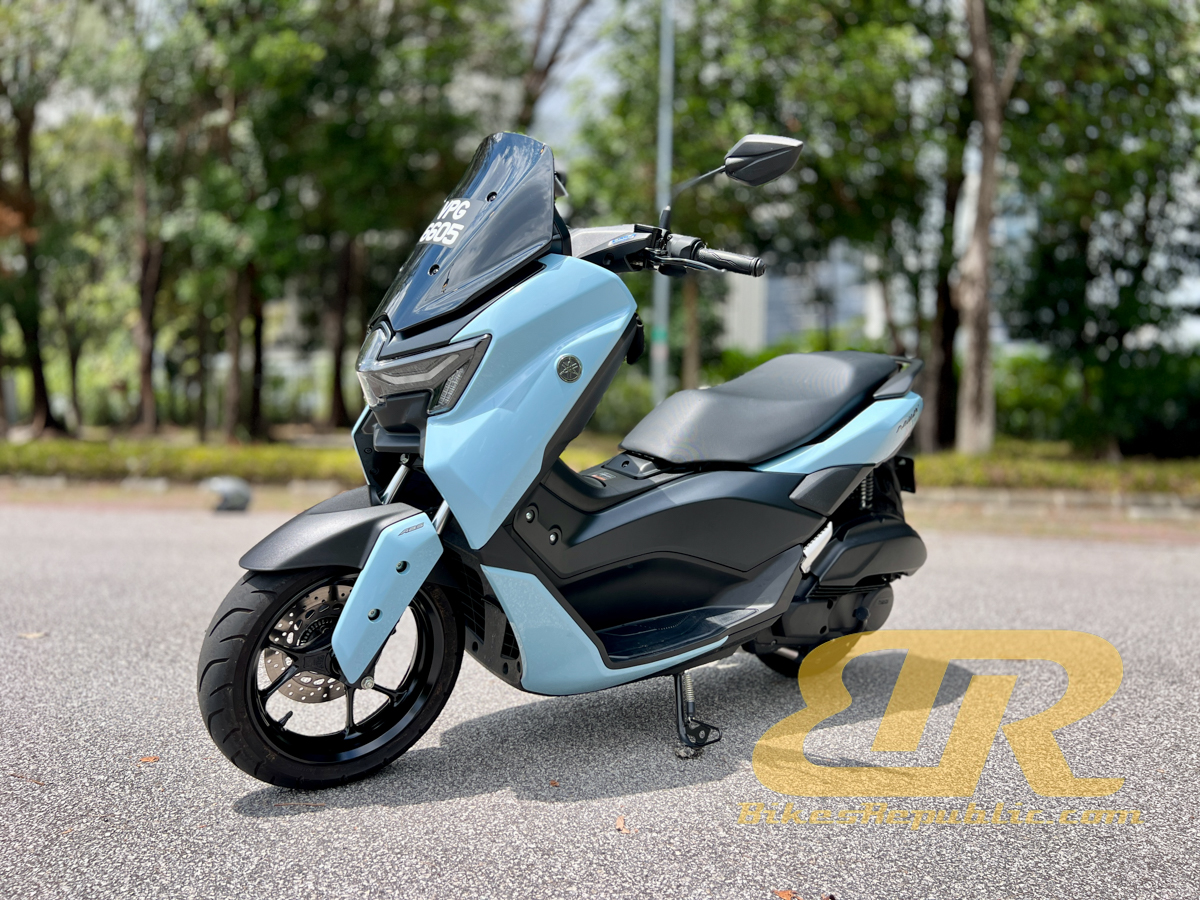
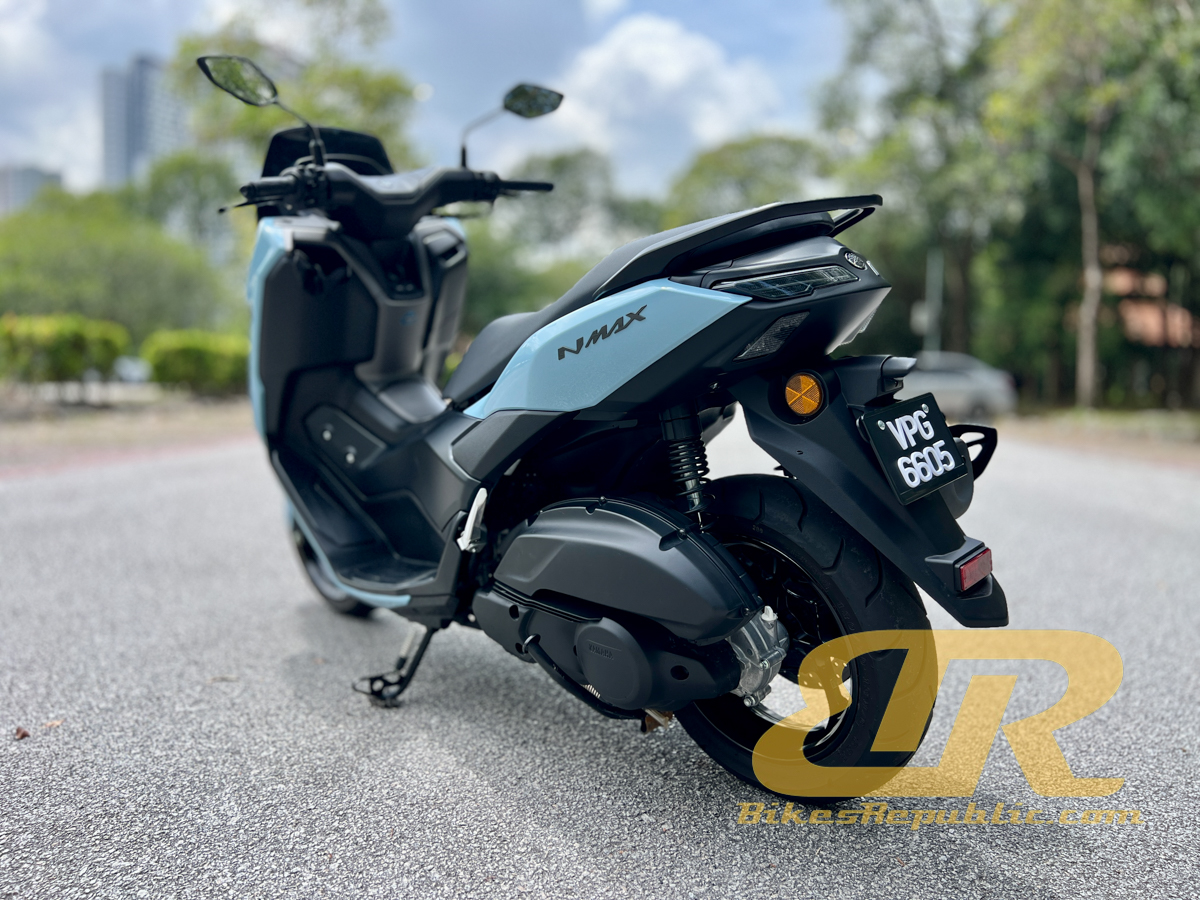
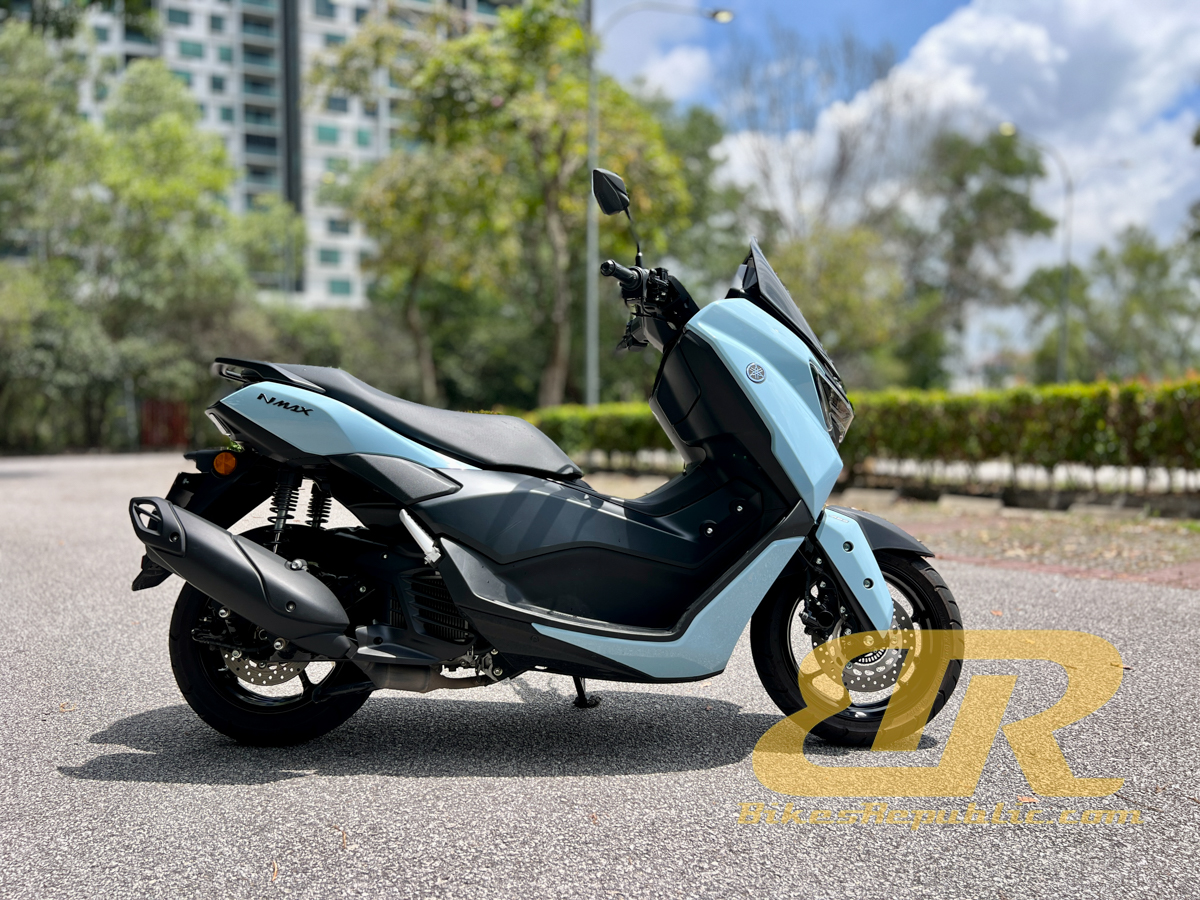
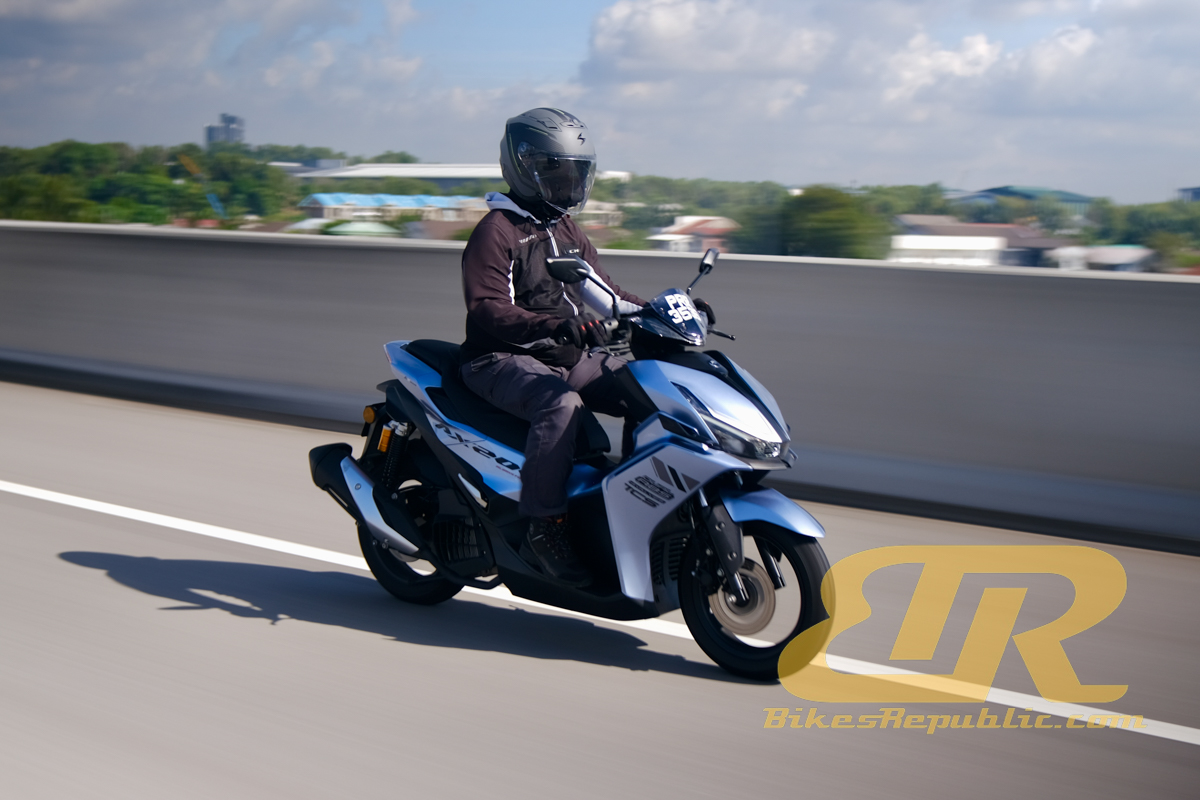
The Yamaha NMAX is one of the most ubiquitous 150cc scooters, being seen everywhere since its 2016 debut in Malaysia. Since then it has been updated to where it is now, the 2025 Yamaha NMAX.

The NMAX is popular for being uncomplicated, user friendly, light on its feet, and pretty good engine perfomance especially beginning the second version. Adding to these points is the convenience that comes with scooters i.e. commendable onboard storage space.

However, we could not get past the elephant in the room, namely, the challenge posed by the large number of Chinese scooters that feature futuristic designs, more electronic gadgetery, all at lower prices.

So, can the NMAX hold its own?

What is the 2025 Yamaha NMAX?

To state the obvious, the bike is set in the 150-160cc ‘twist-and-go’ automatic scooter segment. This segment is hard-fought among manufacturers and distributors alike, as it is the most affordable to the buying public.

Compared to its Yamaha NVX stablemate, the NMAX is marketed as a more utilitarian and approachable variant, while the NVX is a sport-oriented scoot. As such, the NMAX features more storage space and comfort.

Highlights
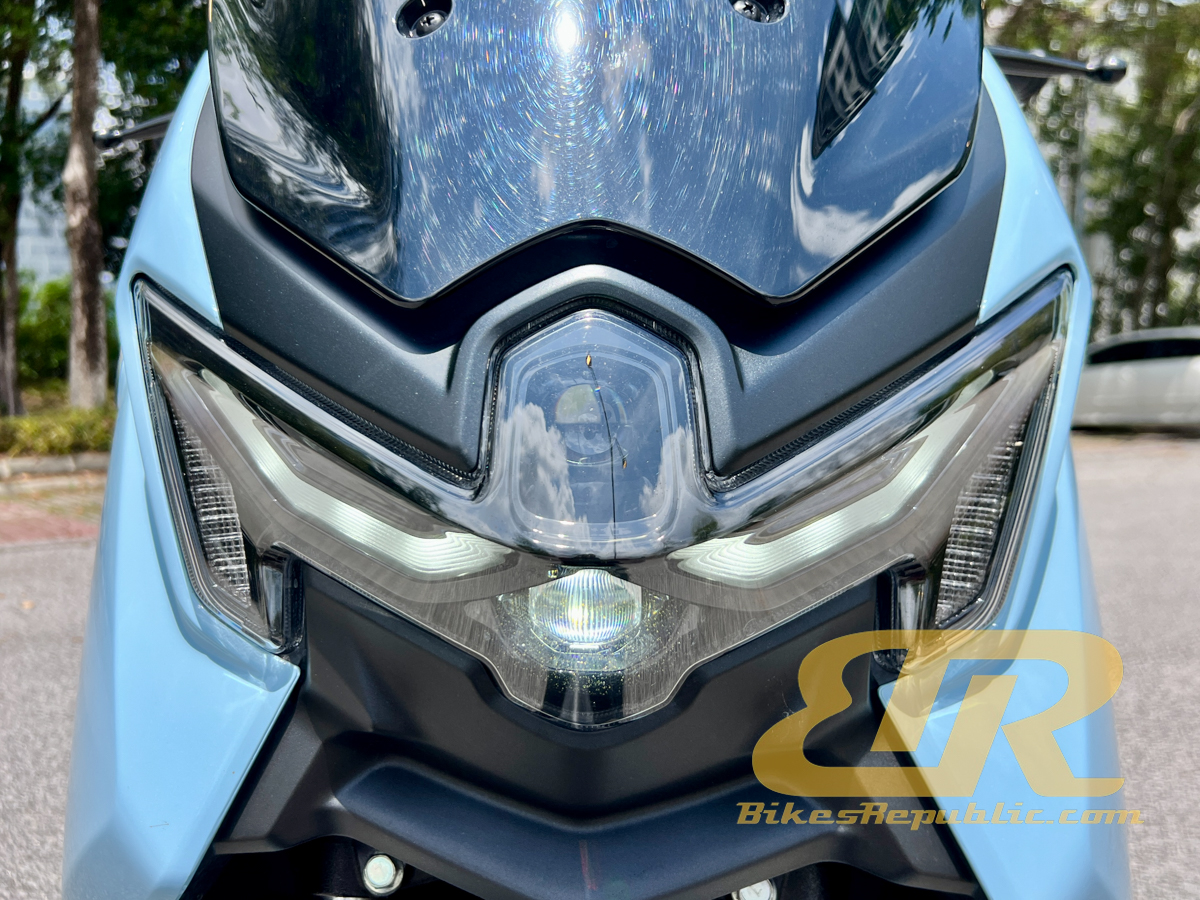
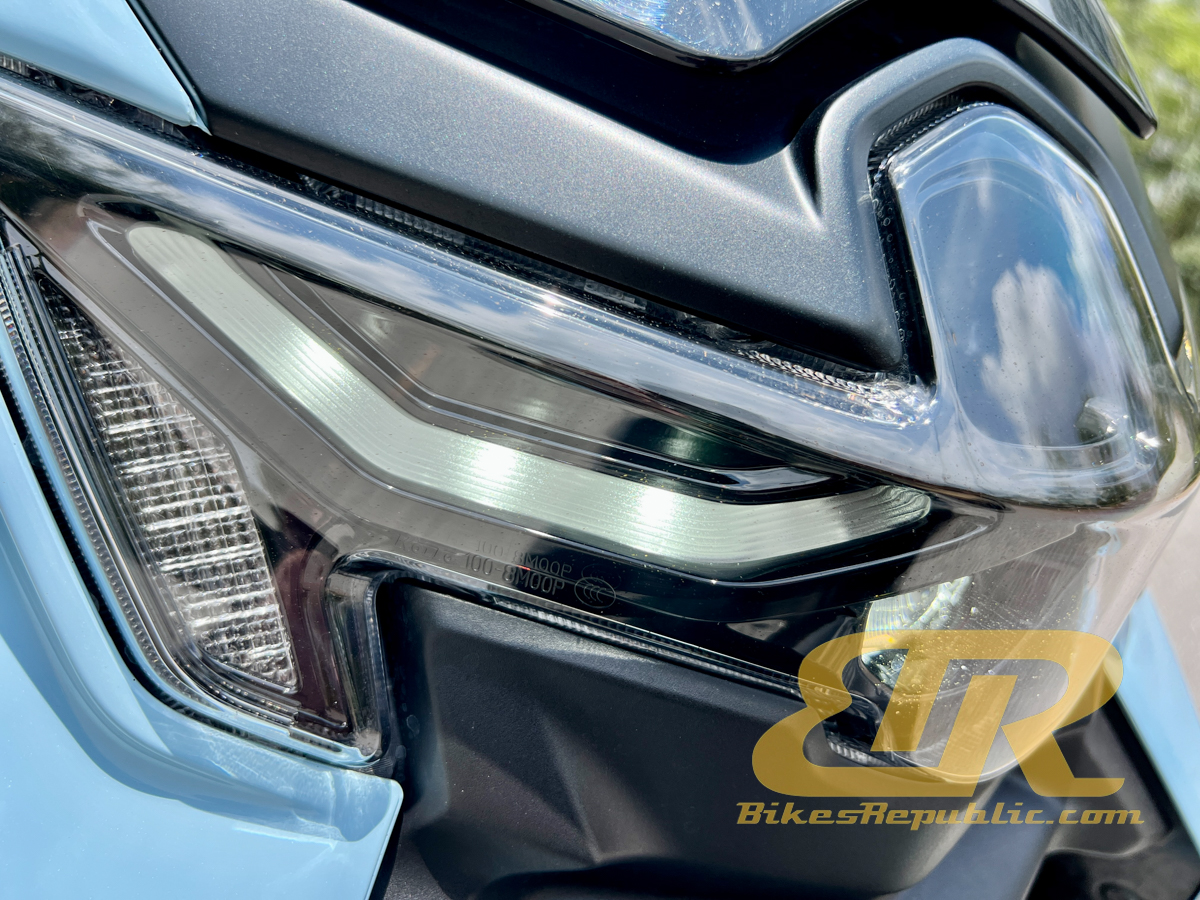
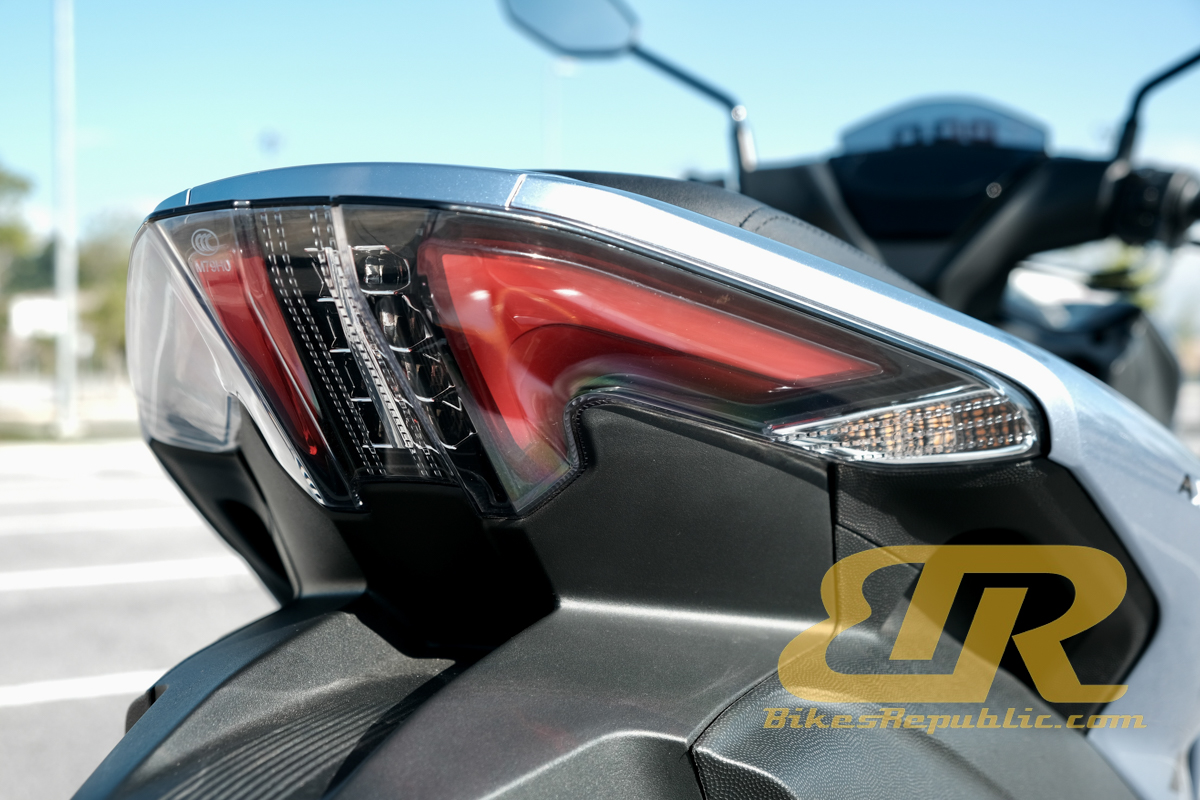
  • The 2025 model features a new headlight and tailight design over its predecessor. This new design makes the bike look sportier and more futuristic.
  • The Malaysian version is not the same as the Yamaha NMAX “Turbo” with the Yamaha Y-Shift feature, currently being sold in Malaysia.
  • Its engine remains as the Blue Core, liquid-cooled, 155cc, single-cylinder, SOHC, 4-valve with VVA (variable valve actuation) unit. It is the same engine found in the NVX and Y16ZR.

  • It produces 15.2 hp (11.3 kW) at 8,000 RPM and 14.2 Nm at 6,500 RPM.
  • Transmission is a CVT, with V-belt final drive.
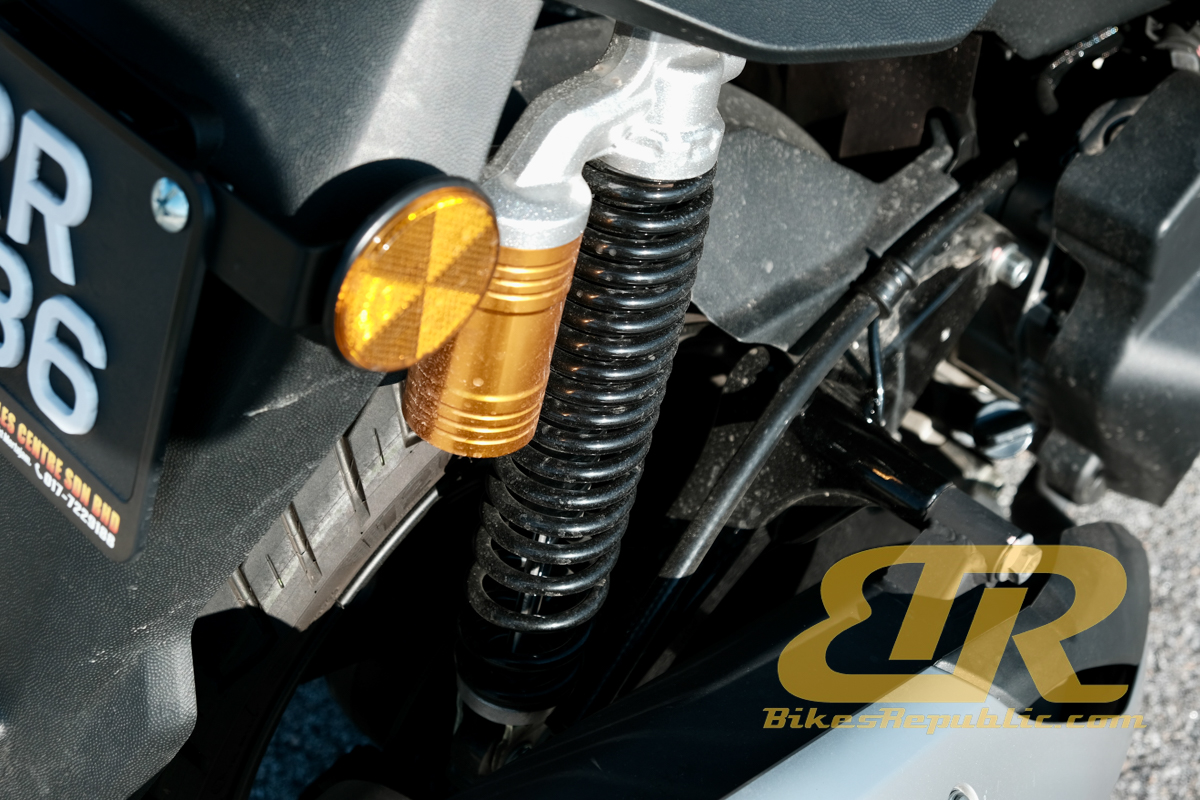
  • Over to the running gear, the front suspension consists of a pair of updated telescopic forks, while the rear is suspended by a pair of shock absorbers.
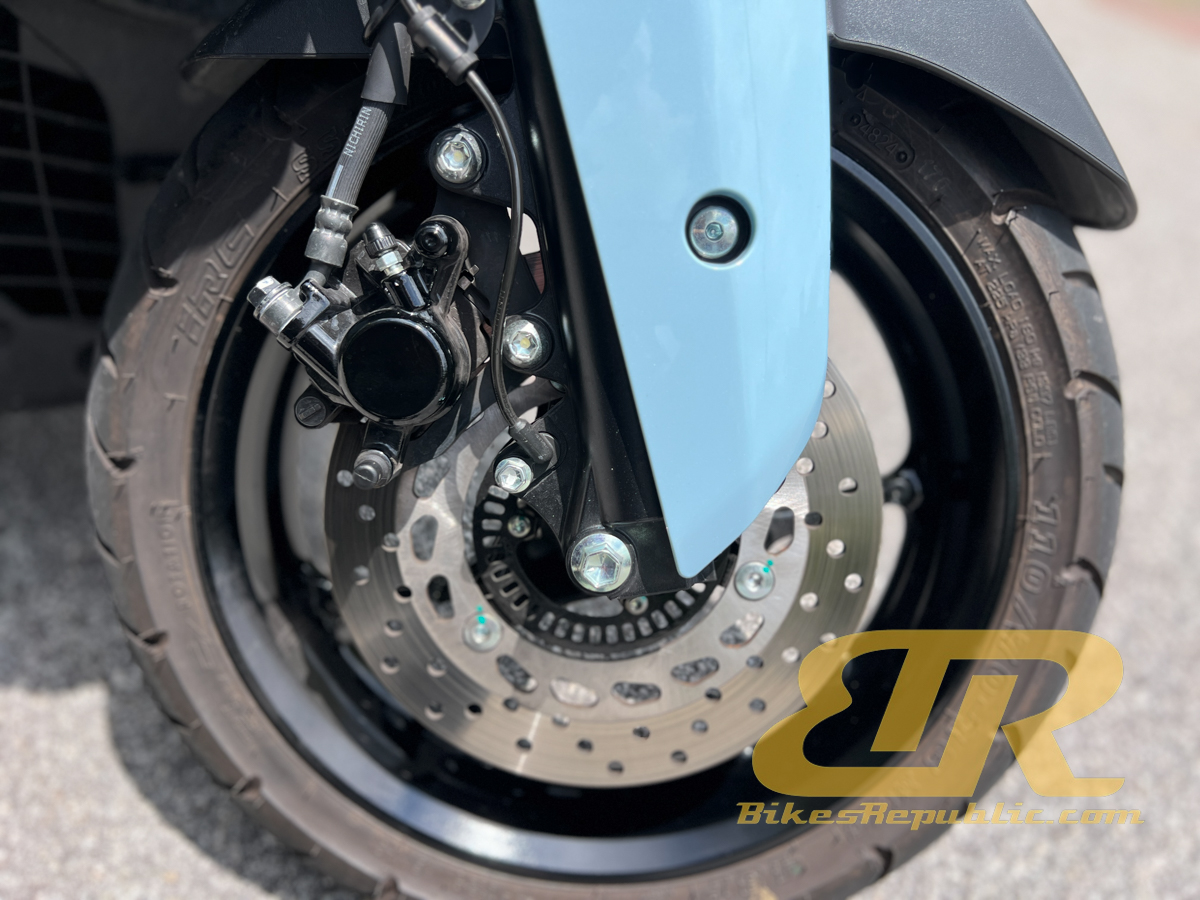
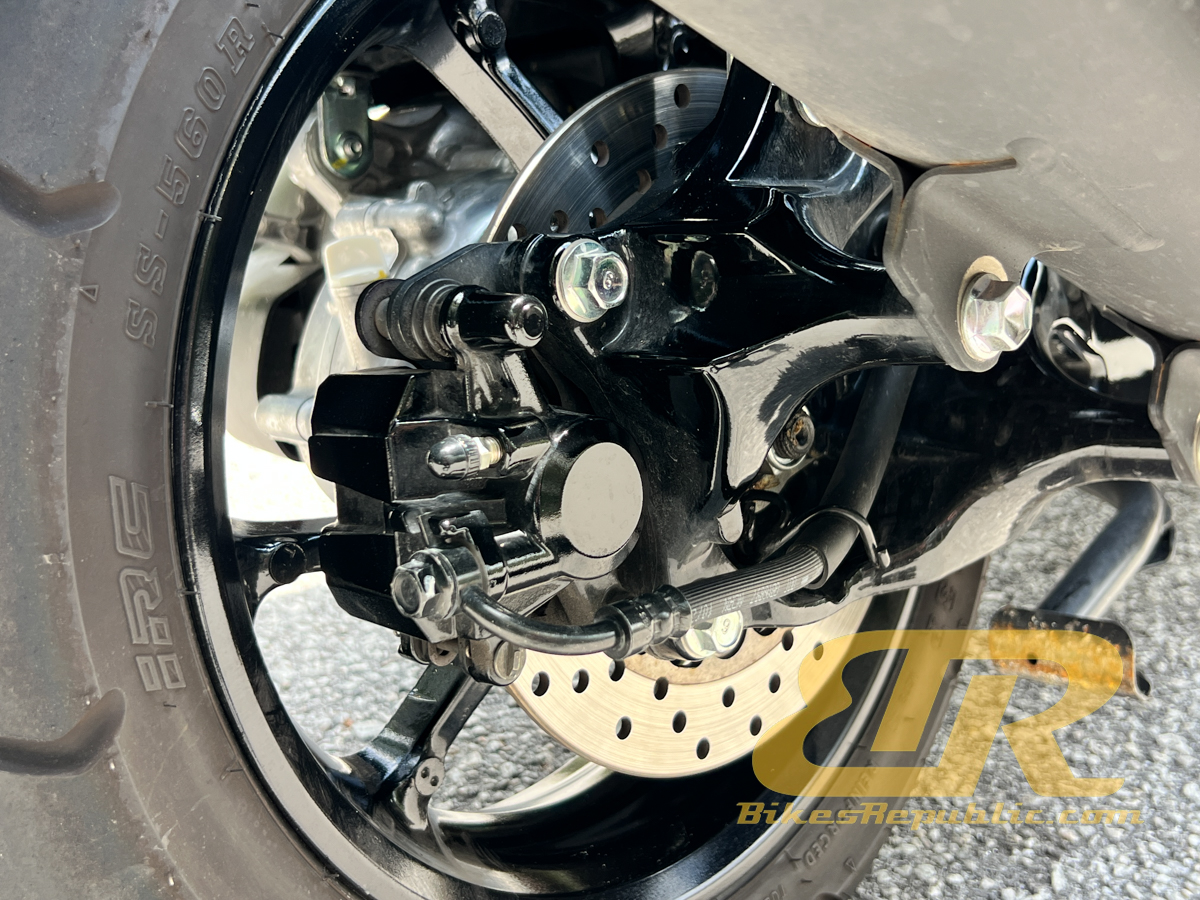
  • Braking duty is handled by single 230mm discs, front and behind.

  • Dual-channel ABS is a standard feature.
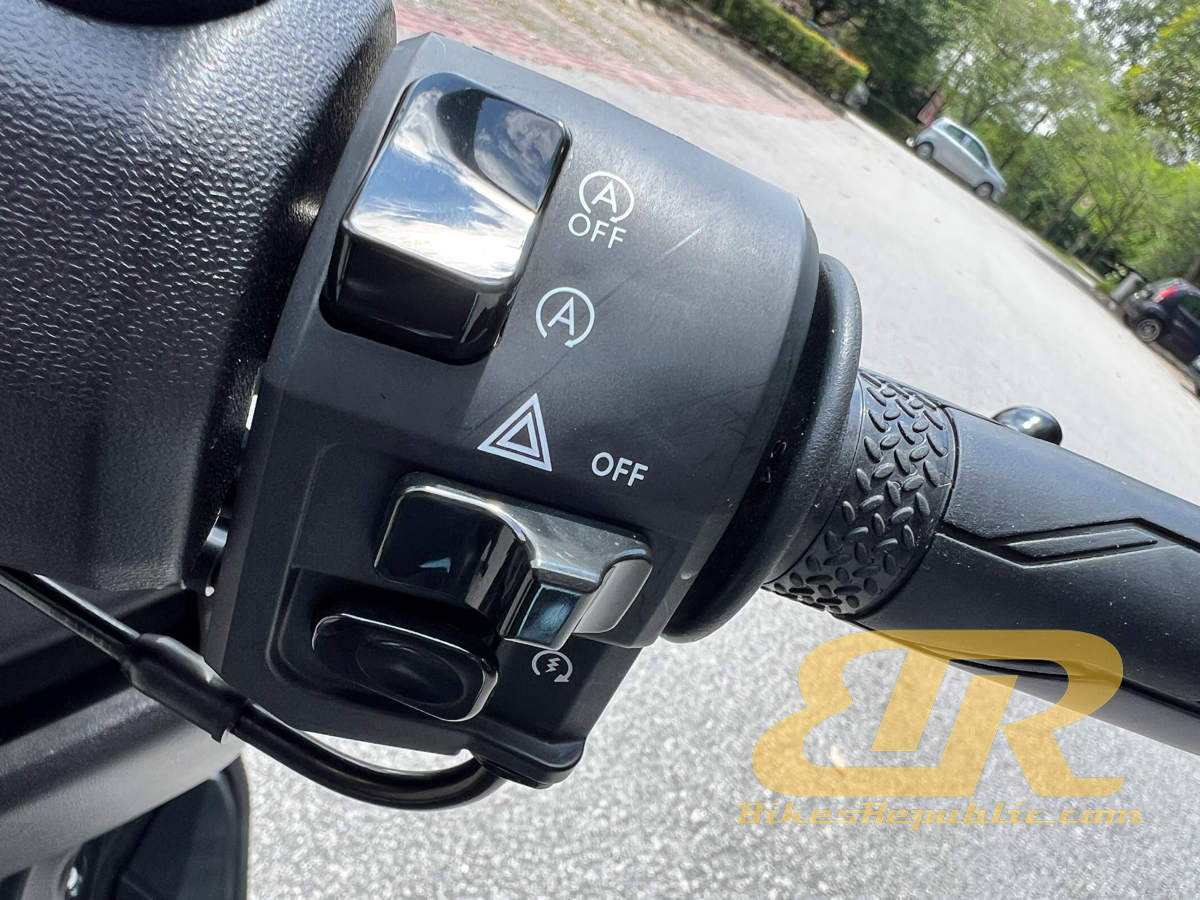
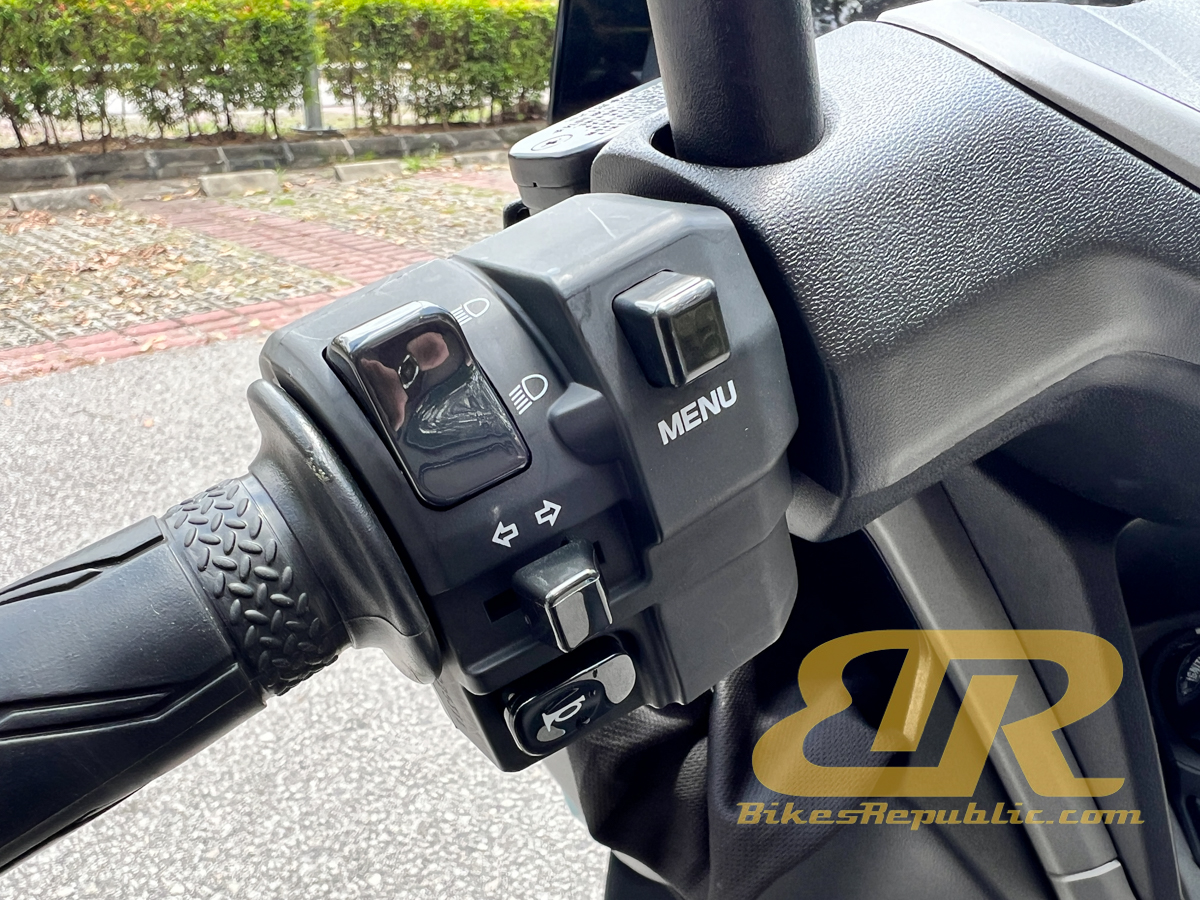
  • Electronic features include a single, large LCD screen with Y-Connect feature; keyless ignition, engine idle stop function, USB charging port, and LED lighting all-around.
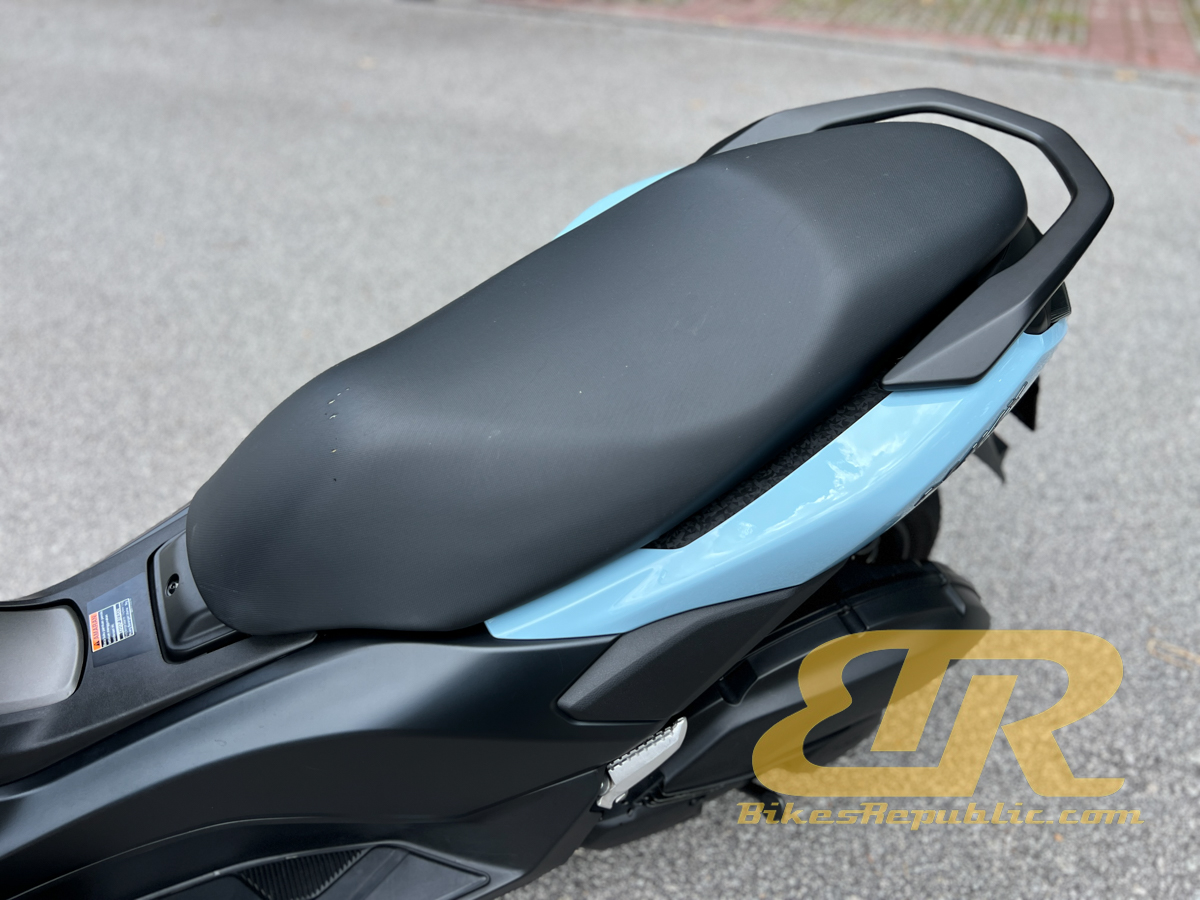
  • Nominal seat height is listed as 775mm.

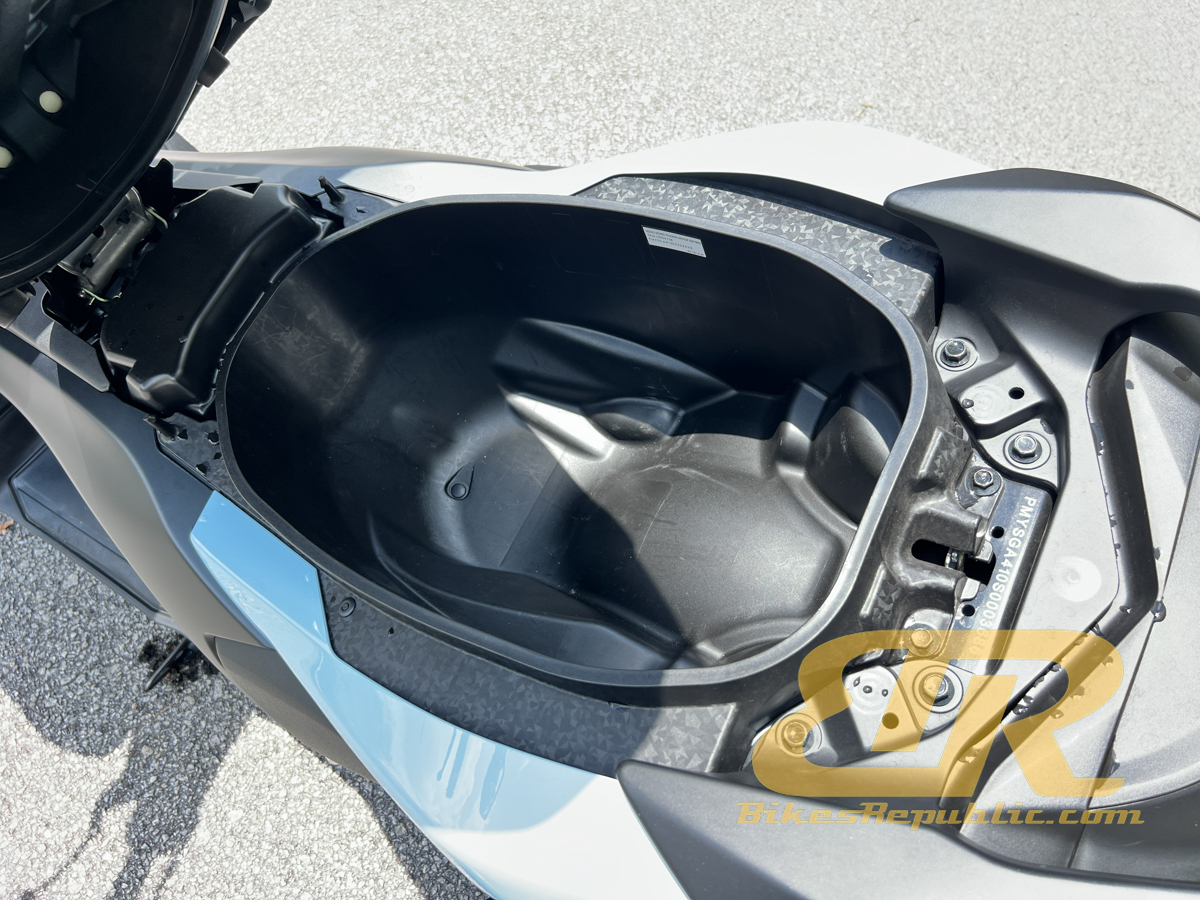
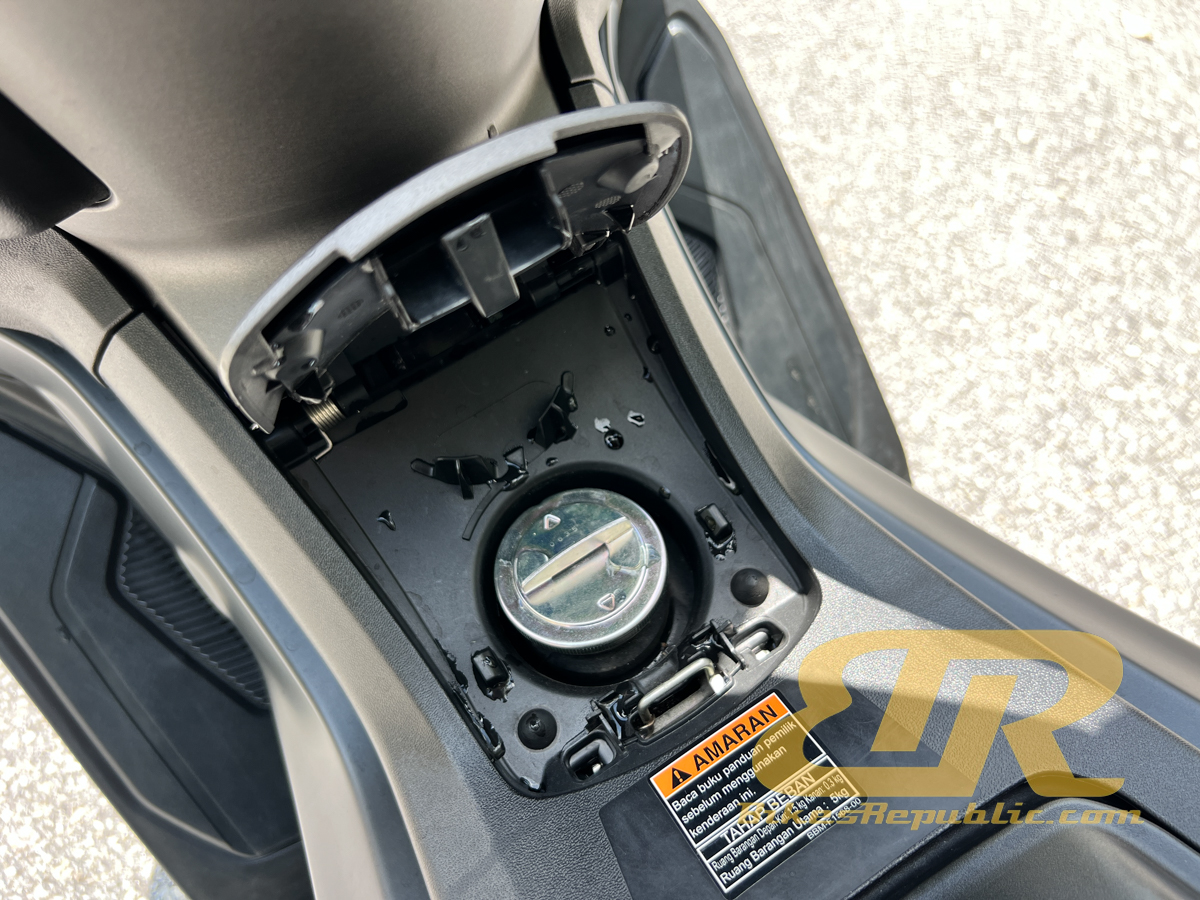
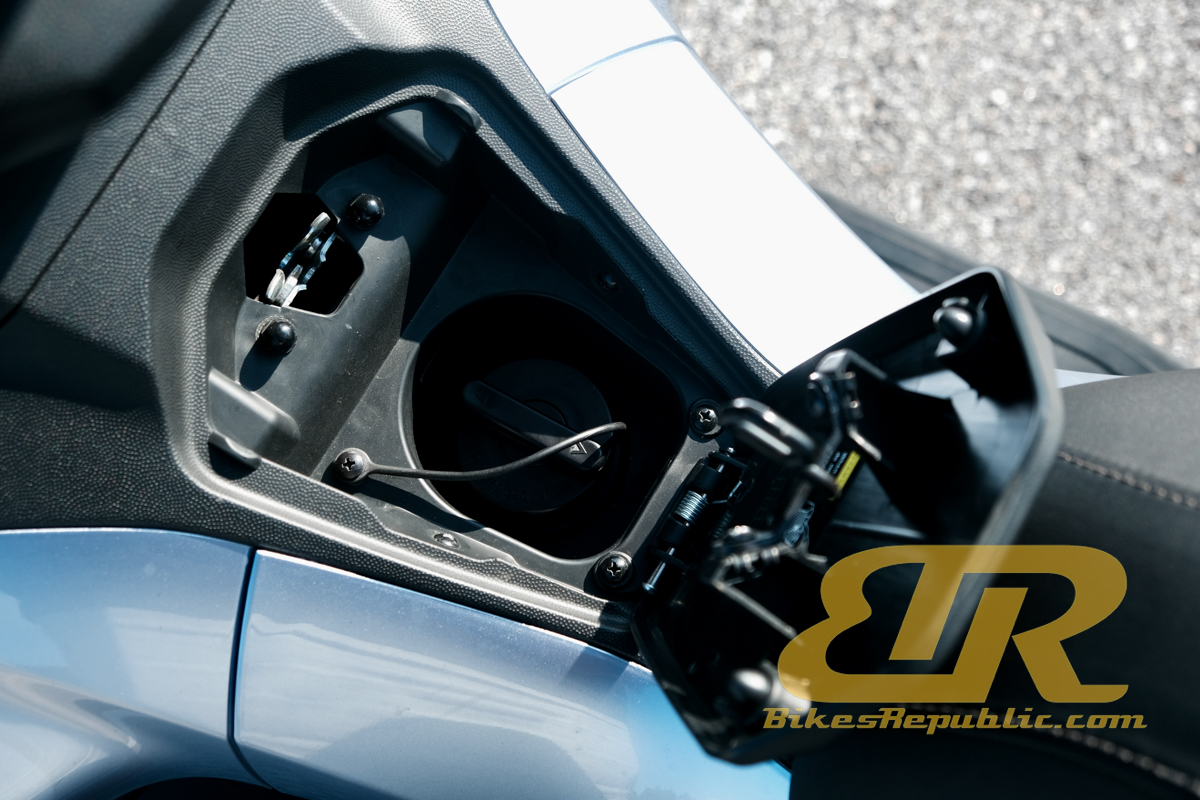
  • Bigger underseat storage, now at 25 litres.
  • The fuel tank has a capacity of 7.1 litres.
  • Yamaha claims that the bike has a wet weight of 131 kg.
Riding the 2025 Yamaha NMAX

Climbing on, we found it having the same ergonomics being the same as the previous iterations, with a narrow body and seat, short reach to the handlebar, and low seat height. Our feet rested comfortably on the floorboards on either sides, with more than enough space to move them around.

The seat cushion felt supple, although we could not remember if it was the same previously. There is enough space to move forward and back, besides good space for the pillion.

The handlebar was narrow with lots of steering lock angle, which was good for scything through traffic.

Opening up the seat reveals the larger underseat storage space which can take a backpack with a 15-inch laptop in it. However, the bag kind of ‘floats’ leaving more room underneath for a rainsuit and shoes. Unfortunately, we tried to store our jet-style open-faced helmet but to no avail. It may be able to stuff in an MS88-style helmet, though.

The engine started quickly each time, while eliciting a note that was characteristic of any single-cylinder scooter. It also revved relatively fast, but without any rough sounds.

Opening the throttle had the scooter accelerating smoothly without a hard punch like the NVX. In fact, the engine and CVT combination delivered a very linear response throughout its rev range. Closing the throttle abruptly did not have the bike slowing abruptly or on the other end of the spectrum, freewheeling forward as if you mistakenly grabbed neutral on a bike with manual transmission. This showed that Yamaha did a great job of balancing the roller weights to the engine’s torque characteristics.

With that mentioned, the engine did deliver plenty of oomph when pushed at highway speeds. It pulled and pulled (albeit smoothly) all the way to its top speed of nearly 130 km/h without feeling as if it will explode. Similarly, opening the throttle from 80 km/h saw it accelerate briskly without running out of breath – courtesy of VVA.

Small scooters such as this are blighted by short suspension travel. It is not unique to the NMAX but a given for any such scooter. As such, the rear suspension felt hard when hitting sharp bumps, but the front felt so much better now. Yamaha said that they had revised its damping rates thus it did not feel clunky or overly harsh when hitting bumps and potholes. The update also gave a lot better feel of the front tyre and what it was doing, thereby elevating our confidence in corners. Its front end was also stable without wagging back and forth in corners like it used to. Nice!

Of course, the bike is not meant to be pushed to 10/10 of its limits, what with the small-diametre tyres. Doing so is not the point of having this bike. Instead, it is meant for easy riding with the extra kick for overtaking other vehicles.

Depending on your skill level, those stock tyres provided plenty of grip both in the dry and rain. We had no qualms about hooning the bike through damp corners, what more when it was sunny.

Riding through traffic was where the NMAX truly excelled. Its dimunitive size and steering angle worked together to see off traffic and tight spaces like they did not exist, hence proving that it is a lot more fun to ride a small bike in the city.

Hong Leong Yamaha Motor loaned us the 2025 Yamaha NMAX for 7 days and we loved every moment we rode it. We commuted to work on it, we ran errands on it, we sent our children to school on it. Hey, forgot to buy something from the supermarket? Just wheel the bike out and go.
And as a plus point, we did not manage to burn through even one tank of gas despite racking on the mileage, and turning the idle stop function OFF throughout our test.

One thing we need to mention is about the bike’s build quality, which was good, as usual. There was no misaligned panels or wayward wires and cables hanging about anywhere. The headlight was also quite bright for a motorcycle of this size.

Conclusion

It was great to see that the 2025 Yamaha NMAX carries on the tradition of the first NMAX by providing an easy-riding and convenient platform, while retaining its comforts and conveniences.

Of note is the jump of RM1,700 in its recommended selling price from RM9,798 to RM11,498. This is due to inclusion of ABS, but hey, it is dual-channel which services both wheels.

Still, although costing much more than most scooters of its class these days, the 2025 Yamaha NMAX represents good value. You get an established engine, with plenty of original, OEM, and aftermarket parts support for a complete peace of mind.

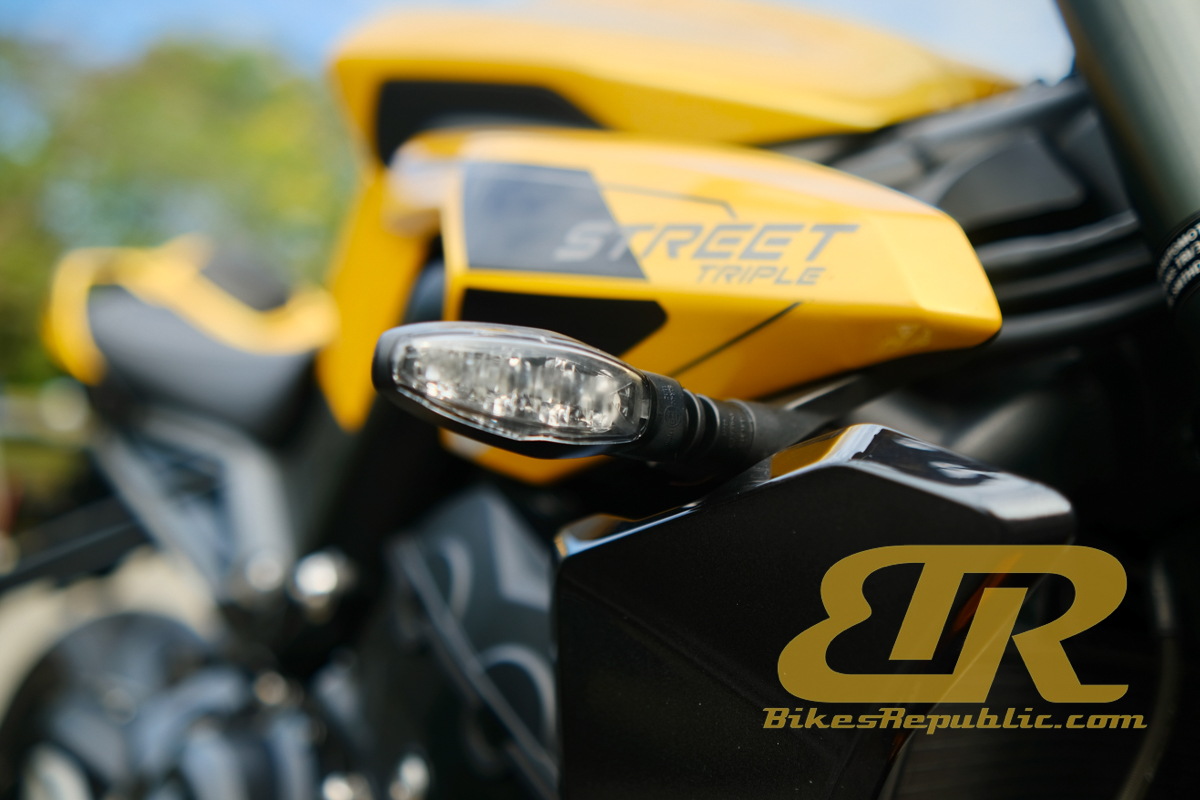
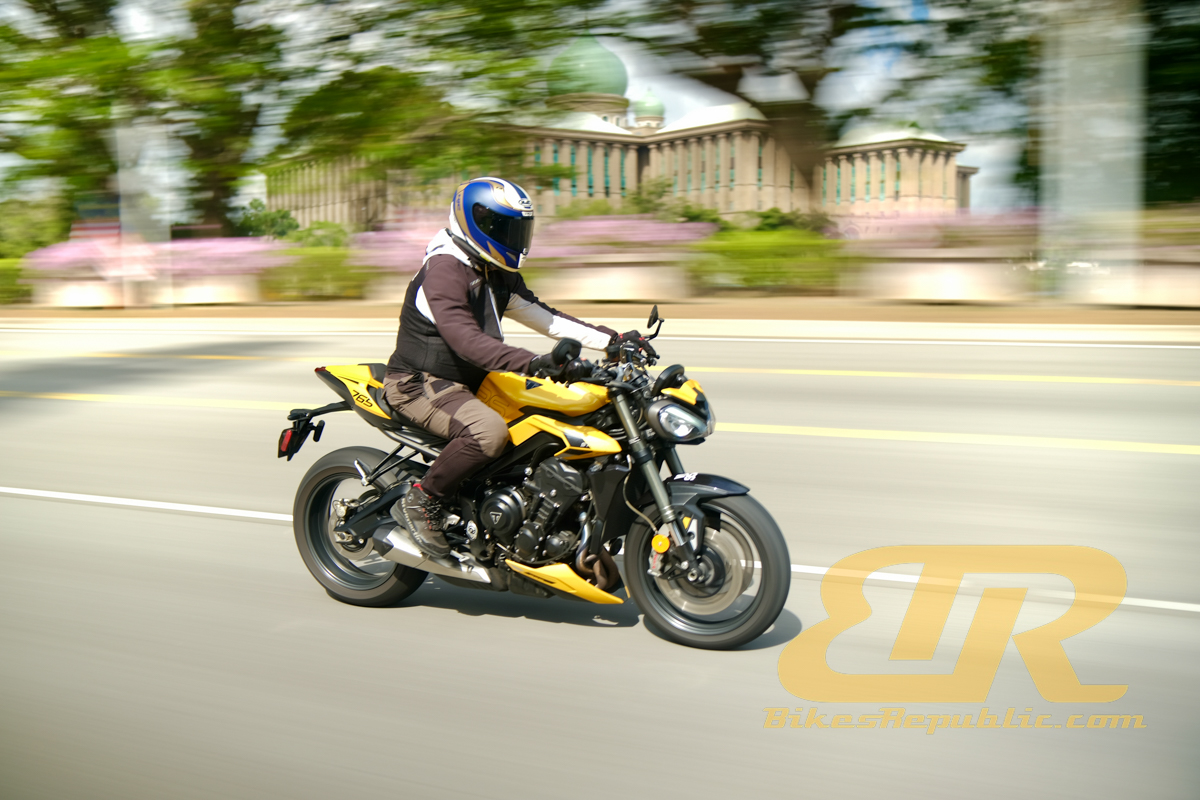
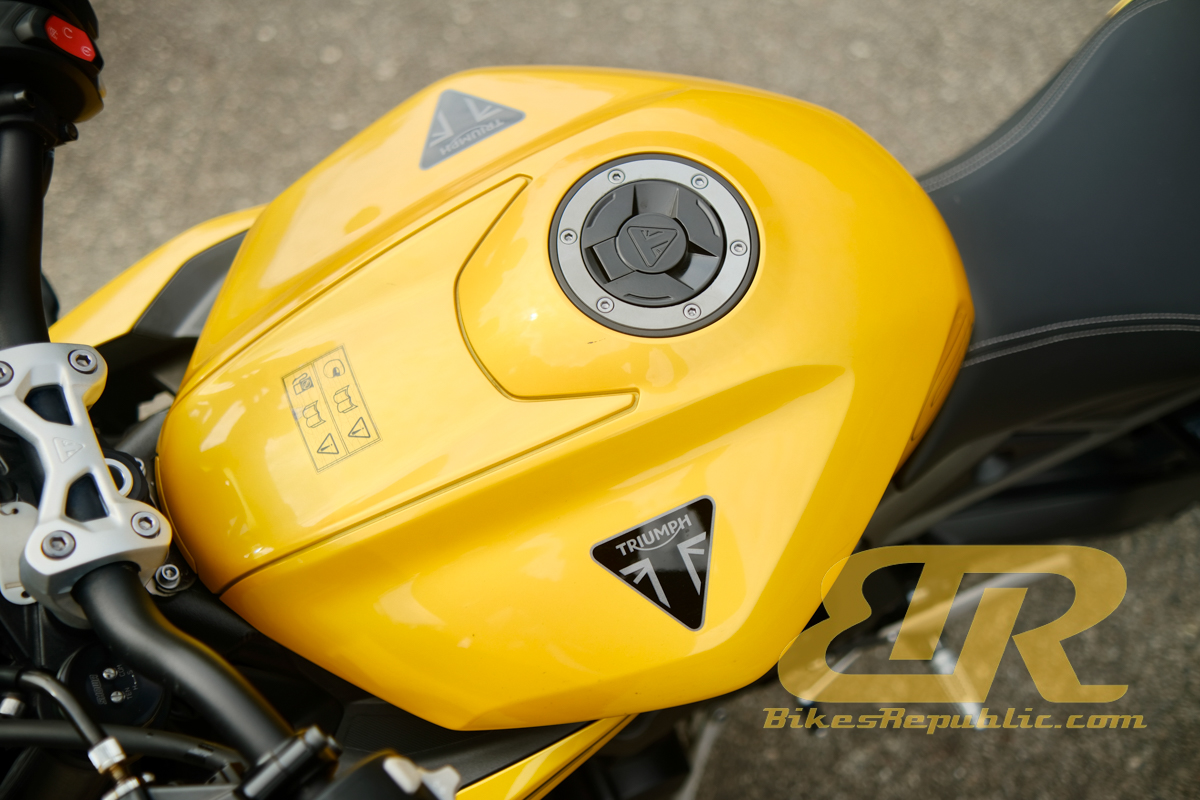
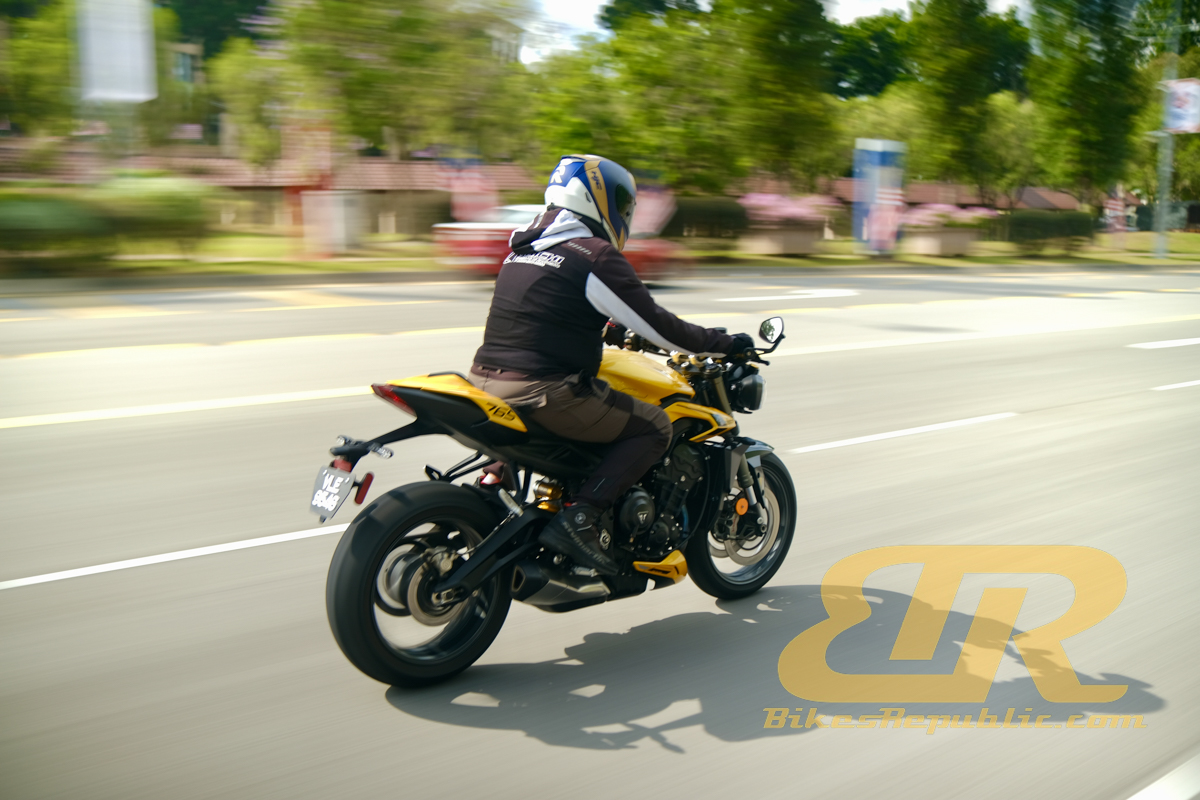
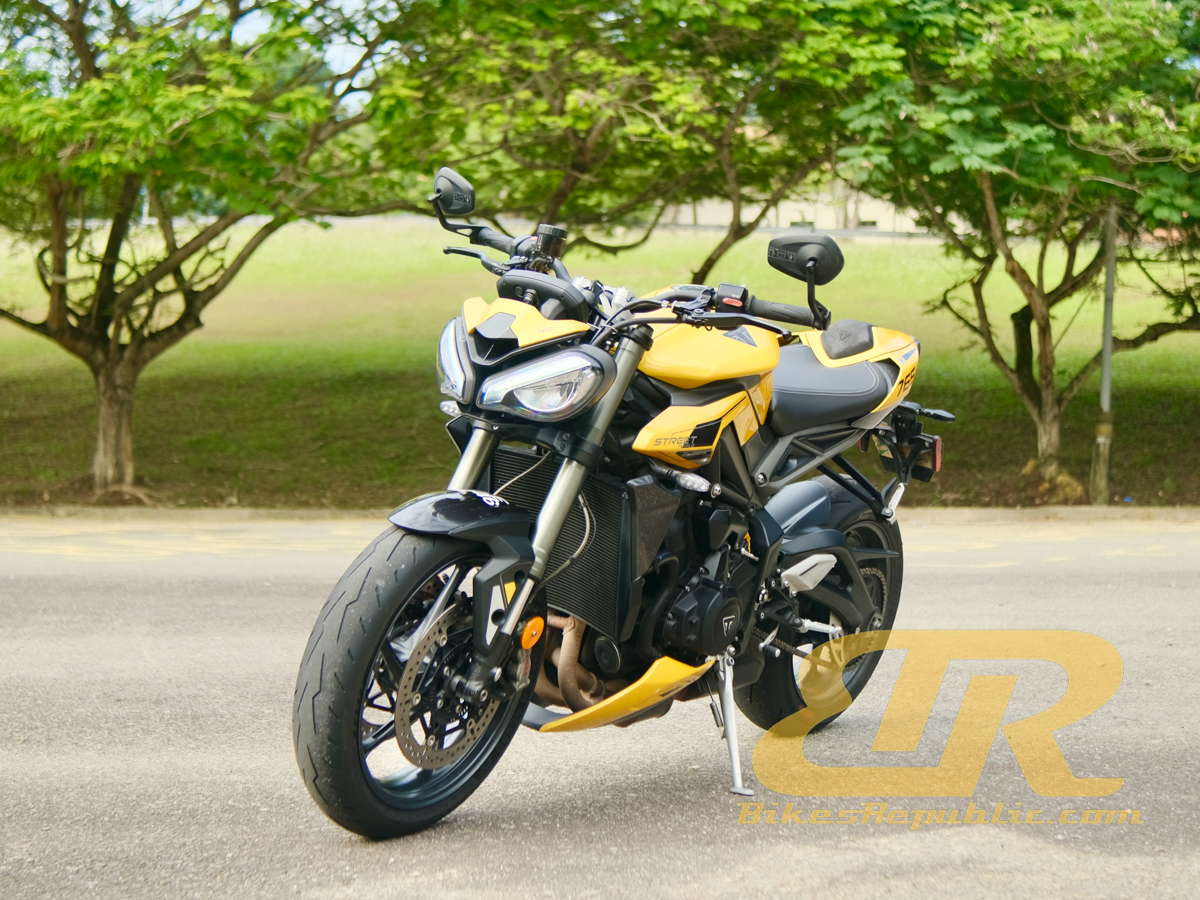
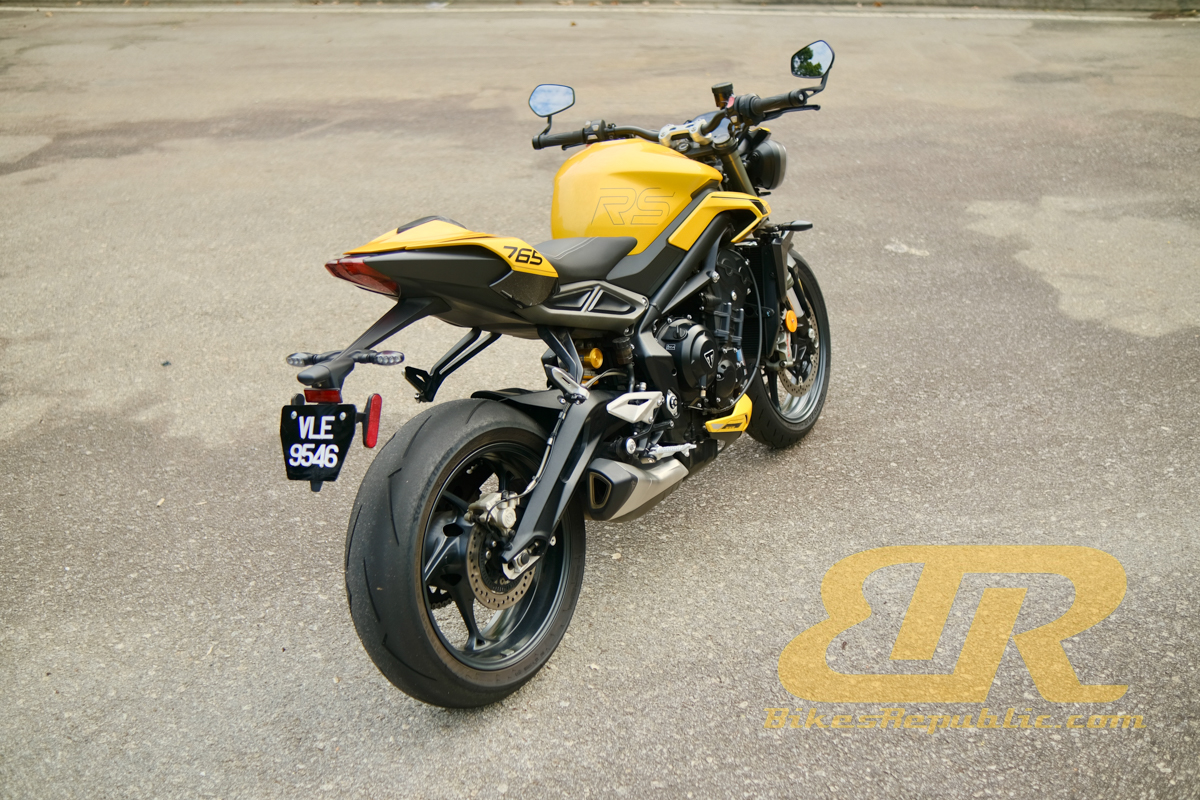
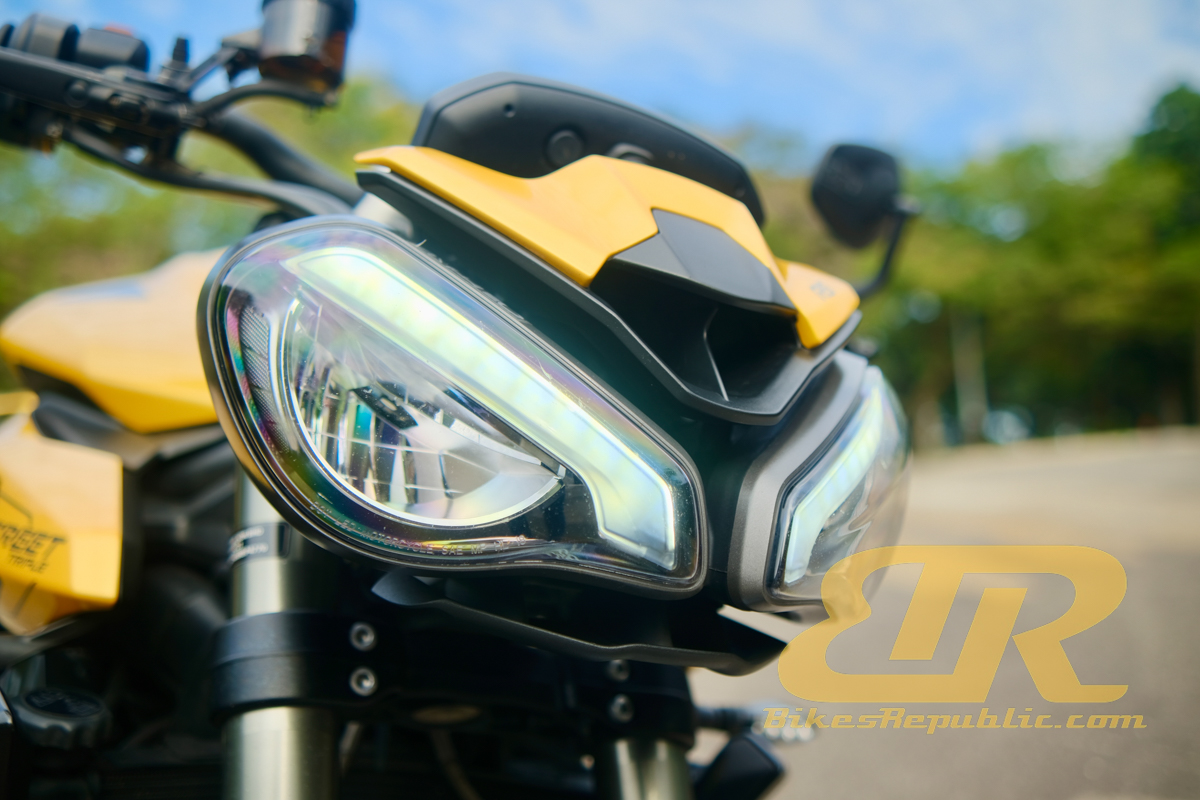
Eyeing the Triumph Street Triple 765 RS after riding it up and down “The Mountain” several times in just a day had us thinking of an allegory befitting its character.

Perhaps, we need to look outside the motorcycling box this time.

The greatest heavyweight boxer – ever – the late-Muhammad Ali had amazing skills in the ring and plenty of charisma to match, both inside and outside the ring. Not one to shun the spotlight, Ali was prolific in using the media to trash talk his opponents, and mess them up mentally before a fight. (Valentino Rossi also did this to his rivals.) It was only fitting that he had some memorable quotes but perhaps the most famous was, “Float like a butterfly, sting like a bee.” He meant that he danced around his opponents while hitting making them eat his punches they never saw coming.

What is the Triumph Street Triple 765 RS?

The Street Triple family had an interesting start.

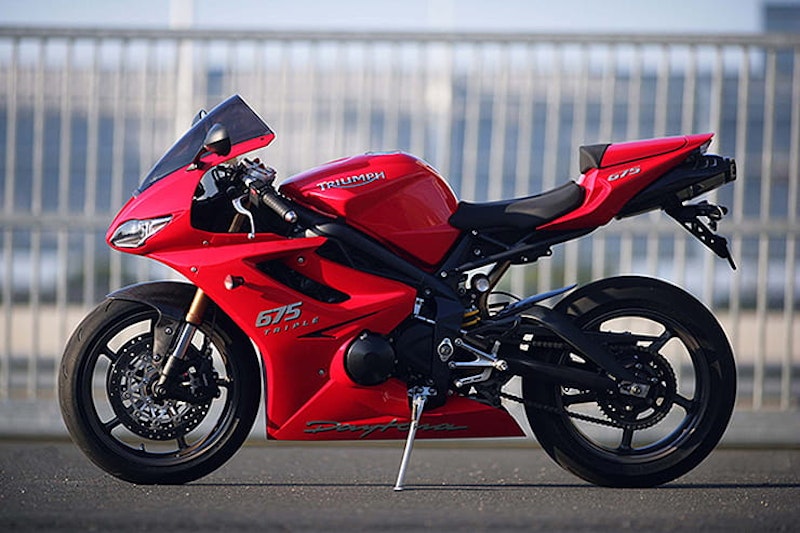
Triumph had released the Daytona 765 fully-faired sportbike in 2006 to global acclaim for its nimbleness and stonking triple-cylinder engine performance.

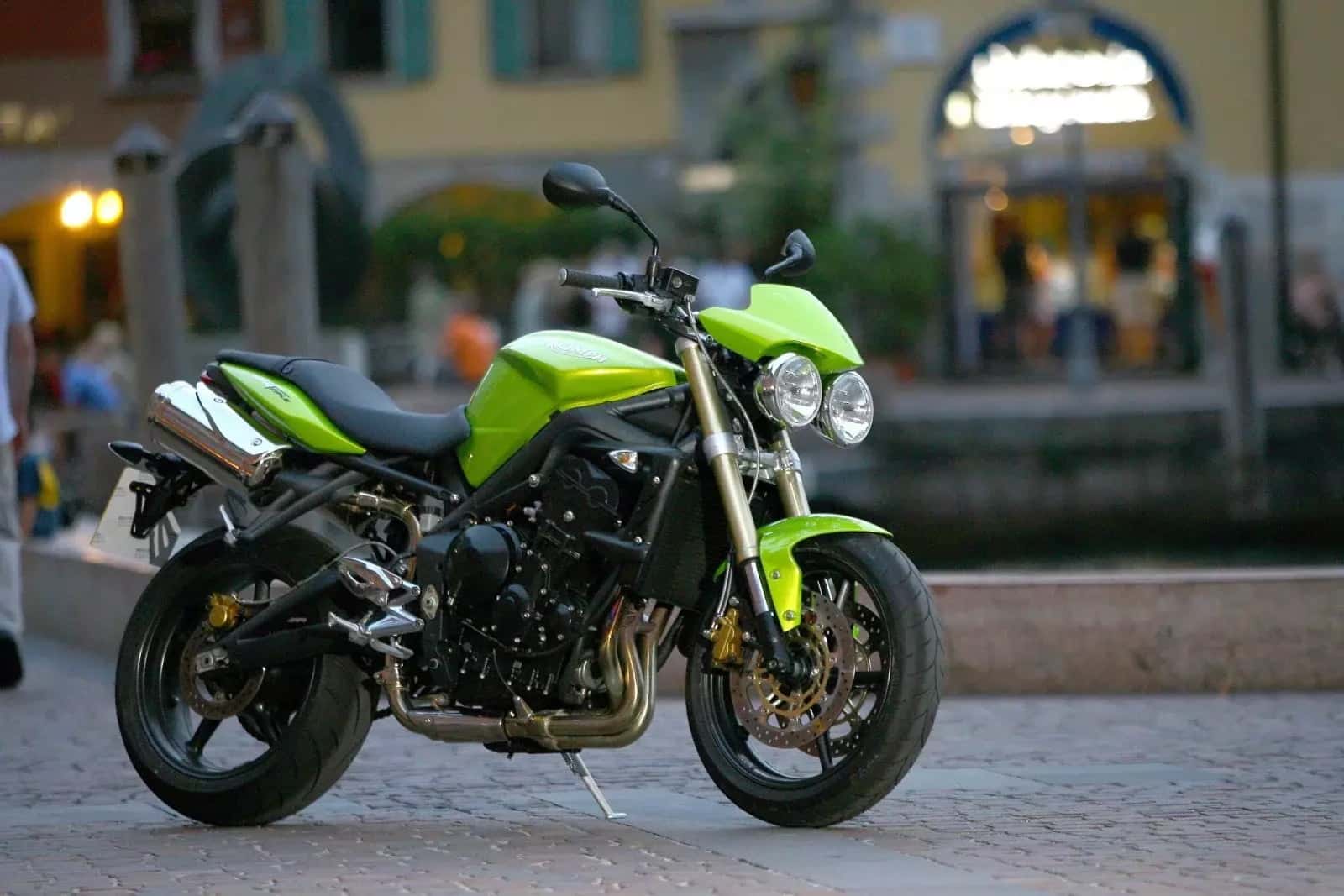
Knowing that an out-and-out sportbike may not be everyone’s cup of Earl Grey, and judging by the bigger Speed Triple’s good sales, Triumph retuned the Daytona’s 675cc engine for more tractable torque, and mounted it to a naked bike. Hence, the Street Triple was born in 2007.

On the styling front, the Street Triple was endowed with the streetfighter style of the Speed Triple, which garnered either love or hate, until this very day.

Hence the first Street Triple found a great following from the outset for its handling and “street savvy” power delivery. This DNA was then infused into all subsequent Street Triples throughout its evolution to this very bike we tested here.


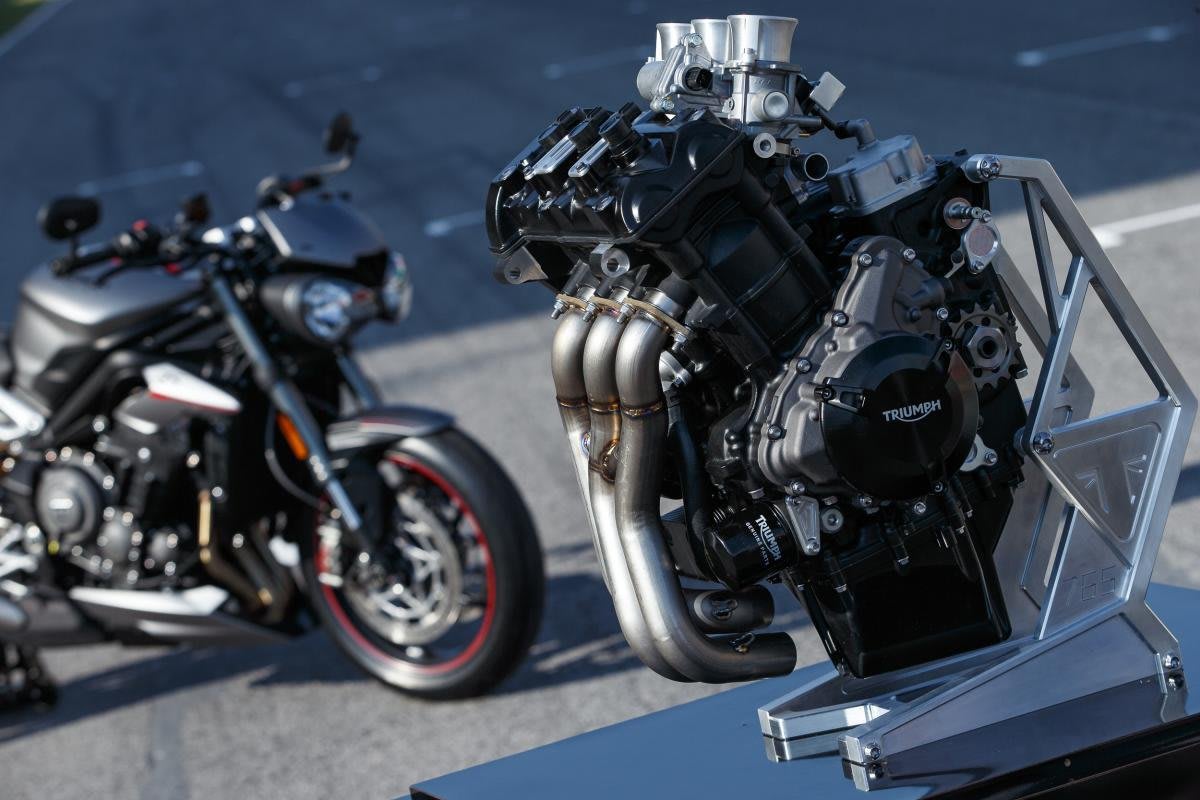
Throughout the years, the 675cc engine grew to 765cc, and in 2019, Dorna adopted the new engine for the Moto2 class, replacing the Honda 600cc inline-four engine. It resulted in the Moto2 class seeing an immediate improvement with shattered lap times and set new top speed records exceeding 300 km/h. There were also more overtaking now since riders were able to utilize the triple’s wider torque spread compared to the previous engine’s narrow and peaky powerband: Riders can reaccelerate faster since the 765cc engine has more torque after going off the racing line to overtake, compared to bogging down previously which discouraged overtaking.

All these developments led directly to the current Triumph Street Triple 765 RS.

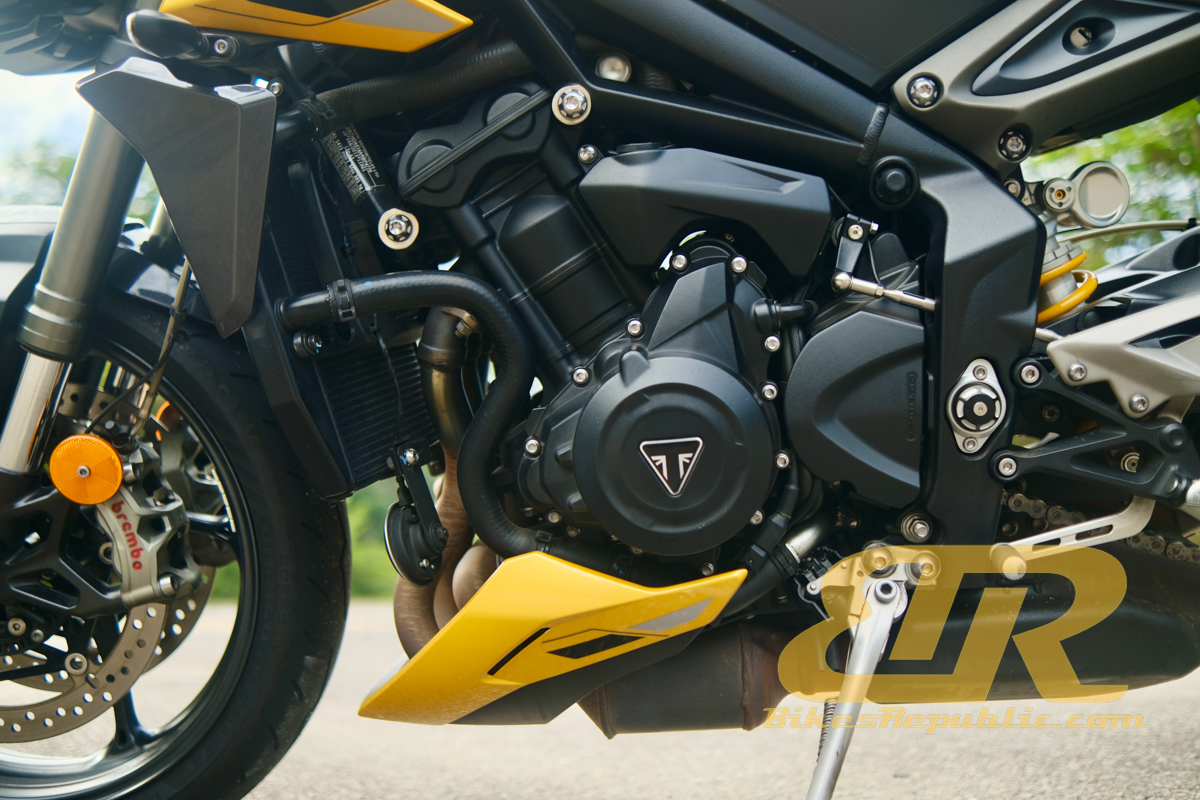
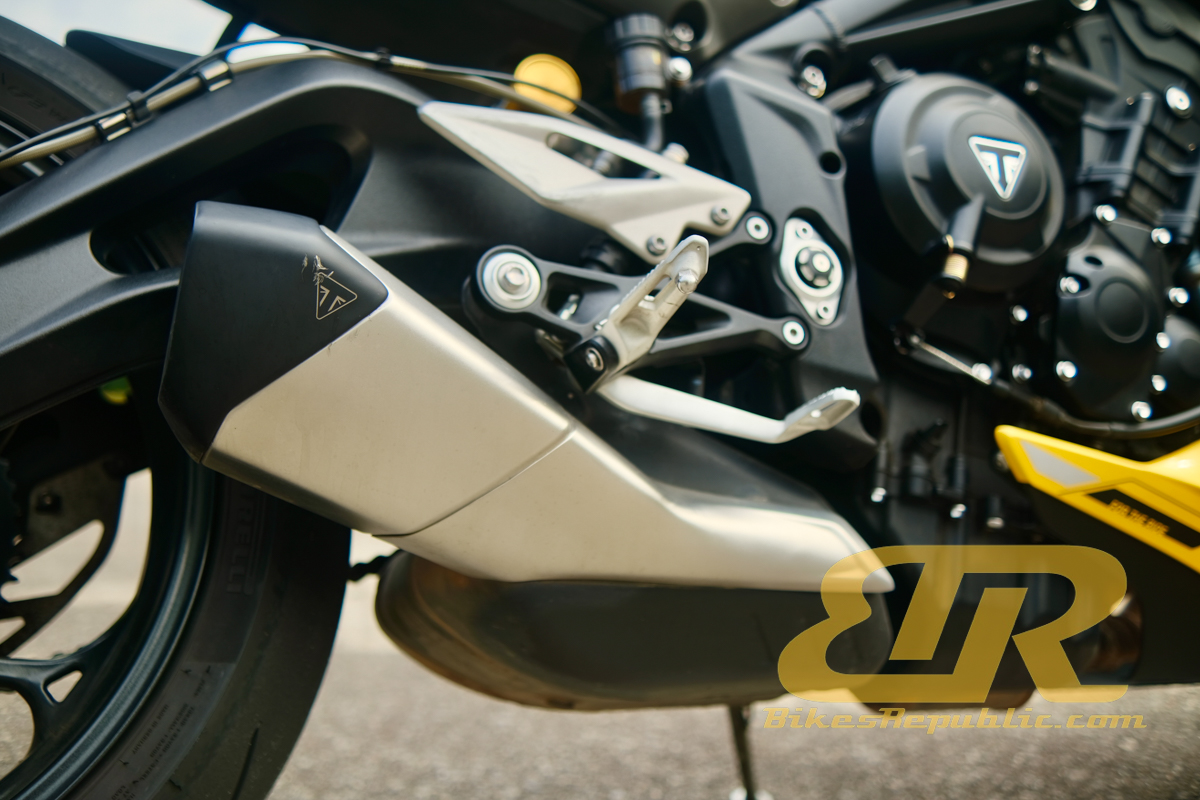
The current engine had been improved with new parts and tuning learned from Moto2 racing, along with a freer-flowing new exhaust. The handlebar has also been moved closer to the rider to provide a slightly more upright riding position.

Highlights

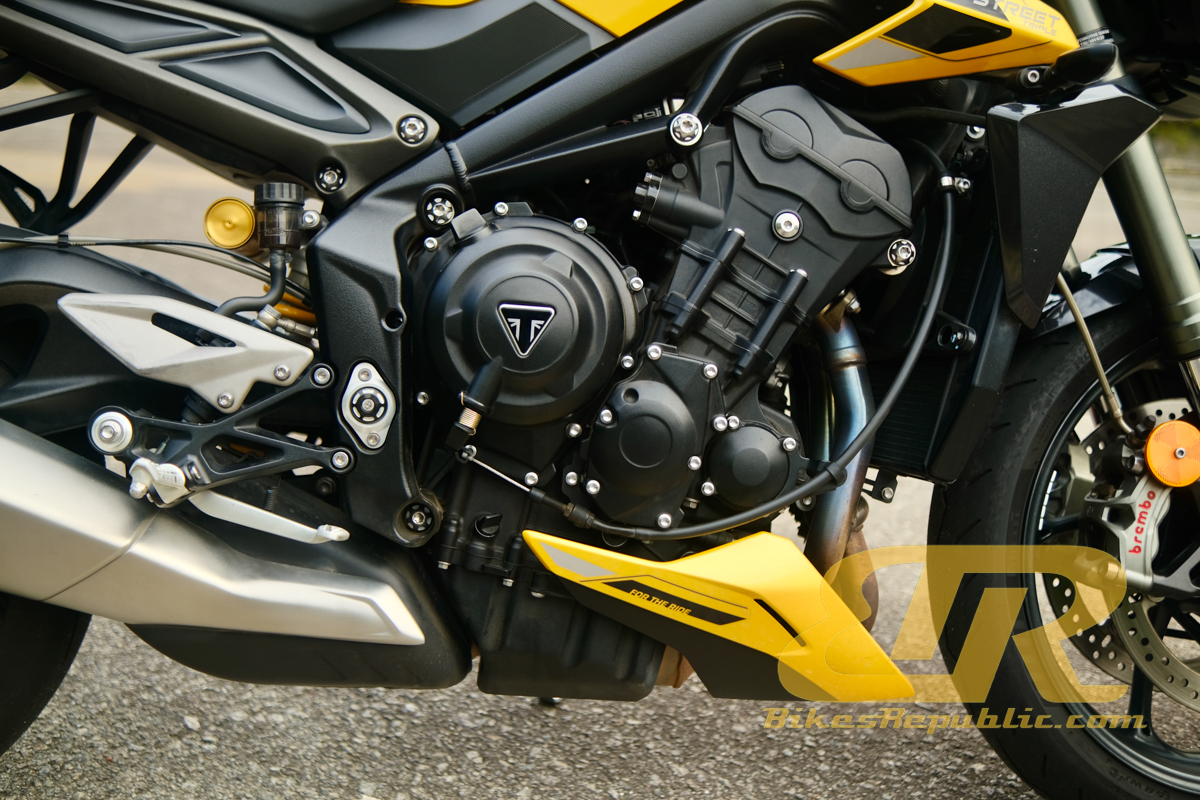
  • 765cc, three-cylinder, DOHC, 12-valve, liquid-cooled engine.
  • The engine produces 128.2 hp (95.6 kW) at 12,000 RPM and 80.0 Nm of torque at 9,500 RPM.
  • Engine power is transmitted through a slip and assist clutch, on its way to the 6-speed gearbox.

  • Triumph Shift Assist (quickshifter) is a standard feature.
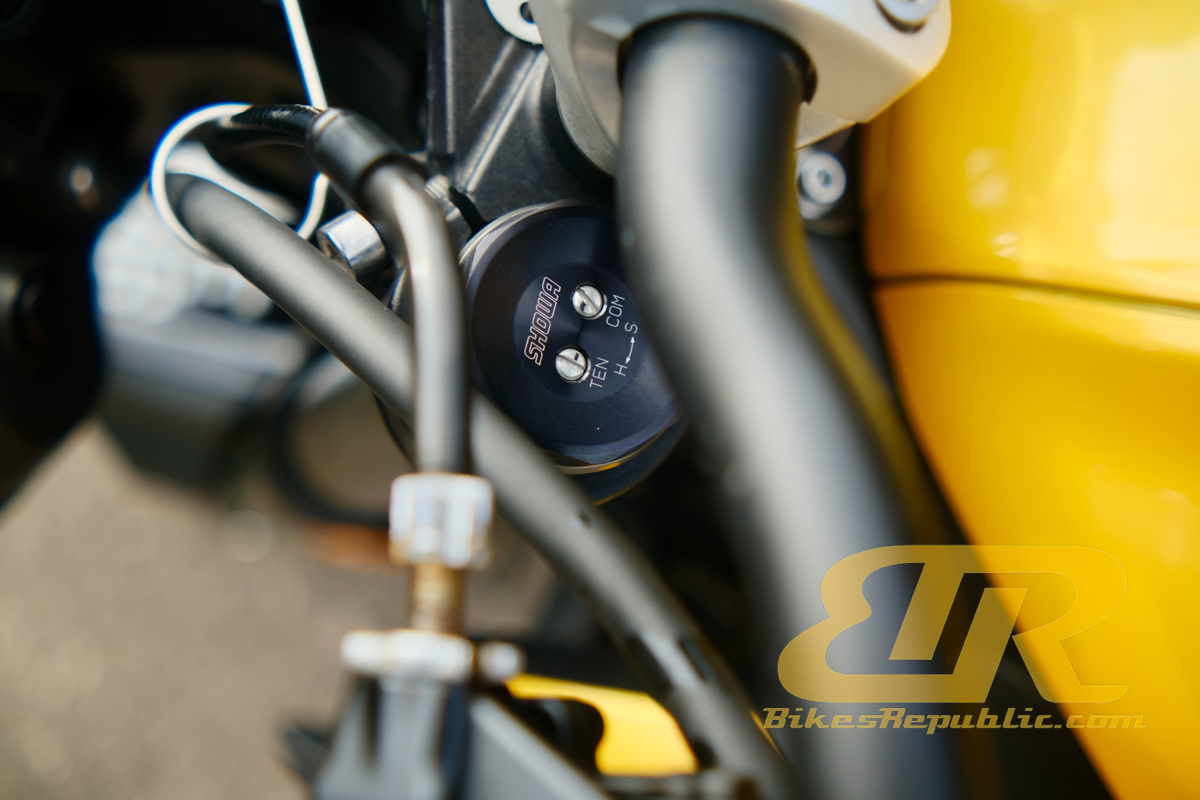
  • The front suspension consists of a pair of fully adjustable, upside-down Showa Big Piston forks.
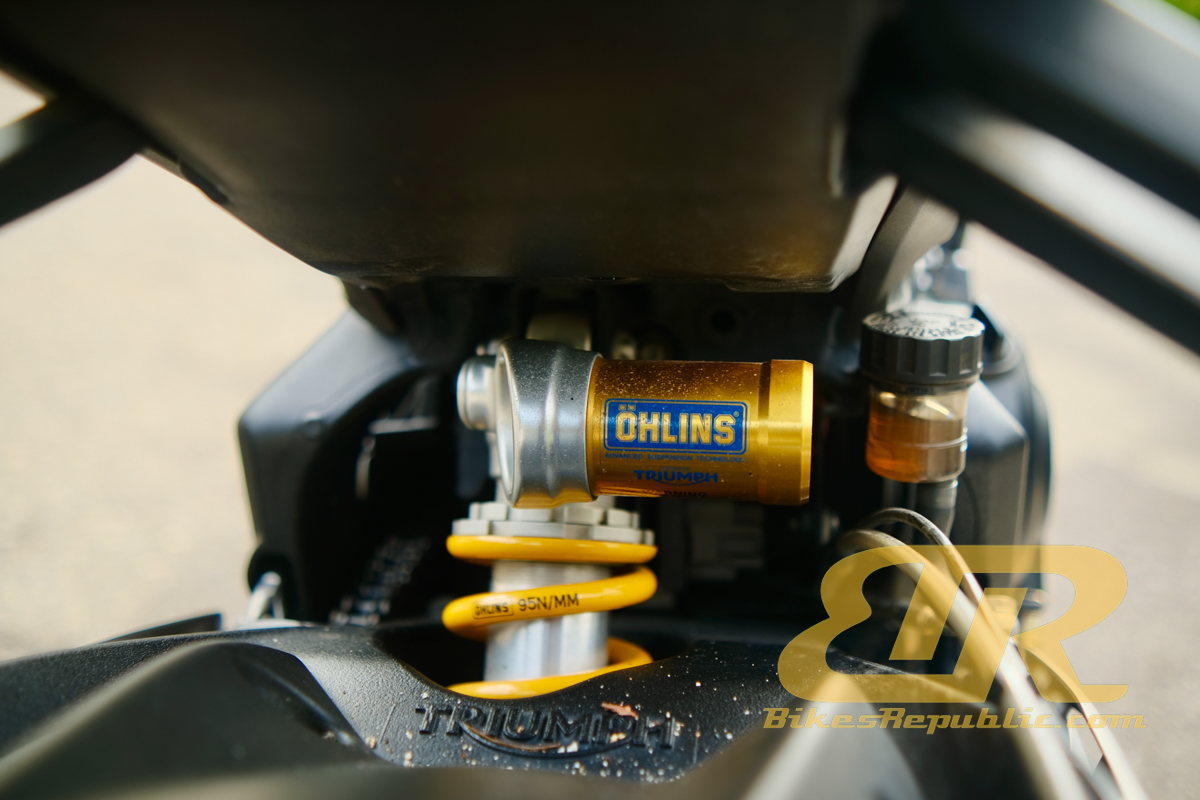
  • Rear suspension duty is handled by a fully adjustable Öhlins STX40 monoshock with piggyback reservoir.

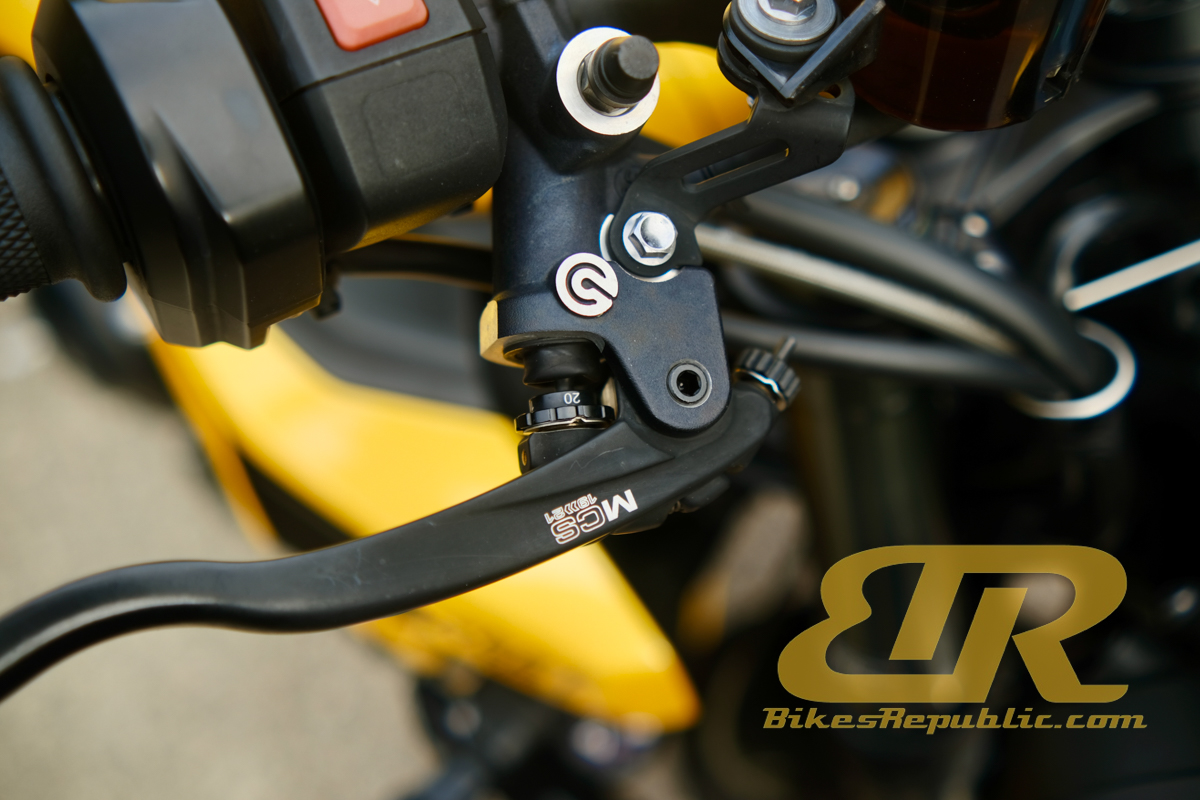
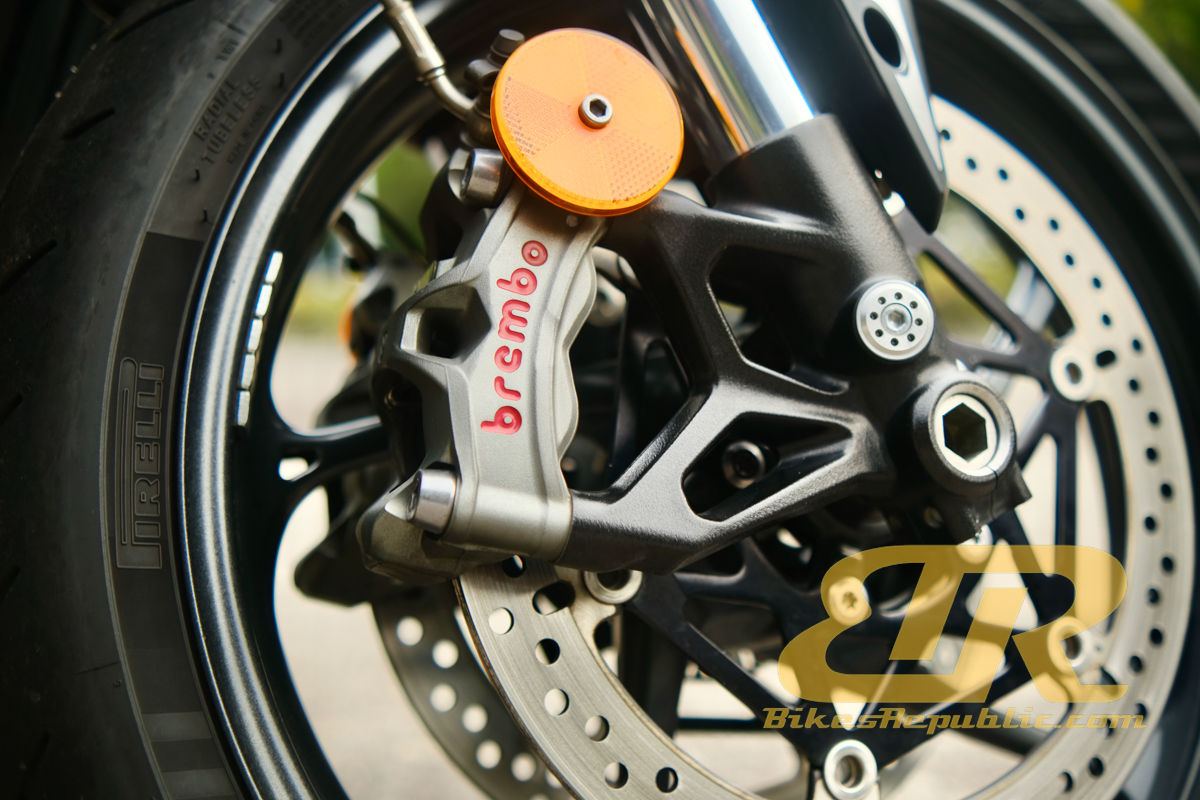
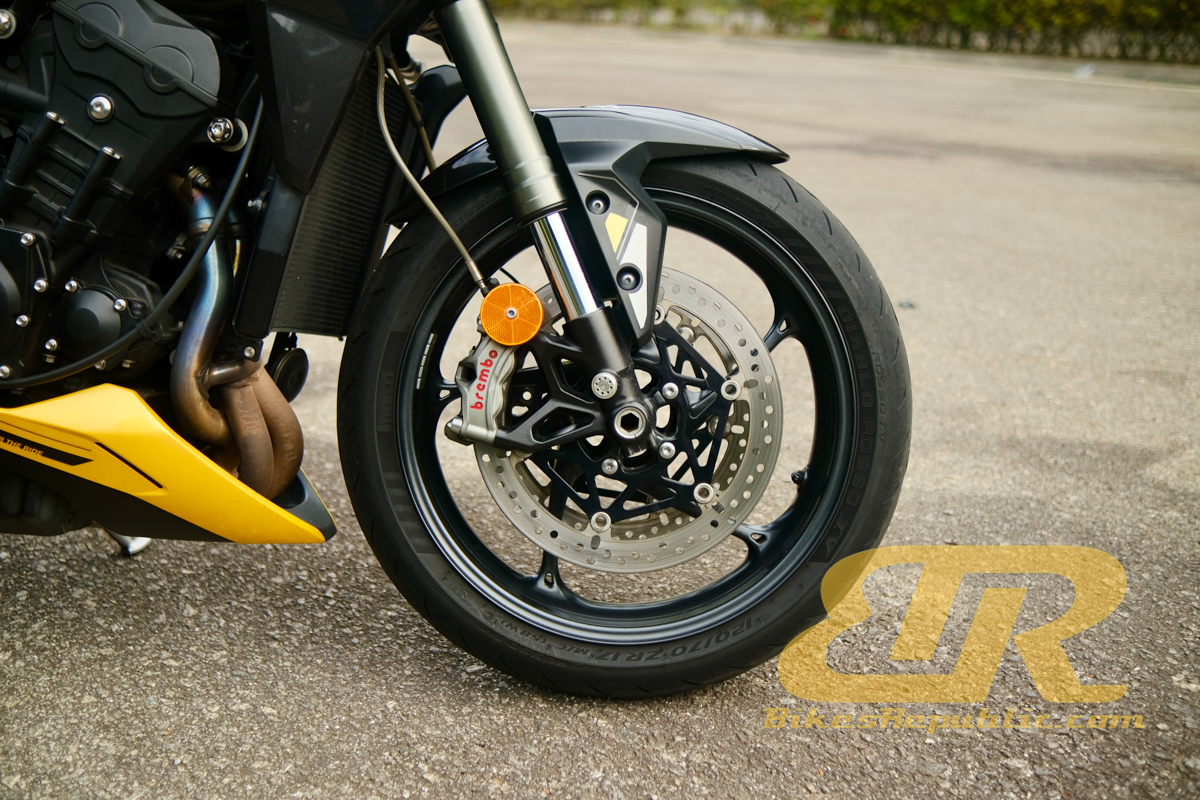
  • Up front, a pair of Brembo Stylema 4-piston calipers grip on 310mm Brembo discs, along with a Brembo MCS radial master cylinder.
  • Out back, there is a single 220mm brake disc, serviced by a Brembo single-piston brake caliper.
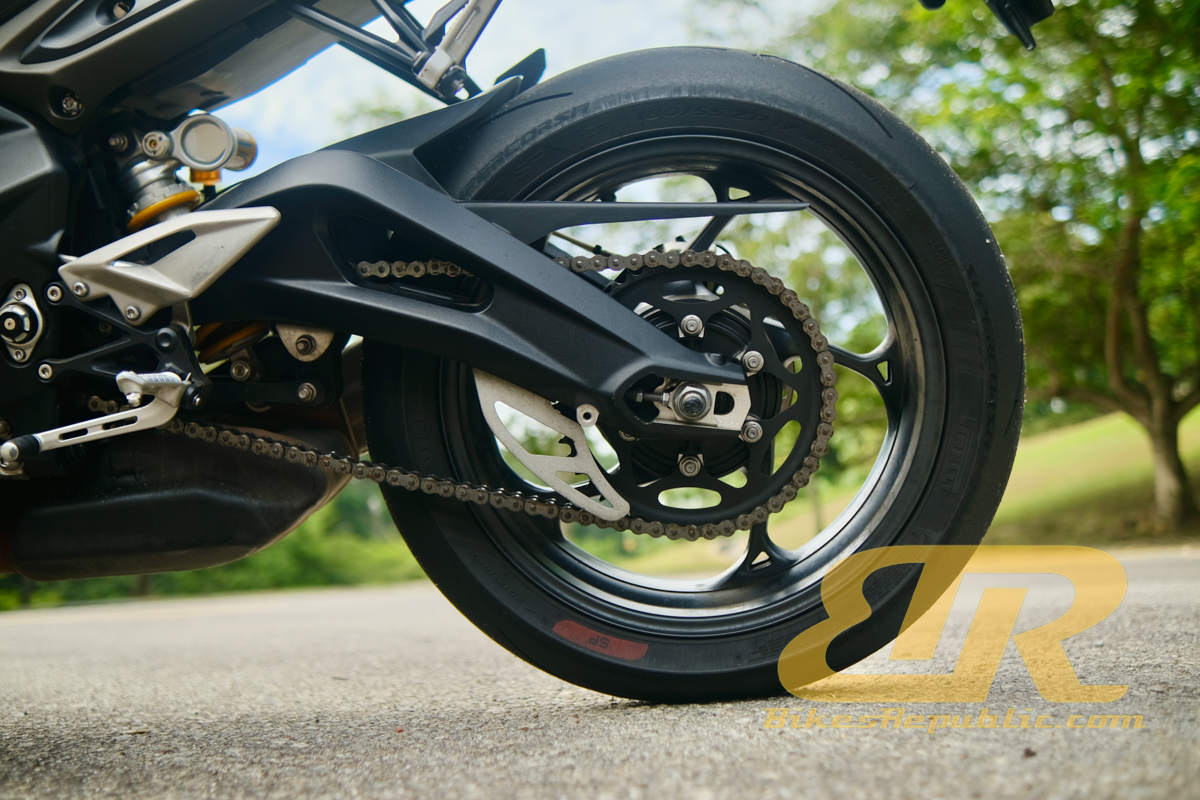
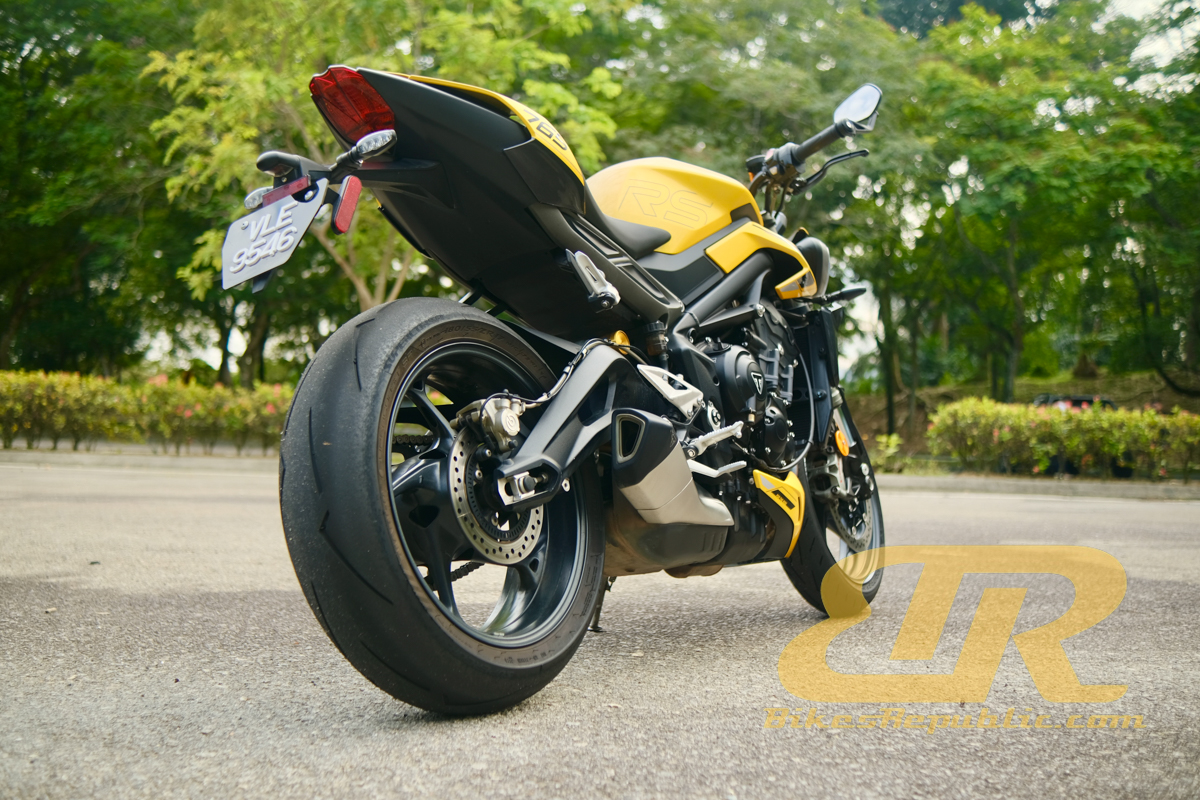
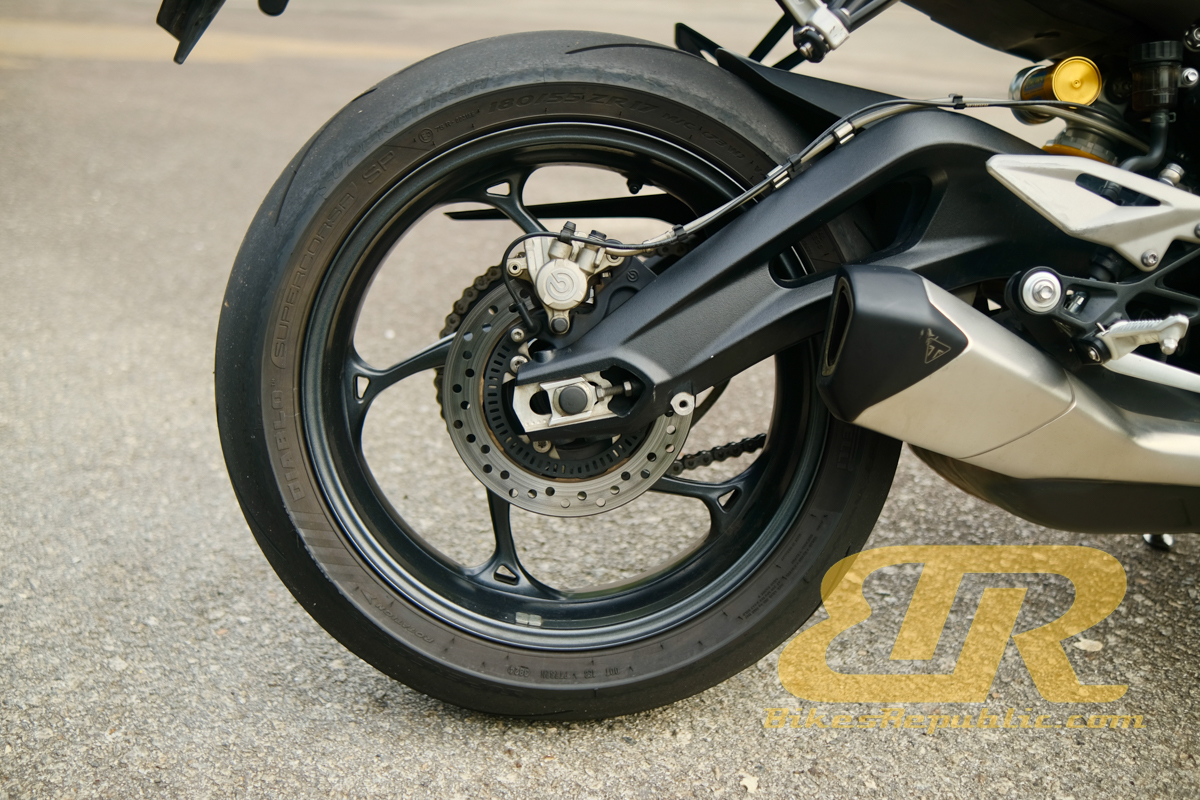
  • Lightweight cast aluminium alloy rims, shod with Pirelli Diablo Super Corsa V3 tyres.

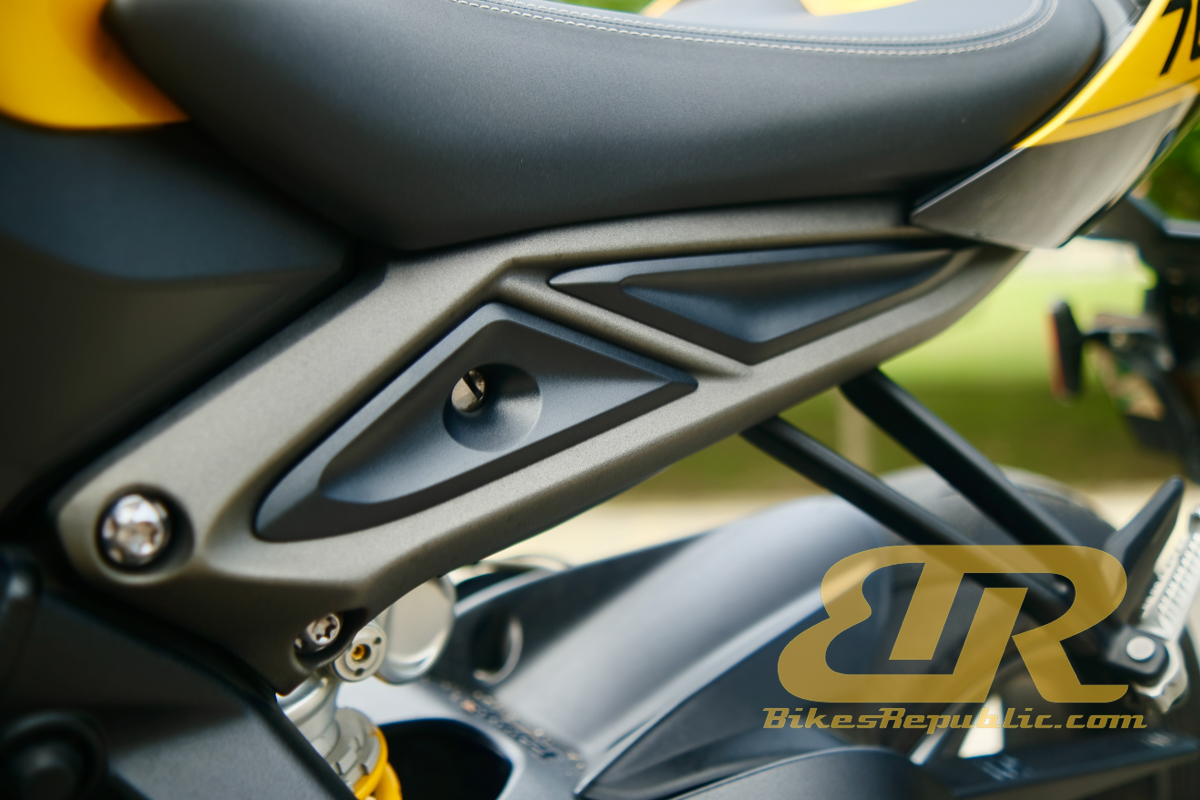
  • Tying everything together is an aluminium twin spar frame, with a bolt-on subframe.
  • The swingarm is also cast aluminium.
  • Seat height is 836 mm with the rear preload at standard setting.

  • A super quick 23.2° steering angle.
  • The fuel tank holds 15 litres of fuel.
  • Triumph claims a wet weight of just 188 kg.

  • On the electronics front, there is a six-axis inertial measurement unit (IMU).
  • Data from the IMU is fed to the engine ECU and ABS ECU to provide cornering traction control and cornering ABS, respectively.
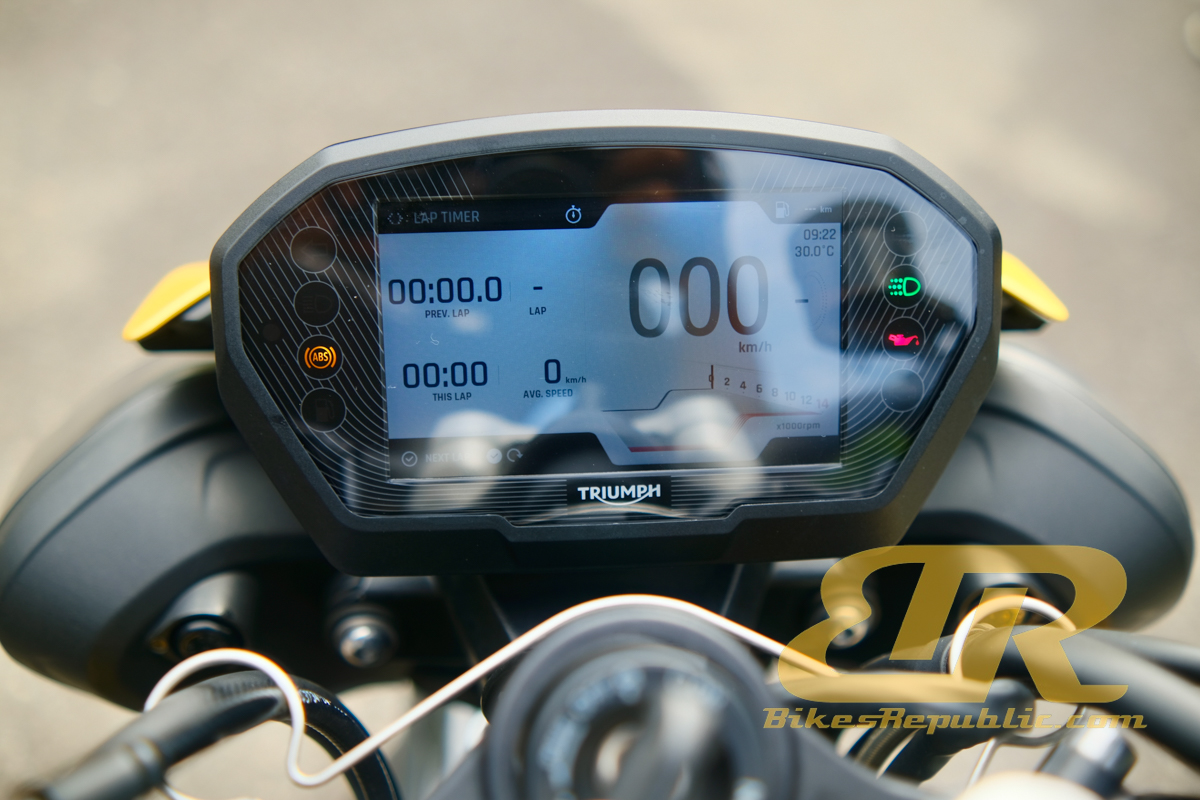
  • A full-colour, 5-inch TFT display.

  • Through it, the rider can select one of 5 riding modes (RAIN, ROAD, SPORT, RACE, USER), display modes, multimedia playback, phone functions, and navigation.

Whether it is decipherable or otherwise, that spec-sheet is filled to the gills with premium components.

RIDING THE TRIUMPH STREET TRIPLE 765 RS
Pre-ride

Pre-ride always involves us setting a bike up even before climbing on. Getting these out of the way now avoids us getting distracted while riding.

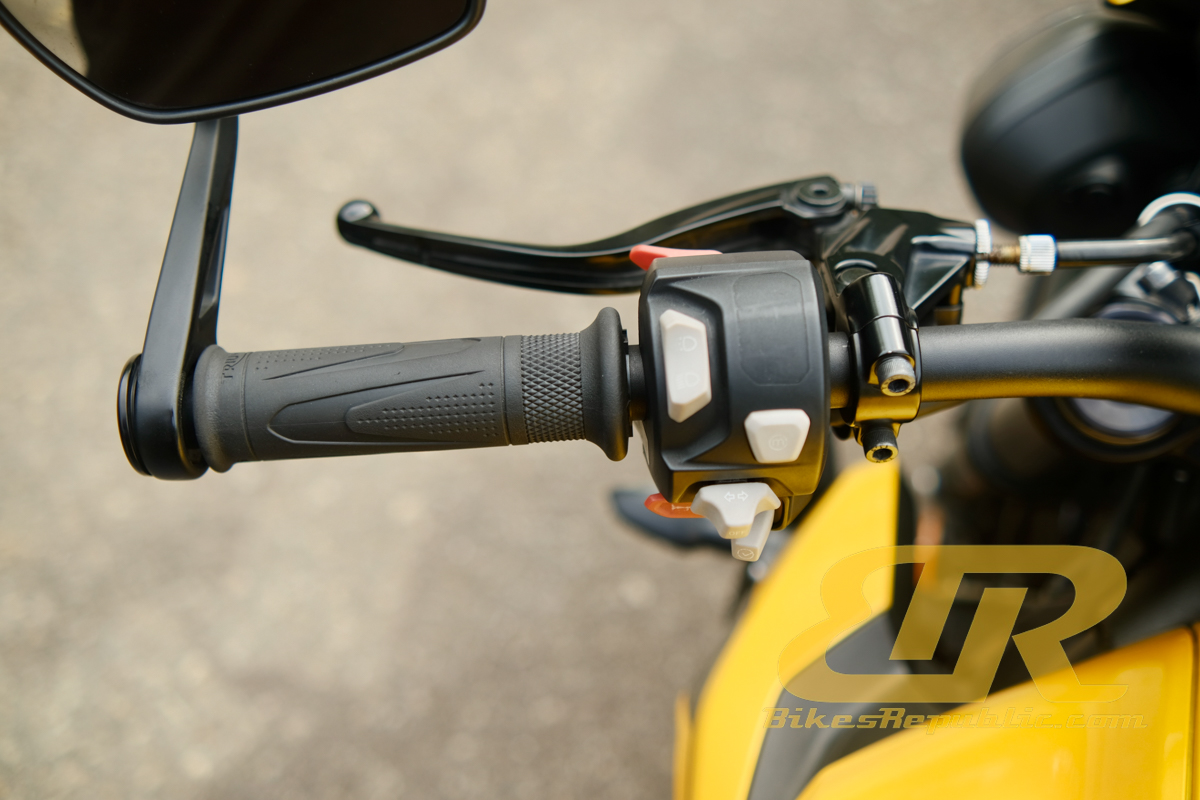
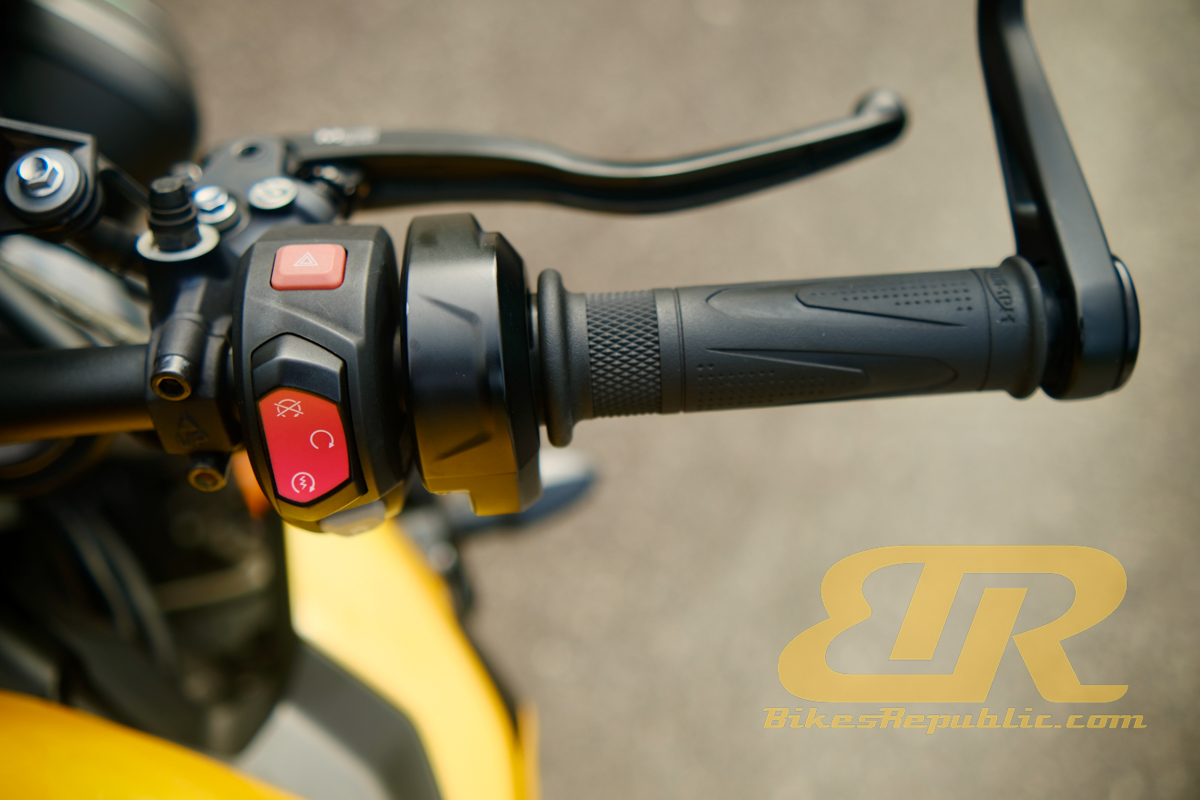
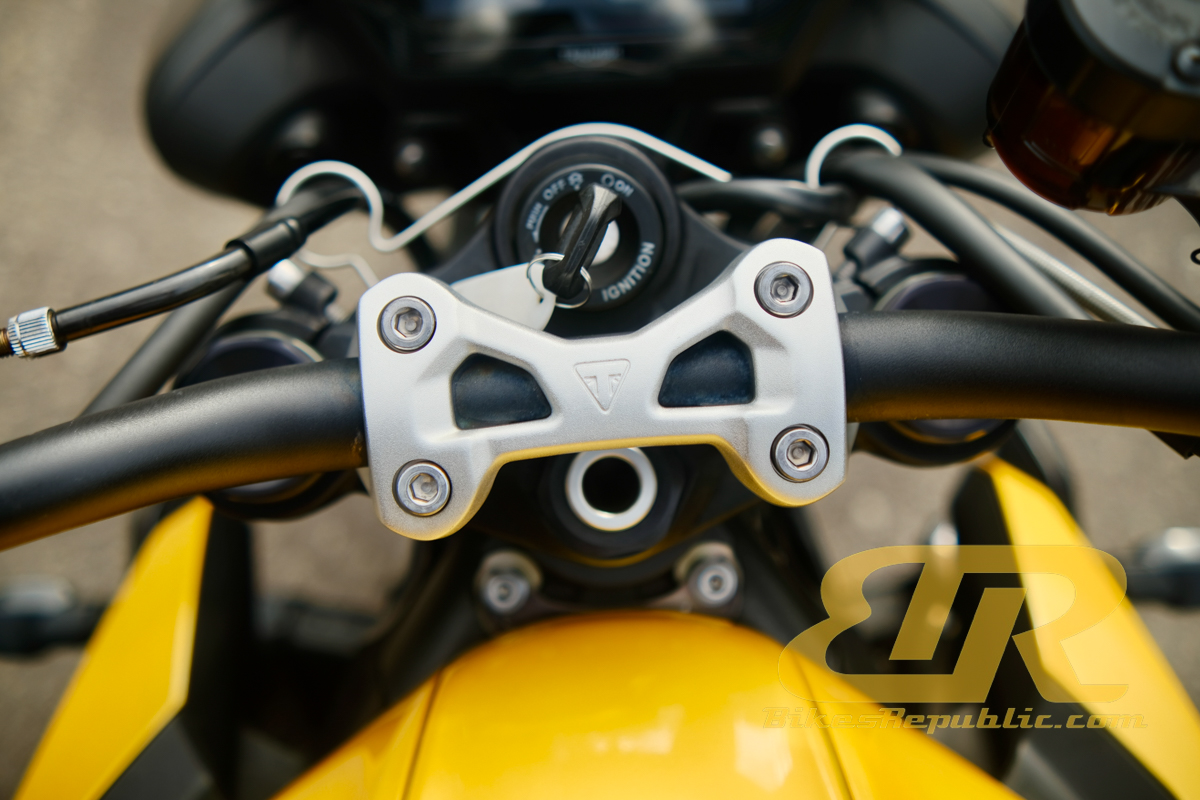
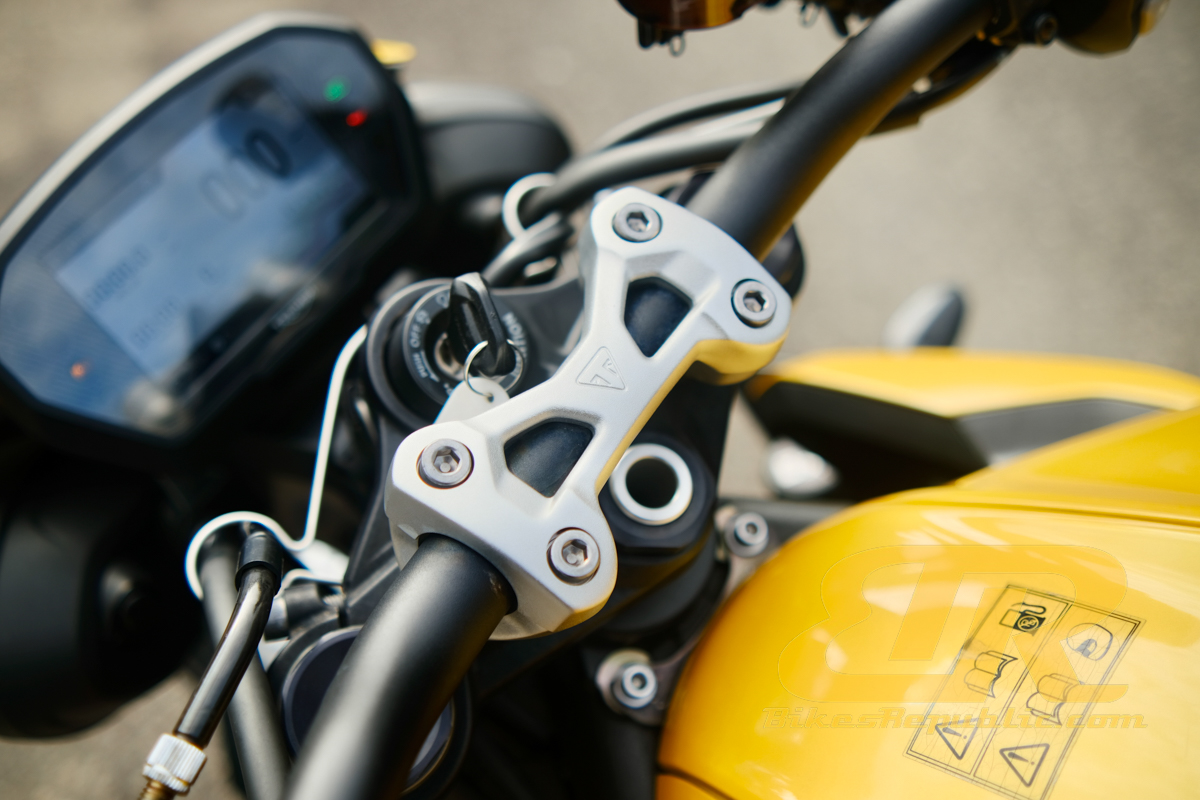
The bike had plenty of switches to play with on the left handlebar and gave us something to play with when we stopped at traffic lights for long durations. Pressing the mode button toggled through the riding modes, while jiggling the “joystick” let us page through several settings including the screen’s display style, connectivity, and navigation (which requires connecting to the Triumph app in your smartphone).

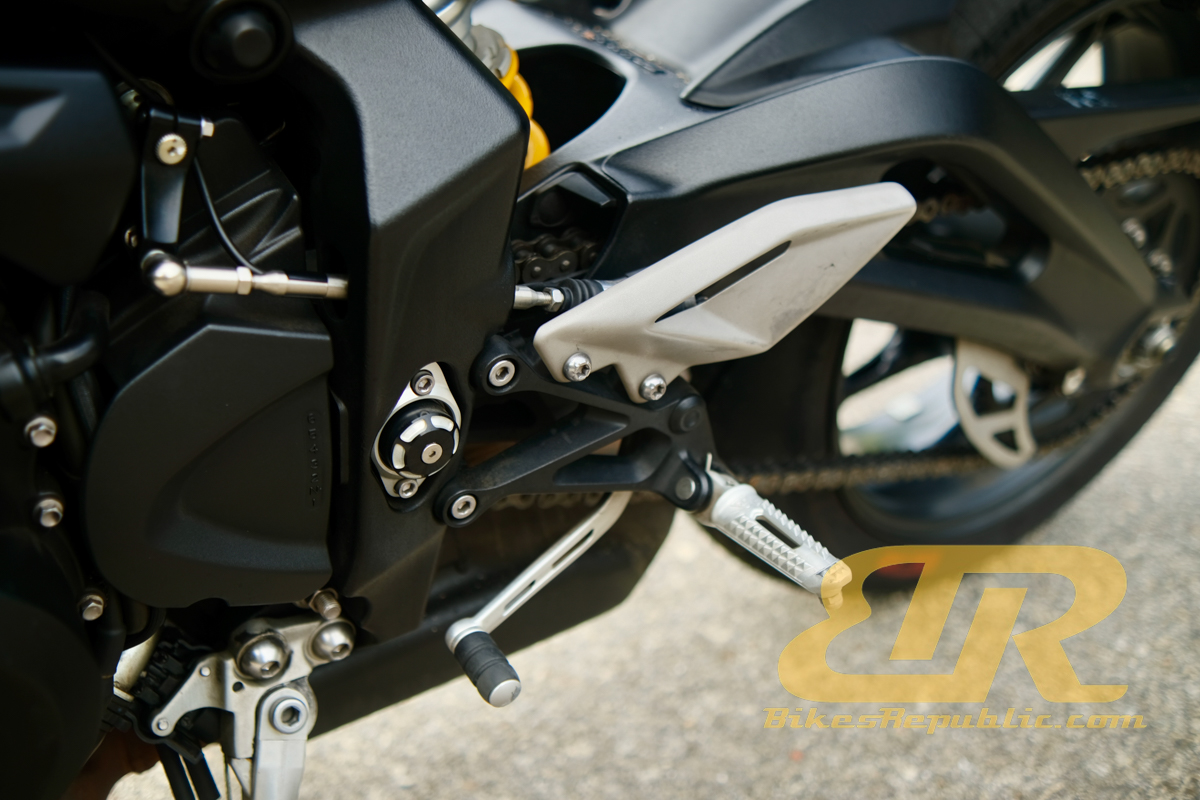
Getting on the bike was like hugging long lost ex, as we had ridden on all the Street Triples prior to this one. The seat was tall, with a lowish front end, although not as low as a pure sportbike’s. The footpegs and foot controls were placed inside, high up and back, out of the way for ground clearance. Putting a foot down needed this tester to hang half a cheek off the seat, but it was not difficult as the fuel tank had a very narrow profile where it joined the seat. Well, Triumph calls it “track ready,” after all.

First ride

With ROAD mode selected, the clutch lever had a very soft yet progressive feel to it, benefits of the clutch’s assist feature. Cracking the throttle ever so slightly was enough to have the engine’s torque rolling the bike forward without fear of stalling.

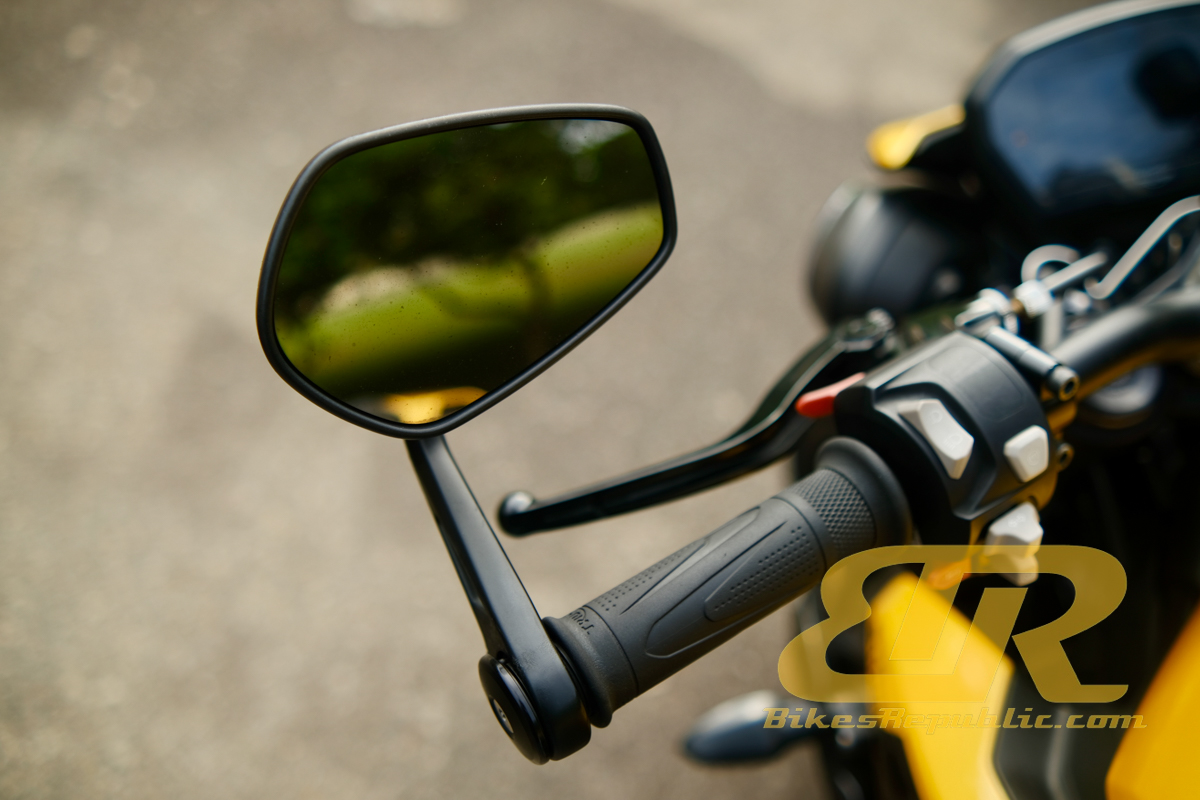
It was immediately apparent that the bike had lost none of its easy yet sharp handling characteristics, as with any Triumph. Heading into the massive traffic jam along Jalan Universiti, the engine’s linear torque delivery along with its nimbleness had us switching lanes with aplomb. It felt a lot like riding a 250cc bike but with a much better sorted chassis. Our only worry were the bar-end-mounted rearview mirrors which stuck quite a long way out.

The Brembo Stylema brakes were of course awesome and needed only the index finger to slow down.

Picking the bike up from Motoplex PJ just after lunch time meant that we had to fight through traffic all the way to Jalan Gasing but again the bike was light on its feet and made the task much easier.

Opening up

Time to test the bike in earnest. We got up early the next morning to ride the bike on the SUKE, SPE, and all the way up The Mountain.

The real test on SUKE and SPE was the bike’s handling on the bumpy corners from Seri Petaling to the Ampang section.

The Street Triple 765 RS’s rear suspension was stiffer when it contacted sharper bumps, while the forks worked well. Again, it truly showed that Triumph was not kidding when they said that the bike is track ready.

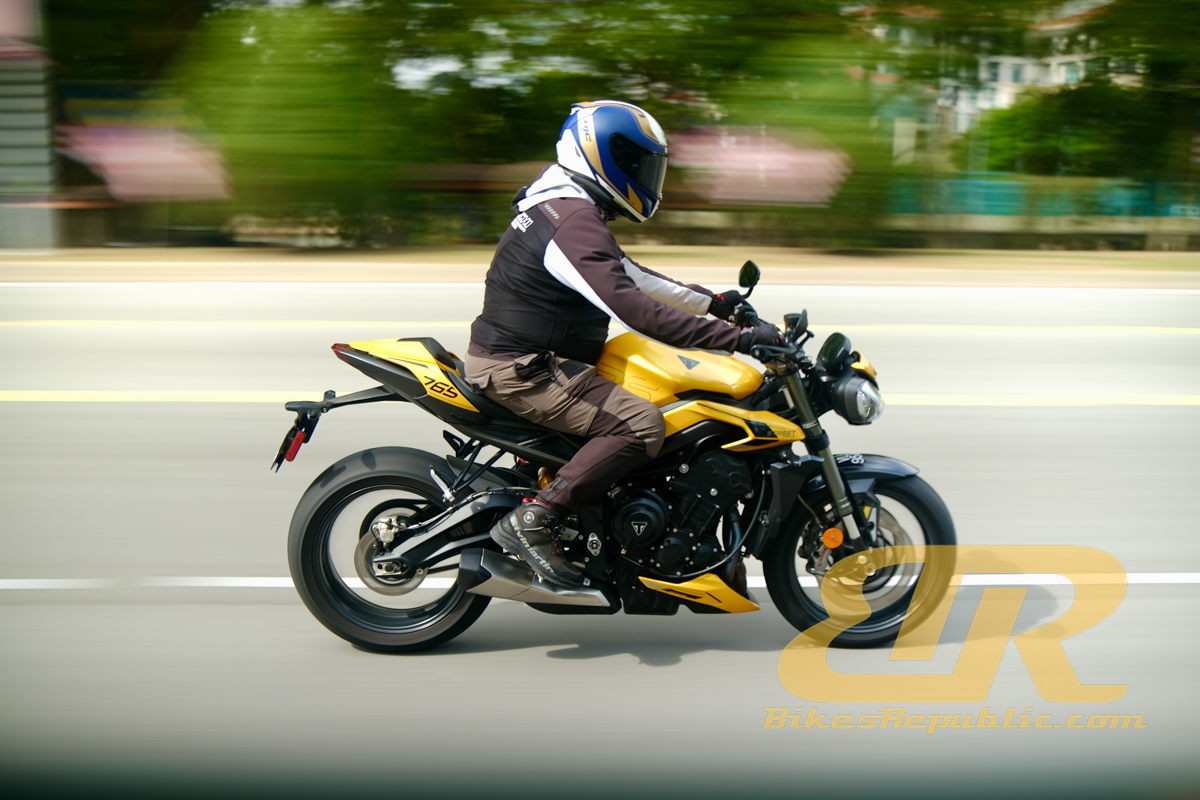
Despite the jumping around, the bike maintained our chosen lines without threatening to send us into the barrier. As with the previous Street Triple’s, this new bike’s handling fits the oft-used “telepathic” cliché to a T. All you need to do is look through a corner, select your line, and the bike already obliges, so much so we rode even faster – bumps be damned!

Stopping for fuel at the Karak BHP petrol station, we retuned the suspension by reducing compression and rebound damping at both ends, to let the tyres bite into the road more. As a note, this writer prefers a softer front end to let the forks sink into their initial stroke in corners. Doing so lets the bike hunker down in corners and avoids it from hopping (on bikes with stiffer suspension) or bobbing up and down (on bikes with softer suspension).

We also told ourselves to take it easy while riding on Karak Highway.

But it was not to be.

Switching to SPORT mode had the engine taking on a rawer character. It sounded more aggressive and responded faster when we blipped the throttle. Letting out the clutch also had the bike pulling away much quicker and the quickshifter became smoother.

The engine howled as it pulled through the rev range, followed by that intoxicating rush as we clicked into another gear by using the quickshifter. Every corner was dispatched with ease, but the real difference was bike’s willingness to change lines mid-corner should we find another vehicle in it. All we needed to do was lift the bike slightly, switch to the next lane, and steer it back into the corner. Done. Mind you, the bike was going way above the legal speed limit at this point.

Heading up The Mountain, the engine’s torque and handling let us ride harder than we thought we would. It did not matter what kind of corner: Sweeper, decreasing radius, on camber, off camber, the Street Triple did not care. We just lined them up and steered. There was no danger of losing grip either since those Super Corsas bit into the road surface like a pitbull. We even dragged the rear brake through the hairpin corner near Chin Swee Temple.

It seemed uncanny that every aspect of the was designed to engage that spot in our brains to unleash the need for thrills. We had so much fun that we turned around and went up the mountain again on the same day. Twice.

Conclusion

At RM76,000, the Triumph Street Triple 765 RS is not cheap for its engine capacity. But what you do get is a premium bike full of high-end components and a handling that any other bike finds it hard to match. For example, personally, this writer would upgrade the suspension on another bike, which would bring that bike’s price to somewhere in the Street Triple’s ballpark anyway. And that may not even yield the right results. So, why not just settle on a complete package from the start?

Yes, we know, not everyone likes the Street Triple’s looks. But guess what? We were in the same boat prior to riding it. The bike has endeared itself to us since then, and we found that the styling is distinctive meaning that no one is going to mistake it for another bike.

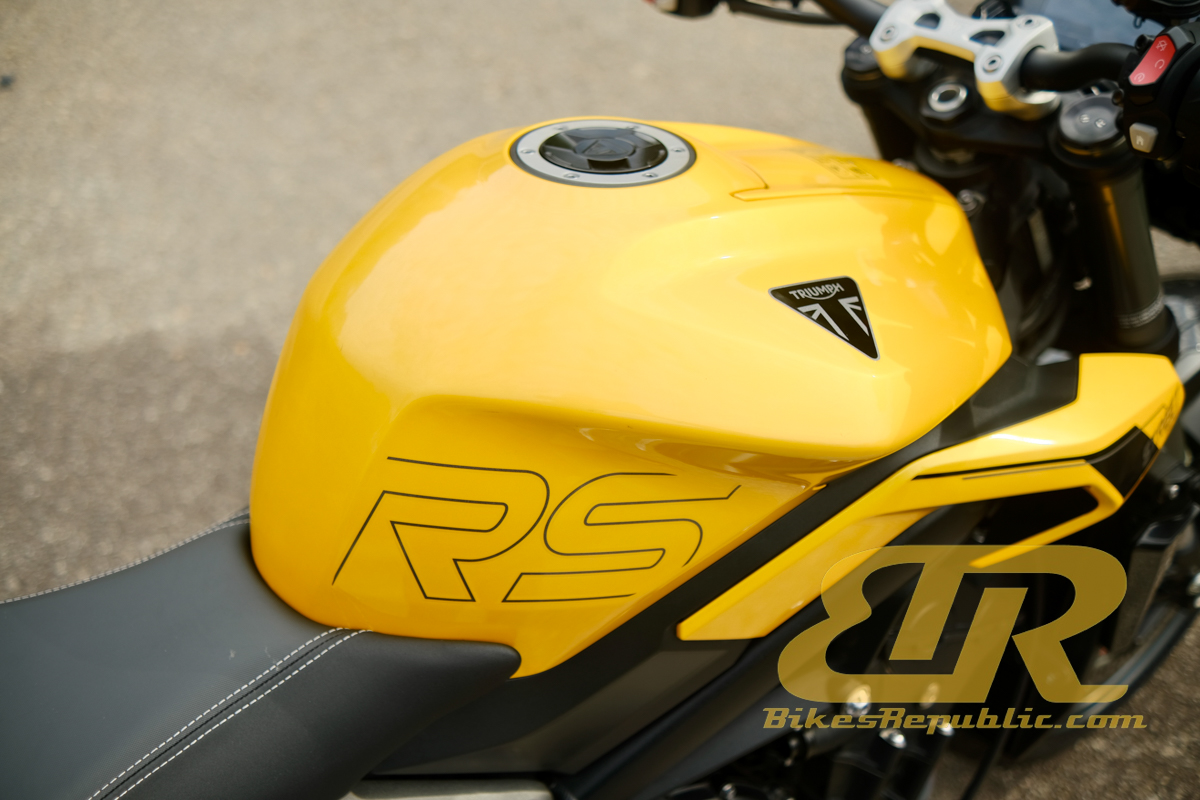
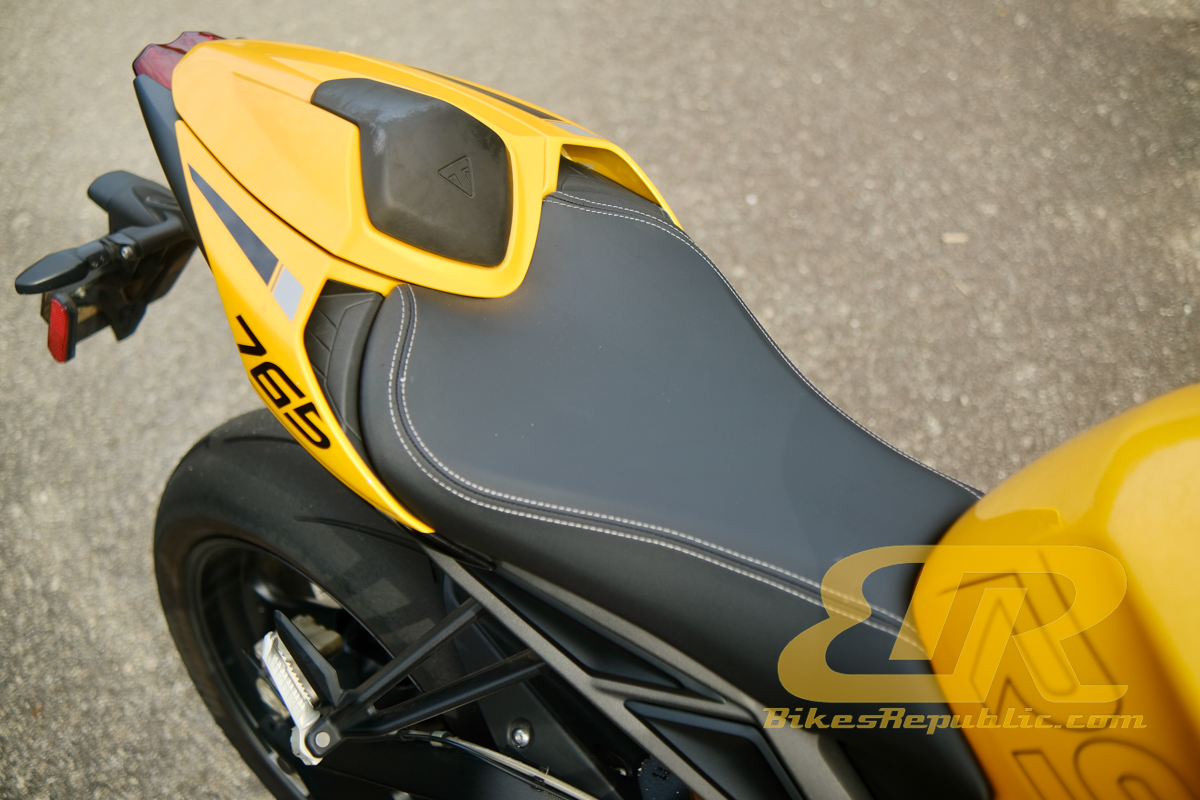
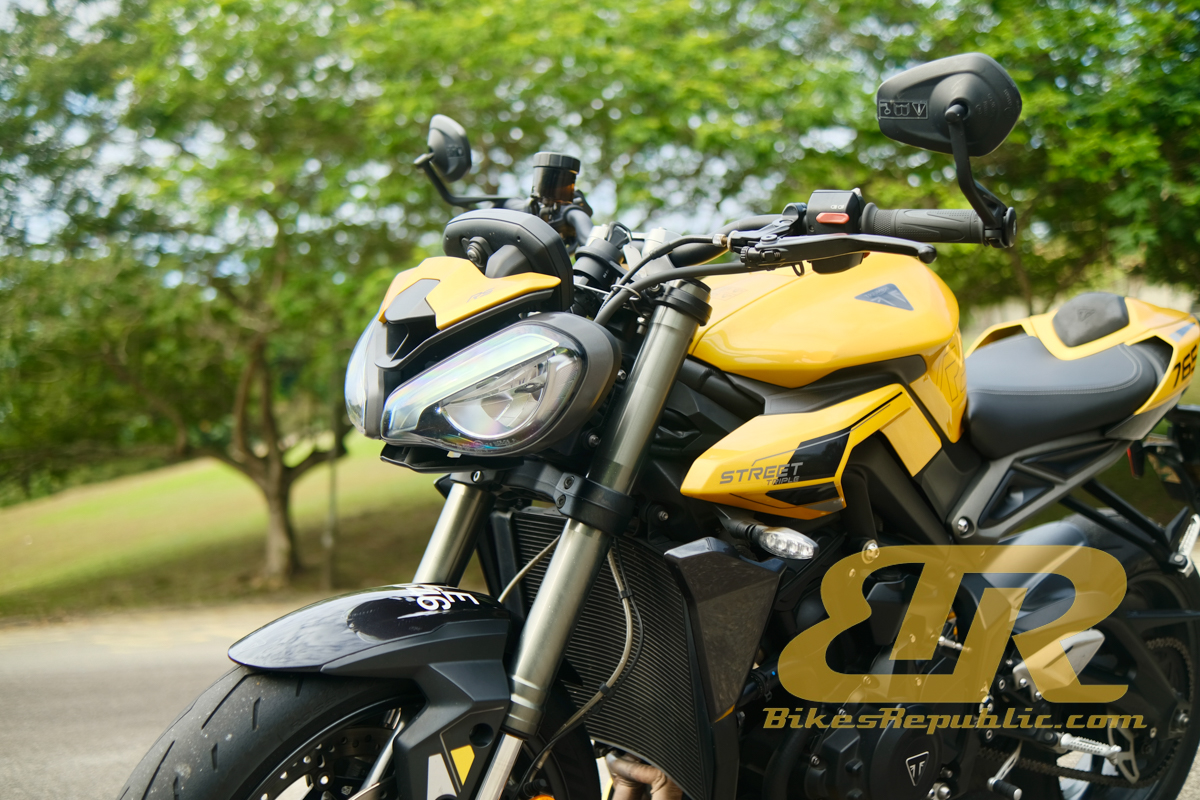
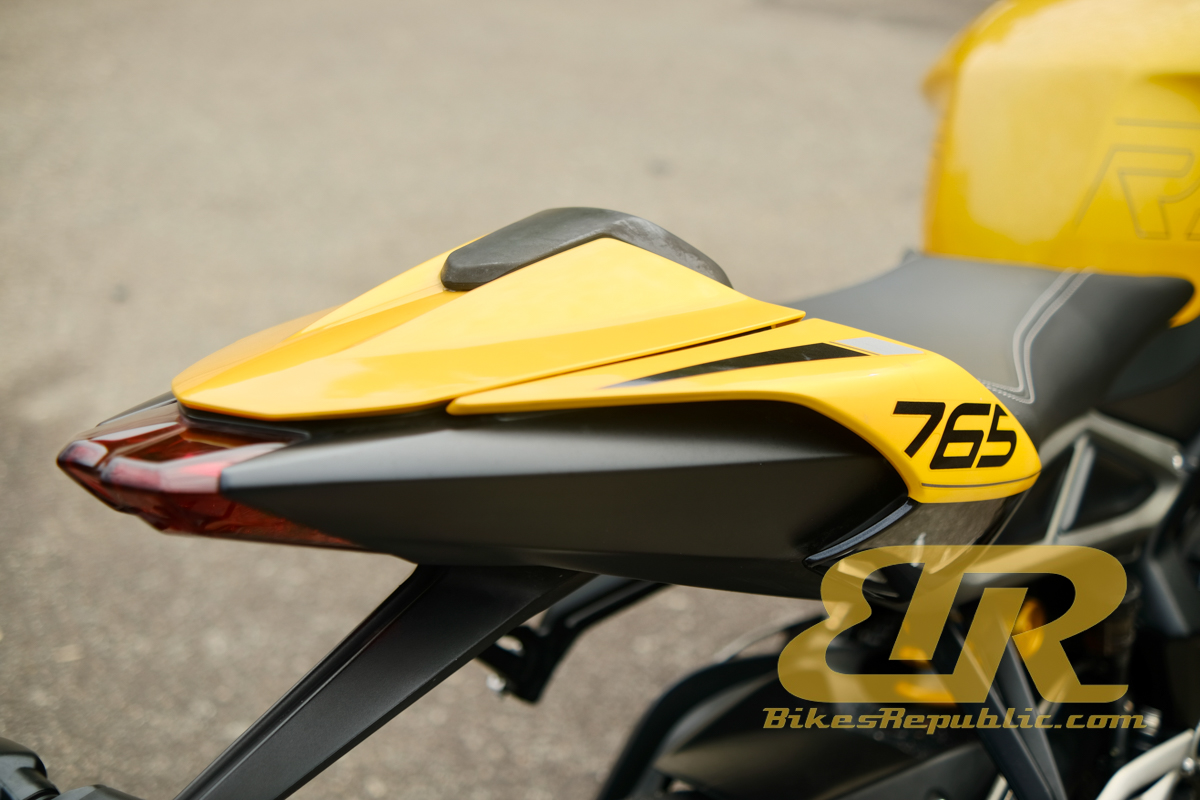
So, there you have it, floated like a butterfly, and stung like a bee. Speaking of a bee, the metallic yellow paint and black accents did make it look like another famous character, Bumblebee, who was also agile on its feet.

Photo gallery

Your bike may be equipped with the best master cylinder, hoses, and calipers, but it all ultimately comes down to the brake pads to slow your bike down. This is the component that provides the friction when it grips the brake disc, and converting kinetic energy (movement) to thermal energy (heat).

Brake pad friction ratings

HH-rated pads are the strongest brake pads one can buy, but do you have any idea what those two Hs stand for? The letters indicate the friction rating and specifically pertain to the puck’s coefficient of friction, with the first letter quantifying the CoF at a normal operating temperature and the second letter listing the pad’s CoF at an extremely high temperature of 340° Celsius. G and H ratings are common for motorcycle brakes, with a G-rating offering a CoF between 0.45 and 0.55. H is the highest rating available and corresponds to a CoF of 0.55 or greater.

Brake pad material

ORGANIC

These pads are devoid of metal content (and asbestos) and instead blend rubber, glass, or Kevlar materials into a heat-resistant binding resin. Organic pads are the softest and thus the quietest option available and are exceptionally easy on rotors. They’re also easy on your wallet. Downsides include shorter service life (compared to semi-metallic or sintered pads) and fading with aggressive use. Organic pads are most commonly found on older (pre-1990s) bikes, smaller modern bikes, and for rear applications on some larger modern machines.

SEMI-METALLIC

These pads incorporate some metallic material (usually 20 to 40 percent by volume) into the friction material to increase the pads’ friction level and durability and to improve fade-resistance under heavy use. These pads were invented as cars and bikes became faster, requiring stronger, more resilient brake systems. Semi-metallic pads are still fairly quiet, don’t score rotors as much as all-metal sintered pads, and are a popular option for a variety of bikes.

SINTERED

The name refers to the production process, which uses extreme heat and pressure to cement powdered metal (usually bronze) to the backing plate. Sintered brakes have a very high coefficient of friction and excellent heat transfer, making them ideal for aggressive use and racing. The downsides are price, increased rotor wear, and the fact that they usually require some heat to perform their best.

Your motorcycle brakes have a tough job.

What’s amazing is that it does. Take the BMW S 1000 XR for example: It accelerates to 160 km/h in 6.1 seconds and 151 metres. Yet it slows to a complete stop in just 5 seconds and in less than 100 metres.

That kind of performance makes the brakes the most powerful component of a motorcycle, contrary to what many believe is the engine. Think about: The force from one or two of your fingers is enough to bring a flying motorcycle down to sane speeds in less time and distance, than the engine takes to accelerate the bike.

That impressive performance is due to the power and resilience of the modern hydraulic brake system, which is comprised of the following components.

Master cylinder

Whether operated by your right hand or your right foot, this converts mechanical force into hydraulic pressure via a lever acting on a piston that presses on a fluid. The force with which you pull the lever, the lever’s leverage ratio, and the size of the master-cylinder piston determine the amount of pressure imparted on the system, which may exceed 10.5 kg/cm².

Brake lines

These multilayer hoses transmit pressure from the master cylinder to the calipers and typically utilize a Teflon inner lining surrounded by a braided-nylon, Kevlar, or stainless-steel reinforcing layer that’s then wrapped in a protective sheathing. The stronger the hoses the better, since any expansion under pressure will reduce braking force and feel. Because rubber hoses lose their strength over time, most manufacturers recommend replacing them every four years.

Brake caliper

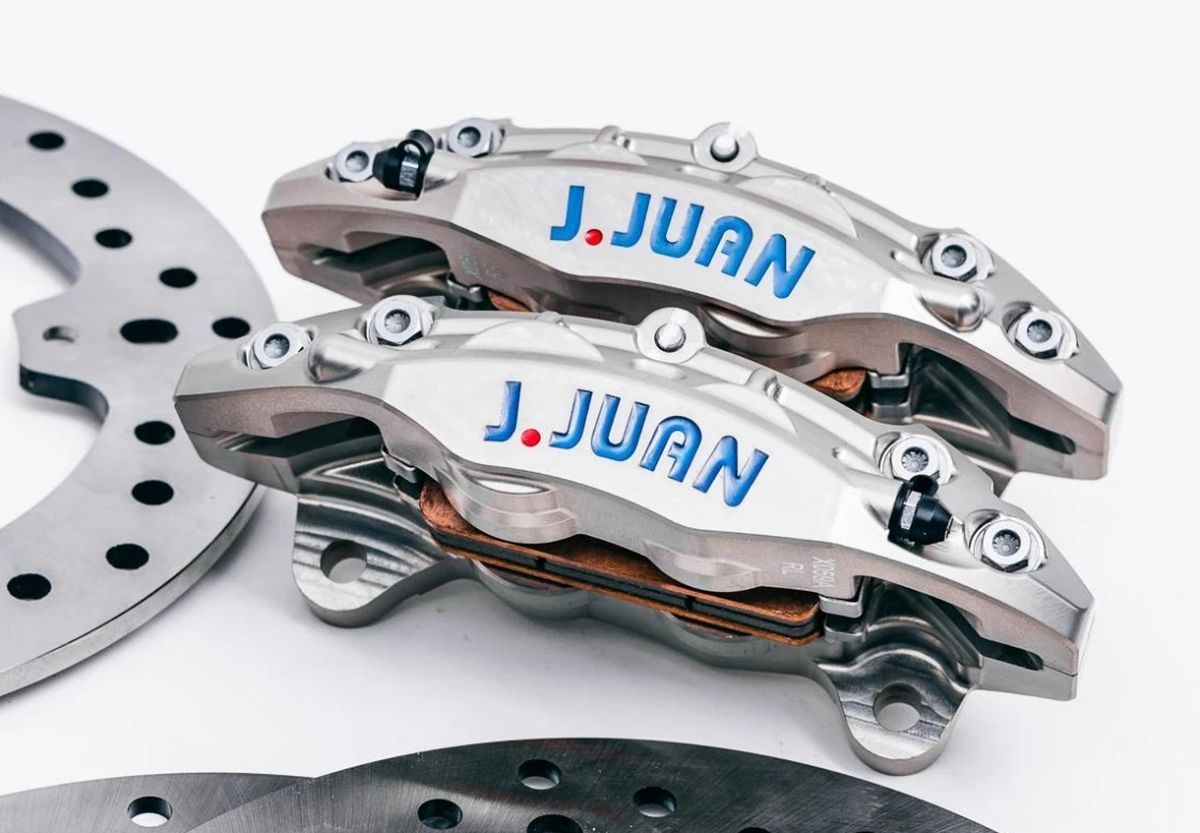
The brake caliper is where the multiplying power of hydraulics comes into play. Since pressure applied to a confined liquid is transmitted undiminished and with equal force to all surfaces within the system, the pressure from the master cylinder is exerted uniformly on the much larger area of the caliper pistons, increasing the force many fold.

Brake pads

If any part of the brake system deserves sympathy, it’s the pads. Their job is to convert your bike’s kinetic energy into heat by way of friction. And we want them to do it quietly and repeatedly and without getting too hot. It’s not uncommon for the brakes on an aggressively ridden streetbike to heat up to 180° Celsius, while the pads and discs on a racebike may exceed 315° Celsius.

Brake disc (or drum)

Transferring the brake pads’ resistance to motion to the wheels and on to the tires’ contact patches are the brake discs or drums. Discs are typically made from stainless steel, while drums are lined with cast iron. Both materials provide a durable, heat-resistant surface for the brake pads to press against. Modern brake discs are relieved, and or drilled, to assist in cooling and to help shed water and debris.

Brake fluid

This is the elixir that allows it all to happen. Brake fluid is responsible for transmitting force from the brake lever to the back of the brake pads. It needs to be non-compressible to effectively transmit pressure, have low viscosity to be compatible with ABS components, have good lubricity for master-cylinder and caliper pistons seals, offer corrosion resistance, and also have a very high boiling point.

Brake fluid is available in four grades: DOT 3, 4, 5, and 5.1. DOT 3, 4, and 5.1 fluids are glycol based and miscible, while DOT 5 fluid is silicone based and can’t be mixed with any other type of fluid. Glycol-based fluids are hydrophilic and will attract and absorb moisture out of the air. DOT 5 fluid is hydrophobic, but due to the repeated heating and cooling cycles and the imperfect sealing of master cylinders and calipers, all fluids will eventually ingest some quantity of water. The difference is that glycol-based fluids will pull moisture out of the air on their own while DOT 5 will not, meaning DOT 5 has a much longer service life.

If you’re thinking DOT 5 sounds really appealing right now, think again. Expense, as well as the fluid’s compressibility and viscosity, makes DOT 5 unsuitable for everyday use. So why does it exist? It was created for the military to use in vehicles that will be parked for years at a time. Harley-Davidson used DOT 5 until a decade ago but specifies DOT 4 now.

A fluid’s classification has little to do with its chemical makeup. Rather, it’s based on the fluid’s boiling point. The Department of Transportation sets minimums for each grade’s “dry” and “wet” boiling point, with the former state completely free of moisture and the latter containing 3.7 percent water as is common after a year or so of regular use. DOT 3 fluid has the lowest minimum dry boiling temperature at 205° C (140° C wet), while DOT 5.1 has the highest at 270° C (180° C wet).

As the temperature ratings above suggest, any water content in the brake fluid will reduce its boiling point. Boiling brake fluid will make your brake lever feel spongy and braking force will be diminished. This condition is known as brake fade or, more specifically, fluid fade. Replacing your brake fluid regularly (most manufacturers say every two years) will help ensure your brakes always perform their best.

Radial vs axial mount callipers

Nearly all modern sportbikes have radial-mount brake calipers, and the general consensus is that they’re better. But why? First, the difference between radial-mount brakes and axial-mount brakes: Radial brakes are secured via bolts that are parallel with the brake disc as compared to bolts that are perpendicular to the disc face (see photo at right) as on traditional brakes.

Radial mounting typically offers better caliper-to-disc alignment and is significantly more rigid than axial mounting. A more rigid setup yields better pad-to-disc contact for improved power and, more significantly, better feel at the lever.

The 2026 Suzuki GSX-R1000R M6’s recent launch garnered positive reception worldwide, with many welcoming the series back. The welcome was perhaps unsurprising since many enthusiasts had decried the manufacturer’s announcement in ending the previous Gixxer’s production since 2022.

However, there was not much technical detail accompanying the launch of the M6 apart from it commemorating the 40th anniversary of the GSX-R1000.

So let us take a deeper dive into the technical updates of the 2026 Suzuki GSX-R1000R M6.

More performance, same ease of riding
  • Suzuki maintained the same ease of riding the bike that it is famous for, and updated the engine for higher performance and Euro 5+ compliance, instead.
  • The heart of the bike is the familiar 999.8cc, liquid-cooled, inline-four engine.
  • It now produces a maximum power of 192.3 hp at 13,200 RPM  and 110.09 of maximum torque at 11,000 RPM.
  • The max power is lower than its predecessor’s but Suzuki says that it improves the engine’s durability, while opening up more tuning potential.

  • Compression ratio is higher at 13.8:1 compared to 13.2:1 due to revised piston crowns. Higher compression allows for better combustion heat efficiency.
  • The size of the exhaust valves has been enlarged to 25 mm from 24 mm.
  • The pistons are forged aluminium with cutaway skirts and DLC-coated connecting pins to reduce friction.
  • The ribs underneath the pistons had also been redesigned to shave weight by 3 g.

  • 3 g may sound small but contributes to a huge difference when the pistons are whizzing up and down 22,000 times a minute at 11,000 RPM
  • The cylinder bores are SCEM-plated to reduce friction and improve heat transfer, with internal cutaways beneath to allow trapped air to escape more efficiently between strokes and enhance ring seal with the cylinder walls.
  • The crankshaft has thicker journals at 37mm from 35mm for improved load handling.
  • Fuel delivery has likewise been revised – the injectors now have eight holes instead of ten.

  • There are also four top-speed injectors in the airbox that spray directly into the newly designed velocity stacks for better fuel atomisation at high RPMs.
  • The throttle body sizes have also been enlarged to 48mm from 46mm.
  • All these revision are for naught if gas flow remains the same.  As such, Suzuki revised the cylinder head, intake and exhaust ports, and gasket shape.
  • The cooling system is now more efficient which eliminates dead zones in the coolant jacket while using less fluid overall, contributing to further small weight savings.

  • The 4-2-1 exhaust system also gets a thorough revamp, now utilising O2 sensors both before and after the redesigned catalytic converter to feedback fuelling data to the ECU.
  • The catalyst itself has also been redesigned, now elliptical and with increased capacity, and mounted closer to the engine to speed up warm-up times.
  • With increased catalyst box volume, the silencer is made smaller than before.
  • Suzuki also tweaked the clutch action, by using an assist and slipper clutch.

  • The biggest highlight is of course the Suzuki variable valve timing system, called SR-VVT.
  • A wider cam chain reduces friction losses, and the cam sprocket shape has been revised together with a new profile.
  • As per its predecessor, the SR-VVT is a centrifugal setup integrated into the intake cam sprocket which operates dependent on engine speed alone, rather than using computer-actuated hydraulics like some other manufacturers.
  • It uses 12 steel balls and slanted grooves to rotate the sprocket and retard the intake valve timing at a pre-set rpm, boosting both low-RPM torque and delivering maximum power in higher RPMs.

The cam lobes have likewise been reworked with a refined DLC-coated finger-followers.

Closing

These revisions do sound very interesting, indeed. They should improve on the Gixxer’s ride ability even more, while providing higher maximum performance. We truly hope we could get to test the bike when it gets here!

Riding the 2025 BMW R 12 nineT was interesting – to say the very least – on several levels. It was not only due to mechanical factors but external ones, too. And questions. Many questions from others. Probably questions from you too, our readers.
What is the 2025 BMW R 12 nineT?

It began in 2014, when BMW Motorrad introduced the R nineT to commemorate the 90th anniversary of BMW motorcycles. Designed by both BMW Motorrad together with custom bike legend, Roland Sands, the R nineT was decidedly modern classic in design by drawing a connection to the BMW “R” Boxer lineage.

First to be produced was the R nineT, followed by several variants based on the same platform: Urban GS, Racer, Scrambler, and Pure.

So, 10 years later, BMW introduced the new R 12 platform as a continuation of the R nineT’s legacy. Following its ancestor, the nineT variant was the first to be introduced.

The R12 nineT is a roadster/standard/naked, built around the same 1170cc Boxer engine, but brings forth several new features. The engine was as far as it went in terms of similarities with its predecessor.

Highlights and features
  • 1170cc, air/oil-cooled, horizontally-opposed-twin (Boxer), which produces a maximum power of 109 hp at 7,000 RPM and a peak torque of 115 Nm at 6,500 RPM.
  • Newly designed exhaust system with twin chrome mufflers.

  • Engine power is transmitted through a single disc dry clutch, and then through a six-speed gearbox.
  • Marzocchi 45mm upside-down forks up front, adjustable for spring preload, compression damping, and rebound damping.

  • Monoshock with a progressive spring at the back, adjustable for spring preload and rebound damping.
  • As with all BMW Boxer-engined models, the R 12 nineT utilises a single-sided Paralever swingarm, but now stouter.

  • Twin 310mm front brake discs, gripped by twin four-piston calipers.
  • Single 265mm brake disc at the back.

  • The brakes are supported by BMW Motorrad Integral ABS Pro.
  • New tubular steel frame.

  • Aluminium fuel tank.
  • 795mm seat height.

  • Three riding modes namely Rain, Road and Dynamic.
  • Electronic rider aids include Dynamic Engine Brake Control, Dynamic Traction Control, Hill Hold Control.
Pre-Ride

Checking out the bike the first time, the bike looked similar but different. BMW did a great job of retaining the previous R nineT’s looks while packing the new model with so many updates.

Upon closer inspection, we noticed that the snail proboscis-like intake trumpet has been deleted. The seat was also visibly lower, with the rear portion of the bike sitting lower over the rear wheel, giving the bike a slightly stretched out and low-slung look.

Speaking of the wheel, our test bike’s wheels were cast aluminium, different from the wire-spoked wheels in BMW’s official pictures. The rear wheel drew lots of attention, as it looked like a shuriken.

The fuel tank was partly painted, while leaving the sides in polished aluminium. Yes, the previous R nineT had this, but it somehow looked better on the new bike.

The new R 12 nineT is a handsome bike when viewed from any angle. Pictures really do not do it any justice.

The twin clocks are beautiful, which had inset LCD screens. These screens may be small, but the characters displayed were big enough to be easily readable. Flipping through the data displayed and set up was achieved through the handlebar mounted switchgear and BMW Multi-Controller ring.

First ride

Firing up the Boxer had it punching to one side. Blipping the throttle also results in such sensation. Now, this is how a Boxer engine is supposed to be, which reminded us that it was alive. Such sensation had since been missing with the introduction of the “Water Head” (liquid-cooled) Boxer.

The new exhaust system sounded slightly softer than its predecessor’s, as a silencer box with catalytic converter sits below below the transmission, which negated the old decibel-controlling valve. Still, there was enough of the signature Boxer roar coming through.

Climbing on surprised us immediately. While we tip-toed on the old bike, both feet found the ground easily now. Reach to the handlebar was slightly far for this writer with short arms and legs but still natural. The handlebar was wide, which stretched out reach further when turning at low speeds.

With ROAD mode selected, we engaged first gear -and it clacked into place without mistake, including aurally.

We released the soft pull clutch lever and away we went, surfing on a wave of Boxer torque.

This was when the fun begins

It was immediately clear that the subject about horsepower versus torque will crop up when discussion this bike. While most people view horsepower figures like the holy grail, the real mover is engine torque. Torque is what gets the motorcycle (or any vehicle) moving, accelerates it and build revs to reach maximum horsepower.

And this was exactly when you have to give BMW credit for sticking to the Boxer. The bike just pulled and pulled through any gear, while serenading you with that distinctive Boxer drawl. We know, some may say that this “Oilhead” engine is “low-tech” compared to the 1300cc, liquid-cooled, and ShiftCam-equipped Boxer of the R-series, but all that notion got blown away every time we opened the throttle. This engine has character.

Soon, we found ourselves “cruising” down MEX Highway at 140 km/h (and above) on cruise control, while the engine just happily droned on between our legs.

Doing the twist

We generally take it very easy in corners with bikes that are low and long. Usually, such motorcycles do not like to attack corners, and instead prefer to be steered smoothly into long and wide curves.

However, steering the R 12 nineT into the sharp right and left corners on the off-ramp to Bukit Jalil had the chassis telling us that we were too slow, as the bike steered eagerly into the inside of those corners.

So, instead of turning into Seri Petaling, we decided to test out the two corners that led to the Sungai Besi Toll Plaza. Steering into the first turn, a long left, had the the suspension sink into its initial compression travel, letting the tyres bite hard into the road. With the confidence gained, we chucked the bike into the decreasing radius right under the tunnel with the throttle off through the apex, before gunning it hard on the exit. We kid you not, the R 12 nineT blasted that corner as good as any modern naked sport bike.

This came to us as a complete surprise as it the bike had no business in handling this good, given its low seat height and long wheelbase!

Yes, yes, the Boxer engine played a huge role in its agility. BMW detractors deride the cylinders hanging out the sides, but it is because of this that lowers the engine’s centre of gravity. This lower centre of gravity also provides a lot of stability, especially when riding at lower speeds. This is why BMW GS owners do not complain about the tall seat when negotiating traffic.

Anyway, we decided to do more corner testing and the best places were the SUKE Highway from Bukit Jalil to Genting Klang, before turning into the SPE, the onwards to the Kesas Highway and up “The Mountain.”

SUKE Highway is the perfect route to test how a bike’s chassis handles bumpy corners. Whereas one bikes hopped over bumps, the R 12 nineT was super smooth. This, without BMW’s Dynamic ESA electronic suspension.

The SPE, on the other hand, has several tight and narrow corners, which the bike dispatched without once threatening to run wide.

The Karak Highway is of course for holding speed through flowing corners, and we switched to DYNAMIC ride mode, which is akin to Sport. Now, the engine felt truly alive, letting us feel every bit of its power stroke and aggression. It was now, that the bike felt a lot more like a power cruiser as it swept through corners while we regulated the throttle, using the engine’s torque for braking and acceleration. Of course we did not bother to chase the 1000cc super bikes, but riders on lighter and more powerful naked bikes were shown the benefits of smooth riding.

Up the mountain, we had so much fun in fully utilising the bike’s superb brakes, quick steering, and Boxer torque, as we roared from one corner to the next. We hardly ever rowed through the gearbox all the way up, keeping the bike in fourth through most corners, while selecting second and third only very occasionally.

The only thing that discouraged us from being more aggressive was the fear of grounding the cylinder heads. In fact, the first accessory we would install if we owned this bike (should we suddenly get a call that a millionaire had us in his will) are cylinder head sliders.

Speaking of the transmission, it was the only downside of the 2025 BMW R 12 nineT. Releasing the clutch too hastily or using the Shift Assist (quickshifter) at slightly lower revs had the gears clunking during engagement, and could be heard all around. As aggressive as we were, we also wanted to portray any test bike in good light, so we learned to let the clutch lever out more progressively, and use the quickshifter only above midrange RPM.

Closing

Honestly, we felt sad to return the bike as we had not felt this way over test bikes for a long time. In fact, to be brutally truthful, we sometimes felt jaded after testing so many bikes. No, were are not saying that they were bad, in fact, almost every bike we tested in the last 5 years or so were excellent in almost every aspect. Instead, what made us love the BMW R 12 nineT was its character.

And oh, let us not forget the amount of stares and enquiries we received when we had the bike.

The 2025 BMW R 12 nineT is priced from RM124,500.

What is the price for kidneys in the black market these days…? (Asking for a friend.)

Photo gallery

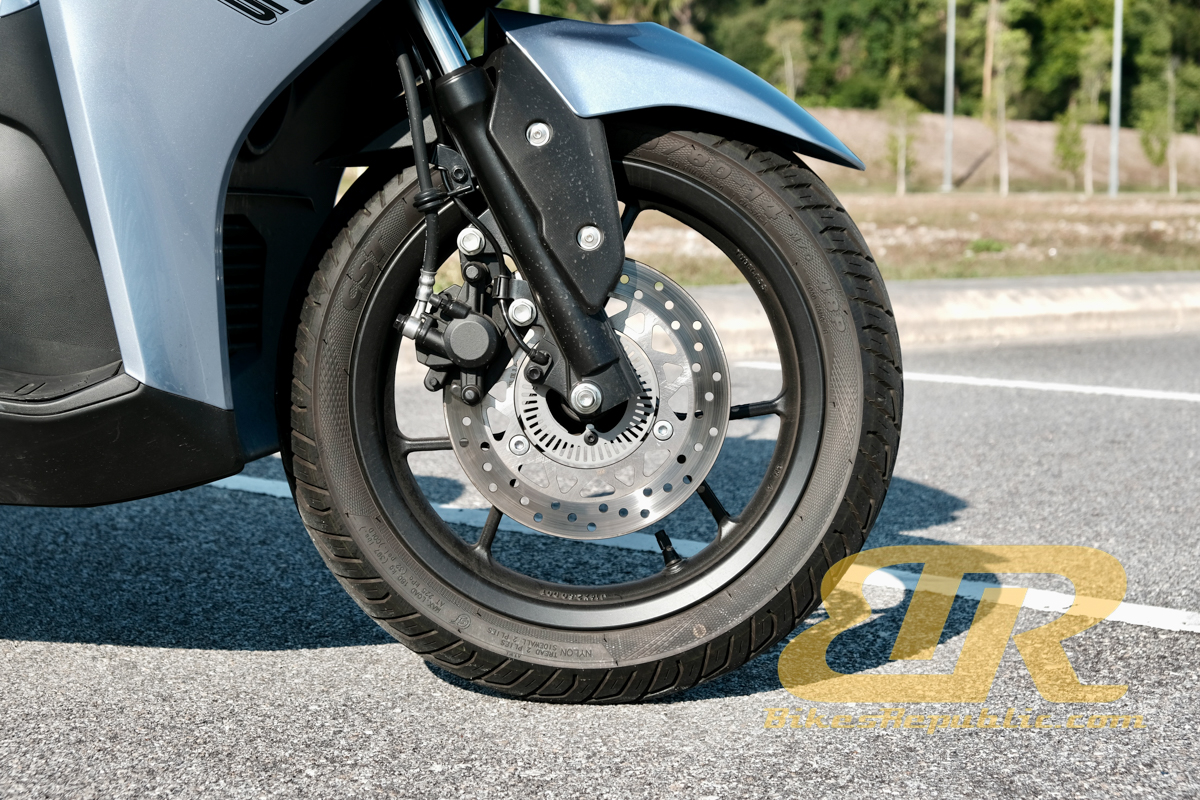
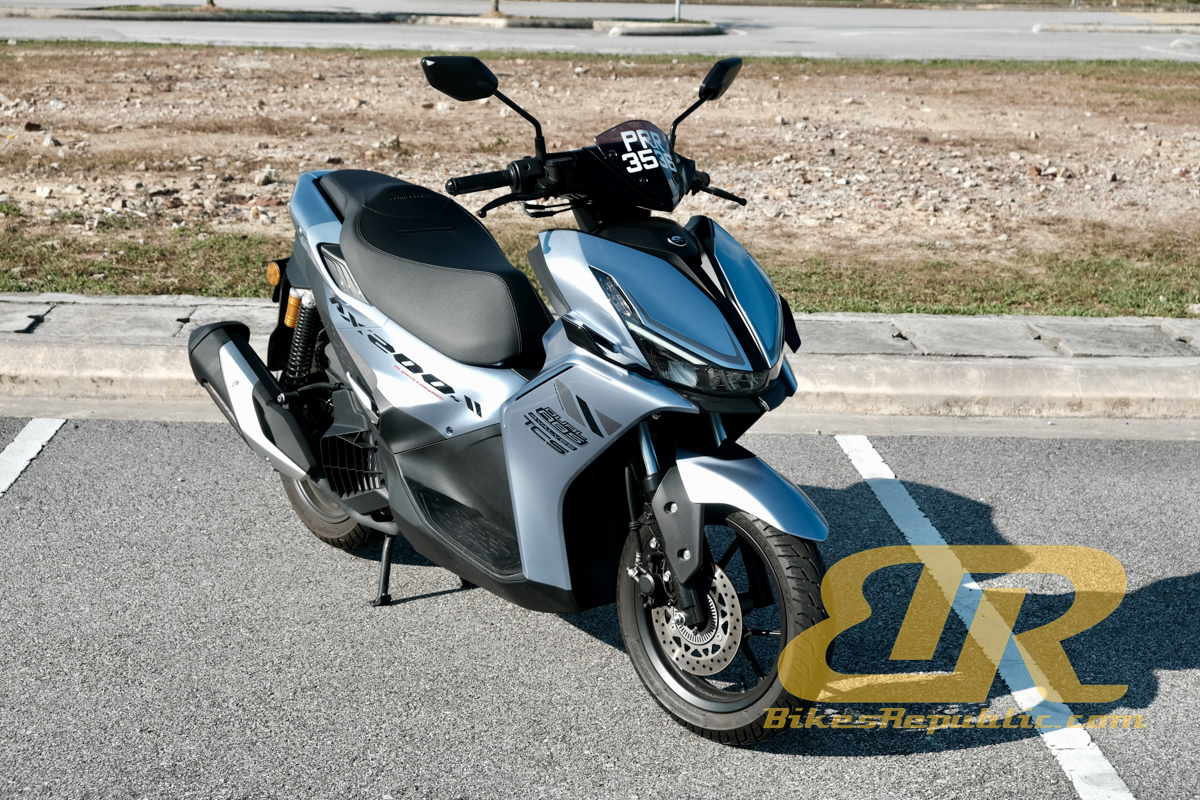
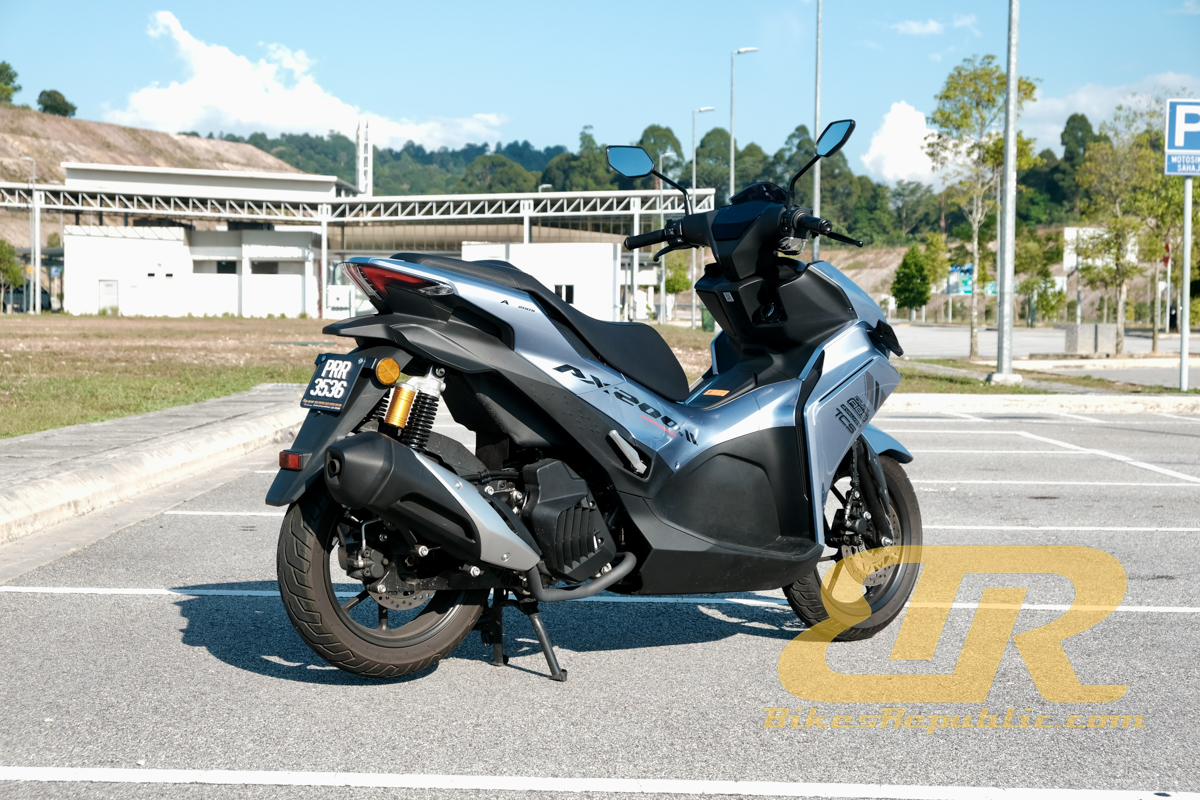
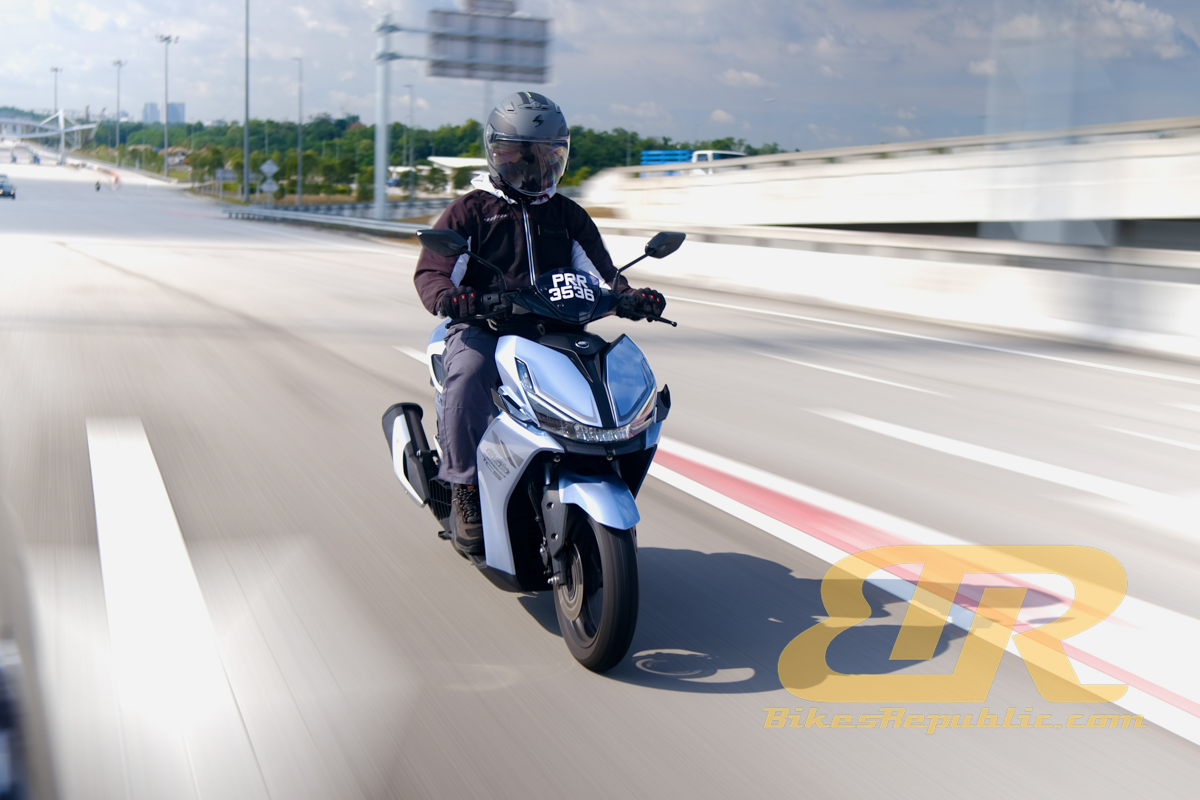
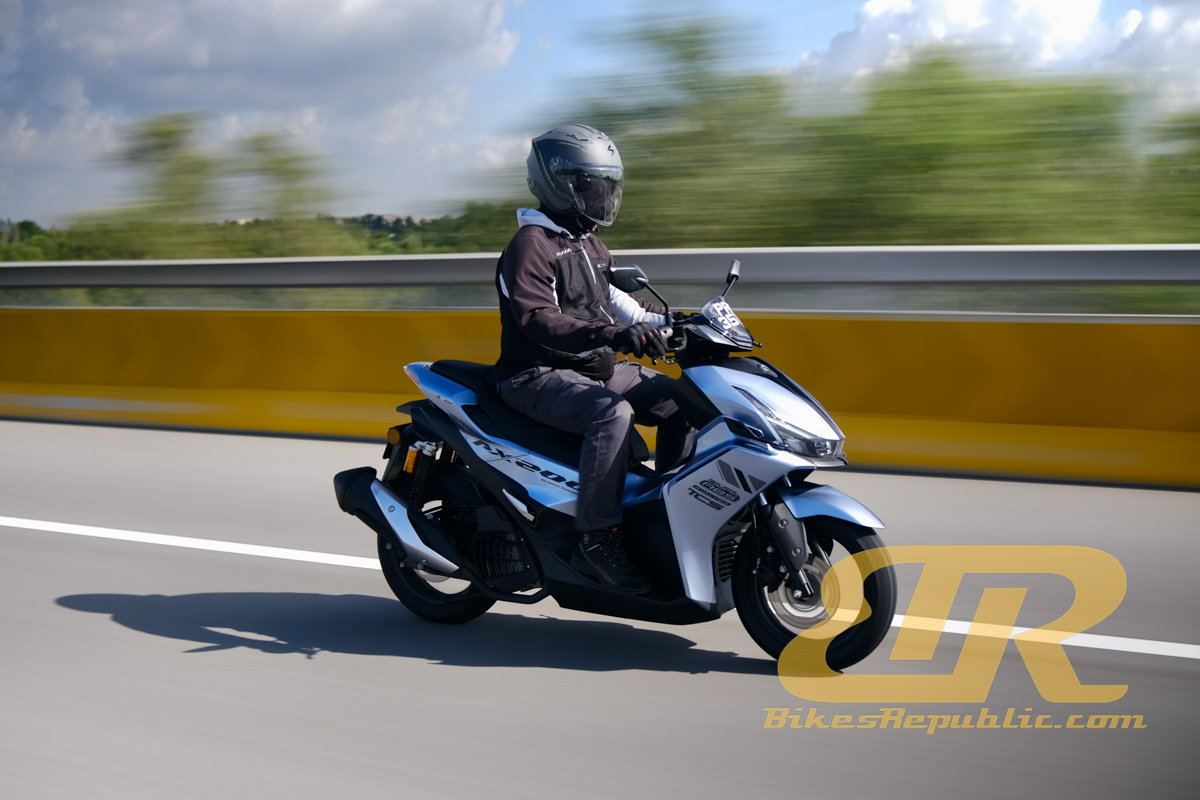
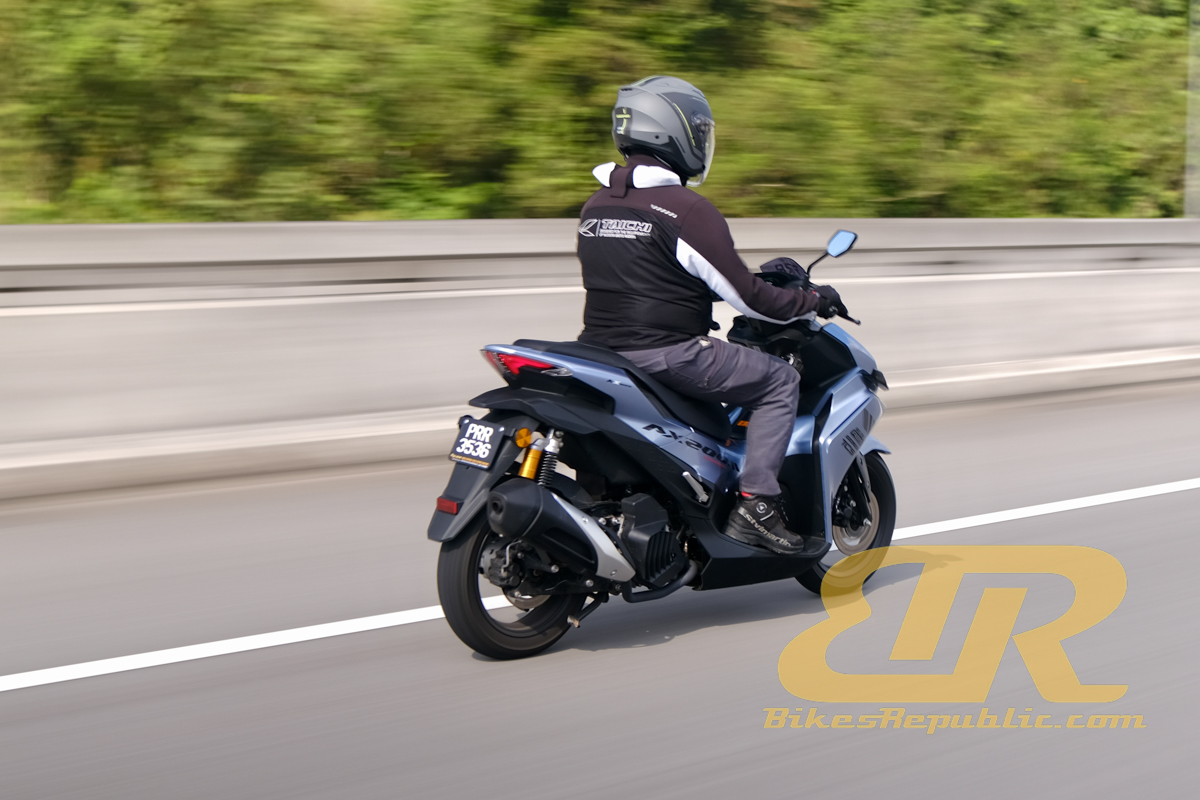
We have been testing scooter after scooter since December 2024, including in China and Taiwan. There have also been several launched in Malaysia during that period, one of which was the 2025 QJMotor AX200s.

Since then, the bike had garnered quite a reputation in the lightweight scooter segment with many comments attaching a whole bunch of (positive) superlatives to it; the most common word used was ‘mantap‘ in Bahasa Melayu which collectively meant “awesome.”

Thus, we were eager to find out for ourselves if those claims really held any water.

What is the 2025 QJMotor AX200s?

The AX200s was launched back in May 2025, as another model distributed by the mega distributor, MForce Bike Holdings.

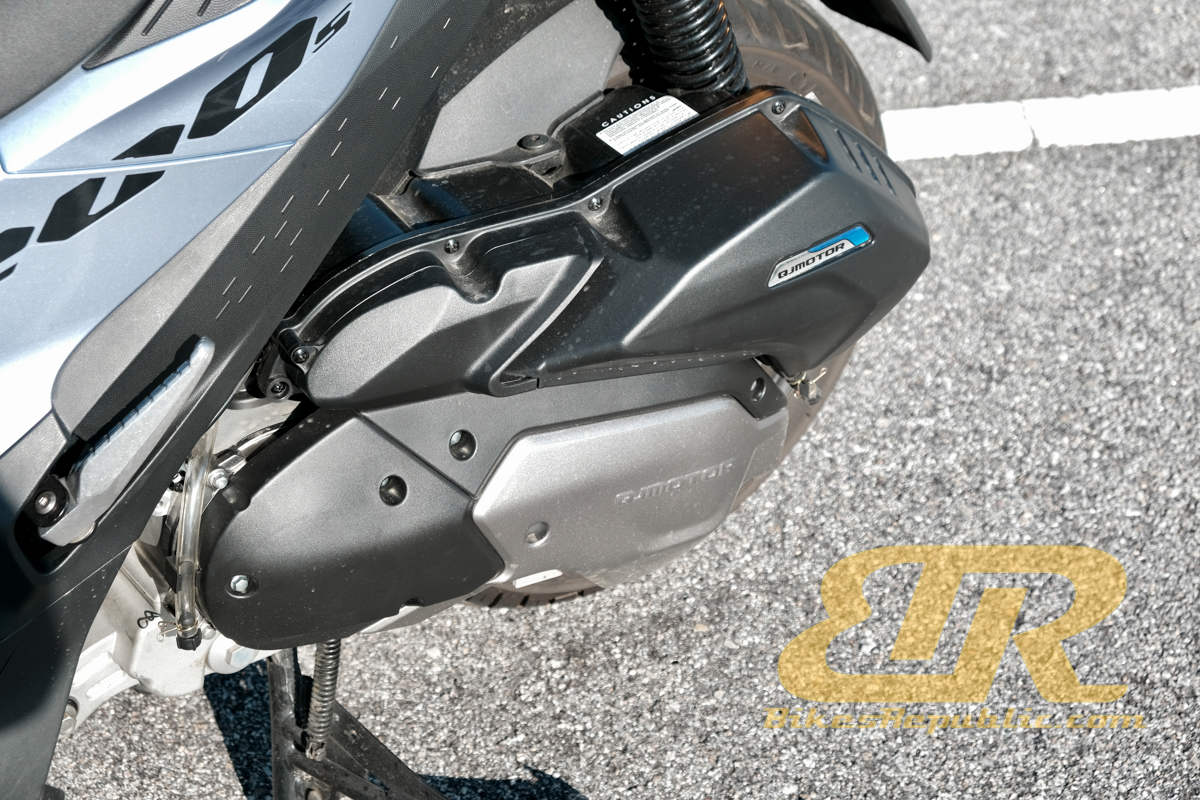
QJMotor, also known as Qianjiang Motorcycle, is a Chinese motorcycle maker that founded in 1985. They have grown by leaps and bounds since then, and currently holds the Keeway and Benelli brands. QJ is also part of the Geely Holding Group. Harley-Davidson had partnered with QJMotor in 2019 to produce a 338cc bike for the Asian market.

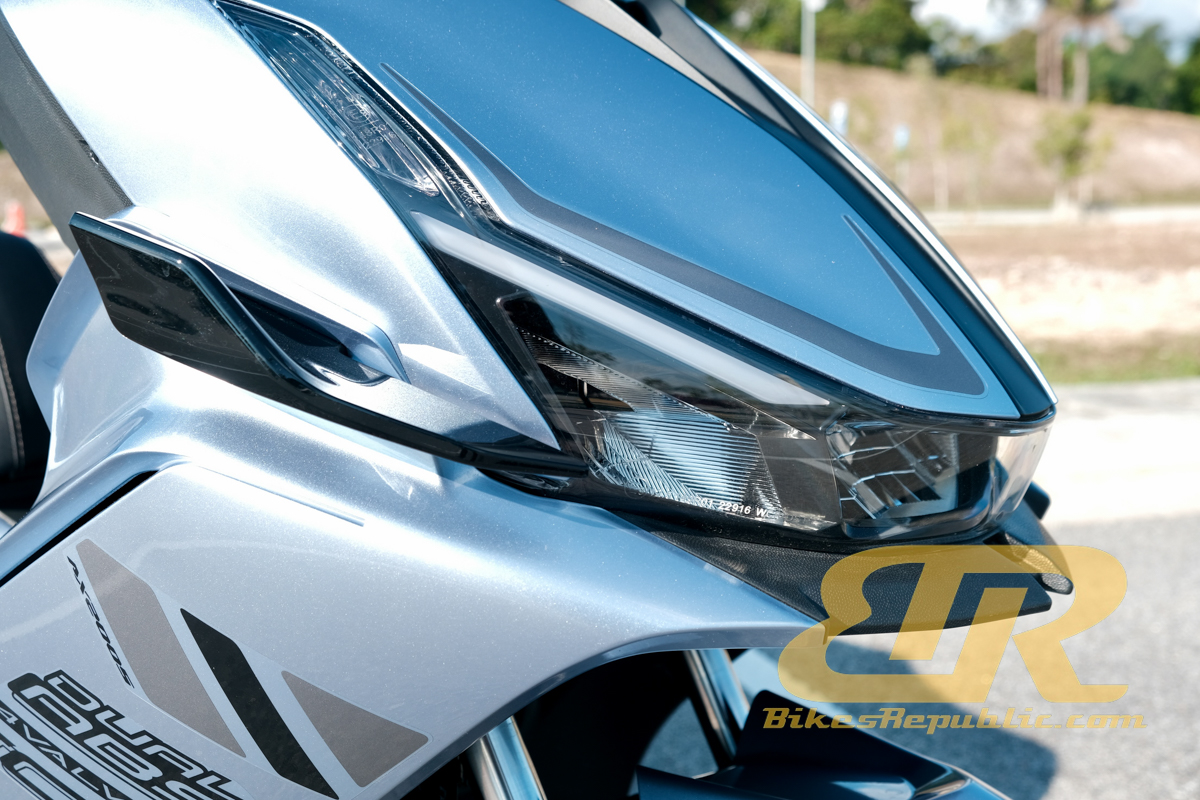
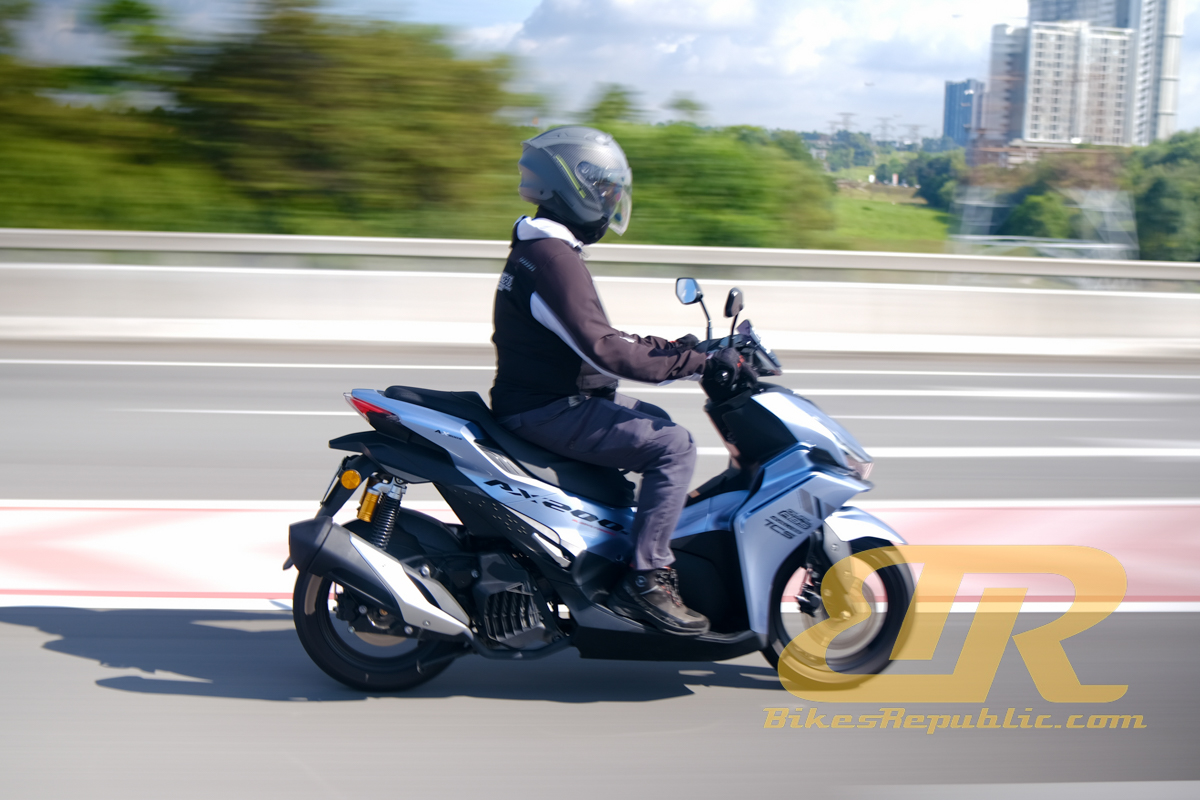
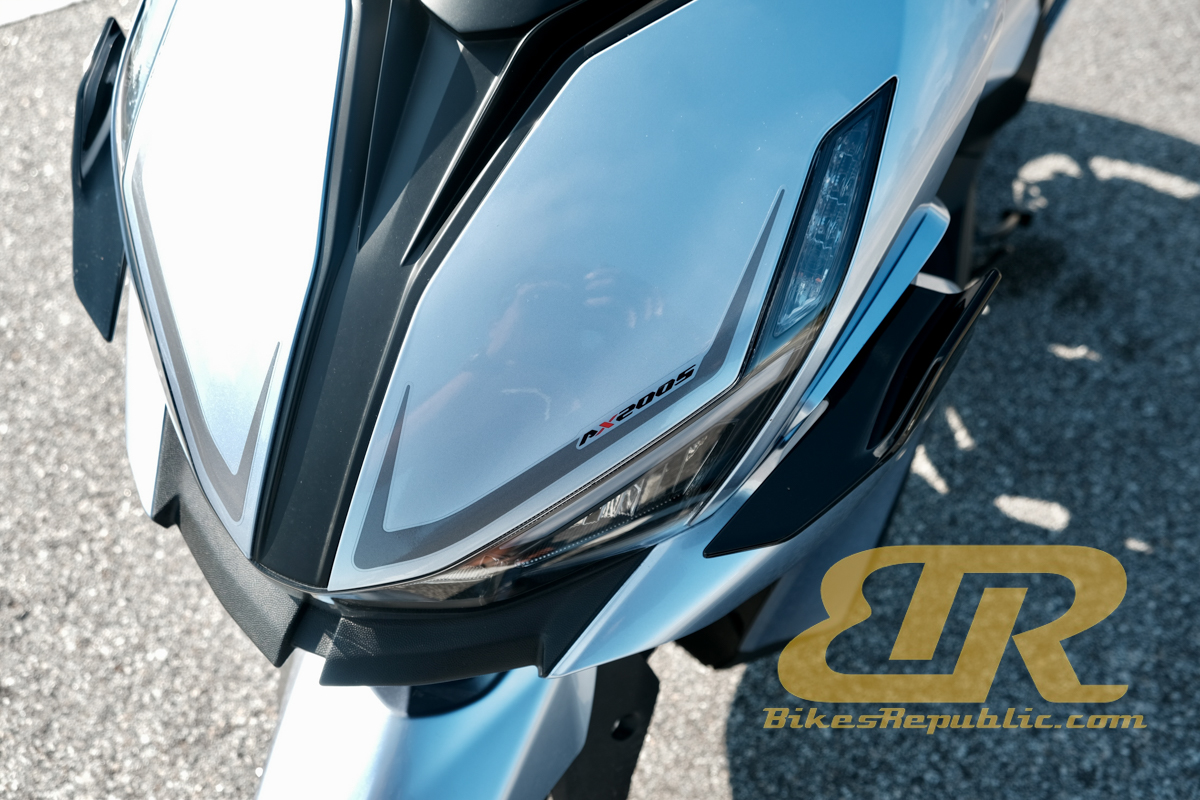
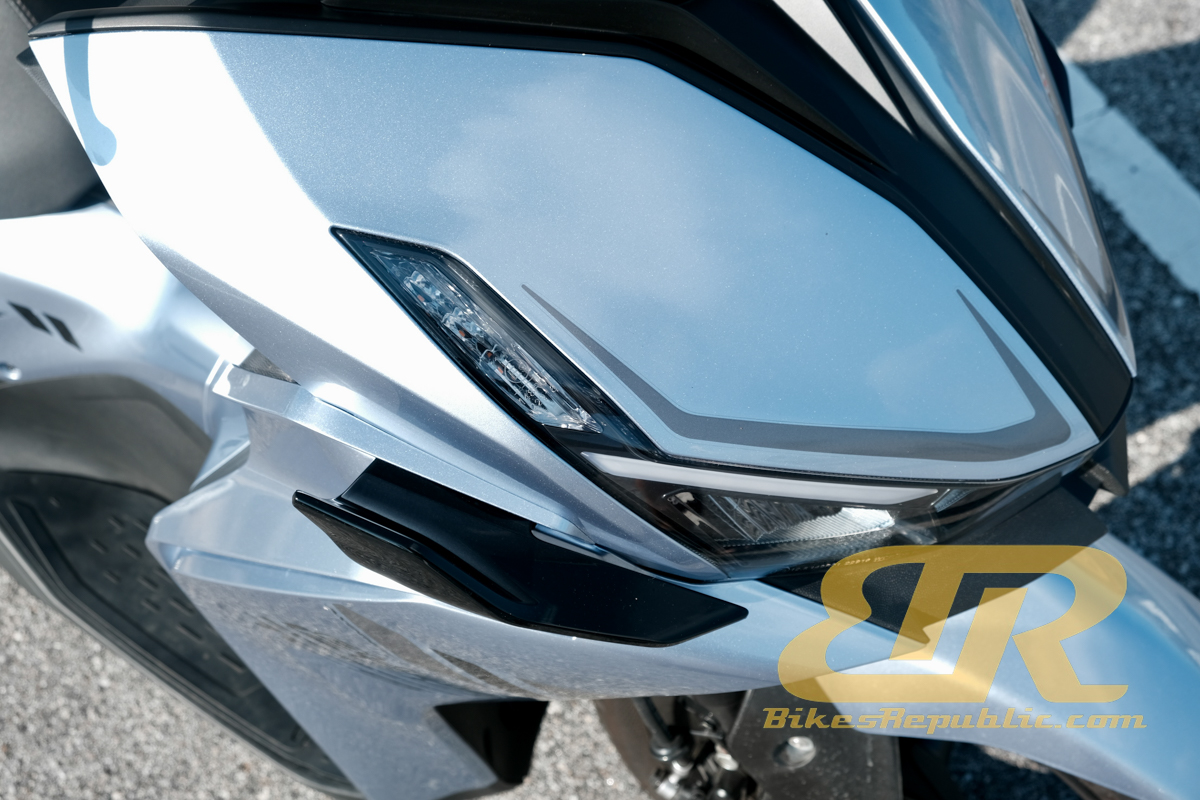
Over to the AX200s, it is a small capacity automatic scooter, but biased toward the urban-sport sub-segment, rather than an adventure scooter. As such, QJMotor did not hide the bike’s intentions by giving it a sharp and aggressive styling.

Let us not beat around the bush and say that it has found itself compared to the Yamaha NVX, mainly because of their similar styling.

Highlights of the 2025 QJMotor AX200s

  • 175cc, single-cylinder, SOHC, 4-valve engine which produces 17.0 hp (13.0 kW) at 8,500 RPM and 15.2 Nm at 6,500 RPM.
  • Front suspension utilises telescopic forks, while there are oil-damped twin shock absorbers at the back.
  • 230mm single brake disc up front, 220mm disc at the back.

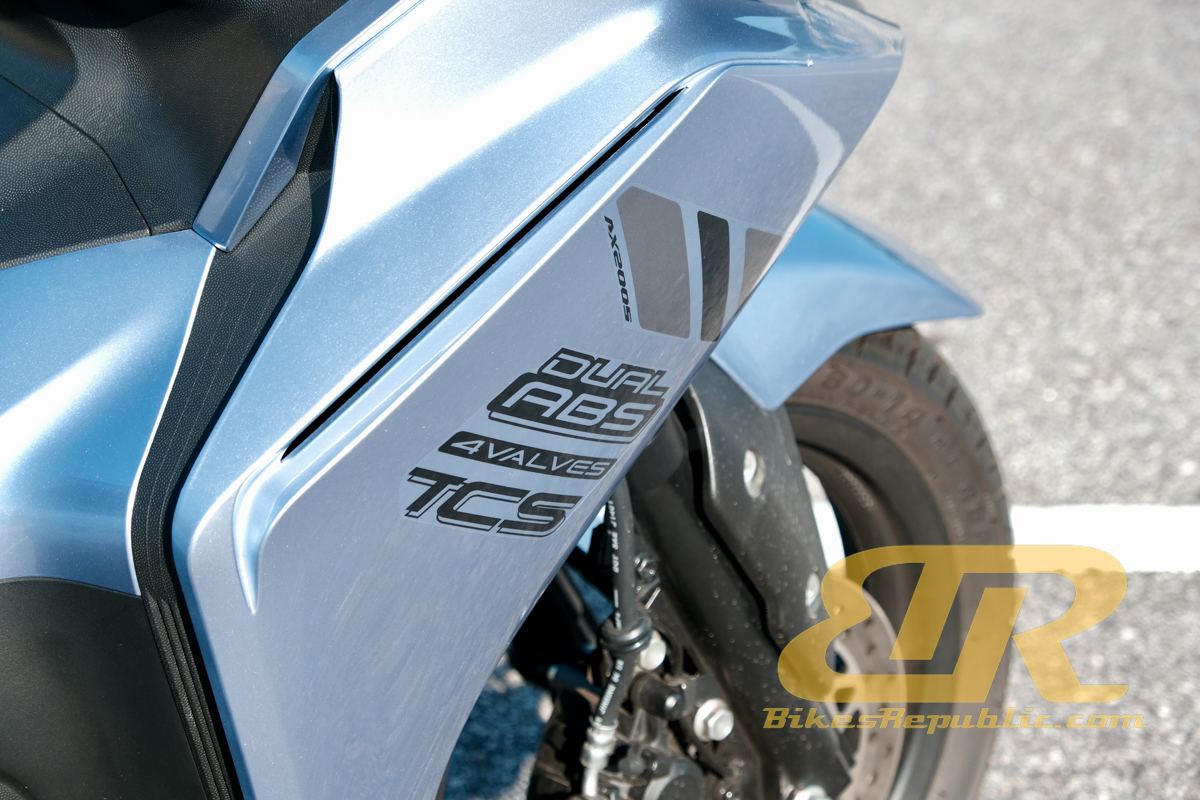
  • Dual-channel ABS and switchable TCS are standard features.
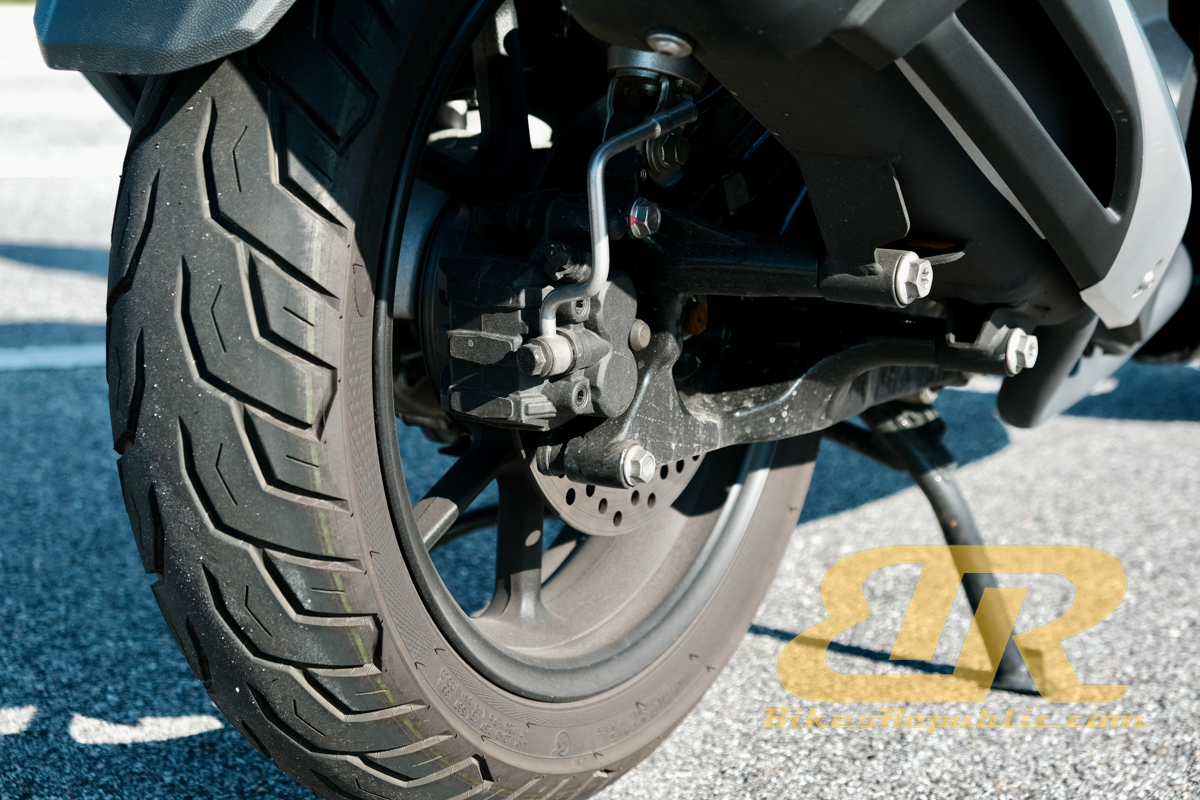
  • 100/80-14 front and 120/70-14 rear tyres.
  • 730mm seat height.

  • 10-litre fuel tank.
  • Dry weight of 127 kg.
  • LCD screen with touchscreen “buttons.”

  • Idle stop function.
  • LED lighting.

On paper, the AX200s pulls ahead in several aspects, such as engine capacity hence maximum power and torque outputs, besides featuring a rear disc brake, bigger fuel tank, and touchscreen metre panel. What it lacks is a smartphone connectivity feature like the Yamaha Y-Connect, but we cannot have it all, can we?

Riding impressions

Pre-ride

Our first impression of the QJMotor AX200s was how compact it is, so much so it could easily be mistaken for a 100cc scooter. It was short from headlight to taillight, had a narrow handlebar, and a diminutive passenger’s seat. That made it look both sporty and cute.

As with every scooter, everything was tucked away underneath a neatly designed bodywork. Speaking about neat, say all you want about Chinese motorcycle makers, but this bike oozed quality: The paint was flawless, there was no rough edge on the plastics, and metal parts had smooth finishing.

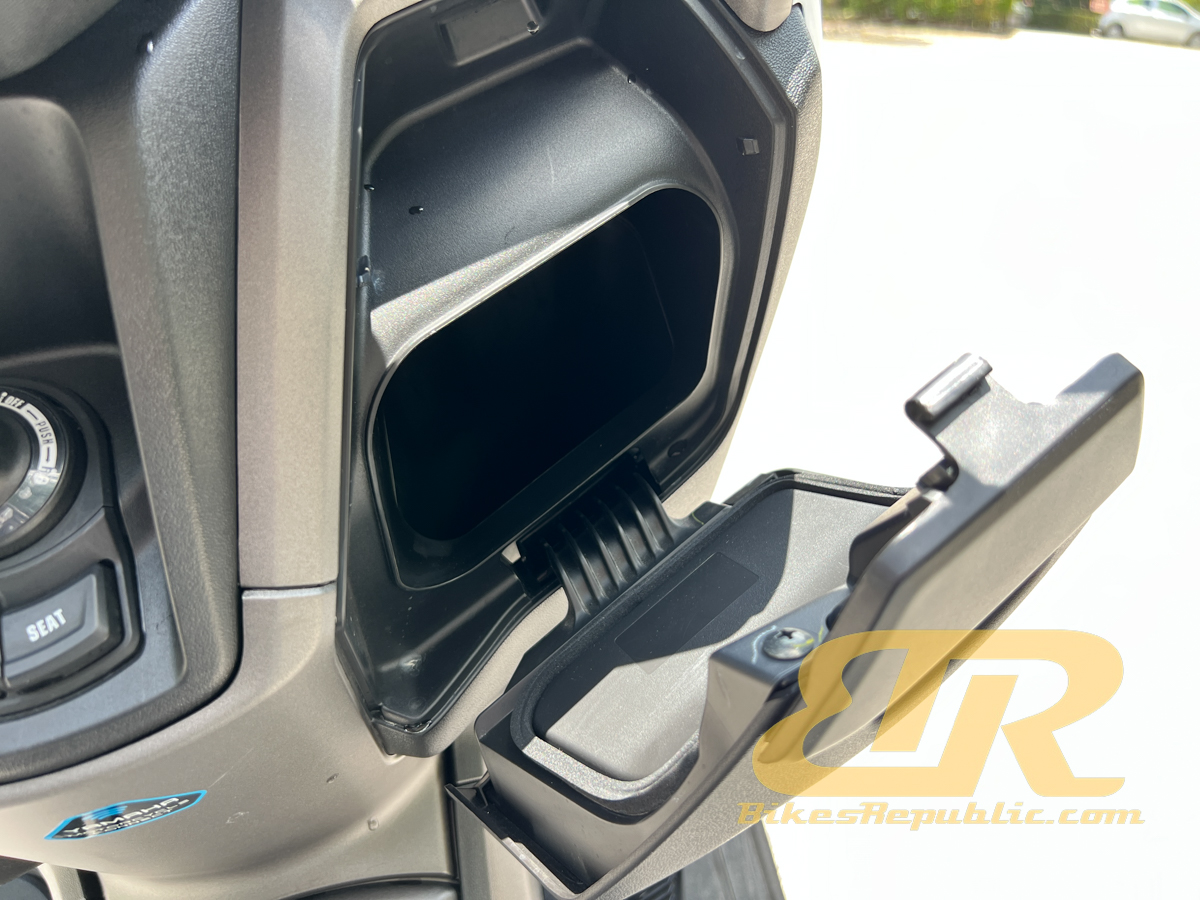
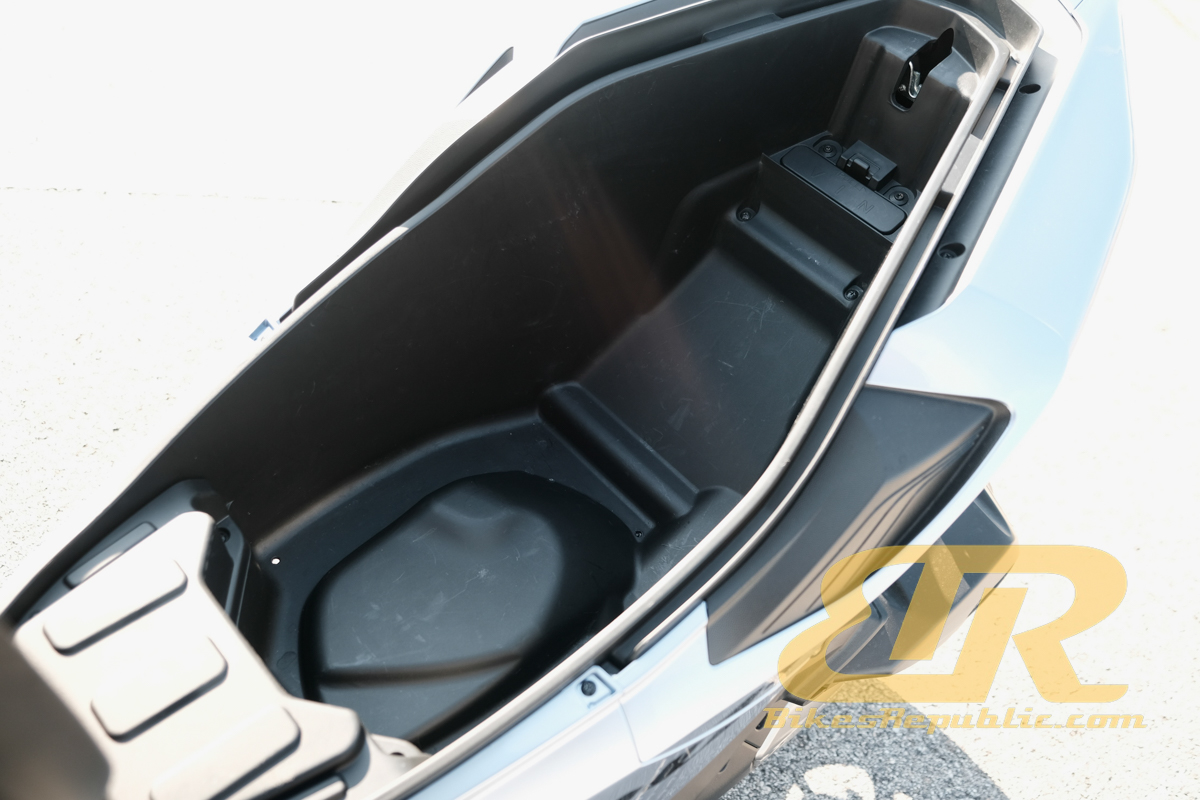
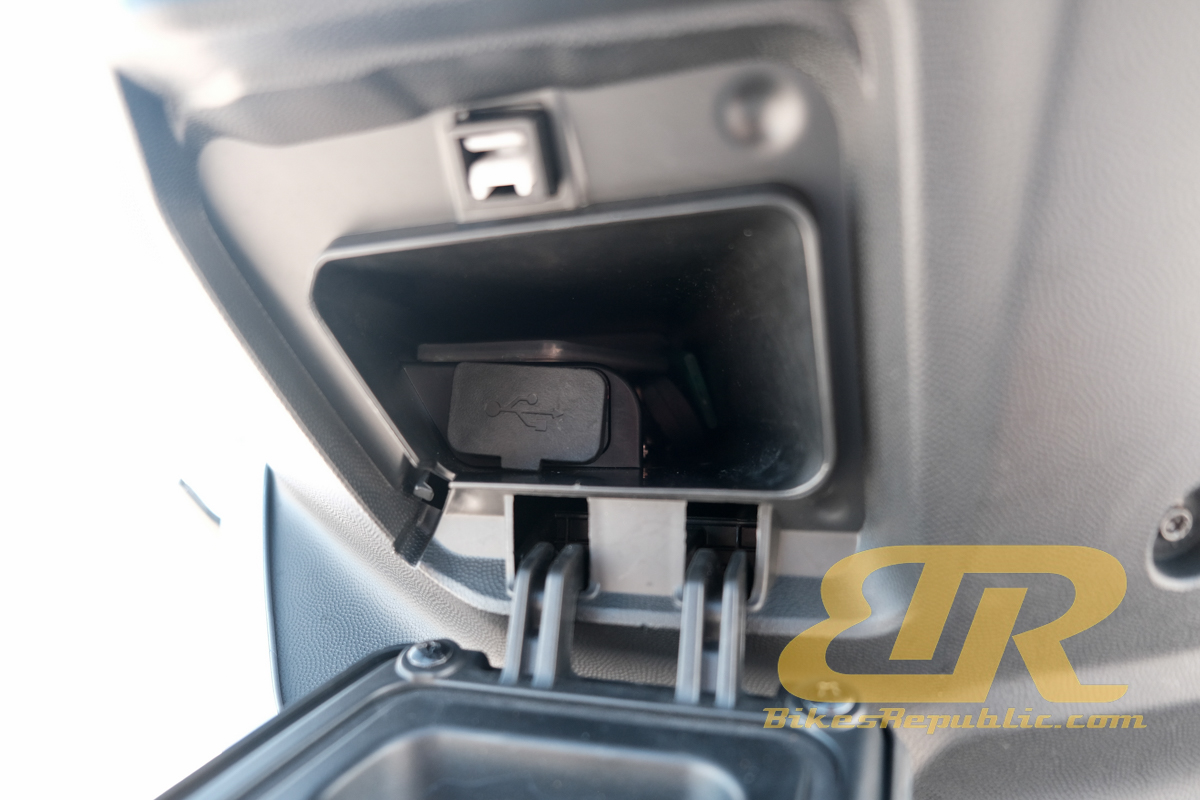
The front “glovebox” was small and had enough space for a standard-sized smartphone and a USB-C charging port. The underseat storage space was also rather small, due to the bike’s compact exterior.

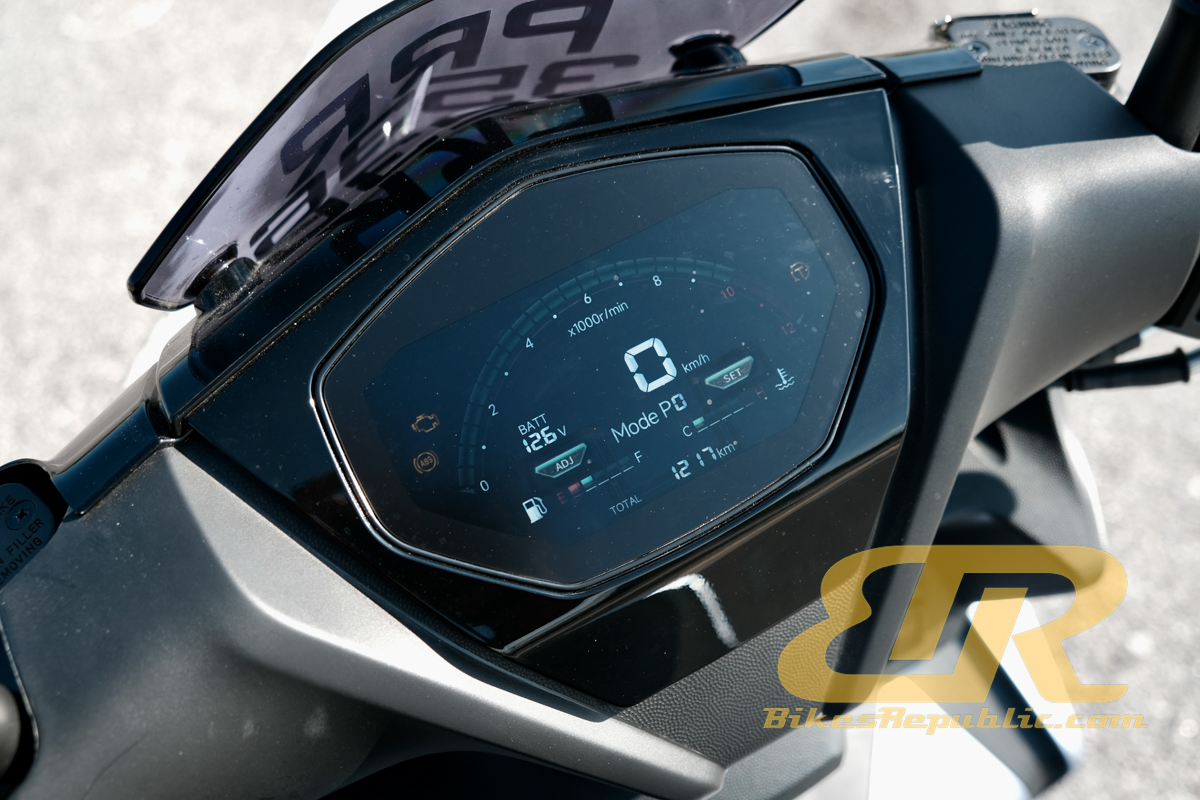
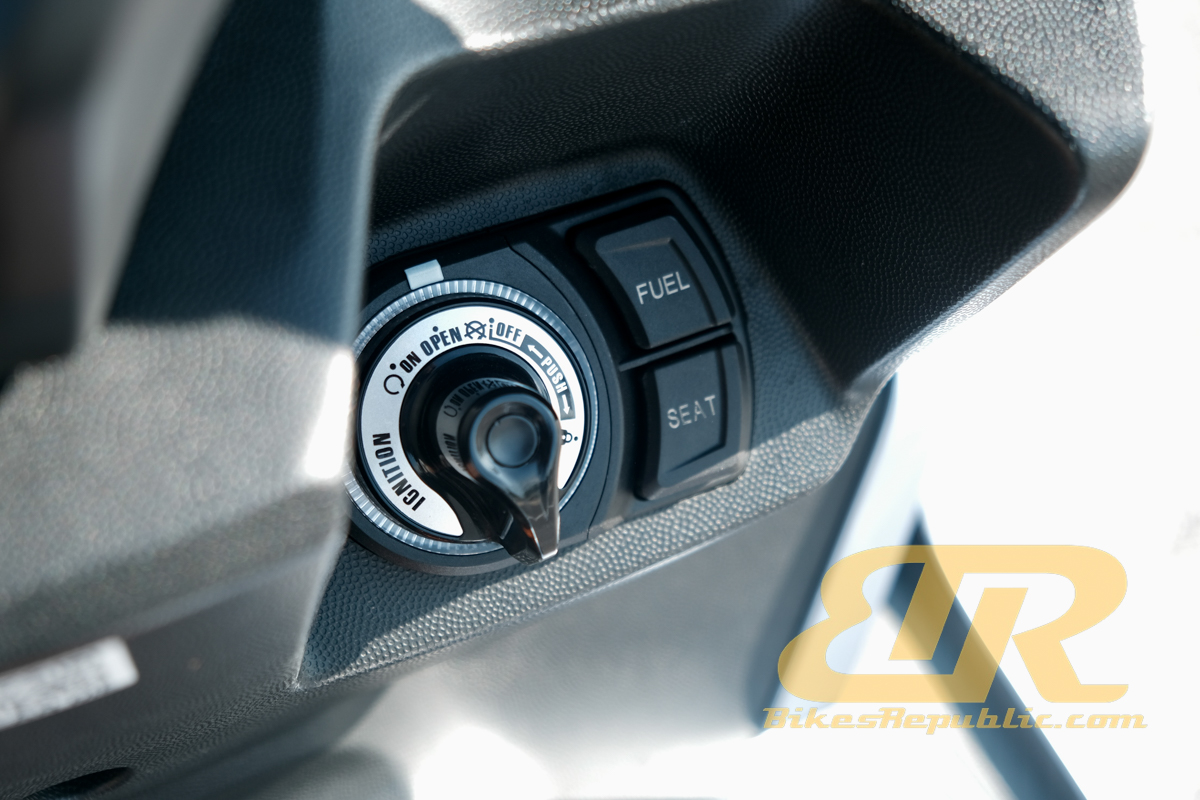
Moving onto the instrumentation, data was displayed on a beautiful colour LCD screen. The letters and icons are so sharp that some thought it was a TFT screen. There was no physical button to switch among the information and to turn the traction control off. Instead, you tap and hold the SET “button” until it blinks, then tap the ADJ icon to select. It works if you wear gloves with phone touch pads, too.

Daily riding

From the perspective of a 167cm rider with short legs and arms, his feet found the ground easily. A little bit of tip toeing, but not ballerina-like, due to the low seat and its shape which taperered sharply toward the front. In any case, the footprint was secure and we could immediately discern the bike’s lightness as it was easy to push around while seated, even up a slight slope.

The reach to the handlebar was (very) short, especially after hopping off a big bike to the AX200s, and we initially felt as if our elbows grew out of our torso. However, it became natural when we spread our elbows.

With all that out of the way, it is a simple scooter and all we had to do was climb on, twisted the Smart Key knob to the correct position, started the engine, twisted the throttle and off we went. There was no power mode or phone connectivity suite to fiddle with.

The AX200s jumped off the line quickly like a scalded cat (apologies for the expression) and kept going as long as the throttle remained open. Glancing in the rearview mirror showed that we had dumped everyone else behind at the traffic lights.

It was not limited to low-RPM torque only as the engine seemed to have much reserve torque anywhere in the RPM range up to its top speed. This quick-reacting torque made overtaking easy, whether on B-roads or highways. The bike’s top speed was also achieved rapidly.

On the other hand, chopping the throttle saw the engine’s back torque (engine braking) grabbing quickly, which pointed toward the bike being fitted with light roller weights.

As such, throttle feedback was a little snatchy when it was first cracked open and shut quickly, especially when we were riding in stop/start traffic. Regardless, we worked around this by holding the throttle very slightly open and dragging the brakes.

Speaking of the brakes, they were superbly strong. Scooters have most of their weight at the back, and therefore the AX200s’s rear brake was more powerful than the front, which was the correct brake force bias. But that did not mean the front brake was anaemic because using the front anchor alone was more enough to bring the bike to a stop without drama.

Another character we enjoyed was its handling. Granted, such scooters feature quick steering as part of their DNA but the AX200s was also stable through corners, unlike some that waggle their handlebars. As such, we ended up charging into and blasting out of corners as if it was a bigger bike. Adding to this attribute was the bike’s generous cornering clearance – we tried to see if it dragged a stand into corners but never succeeded despite throwing the bike into 90-degree corners at high speeds.

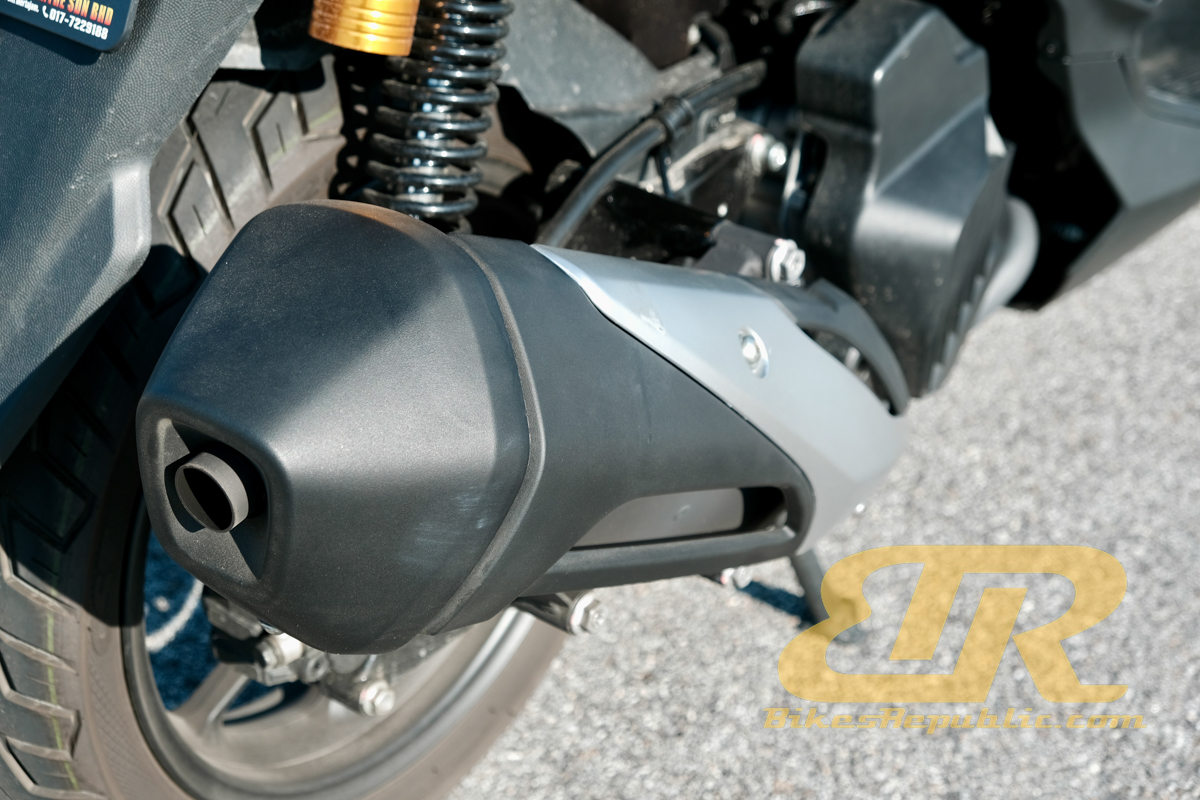
Contributing to the QJMotor AX200s’s admirable handling was its suspension and chassis. The forks looked basic but they do not dive like the Titan submersible even during hard braking that activated the ABS. The dual rear shocks provided a progressive damping characteristic, especially useful in corners.

However, there is only so much suspension travel for urban scooters compared to adventure scooters. Consequently, the AX200s’s suspension felt harsh over sharp bumps. Still, it was necessary and easy to live with compared to having a suspension that wallows like a boat.

Last but not least, that engine returned great fuel economy despite us wringing its neck and deactivating the engine idle stop feature. We filled up half a tank only once during our test period, after picking it up with the low fuel warning showing. Thus the full 10 litres should be able to carry you over a long distance.

Oh yes, talking about low fuel warning: The bike automatically flashed the emergency signal when the fuel level dropped too low, as a warning to the rider and other road users that the engine may flame out at any time. The said warning turned itself off after filling up.

Conclusion

We thoroughly enjoyed ourselves while testing the AX200s. It truly showed just why scooters are so popular at the moment – convenience being on the top of the list. However, the AX200s provided much more than convenience, making it a lot of fun, even for us jaded old timers.

Our only complaint was the small underseat storage space, but it was still enough to fit a three-day grocery bag. Looking at it objectively, not everyone rides along with their laptop computer everyday like us.

Overall, the 2025 QJMotor AX200s was a good product, worthy of the attention. At just RM7,988 (not on-the-road), it is certainly enticing.

Photo gallery

Open-class naked bikes. It is about aggressiveness, style, and performance. In other words, pure motorcycling. Granted, we are lucky to have many open class (1000cc) naked bikes in Malaysia, but the Japanese offerings seem to play the second fiddle to their European rivals in the minds of consumers. So, will this 2025 Honda CB1000 SP bring about a shift in this perception?

What is the 2025 Honda CB1000 SP?

Firstly, the CB1000 is also known as the Hornet 1000 in European markets, and therefore, we need to elaborate further.

The CB1000 range consists Honda’s open-class naked/roadster motorcycles, and it has two current models, namely this CB1000 and the CB1000R. A CB1000F prototype was  also revealed at the Tokyo Motorcycle Show this March and may be launched at the Suzuka 8 Hours Endurance Race in August.

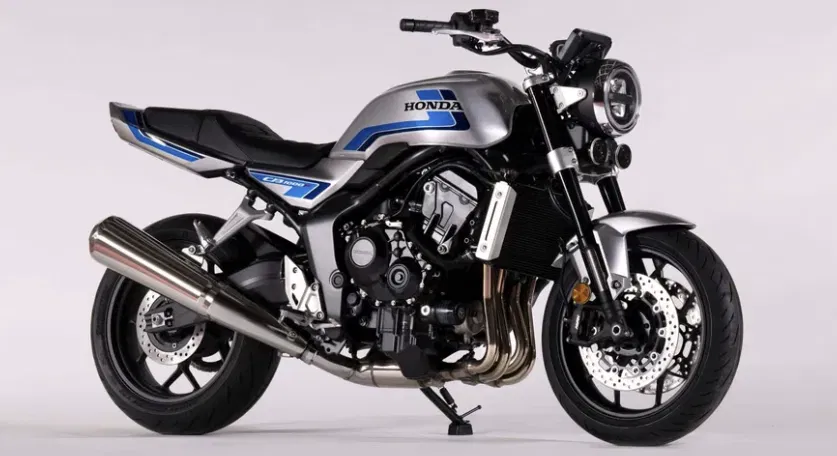
Honda CB1000F

CB1000R: Honda calls it a Neo Café streetfighter, with a single-sided swingarm.

CB1000F: The upcoming variant is an homage to the CB750F/CB900F that Freddie Spencer campaigned in the AMA Superbike Championship in the late 70s and early 80s.

CB1000/CB1000 SP/Hornet 1000: A sporty streetfighter, with a conventional double-side swingarm. The SP version features several goodies.

All three variants share the same 1000cc, inline-four engine adopted from the 2017 Honda CBR1000RR Fireblade, albeit tuned for low to mid-range torque, plus the tubular steel frame.

To understand the CB1000’s philosophy further, the Hornet name is hallowed to Honda. The maker launched the first CB600F Hornet in 1998 for the European market. It was powered by the 599cc, inline-line four engine adopted from the CBR600F (and later CBR600RR) sportbike, and minus the higher-end components. Hence, The Hornet was more accessible, practical, and cheaper, becoming the most popular 600c motorcycle in the UK and Europe.

Coming back to the CB1000/Hornet 1000, it embodies the spirit of accessible performance, practicality, at a budget friendly price, wrapped up in a sharp, aggressive bodywork thereby distinguishing its character compared to its brethren.

Highlights of the 2025 Honda CB1000 SP

  • 1000cc, liquid-cooled, 16-valve DOHC inline-four delivers 155 hp (115.6kW) at 11,000rpm and 107Nm of torque at 9,000rpm.
  • The gain of 5.4 hp (4kW) and 2 Nm is achieved through the addition of a Revolutionary Controlled (RC) valve in the 7.1L exhaust muffler, compared to the non-SP version.
  • Fueling is managed via PGM-FI (Programmed Fuel Injection), supported by a 17L fuel tank.

  • Multi-plate assist & slipper wet clutch, and 6-speed transmission.
  • Adjustable quickshifter enables clutchless up/down shifts.
  • Twin LED projectors and a muscular-style tank.

  • Twin-spar steel frame.
  • Fully-adjustable 41mm Showa SFF-BP forks.
  • Fully-adjustable Öhlins TTX36 rear shock with Pro-Link.

  • Brembo Stylema front brake calipers and 310mm floating discs.
  • 5″ TFT display with Honda RoadSync supports calls, music, nav, and notifications via Bluetooth.
  • Emergency Stop Signal (ESS) system flashes hazard lights during sudden braking for added safety.

  • Three default ride modes (SPORT, STANDARD, RAIN) plus two customisable USER modes.
  • USER1 and USER2 modes allow the rider to tailor Adjustable Power and Engine Braking.
  • Four-level Honda Selectable Torque Control (HSTC) and Wheelie Control boost traction and stability across conditions.
  • 211 kg curb weight.

Riding the 2025 Honda CB1000 SP

Pre-Ride

Our first impression of the new CB1000, engine rumbling at idle with its heat washing over us got our pulse pumping. We have ridden the CB1000R several years ago but that did not have the same effect, for some reason… The new bike has sharper front end (which split opinion, yes), bulbous fuel tank, and sharp tail. The gold rims and forks offset the stealth fighter-like matte black bodywork, resulting in a luxurious look, like that of 70s racebikes and race cars.

Speaking about the front end, we have had comments that it is similar or even identical to the Kawasaki Z1000 and Ducati Streetfighter. What we could say is it looked so very different in the flesh.

We always begin our initial test rides with familiarising ourselves with the bikes’ conrols and settings, to avoid getting confused and distracted while riding.

The 5-inch TFT panel was the same as the one on the NSS250 scooter we just dropped off, and it was a welcome sight, given its sharp and vivid colour display. Every icon, number, and graph were easily discernible and digested. Toggling through the data and features was through “joystick” on the left handlebar. So, we paired our Bluetooth devices by adding another bike in the Honda RoadSync App, customised our display settings, set the riding mode, and quickshifter modes through the TFT screen.

The CB1000 not only use the same TFT screen, its software is also identical as the NSS250’s. We feel that this is a good thing because it makes it easy to configure all the Honda motorcycles in your garage. (In our wildest dreams, of course, judging by how much we make.)

First ride

Throwing a leg over the bike had us discovering its low seat height. Yes, it looked tall in pictures and in real life but we could place both feet on the ground securely. Honda listed the seat height at just 810mm, while most open-class naked motorcycles feature seat heights in the 830mm region.

Helping with that was the bike’s thin “waist” where the seat met the fuel tank. The profile at  the front of the tank was wide, thinned down in the middle, then the passenger’s seat widened out again, giving the motorcycle the profile of a hornet when viewed from the top.

We started out in STANDARD ride mode and the bike made it vividly clear to us that it was tuned for aggression. Slipping out the clutch in first gear and opening the throttle slightly was enough to have the bike roaring down the road. It was enjoyable to blow away absolutely everyone else when taking off from the traffic lights, along with the exhaust that was surprisingly loud for a stock unit.

Daily riding

As much as we loved that low and mid-RPM torque, which made it feel a lot more like a triple rather than a traditional inline-four, it was apparent that the engine was very eager to go. Trying to split lanes at low speeds and in STANDARD mode had the bike lunging forward as soon as the throttle was cracked open, while rolling off ever so slightly resulted in strong engine braking.

We tried to lower engine braking further in the USER1 and USER2 modes to no avail. In the end, we resorted to using the clutch a lot more.

We soon discovered that the best mode to navigate through heavy traffic was RAIN. Switching to this mode had the engine calm down aurally, and the throttle response and engine braking became very smooth.

But do not get us wrong, the CB1000 was still a huge pleasure to ride and ride quickly in urban surroundings, given that we have so many highway on and off ramps!

The Mountain

The “Mountain” is our regular test route as it offers everything the Malaysian road system could muster: Fast sweepers on the highway, tight and bumpy corners on the way up and down.

We switched to SPORT mode before leaving the BHP Gombak petrol station. The engine sounded like it was burning rocket fuel now – louder, rawer, more visceral – even before we got moving.

Pulling out of the station’s forecourt and onto the highway had our arms stretched straight as the engine gave a mighty kick, so much so that the handlebar became light and started to waggle. We were grateful that the HSTC package included Wheelie Control and could hear the engine dragging a little like the clutch being slipped. Otherwise, we would probably be pulling a crossed up wheelie.

Also thankfully, the bike’s suspension and chassis are up to the task, despite looking basic. On the highway, the bike’s sharp steering had it hitting every point we pointed it without hesitation or drama. We could change our line through corners despite being leaned way over without the chassis and tyres tying itself up in knots. Bumps on the highway felt non-existent. The only difficulty was trying to hang on due to the wind blast at elevated speeds.

Up the mountain road, we charged into corners regardless of radius or camber and let the engine’s torque carry us out to the next one. However, the suspension, especially the rear shock felt stiffer when faced with the bigger bumps and potholes. Three clicks off the TTX36’s rebound damping solved it. From here on, no bump could upset our chosen cornering line.

The brakes were also awesome. They provided amazing stopping power along with a superb feel at the lever. When push came to shove, we used that feedback to trail brake into corners which surprised several supersport riders.

Adding to the visceral feel of the bike was the RC exhaust valve which beings to open at 5,700 RPM. Riding the bike below that point, we hear the growling exhaust note. From 5,700 RPM and above, the exhaust note became a howl which stood the hairs on the back of neck up.

However, do keep in mind that 5,700 RPM in sixth gear had the bike running at over 130 km/h…

It suddenly dawned upon us about how easily we could contradict (read: fool) ourselves. This tester had said to himself that riding a slower bike or scooter was relaxing, and questioned who needs a powerful bike, only to giggle in his helmet like a schoolgirl when the Honda CB1000 SP blew everyone away. When they said power corrupts, it really does.

Conclusion

The 2025 Honda CB1000 SP reminded us that a powerful, but controllable motorcycle was always fun to ride. It is this kind of motorcycle that makes you want to go out and just ride. And ride. Repeat.

Of course, it was not perfect due to the abrupt throttle response in some riding modes but we overcame that in the first few minutes riding the bike. But it was this kind of character that imbues the bike with the two distinct personalities of a (sassy) pussycat and a tiger, depending on your preference and mood.

Also, upshifting with the quickshifter was not as smooth in the first three gear despite us playing around with different RPMs, modes, and settings. But so what? We still shift gears manually on every motorcycle (not scooters, of course!) anyway.

At just RM69,999 (RRP, not on-the-road), Boon Siew Honda had brought in another winner, and yes, it can rival the European bikes by offering great handling and accessibility.

Our final advice: Do not test ride the bike unless you are willing to suffer the adrenaline withdrawal like we did.

2025 Honda CB1000 SP Specifications

Model CB1000 Hornet SP
ENGINE
Type 1,000cc liquid-cooled, 27.6º inclined, inline-four, four-stroke
Valve Train DOHC; 4 valves per cylinder
Bore x Stroke 76.0mm x 55.1mm
Compression Ratio 11.7:1
Induction PGM-FI fuel injection with 44mm throttle bodies (ride by wire throttle)
Ignition Full transisterized
Starter Electric
Transmission 6-speed manual
Clutch Multiplate wet
Final Drive #525 Chain; 15T/45T
SUSPENSION
Front 41mm Showa Separate Function Front Fork Big Piston (SFF-BP) with adjustable preload and compression/rebound damping; 5.1 in. travel
Rear Pro-link system with Öhlins TTX36 shock absorber, adjustable preload, compression, and rebound damping; 130mm travel
BRAKES
Front Dual Brembo Stylema radial-mount four-piston hydraulic calipers with 310mm floating discs; ABS
Rear Single Nissin one-piston hydraulic caliper with 240mm disc; ABS
TIRES
Front 120/70-17
Rear 180/55-17
MEASUREMENTS
Rake (Caster Angle) 25º
Trail 98 mm
Length 2141.22 mm
Width 792.48 mm
Height 1087.12 mm
Ground Clearance 134.62 mm
Seat Height 810.26 mm
Wheelbase 1455.42 mm
Fuel Capacity 17 litres (incl. 3.78 litres reserve)
Curb Weight 210.92 kg
OTHER
Colour Matte Black Metallic

Photo gallery

Automatic scooters are undoubtedly the in-thing in the Malaysian motorcycle market these days, with more and more models entering the “war zone” almost on a monthly basis. However, let us not ignore the elephant in the room: It is now the legacy manufacturers versus the Chinese contenders. As such, how will the 2025 Honda NSS250 fare?

What is the Honda NSS250

The 2025 Honda NSS250 is a new(-ish) 250cc maxi-scooter. Newish because Honda had revised the the previous Forza 250 (called the NSS250 overseas), which was available in Malaysia. So now, it is the NSS250 in Malaysia, while it is the Forza 250 overseas.

2025 Honda NSS250

Still, we feel that Honda did a great job as they have taken the NSS250 to a contemporary styling, compared to the old school style previously. And Honda being Honda, the bike’s styling is modern but restrained without being fussy. Pictures do not do it justice, because you could just sit beside the NSS250 and point out the small details for hours.

One look at the bike and you will realise how much the maker paid attention to comfort, convenience, and elegance, besides sportiness.

Highlights

  • Powered by a 249.5cc, single-cylinder, liquid-cooled, SOHC, 4-valve, with PGM-FI injection and eSP+ engine, which delivers 23 hp (17 kW) at 7,750 RPM and 24 Nm of torque at 6,250 RPM.
  • The PGM-FI and eSP+ features ensure a smooth torque delivery, along with optimum fuel efficiency.
  • Automatic transmission with dry centrifugal clutch.

  • Telescopic 33mm diameter front forks, dual shocks at the rear with double-sided swingarm.
  • Single 256mm brake disc up front, single 240mm brake disc at the back.
  • Dual-channel ABS.

  • Tyre sizes are 120/70-15 in front and 140/70-14 rear.
  • 11.7-litre fuel tank.
  • 780mm seat height.

  • 185kg curb weight.
  • 5-inch TFT display with weather, navigation, music streaming, volume control, phone calls, and message notification features via the Honda RoadSync app.
  • Honda Selectable Torque Control (HSTC) traction control system.

  • Emergency Stop Signal feature which flashes the double signal during hard, emergency stops.
  • LED lighting throughout, the front signals are integrated in the fairing-mounted rearview mirrors.
  • Electrically-adjustable windshield.

  • Smart Key ignition.
  • 48-litre underseat storage space, enough for two full-faced helmet.
  • Lockable glovebox with USB-C charger, that is large enough to fit a 1.5-litre bottle of water, besides a smartphone!

Riding the 2025 Honda NSS250

Pre-Ride

Our first impression of the new NSS250 was how different it was compared to its predecessor. The older model definitely looked er… older, being long, low, bulbous. The new bike is more compact, sharper, and enticing. The rims are beautifully powdercoated in magnesium-gold, the bodywork has some tastefully-done panels, the tyres are fat, and that taillight cluster was the nicest among all scooters in the market.

Switch it on and the TFT panel comes to life with the Honda wing, before switching to a vivid and sharp display. All the icons, numbers, and tachometer are easily discernible without this writer wearing his reading glasses. The “joystick” on the left handlebar allows to you to toggle through all the bike’s data and features, such as pairing Bluetooth devices, display settings, data display settings, turning HSTC on or off, plus your next maintenance schedule.

Speaking of Bluetooth connectivity, we would always get it done right after receiving the key, before the initial ride. Connectivity needed to be performed through the Honda RoadSync app, which guided us step-by-step, hence it was painless. Once connected, we could begin to use the navigation feature, which we either typed in or spoke of the location into the phone.

However, we would like to point out that since all of us used iPhones, music streaming on the bike is only available through the Apple Music app. But this is only a small niggle, as we hooked up our Midland BT Mini Bluetooth headset directly to our phone, and played music through Spotify. The only shortcoming was we could not control music playback via the NSS250’s joystick or see the song being played on the TFT screen.

The navigation feature was nice to have, of course, but beware, it is not yet as intuitive as Waze when you hope to ride around heavy traffic. Instead, it only points you to take the nearest route, much like when you set your Google Map to motorcycle mode. It also lagged when we rode at high speed, and sent us in the wrong direction altogether. Further, you could not activate shared locations directly to the app. We hope Honda can update the RoadSync app.

First ride

With that out of the way, the engine fired up with a quick but smooth vroom to let us know it was alive. Blipping the throttle while the bike was on its centrestand did not have it vibrate so much that it scraping along the ground. No, the NSS250’s engine was smooth.

Getting it off the stand was super easy and the bike seemed lighter than its published 185kg curb weight. It was also perhaps Honda mounted the centrestand in the correct centre of gravity.

Having ridden other scooters in the past, we began with a small throttle openings to avoid punching off the line with our feet akimbo and zig-zagging like a fool. Instead, the bike rewarded us with a silky smooth acceleration. The engine sounded like your average single-cylinder scooter, but that typical clunking noise was absent.

We tried it again from another traffic light and again, the bike will push off idle in a smooth fashion, as long as the throttle remain in the first one-third.

However, when we ripped the throttle above fifty percent, things happened mighty quickly. Acceleration was still smooth, mind you, but the speeds piled on almost in a blur. Once it reached 90 km/h, the NSS250 took off like it lit the afterburner. And at these speeds, rolling off the throttle will have the bike coasting as if it was freewheeling, which was evident of heavy rollers.

We hope you do not misinterpret what we meant. This was not a bad thing, not at all. Honda did a great job of giving the 2025 Honda NSS250 this “dual character” for better riding. The smooth, linear torque is great for riding in congested traffic and urban areas, while the quick torque and power hit are great for riding on the open highway. In doing so, you do not have to struggle with an abrupt on/off throttle response while lane splitting, while still having reserves of power when you need to overtake slower vehicles on the highway. And Honda did so without needing to equip the bike with a variable valve system which just adds extra complexity.

Handling

We shall come right out and say that the 2025 Honda NSS250 is the best-handling 250cc scooter.

It is given that any scooter is keen to change direction, but the NSS250 does it great stability, almost like a big bike. The front end did not felt like it wanted to plop into any corner and did not waggle like a happy puppy. There was also plenty of feedback from the tyres, unlike other scooters, which gave us plenty of confidence to hoon the bike through corners.

The bike was ultra stable at top speed in a straight-line, too. It seemed to just hunker down on its suspension at speed, despite us sitting upright.

As for the suspension, it is a given that scooters feel harsh over sharp bumps due to their short-travel suspension. But we were completely surprised by this bike as both ends absorbed road irregularities well without once transferring bump energy to our liver. Yet, the chassis did not damp out the feel from the tyres, like we mentioned earlier.

Next come the brakes. The calipers and master cylinders are from Nissin and provided a crazy amount of stopping power when you need it. There was also plenty of feel on the levers, therefore letting you know how much braking you could utilise, which was something which I wished that some bigger bikes has it. Heck, we even trail-braked the bike into corners, which was something very dangerous for scooters.

Convenience, fuel economy, everyday riding

Although Boon Siew Honda loaned the NSS250 to us for only four days, we racked up close to 600 kilometres in that time. We would not have ridden it so much if it was not enjoyable (and we had two other test bikes just sitting at home).

That electrically-activated windshield was a huge welcome. We lowered it for more airflow and visibility when negotiating gridlocked traffic, and moved it up to reduce wind noise on the highways.

The underseat storage space was a huge (pun intended) welcome. We could store our jet-type helmet, plus a 10kg bag of rice and groceries. The front glovebox took a whole 1.5-litre bottle of water (great thing since it is so hot now). So who needs a Givi case when you ride this bike???

Not once was the bike difficult to start or to get on or off. The seat was low enough despite its large side panels, enabling us to plant our feet on the ground securely. Yes, the seat cushion seemed a little hard at first, but our backside did not feel sore after riding all day.

Add to that is Honda’s signature quality. The bike was oozing quality every centimetre we peeked. The panels fitted tightly, there was no creaking when we rode the bike over bumps, everything clicked and locked as they should.

Last but not least, the engine was really fuel efficient. We picked up the bike with half a tank of petrol and we only filled it back up once, also with half a tankful during our review.

Conclusion

To answer our opening question, the 2025 Honda NSS250 clearly shows why the legacy manufacturers are still in the game. Its ride quality, engine performance, build quality are nothing to be sneezed at. Sure, the Chinese contenders pack their bikes with more tech and features, but it is still the Japanese manufactures who provide an complete overall riding experience, especially in the chassis, handling, and overall quality fronts. In fact, this new NSS250 has beaten its closest Japanese rival.

In fact, it occurred to us that it was almost like riding the class-leading Honda Gold Wing, albeit a smaller version. Seriously, it is not because we are pandering to Honda, but it is truly so.

The only shortcoming we encountered was the navigation and music streaming feature, but that has to do with the external app, rather than the motorcycle itself.

So, is the 2025 Honda NSS250 worth the RM25,888 (recommended retail price, not on-the-road)? Every sen of it!

Specifications of the 2025 Honda NSS250

Engine
Type Single-cylinder, liquid-cooled, SOHC, 4-stroke, 4-valve, eSP+, PGM-FI
Displacement 249.5 cm³
Bore x Stroke 67.0 mm x 70.7 mm
Compression Ratio 10.2 : 1
Max. Power 23 hp (17 kW) / 7,750 rpm
Max. Torque 24 Nm / 6,250 rpm
Engine Oil Capacity 1.3 ℓ (After draining), 1.8 ℓ (After disassembly)
Drivetrain
Clutch Type Automatic centrifugal clutch dry type
Transmission Type Automatic
Chassis
Frame Type Underbone
Dimensions (L x W x H) 2,143 mm x 754 mm x 1,507 mm
Wheelbase 1,510 mm
Seat Height 780 mm
Ground Clearance 140 mm
Curb Weight 185 kg
Running gear
Suspension Type FR Telescopic
RR Swing Arm with Double Suspension
Tyre FR 120/70 – 15M/C (56P)
RR 140/70 – 14M/C (62P)
Brakes FR 256mm Hydraulic Single Disc with 2-piston Calliper, ABS
RR 240mm Hydraulic Single Disc with 1-piston Calliper, ABS

Photo gallery

Archive

Follow us on Facebook

Follow us on YouTube