Bikesrepublic

Latest News

We have written about fuel octane, or more specifically, what it does and why do we have different RON ratings at the pump. Fuel octane is directly tied to the engine’s compression ratio.

What is compression ratio?

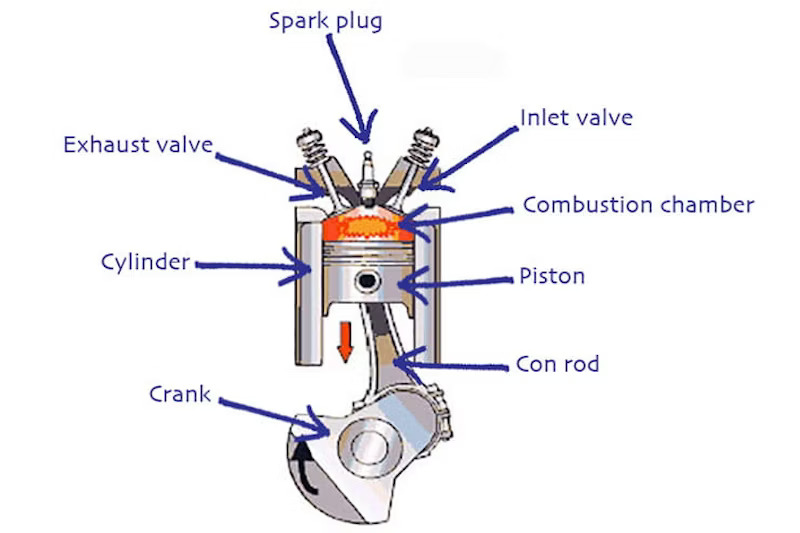
A ratio means something divided by another thing. Firstly, take the cylinder’s volume when the piston is fully at the bottom of its stroke (bottom dead centre/BDC), and add the combustion chamber’s volume. Secondly, take the volume of the cylinder when the piston is fully at the top of its stroke (top dead centre/TDC). Now take the BDC volume and divide against the TDC volume. This is why compression is expressed as 10:1. 11:1. 13:1 and so forth.
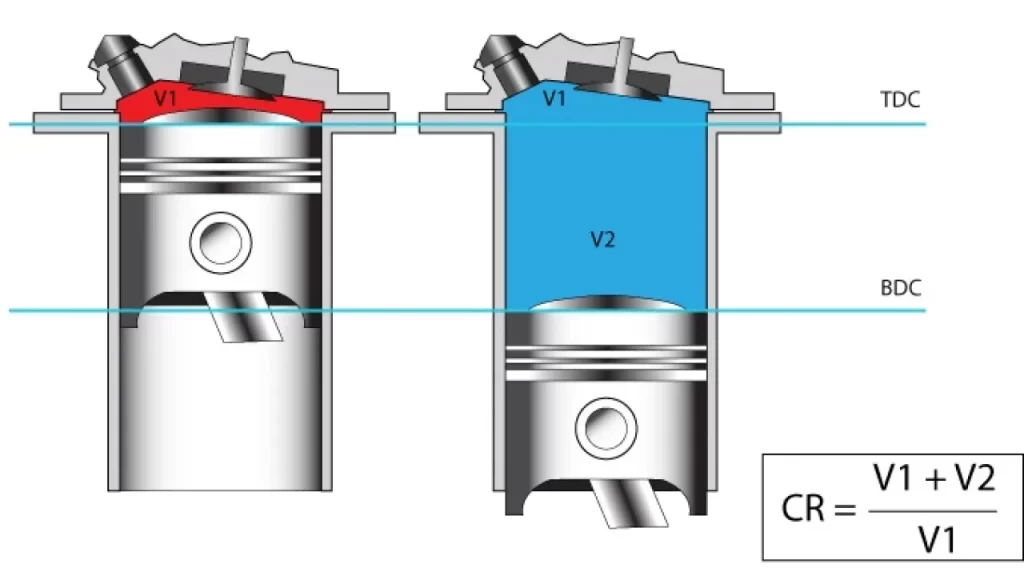
The higher the ratio means the fuel air mixture that enters the cylinder is squeezed into a much tighter space. Higher compression is good for making more power as more of the heat from combustion is transferred to kinetic energy in pushing the piston down.

Whichever way we go about it boosting the compression ratio is an easy route to more power. High compression pistons are in essence “bolt-on horsepower”. Modern bike engines tend to run compression ratios in the 10:1 to 12:1 region.

However, there is a limit

But there are limits to how high the compression ratio can go.

Any medium, whether is it just air or the fuel air mixture will get hot as it is compressed more and more. The higher the compression, the higher heat the medium will achieve. And, when the heat becomes too high, the fuel air mixture will self ignite before the spark plug ignites it at the correct timing.

This self-ignition sends shockwaves around the combustion chamber that can cause catastrophic failure. These shockwaves can be audibly heard and has a metallic knocking sound, hence called “knocking” or “pinging.”

In fact, diesel engines work this way. They employ very high compression ratios and compressed air alone until it gets really hot before diesel is injected into the combustion chamber. This mix causes instantaneous ignition. It is also why diesel engines produce that signature clacking sound.
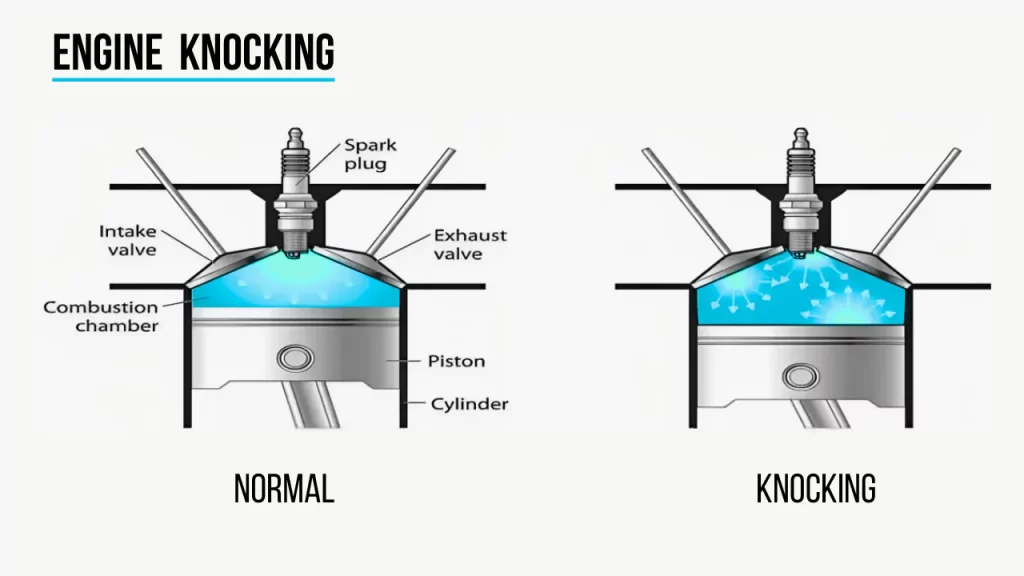
So, how do we stop self-ignition? There are three methods: Lowering the compression ratio, retarding the ignition timing, or using fuels with higher octane rating. We shall explore this in another article.

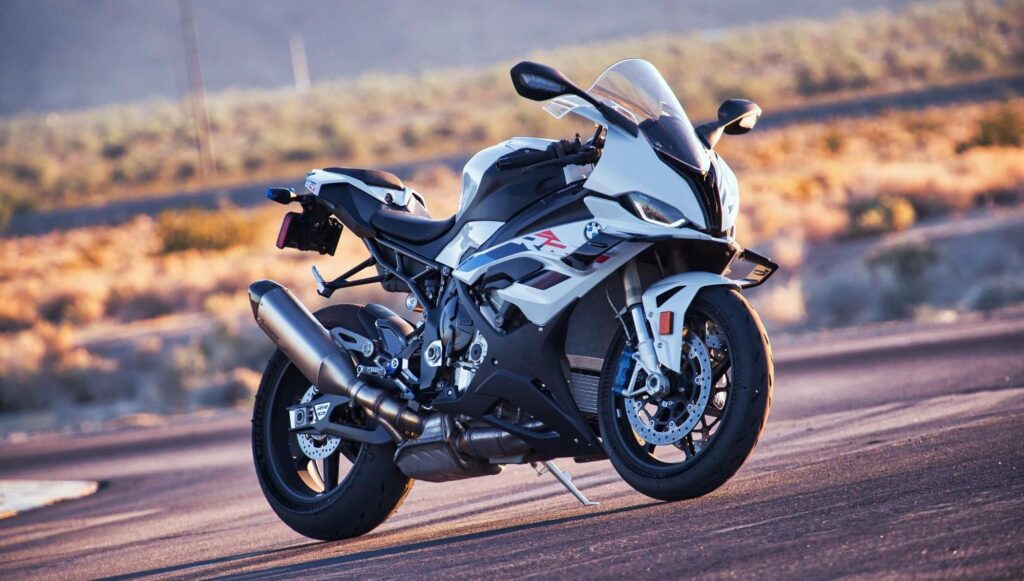
BMW Motorrad sales broke records again in 2024, with the German marque claiming to sell a total of 210,408 new bikes.

The biggest seller was of course, and without doubt, the new R 1300 GS and the previous R 1250 GS. Their biggest market was once again in their homeland.

Top sales region and countries:
  • 118,727 new bikes were sold in Europe, making making it the most valuable region.
  • Sales in Germany were up eight per cent with 26,177 bikes.
  • France was the next best-performing country, with 20,693 units.
  • Followed by Italy, with 16,617 units.
  • Central Europe, which includes countries like Poland, Romania, Switzerland and Serbia collectively sold 11,411 new bike sales. It was a 12 per cent increase from the previous year.
Best-seling models:
  • As mentioned ealier, R1300 GS and R1250 GS were the most popular, selling 68,000 worldwide.
  • The S 1000 RR was the best-selling four-cylinder model, with 11,610 shifted
  • The entire four-cylinder family (S 1000 RR, M 1000 RR, S 1000 R, M 1000 R, S 1000 XR, and M 1000 XR) sold 27,147 units worldwide.

Markus Flasch, head of BMW Motorrad, said, “I would like to extend my heartfelt thanks to our customers and community around the world for the tremendous trust they have placed in us once again in 2024. With the strongest sales result in company history, BMW Motorrad remarkably claims the 1st Place in the global Premium Motorcycle segment. Our market leadership in numerous segments and markets in based on our claim to innovation leadership, our highly attractive product offering as well as the consistent strategic focus on brand strength. Based on these success drivers, BMW Motorrad is well-positioned for the future and so I approach the year 2025 with a very positive outlook.

We were treated to an all-new Yamaha YZF-R1 for this year. Poring over the specification sheet we found that the engine’s bore and stroke has changed i.e. larger bores and shorter strokes. And yes, it revs higher.

What is bore and stroke?

To put it simply, the bore is the hole the piston sits in. Stroke, on the other hand, is the length that the piston needs to travel between its highest and lowest points.

But why is that?

The relationship between an engine’s bore and stroke determine, to an extent, how it makes its power. For a given capacity, ‘long stroke’ engines – ie those with a relatively long stroke in relation to the bore size – will tend to be relatively low revving but with strong low down power, while ‘short stroke’ or ‘oversquare’ motors – short stroke with a wide bore – will be able to rev higher. And, because more revs equal more horsepower (horsepower = torque x rpm divided by 5252, so increase the revs and the bhp increases too), manufacturers are always looking at ways of safely increasing the upper rev limit of their motors.

One of the major factors determining an engine’s upper rev limit is piston speed. For every revolution of an engine, the piston moves up from the bottom of its stroke (bottom dead centre or BDC) to the top of its stroke (top dead centre or TDC) and back again. So in the case of the ’04 R1, the 77mm wide piston goes from a standstill, travels 53.6mm up, stops, and comes back down again. At 10,000rpm it makes this journey just over 166 times each way every single second, at an average speed of 17.9 metres a second.

The stresses on a piston and conrod at high revs are massive. If the piston is forced to travel too quickly something’s going to break. Put very simply, if you reduce the distance the piston has to travel – ie its stroke – it doesn’t have to travel as fast and can make that journey more often. So that’s what Yamaha chose to do with their new R1, reducing the stroke by 4.4mm and adding 3mm to the bore. Last year’s R1 redlined at 11,750rpm, while this year’s redlines at 13,750, and makes its peak power 2000rpm further up the RPM scale.

Another way of reducing driveline stresses

Another way of reducing stresses is by using lighter materials for the pistons and connecting rods. Every moving part has momentum, and momentum is calculated by acceleration multiplied by mass. So, the more mass a moving object has, or/and the faster it moves, the higher its momentum. Lightening these parts will reduce stresses and also lets the engine rev faster.

We have covered the subject of the slipper clutch, now let us look at the assist clutch function. The assist function is an evolution of the slipper clutch and is fitted to an increasing number of motorcycles these days.

Why do we need the assist function?

Previously, harder clutch springs are required for high powered motorcycle engines in order to force the clutch plates and friction plates together, in order to maximise power transfer. Cutch springs that are too light can cause the plates to slip past each other, especially under hard acceleration.

Problem is, the clutch lever will feel very stiff as we need more finger pressure to overcome the springs’ force. It becomes even worse when the bike is accelerating hard and at speed, as the clutch’s centrifugal force pushes the plates in. Not only that, the gear lever can also feel really when using a quickshifter.

So how does the assist function work?

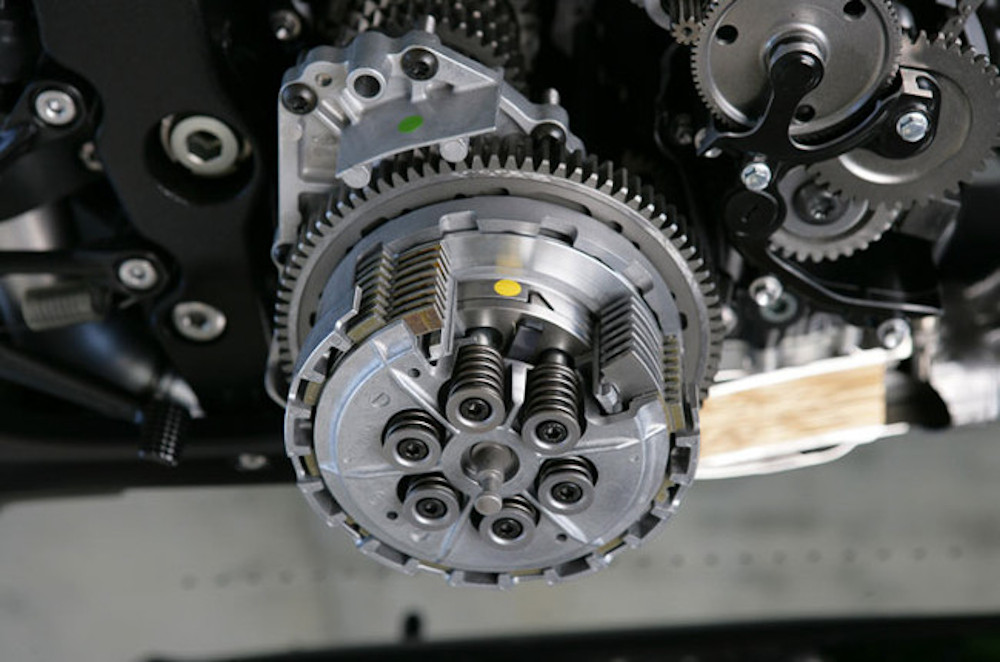
As with the slipper clutch, there are also ramps on the clutch’s pressure plate. However, these ramps face the other way, which cause the pressure plate to push inside onto the clutch plates for more positive engagement. In other words, less of the engine’s power is wasted from clutch slippage.

The takeaway from this is we can now use lighter clutch springs, allowing for a lighter pull on the clutch lever. It is especially useful when your motorcycle does not have a quickshifter. Additionally, shifting with the quickshifter can be potentially faster and the gear lever feels softer.

The slipper clutch is a common feature in road motorcycles nowadays, compared to when it was used in racing exclusively. Even some “performance” kapchais are equipped with it.

Why do we need a slipper clutch?

We are familiar with that deceleration when we shut off the throttle, or when we downshift. That is called engine braking or back torque. It is especially strong on four-stroke motorcycles with bigger engines that produce higher torque. The higher the engine’s torque, the higher its back torque too.

This engine braking can become intrusive, especially when we downshift to aggressively or we accidentally downshift to a gear that is too low. It can cause the rear wheel to hop, or even lock up momentarily. It is not something we want as we are tipping the bike into a corner, and certainly when the road is wet.

How does it work?

That is exactly why the slipper clutch was developed for: To reduce the engine’s back torque through the clutch plates to the transmission and to the final drive.

Slipper clutches usually consists of ramps that would cause the clutch basket to disengage or in other words, “slip” when the rear wheel tries to drive the engine faster above a certain deceleration threshold.


These angled ramps let the clutch faces which are normally meshed together under acceleration and normal riding to pull apart and disengaging the plates when there is too much back torque. Consequently, the rear tyre continue to rotate. It also decreases wear and tear on other transmission and engine parts due to the engine overrevving.

However, on some more sophisticated bikes (read: expensive), the slipper clutch works in conjunction with an electronic feature called engine braking control which regulates the engine speed to avoid clutch hop altogether. But that is a story for another day.

Following the news of an upcoming Triumph Thruxton 400 to replace the Bonneville Thruxton R 1200, let us take a look at the origin of the Thruxton name.

The Thruxton name plays a significant part in the marque’s history, just like the Daytona, Bonneville, Speedmaster, Trophy, Speed Twin. This is why Triumph decided to keep the name running albeit in the 400cc range, after stopping production of the 1200cc model.

What is Thruxton?

More like where, actually. It is the name of the Thruxton Circuit, in Hampshire, England.

It began as a military airbase, known as RAF Thruxton in 1942, and was home to troop carrying aircraft of both the RAF and USAAF. In fact, some of the airborne troops who took part in D-Day, 1944, took off from from this airbase.

The circuit was laid out along the perimeter of the runway since the 1950s, but the longer and present track was only fully established in 1968. History, it has since hosted the Thruxton 500 endurance race (1960-1964, 1969-1977), British Formula 3, British Formula 2, and many more. The circuit remains part of the British Superbike Championship (BSB) and British Touring Car Championship (BTCC) calendar until today.

The Thruxton 500

However, the most relevant and important race in this story was the Thruxton 500.

It all began as a 9-hour endurance race for motorcycles in 1955, followed by another two in 1956 and 1957. This 9-hour race evolved into the famous Thruxton 500 mile (800km) race from 1958.

The Thruxton 500 was a production motorcycle race, meaning the motorcycles being  raced must be available to the public, not unlike the current day FIM Endurance World Championship. Each bike entered will be ridden by two riders on rotation.

Anyway, Triumph entered the inaugural endurance race in 1958 with a Bonneville T120, entered with Mike “The Bike” Hailwood and Dan Shorey as riders. They won.

The race soon caught the attention of the public. As such, motorcycle manufacturers were keen to win it to showcase their products’ performance. “Win on Sunday, sell on Monday,” even before Soichiro Honda made those words famous.

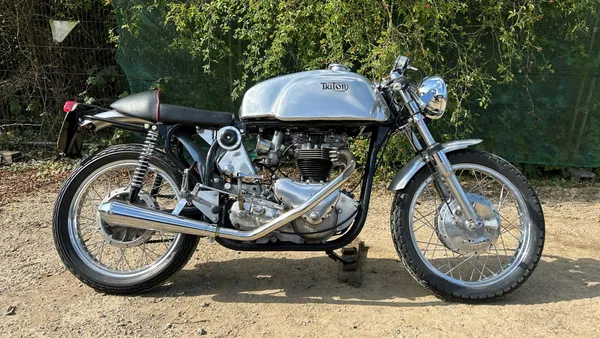
Triumph won again in 1961 with Tony Godfrey and John Holder after being runner ups to the BMW and AJS in 1959 and 1960. It was this win that spurred the Triumph factory to build the T120R Thruxton, which was hand-built by a team of Triumph technicians using specially picked components and precision-machined cylinder heads and crankcases. Peak power was increased and each ‘Thruxton’ engine was bench tested to deliver around 53 bhp (40 kW) at 6,800 rpm with a safe rev ceiling of 7,200 rpm. Only 52 of the Thruxton T120Rs were built in 1964/5 to meet homologation requirements for production racing. About 100 more machines were subsequently manufactured and supplied to selected dealers and riders.

It was one of the rarest Triumph motorcycles.

Rise of the modern Triumph Thruxton

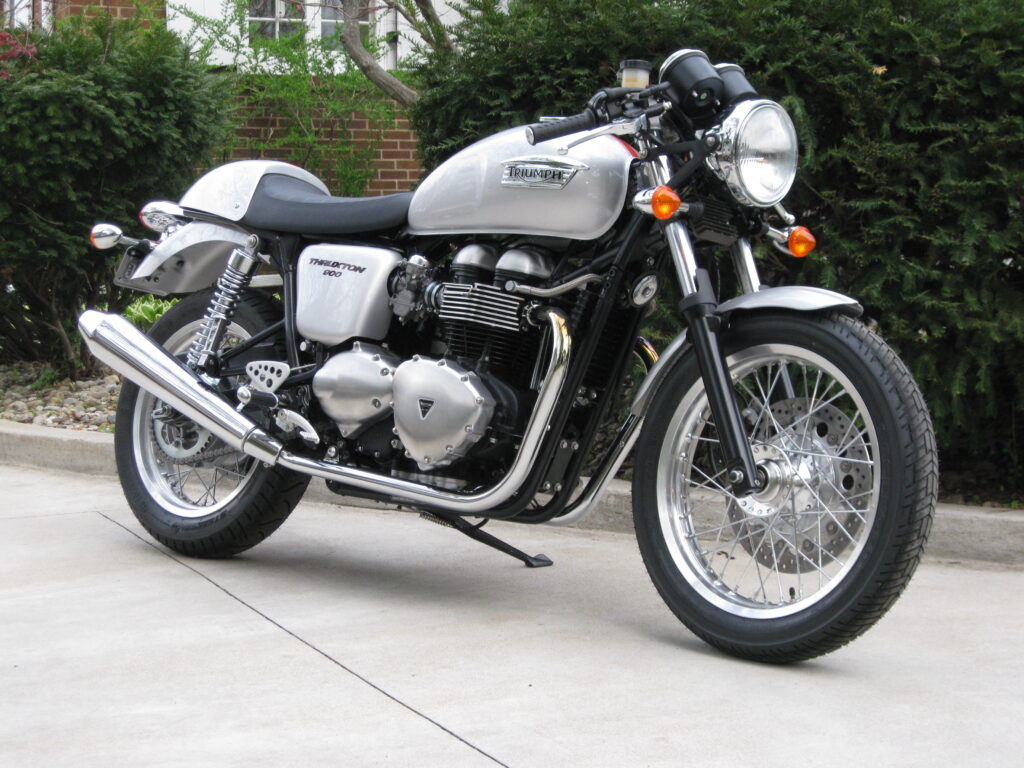
In 2004, the new Triumph factory based in Hinckley, England introduced the Thruxton 900. The engine was derived from the Bonneville lineup, but has new cams and pistons 90mm pistons, taking capacity to 865 cc and power up to 70 bhp. The crank was a 360°, which meant both pistons rose and fell together. Triumph was smart to sell the Thruxton 900 as the café racer of the Bonneville lineup. (Tom Cruise rode it in The Edge of Tomorrow, by the way.)

The company then introduced the new Thruxton in 2016. It used the new 1200cc, 270º, liquid-cooled engine. There were two variants, one the standard while the “R” got Ohlins shocks, Showa forks, and Brembo brakes.

The Thruxton has since enjoyed good sales the world over, although the later-launched Boneville Bobber pipped it as the best selling Triumph.

Then, in 2024, Triumph announced the Thruxton Final Edition as they moved the performance Bonneville to the Speed Twin.

Closing

Long live the Triumph Thruxton!

Archive

Follow us on Facebook

Follow us on YouTube